4 Shots From 4 Films: Special Jeff Bridges Edition


4 Shots From 4 Films is just what it says it is, 4 shots from 4 of our favorite films.  As opposed to the reviews and recaps that we usually post, 4 Shots From 4 Films is all about letting the visuals do the talking.

Today, we celebrate the birthday of Jeff Bridges!  It’s time for….

4 Shots From 4 Jeff Bridges Films

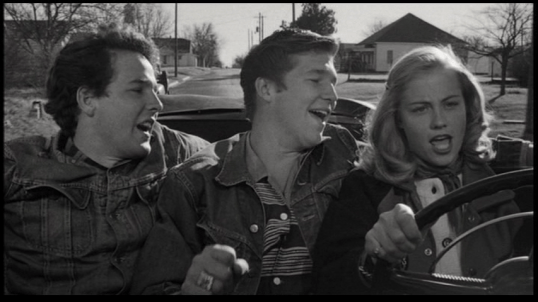
The Last Picture Show (1971, dir by Peter Bogdanovich, DP: Bruce Surtees)

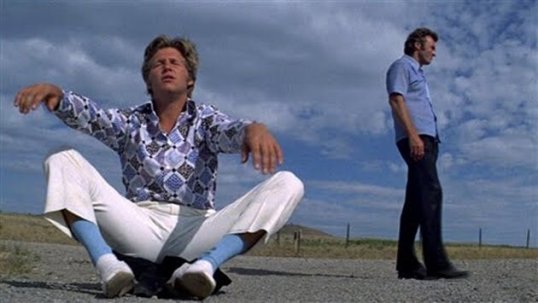
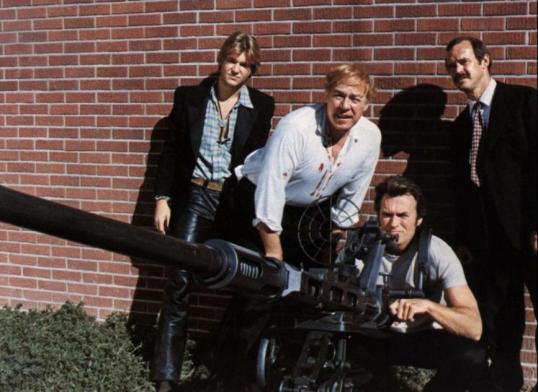
Thunderbolt and Lightfoot (1974, directed by Michael Cimino, DP: Frank Stanley)

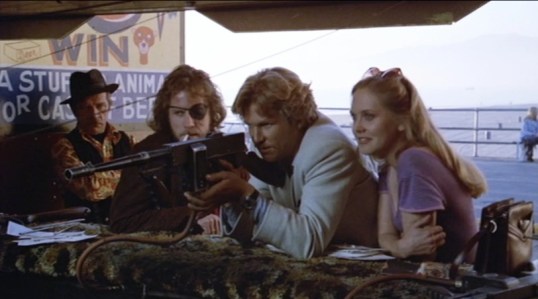
Cutter’s Way (1981, dir by Ivan Passer, DP: Jordan Cronenweth)

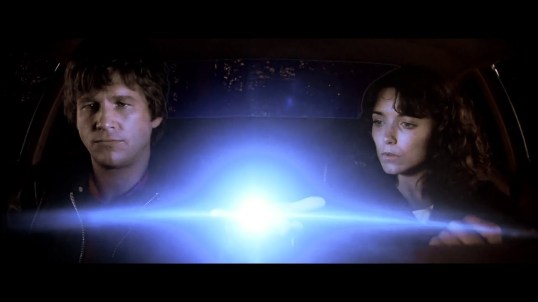
Starman (1984, dir by John Carpenter. DP: Donald M. Morgan)


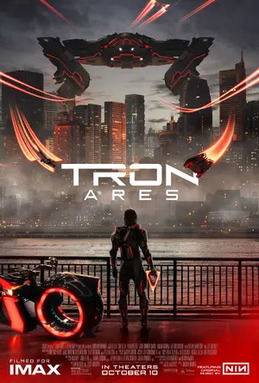
Tron Ares (dir. by Joachim Rønning)


Tron Ares is this year’s Spawn for me. 

For those unaware (and I really should write about Spawn one of these days), I saw Spawn with a friend when it first came out. I loved it, walking out the theatre and raving about it. Over pizza, my friend explained in great detail the many ways it actually sucked. Even Michael Jai White hated it. 

With my expectations being lower than they ever were for anything, Tron Ares surprised me. I leaned forward in my seat. I chuckled, and bobbed my head to the music and stayed until all of the credits were done. It could have done many things much better than it chose to do, but given the distance in time between Legacy and the choices for where the story could go, it’s not the worst film in the world. It’s not like Tron as an entire franchise was ever that deep with its storytelling (with the clear exception being Tron Uprising, of course). It brings some new elements to the overall tale that I didn’t even consider. Imagine what the writers could have done if they started working on this right after Legacy. With 15 years gone, it’s hard to get actors together for a project.

Both Trent Reznor and Atticus Ross are Executive Producers on Tron Ares. They threw money at this. They even have cameos in the film. At best, Tron Ares is the coolest looking Nine Inch Nails feature length music video to have ever existed since perhaps The Perfect Drug. The music compliments the film exactly as Daft Punk’s did for Legacy and Wendy Carlos’ did for the original. The sights are dazzling and the sounds are sharp. The music isn’t so much the subtle Reznor/Ross we’ve had with Bones and All, or the weirdness of Teenage Mutant Ninja Turtles: Mutant Mayhem. This is loud and kind of booming. We finally get light cycles in the real world (which isn’t giving anything away that wasn’t already in the trailers). In that sense, it’s a win on a few levels. 

If it’s a deep story with characters you’ll root for and possibly worry about, however, Tron Ares is not that film. You’re probably better off with either One Battle After Another or Weapons, both of which are equally good. I will say that what Tron Ares lacks in story, it does make up for with some generous fan service moments. There are tons of references to both Tron and Legacy if you pay attention, even if the story itself veers off tangent. I felt it handled this so much better than Legacy ever did. You can’t say the other films weren’t considered in making this. It’s not that far from another Disney project, F/X’ and Hulu’s Alien: Earth in some ways. 

In the years after Tron Legacy, there have been many changes. Encom encounters some competition in the form of the Dillinger Corporation, lead by genius Julian Dillinger (Evan Peters, X-Men: Days of Future Past) and his mother, Elizabeth (Gillian Anderson, The X-Files). Kevin Flynn’s (Jeff Bridges, The Big Lebowski) dream of crossing the digital frontier has become a race to see who can make their digital assets a reality. Dillinger’s newest, greatest program is Ares (Jared Leto, Morbius), who is fully versed in various fighting techniques and security protocols. What does this mean for life in The Grid, the universe inside the machine? Can Ares be trusted, or controlled, for that matter?

Acting-wise, everyone has a job to do. To his credit, Leto is not bad in this. It’s not robotic, but it’s not quite the second coming of Jordan Catalano (if anyone even recalls who that is). It’s not like the script, written by Jesse Wigutow (Daredevil: Born Again) and David DiGilio (The Terminal List & The Terminal List: Dark Wolf) calls for his character to have a great depth of emotion. Greta Lee (Past Lives) and Evan Peters do most of the work, along with Jodie Turner-Smith, who seemed to have the most fun. Anderson also does a good job, but again, there’s not a whole lot to work with. 

Tron Ares hovers right above the Incident mark for me. It could have been so much better than what it was, and who knows how long the visuals will stay with me. Yet, just like the films before it, it’s rescued by a score that may be remembered more than the film itself in the years to come. I don’t know if I’d go back out to see this, but would happily catch it once it comes to digital. 

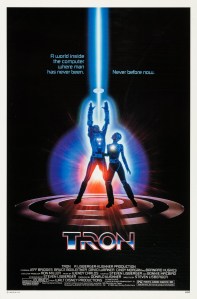
Tron (dir. by Steven Lisberger)


Many years ago in Southern Oregon, I had a conversation with friends about some of our favorite films growing up. Movies like The Goonies, The Dark Crystal, Watership Down and The Secret of Nimh were all on the list, as well as Disney’s Tron. In our excitement for all these movies, we ended up renting the films from a local video store to relive our childhood. While the nostalgia was nice, we all ended falling asleep halfway through Tron, despite our love for it.

I guess one’s enjoyment of Tron is based on how it’s viewed. I caught the film two years ago at the Museum of the Moving Image, in 70MM. The first thing that caught my attention was the film grain. I’ve grown so used to the clarity of digital film presented in 4K that I couldn’t help but catch the little flicks and “cigarette burns” in at the start. This was life before digital, and it was beautiful to revisit. In a theatre, the film’s 96 minutes blazed by for me. The early 1980s was basically made up of bike rides and video arcades. The little boedga on the corner of my block back home even had a few arcade machines in the front of the store in the first half of the 80s. The Bodega’s still there, the arcade’s now a deli/hot meal area. Times can and do change.

Tron is the story of Kevin Flynn (Jeff Bridges, Bad Times at the El Royale), a former employee at Encom, a major computing and videogame company. Encom’s made some wonderful strides in technology as of late, by 1980’s standards. Encom performs special matter tests in a specialized lab, while the programmers grind away code in their cubicles. All of their work is overseen by the Master Control Program, an operating system of sorts. Granted, the workforce at Encom isn’t too pleased about having the MCP monitor their applications. Alan Bradley (Bruce Boxleitner, Kuffs) and Lori Baines (Cindy Morgan, Caddyshack) also have programs and projects of their own that are being culled. Alan’s program, Tron (also played by Boxleitner) is of particular interest to the MCP, as it acts an a security threat that could bring some serious problems. Kevin tries to hack his way into Encom with the use of a program he created called Clu (also Bridges), but the MCP and the Senior Vice President of Encom, Ed Dillinger (David Warner, The Omen, Teenage Mutant Ninja Turtles II: The Secret of the Ooze) keep Flynn at bay. When Alan and Lori discover what Flynn’s up to, they confront him at his arcade, where he explains that he was the actual creator of Encom’s top games. He only needs the data as proof. This leads to the team breaking into Encom, where the MCP digitizes Flynn and brings him into the computer world. Can Flynn escape and help liberate the programs enslaved by the MCP and its henchman, Sark (both also played by Warner)? Can Flynn find the proof to exonerate him? And just who is this Tron fellow, anyway?

The plot for Tron inside the machine becomes a bit theological. The programs believe in the Users, and that they were each created for a particular purpose. From Ram (Dan Shor, Bill & Ted’s Excellent Adventure) being an Actuarial Program to Tron being a defense against the MCP, it’s kind of interesting once Flynn shows up. As a User, he doesn’t have much more power than a program, save that he can’t really be derezzed and that he can mimic the neon glow of anyone he touched. I always thought they could have given him something cooler to do, though for 1982, repurposing machines does have some benefits. The story slows down a bit in the middle, feeling like it’s somewhat unsure of itself, but picks up in the final act with Tron vs. Sark and the MVP. Though Flynn is important to the outcome, he’s more like Big Trouble in Little China’s Jack Burton, kind of just watching this happen around him. He does have his moments, though.

When I was little, my dad owned a Commodore 64 and a Floppy Disk Drive. He would regularly pick up magazines like Byte! to catch up on new innovations. In most of these magazines, they’d have a program that you could enter in at home to create various effects like making a balloon fly across your screen. Those programs were usually written over a number of pages with hundreds of lines of code. For Tron, there were 3 teams dedicated for the Visual Effects. According to the behind the scenes documentary on the disc, Information International Inc., known as Triple-I, was brought in to handle the major work along with Mathematic Applications Group Inc. (MAGI), who director Steven Lisberger worked for at one point early in his career. Digital Effects of New York handled some of the responsible for some of the original CGI work used in Michael Crichton’s Westworld (considered one of the first CGI movie uses ever) and it’s sequel, Futureworld. For the time, the effects were groundbreaking. Mind you, most of this was all before we ever hit the 8-bit era of Nintendo, the Commodore Amiga or even the high resolution arcade games of Sega’s heyday like Space Harrier, Outrun or Afterburner. In an actual arcade in 1982 had games like Q-Bert or Dig Dug with the kind of graphics you’d never see on home systems.

Kevin Flynn (Jeff Bridges) and others (including a young Michael Dudikoff to his right) watch Tron fight for the users. This would inspire Dudikoff to become an American Ninja.

The designs for the look and feel of the computer world came from Lisberger himself, with a bit of assistance from both futurist Syd Mead and legendary artist Jean “Mobius” Giraud. Both men were extremely popular. Mead was the equivalent of Apple’s former Chief Design Officer Jony Ive, having created the “V’ger” model for Star Trek:The Motion Picture. Ironically, Mead’s work (both on the set design and the flying cars) would be seen by audiences watching Ridley Scott’s Blade Runner just a month shy of Tron’s release. Having worked on Alien years prior, Giraud helped to design and inspire both the clothing and some of the vehicles, such as the weird cradle for Dumont (Bernard Hughes, The Lost Boys) and the Light Cycles.

Jean "Mobius" Giraud's sketches for Dumont in Tron.

A film dealing with computers needed a composer familiar with electronic music.It seemed fitting that Wendy Carlos(A Clockwork Orange, The Shining) took on the challenge. Having built a computer at 14, Carlos’ love for music over the years lead her (with Robert Moog) to help develop the Moog synthesizer system. The Moog would go on to be used by Kraftwerk, Giorgio Mororder, Nine Inch Nails, The Prodigy Daft Punk and even J Dilla, among others. The Tron Soundtrack was a mix of orchestra, choir and electronic music. Although the sound may not be as dark and digital as Daft Punk’s score for Tron: Legacy, I felt it worked for the time and moves well with the film. In addition to Carlos’ score, Journey wrote the song “Only Solutions” for the film, which also happens to be a line uttered by Kevin Flynn.

Overall, Tron is one of those movies I can happily rewatch without much in the way of expectation. I enjoy it for its place in Sci-Fi cinema, and the memories it awakens. I don’t think Disney ever fully recognized the full potential of where they could take the story, though the animated Tron: Uprising was a great part of the saga. I’m just hoping Tron: Ares doesn’t stray too far from the fold.

Film Review: Stay Hungry (dir by Bob Rafelson)


In the 1976 film Stay Hungry, Jeff Bridges plays Craig Blake.

When we first meet Craig, he doesn’t have much of a personality, though we still like him because he’s played by Jeff Bridges.  Living in Alabama, he’s a young rich kid who, after the death of his parents, divides his time between his nearly empty mansion and his country club.  Craig suffers from a good deal of ennui and seems to spend a lot of time writing letters to his uncle in which he promises that he’s going to eventually get his life together.  Craig eventually gets a job at a real estate firm that is managed by Jabo (Joe Spinell).  We know that the real estate firm is shady because Joe Spinell works there.

Craig is assigned to handle the purchase of a small gym so that he can eventually close the place and allow it to be torn down to make room for an office building.  However, Craig soon falls for the gang of colorful eccentrics whose lives revolve around the gym and bodybuilder Joe Santo (Arnold Schwarzenegger, who gets an “introducing” credit, even though this was his fourth film).  The friendly Franklin (Robert Englund) is Santo’s “grease” man.  Anita (Helena Kallianiotes) is tough and can kick anyone’s ass.  The receptionist, Mary Tate (Sally Field), is a free spirit with whom Craig soon falls in love.  In fact, the only less than likable person at the gym is the former owner, Thor Erickson (R.G. Armstrong), a heavy-drinking perv who has a hole in the floor of his office that he uses to peek down at the women’s locker room.

There’s not much of a plot here.  Instead, the film plays out in a rather laid back manner, with Santo befriending Craig and showing him the joy of embracing life.  Arnold Schwarzenegger actually won an award (well, a Golden Globe) for his performance here and it must be said that he’s very good as the gentle and easy-going Santo.  Because he’s huge and he’s Schwarzenegger, we expect him to be intimidating.  Instead, he’s a soft-spoken guy who is quick to smile and who doesn’t even get upset when he finds out that Mary Tate and Craig are now involved.  There’s even a surprising scene where Joe Santo picks up a fiddle and starts playing with a bluegrass band.  Schwarzenegger is so likable here that it’s easy to wonder where his career might have gone if he hadn’t become an action star.  Even early in his career (and when he was still speaking with a very thick accent), Schwarzenegger shows off a natural comic timing.  He’s fun to watch.

In fact, he’s so much fun that the rest of the film suffers whenever he’s not onscreen.  The cast is full of talented people but the film’s loose, plotless structure keeps us from truly getting too invested in any of them.  (Santo is training for Mr. Universe so at least he gets an actual storyline.)  Sally Field and Jeff Bridges are cute together but their romance is never quite as enchanting as it seems like it should be.  The main problem with the film is that, when it ends, one still feels like Craig will eventually get bored with the gym and return back to his mansion and his country club.  One doesn’t get the feeling that Craig has been changed so much as Craig just seems to be slumming for the heck of it.

There are charming moments in Stay Hungry.  I’m a Southern girl so I can attest that the film captured the feel of the South better than most films.  If you’re a Schwarzenegger fan, you have to see this film because it really does feature Arnie at his most charming and natural.  Unfortunately, despite all that, the film itself never really comes together.

Film Review: Thunderbolt and Lightfoot (dir by Michael Cimino)


1974’s Thunderbolt and Lightfoot opens with two men, one young and one middle-aged, facing a moment of truth.

The younger of the two is Lightfoot (Jeff Bridges), a wild and hyperactive rich kid who is in his 20s and who steals a corvette right off of a used car lot.  The other man is simply known by his nickname, Thunderbolt (Clint Eastwood).  When we first see Thunderbolt, he’s giving a sermon in a small Montana church.  When a gun-wielding man steps into the church and promptly starts firing at Thunderbolt, he takes off running.  Pursued by his attacker, Thunderbolt runs through a field and just happens to jump onto Lightfoot’s speeding corvette.  Lightfoot runs over the Thunderbolt’s pursuer.  Thunderbolt slips into the car and Lightfoot drives on for a bit.  Lightfoot is excited and talkative.  Thunderbolt is more concerned with popping his shoulder back into its socket.  A stop at a gas station leads to the men stealing someone else’s car.

And so it goes for a good deal of the movie.  Thunderbolt and Lightfoot is a road movie, the majority of which is taken up with scenes of the two men just hanging out.  Thunderbolt and Lightfoot take an instant liking to each other.  When Lightfoot picks up a prostitute (Catherine Bach), he makes sure to ask that she bring along a friend for Thunderbolt.  When a criminal punches Lightfoot, Thunderbolt is quick to punch back.  “That’s for the kid,” Thunderbolt says.  That’s the type of friendship that they have.  Jeff Bridges is handsome and full of energy as Lightfoot and Clint Eastwood smiles more in this film than I think I’ve seen him smile in any other film.  For once, Eastwood is not playing a perpetually grumpy stranger or a supercop.  Instead, he’s just a blue collar guy who enjoys having a friend to travel with.

Eventually, Thunderbolt and Lightfoot meet up with two of Thunderbolt’s former associates.  Red (George Kennedy) is a brutal brawler who, it is suggested, served with Thunderbolt in the Korean War.  Goody (Geoffrey Lewis) is a gentle soul who takes orders from Red but still can’t bring himself to shoot anyone, no matter how much Red demands that he pull the trigger.  Red and Goody have always assumed that Thunderbolt stole the loot from a bank robbery that they pulled off.  Thunderbolt explains that he didn’t steal the money.  He just got arrested after hiding it.  Lightfoot suggests that maybe the four of them could pull off another bank heist….

Kennedy and Lewis are perfectly cast as the two criminals who end up working with Thunderbolt and Lightfoot.  In many ways, the relationship between Red and Goody mirrors the relationship between our lead characters.  The main difference is that Red is sadistic and quick to loose his temper, whereas Thunderbolt controls his emotions and tries not to hurt anyone while committing his crimes.  Lightfoot looks up to Thunderbolt and Goody looks up to Red.  Again, the difference is that Thunderbolt actually cares about Lightfoot, whereas Red is incapable of truly caring about anyone but himself.  Eastwood, Bridges, Kennedy, and Lewis make quite a team and it’s hard not to worry about all four of them, especially when the film takes an unexpectedly dramatic turn during its third act.

I really wasn’t expecting Thunderbolt and Lightfoot to make me cry but the final thirty minutes of the film brought tears to my eyes as what started out as a buddy comedy turned into a tragedy.  (I shouldn’t have been surprised.  I’ve seen enough 70s movies that I really should have known better than to have expected a happy ending.)  Thanks to the perceptive script by Michael Cimino (who would go on to make The Deer Hunter and Heaven’s Gate) and the performances of Eastwood and Bridges, the movie’s final moments carry quite a punch and they leave you wondering if Thunderbolt and Lightfoot’s road trip was worth the price that was ultimately paid.  The film works as not only a tribute to friendship but also as a fatalistic portrait of life on the backroads of America.

Thunderbolt and Lightfoot was the first Eastwood film to receive an Oscar nomination, with Jeff Bridges competing for Best Supporting Actor.  (He lost to Robert De Niro’s star turn in The Godfather, Part II.)  Eastwood, reportedly, felt that he deserved a nomination for his performance as Thunderbolt and, considering that that Oscar itself was won by Art Carney for his pleasant but hardly revelatory work in Harry and Tonto, Eastwood was correct.  Instead, Eastwood would have to wait for another 18 years before he finally received Academy recognition for starring in, producing, and directing Unforgiven.

Film Review: Starman (dir by John Carpenter)


John Carpenter has directed 18 features film, from 1974’s Dark Star to 2010’s The Ward.  Some of his films have been huge box office successes.  Some of his films, like The Thing, were box office flops that were later retroactive recognized as being classics.  Carpenter has made mainstream films and he’s made cult favorites and, as he’s always the first to admit, he’s made a few films that just didn’t work.  When it comes to evaluating his own work, Carpenter has always been one of the most honest directors around.

Amazingly, Carpenter has only directed one film that received an Oscar nomination.

That film was 1984’s Starman and the nomination was for Jeff Bridges, who was one of the five contenders for Best Actor.  (The Oscar went to F. Murray Abraham for Amadeus.)  Bridges played the title character, an alien who is sent to Earth to investigate the population and who takes on the form of the late husband of Jenny Hayden (Karen Allen).  The Starman takes Jenny hostage, though its debatable whether or not he really understands what it means when he picks up her husband’s gun and points it at her.  He and Jenny drive across the country, heading to Arizona so that he can return to his ship.  Pursued by the government (represented by the sympathetic Charles Martin Smith and the far less sympathetic Richard Jaeckel), the Starman learns about emotions, eating, love, and more from Jenny.  Jenny goes from being fearful of the Starman to loving him.  Carpenter described the film as being It Happened One Night with an alien and it’s not a bad description.

After Jenny and the alien visitor make love in a boxcar, the Starman says, “I gave you a baby tonight,” and that would be an incredibly creepy line coming from a human but it’s oddly charming when uttered by an alien who looks like a youngish Jeff Bridges.  Bridges definitely deserved his Oscar nomination for his role here.  Speaking with an odd accent and moving like a bird who is searching for food, Bridges convincingly plays a being who is quickly learning how to be human.  The Starman is constantly asking Jenny why she says, does, and feels certain things and it’s the sort of thing that would be annoying if not for the way that Bridges captures the Starman’s total innocence.  He doesn’t mean to be a pest.  He’s simply curious about everything.

Bridges deserved his nomination and I would say that Karen Allen deserved a nomination as well.  In fact, it could be argued that Allen deserved a nomination even more than Bridges.  It’s through Allen’s eyes that we see and eventually come to trust and then to love the Starman.  Almost her entire performance is reactive but she makes those reactions compelling.  I would say that Bridges and Allen deserved an Oscar for the “Yellow light …. go much faster” scene alone.

Carpenter agreed to make Starman because, believe it or not, The Thing had been such a critical and commercial flop that it had actually damaged his career.  (If ever you need proof that its best to revisit even the films that don’t seem to work on first viewing, just consider Carpenter’s history of making films that were initially dismissed but later positively reevaluated.  Today, The Thing, They Live, Prince of Darkness, and In The Mouth of Madness are all recognized as being brilliant films.  When they were first released, they all got mixed reviews.)  Carpenter did Starman because he wanted to show that he could do something other than grisly horror.  Starman is one of Carpenter’s most heartfelt and heartwarming films.  That said, it also features Carpenter’s trademark independent streak.  Starman not only learns how to be human but, as a result of the government’s heavy-handed response to his arrival, one can only assume that he learns to be an anti-authoritarian as well.

Starman is one of Carpenter’s best films and also a wonderful showcase for both Karen Allen and Jeff Bridges.

Film Review: Tucker: The Man and His Dream (by Francis Ford Coppola)


First released in 1988, Tucker: The Man and His Dream is a biopic about Preston Tucker.

Tucker was an engineer in Detroit who went from designing vehicles for the Army during World War II to trying to launch his own car company.  His ideas for an automobile don’t sound particularly radical today.  He wanted every car to have seat belts.  He wanted a windshield that popped out as a safety precaution.  He want brake pads and he also wanted a car that looked sleek and aerodynamic, as opposed to the old boxy cars that were being pushed out be Detroit.  He wanted a car that got good mileage and he wanted one that could be taken just about anywhere.  Unfortunately, Tucker’s dreams were cut short when he was indicted for stock fraud, a prosecution that most people agree was a frame-up on behalf of the Big Three auto makers.  Tucker was eventually acquitted but his car company went out of business.  Of the 50 cars that Tucker did produce, 48 of them were still on the road and being driven forty years later.

The film stars Jeff Bridges as Preston Tucker, Joan Allen as his wife, Christian Slater and Corin Nemec as two of his sons, Lloyd Bridges as the senator who tried to take Tucker down, Martin Landau as Tucker’s business partner, and Dean Stockwell as Howard Hughes, who shows up for a few minutes to encourage Tucker to follow his dreams regardless of how much the government tries to stop him.  One gets the feeling that the film was a personal one for director Francis Ford Coppola, a filmmaker who has pretty much spent his entire career fighting with studios while trying to bring his vision to the screen.  Tucker fought for seat belts.  Coppola fought for a mix of color and black-and-white in Rumble Fish.  Tucker stood up for his business partner.  Francis Ford Coppola stood up for Al Pacino when no one else could envision him as Michael Corleone.  As is the case with many of Coppola’s films, Tucker: The Man And His Dream is a film that Coppola spent years trying to get made.  It was the film that Coppola originally intended to be the follow-up to The Godfather, with Marlon Brando projected for the lead role of Tucker.  After watching the Tucker, it’s hard not to feel that it worked out for the best that Coppola was not able to make the film in 1973.  It’s impossible to imagine anyone other than Jeff Bridges in the role of Preston Tucker.

“Chase that tiger….chase that tiger….chase that tiger….” It’s a song that Tucker sings constantly throughout the film as the camera spins around him and how you react to Tucker: The Man And His Dream will largely depend on how tolerant you are of Coppola’s stylistic flourishes.  Coppola directs the film as a combination of Disney fairy tale and film noir.  The opening of the film, with Tucker running around in almost a manic state and excitedly telling everyone about his plans, is presented with vibrant colors and frequent smiles and an almost overwhelming air of cheerful optimism.  As the film progresses and Tucker finds himself being targeted by both the government and the other auto companies, the film gets darker and the viewer starts to notice more and more shadows in the background.  The moments of humor become less and less and there’s a heart-breaking moment where Martin Landau, in one of his best performances, reveals just how far the government will go to take down Tucker’s company.  But, in the end, Tucker refuses to surrender and Jeff Bridges’s charming smile continues to fill the viewer with hope.  The film becomes about more than just cars.  It’s a film that celebrates all of the innovators who are willing to defy the establishment.

There’s a tendency to dismiss the majority of Coppola’s post-Apocalypse Now films.  However, Tucker: The Man And His Dream is a later Coppola film that deserves to be remembered.

Film Review: Heaven’s Gate (dir by Michael Cimino)


First released in 1981 and then re-released in several different versions since then, Heaven’s Gate begins at Harvard University.

The year is 1870 and the graduates of Harvard have got their entire future ahead of them.  At the graduation ceremony, Joseph Cotten gives a speech about how, as men of cultivation, they have an obligation to help the uncultivated.  Student orator Billy Irvine (John Hurt) then gives a speech  in which he jokingly says the exact opposite.  Amongst the graduates, Billy’s friend, Jim Averill (Kris Kristofferson), laughs at Billy’s speech.  It’s a bit of a strange scene, if just because all of the graduates appear to be teenagers except for Hurt and Kristofferson, who are both clearly in their 30s.  The graduates of Harvard sing to their girlfriends and dance under a tree and, for a fleeting moment, all seems to be right with the world.

Twenty years later, all seems to be wrong with the world.  Averill is now the rugged and world-weary marshal of Johnson Country, Wyoming.  Cattle barons are trying to force immigrant settlers to give up their land.  Gunmen, like Nate Champion (Christopher Walken) and Nick Ray (Mickey Rourke), are accepting contracts to execute immigrants who are suspected of stealing cattle.  When Averill stands up for the people of Johnson Country, the head of the Wyoming Stock Grower Association, Frank Canton (Sam Waterston), hires a group of mercenaries to ride into Johnson County and execute 125 settlers.  Billy Irvine, who now is dissolute alcoholic who works with Canton, warns his old friend Averill.  Averill, who has fallen in love with Ella (Isabelle Huppert), the local madam, announces that he will defend the immigrants.  Nate, who is also in love with Ella, considers changing sides.

Heaven’s Gate is loosely based on an actual event.  I actually have three distant ancestors who traveled to Wyoming to take part in the Johnson County War.  All three of them survived, though one of them was shot and killed in an unrelated manner shortly after returning to Ft. Smith, Arkansas.  That said, director Michael Cimino is clearly not that interested in the historical reality of the Johnson County War or the issues that it raised.  Just as he did with Vietnam in The Deer Hunter, Cimino uses the Johnson County War as a way to signify a loss of national innocence.  Averill and Irvine start the film as hopeful “young” men with the future ahead of them.  By the end of the film, one is dead and the other is living on a yacht and dealing with what appears to be crippling ennui.

Heaven’s Gate is a bit of an infamous film.  Though the film was pretty much a standard western, Cimino still went far over-budget and turned in a first cut that was over six hours long.  A four hour version was briefly released in 1980 but withdrawn after a week, due to terrible reviews and audience indifference.  A studio-edited version that ran for two hours and 35 minutes got the widest release in 1981.  Since then, there have been several other versions released.  Cimino’s director’s cut, which was released as a part of the Criterion Collection in 2012, runs for 212-minutes and is considered to now be the “official” version of Heaven’s Gate.

For years, Heaven’s Gate had a terrible reputation.  It’s failure at the box office was blamed for bankrupting United Artists.  After the excesses of the Heaven’s Gate production, studios were far more reluctant to just give a director a bunch of money and let him run off to make his movie.  (They should have learned their lesson with Dennis Hopper and The Last Movie.)  Described by studio execs as being self-indulgent and even mentally unstable, Michael Cimino’s career never recovered and the director of The Deer Hunter went from being an Oscar-winner to being an industry pariah.  (Some who disliked The Deer Hunter’s perceived jingoistic subtext claimed that Heaven’s Gate proved The Deer Hunter was just an overrated fluke.)  However, the reputation of Heaven’s Gate has improved, especially with the release of Cimino’s director’s cut.  Many critics have praised Heaven’s Gate for its epic portrayal of the west and, ironically given the controversy over The Deer Hunter, its political subtext.  It’s anti-immigrant villains made the film popular amongst the Resistance-leaning film historians during the first Trump term.

So, is Heaven’s Gate a masterpiece or a disaster?  To be honest, it’s somewhere in between.  Whereas it was once over-criticized, it’s now over-praised.  Visually, it’s a beautiful film but those who complained that the film was too slow had a point.  As with The Deer Hunter, Cimino takes the time to introduce us to and immerse us in a tight-knit immigrant community.  Personally, I like the much-criticized scenes of the fiddler on skates and Averill and Ella dancing in the roller rink.  Overall though, as opposed to The Deer Hunter, the members of the film’s victimized community still feel less like individual characters and more like symbols.  As for the political subtext, I think that any subtext of that sort is accidental.  (I feel the same way about The Deer Hunter, which I like quite a bit more than Heaven’s Gate.)  Cimino is more interested in the loss of innocence than whether or not the Johnson County War can be fit into some sort of nonsense Marxist framework.

The main problem with the film is that there is no center to keep everything grounded.  Kris Kristofferson had a definite screen presence but, as an actor who was incapable of showing a great deal of emotion, he lacks the gravitas necessary to keep from being swallowed up by Cimino’s epic pretensions.  Isabelle Huppert, an otherwise great actress, also feels lost in the role of Ella and Sam Waterston is not necessarily the most-intimidating villain to ever show up in a western.  Christopher Walken, as the enigmatic and intriguing Nate Champion, gives the best performance in the film but his character still feels largely wasted.

There are some brilliant visual moments to be found in Heaven’s Gate.  I even like the Harvard prologue and the ending on the boat, both of which are not technically necessary to the narrative but still add an extra-dimension to both Averill and Irvine.  But, in the end, Heaven’s Gate is big when it should have been small and epic when its should have been intimate.  It’s a misfire but not a disaster.  Even great directors occasionally have a film that just doesn’t work.  Speilberg had his 1941.  Scorsese has had a handful.  Coppola’s career has been a mess but no one can take his successes away from him.  Michael Cimino, who passed away in 2016, deserved another chance.

Retro Television Reviews: In Search of America (by Paul Bogart)


Welcome to Retro Television Reviews, a feature where we review some of our favorite and least favorite shows of the past!  On Sundays, I will be reviewing the made-for-television movies that used to be a primetime mainstay.  Today’s film is 1971’s In Search of America!  It  can be viewed on YouTube!

College student Mike Olson (young Jeff Bridges) returns home and informs his mother (Vera Miles) and his father (Carl Betz) and his annoyingly quirky grandmother (Ruth McDevitt) that he’s dropped out of college.  He apologizes for wasting all the money that they spent on tuition but hey, maybe he can make it up to them by taking them on a journey as he drives across America in an old bus.

Uhmmm….

Now, let me just repeat this so that there is no confusion.  This absolutely schmuck took his parents’ money, wasted it, dropped out of college, and now he expects everyone to travel with him across America because he’s decided that he’s a part of the counterculture.

And, instead of telling him to go to Hell and get a job, his family agrees.

Oh sure, Mom is a little bit hesitant about Mike’s idea.  But Dad is really enthusiastic.  He understands the kids and he wants a chance to relive his own youth, before he got tied down with things like paying bills and being a responsible human being.  And, of course, if the Hippies were famous for anything, it was their love of upper class, middle-aged people.  Just ask the LaBiancas.

And, of course, grandma is totally excited about it because she’s an old person in a made-for-TV movie.

So, they all board the bus and Mike takes them to a music festival so that they can meet some of his friends.  For instance, there’s Nick (Sal Mineo), a drop-out who says that he’s more burned out than turned on.  There’s Annie (Tyne Daly), who is going to need someone to help deliver her baby.  There’s Bodhi (Glynn Turman), who is some sort of doctor.  He and grandma bond of their shared quirkiness.  And then there’s Kathy (Renne Jarrett), who is at the music festival despite the fact that she’s really sick and on the verge of dying. When Kathy’s parents (Howard Duff and Kim Hunter) show up looking for her, Mike has to decide whether to save her life or respect her wish to do her own thing.

This was obviously meant to be a pilot for a show where the family would travel around the country and I guess get involved in different adventures each week.  The main problem is that, while Jeff Bridges seems to be a bit of a hippie in real life, he’s not particularly convincing in this film.  He’s way too clean-cut and his family’s decision to follow him across the country never makes the least bit of sense.  As for the hippies themselves, they come across as being so shallow that I found myself wanting to donate money to the Nixon campaign.

Film Review: King Kong (dir by John Guillermin)


The 1976 remake of King Kong is the version of the great ape’s story that no one ever seems to want to talk about.

Everyone, of course, continues to appreciate the original King Kong from 1933, with its charmingly dated but still somewhat effective special effects. The Japanese King Kong films have their fans, even if it still annoys me that two endings were made for the original King Kong vs. Godzilla. The Peter Jackson-directed remake from 2005 had many admirers, including me. The monsterverse Kong certainly has many fans, as is indicated by the fact that Godzilla vs Kong is the first box office hit of the post-pandemic era. King Kong is a beloved character and yet the 1976 version of his story never seem to get as much attention as all the others.

Some of that, of course, is because the 1976 version of King Kong is often described as not being very good. It tells the same basic story as the first King Kong but there’s a few key differences. The expedition to the hidden island is no longer made up of a film crew. Instead, everyone has a separate backstory that doesn’t really make much sense. Fred Wilson (Charles Grodin) is an energy company executive who is looking for a new source of oil. Jack Prescott (Jeff Bridges) is a long-haired hippie environmentalist type who stows away on Wilson’s ship. Prescott apparently thinks that there’s some sort of ancient primate living on the island. Meanwhile, Dwan (future great actress Jessica Lange, making her film debut) is an aspiring actress who is discovered in a life raft, floating out in the middle of the ocean. It turns out that Dwan (that’s not a typo, that’s her name) has escaped from the yacht of a sleazy film producer. Nobody on the ship seems to be surprised when Dwan suddenly shows up in her life raft and Dwan doesn’t seem to have any hesitation about accompanying a bunch of strangers to previously unexplored island. That’s the type of film this is.

After a considerable amount of time, during which Dwan falls in love with Jack and Fred spends a lot of time looking generally annoyed, the island is discovered. As you can already guess, Dwan is kidnapped by the island’s natives, and she’s rescued by a giant ape who falls in love with her after she punches him in the nose and says, “Put me down, you male chauvinist pig ape!” In some shots, Kong is obviously a man in a rubber suit. In others, he’s just as obviously an animatronic model. Unfortunately, the animatronic version of Kong sometimes appears to kind of be leering whenever he looks down at Dwan in the palm of his hand, which bring a definite element of ickiness to a few of the scenes in which Kong carries Dwan across the island.

I would have started praying too.

Eventually, just as in the original film, Kong ends up a prisoner in New York. This time, when he escapes, grabs Dwan, and goes on a rampage, he ends up climbing the Two Towers. This leads to scenes of helicopters and fighter planes all firing at the Two Towers, which is a bit difficult to watch today. I remember a few years ago, one of our local stations actually broadcast this version of King Kong on September 11th and it definitely did not feel right.

The 1976 version of King Kong was a hit at the box office and was nominated for three Academy Awards. It won the the award for Best Visual Effects, sharing the Oscar with Logan’s Run. That said, King Kong wasn’t exactly popular with critics, either at the time of its release or today. To a certain extent, it’s understandable why this version of King Kong is so frequently criticized. The script takes a deliberately campy approach to material that, in order to have any real emotional impact, needs to be played straight regardless of how silly the story might seem. Charles Grodin never seems to be sure whether the film is a drama or a comedy. Jeff Bridges is likable but a bit too naturally mellow for his role. Jessica Lange made her film debut in King Kong, famously beating out Meryl Streep for the role. Despite the fact that the film was a box office hit, the reviews of Lange’s performance were so negative that she didn’t work for three years after appearing in the film. (She spent that time studying acting. She went on to win a Tony, two Oscars, and three Emmys so take that, critics.)

And yet, I kind of like this version of King Kong. When taken on its own very silly terms (and not as a remake of a legitimate classic), it’s definitely entertaining. Even the fact that Grodin, Bridges, and Lange are all miscast kind of works to the film’s advantage. You can’t help but appreciate that all three of them are trying so hard to be convincing in roles that they shouldn’t have been playing. For all the criticism of Jessica Lange’s performance, she actually does as well as anyone could with some of the dialogue that she gets stuck with. It’s not easy to pull off a scene where you explain to a giant ape that the relationship is never going to work because you’re a city girl and he’s a …. well, he’s a giant ape. But Lange manages to deliver the lines without laughing and that couldn’t have been easy. Lange’s then-inexperience is obvious whenever she’s having to react to or interact with the other actors but she does fine when she’s having to talk to a guy in a rubber suit or a big animatronic head. (Let’s see Meryl Streep pull that off.) Though it seems to take forever for Kong to actually get captured, the film picks up once he’s transported to New York. If you can look past the awkwardness of how the film uses the Twin Towers, the scenes of Kong rampaging through the city have an over-the-top grandeur that’s both ludicrous and compelling. By the time he reaches the top of the World Trade Center, you will totally be on his side. That’s the way it should be.

This remake of King Kong is deeply, deeply silly but, sometimes, that’s exactly what you’re looking for.