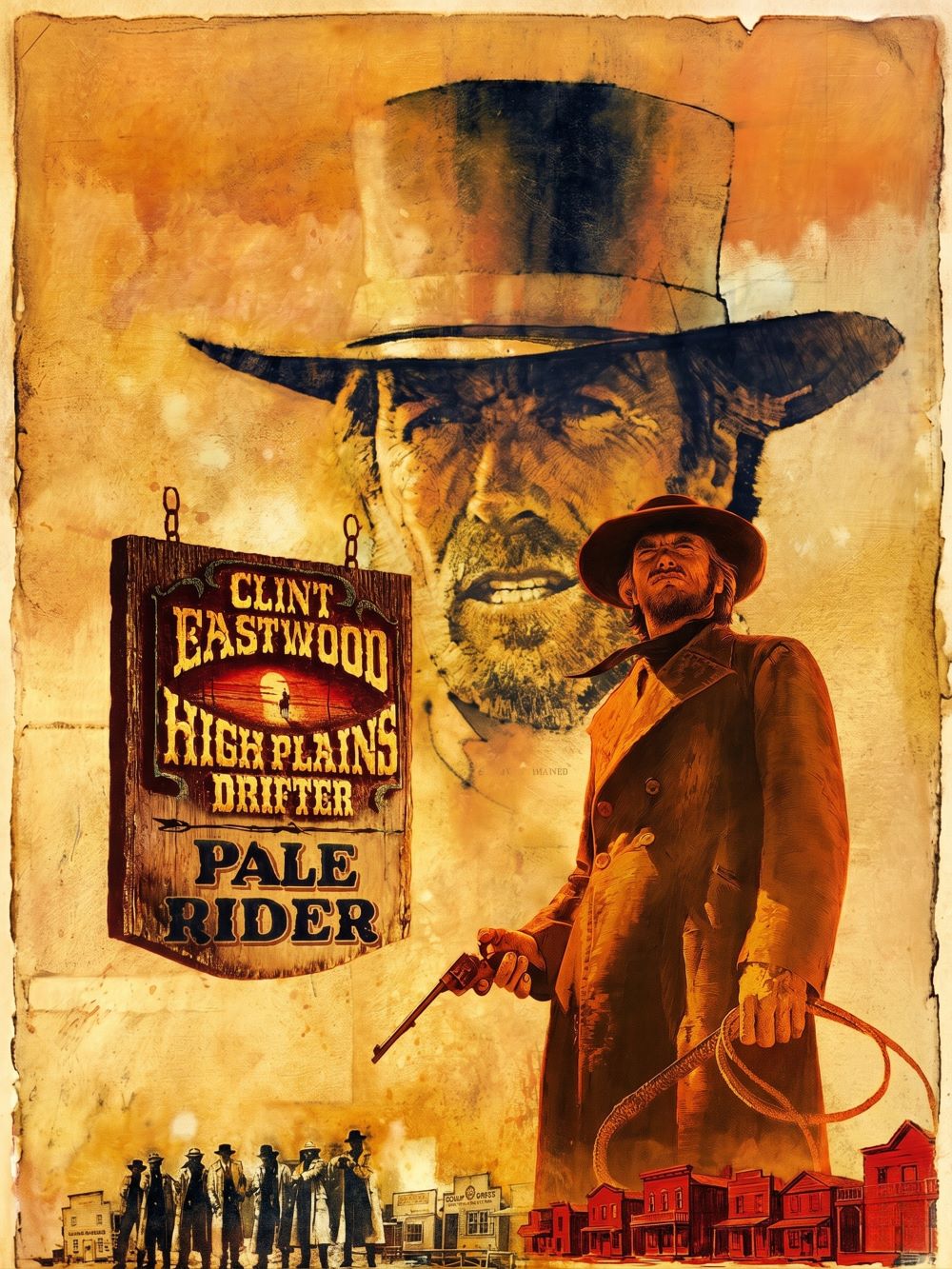
Ghosts of the Frontier: Vengeance and Redemption in Eastwood’s Twin Westerns


“It’s what people know about themselves inside that makes ’em afraid.” — The Stranger

Mythic Outsiders and the Shape of the Stranger

Clint Eastwood’s High Plains Drifter and Pale Rider both revolve around the arrival of a mysterious outsider whose presence destabilizes and reconfigures a frontier community already burdened by moral pressure, economic vulnerability, or buried violence. In High Plains Drifter, the Stranger arrives with the weight of something closer to metaphysical judgment than human intention. He is introduced not as a conventional protagonist but as an unsettling disruption of reality itself, a figure who seems to exist slightly outside the normal rules governing cause and consequence. His relationship to the town of Lago is immediately adversarial, but not in a personal sense—it is structural, almost cosmic, as though he is less reacting to the town than fulfilling a prewritten moral outcome.

By contrast, Pale Rider preserves the same narrative skeleton but shifts the emotional and moral emphasis toward intervention rather than judgment. The Preacher still carries ambiguity—his scars, his sudden appearance, and his almost supernatural timing all suggest something beyond ordinary human agency—but his role is fundamentally protective. He enters a world defined by industrial pressure and economic coercion rather than buried collective sin, and his presence functions as a counterweight to imbalance rather than an execution of moral sentence. The result is that both films feel like variations of the same mythic story, but one is written as condemnation while the other reads as reluctant guardianship.

Old Testament Retribution vs. Folkloric Myth

One of the most revealing ways to distinguish the two films is through their mythic grammar. High Plains Drifter reads like an Old Testament narrative of retribution, where morality is absolute, guilt is inherited collectively, and punishment is not only justified but structurally inevitable. The Stranger operates like a figure of divine wrath, not because he explicitly claims divine authority, but because the world of the film behaves as though such authority is implicit. Lago is not a community undergoing moral testing; it is a community already judged. Every act the Stranger commits feels like the unfolding of a sentence that predates his arrival. Violence in this framework is not expressive or emotional—it is procedural, almost liturgical, as though the town is being dismantled according to a moral code that does not permit negotiation.

The Old Testament quality of High Plains Drifter is also evident in its treatment of time and consequence. The past is not past—it is active, invasive, and inescapable. The town’s buried crime against its former marshal is not simply a backstory element; it functions as a theological stain that structures everything that follows. The Stranger does not introduce justice into the world; he reveals that justice was already waiting, dormant and inevitable.

Pale Rider, by contrast, operates within a folkloric mode that feels less doctrinal and more narrative in the oral-tradition sense. The Preacher is not a judge delivering sentence but a figure who appears within a story because the story requires balance. Folklore does not insist on moral finality in the same way scripture does; instead, it preserves ambiguity, repetition, and interpretive openness. The Preacher’s identity remains unresolved not because the film withholds information, but because resolution itself is not the point. He resembles figures from frontier legend—wandering spirits, unnamed avengers, or protective ghosts whose purpose is understood only through their effects on a community rather than through explicit explanation.

Where High Plains Drifter insists on inevitability, Pale Rider allows for contingency. The Preacher arrives in response to suffering rather than in fulfillment of punishment. His presence suggests that moral intervention is episodic rather than absolute, something that occurs when imbalance becomes intolerable rather than something decreed in advance. The result is a world that feels open-ended rather than sealed.

Moral Worlds: Guilt Versus Vulnerability

The moral architecture of each film is constructed through the condition of its community. In High Plains Drifter, Lago is defined by collective guilt so pervasive that it erases meaningful individuality. The townspeople are not simply flawed characters; they are components of a shared moral collapse. Their original crime—the betrayal and murder of their marshal—functions as the foundation of their identity. The Stranger’s arrival does not introduce new moral tension; it activates an existing one that has been suppressed but never resolved. The town’s psychology is therefore circular: guilt produces fear, fear produces complicity, and complicity guarantees punishment.

This circularity is what gives High Plains Drifter its claustrophobic quality. There is no outside moral perspective capable of altering the town’s fate. Even resistance or survival strategies feel complicit in the same moral structure. The town is effectively trapped inside its own ethical architecture.

In Pale Rider, however, the mining community is framed through vulnerability rather than guilt. These characters are not haunted by a collective sin but threatened by external forces—specifically Coy LaHood’s industrial expansion, which seeks to displace them through economic pressure and intimidation. The moral stakes are therefore asymmetrical: a powerful industrial entity versus a fragile group of independent miners. This reframing is crucial because it transforms the Preacher’s role from agent of punishment to agent of protection. He does not expose corruption within the miners; he resists corruption directed toward them.

Tone and Philosophical Direction

The tonal difference between the films reflects Eastwood’s evolving relationship with the Western mythos. High Plains Drifter is austere, surreal, and deliberately disorienting. The town of Lago feels less like a historical location than a moral construct, a space designed to contain judgment. The visual and narrative isolation of the town reinforces its status as a closed system, one in which moral consequence operates without interference from broader social or geographic context. The result is a film that feels almost metaphysical in its severity, as though it is staging a moral experiment rather than telling a grounded story.

Violence in this context becomes an instrument of revelation. Each act performed by the Stranger peels back layers of denial and self-deception, leaving only the raw structure of guilt beneath. The tone is not merely dark—it is stripping, reductive, and final.

Pale Rider, while still restrained and often somber, introduces a more grounded emotional texture. The mining settlement feels materially real, shaped by labor, scarcity, and interpersonal bonds. This grounding prevents the film from collapsing into abstraction. Even when supernatural ambiguity is present, it is embedded within a world that feels historically and physically tangible. This creates a tonal tension between myth and realism that softens the absolutism found in High Plains Drifter. Instead of moral vacuum, Pale Rider offers moral friction.

The Outsider as Moral Force

Eastwood’s performances in both films embody the evolution of the outsider archetype. In High Plains Drifter, the Stranger is almost entirely detached from human relatability. His silence is not contemplative but destabilizing, creating unease in every interaction. He functions like a moral solvent, dissolving social bonds and exposing hidden structures of guilt. There is no suggestion that he belongs to the world he enters; instead, he appears to impose a structure upon it.

In Pale Rider, the Preacher retains the same controlled economy of expression, but his presence is tempered by moments of relational meaning. His connection to the miners, particularly the young girl whose prayer summons him, introduces a reciprocal dimension absent from High Plains Drifter. He is not simply an external force acting upon the world; he is a figure whose arrival is framed as response. This responsiveness is what aligns him more closely with folkloric tradition, where characters are defined not by origin but by function within a narrative ecosystem.

Violence as Judgment vs. Necessity

Violence in High Plains Drifter operates as moral inevitability. It is structured, ritualized, and unavoidably recursive. Each act feels like the continuation of a moral sequence already underway, as though the Stranger is simply advancing toward a predetermined conclusion. The emotional effect is one of inevitability without catharsis.

In Pale Rider, violence is repositioned as necessity rather than inevitability. It emerges only when economic exploitation and coercion leave no viable alternatives. This reframing is subtle but significant: violence becomes situational rather than cosmic. The Preacher does not embody judgment; he responds to imbalance. As a result, even the film’s climactic confrontations carry a different emotional charge—they feel like interruptions in injustice rather than fulfillments of destiny.

Supporting Communities and Narrative Focus

Both films maintain a strong central focus on Eastwood’s outsider, which inevitably limits the depth of supporting character development. However, the implications of this limitation differ between them. In High Plains Drifter, the flattening of the townspeople reinforces the idea of collective moral identity. Individual psychology is irrelevant because the town functions as a single ethical organism. The lack of distinction between characters serves the film’s allegorical purpose.

In Pale Rider, the miners are more individualized in performance even if not fully developed in script. Actors such as Michael Moriarty and Carrie Snodgress bring emotional specificity that suggests lives extending beyond the frame. This helps ground the film’s mythic structure in human stakes, preventing it from becoming purely symbolic. Even if the characters are archetypal, they are not abstract.

Visual Mythmaking

Cinematographically, the two films articulate their mythic identities through environment. High Plains Drifter constructs a space that feels artificially isolated, as though removed from ordinary geography and placed into a moral void. The town becomes a sealed chamber in which ethical consequences unfold without external interference. This abstraction reinforces its Old Testament quality: a world governed by decree.

Pale Rider, shot by Bruce Surtees, leans into environmental tactility. The forests, mountains, and mining encampments feel embedded in a larger natural system. This grounding creates a sense of narrative openness. Rather than existing as a moral stage, the landscape feels like a lived world in which myth temporarily emerges before receding again into ordinary life. This is essential to its folkloric tone.

Conclusion: Two Mythic Languages of the Western

Ultimately, High Plains Drifter and Pale Rider function as two distinct mythic languages within Clint Eastwood’s evolving critique of the Western. One articulates itself through Old Testament logic—absolute judgment, collective guilt, and irreversible consequence. The other speaks in folkloric terms—episodic intervention, narrative ambiguity, and moral imbalance temporarily corrected rather than permanently resolved. Together, they form a sustained meditation on the Western outsider as both executioner and legend: one who arrives to complete a sentence already written, and another who arrives like a story that briefly becomes real before fading back into myth.

Frontier Fractured: Taylor Sheridan’s Neo-Western Reckoning


“The characters are fiction, but the landscape and the lives the characters are navigating are real.” — Taylor Sheridan

Taylor Sheridan’s American Frontier Trilogy—Sicario (2015), Hell or High Water (2016), and Wind River (2017)—stands as a landmark in modern neo-Western cinema, a tightly crafted exploration of America’s frayed edges penned by the screenwriter who would later dominate television with Yellowstone. These films, while not narratively linked, form a thematic triptych that dissects the moral decay of the contemporary frontier, where law buckles under the weight of systemic injustice, economic despair, and cultural erasure. This retrospective examines Sheridan’s screenplays as a cohesive vision of a nation haunted by its own myths of manifest destiny, blending pulse-pounding tension with unflinching social critique.

Defining the Trilogy’s Core

Sheridan’s “American Frontier” trilogy emerged from his own observations of overlooked American landscapes, as he described in interviews around Wind River‘s release. Sicario, directed by Denis Villeneuve, plunges into the U.S.-Mexico border war on drugs, following idealistic FBI agent Kate Macer (Emily Blunt) as she’s drawn into a shadowy CIA operation led by the enigmatic Matt Graver (Josh Brolin) and the ruthless Alejandro (Benicio del Toro). The film boasts breakneck pacing and claustrophobic tension, transforming a procedural thriller into a meditation on moral compromise, where the line between hunter and hunted dissolves in Juarez’s blood-soaked streets.

Hell or High Water, helmed by David Mackenzie, shifts to West Texas, chronicling brothers Toby (Chris Pine) and Tanner Howard (Ben Foster) as they rob branches of the Texas Midlands Bank—the same institution foreclosing on their mother’s ranch. It delivers a lean, character-driven drama, with an ear for authentic dialogue that captures rural Texan fatalism: lines like “You’re free now” underscore a cycle of poverty where crime becomes an act of reclamation. Ranger Marcus Hamilton (Jeff Bridges), pursuing them, embodies the law’s weary inefficiency.

Wind River, which Sheridan also directed, unfolds on Wyoming’s Wind River Indian Reservation, where U.S. Fish and Wildlife officer Cory Lambert (Jeremy Renner) aids rookie FBI agent Jane Banner (Elizabeth Olsen) in investigating a young Native woman’s death in the snow. It lands as a gut-punch of grief and rage, spotlighting the epidemic of missing and murdered Indigenous women (MMIW), with Cory’s personal loss fueling a vigilante justice that indicts federal neglect.

What unites them? Remote, unforgiving terrains—the border deserts, dusty plains, frozen reservations—mirror the characters’ isolation. Protagonists skirt legality not from villainy but necessity, exposing institutions (CIA, banks, FBI) as complicit oppressors. The “United States legal system” emerges as the trilogy’s true antagonist, wreaking havoc on the marginalized.

Thematic Pillars: Justice Beyond the Badge

At the trilogy’s heart lies a profound distrust of official justice, a motif each film escalates. In Sicario, Kate’s arc is one of disillusionment; she clings to warrants amid Graver’s extralegal raids, only to realize the “war” thrives on endless escalation. Sheridan’s script masterfully builds dread through escalating set-pieces—like the night-vision tunnel assault—while Alejandro’s backstory reveals the human cost of cartel savagery, blurring good and evil. It’s a film where victory feels pyrrhic, the frontier’s violence spilling northward unchecked.

Hell or High Water flips the script to economic predation. The Howards aren’t greedy outlaws but desperate everymen funding their family’s future against predatory lending. Sheridan’s sardonic humor amid despair shines in banter between Marcus and his partner Alberto (Gil Birmingham), laced with casual racism that humanizes their bond. The film’s climax, a bank standoff turned shootout, affirms the brothers’ twisted righteousness, critiquing how banks “won the West” anew through debt. It’s Sheridan’s most optimistic entry, suggesting personal agency can pierce systemic greed.

Wind River delivers the rawest indictment, weaving personal trauma into institutional failure. Cory tracks predators—animal and human—across a landscape where Native lives vanish without trace; statistics cited in the film (96% of reservation rapes unreported) hit like bullets. Its poetic minimalism—from snow-dusted crime scenes to Cory’s haunting promise to a grieving father: “I wish I could take that pain away”—underscores how the reservation embodies America’s forgotten frontier. Here, justice is vengeance, meted quietly in the mountains.

Across the trilogy, Sheridan updates Western archetypes: the principled lawman (Kate, Marcus, Jane) yields to the lone avenger (Alejandro, Toby, Cory). This serves as a modernization of classic Western struggles, swapping cattle barons for cartels and banks.

Stylistic Mastery and Sheridan’s Voice

Sheridan’s prose is economical yet evocative, favoring sparse dialogue that reveals worlds. His authentic regionalism comes through in Texan drawls in Hell or High Water, Arapaho stoicism in Wind River, and border Spanglish in Sicario. Directors amplify this: Villeneuve’s Sicario is visceral, with Roger Deakins’ cinematography turning borders into hellscapes; Mackenzie’s Hell or High Water feels expansive yet intimate, Giles Nuttgens capturing Texas’s soul-crushing vastness; Sheridan’s Wind River is austere, Nick Cave’s score amplifying isolation.

Performances elevate the scripts. Del Toro’s coiled fury in Sicario earned Oscar nods; Bridges’ folksy gravitas anchors Hell or High Water; Renner and Olsen ground Wind River‘s procedural in raw emotion. Yet Sheridan’s writing shines brightest in quiet beats: Kate’s post-raid breakdown, Toby’s motel confession, Cory’s frozen vigil.

The films were critically acclaimed for their sharp writing and thematic depth, earning Sheridan Oscar nominations for Hell or High Water and Wind River, while resonating widely with general audiences through gripping narratives and relatable human struggles that packed theaters and sparked enduring discussions. This neo-Western revival took audiences to unseen locales, from Juarez slums to Wind River snows.

Cultural Impact and Legacy

Released amid the turbulent 2010s—marked by escalating border crises, the lingering financial fallout from the 2008 recession, and rising awareness of the #MMIW epidemic—the trilogy presciently tapped into deep-seated national anxieties, reshaping conversations around justice, identity, and power in America. Sicario arrived as tensions over immigration and the drug war boiled over, humanizing the futility of America’s “war on drugs” just before the 2016 presidential debates on border walls and cartel violence. Its portrayal of shadowy U.S. operations crossing ethical lines sparked debates on real-world CIA tactics and the moral cost of security, influencing discourse in policy circles and popular media alike. The film’s raw depiction of Juarez’s carnage forced viewers to confront overlooked atrocities, bridging Hollywood thrillers with journalistic urgency and priming audiences for later works like Narcos.

Hell or High Water struck a populist chord amid post-recession rage, echoing Occupy Wall Street’s anti-bank fervor and the foreclosure crisis that ravaged rural America. By framing bank robbers as sympathetic everymen fighting predatory lending, Sheridan tapped into widespread resentment toward financial institutions, a sentiment that fueled political movements from Tea Party economics to progressive wealth taxes. The film’s Texas setting amplified its authenticity, resonating in heartland theaters and inspiring think pieces on economic despair as a driver of crime. Its legacy endures in modern “eat the rich” narratives, from The Gentlemen to economic thrillers, while proving indie sensibilities could deliver blockbuster emotional punches.

Wind River ignited a cultural firestorm by centering the MMIW crisis, a long-ignored epidemic where Native women face violence at rates exponentially higher than the national average. The film’s stark statistics and harrowing story propelled #MMIW into mainstream consciousness, directly contributing to legislative momentum like Savanna’s Act (passed in 2020), which improved federal responses to cases on tribal lands. Sheridan consulted with Native communities for accuracy, amplifying Indigenous voices through actors like Gil Birmingham and Julia Jones, though it faced critiques for “white savior” elements. Nonetheless, it opened doors for Native-led stories in films like Reservation Dogs and heightened Hollywood’s focus on underrepresented frontiers.

Collectively, the trilogy’s impact reverberates profoundly. Lionsgate’s 2022 Blu-ray collection formalized its status as a cinematic canon, while Sheridan’s scripts birthed his TV empire—Yellowstone1883Lioness—exporting frontier grit to streaming billions. Yet the films surpass his serialized work in laser-focused purity, influencing a neo-Western renaissance seen in No Country for Old Men echoes, The Power of the Dog, and series like Longmire. In policy realms, Sicario informed border security debates under both Biden and now-President Trump’s 2025 reelection; Hell or High Water prefigured rural economic populism in Trump-era politics; Wind River bolstered tribal advocacy amid ongoing land rights battles.

By 2026, amid Sheridan’s Yellowstone spinoffs dominating Paramount+ and renewed border rhetoric in a second Trump administration, the trilogy feels more vital than ever. It birthed a cinematic language for America’s internal fractures—geographic, economic, racial—challenging viewers to question who truly governs the forgotten edges. Academic panels dissect its archetypes; fan communities on Reddit and Letterboxd binge it as essential viewing. Flaws persist—Sicario 2‘s dilution without Sheridan, Wind River‘s debated optics—but its triumph lies in tension and truth, proving standalone stories can outlast franchises. Sheridan’s evolution from struggling actor to scribe magnate underscores a rare feat: films that entertain viscerally while indicting society, ensuring the frontier’s ghosts haunt us still.

Individual Breakdowns

Sicario: Border Inferno

Villeneuve’s adaptation turns Sheridan’s outrage at Juarez carnage—ignored by U.S. media—into a descent narrative. Kate’s naivety crumbles amid moral voids; Alejandro’s vendetta personalizes cartel horrors. Its operatic violence peaks in the stadium raid, where justice devolves to assassination. At 121 minutes, it’s taut prophecy.

Hell or High Water: Desperate Heist

Sheridan’s personal favorite channels his Texas roots, pitting family against finance. Pine’s everyman resolve contrasts Foster’s volatility; Bridges steals scenes with wry wisdom. The thrilling cat-and-mouse culminates in redemption through sacrifice, a neo-Bonnie and Clyde for foreclosure America. 102 minutes of populist fire.

Wind River: Frozen Requiem

Sheridan’s directorial bow personalizes loss—his script grew from real MMIW stats. Renner’s haunted tracker partners uneasily with Olsen’s fish-out-of-water fed; subplots flesh reservation despair. Its heartbreaking intimacy ends not in triumph but resolve amid endless winter. 107 minutes of unflinching truth.

Why It Endures

Sheridan’s trilogy isn’t mere genre exercise; it’s elegy for eroded American dreams. By bucking plot contrivances for lived-in despair, it forces reckoning with borders, banks, and buried bodies. These thrillers bleed social conscience—unadulterated, unflagging. In a franchise-saturated era, these standalone gems reclaim cinema’s frontier spirit.