Time Walker tells the story of what happens when a mummy that’s actually an alien awakens on a college campus. As you might guess, mayhem and bad fashion choices ensue. To be honest, Time Walker is not the best horror film ever made. In fact, it’s actually pretty bad. However, it is definitely a time capsule of the era in which it was produced and it has one of those WTF endings that you kind of have to see for yourself.
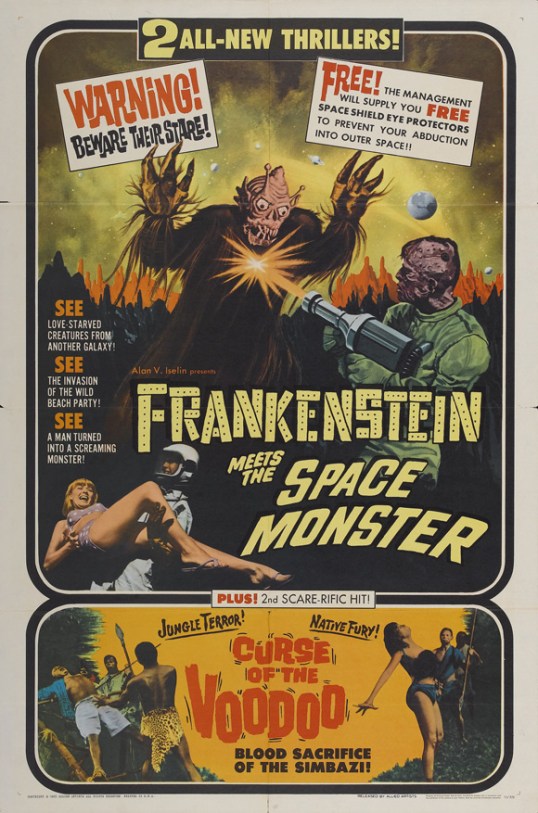
For today’s selection of horror on the lens, we offer up the odd 1965 horror/sci-fi/beach movie hybrid, Frankenstein Meets The Space Monster. Despite the movie’s title, it’s not about Frankenstein. Instead, it’s about an astronaut named Frank who is actually an android. When his latest mission into space goes wrong, Frank ends up crashing in Puerto Rico. Now malfunctioning, Frank causes some major chaos. Can his creator, Dr. Adam Steele (played by character actor James Karen, who years later would appear in Return of the Living Dead), track Frank down and put an end to his reign of terror?
And what about the Martians? Android Frank isn’t the only threat in Puerto Rico. A group of Martians have landed and are determined to kidnap any girl wearing a bikini so that they can use them to repopulate their race. We’re told that every woman on Mars — with the apparent exception of Princess Marcuzan, played with evil haughtiness by Marilyn Hanold — has been killed as the result of an atomic war. Assisting Princess Marcuzan is Dr. Nadir (Lou Cutell), a short, bald Martian with pointy ears.
One of the oddest things about Frankenstein Meets The Space Monster is that, despite being a standard — if wonderfully nonsensical — low-budget B-movie, it features a great soundtrack!
For our latest entry in the 44 Days of Paranoia, we take a look at Oliver Stone’s 1995 presidential biopic, Nixon.
Nixon tells the life story of our 37th President, Richard Nixon. The only President to ever resign in order to avoid being impeached, Nixon remains a controversial figure to this day. As portrayed in this film, Nixon (played by Anthony Hopkins) was an insecure, friendless child who was dominated by his ultra religious mother (Mary Steenburgen) and who lived in the shadow of his charismatic older brother (Tony Goldwyn). After he graduated college, Nixon married Pat (Joan Allen), entered politics, made a name for himself as an anti-communist, and eventually ended up winning the U.S. presidency. The film tells us that, regardless of his success, Nixon remained a paranoid and desperately lonely man who eventually allowed the sycophants on his staff (including James Woods) to break the law in an attempt to destroy enemies both real and imagined. Along the way, Nixon deals with a shady businessman (Larry Hagman), who expects to be rewarded for supporting Nixon’s political career, and has an odd confrontation with a young anti-war protester who has figured out that Nixon doesn’t have half the power that everyone assumes he does.
Considering that his last few films have been W., Wall Street: Money Never Sleeps, and Savages, I think it’s understandable that I’m often stunned to discover that, at one point in the distant past, Oliver Stone actually was a worthwhile director. JFK, for instance, is effective propaganda. Nixon, which feels a lot like an unofficial sequel to JFK, is a much messier film than JFK but — as opposed to something like Savages — it’s still watchable and occasionally even thought-provoking. Thanks to Hopkins’ performance and, it must be admitted, Stone’s surprisingly even-handed approach to the character, Nixon challenges our assumptions about one of the most infamous and villified figures in American history. It forces us to decide for ourselves whether Nixon was a monster or a victim of circumstances that spiraled out of his control. If you need proof of the effectiveness of the film’s approach, just compare Stone’s work on Nixon with his work on his next Presidential biography, the far less effective W.
(I should admit, however, that I’m a political history nerd and therefore, this film was specifically designed to appeal to me. For me, half the fun of Nixon was being able to go, “Oh, that’s supposed to be Nelson Rockefeller!”)
If I had to compare the experience of watching Nixon to anything, I would compare it to taking 10 capsules of Dexedrine and then staying up for five days straight without eating. The film zooms from scene-to-scene, switching film stocks almost at random while jumping in and out of time, and not worrying too much about establishing any sort of narrative consistency. Surprisingly nuanced domestic scenes between Anthony Hopkins and Joan Allen are followed by over-the-top scenes where Bob Hoskins lustily stares at a White House guard or Sam Waterston’s eyes briefly turn completely black as he discusses the existence of evil. When Nixon gives his acceptance speech to the Republican Convention, the Republican delegates are briefly replaced by images of a world on fire. Familiar actors wander through the film, most of them only popping up for a scene or two and then vanishing. The end result is a film that both engages and exhausts the viewer, a hallucinatory journey through Stone’s version of American history.
Last night, the temperature plunged here in Texas. When I woke up this morning, I was confronted with a world that was literally frozen. Needless to say, nobody in Dallas went to work today. Instead, we all sat in our houses and tried to keep ourselves entertained. I kept myself occupied by watching a film that was initially released way back in 1978 and which takes place in my home state.
The name of that film was Capricorn One and it’s the latest entry in the 44 Days of Paranoia.
Capricorn One begins with three astronauts preparing to take the fist manned space flight to Mars. James Brolin is the stoic leader. Sam Waterston is the guy who has a joke for every occasion. And O.J. Simpson is … well, O.J. really doesn’t have much of a personality. He’s pretty much just along for the ride.
However, it turns out that there really isn’t going to be a ride. Just as the countdown begins, the astronauts are ordered to leave the capsule. They are then transported to secret base in the Texas desert. It’s here that they have a meeting with the Head of NASA, who is played by Hal Holbrook. (It’s simply not a 70s conspiracy film if Hal Holbrook isn’t somehow involved). Holbrook proceeds to deliver a stirring monologue where he talks about how he and Brolin have always dreamed of sending a manned flight to Mars. However, as Holbrook explains, the life support system on the crew’s ship was faulty. If Holbrook had allowed them to be launched, they would have died as soon as they left the Earth’s atmosphere. However, if the mission had been canceled then there was a chance that the President would use that cancellation as an excuse to cut NASA’s funding.
So, as Holbrook explains, an empty spaceship has been launched into space. As far as the American public is concerned, the three astronauts are currently on their way to Mars. Now, in order to save the space program, they are going to have to fake the mission. In a studio, a fake alien landscape has been set up and it’s from that studio that Brolin, Waterston, and Simpson will pretend to explore Mars.
Brolin, Waterston, and Simpson reluctantly agree to cooperate with the plan. However, after doing the first fake broadcast, Brolin starts to have second thoughts. Realizing that he can’t trust the three astronauts to keep a secret, Holbrook announces that the capsule’s heat shields failed during re-entry and that the crew of Capricorn One is now dead. Now, all he has to do is have the three of them killed for real.
Meanwhile, a NASA technician (Robert Walden) stumbles onto evidence of the deception. He subsequently vanishes but not before he tells reporter Elliott Gould about his suspicions. While the three astronauts try to escape from Holbrook’s agents, Gould tries to find out what really happened to Capricorn One.
It’s probably half-an-hour too long, the plot is full of holes (the least of which being why Holbrook waited until after he had announced the fake deaths to order the real deaths), and director Peter Hyams allows a few scenes to run on and on while others seem to end with a jarring abruptness. However, for the most part, Capricorn One is a well-acted and solidly entertaining film. However, there are two things that make Capricorn One especially memorable.
First off, Capricorn One features one of the most exciting action sequences that I have ever seen. It occurs while Gould is investigating Walden’s disappearance. After visiting Walden’s apartment and discovering that it’s inhabited by a woman who claims to have never heard of his friend, Gould is driving away when he discovers that his brakes have been disabled. The car then starts to accelerate and Gould finds himself desperately trying to regain control as the car careens through the streets of Houston. The scene is shot almost entirely from Gould’s point-of-view and, for five minutes, we watch as everything from other cars to unlucky pedestrians come hurtling towards the car. For those few minutes, when the viewer and Gould become one, Capricorn One is not only exciting but it feels genuinely dangerous as well.
Secondly, Capricorn One features some of the oddest dialogue imaginable. Peter Hyams not only directed the film but he also wrote the screenplay as well. Watching the film, one gets the feelings that Hyams was so in love with his dialogue and with all of his quirky characters that he simply could not bring himself to cut anything or anyone. As a result, the film is full of lengthy monologues. When the characters speak to each other, they don’t have conversations as much as they trade quips. Characters like Gould’s ex-wife (played by Karen Black) and his editor (David Doyle) show up for a scene or two, deliver monologues that are only tangibly related to the film’s plot, and then vanish. Sam Waterston ends up telling the world’s longest joke while he climbs a mountain in the desert. Towards the end of the film, Telly Savalas (who was in my favorite Mario Bava film, Lisa and the Devil) shows up as a foul-tempered crop duster and engages in a long argument with Gould who, despite being a reporter, never bothers to question why Savalas would have a crop dusting business in the middle of the desert.
But here’s the thing — it works. As odd as some of the dialogue may be and as superfluous as some of the action is to the overall plot, it still all works to the film’s benefit. The constant quirkiness works to keep the audience off-balance and to give Capricorn One its own unique rhythm.
Capricorn One — see it now before Michael Bay remakes it.
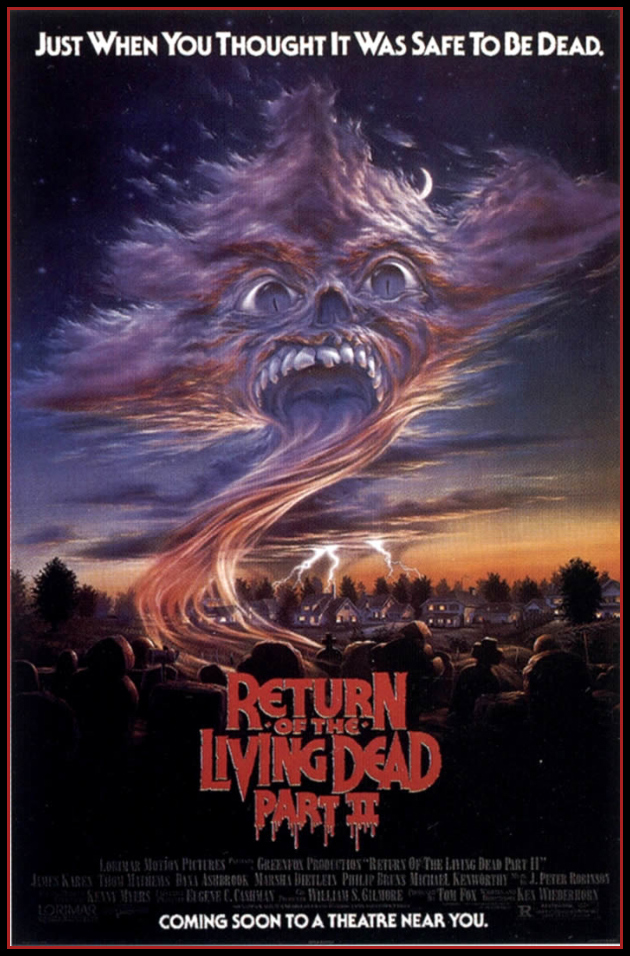
1988 saw the release of Return of the Living Dead Part II. This film is a sort of sequel/reboot of the first film in that the story and even some of the characters bear too much of a similarity to the original film. Ken Weiderhorn both writes and directs this “sequel” and it shows. The film reuses alot of what made the first film a cult-classic amongst horror fans. Weiderhorn seems to be of the philosophy that if something ain’t broke then don’t fix it. What this does is make the film feel like a deja vu and maybe that was his intent since two of the main characters in the film say pretty much the same thing. Despite all this the film itself is pretty good and stays true to the original, albeit with abit more humor and better effects work.
Reprising similar roles they had in the first film are James Karen as Ed and Thom Mathews as Joey. Both work as in the post-burial industry and moonlight stealing valuables from the privates crypts and mausoleum in the cemetery they’re working in. Their characters act and almost have similar lines from Karen and Mathews’ characters of Frank and Freddy in the first film. Karen as Ed goes over-the-top once the 2-4-5 Trioxin gas is let loose and the dead bodies in the cemetery begin to come back to life seeking live brains. It’s these two characters who really keep the film from spiraling down to awful status. Even though their characters are similar to the original film, Karen and Mathews still bring a dose of great comedic timing and horror to the situation.
This time around the town has been safely evacuated by the military except for a few people who lived on the newly-built suburban housing area in the outskirt of town. It’s these survivors who must try and find a way to defeat the zombies and at the same time convince the military blockading the town that they’re not infected. There’s more action and comedy in this sequel. I think the comedy part of the film got way too much attention, but as I said earlier, Weiderhorn seems to think that if it worked in the original then it should work with more in this film. The effects work looks a bit better and probably due to an increase in the budget.
In the end, Return of the Living Dead Part II never brought anything new to the original it was following-up. The film pretty much reuses the same characters and situations. Weiderhorn does this to good effect and the finished product was an entertaining enough horror-comedy. Who knows how this sequel would’ve turned out if Russo had written it and O’Bannon back directing.
Return of the Living Dead has to go down as one of the funniest and inventive take on the zombie subgenre that began after the release of George A. Romero’s Night of the Living Dead. Due to a dispute between Romero and John Russo (co-producer of the original NOTLD), the sequels to Night of the Living Dead that were produced and directed by Romero dropped the “Living Dead” part in their titles. Russo retained the rights to create sequels using those words while Romero just kept the word “Dead” in the follow-up films to Night. It took Russo awhile, but he finally got to use those naming rights with 1985’s Return of the Living Dead.
Even though there were some acrimony between Romero and Russo, the screenplay for Return of the Living Dead makes several complimentary nods to Night of the Living Dead. The film’s premise was what if Romero’s first film was actually based on a true event and that the government and the military covered it up before people got a wind of it. The film takes that simple premise and creates an action-packed horror-comedy that still stands the test of time.
Unlike Romero’s films, Return of the Living Dead actually gives an explanation as to what causes the dead to return to life with a singular purpose of attacking the living. The cause of all this undead mayhem was due to a bioweapon nerve toxin called 2-4-5 Trioxin which was originally designed by the military to defoliate marijuana crops. To say that the side-effects of the gas had some interesting effects was an understatement. The zombies created by Trioxin do attack the living but they’re also much more livelier and smarter (retaining agility, strength and mental capacity of their previous life) than the traditional Romero-zombies. They also do not feed on just humans. They also feed on other animals. The last major difference between the Romero-zombies and the Trioxin-zombies was that the latter only wanted to feed on live brains to end the pain of being dead. These differences made for a much faster-paced horror movie. As much as I consider the Romero zombie films as the best out there, I hold a special place in my horror-fan heart for these Trioxin dudes.
The story by John Russo would be turned into a screenplay and directed by Dan O’Bannon also made Return of the Living Dead behave more as a horror-comedy than just a straight-up horror. The dialogue between the characters were full of great one-liners that would’ve sounded cheesy if not for the great and game performances from the cast. Clu Gulager as Burt Wilson (owner of the medical supplies warehouse where the lost canister of Trioxin was being stored in) did a great job being incredulous at the events happening around him. His back and forth with his friend Ernie (played with Peter Lorre eyes by Don Calfa), the local mortuary’s gun-toting mortician, keep the film lively and hilarious in-between scenes of horror.
The scene stealers in the film must go to a bumbling pair of Burt’s employees who inadvertently release the toxic and reanimating gas from the warehouse’s inventory of Trioxin canister. James Karen as the worldly and cynical Frank was a riot from start to end. His over-the-top performance had me in stitches. He played Frank with such a manic, panicky style that it was difficult not to get caught up in his hysterics. To balance out Frank’s Hardy with his more subdued, but no less panicked Laurel, was Thom Mathews as Freddy. Mathews would later appear in other horror movies in the decade and even reprise a similar role in this film’s sequel. His performance as the straight man to Karen’s fool was also very good. His slow decline into becoming one of the zombies after the initial inhalation of the Trioxin gas in the film’s introduction was funny and sad. Of all the zombies in the film he gets the brunt of the slapstick sequences, especially once he starts hunting his girlfriend for her brains. His professing of his love for her and at the same time wanting her to give up her brain was hilarious, if not creepy as well.
Another thing that Return of the Living Dead had that made it different from Romero’s zombie movies were the scenes of gratuitious nudity throughout the film. A majority of the nude scenes were courtesy of scream queen Linnea Quigley as the punk rock Trash whose morbid obsession with all things death made her an early victim for the zombies and later on as one of their leaders. I know that kids my age at that time replayed over and over the scene of her strip-tease down to nothing atop a graveyard headstone. Even now many fans of the film consider that sequence as one of their favorite.
Return of the Living Dead still counts as one of the best zombie movies out there and preceded the UK’s Shaun of the Dead by two decades as a great horror-comedy. There was a sequel a few years later to capitalize on the popularity of the first film. It tried to capture the hilarity and horror of the first one but did not measure up in the end.

 Through the Shattered Lens