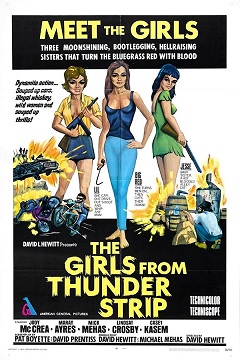
A group of dirty, good-for-nothing bikers roll into a Southern town. Led by Teach (Gary Kent), the bikers are obsessed with murder and rape, the latter of which opens the film and is treated in a fashion that is meant to be comedic. When some pointless bullying of a gas station attendant leads to the gang’s only female member getting stabbed to death, the bikers are arrested and thrown in the county jail.
Meanwhile, three sisters (Maray Ayres, Megan Timothy, and Melinda MacHarg) are making their own moonshine and selling it to the local hillbillies. A federal agent (played by Casey Kasem, the DJ who used to countdown the Top 40 songs in America and who voiced Scooby-Doo’s stoner friend, Shaggy) comes to town and insists that the local sheriff (Jack Starrett) arrest the three sisters. However, only one of the sisters is taken to jail while the other two escape. The federal agent manages to accidentally blow up the still but he only ends up with a face full of soot as a result. That Kasem can survive getting blown up without getting so much of a scratch on him would make sense if the rest of The Girls From Thunder Strip were presented as being a live-action cartoon but it’s not so the entire Kasem storyline feels like it was lifted from another, more light-hearted moonshiner movie.
With the help of the bikers, the incarcerated sister is able to break out of the county jail. But just because they helped each other, that doesn’t mean that the sisters trust the bikers, especially after the bikers murder a deputy who happened to be a cousin to the bootleggers. The bikers try to take over the moonshine business while the sisters (and one convenient mountain lion) take on the bikers.
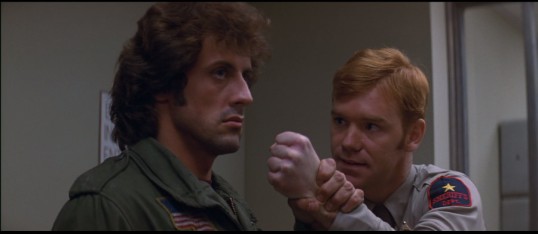
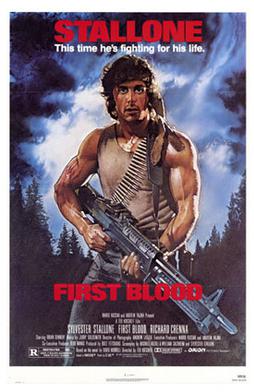
The movie is all over the place. On the one hand, you’ve got the bikers raping and killing nearly everyone they meet. On the other hand, you’ve got Casey Kasem, playing a federal agent and pursuing the sisters with all the panache of a cartoon cat chasing a mouse. The action scenes are lousy. The characters have no motivation. With one exception, the actors are terrible and no, that exception is not Casey Kasem. Instead, the one exception is Jack Starrett, who plays the sheriff. Starrett, with his trademark gravelly voice, was a director who had sideline playing intimidating authority figures. In First Blood, he played Galt, the worst member of Brian Dennehy’s police force. (He was the one who laughed when he ordered the deputies to shave Rambo with a straight razor. Later he fell out of a helicopter and Rambo was blamed for his death.) Starrett gives the same performance in The Girls From Thunder Strip that he later gave in First Blood and since the sheriff is not actually given a name, I’ve decided that he and Galt are the same character and Girls From Thunder Strip takes place in the Rambo Cinematic Universe.
Other than providing a look at the early life of Art Galt, there’s not much else to recommend The Girls From Thunder Strip. Even aficionados of the biker and moonshine genres will want to look elsewhere.
A group of old west outlaws stumble across an Apache camp. Though everyone’s friendly at first, the outlaws discover that the Apaches have gold so they kill all of the Apaches except for one, Jemme (Maria Gahua). They drag Jemme off with them, intent on having their way with her after forcing her to lead them to more gold. Only one member of the gang, Pitcallin (Jody McCrea), is willing to protect Jemme and treat her with kindness. (In fact, Pitcallin is such a nice and decent person that it doesn’t make any sense for him to be riding with the outlaws in the first place.) Meanwhile, Jemme’s brother (Marcus Rudnick) discovers the camp and, upon discovering his family dead, cries and screams for several minutes. Then he sets off for revenge against the gang.
The best thing about Cry Blood, Apache is that it opens with Joel McCrea, father of Jody, playing the elderly Pitcallin and riding his horse to the where the old Apache camp used to be. While the old Pitcallin is looking around, he hears the voices of the former members of the gang and then the rest of the film is told in flashback. This makes it seem like Cry Blood, Apache is going to be about an old outlaw coming to terms with the terrible things that happened in the past. Unfortunately, Joel McCrea’s only in the movie for about two minutes and since the movie sat on the shelf for three years before it was finally released, it’s probable that his scenes were shot long after the rest of the movie. Along with starring in the film, Jody McCrea also produced it and Joel probably only agreed to lend some star power to the movie as a favor to his son. But teasing western fans with Joel McCrea, just to then bring out Jody McCrea is just plain unfair.
Other than the opening scenes with Joel McCrea, the rest of this film is so poorly put together that it’s a struggle to sit through. Cry Blood, Apache is edited in such a haphazard manner that it’s nearly impossible to follow the plot. While the gang searches for more gold, Jemme’s brother searches for the gang but the film never makes it clear how close the brother is to finding the gang so there’s zero suspense generated. Jody McCrea was too naturally amiable to play a believable outlaw. There was nothing tough about him. Meanwhile, both Marcus Rudnick and Maria Gahua overact to such an extent that scenes that should be emotionally wrenching become unintentionally humorous instead.
Cry Blood, Apache was directed by Jack Starrett, who went on to direct far better movies than this one. He also appears in the film as a member of the gang, the bible-quoting Deacon. Even though he’s got long hair and is considerably younger in his film, most viewers will hear his voice and immediately recognize him as Galt, the sadistic cop from First Blood.
From everything that I had heard and seen over the past few years, I was under the impression that this 1982 film was the ultimate in mindless action. I figured that the film was basically just two hours of Sylvester Stallone hiding in the woods, firing a machine gun, riding a motorcycle, and eventually blowing up a small, bigoted town. It wasn’t a film that I was in any particular hurry to experience but I knew it was one that I would have to watch eventually, if just because of how many filmmakers have cited the film as an influence. On Sunday night, First Blood aired on the Sundance Channel and, for the first time, I watched it all the way through. What I discovered is that there’s a lot more to First Blood than I had been led to believe.
Now, don’t get me wrong. It’s definitely an action film. Stallone spends a lot of time hiding in the woods, firing a machine gun, riding a motorcycle, and blowing up a town. Somewhat improbably, only one character actually dies over the course of the film, though quite a few end up getting maimed and wounded. There’s even a close-up of Stallone stitching up a nasty gash on his arm, which totally made me cringe. But, even with all the gunfire and explosions, First Blood has more on its mind than just carnage. It’s a brooding film, one that angrily takes America to task for its treatment of its veterans and outsiders. In its way, it’s an action film with a heart.
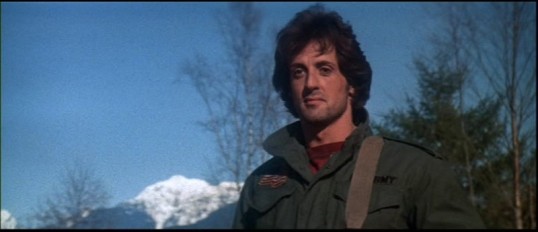
Sylvester Stallone plays John Rambo, a troubled drifter who is still haunted by not only his experiences in Vietnam but also by the feeling that his own country doesn’t want him around. When Rambo, with his unkempt hair and wearing a jacket with an American flag patch prominently displayed, shows up in the town of Hope, Washington, it’s not to cause trouble. He just wants to see an old friend, a man with whom he served. Unfortunately, his friend has died. The man’s bitter mother says that he got cancer from “that orange stuff they were spraying around.” Even though the war is over, it’s still killing the only people who can possibly understand how Rambo feels about both his service and his uncertain place in American society.
As Rambo walks through the town, he’s spotted by Sheriff Will Teasle (Brian Dennehy). Rambo just wants to get a cup of coffee and relax. Teasle, however, views Rambo as being a stranger and, therefore, a possible threat to his town. Teasle wants Rambo to leave. Rambo wants to know why, after everything that he’s sacrificed for his country, he’s being told that he needs to get a haircut. From this simple conflict — a misunderstanding really, as Teasle doesn’t know that Rambo is mourning the death of his friend and instead interprets Rambo’s sullen silence as being a threat — an undeclared and unwinnable war soon breaks out.
Technically, Teasle is the film’s villain. He’s the one who arrests Rambo for vagrancy. It’s his abusive deputies who cause Rambo to have the flashbacks that lead to him breaking out of jail. It’s Teasle’s arrogance that leads to him ignore the warnings of Rambo’s former commanding office, Sam Trautman (Richard Crenna). And yet, Teasle himself is never portrayed as being an evil man. Instead, Dennehy plays Teasle as being well-meaning but stubborn. It’s been written that the most compelling villains are the ones who don’t realize that they’re the villain and that’s certainly true in Teasle’s case. Teasle’s job is to protect the town and its citizens and that’s what he’s determined to do. If his actions become extreme, it has less to do with any deliberate cruelty on his part and everything to do with the fact that, towards the end of the film, he finally figures out that he’s in way over his head.
Once Rambo has disappeared into the woods and maimed (but not killed) all of Teasle’s deputies, he only has one request and that’s to be left alone. He simply wants to stay in the woods, hunting for food and free from a society that has nothing to offer him during peacetime. What’s interesting is that, at the start of the film, everyone wants Rambo to just disappear. He’s a reminder of not just the turmoil of the Vietnam era but also the fact that Vietnam was the first war that America lost. Rambo’s presence is viewed as being like an ugly scar that you wish would just fade away. However, once Rambo does actually vanish, people won’t stop looking for him. As opposed to the later films in the franchise, the Rambo of First Blood doesn’t want to fight anyone. Rambo just wants to be left alone in solitude and considering the way that he’s treated by the town of Hope, it’s hard to blame him.
And so, you end up sympathizing with this John Rambo. Even thought he’s blowing up a town during the Christmas season and there’s a few scenes where he’s kind of scary, it’s impossible not to feel that he has a right to his anger. You find yourself wishing that the Sheriff had just left him alone or that maybe Rambo had just taken Teasle’s earlier advice and left town. Because, as you watch the film, you know that 1) there was no good reason why any of this had to happen and 2) things probably aren’t going to end well for either John Rambo or Will Teasle.
First Blood was based on a novel that was first published in 1972. The film spent nearly a decade in development, as various directors, screenwriters, and actors circled around the project. At one point, First Blood was envisioned as an anti-war film that would have been directed by Sidney Lumet and which would have featured a bearded Al Pacino lurking through the wilderness and killing not only Teasle but also several deputies and national guardsmen. When Stallone agreed to star in the film, he also rewrote the script, transforming Rambo into a sympathetic outsider who goes out of his way not to kill anyone. The end result was an underdog story that audiences could embrace.
Seen today, it’s interesting to see how many familiar faces pop up in First Blood. For instance, a young and really goofy-looking David Caruso pops up and totally overacts in the role of the only sympathetic deputy. A less sympathetic deputy is played by Chris Mulkey, who would go on to play other unsympathetic characters in a huge number of movies and TV shows. Interestingly enough, the most sadistic of the deputies was played by Jack Starrett, who directed a several classic B-moves in the 70s. (One of Starrett’s films was The Losers, in which a bunch of bikers were sent to Vietnam to rescue an American diplomat.)
As opposed to many of the films that it subsequently inspired, First Blood holds up surprisingly well. It may be violent but it’s violence with a heart.
4 Shots From 4 Films is just what it says it is, 4 shots from 4 of our favorite films. As opposed to the reviews and recaps that we usually post, 4 Shots From 4 Films is all about letting the visuals do the talking.
Today is the first day of summer so these 4 shots all celebrate films about summer vacation!
4 Shots From 4 Summer Films
Race With The Devil (1975, dir by Jack Starrett)
Hitch-Hike (1977, dir by Pasquale Festa Campanile)
The Mafia just pissed off the wrong ex-Green Beret.
After his father is blown up by a car bomb, Captain Slaughter (Jim Brown) single handily wipes out the Cleveland mob. Only one gangster, Dominic Hoffo (Rip Torn), escapes to South America. The Treasury Department (represented by Cameron Mitchell) sends Slaughter and two other agents (Don Gordon and Marlene Clark) after Hoffo. Along with being a ruthless gangster, Hoffo is a viscous racist and is convinced that he will be able to easily take care of Slaughter. Hoffo does not understand how much trouble he’s in. No one stops Slaughter.
Produced by American International Pictures, Slaughter is one of the classic blaxploitation films. While it may not have the political subtext of some of the best blaxploitation films, Slaughter is a fast and mean action film, directed in a no nonsense manner by B-movie veteran Jack Starrett. There is not a wasted moment to be found in Slaughter. It starts and ends with cars exploding and, in between, it doesn’t even stop to catch its breath.
In the 1970s, Richard Roundtree was John Shaft, Ron O’Neal was Superfly, Jim Kelly was Black Belt Jones, Fred Williamson was Black Caesar, and Jim Brown was Slaughter. Whatever skills Jim Brown lacked as an actor, he made up for with sheer presence. He commanded the screen. Whether he was playing football on television or beating down the Mafia in the movies, no one could stop Jim Brown. Slaughter is Brown at his toughest. Rip Torn is the perfect villain, screaming out racial slurs even when Slaughter has him trapped in an overturned car. Jim Brown has said that, of all the films he has made, Slaughter is one of his three favorites. (The other two were The Dirty Dozen and Mars Attacks!)
Slaughter‘s cool factor is increased by the presence of Stella Stevens, playing the role of Ann, Hoffo’s mistress. It only takes one night with Slaughter for Ann to switch sides. Nothing stops Slaughter.
4 Shots From 4 Films is just what it says it is, 4 shots from 4 of our favorite films. As opposed to the reviews and recaps that we usually post, 4 Shots From 4 Films is all about letting the visuals do the talking.
For those who might question my decision to highlight four grindhouse films on International Women’s Day, I kindly refer them to my essay, Too Sordid To Ever Be Corrupted.
4 Shots From 4 Films
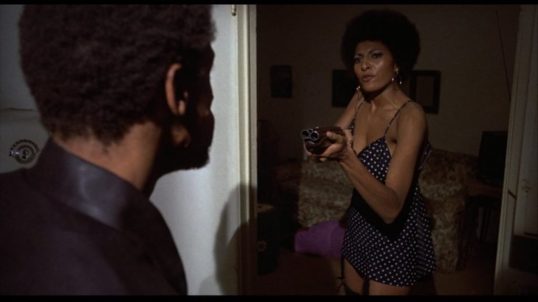
Coffy (1973, dir by Jack Hill)
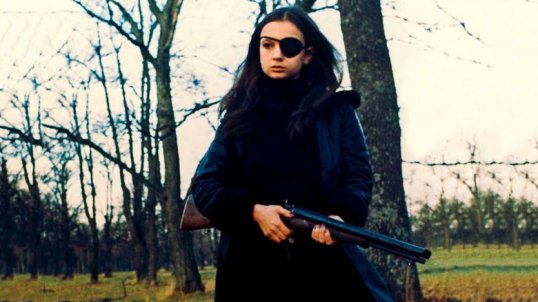
Thriller, A Cruel Picture a.k.a. They Call Her One Eye (1973, dir by Bo Arne Vibenius)
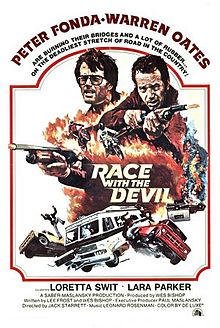
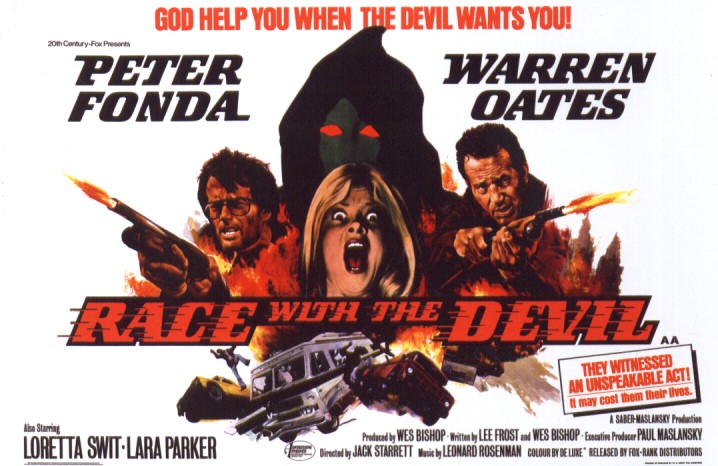
Roger (Peter Fonda) and Frank (Warren Oates) are lifelong friends and business partners who, along with their wives Kelly (Lara Parker) and Alice (Loretts Swit), are planning on taking the “best damn vacation we ever had.” Traveling to Colorado in Frank’s RV, they decide to camp for a night next to a river. Not only do Frank and Roger witness what appears to be a human sacrifice but they also have to run for their lives when they are spotted. The local sheriff (R.G. Armstrong) tells them that they probably just saw a bunch of hippies killing an animal but Peter Fonda knows hippies and those were not hippies. Taking some blood-stained dirt so it can be analyzed by the authorities, Roger and Frank try to drive on but find themselves being pursued by Satanists.
A relentless and entertaining B-movie, Race With The Devil is a hybrid of Rosemary’s Baby, Smokey and the Bandit, and Easy Rider, with some Parallax View-style paranoia mixed in as well. Eventually, it seems as if everyone in rural Texas — from the sheriff to the gas station attendant to the residents of an RV park where our heroes try to spend the night — is a Satanist. (Even a wrecked school bus turns out to just be an excuse to get the RV to slow down so the Satanic rednecks can attack, leading to Warren Oates’s classic line, “I don’t believe in a school bus on Sunday.”)
A big part of the fun of Race With The Devil is getting to watch Peter Fonda and Warren Oates acting opposite each other. (A lot of drive-in patrons probably left Race With The Devil with a crush on the lovely Lara Parker as well.) Friends both on and off-screen (Oates previously co-starred in Fonda’s directorial debut, The Hired Hand), Fonda and Oates are a lot of fun to watch playing off of each other in Race With The Devil, with Warren Oates’s natural intensity providing a good contrast to Fonda’s laid back style.
It may not rank up there with the movies that he appeared in for Sam Peckinpah and Monte Hellman but Race With The Devil is still one of Warren Oates’s most entertaining films.
For the past week and a half, I have been on a major Warren Oates kick. The latest Oates film that I watched was Kid Blue, a quirky western comedy that features Warren in a small but key supporting role.
Bickford Warner (Dennis Hopper) is a long-haired and spaced-out train robber who, after one failed robbery too many, decides to go straight and live a conventional life. He settles in the town of Dime Box, Texas. He starts out sweeping the floor of a barber shop before getting a better job wringing the necks of chickens. Eventually, he ends up working at the Great American Ceramic Novelty Company, where he helps to make ashtrays for tourists.
He also meets Molly and Reese Ford (Lee Purcell and Warren Oates), a married couple who both end up taking an interest in Bickford. Reese, who ignores his beautiful wife, constantly praised Greek culture and insists that Bickford take a bath with him. Meanwhile, Molly and Bickford end up having an affair.
Bickford also meets the local preacher, Bob (Peter Boyle). Bob is enthusiastic about peyote and has built a primitive flying machine that he keeps in a field. The town’s fascist sheriff, Mean John (Ben Johnson), comes across Bob performing a river baptism and angrily admonishes him for using “white man’s water” to baptize an Indian.
Bickford attempts to live a straight life but is constantly hassled by Mean John, who suspects that Bickford might actually be Kid Blue. When Bickford’s former criminal partner (Janice Rule) shows up in town and Molly announces that she’s pregnant, Bickford has to decide whether or not to return to his old ways.
Kid Blue is one of a handful of counterculture westerns that were released in the early 70s. The film’s biggest problem is that, at the time he was playing “Kid” Blue, Dennis Hopper was 37 and looked several years older. It’s hard to buy him as a naïve naif when he looks older than everyone else in the cast. As for Warren Oates, his role was small but he did great work as usual. Gay characters were rarely presented sympathetically in the early 70s and counter-culture films were often the worst offenders. As written, Reese is a one-note (and one-joke) character but Warren played him with a lot of empathy and gave him a wounded dignity that was probably not present in the film’s script.
Kid Blue plays out at its own stoned pace, an uneven mix of quirky comedy and dippy philosophy. Still, the film is worth seeing for the only-in-the-70s cast and the curiosity factor of seeing Dennis Hopper in full counterculture mode, before he detoxed and became Hollywood’s favorite super villain.
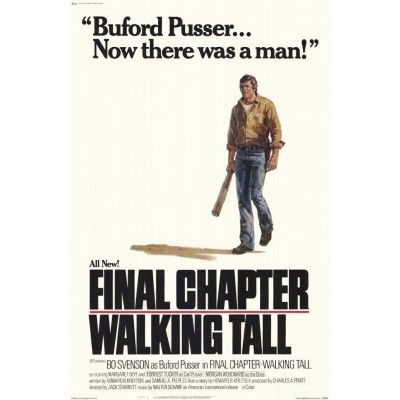
For one last time, Buford Pusser is back! The 1977 film Walking Tall: Final Chapter ends the story that was begun in Walking Tall and continued in Walking Tall Part II.And it turns out that the final chapter is pretty much just like the previous two chapters. In fact, I’m tempted to just tell you go reread my review of Walking Tall Part II because that review works just as well for most of the Final Chapter.
Final Chapter starts with footage from the first Walking Tall, with Bo Svenson awkwardly inserted in place of Joe Don Baker. Once again, we watch as Elizabeth Hartman is shot in the back of the head and Svenson — in the role of Buford Pusser — is shot in the face. Oh my God, we think, how many times can the exact same thing happen to the exact same character!?
Oh wait — it turns out that Buford is just remembering the death of his wife. Buford is still haunted by that day and he’s still out for vengeance. For the next hour or so, we follow Buford as he and his deputies blow up moonshiners across Tennessee. After each arrest, an attorney shows up and yells at Buford for violating everyone’s civil rights. In response, Buford smirks until the attorney gets so mad that he decides to run for sheriff himself.
Buford doesn’t give his opponent much of a chance. As one of his deputies puts it, this guy is just a “bleeding heart liberal.” (But if he’s so liberal, what’s he doing in Tennessee? Off with you, sir — return to Vermont!) Instead of campaigning, Buford spends his time hunting down more moonshiners. When he discovers that one moonshiner is also an abusive father, he personally drives the man’s son down to the local orphanage. Oddly enough, Buford does not offer to adopt the kid himself.
Anyway, to the shock of everyone, Buford is not reelected. No longer sheriff, he struggles to find a full-time job and makes plans to run in the next election. One of the moonshiners shows up and taunts Buford until Buford is forced to beat him up in the middle of the street. The new sheriff show up and demands to know what happened. None of the townspeople are willing to snitch on Buford. Good for them!
After about an hour and a half of this, something interesting actually happens. A film producer drives up to the Pusser Farm and tells Buford that he wants to make a movie out of his life. “We’re going to tell the story exactly how it happened!” the producer assures him. In the next scene, Buford is advising the director of Walking Tall on how to properly film a car chase.
And you know what? These scenes of Buford watching his life story be filmed are actually rather charming. For the only time in the series, Bo Svenson actually appears to be having fun in these scenes. And, when Buford runs from a theater while watching the recreation of his wife’s murder, it’s actually a very effective moment.
Anyway, there’s not much running time left after all of that. We see Buford sign a contract to play himself in the sequel and, by this point, we all know what happened afterward. Buford was killed in a mysterious car accident. But fear not! The film opens with a heavenly choir and Svenson’s voice booming from the heavens so we all know that Buford Pusser is arresting moonshiners in Heaven.
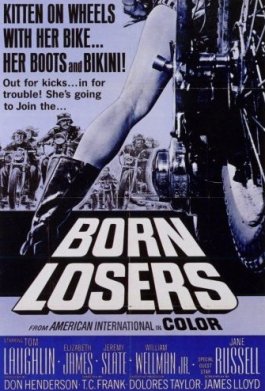
For the past few days, I’ve been in the process of reviewing 94 films about politics and politicians. With that in mind, you may be wondering why, after reviewing films like The Last Hurrah, Sunrise at Campobello, and Advise & Consent, I am now reviewing a 1967 biker film called The Born Losers.
It all comes down to Billy Jack. In the 70s, Tom Laughlin would write, direct, and star in two hit films — Billy Jack and The Trial of Billy Jack. In these films, Laughlin played the title character. Billy Jack was everything that you could hope for in a counter-culture hero. First off, as an American Indian, he was an authentic American as opposed to just another European intruder. He was a war hero, who had served as a Green Beret in Vietnam. He often carried a gun with him, which meant that he understood and supported the 2nd Amendment and good for him! Billy Jack was also a master of hapkido, which meant that he could kick ass in the most visually appealing way possible.
Even more importantly, Billy Jack called the Man out on his racism and his intolerance. Billy Jack was an environmental activist before anyone else. Billy Jack went on vision quests. Billy Jack was anti-war. Billy Jack was a pacifist. And, of course, Billy Jack ended up killing a lot of people but they were all bad guys.
By making and distributing Billy Jack himself, Laughlin became an independent film pioneer and made history. He also became a counter-culture hero and Billy Jack remains a cult figure even today. But what a lot of people don’t realize is that Billy Jack first appeared in Born Losers and that, in the little seen Billy Jack Goes To Washington, he eventually ended up serving in the U.S. Senate.
When you consider that Billy Jack would eventually be Sen. Jack, that means the Born Losers isn’t just a low-budget, violent biker film. Instead, it’s the exploitation version of Young Mr. Lincoln. It’s a chance to see what Billy Jack was doing before he became a statesman.
(And rest assured, the other three Billy Jack films will be reviewed before Shattered Politics ends.)
As we discover at the start of Born Losers, pre-politics Billy Jack was just an enigmatic veteran who lived in the mountains of California. When we first see Billy, he’s walking along a grassy hill. A deer safely runs by the camera. A rabbit pops its head out of a hole in the ground and looks relieved to see Billy. If I’m being a little bit snarky, it’s because I’ve seen all of the Billy Jack films and I know how often this exact scene is played out over the course of the franchise. But, in all fairness, it’s actually a fairly well-done and visually appealing scene and, as an actor, Laughlin had the presence to pull it off.
A far less pretty scene is occurring in the town of Big Rock, where teenagers are showing up to hang out on the beach and are being harassed by a group of bikers, the Born Losers of the title. The Born Losers are an odd collection of bikers, with half of them looking like extras from Sons of Anarchy and the other half looking like the type of hipsters that I always see whenever I go to a movie at the Alamo Drafthouse. Their leader (Jeremy Slate) is named Danny but the rest of the gang are known by their nicknames.
(For instance, there’s Crabs. Why is he called Crabs? “Because he’s got them!” Danny helpfully explains.)
After the Born Losers rape four girls, they launch a campaign of violence and intimidation to keep the girls from testifying in court. Billy comes to the aid of one of the girls, Vicky (Elizabeth James, who also wrote the script). I related to Vicky, largely because she does things like ride a motorcycle while wearing a white bikini, which is exactly the sort of thing that I would do if I lived in California.
Now, there’s a lot of negative things that I could say about Born Losers. It’s talky. With the exception of Laughlin and Slate, it’s obvious that the majority of the cast was made up of amateurs. The final half of the film drags as you wait for an ending that you have probably already predicted.
But you know what?
I actually like The Born Losers. Hidden underneath all of the exploitation trappings and heavy-handed moralizing, this is a very sincere film. Whatever they may have lacked in budget or subtlety, Laughlin’s films made up for in sincerity. And, as strange as it may be to say about a film that features four rapes and is padded out with a thoroughly gratuitous striptease, The Born Losers is not a misogynistic film. Both Laughlin the director and Billy Jack the character are on the side of the victims of the Born Losers and when the film calls out society for blaming the victims instead of the rapists, it does so with a fury that elevates the entire film above your typical 1967 biker film.
And, while I don’t know if I’d ever vote for Billy Jack, there’s nobody I’d rather have on my side.
 This one is pretty bad.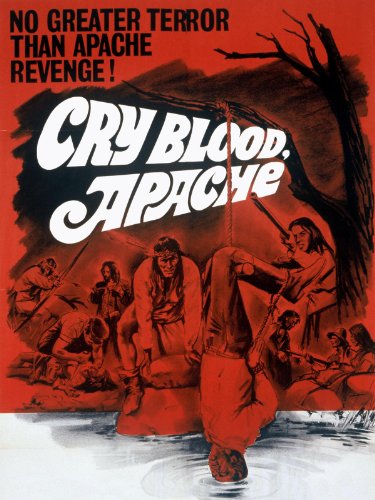




 The Mafia just pissed off the wrong ex-Green Beret.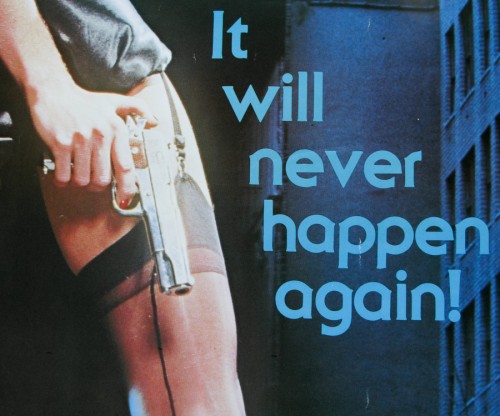


 Through the Shattered Lens