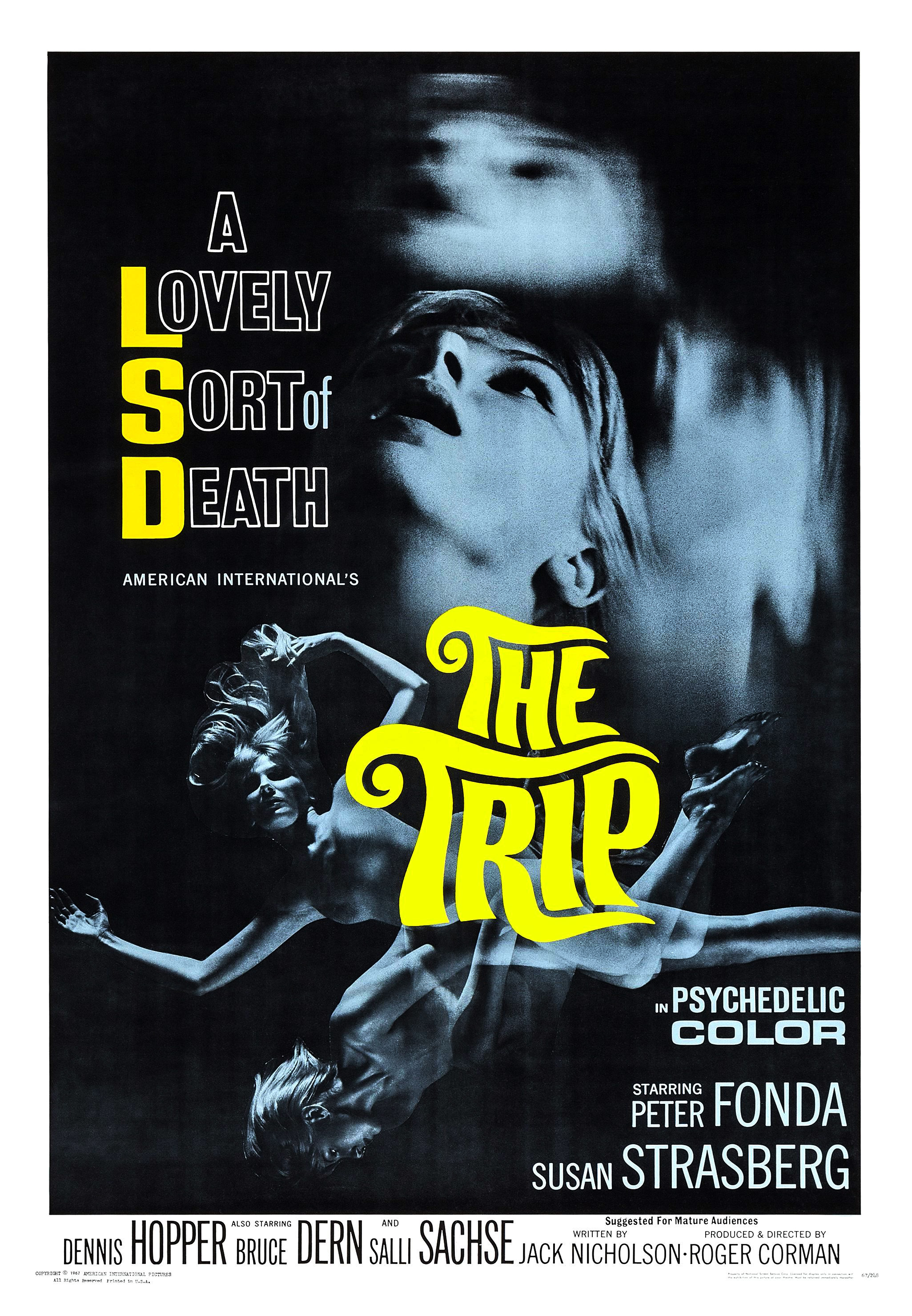
“You are about to be involved in a most unusual motion picture experience. It deals fictionally with the hallucinogenic drug LSD. Today, the extensive use in black market production of this and other so-called ‘mind bending’ chemicals are of great concern to medical and civil authorities…. This picture represents a shocking commentary on a prevalent trend of our time and one that must be of great concern to us all.” – Disclaimer at the beginning of 1967’s THE TRIP
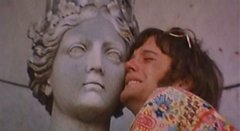
“Tune in, turn on, drop out”, exhorted 60’s acid guru Timothy Leary. The hippie generation’s fascination with having a psychedelic experience was a craze ripe for exploitation picking, and leave it to Roger Corman to create the first drug movie, THE TRIP. Released during the peak of the Summer of Love, THE TRIP was a box office success. Most critics of the era had no clue what to make of it, but the youth…
(It’s tradition here at the Lens that, every October, we watch the original Little Shop of Horrors. And always, I start things off by telling this story…)
Enter singing.
Little Shop…Little Shop of Horrors…Little Shop…Little Shop of Terrors…
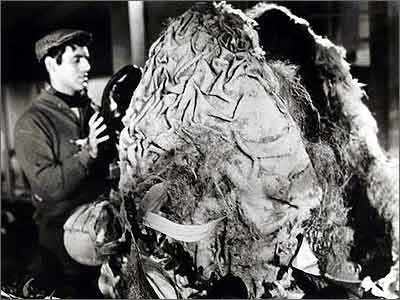
Hi! Good morning and Happy October the 25th! For today’s plunge into the world of public domain horror films, I’d like to present you with a true classic. From 1960, it’s the originalLittle Shop of Horrors!
When I was 19 years old, I was in a community theater production of the musical Little Shop of Horrors. Though I think I would have made the perfect Audrey, everybody always snickered whenever I sang so I ended up as a part of “the ensemble.” Being in the ensemble basically meant that I spent a lot of time dancing and showing off lots of cleavage. And you know what? The girl who did play Audrey was screechy, off-key, and annoying and after every show, all the old people in the audience always came back stage and ignored her and went straight over to me. So there.
Anyway, during rehearsals, our director thought it would be so funny if we all watched the original film. Now, I’m sorry to say, much like just about everyone else in the cast, this was my first exposure to the original and I even had to be told that the masochistic dentist patient was being played by Jack Nicholson. However, I’m also very proud to say that — out of that entire cast — I’m the only one who understood that the zero-budget film I was watching was actually better than the big spectacle we were attempting to perform on stage. Certainly, I understood the film better than that screechy little thing that was playing Audrey.
The first Little Shop of Horrors certainly isn’t scary and there’s nobody singing about somewhere that’s green (I always tear up when I hear that song, by the way). However, it is a very, very funny film with the just the right amount of a dark streak to make it perfect Halloween viewing.
So, if you have 72 minutes to kill, check out the original and the best Little Shop of Horrors…
(As some of you may have noticed, I shared this movie last year as well. However, since the video that I embedded in the previous post was subsequently taken down, I figured I might as well post it again this year. Plus, it’s Boris Karloff, Jack Nicholson, and Dick Miller! Why not post it twice?)
Have you ever woken up and thought to yourself, “I’d love to see a movie where a youngish Jack Nicholson played a French soldier who, while searching for a mysterious woman, comes across a castle that’s inhabited by both Dick Miller and Boris Karloff?”
Of course you have! Who hasn’t?
Well, fortunately, it’s YouTube to the rescue. In Roger Corman’s 1963 film The Terror, Jack Nicholson is the least believable 19th century French soldier ever. However, it’s still interesting to watch him before he became a cinematic icon. (Judging from his performance here and in Cry Baby Killer, Jack was not a natural-born actor.) Boris Karloff is, as usual, great and familiar Corman actor Dick Miller gets a much larger role than usual. Pay attention to the actress playing the mysterious woman. That’s Sandra Knight who, at the time of filming, was married to Jack Nicholson.
Reportedly, The Terror was one of those films that Corman made because he still had the sets from his much more acclaimed film version of The Raven. The script was never finished, the story was made up as filming moved alone, and no less than five directors shot different parts of this 81 minute movie. Among the directors: Roger Corman, Jack Hill, Monte Hellman, Francis Ford Coppola, and even Jack Nicholson himself! Perhaps not surprisingly, the final film is a total mess but it does have some historical value.
(In typical Corman fashion, scenes from The Terror were later used in the 1968 film, Targets.)
2016 is an election year and things are looking pretty grim right now. It’s enough to make you throw your hands up in frustrating and demand that someone push the reset button. However, things could always be worse. From the world of film, here are 8 President so incompetent, corrupt, and sometimes murderous that they will make you long for the dull mediocrity of a Jeb Bush or a Martin O’Malley.
1) The President (William Devane) in The Dark Knight Rises (2012)
You’re the leader of the free world and a masked terrorist has just launched a deadly attack on a major U.S. city. He has blown up a major sporting event on national television. He has killed the mayor. He is allowing a crazy sociopath to preside over show trials. The terrorist demands that you neither send troops into the city nor do you aid anyone who is trying to leave. What do you? If you are the President played by William Devane in The Dark Knight Rises, you say, “Okay,” and then breathe a sigh of relief when Batman turns out not to be dead after all. William Devane also played JFK in The Missiles of October and President James Heller on 24. Neither of them would have backed down to Bane as quickly as the President in The Dark Knight Rises.
2) The President (Billy Bob Thornton) in Love Actually (2003)
This President thinks that he can bully the world until he makes the mistake of getting on the bad side of the new British Prime Minister (Hugh Grant). How are you going to call yourself the leader of the free world when even Hugh Grant can make you look like a fool?
3) The President (Donald Pleasence) in Escape From New York (1981)
Hey, Mr. President, when Snake Plisskin nearly gets killed trying to save your life, you might want to try showing a little gratitude. Escape From New York ends with Snake asking The President who he feels about all the people who died rescuing him from New York. When the President can only mutter a few words of regret, Snake responds by destroying the tape that would have presumably prevented World War IV. Way to go, Mr. President! Would it have killed you to shed a few crocodile tears, at least over the fate of Cabbie?
4) The President (Cliff Robertson) inEscape From L.A. (1996)
The President from Escape From New York was practically Lincolnesque compared to the jerk who succeeded him. A theocrat who claimed to have an open line to God, this President banned smoking, drinking, cursing, red meat, guns, atheism, pre-marital sex, and everything else that made life fun. Anyone who disagreed got exiled to the island of California. Good thing that Snake Plisskin was still around to set things straight, even if it did mean that Florida ended up getting conquered by Cuba. Why doesn’t Snake ever run for President?
5) President Thomas J. Whitmore (Bill Pullman) in Independence Day (1996)
In a word, overrated. Yes, President Whitmore did lead the army that repealed the alien invaders but he would not have had to do that in the first place if he had prevented the Earth from being invaded in the first place. How many warning signs did the Whitmore administration ignore until it was too late? And how much funding did his administration cut from the military that the Air Force was left in such poor shape that they could get shown up by Randy Quaid in a crop duster? As for Whitmore’s famous speech and the battle that followed, a sequel to Independence Day is coming in June so he must not have done that good of a job of scaring the aliens off.
6) President James Dale (Jack Nicholson) in Mars Attacks! (1996)
At least President Whitmore got a chance to redeem himself by leading the battle against the invaders. James Dale did not even get that far. After foolishly believing everyone who told him that the aliens came in peace, he made the mistake of offering his hand in friendship and ended up with a flag sticking out of his chest.
7) President Alan Richmond (Gene Hackman) in Absolute Power (1997)
Not only did President Richmond think that he could get away with murder, he also thought he could outsmart Clint Eastwood. Big mistake. Clint Eastwood is no Hugh Grant.
8) President Merkin Muffley (Peter Sellers) in Dr. Strangelove: Or How I Learned To Stop Worrying And Love The Bomb (1964)
Mixing the raw charisma of Adlai Stevenson and the phone skills of Bob Newhart, President Merkin Muffley attempts to stop the end of the world and fails miserably. He even allows the Soviet ambassador to get a picture of the Big Board! But don’t worry. President Muffley may have failed to prevent nuclear war but he will not allow there to be a mineshaft gap!
When this election year get you down, just remember: things could always be worse!
(For those following at home, Lisa is attempting to clean out her DVR by watching and reviewing 38 films by the end of this Friday. Will she make it? Keep following the site to find out!)
I’ll give you three chances to guess what the 1987 film Broadcast News is about.
Broadcast News takes place at the Washington bureau of a major network news operation. (You can tell this film was made in the 80s in that nobody’s working for a blog and there’s no mention of Fox, MSNBC, or CNN.) This is where a group of hard-working men and women do their best to make the national news anchor, Bill Rorish, look good.
Bill Rorish is played by Jack Nicholson and, even though he only has about five minutes of screen time (out of a 133 minute movie), he pretty much dominates the entire film. Some of that is because he’s Jack Nicholson and he kicks ass. All Jack has to do to dominate a scene is show up and arch an eyebrow. But, beyond that, everyone in the movie is obsessed with impressing Bill Rorish. Whenever a reporter and his producer get a story on the air, they obsessively watch to see if Bill smiles afterward. Bill Rorish is the God they all hope to please and the film (as well as Nicholson’s performance) suggests that he barely even knows that they’re alive. It’s telling that the only time Bill shows up in person (as opposed to appearing on a TV screen), it’s because a huge number of people at the Washington bureau are being laid off.
When Bill says that it’s a shame that budget cuts are leading to so many good newspeople being laid off, someone suggests that maybe Bill could help by taking a cut in his million-dollar salary. Needless to say, Bill Rorish is not amused.
Broadcast News centers on three of the characters who work at the Washington Bureau. First off, there’s Jane Craig (Holly Hunter), a producer. Jane is a true believer in the mission and the importance of journalism. Her ethics and her belief in what constitutes proper journalism are everything to her and, at times, she can get more than a little self-righteous about it. (If Broadcast News were made today, Jane would spend the entire movie whining about how new media is destroying the country.) At the same time, Jane is completely neurotic, a self-described “basket case” who, at one point, ends up sobbing in a hotel room as she prepares to go to sleep by herself.
Jane’s best friend is Aaron Altman (Albert Brooks), a reporter who wants to someday be an anchor. Aaron is smart and funny (and he better be, seeing as how he’s being played by Albert Brooks) but he’s not telegenic and he’s almost as neurotic as Jane. Like Jane, Aaron is all about journalistic ethics but there’s a defensiveness to Aaron. Whenever Aaron complains about vapid news anchors, it’s obvious that he’s more jealous than outraged.
And then there’s Tom Grunick (William Hurt), who represents everything that Jane and Aaron claim to be against. He’s handsome, he’s smooth, he’s charismatic, and he’s definitely not an intellectual. He knows little about the specifics of current events. However, he has great instincts. He knows how to sell a story and he knows how to present himself on camera. He’s also a surprisingly nice and sincere guy, which makes it all the more difficult for Aaron to justify his belief that “Tom is the devil.”
From the minute that Tom arrives at the Washington bureau, there’s a strong attraction between Tom and Jane. (Jane even sends another reporter to Alaska after she finds out that Tom slept with her.) Tom wants to be a better reporter. Jane wants to be happy but fears compromising her ethics. And Aaron … well, Aaron wants Jane.
Not surprisingly, considering that the film was made 29 years ago, there were some parts of Broadcast News that felt extremely dated. A scene where Aaron complains about a story that Tom did on date rape feels especially uncomfortable when viewed today and both Jane and Aaron occasionally came across as being a bit too self-righteous. In today’s media world, Tom’s sins really didn’t seem like that big of a deal.
But, for the most part, I enjoyed Broadcast News. It was an intelligent film, one the featured people having actual conversations about actual ideas and, listening to them, I realized how rare, in both movies and real life, that actually is. It’s a witty film, full of good performances. While I hope I never become as self-righteous as Jane, I could still relate to her in her more neurotic moments. And who wouldn’t want a best friend like Aaron?
And, for that matter, who wouldn’t want a lover like Tom?
(That’s something I never expected to write about a character played by William Hurt.)
And, of course, there’s this scene. Poor Aaron!
Broadcast News was nominated for best picture of 1987. However, it lost to The Last Emperor.
Little Shop…Little Shop of Horrors…Little Shop…Little Shop of Terrors…
Hi! Good morning and Happy October the 25th! For today’s plunge into the world of public domain horror films, I’d like to present you with a true classic. From 1960, it’s the originalLittle Shop of Horrors!
When I was 19 years old, I was in a community theater production of the musical Little Shop of Horrors. Though I think I would have made the perfect Audrey, everybody always snickered whenever I sang so I ended up as a part of “the ensemble.” Being in the ensemble basically meant that I spent a lot of time dancing and showing off lots of cleavage. And you know what? The girl who did play Audrey was screechy, off-key, and annoying and after every show, all the old people in the audience always came back stage and ignored her and went straight over to me. So there.
Anyway, during rehearsals, our director thought it would be so funny if we all watched the original film. Now, I’m sorry to say, much like just about everyone else in the cast, this was my first exposure to the original and I even had to be told that the masochistic dentist patient was being played by Jack Nicholson. However, I’m also very proud to say that — out of that entire cast — I’m the only one who understood that the zero-budget film I was watching was actually better than the big spectacle we were attempting to perform on stage. Certainly, I understood the film better than that screechy little thing that was playing Audrey.
The first Little Shop of Horrors certainly isn’t scary and there’s nobody singing about somewhere that’s green (I always tear up when I hear that song, by the way). However, it is a very, very funny film with the just the right amount of a dark streak to make it perfect Halloween viewing.
So, if you have 72 minutes to kill, check out the original and the best Little Shop of Horrors…
Have you ever woken up and thought to yourself, “I’d love to see a movie where a youngish Jack Nicholson played a French soldier who, while searching for a mysterious woman, comes across a castle that’s inhabited by both Dick Miller and Boris Karloff?”
Of course you have! Who hasn’t?
Well, fortunately, it’s YouTube to the rescue. In Roger Corman’s 1963 film The Terror, Jack Nicholson is the least believable 19th century French soldier ever. However, it’s still interesting to watch him before he became a cinematic icon. (Judging from his performance here and in Cry Baby Killer, Jack was not a natural-born actor.) Boris Karloff is, as usual, great and familiar Corman actor Dick Miller gets a much larger role than usual. Pay attention to the actress playing the mysterious woman. That’s Sandra Knight who, at the time of filming, was married to Jack Nicholson.
Reportedly, The Terror was one of those films that Corman made because he still had the sets from his much more acclaimed film version of The Raven. The script was never finished, the story was made up as filming moved alone, and no less than five directors shot different parts of this 81 minute movie. Among the directors: Roger Corman, Jack Hill, Monte Hellman, Francis Ford Coppola, and even Jack Nicholson himself! Perhaps not surprisingly, the final film is a total mess but it does have some historical value.
(In typical Corman fashion, scenes from The Terror were later used in the 1968 film, Targets.)
I record a LOT of movies. Probably around ten per week, more or less. And since I also have to do little things like work, exercise, cook, clean, breathe, etc etc, I don’t always have time to watch them all (never mind write full reviews), so I’ve decided to begin a series of short, capsule reviews for the decades covered here at Cracked Rear Viewer. This will be whenever I find my DVR getting cluttered, which is frequent! I’ll try to make CLEANING OUT THE DVR a bi-weekly series, but there are no guarantees. Monthly is more realistic. Anyway, here are five films from the 1930s to the 1970s for your reading pleasure.
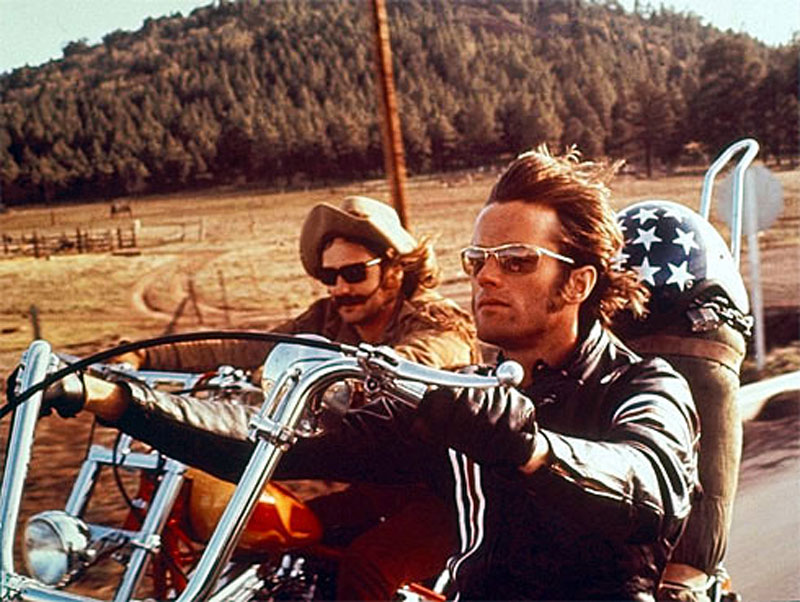
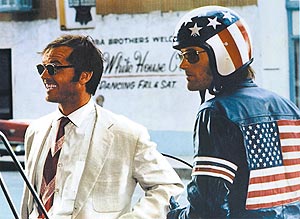
1969 was a watershed year for both America and the movies. While the war in Viet Nam dragged on and turmoil raged at home, movie audiences watched as two generations of Fondas appeared in movies about the American dream. In Sergio Leone’s Once Upon A Time In The West, Henry Fonda played Frank, a gunslinger so ruthless that he shoots a child during his first scene. In They Shoot Horses, Don’t They?, daughter Jane Fonda played a woman struggling to survive the Great Depression. And, in Easy Rider, Peter Fonda played Captain America.
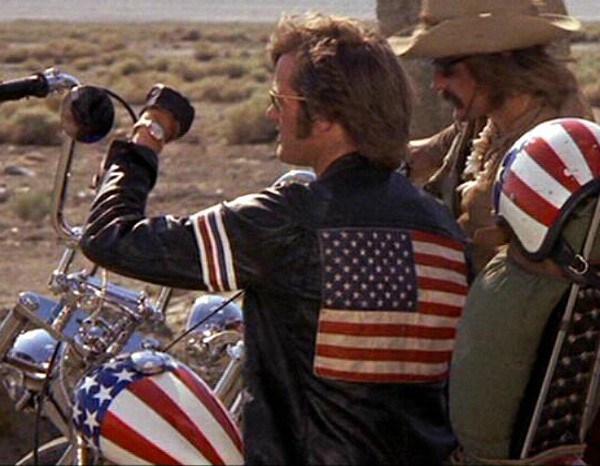
The Captain America of Easy Rider should not be mistaken for the super soldier played by Chris Evans. Instead, this Captain America is actually Wyatt Williams, a motorcycle rider who is planning on going to Mardi Gras with his friend Billy (Dennis Hopper, who also directed). Wyatt is nicknamed Captain America because he wears a leather jacket with an American flag on the back. It is an appropriate nickname because Wyatt represents everything that is good about America.
When we first meet Captain America, he and Billy are engaged in a business transaction, bringing to mind the old saying that the business of America is business. They are selling cocaine to none other than Phil Spector. Taking Spector’s money, Wyatt stuffs it into a plastic tube that he keeps hidden in his motorcycle’s fuel tank. It is no coincidence that the fuel tank is decorated with the stars and bars.
Having made their money, Wyatt and Billy ride across the country to celebrate. At the start of their journey, Wyatt takes off his watch and leaves it on the ground, declaring that time has no meaning to a man who has freedom. If you replaced their motorcycles with horses, there would be little to distinguish Wyatt and Billy from the American outlaws who might show up in an old Henry Fonda western.
On their way to New Orleans, Wyatt and Billy interact with many different people. If the always paranoid and nervous Billy represents America’s worst impulses, Wyatt represents the best. When Wyatt and Billy eat dinner with a rancher and his family, Wyatt alone appreciates what the rancher has accomplished and says, “You’ve got a nice place. It’s not every man that can live off the land, you know. You do your own thing in your own time. You should be proud.” When they later stop off at a ramshackle hippie commune, Wyatt is the one who says, in the best tradition of American optimism, that “They’ll make it.”
When they stop to pick up a hitchhiker and then later when alcoholic lawyer George Hanson (Jack Nicholson) joins them on their trip, it’s always Wyatt who volunteers to share his bike. (Billy always rides alone.) Whenever they stop for the night, it is always the generous Wyatt who offers to share his grass with whomever is traveling with them. When George smokes for the first time, Wyatt is the one who teaches him. It is the stoned George who tells Wyatt and Billy that they represent freedom.
It is only after George is beaten to death by a group of rednecks that Wyatt loses his optimistic outlook and his generous spirit. George’s death opens Wyatt’s eyes in much the same way that the turmoil of the 1960s did for the rest of America. After George’s murder, Wyatt loses his faith in himself. When he and Billy reach New Orleans, Mardi Gras is a letdown. When he takes the acid that was given to him by the hitchhiker, Captain America’s journey becomes a bad trip both figuratively and literally.
While Billy insists that they had a great time in New Orleans (in much the same way that some insist that America is just as strong a nation as it has ever been), Wyatt knows the truth. “We blew it,” Wyatt says, speaking for the entire nation.
Despite his mistakes and despite having blown it, Wyatt, much like America itself, remains good at heart. When Captain America dies at the end of the film, it is because he is trying to protect his friend Billy. In the best American tradition, he sacrifices himself to protect another.
This Independence Day, let us all take a few moment to appreciate Wyatt Williams, the man known as Captain America.
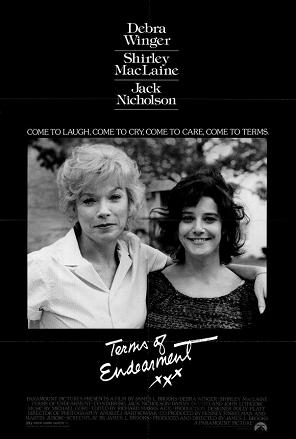
I have to admit that, when I first sat down and watched the 1983 best picture winner Terms of Endearment, I was actually taken by surprise. Before I actually saw it, I was under the impression that Terms of Endearment was considered to be one of the weaker films to win best picture. I had read a few reviews online that were rather dismissive of Terms, describing it as being well-made but overrated.
But then, a few weeks ago, I watched Terms of Endearment on Netflix. The film started with a scene of new mother Aurora Greenwood (Shirley MacClaine) obsessively checking on her daughter, Emma. Stepping into the bedroom, Aurora is, at first, scared that Emma’s dead. Without bothering to take off her high heels, Aurora nearly climbs into the crib to check on her. Fortunately, Emma starts to cry.
And I laughed because I’ve been told about how my mom used to obsessively check in on me when I was a baby. And, while my mom was never the type to wear high heels around the house, I could still imagine her climbing into a crib to check on me and my sisters.
And then, when Emma (now played by Debra Winger) married Flap Horton (a very young Jeff Daniels) over the objections of her mother, I smiled but I didn’t laugh because, in this case, I was relating to Emma. Because the fact of the matter is that every girl has known a boy like Flap Horton, the smart and funny guy who is destined to ultimately hurt her.
And when Flap got a job in Des Moines and Emma moved from Houston to Iowa, I knew — as did Aurora — what was going to happen. I knew that Flap would deal with his insecurity over not being a good provider for his wife and children by cheating on his wife. And when he did, I wanted to cry with Emma.
But then I wanted to cheer when Emma has an affair of her own. In the role of Sam, John Lithgow doesn’t have much screen time in Terms of Endearment but he does get the best line. When a rude cashier claims that she doesn’t feel that she was being rude to Emma, Sam replies, “Then you must be from New York.”
Meanwhile, the widowed Aurora is having an affair of her own. Jack Nicholson plays Garrett Breedlove, a former astronaut who now has both a drinking problem and a house with a pool. Garrett gets Aurora to loosen up. Aurora makes Garrett realize that he actually is capable of being a decent guy. MacClaine and Nicholson both won Oscars for their performances here and they deserved them.
And then, Emma was diagnosed with cancer. And I cried and cried because, at this point, I had come to think of Emma and Aurora as being real people. And when Emma told her friends that she was dying and she spent her final days with her children, I sobbed because it made me think about my mom. And now I’m sobbing as I write this review.
But it’s a great film, even if it did make me cry. Because, in the end, you’re glad that you got to know these characters. And, even through the tears, the film leaves you happy that you got to spend some time with them.
And isn’t that what a great film is supposed to do?


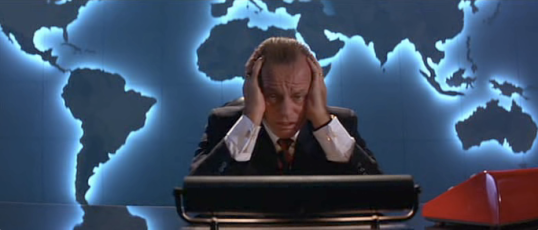
 You’re the leader of the free world and a masked terrorist has just launched a deadly attack on a major U.S. city. He has blown up a major sporting event on national television. He has killed the mayor. He is allowing a crazy sociopath to preside over show trials. The terrorist demands that you neither send troops into the city nor do you aid anyone who is trying to leave. What do you? If you are the President played by William Devane in The Dark Knight Rises, you say, “Okay,” and then breathe a sigh of relief when Batman turns out not to be dead after all. William Devane also played JFK in The Missiles of October and President James Heller on 24. Neither of them would have backed down to Bane as quickly as the President in The Dark Knight Rises.
 Hey, Mr. President, when Snake Plisskin nearly gets killed trying to save your life, you might want to try showing a little gratitude. Escape From New York ends with Snake asking The President who he feels about all the people who died rescuing him from New York. When the President can only mutter a few words of regret, Snake responds by destroying the tape that would have presumably prevented World War IV. Way to go, Mr. President! Would it have killed you to shed a few crocodile tears, at least over the fate of Cabbie?
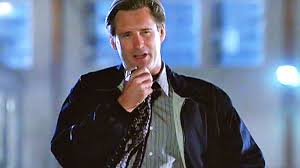 In a word, overrated. Yes, President Whitmore did lead the army that repealed the alien invaders but he would not have had to do that in the first place if he had prevented the Earth from being invaded in the first place. How many warning signs did the Whitmore administration ignore until it was too late? And how much funding did his administration cut from the military that the Air Force was left in such poor shape that they could get shown up by Randy Quaid in a crop duster? As for Whitmore’s famous speech and the battle that followed, a sequel to Independence Day is coming in June so he must not have done that good of a job of scaring the aliens off.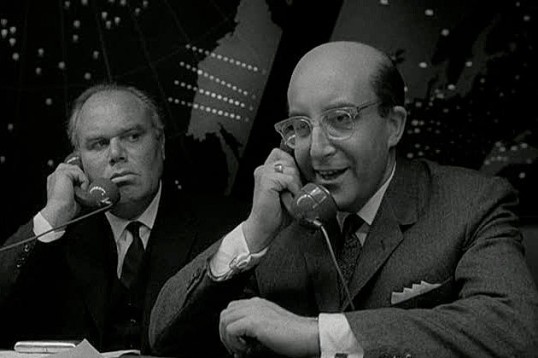


 Through the Shattered Lens