Horror Film Review: Dead & Buried (by Gary Sherman)


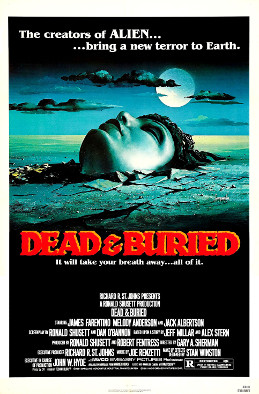
The 1981 horror film, Dead & Buried, takes place in the small town of Potters Bluff.  It seems like it should be a nice place to live.  The people are friendly.  The scenery is lovely.  The town is right on the coast of the ocean so the view is great.  It’s a bit of an artist’s colony, the type of place where you would expect to find Elizabeth Taylor painting the sunset while Richard Burton battles a hangover in the beach house.  It’s the type of small town that used to by very popular on television.  It’s just one Gilmore girl away from being an old CW show.

It’s such a nice town.  So, why are so many people dying?

That’s the mystery that Sheriff Dan Gillis (James Farentino) has to solve.  Actually, it’s one of the many mysteries that Dan has to solve.  There’s also the mystery of why his wife, Janet (Melody Anderson), has been acting so strangely.  And then there’s the mystery of what happened to the person who, one night, Dan ran into with his car.  The person ran away but he left behind his arm.  When Dan gets some skin from the arm analyzed, he’s told that the arm belongs to someone who has been dead for at least four months!

Who can explain all of this?  How about William G. Dobbs (Jack Albertson), the folksy coroner who seems to enjoy his work just a little bit too much.  In fact, Dr. Dobbs seems to be a bit more than just a tad eccentric.  One would necessarily expect a coroner to have a somewhat macabre view of life but Dr. Dobbs seems to take things to extreme.  Is it possible that Dr. Dobbs knows more than he’s letting on?

Dead & Buried has a reputation for being something of a sleeper, a deliberately-paced and often darky humorous horror film that had the misfortune to be released at a time when most horror audiences were more interested in watching a masked man with a machete kill half-naked teenagers.  Because the studio wasn’t sure how exactly to market Dead & Buried, it failed at the box office and it was only years later, after it was released on home video, that people watched the film and realized that it was actually pretty good.  And make no mistake about it, Dead & Buried is a fairly clever horror film, one that is full of effective moments and which does a good job of creating a creepy atmosphere.  If I’m not quite as enthused about this film as others, that’s because I do think that it’s occasionally a bit too slow and the film’s twist ending, while well-executed, didn’t particularly take me by surprise.  This is one of those films that you enjoy despite the fact that you can see the surprise conclusion coming from a mile away.

In the end, Dead & Buried fills like a particularly twisted, extra-long episode of one of those old horror anthology shows, like Night Gallery, Twilight Zone, or maybe even Ghost Story.  It’s a nicely done slice of small town horror, featuring a study lead performance from James Farentino and an enjoyably weird one from Jack Albertson.  Though the film is not heavy on gore, Stan Winston’s special effects are appropriate macabre.  Even if it’s not quite up there with Gary Sherman’s other films (like Vice Squad and Death Line, to name two), Dead & Buried is an entertainingly eccentric offering for Halloween.
Recipe for Disaster: THE POSEIDON ADVENTURE (20th Century-Fox 1972)


gary loggins's avatarcracked rear viewer

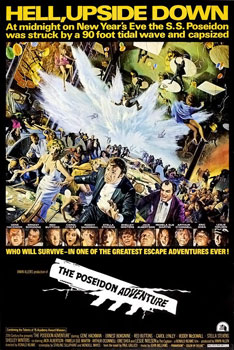
Although 1970’s AIRPORT is generally credited as the first “disaster movie”, it was 1972’s THE POSEIDON ADVENTURE that made the biggest splash for the genre. Producer Irwin Allen loaded up his cast with five- count ’em!- Academy Award winners, including the previous year’s winner Gene Hackman (THE FRENCH CONNECTION ). The special effects laden extravaganza wound up nominated for 9 Oscars, winning 2, and was the second highest grossing film of the year, behind only THE GODFATHER!

And unlike many of the “disasters” that followed in its wake, THE POSEIDON ADVENTURE holds up surprisingly well. The story serves as an instruction manual for all disaster movies to come. First, introduce your premise: The S.S. Poseidon is sailing on its final voyage, and Captain Leslie Nielsen is ordered by the new ownership to go full steam ahead, despite the ship no longer being in ship-shape. (You won’t be able to take…

View original post 539 more words

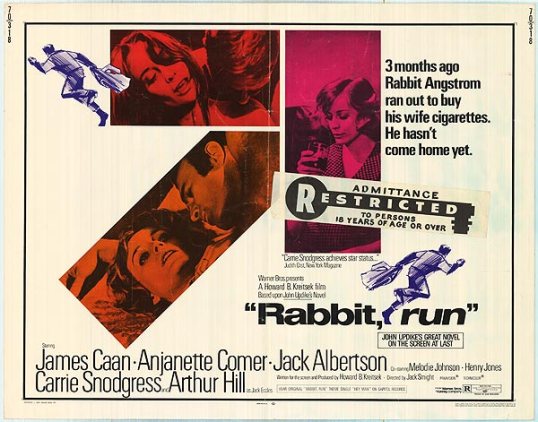
Insomnia File #26: Rabbit Run (dir by Jack Smight)


What’s an Insomnia File? You know how some times you just can’t get any sleep and, at about three in the morning, you’ll find yourself watching whatever you can find on cable? This feature is all about those insomnia-inspired discoveries!

If, at one in the morning on Wednesday, you were suffering from insomnia, you could have turned over to TCM and watched the 1970 film, Rabbit Run.  That’s what I did.

Rabbit Run is the epitome of a dumb lug film.  In a dumb lug film, a male character finds himself living an unfulfilling life but he can’t figure out the reason.  Why can’t he figure it out?  Because he’s a dumb lug, with the emphasis on dumb.  Usually, the viewer is supposed to sympathize with the dumb lug because he doesn’t mean to hurt anyone and everyone else in his world is somehow even more annoying than he is.  Typically, the dumb lug will have an emotionally distant wife who refuses to have sex with him and who is usually portrayed as being somehow at fault for everything bad that has happened in the dumb lug’s face.  (Want to see a more recent dumb lug film than Rabbit Run?  American Beauty.)  Ever since the silent era, there have been dumb lug films.  In particular, male filmmakers and critics seem to love dumb lug films because they allow them to pat themselves on the back for admitting to being dumb while, at the same time, assuring them that everything is the fault of the wife or the girlfriend or the mother or the mother-in-law.

In Rabbit Run, the dumb lug is named Harry Angstrom (James Caan), though most people still remember him as Rabbit, the high school basketball star.  Harry’s life peaked in high school.  Now, he’s 28 and he can’t hold down a job.  He’s married to Janice (Carrie Snodgress), who spends all of her time drinking and watching TV.  He has a son and another baby is on the way.  One day, when the pregnant Janice asks him to go out and get her a pack of cigarettes, Harry responds by getting in his car and driving all the way from Pennsylvania to Virginia.

When he returns to Pennsylvania, Rabbit doesn’t go back to his wife.  Instead, he drops in on his former basketball coach (Jack Albertson) and begs for advice on what he should do.  The coach, it turns out, is more than little creepy.  He also has absolutely no practical advise to give.  He does introduce Rabbit to a part-time prostitute named Ruth (Anjanette Comer).  Rabbit quickly decides that he’s in love with Ruth and soon, he’s moved in with her.

Meanwhile, there’s all sorts of little things going on.  Rabbit gets a job working as a gardener.  Rabbit befriends the local Episcopal minister (Arthur Hill), even while the minister’s cynical wife (Melodie Johnson) tries to tempt Rabbit away from both his wife and his mistress.  Rabbit both resents and envies the sexual freedom of the counter culture, as represented by his younger sister.  And, of course, Janice is pregnant…

Rabbit Run is based on a highly acclaimed novel by John Updike.  I haven’t read the novel so I can’t compare it to the film, beyond pointing out that many great works of literature have been turned into mediocre movies, largely because the director never found a way to visually translate whatever it was that made the book so memorable in the first place.  Rabbit Run was directed by Jack Smight, who takes a rather frantic approach to the material.  Since Rabbit Run is primarily a character study, it needed a director who would be willing to get out of the way and let the actors dominate the film.  Instead, Smight overdirects, as if he was desperately trying to prove that he could keep up with all the other trendy filmmakers.  The whole movie is full of extreme close-ups, abrupt jump cuts, intrusive music, and delusions of ennui.  You find yourself wishing that someone had been willing to grab Smight and shout, “Calm down!”

(On the plus side, as far as the films of 1970 are concerned, Smight’s direction of Rabbit Run still isn’t as bad as Richard Rush’s direction of Gettting Straight.)

James Caan actually gives a likable performance as Rabbit, which is good because Rabbit would be totally unbearable if not played by an actor with at least a little genuine charisma.  There’s nothing subtle about Caan’s performance but he makes it work.  You never like Rabbit but, at the same time, you don’t hate him.

Unfortunately, there’s nothing subtle about the rest of the cast either.  Something rather tragic happens about 80 minutes into the film and, as much as I knew I shouldn’t, I still found myself giggling because Carrie Snodgress’s performance was so bad that it was impossible for me to take any of it seriously.  Even worse is Arthur Hill, as the minister who won’t stop trying to help Rabbit out.  I eventually reached the point where, every time that sanctimonious character started to open his mouth, I found myself hoping someone would hit him over the head and knock him out.  Among the major supporting players, only Anjanette Comer is allowed a chance to be something more than just a sterotype.  Like Caan, she does the best that she can but ultimately. this is James Caan’s movie.

It’s a disappointing movie but it did not put me to sleep.  Give credit for that to James Caan, who is the only reason to see Rabbit Run.

Previous Insomnia Files:

  1. Story of Mankind
  2. Stag
  3. Love Is A Gun
  4. Nina Takes A Lover
  5. Black Ice
  6. Frogs For Snakes
  7. Fair Game
  8. From The Hip
  9. Born Killers
  10. Eye For An Eye
  11. Summer Catch
  12. Beyond the Law
  13. Spring Broke
  14. Promise
  15. George Wallace
  16. Kill The Messenger
  17. The Suburbans
  18. Only The Strong
  19. Great Expectations
  20. Casual Sex?
  21. Truth
  22. Insomina
  23. Death Do Us Part
  24. A Star is Born
  25. The Winning Season


Embracing the Melodrama Part II #44: The Poseidon Adventure (dir by Ronald Neame)


PoseidonAdventure

A few years ago, when I first told Arleigh that I had recently watched the 1972 film The Poseidon Adventure, I remember him as being a bit shocked and amazed that I had made it through the entire film.  This was because Arleigh knows that I have a morbid obsession with drowning and that the mere sight of someone struggling underwater is enough to send me into a panic attack.

And The Poseidon Adventure is a film that is totally about drowning.  The majority of the cast drowns over the course of the film.  The few who survive spend all of their time trying not to drown.  The main villain in The Poseidon Adventure is the ocean.  The Poseidon Adventure is a film specifically designed to terrify aquaphobes like me.

And there are certain parts of The Poseidon Adventure that freaked me out when I first watched it and which continue to freak me out whenever I rewatch it.

For instance, just the film’s plot freaks me out.  On New Year’s Day, an ocean liner is capsized by a huge tidal wave.  With the boat upside down, a small group of survivors struggle to make their way up to the hull where, hopefully, they might be rescued.  That involves a lot of fighting, arguing, climbing, and drowning.

It freaks me out whenever I see the huge tidal wave crash into the bridge and drown Captain Leslie Nielsen.  That’s largely because it’s impossible for me to look at Leslie Nielsen without smiling.  (I’ve already written about my reaction to seeing him in the original Prom Night.)  When he suddenly drowns, it’s not funny at all.

It freaks me out when the boat turns over and hundred of extras are tossed around the ballroom.  I always feel especially bad for the people who vainly try to hold onto the upside down tables before eventually plunging to their deaths.  (Did I mention that I’m scared of heights as well?)

It freaks me out when Roddy McDowall plunges to his death because who wants to see Roddy McDowall die?  Whenever I see him in an old movie, he always come across as being such a super nice guy.  (Except in Cleopatra, of course…)  Plus, Roddy had an absolutely chilling death scream.  They need to replace the Wilhelm Scream with the Roddy Scream.

It freaks me out when survivor Shelley Winters has a heart attack right after swimming from one part of the ship to another.  Because seriously, Shelley totally deserved the Oscar nomination that she got for this film.

And it really freaks me out when Stella Stevens plunges to her death because I related to Stella’s character.  Stella was tough, she didn’t take any crap from anyone, and she still didn’t make it.  If Stella Stevens can’t make it, what hope would there be for me?

And yet, at the same time, The Poseidon Adventure is such an entertaining film that I’m willing to be freaked out.  The Poseidon Adventure was one of the first of the classic disaster films and it’s so well done that even the parts of the film that don’t work somehow do work.

For instance, Gene Hackman plays the Rev. Frank Scott, the leader of the group of survivors.  And Hackman, who can legitimately be called one of the best actors ever, gives an absolutely terrible performance.  His performance is amazingly shrill and totally lacking in nuance.  When, toward the end of the film, he starts to angrily yell at God, you actually feel sorry for God.  And yet, Hackman’s terrible performance somehow works perfectly for the film.  It’s such an over-the-top performance that it sets the tone for the whole film.  The Poseidon Adventure is an over-the-top film and, if Hackman had invested his character with any sort of nuance, the film would not have worked as well as it did.

And then there’s Ernest Borgnine, who plays Stella Stevens’s husband.  Borgnine spends the entire film arguing with Gene Hackman.  Whenever something bad happens, Borgnine starts acting like Edward G. Robinson in The Ten Commandments.  He never actually says, “Where is your God now!?” but it wouldn’t have been inappropriate if he had.  And yet, again, it’s exactly the type of performance that a film like this needs.

And finally, there’s that theme song.  “There has to be a morning after…”  It won an Oscar, defeating Strange Are The Ways Of Love from The Stepmother.  And is it a good song?  No, not really.  It’s incredibly vapid and, while it does get stuck in your head, you don’t necessarily want it there.  But you know what?  It’s the perfect song for this film.

The Poseidon Adventure is not a deep film, regardless of how many times Hackman and Borgnine argue about the role of God in the disaster.  It’s an amazingly shallow film about people drowning.  But it’s so well-made and so perfectly manipulative that you can’t help but be entertained.

The Poseidon Adventure totally freaks me out.  But I will probably always be willing to find time to watch it.