Italian Horror Showcase: City of the Living Dead (dir by Lucio Fulci)


In New York City, a group of people sit around a table, holding a seance.  One of them, a woman named Mary (Catriona MacColl) has a vision.  She sees a sickly, hollow-cheeked priest walking through a cemetery.  She watches as he hangs himself and, as the priest dangles from a tree branch, Mary lets out a piercing scream and collapses to the floor.  The police are called and they promptly declare that Mary has died.  Later, while a hard-boiled reporter named Peter Bell (Christopher George) watches as two grave-diggers walk away from her half-buried coffin, he hears something coming from the grave.  From insider her coffin, Mary is screaming and struggling to get out!

Peter grabs a pickax and smashes it down into the coffin.  Peter may be trying to free her but what he doesn’t realize is that, with each blow of the pickax, he comes dangerously close to hitting Mary in the face.  Somehow, Peter manages to avoid killing Mary.  Once he gets her out of the coffin, Peter and Mary go and see a medium to try to figure out the meaning behind Mary’s previous vision.

What they don’t discuss is why or, for that matter, how everyone was convinced that Mary was dead for at least a day or two.  Mary doesn’t mention that Peter nearly killed her with the pickax.  In fact, for two people who have just met under the strangest and most disturbing of circumstances, Peter and Mary seem to be getting along famously.  For that matter, they don’t appear to be too surprised when the medium informs them Mary’s vision indicated that the dead will soon be entering the world of the living.

And so begins Lucio Fulci’s wonderfully odd and surreal City of the Living Dead.  Reading the paragraphs above, you might think that I was criticizing City of the Living Dead but nothing could be further from the truth.  From the start, Fulci establishes that City of the Living Dead is going to fully embrace its own unique aesthetic.

The majority of City of the Living Dead takes place in a small town with the name of Dunwich, a name that immediately (and, I believe, intentionally) brings to mind the writing of H.P. Lovecraft.  Dunwich is a town that always seems to be covered in fog.  At the local bar, men talk about the recent suicide of Father Thomas and they discuss what to do about Bob (Giovanni Lombardo Radice), who the majority of them believe to be a a pervert.  Meanwhile, Bob comes across an inflatable sex doll in a deserted warehouse and, for the most part, just tries to stay out of everyone’s way.

(Bob was one of Radice’s first roles and, along with his turn as David Hess’s sidekick in The House On The Edge of the Park, the one that many fans of Italian horror continue to associate him with.  It’s a testament to Radice’s talent that he could make even a creepy character like Bob sympathetic.)

Even without the presence of the living dead, Dunwich doesn’t seem like the ideal place to live.  A greedy morgue attendant attempts to steal a dead woman’s jewelry.  A psychiatrist named Gerry (Carlo de Mejo) struggles to calm the nerves of his patient, Sandra (Janet Agren).  At one point, one man gets so angry with another that he drills a hole in his head.  That’s Dunwich, for you.  Who needs the dead when you’re surrounded by the worst of the living?

Speaking of the dead, that dead priest is still wandering around town.  When he comes across two teenagers making out in a jeep, he rips open the boy’s head while the girl bleeds from her eyes and proceeds to vomit up her intestines.  (Somewhat inevitably, the boy is played by Michele Soavi who, before launching his own acclaimed directing career, always seemed to die in films like this.  Even more inevitably, the girl is played Daniela Doria, who appeared in four Fulci films and suffered a terrible fate in every single one of them.)

By the time that Peter and Mary actually reach the town, the dead are already moving through the fog while storms of maggots crash through windows.  Even the sight of a seemingly innocent child running towards the camera leads to the sound of people screaming off-screen….

Even though it’s actually one of Fulci’s more straight-forward films (i.e., a character says that Dunwich is going to be overrun by zombies and then Dunwich actually is overrun by zombies), it still plays out like a particularly intense dream.  From the fog-shrouded visuals to the often odd dialogue, City of the Living Dead is a film that plays out according to its own unique logic.  The film’s surreal atmosphere may have partially been the result of a rushed production schedule but it also serves to suggest that, as a result of the priest’s suicide, the nature of reality itself has changed.

City of the Living Dead is not a film for everyone.  If I was introducing someone to Fulci for the first time, I would probably have them watch Zombi 2The Black Cat and Lizard In A Woman’s Skin long before I even suggested they take a look at City of the Living Dead.  That City of the Living Dead is a gory film should come as no surprise.  That was one of Fulci’s trademarks, after all.  Instead, what makes City of the Living Dead a difficult viewing experience for some is just how bleak the film truly is.  Even before the living dead arrive, Dunwich is a town the seems to epitomize the worst instincts of humanity.  There’s a darkness at the heart of the City of the Living Dead and it has nothing to do with zombies.

First released in 1980, City of the Living Dead is generally considered to be the first part of Fulci’s Beyond trilogy.  Catriona MacColl, who gives such a good performance here, appeared in the film’s two follow-ups, The Beyond and The House By The Cemetery.  (MacColl played a different character in each film.)  With each film, Fulci’s vision grew more and more surreal until eventually, he seemed fully prepared to reject the idea of narrative coherence all together.

Though initially dismissed by critics, The Beyond trilogy is today celebrated as one of the greatest achievements in the history of Italian horror.  City of the Living Dead is probably the most narratively coherent film in the trilogy, even if its ending raises more questions than it answers.  Personally, I love the ending of City of the Living Dead, even though it was apparently a last-minute decision.  (According to Wikipedia — so take this with a grain of salt — someone spilled coffee on the original work print of the ending, which led to Fulci having to improvise.)  It’s an ending that suggests that not only has the film broken apart but that the world is shattering right along with it.  In the end, the world falls apart not with a bang but with one long scream.


4 Shots From 4 Collegiate Slasher Films: Final Exam, The Dorm That Dripped Blood, Pieces, The House on Sorority Row


4 Shots From 4 Films is just what it says it is, 4 shots from 4 of our favorite films. As opposed to the reviews and recaps that we usually post, 4 Shots From 4 Films lets the visuals do the talking.

Many great horror films have taken place in a college setting.  Then again, so have many, many bad ones.  In honor of all of those films, here are….

4 Shots From 4 Collegiate Slasher Films

Final Exam (1981, dir by Jimmy Huston)

The Dorm That Dripped Blood (1982, dir by Stephen Carpenter and Jeffrey Obrow)

Pieces (1983, dir by J. Piquer Simon)

The House on Sorority Row (1983, dir by Mark Rosman)

Horror Film Review: Happy Death Day (dir by Christopher B. Landon)


So, imagine this.

You’re a college student.  You’re a member of a sorority.  You start your day by waking up in a stranger’s bed, with a hangover.  When you walk across campus, you blow off the girl trying to get you to sign her anti-climate change petition.  When you get back to your sorority house, you’re rude to her roommate and refuse to eat the birthday cupcake that she made for you.  You body shame a girl at lunch.  You’re sleeping with one of your professors.  You’re rude to your father.  You’re going to a party.

Oh!  And did I mention that you’re in a slasher film and that there’s a really creepy figure wearing a baby mask who is following you around?

Seriously, you are so dead.

That’s the situation that Theresa “Tree” Gelbman (Jessica Rothe) finds herself in 2017’s Happy Death Day.  It’s her birthday and, unfortunately, she’s murdered at the end of it.  Of course, if you’ve ever seen in a slasher film, it’s not a shock when Tree dies.  She’s the quintessential self-centered girl who always gets killed in these type of movies.

(For the record, I would probably die within the first ten minutes of any slasher film.)

However, in Tree’s case, she gets another chance.  And then another one after that.  And then, another one after that… every night, Tree dies.  Every morning, Tree wakes up in the dorm room of Carter Davis (Israel Broussard) and she has to relive the last day of her life all over again.

To the film’s credit, it doesn’t take long for Tree to realize that she’s in a time loop.  (Also, to the film’s credit, Carter specifically points out that Tree’s story sounds exactly like the plot of Groundhog Day.  “What’s that?” Tree asks.  Carter explains that it’s a film with Bill Murray.  “Who’s Bill Murray?” Tree replies.)  Once Tree figures out that she’s going to have to keep living the same day over and over again, she sets out trying not to die.  She doesn’t go to the party but that just means that the killer comes to her.  She tries to spend a day barricaded in her dorm room, just to find that the killer is hiding in a corner.  She follows the various suspects around as they go about their day.  It seems like no matter what she does, she can’t keep the killer from catching her.

On the plus side, as a result of having to deal with the same crap over and over again, she does become a better person.  She’s less rude and condescending.  She grows more confident in herself and stops worrying so much about what everyone else is going to think about her.  Of course, becoming a better person isn’t going to do her much good if she keeps dying every night….

Happy Death Day is a clever combination of horror and comedy.  It’s a movie that’s smart enough not take itself too seriously.  Even when Tree becomes a nicer person, both the character and the film retain their sarcastic edge.  Even when she learns to face the world with positivity and happiness, the film seems to be gently mocking the ease by which film characters can go from being self-centered to thoroughly altruistic.  Meanwhile, the killer may be frightening but again, the film mines plenty of dark humor from the character’s pure determination.  No matter Tree does, that killer eventually shows up.

It’s a precarious balancing act, trying to be scary and funny at the same time.  Fortunately, Happy Death Day benefits from a clever script and a good lead performance from Jessica Rothe.  Rothe gives an intelligent and empathetic performance as Tree.  It’s impossible not to sympathize with her frustration as she wakes up to discover that she has to go through the exact same day yet again.  It’s a sign of the strength of Rothe’s performance that you sympathize with Tree even before she becomes a nicer person.

Happy Death Day is a clever film and one that I’m surprised to say I missed when it was originally released.  If you also missed it, now’s a great time to catch it!

Horror on the Lens: The Four Skulls of Jonathan Drake (dir by Edward L. Cahn)


It’s the voodoo!

Today’s horror on the lens in 1959’s The Four Skulls of Jonathan Drake.  It’s a film about a family, a zombie, decapitation, and a family curse.  Someone is murdering all of the descendants of the legendary Captain Drake.  Can Jonathan Drake be saved or is he destined to become just another skull?

The Four Skulls of Jonathan Drake is an atmospheric little movie, one that treats its potentially campy plot with the utmost seriousness.

Enjoy!

Music Video of the Day: Suspiria by Daemonia (2001, dir by ????)


Both on his own and as a member of Goblin. Claudio Simonetti has been responsible for some of the most iconic scores in the history of Italian horror cinema.  He is probably best known for Goblin’s score for Dario Argento’s Suspiria.  The minute you hear the opening of that score, you are immediately transported into Argento’s nightmarish world of witches, death, and ballet.

In 1999, Simonetti formed Daemonia, a heavy mental band that played updated version of his classic horror scores, along with new material.  In this video, they perform Suspiria and the end result is a perfect video for October!

Divertiti!

Horror On TV: One Step Beyond 1.19 “The Captain’s Guests” (dir by John Newland)


On tonight’s episode of One Step Beyond, a couple moves into a house on the coast.  Everyone tells them that the house is haunted but the couple refuses to believe them.  After all, everyone knows how superstitious people are in New England.  I mean, Stephen King had to pick it up from somewhere, right?

However, after moving into the house, the couple starts to realize that they are not alone….

According to the show’s host, John Newland, this is based on a true story (maybe)!

This episode originally aired on May 26th, 1959.  The husband is played by Robert Webber, who also played Juror #12 in Sidney Lumet’s 12 Angry Men.

Enjoy!

We All Float Down Here: Graveyard Shift (1990, directed by Ralph S. Singleton)


The old textile mill has a problem.  The people who work there keep dying, especially the ones who work the night shift.  The mill has another problem.  It’s become infested with rats.  Just stepping into the mill means you’re running the risk of having a rat fall through the ceiling and land on your head.  The evil mill foreman, Warwick (Stephen Macht), puts together a cleanup crew to work overnight and take care of the infestation.  Idealistic drifter John Hall (David Andrews) is hired to help and soon discovers that there’s something even bigger than a rat living underneath the mill.  Unfortunately, by the time that John makes his discovery, almost everyone else is dead and Warwick, having had an Apocalypse Now-style breakdown, is painting his face with muck and trying to kill whoever’s left.

This is a weak film adaptation of a throw-away Stephen King short story.  That the film itself is clearly not meant to taken seriously doesn’t make it any better.  The only thing that this film has to recommend it is Brad Dourif, who has an extended cameo as a crazy exterminator named Tucker Cleveland.  Cleveland knows everything about how rats have been weaponized over the years and he will be more than happy to explain every detail.  It’s too bad that Dourif does not have a bigger role because the movie is lot less entertaining when he’s not around.  If you do watch Graveyard Shift, stick around for the end credits so you can hear the theme song that is made up of samples of dialogue from the movie.

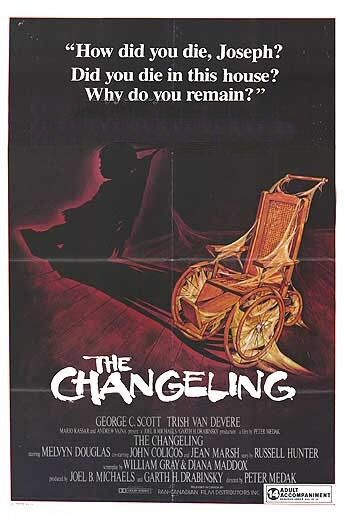
Horror Scenes That I Love: Trish Van Devere Explores The House In The Changeling


Since it’s Thanksgiving in Canada, it seems appropriate that today’s horror scene that I love should come from one of the best Canadian horror films of all time and….

What?

No, it’s not the disco scene from Prom Night!  Anyway, I’ve already shared that scene like a thousand times….

No, this scene is from the 1980 film, The Changeling.  Directed by Peter Medak, the film is about a house that’s haunted by the spirit of a boy who was murdered there decades ago.  When George C. Scott moves into the house, he discovers the truth about not just the murder but the political conspiracy that led to it.  It’s a really good movie.  You should watch it.

Anyway, in this atmospheric scene, Trish Van Devere explores the house.  It’s always a bit strange to watch a horror scene devoid of context but let me just say that The Changeling is such an atmopsheric and intense ghost film that you’ll never want to wander around a potentially haunted house again once you’ve seen it!

4 Shots From 4 Canadian Horror Films: The Changeling, Prom Night, Videodrome, Cube


4 Shots From 4 Films is just what it says it is, 4 shots from 4 of our favorite films. As opposed to the reviews and recaps that we usually post, 4 Shots From 4 Films lets the visuals do the talking.

Happy Thanksgiving, Canada!  Today’s edition for 4 Shots From 4 Films is dedicate to you!

4 Shots From 4 Canadian Horror Films

The Changeling (1980, dir by Peter Medak)

Prom Night (1980, dir by Paul Lynch)

Videodrome (1983, dir by David Cronenberg)

Cube (1997, dir by Vincenzo Natali)

Horror Film Review: Near Dark (dir by Kathryn Bigelow)


The 1987 film Near Dark is the story of two American families.

The Coltons are a family of ranchers living Oklahoma.  Loy Colton (Tim Thomerson) is the patriarch, keeping a watchful eye on his children, Caleb (Adrian Pasdar) and Sarah (Marcie Leeds).  Caleb is a cowboy and a nice guy, even if he does seem to be a little bit too naive for his own good.  After Caleb disappears one night, Loy and Sarah start their own search, traveling across the back roads of the Southwest.

The other family may not share any biological relation to one another but they definitely share blood.  They’re a group of outcasts who have found each other and now spend their nights searching for people who can satisfy their hunger.  They’re vampires, even though that’s not a word that they tend to use.  (In fact, for all the blood-sucking that goes on throughout the film, the term “vampire” is never actually heard.)  At night, they’re all-powerful but during the day, even the slightly exposure to the sun can set them on fire.

The patriarch of this family is Jesse Hooker (Lance Henriksen), a scarred war veteran.  Jesse will do anything to protect the members of his family but he expects each of them to pull their weight.  At one point, when Jesse is asked how old he is, he says that he fought for the South and that the South lost.

Jesse’s girlfriend is Diamondback (Jenette Goldstein), who is just as ruthless as Jesse.  Filling the role of oldest son is Severen (Bill Paxton), a cocky gunslinger with a quick smile and cruel sense of humor.  Homer (Joshua Miller) appears to be a 12 year-old boy but he’s actually one of the older and more violent members of the family.  And then there’s Mae (Jenny Wright), the rebellious daughter.

Mae is the one who first met and bit Caleb.  She’s the one who turned Caleb into one of them, though it takes Caleb a while to not only discover but also understand what he’s become.  When Caleb tries to escape from Mae and his new family, he becomes violently ill.  He can no longer eat human food but, at the same time, he can’t bring himself to hunt.  Instead, he’s forced to drink whatever blood Mae can provide for him.  Even when Jesse’s group attacks a redneck bar, one cowboy manages to escape, specifically because Caleb cannot bring himself to kill him.

What is Caleb to do?  He can’t return to his old family, as much as he may want to.  (It doesn’t help that Homer has developed an obsession with Caleb’s sister, Sarah.)  At the same time, his new family says that they’re going to kill him unless he starts hunting for blood.  They only thing keeping Caleb alive is the fact that Mae likes him and even she’s telling him that he’s going to have to hunt.

Meanwhile, Loy continues his own hunt, the hunt for his son….

Long before she became the first female director to win an Oscar for The Hurt Locker, Kathryn Bigelow directed this stylish vampire film.  Visually, Bigelow emphasizes the emptiness of the Southwestern plains.  Looking at the desolate landscape, it’s easy to believe that Jesse and his family could use them to successfully hide from the rest of the world.  It’s also just as easy to believe that a well-meaning but not particularly bright young man like Caleb could get lost and not be able to find his way home.  Bigelow turns the vampire family into a group of modern-day outlaws, crossing the land in their sun-proofed vehicles and trying to stay one step ahead of modern-day posses made up by concerned families and law enforcement officers who don’t know what they’re getting into.

Even if not for Bigelow’s stylish direction, the film would be a classic for just the cast alone.  Henriksen, Paxton, and Goldstein all previously appeared in James Cameron’s Aliens and they have a camaraderie that feels real.  In fact, the vampires work so well together that it’s impossible not to kind of admire them.  They’ve got it together and, even when faced with an army of police officers determined to make them step out into the sunlight, they don’t lose their sardonic sense of humor.  The much missed Bill Paxton’s performance is a hyperactive marvel, both menacing and sexy at the same time.  Meanwhile, Jenny Wright and Adrian Pasdar have a likable chemistry as Mae and Caleb while Tim Thomerson makes Loy’s love and concern for his son feel so real that adds an unexpected emotional depth to the overall movie.  The script, written by Eric Red and Bigelow, is full of quotable dialogue and the cast takes full advantage of it.

Near Dark is vampire classic and definitely one to watch this Halloween season.