Great Moments In Comic Book History #41: Tomb of Dracula #41


For my money, the original Tomb of Dracula is still the best horror comic to ever show up at a newsstand.  From 1975, The cover of Tomb of Dracula #41 is a classic.  Credit for this goes to Gene Colan, Tom Palmer, and Gaspar Saladino.

Previous Great Moments In Comic Book History:

  1. Winchester Before Winchester: Swamp Thing Vol. 2 #45 “Ghost Dance” 
  2. The Avengers Appear on David Letterman
  3. Crisis on Campus
  4. “Even in Death”
  5. The Debut of Man-Wolf in Amazing Spider-Man
  6. Spider-Man Meets The Monster Maker
  7. Conan The Barbarian Visits Times Square
  8. Dracula Joins The Marvel Universe
  9. The Death of Dr. Druid
  10. To All A Good Night
  11. Zombie!
  12. The First Appearance of Ghost Rider
  13. The First Appearance of Werewolf By Night
  14. Captain America Punches Hitler
  15. Spider-Man No More!
  16. Alex Ross Captures Galactus
  17. Spider-Man And The Dallas Cowboys Battle The Circus of Crime
  18. Goliath Towers Over New York
  19. NFL SuperPro is Here!
  20. Kickers Inc. Comes To The World Outside Your Window
  21. Captain America For President
  22. Alex Ross Captures Spider-Man
  23. J. Jonah Jameson Is Elected Mayor of New York City
  24. Captain America Quits
  25. Spider-Man Meets The Fantastic Four
  26. Spider-Man Teams Up With Batman For The Last Time
  27. The Skrulls Are Here
  28. Iron Man Meets Thanos and Drax The Destroyer
  29. A Vampire Stalks The Night
  30. Swamp Thing Makes His First Cover Appearance
  31. Tomb of Dracula #43
  32. The Hulk Makes His Debut
  33. Iron Man #182
  34. Tawky Tawny Makes His First Appearance
  35. Tomb of Dracula #49
  36. Marvel Publishes Star Wars #1
  37. MAD Magazine Plays Both Sides
  38. The Cover of Green Lantern/Green Arrow #85
  39. LBJ Stands Up For The Hulk
  40. Chamber of Chills #2

Horror Scenes That I Love: Bela Lugosi in Bride of the Monster


“Home?  I have no home.”

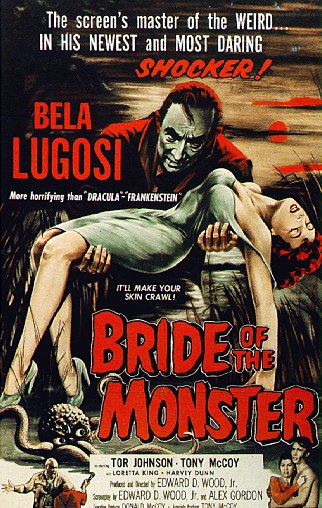
So begins the monologue that serves as the centerpiece of the 1955 Ed Wood film, Bride of the Monster.  The monologue is delivered by Bela Lugosi, appearing in one of his final roles.

Far too often, people tend to be snarky about the work that Lugosi did under the direction of Ed Wood.  But you know what?

He actually delivers a pretty good performance in Bride of the Monster.

Ignore all of the stuff about atomic supermen and instead, just pay attention to the way Lugosi delivers the lines.  Pay attention to the pain in his voice as he says that he has no home.  Pay attention and you’ll discover that Lugosi actually gave a good performance in Bride of the Monster.  He delivers the lines with such wounded pride that you can’t help but think that maybe we should let him create a race of atomic supermen.

Among the old horror icons, Lugosi has always been the most underrated actor.  He got typecast early and he appeared in some unfortunate films but Bela Lugosi had real talent and you can see it in this scene.

October True Crime: Looking for Mr. Goodbar (dir by Richard Brooks)


In 1977’s Looking for Mr. Goodbar, Diane Keaton plays Theresa Dunn.

A neurotic and single woman who has never emotionally recovered from her childhood struggle with scoliosis, Theresa is trying to find herself in the wild and promiscuous world of the 1970s.  After losing her virginity to a condescending college professor (Alan Feinstein), Diane goes on to have relationships with a needy social worker (William Atherton) and an hyperactive petty criminal (Richard Gere).  During the day, she teaches deaf children and she’s good at her job.  She even manages to win over the distrustful brother (Levar Burton) of one of her students.  At night, she hits the bars.  She buys drugs from the neighborhood dealer (Julius Harris).  She tries to read the book that she always carries with her.  (Some nights, it’s The Godfather and other nights, it’s something else.)  She picks up strange men and takes them to her roach-infested apartment.  One of those men, Gary (Tom Berenger), turns out to both be a bit insecure about his masculinity and also totally insane….

Looking for Mr. Goodbar is an adaptation of a novel that was inspired by the real-life murder of a New York school teacher named Roseann Quinn.  The book was best seller and, just as he had with a previous best-selling true crime novel, director Richard Brooks bought the rights and both wrote and directed the film.  Diane Keaton, who at that point was best-known for playing Kay Adams in The Godfather and for appearing in Woody Allen’s comedies, took on the demanding role of Theresa and, whatever one may think of the film itself, it can’t be denied that Keaton gives a brave performance as the self-destructive Theresa.  In fact, I would say it’s one of Keaton’s best performances, outside of her work with Woody Allen and The Godfather Part II.  If she had been played by a lesser actress, Roseann could have been unbearable.  As played by Diane Keaton, though, she’s everyone’s best friend who just need some time to find herself.  The viewer worries about her and wants to protect her as soon as they see her, making her ultimate fate all the more tragic.

As for film itself, I’ve watched Looking For Mr. Goodbar a few times and I’m always a little bit surprised by how bad the movie actually is.  The film actually gets off to a strong start.  The scenes between Theresa and the professor make for a sensitive portrait of a repressed young woman finally getting in touch with her sexuality and, in the process, discovering that she deserves better than the man she’s with.  But once Theresa moves into her apartment and starts hitting the bars at night, the film takes on a hectoring and moralistic tone that leaves the viewer feeling as if the film is blaming Theresa for the tragedy that’s waiting for her at the end of the story.  Diane Keaton and Tuesday Weld (who plays her sister) both give excellent performances but everyone else in the film either does too much or too little.  This is especially true of Richard Gere, who is very hyperactive but still strangely insubstantial in his role.  (Whenever Richard Gere appears on screen, one gets the feeling that they could just walk right through him.)  A scene where Gere jumps around the apartment is meant to be disturbing but it’s more likely to inspire laughter than chills.

It’s an overly long film and the moments in which Theresa has dark, sexually-charged fantasies are never quite as powerful as the film obviously meant for them to be.  (Brian Dennehy makes his film debut as a doctor who kisses Theresa’s breast during one of her fantasies.)  As opposed to the empathy that he brought to In Cold Blood, one gets the feeling that director Richard Brooks didn’t like anyone in this movie and that he was more interested in Theresa as a cautionary tale than as a human being.  With this film, Brooks seemed to be standing athwart the Sexual Revolution and shouting, “Stop!”  That said, the film’s final moments are genuinely disturbing and difficult to watch.  It’s the one moment where Brooks’s lack of subtlety pays off.  Those last minutes are about as horrific as anything you could expect to see.

As for Roseann Quinn, her killer was eventually arrested.  John Wayne Wilson hung himself in prison, 5 months after murdering her.

Horror Song of the Day: Mater Tenebrarum by Keith Emerson


Inferno (1980, dir by Dario Argento, DP: Romana Albano)

Today’s horror song of the day comes from Keith Emerson’s soundtrack of Dario Argento’s Inferno.  Emerson did not have an enviable task, having to follow up Goblin’s soundtrack for Suspiria.  But Emerson pulled it off, crafting a score that compliments Goblin’s earlier work while maintaining an identity of its own.

4 Shots From 4 Horror Films: The 1940s Part Three


This October, I’m going to be doing something a little bit different with my contribution to 4 Shots From 4 Films.  I’m going to be taking a little chronological tour of the history of horror cinema, moving from decade to decade.

Today, we look at the latter half of the 1940s.

4 Shots From 4 Horror Films

Strangler of the Swamp (1946, dir by Frank Wisbar)

Strangler of the Swamp (1946, dir by Frank Wisbar)

House of Horrors (1946, dir by Jean Yarbrough)

House of Horrors (1946, dir by Jean Yarbrough)

She-Wolf of London (1946, dir by Jean Yarbrough)

She-Wolf of London (1946, dir by Jean Yarbrough)

Scared To Death (1947, dir by Christy Cabanne)

Scared To Death (1947, dir by Christy Cabanne)

Horror Film Review: Wax Mask (dir by Sergio Stivaletti)


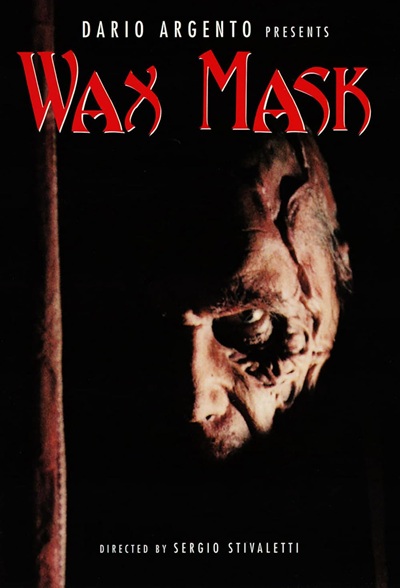
The 1997 Italian horror film, Wax Mask, takes place in Rome at the turn of the 20th Century.

The film opens in 1900, with a young girl named Sonia witnessing the murder of her parents by a man with an iron claw and a wax mask.  12 years later, Sonia (Romina Mondello) steps into a Rome’s newest sensation, a wax museum where all of the wax figures appear to either be victims or murderers.  The museum is meant to scare people.  One man accepted a dare to spend the night in the museum and he was found dead the next morning, frightened to death.  Sonia’s not interested in being scared.  She just needs a job.  Her mother taught her how to make clothes for wax figures.  The owner of the museum, Boris (Robert Hossein), hires her.

When Sonia leaves the museum, her picture is taken by Andrea (Riccardo Serventi Longhi), a reporter who is investigating the mysterious deaths that have been connected to the museum.  Meanwhile, Inspector Lanvin (Aldo Massasso) contacts Sonia to let her know that he’s following up some new leads concerning the still-unsolved deaths of her parents.  He seems quite concerned about her working at the museum.  When Lanvin later turns up dead, Sonia becomes concerned as well.

You can probably guess where all of this is going.  Wax Mask is a remake of House of Wax, with the action moved to Rome and also with a lot more nudity and considerably more gore.  The murders are brutal and bloody and the same can be said of what Sonia discovers when she starts to take a closer look at the wax figures in the museum.  Perhaps the most disturbing aspect of this film is the idea that the wax figures are actually suspended in a state between life and death, aware of what is happening but unable to move, speak, or do anything about it.  Wax Mask is a frequently diverting throwback to the bloody but atmospheric giallo films of the 70s.  Suspense is mixed with special effects, some of which are more effective than others.

Wax Mask was originally meant to be Lucio Fulci’s final film.  Dario Argento saw his old cinematic rival, Lucio Fulci, in 1994, by which point Fulci was using a wheelchair and was in frequent pain.  Thinking that working on a movie might be good for Fulci’s state-of-mind and overall health, Argento agreed to produce Fulci’s next film.  The idea that they came up with was to remake House of Wax.  While Argento wanted to concentrate on spectacular death scenes, Fulci wrote a script that emphasized atmosphere over blood.  Tragically, Fulci died in 1997 while the film was still in pre-production.  Argento replaced Fulci with Sergio Stivaletti, a special effects artist who has worked on several Argento films.

Stivaletti rewrote the script and put the emphasis back on the special effects.  (In the end, the killer has as much in common with The Terminator than with a traditional giallo killer.)  Stivaletti does a good job directing the film.  There are plenty of scary scenes.  The film looks good.  Even the special effect shots that don’t quite work still have a certain charm to them.  That said, it’s hard to watch the film without thinking about what Fucli, at his best, could have done with the material.

In the end, though, Wax Mask is an effective work of late era Italian horror.

Horror Film Review: C.H.U.D. (dir by Douglas Cheek)


There’s something living under the streets of New York City.

That’s the basic idea behind 1984’s C.H.U.D., a film that opens with an upper class woman and her little dog being dragged into the sewers by a creature the reaches out of a manhole.  People are disappearing all over the city but the authorities obviously aren’t revealing everything that they know.  Even after the wife of NYPD Captain Bosch (Christopher Curry) disappears, the city government doesn’t seem to be too eager to dig into what exactly is happening.

Instead, it falls to two activists.  Photographer George Cooper (John Heard) specializes in taking picture of the homeless, especially the one who live underground in the New York subways.  He’s like a well-groomed version of Larry Clark, I guess.  Social activist A.J. “The Reverend” Shepherd (Daniel Stern) runs a homeless shelter and is convinced that something is preying on the most vulnerable citizens of New York.  When the police won’t do their job, George and the Reverend step up!

So, what’s living in the sewers?  Could it be that there actually are cannibalistic humanoid underground dwellers out there?  Everyone in New York City has heard the legends but, much like stories of the alligators in the Chicago sewers, most people chose not to believe them.  Or could the disappearance have something to do with the cannisters labeled Contamination Hazard Urban Disposal that are being left in the sewers by the Nuclear Regulatory Commission?  Wilson (George Martin) of the NRC says that they would never purposefully mutate the people living underground but Wilson works for the government so who in their right mind is going to trust him?

C.H.U.D. is a horror film with a social conscience.  It’s very much an 80s films because, while you have Shepherd running around and attacking everyone for not taking care of the most vulnerable members of society, the true villain is ultimately revealed to be the members of a regulatory agency.  Instead of finding a safe way to get rid of their nuclear waste, they just found a sneaky way to abandon it all in New York and obviously, they assumed no one would care because …. well, it’s New York.  Everyone in the country knows that New York City isn’t safe so who is going to notice a few underground monsters, right?

The idea behind C.H.U.D. has a lot of potential but the execution is a bit lackluster.  For every good C.H.U.D. kill, there’s long passages where the story drags.  Considering that Heard spent most of his career typecast as the type of authority figure who would dump nuclear waste under New York City, it’s actually kind of interesting to see him playing a sympathetic role here.  Daniel Stern, on the other hand, is miscast and rather hyperactive as Shepherd.  You really do want someone to tell him to calm down for a few minutes.  Watching C.H.U.D., one gets the feeling that it’s a film with an identity crisis.  Is it a horror film, an action flick, a work of social commentary, or a dark comedy?  There’s no reason why it can’t be all four but C.H.U.D. just never really comes together.  It ultimately feels more like a mix of several different films instead of being a film made with one clear and coherent vision.

In the end, Death Line remains the film to see about underground cannibals.

Horror Film Review: Mesa of Lost Women (dir by Herbert Tevos and Ron Ormond)


“Have you ever been kissed by a girl like this?” a disembodied voice asks at the start of 1953’s Mesa For Lost Women as a pair hands with claw-like fingernails caresses the face of someone who is later identified as being “Doc” Tucker (Allan Nixon).

Things get stranger from there.  A couple is found lost and dehydrated in the Mexican desert.  Grant Phillips (Robert Knapp) rambles about “super bugs” out in the desert and how they have to be destroyed.  American land surveyor Frank (John Martin) assumes that Grant must be delirious but Frank’s assistant, Pepe (Chris Pin Martin), knows differently.  We know that Pepe knows differently because the narrator tells us that Pepe had heard all about the monsters in the desert but Pepe keeps that information to himself….

Who is this narrator and why is he so condescending?  (For the record, he’s actor Lyle Talbot, who split his career between major, Oscar-winning productions and stuff like this.)  Have you ever noticed that a narrator usually just leaves you feeling even more confused by what you just watched?  There’s a trailer playing right now for a film called Ella McCay that opens with Julie Kavner saying, “Hi, I’m the narrator!” and whenever I hear that line, I’m just like, “Oh, this film is going to be so bad!”

I think it’s because most narrators are added after the fact, in an attempt to give some sort of uniformity to a badly constructed movie.  The narrator is there to tell us stuff that a good movie would be able to show us.  For instance, in the trailer for Ella McCay, Julie Kavner tells us that “I’m nuts about her,” as a way to assure us that Ella McCay is someone worth making a movie about.  Now, ideally, you wouldn’t have to have someone tell you that.  You would just watch the movie and say, “Hey, Ella McCay!  She deserves all the happiness in the world!”  But when your trailer is a bunch of scenes of Ella McCay acting a bit immature for someone who is destined to become “governor of the state you were born and raised in,” you need that narrator to say, “No, she’s likable, I promise!”

By that same logic, Mesa of Lost Women was apparently a mash-up of several different films, none of which had a complete script.  Narrator Lyle Talbot is here to tell us that, despite what we’re seeing, Mesa of Lost Women is an actual movie with an actual story as opposed to just a bunch of random scenes that were haphazardly crammed together.  We get a flashback of a scientist named Masterson (Harmon Stevens) traveling to the laboratory of Dr. Aranya (Jackie Coogan) and discovering that Aranya is creating giant tarantulas and transforming human women into mind-controlled slaves with the instincts of a spider.  Masterson doesn’t think that’s ethical so Aranya’s assistant, Tarantella (Tandra Quinn), gives him an injection that turns him into a simpleton.  Masterson ends up in a mental hospital, though he later escapes.  Meanwhile, an American businessman and his girlfriend (Mary Hill) come to Mexico and witness Tarantella dancing in a bar.  Masterson shows up and shoots Tarantella and then takes everyone hostage so that he can force Grant, who we now discover is a pilot, to fly him to the mesa of lost women …. or something.

Despite the best efforts of the narrator, the film is impossible to follow.  A big problem is that Dr. Aarnya’s plan never makes much sense.  How is creating a giant spider and a bunch of women who think that they’re spiders going to help him conquer the world?  The other problem is that the film had two directors, one of whom was an enigmatic German named Herbert Tevos who got the job by claiming to have directed Josef von Sternberg’s The Blue Angel.  Tevos’s footage of Dr. Aranya, the giant tarantula, and the “lost women” was not enough to secure the film distribution so a second director, Ron Ormond, was brought in to shoot a bunch of new footage to make the film more commercial.  Tevos’s film became an extended flashback in the middle of Ormond’s film and the whole thing is a big mess.

In fact, the film is such a mess that some people insist Ed Wood must have been involved.  It is true that narrator Lyle Talbot also appeared in Plan 9 From Outer Space and Glen or GlendaPlan 9‘s Mona McKinnon appears as a spider woman.  So does Dolores Fuller, who was Wood’s girlfriend at the time.  Wood later “borrowed” Mesa of Lost Women‘s score for Jail BaitMesa of Lost Women was definitely Wood-adjacent but, by all accounts, Wood didn’t actually do any work on the film.  This mess of a film belongs to Tevos and Ormond.

And it is a mess.  It’s a watchable mess, in much the same way that a nuclear meltdown would probably be watchable.  But, nonetheless, it’s still a mess and the incoherence of the plot really does get on one’s nerves, despite the best efforts of Lyle Talbot.  Talbot can’t sell the viewer on Mesa of Lost Women.  Maybe he would have had better luck with Ella McCay.

Horror On The Lens: Bride of the Monster (dir by Edward D. Wood, Jr.)


Oh, how I love Bride of the Monster.

First released in 1955 and directed by the legendary Ed Wood, Bride of the Monster is a classic mix of a haunted house, a mad scientist, a lumbering assistant, and a giant octopus.  The plot may be impossible to follow but it doesn’t matter when you’ve got Tor Johnson grunting and Bela Lugosi giving a surprisingly good performance as the persecuted Dr. Vornoff, a man who “tampered in God’s domain.”

A lot of people consider this to be Wood’s best film.  Personally, I would go with Plan 9 From Outer Space but Bride of the Monster is still an entertaining look at monsters and madmen.


Live Tweet Alert: Watch Creature From The Black Lagoon With #ScarySocial!


As some of our regular readers undoubtedly know, I am involved in a few weekly live tweets on twitter.  I host #FridayNightFlix every Friday, I co-host #ScarySocial on Saturday, and I am one of the five hosts of #MondayActionMovie!  Every week, we get together.  We watch a movie.  We tweet our way through it.

Tonight, for #ScarySocial, I will be hosting a true classic, Creature From The Black Lagoon!

If you want to join us on Saturday night, just hop onto twitter, start the film at 9 pm et, and use the #ScarySocial hashtag!  The film is available on Prime and Tubi!  I’ll be there co-hosting and I imagine some other members of the TSL Crew will be there as well.  It’s a friendly group and welcoming of newcomers so don’t be shy!