Book Review: Night of the Living Dead by John A. Russo


A few years ago, I found a slightly beat-up copy of John Russo’s novelization of Night of the Living Dead at Half-Price Books. Of course, I immediately purchased it. From my own knowledge of the making of George Romero’s classic horror movie, I knew that John Russo was the one who came up with an idea involving zombies which led to Romero writing a story outline for Night of the Living Dead which Russo then turned into the film’s screenplay.

I also knew that Romero and Russo had a falling out of sorts after the success of Night of the Living Dead. With the film in the public domain as the result of a screw-up on the part of the movie’s distributor, there was some controversy over who had the rights to the original’s story. That’s one reason why the titles of Romero’s subsequent zombie films (i.e., Dawn of the Dead, Day of the Dead, Land of the Dead, and the rest) were all about “the Dead” as opposed to “the Living Dead.” Russo’s subsequent zombie-themed work (i.e. Return of the Living Dead) featured the term “Living Dead” and was also sold as a sequel to the original Night of the Living Dead.

With all that in mind, I was curious to see what Russo’s novelization would be like. What extra information would the book contain about the characters? Would there be any extra details that were cut from the film? How about an alternate ending? It’s been known to happen. (Check out the novelization for Halloween if you want to see how much a novelization can differ from the film that inspired it.)

Well, it turns out that novelization of Night of the Living Dead is pretty much a straight recreation of the film. We do learn a bit more about just how bad a relationship Barbara has with her brother Johnny. And it’s firmly established that Ben was a truck driver before the dead came back to life. Otherwise, it’s pretty much just the movie in novel form. We don’t learn much about the characters that we didn’t already know. Harry is still stubborn and cowardly. Ben is still the designated hero who manages to get everyone killed through his own stubbornness. Barbara is still catatonic for most of the book. (I know some would complain about Barbara being so passive but her stunned disbelief is perhaps the most realistic part of the film and the novel. That’s how most of us would react to going through what she’s just been through.) Russo is a good writer and he does a good job capturing the tension in that little house. The final few chapters — which recreate the film’s downbeat ending — are particularly well-done. But there’s not much in the book that isn’t also in the movie.

One interesting thing about the novelization is that it was originally published in 1974, six years after the release of Night of the Living Dead. Was it written in an attempt to help establish that Russo and/or Romero owned the rights to the film? Or did it just take the publisher that long to realize that they’re might be a market for a novel based on the film? Who knows?

The book doesn’t add much to the overall story but I’m still glad I’ve got a copy, You can never have enough Night of the Living Dead memorabilia.

The Martian Chronicles: Episode 1: The Expeditions (1980, directed by Michael Anderson)


In 1980, NBC adapted the Ray Bradbury short story collection, The Martian Chronicles, into a three-part miniseries.  Though Bradbury’s original book featured short stories that were only loosely connected by two shared locations (Earth and Mars), the miniseries connected most of the stories through the character of Colonel John Wilder (Rock Hudson), the NASA project director who headed up the project to colonize Mars and who later regretted his decision after it became clear that humanity was going to treat Mars just as badly as they treated their previous home.  The miniseries was adapted by Richard Matheson and directed by Michael Anderson.

Unfortunately, the miniseries itself was not a hit with critics, who complained that the story moved too slowly.  Audiences, having just experienced Star Wars and Close Encounters of the Third Kind, were not impressed with the special effects, in which miniatures were used to simulate spacecraft flying through space.  Despite all of that, though, The Martian Chronicles has built up a cult following.  I can remember first catching the miniseries playing late at night on one of the local station in Baltimore.  I’ve always liked it.  It’s not as good as Bradbury’s original collection, of course.  But the miniseries still has its strengths, despite the miniatures.

The first and best episode of the miniseries was The Expeditions.  Starting with a recreation of Viking 1 landing on Mars in 1976, the episode jumps forward to the far future of 1999!  The first manned spacecraft lands on Mars and the two astronauts aboard are promptly killed by the first Martian that they meet, an angry husband who thinks that one of the astronauts is going to have an affair with his wife.

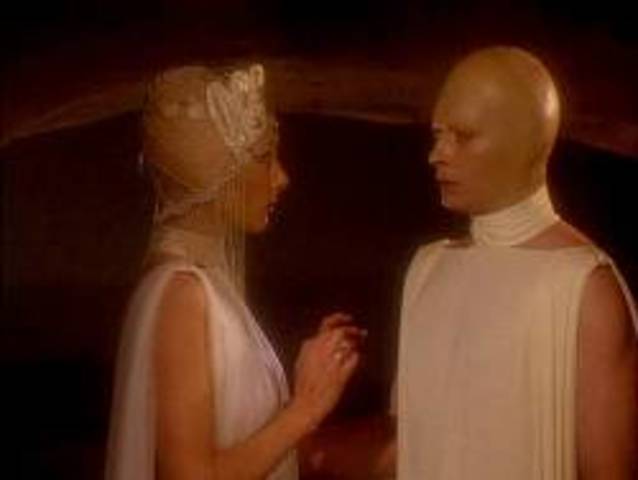
The second expedition is led by Captain Arthur Black (Nicholas Hammond, best-know for playing Spider-Man in the late 70s TV series).  When they land on Mars, they discover that the formerly Red Planet now looks like Black’s childhood home of Green Bluff, Illinois.  All of their relatives are waiting for them!  Falling into the belief that they’ve returned to the past, the astronauts are killed by their “families” that night.  It turns out that the Martians were using Black’s memories to set a trap for them.  As the Martian who disguises himself as Black’s brother explains it, they’ve seen, in the minds of the astronauts, what the humans are doing to their own planet and they can’t allow that to happen to Mars.  “Forgive us,” the Martians says, “we were once an honorable race.”  In one of the best scenes in both the book and the miniseries, the Martians still have an Earth-style funeral for the men that they’ve killed because they too got sucked into the world that they created and came to care about the men they felt they had to kill.

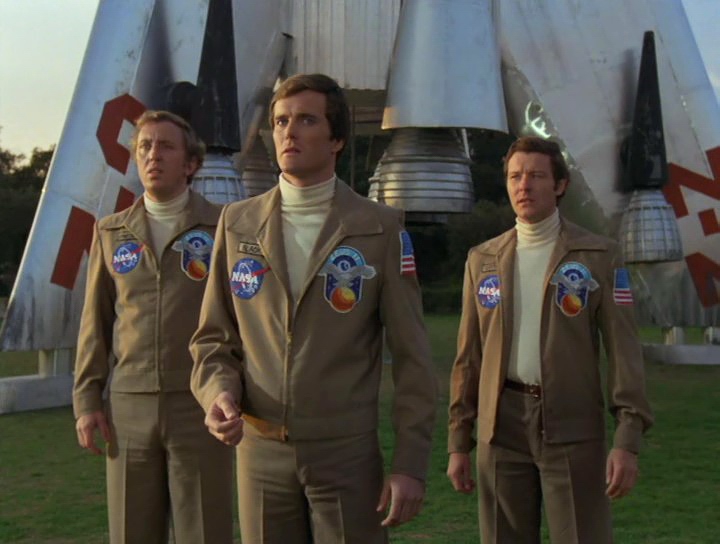
Years later, a third expedition arrives.  This one takes up the majority of the episode.  It’s led by Colonel Wilder himself and includes Sam Parkhill (Darren McGavin), Jeff Spender (Bernie Casey), Briggs (John Cassady), and McClure (Peter Marinker).  Almost all of the Martians have apparently died, the victims of the Earth germs that were brought to the planet by the second expedition.  While Parkhill plots to open a barbecue joint and Briggs gets drunk and tosses his empty beer cans into a waterway that he christens, “Biggs Canal,” Spender investigates a deserted Martian city.  Unlike the others, Spender is in awe of the Martian civilization and angry that it’s been so casually destroyed.  When Spender returns, he declares himself to be “the last Martian” and tries to kill the members of the expedition.

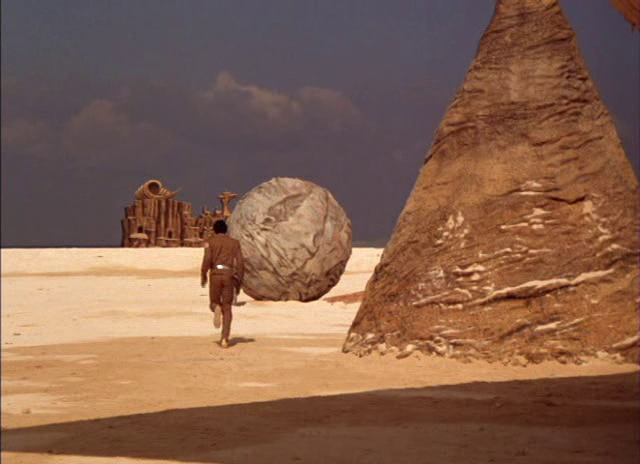
Of the three episodes, The Expeditions is the one that sticks closest to the stories on which it was based, in both content and theme.  Not surprisingly, it’s also the best of the miniseries, with each vignette working as both a separate story and a part of a larger whole.  It’s the episode that sticks closest to what Bradbuy himself was going for in his original collection.  While the miniature spaceships are a distraction, the desolate Martian landscape is sharply realized and the first episode is full of striking shots, from the Martian husband walking through the red desert to “greet” the first expedition to the funeral for the second expedition to the final battle between Spender and the survivors of the third expedition.  Among the members of the cast, Nicholas Hammond and Bernie Casey are the stand-outs but everyone plays their part well.  Darren McGavin is always a welcome presece in any miniseries and John Cassady is so obnoxious as Briggs that it’s impossible not to see where Spender is coming from.  (Back when the IMDb still has message boards, every message on Cassady’s board was someone posting about Briggs Canal.)  Rock Hudson is as stiff as ever but it’s appropriate for his character.  The scene where he and Bernie Casey debate whether humanity is worthy of a planet like Mars is well-acted by both actors, with the different opinions of their characters reflected in the different performing styles of the two actors.  Though the miniseries never explicitly states it, it is perhaps not a coincidence that Spender, as the only black character in the miniseries, is the only one to truly understand what humans colonizing Mars could lead to.

The Expeditions ends with Spender warning that humans will destroy Mars if they’re allowed to colonize it.  The next episode would explore whether he was correct.  We’ll take a look at The Settlers tomorrow.

Great Moments In Comic Book History: The First Appearance of Werewolf By Night


From 1954 to 1971, comic book readers across America were safe from werewolves. The Comics Code Authority, that set of rules instituted to get Dr. Frederic Wertham to stop declaring comic books to be the greatest menace to the American way of life since the horseless carriage, forbade any supernatural characters. Werewolves were not allowed to fight alongside or against any of the super heroes published by D.C., Marvel, or any of the other comic books companies governed by the CCA.

The CCA started to relax their rules in 1971, especially after Marvel published an issue of Spider-Man that did not get the CCA’s seal of approval because it featured a friend of Peter Parker’s getting hooked on drugs. When the issue not only sold well but also generated a lot of negative publicity about how out-of-touch the CCA was with what comic book readers were actually having to deal with, the CCA started to relax their rules.

Marvel reacted by introducing a whole host of supernatural characters who had previously been banned under the CCA. Throughout the 70s, Captain America, Spider-Man, and others often shared their pages with the likes of Dracula, Frankenstein’s Monster, and sometimes even Satan himself.

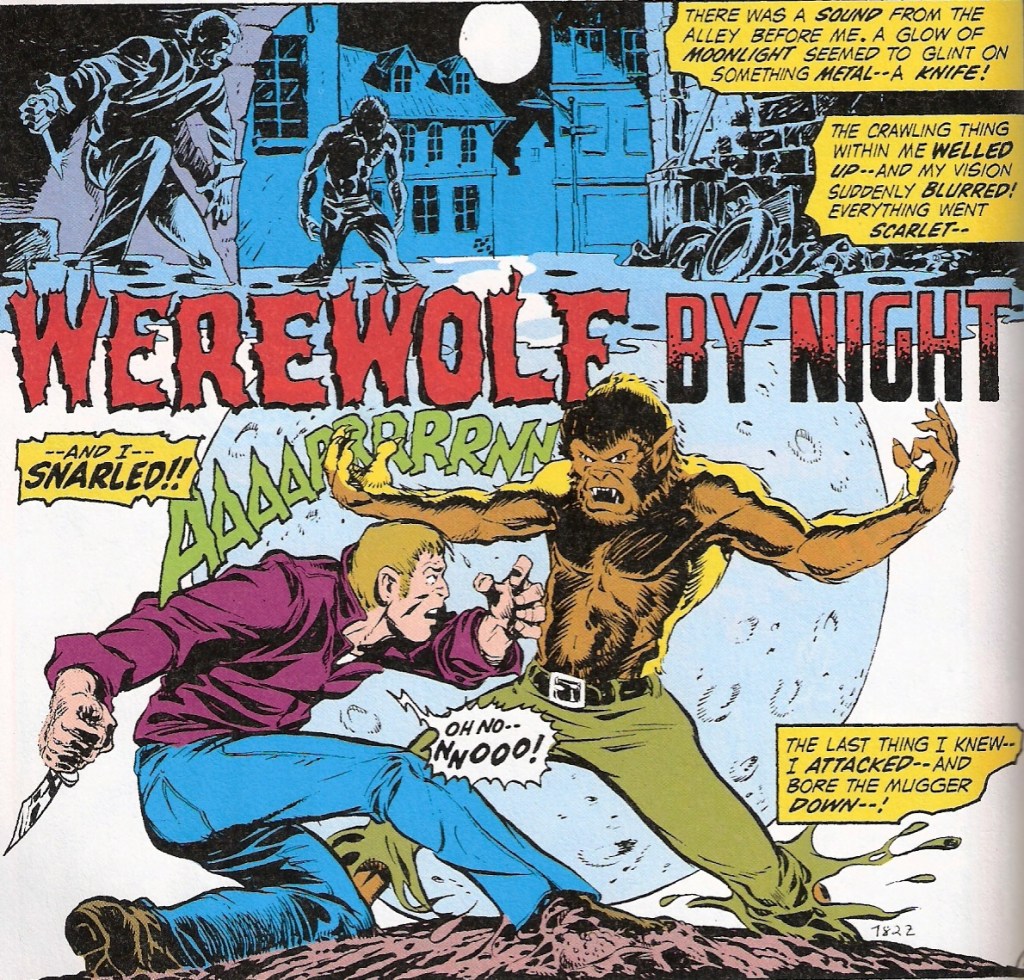
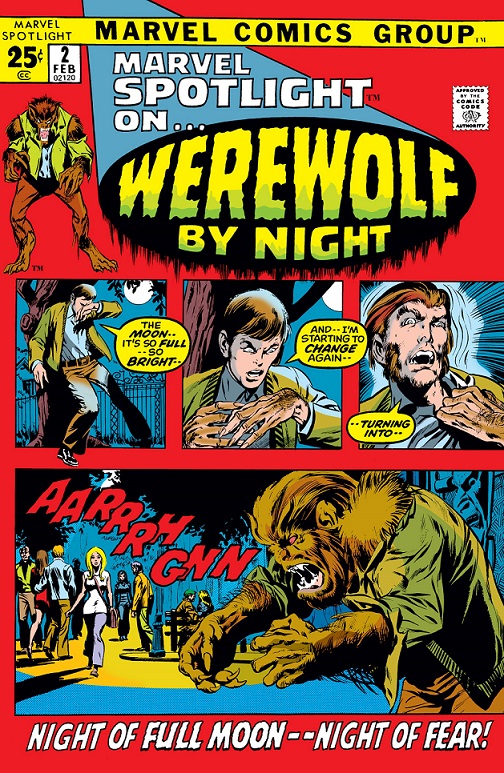
Werewolf by Night was Marvel’s first werewolf. (The title had previously been used before the CCA went into effect, back when Marvel was still known as Atlas.) He made his first appearance in the 2nd issue of Marvel Spotlight. By day, he was Jack Russell. He was also Jack Russell by night, unless there was a full moon. Then, he was Werewolf by Night! He was different from most Marvel characters in that he lived in Los Angeles instead of Manhattan. However, one thing that he did have in common with a surprisingly large amount of comic book heroes is that his story started with a mugging.

At first, Jack thinks this was just a dream. It’s only later in the issue that his mother confesses that Jack’s father was a werewolf and apparently, the curse has been passed down. Jack is not happy to hear that and after promising to never attack his stepfather, Jack runs off into the night. Later, when Jack nearly breaks his promise, he realizes that a werewolf cannot have a family. A werewolf must always be alone.

From such simple beginnings, one of Marvel’s most venerable characters was born. Many of the Marvel horror characters disappeared after a few issues but Werewolf by Night has remained an active member of the Marvel Universe. Though my favorite Marvel werewolf remains Man-Wolf, Werewolf By Night has had his moments. My personal favorite was when he, Spider-Man, and Franenstein’s Monster teamed up to take down the Monster Maker. It’s not easy being a werewolf but Jack Russell (and, when the series was recently rebooted, Jake Gomez) has always done his best.

Marvel Spotlight Vol.1 #2 (February 1972) — “Night of Full Moon — Night of Fear

Writers — Roy Thomas, Dean Thomas, Gerry Conway

Penciler and Inker — Mike Ploog

Letterer — John Costanza

Editor — Stan Lee

Previous Great Moments In Comic Book History:

  1. Winchester Before Winchester: Swamp Thing Vol. 2 #45 “Ghost Dance” 
  2. The Avengers Appear on David Letterman
  3. Crisis on Campus
  4. “Even in Death”
  5. The Debut of Man-Wolf in Amazing Spider-Man
  6. Spider-Man Meets The Monster Maker
  7. Conan The Barbarian Visits Times Square
  8. Dracula Joins The Marvel Universe
  9. The Death of Dr. Druid
  10. To All A Good Night
  11. Zombie!
  12. The First Appearance of Ghost Rider

International Horror Film Review: The Brood (dir by David Cronenberg)


O Canada!
Our home and native land!
True patriot love in all of us command.
With glowing hearts we see thee rise,
The True North strong and free!
From far and wide,
O Canada, we stand on guard for thee.
God keep our land glorious and free!
O Canada, we stand on guard for thee.

Canada!  It always seems like such a nice country until you watch a David Cronenberg film.  Hailing from Toronto, Cronenberg started his film career with two satirical, black-and-white science fiction shorts and then went on to become one of Canada’s best-known filmmakers.  At a time when most people associated Canada with politeness and maple syrup, Cronenberg made visceral and often-disturbing films, ones that often mixed sexuality with graphic body horror.  At a time when the genre was being dominated by Italian filmmakers, Cronenberg brought a uniquely Canadian sensibility to horror.

Take 1979’s The Brood, for instance.

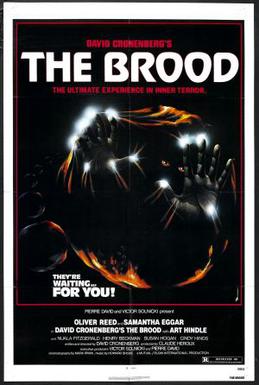
The Brood tells the story of one very doomed marriage.  Frank (Art Hindle) and Nola (Samantha Eggar) Carveth are fighting for custody of their five year-old daughter, Candice (Cindy Hinds).  (Not coincidentally, Cronenberg was going through his own custody battle when he first came up with the idea for The Brood.)  Nola, who has been emotionally scarred by both her alcoholic parents and her troubled marriage to Frank, is a patient at Somafree Institute.  Her psychotherapist, Dr. Hal Raglan (Oliver Reed), practices a technique called “psychoplasmics.”  Though it’s not easy to describe (and, wisely, Cronenberg doesn’t spend too much time trying to justify the science of it), it basically involves channeling anger and suppressed emotions into body modification.  What you or I might consider to be a hive or a welt is what Dr. Raglan would call a major breakthrough.

Frank is skeptical about Dr. Raglan’s theories but he still takes Candice to visit her mom.  However, when Candice returns from one visit bruised and scratched, Frank is convinced that Nola has been abusing her.  Hoping to both win custody of Candice and prove that Dr. Raglan’s methods are dangerous, Frank starts his own investigation into just what exactly has been happening at the Somafree Institute.

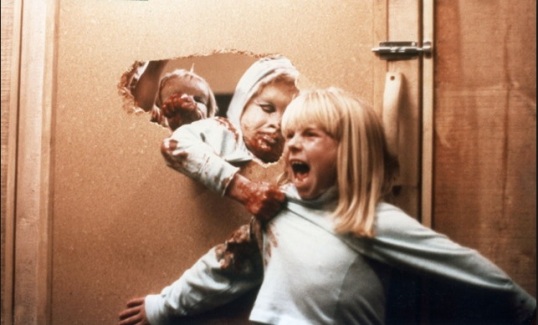
That’s when the children start to show up.  The children are small, with pale skin and light hair and oddly featureless faces.  They never smile.  They never speak.  They show up without any warning and violence always seems to follow them.  They attack both Nola’s mother and father.  When Nola suspects that Frank might be having an affair with Candice’s teacher, two of the children suddenly appear in her classroom.  Candice is scared of the children but still seems to have some sort of connection to them…

Even if you didn’t know this was a Cronenberg film, it would take just one look at the snow-covered landscape to identify The Brood as being a Canadian film.  As was often the case with Cronenberg’s early horror films, the imagery is frequently cold and chilly.  However, The Brood is not a cold film.  With its look at dysfunctional families and its emphasis on Frank’s attempts to protect his daughter, The Brood is actually one of Cronenberg’s most emotional films.  It’s a film about not only anger but also how people deal with that anger.  The killer kids are both literally and metaphorically children of rage.

Even by the standards of Cronenberg, things get grotesque.  Fortunately, the film’s talented cast keeps you interested, even when the bloody visuals might make you want to find a nice comedy to watch instead.  Art Hindle and Cindy Hinds are sympathetic as the father and daughter.  Oliver Reed keeps you guessing as to what exactly Dr. Raglan is actually trying to accomplish.  Nicholas Campbell and Robert A. Silverman, two members of the Cronenberg stock company, both make an impression in smallish roles.  And Samantha Eggar totally throws herself into her role, turning Nola into an absolutely terrifying monster.

Though it never quite reaches the flamboyant heights of either Scanners or ShiversThe Brood is still an effective horror film.  As opposed to some of his other films of the period, Cronenberg actually seems to not only care about the characters in the film but it also comfortable with encouraging us to care about them as well.  As a result, The Brood becomes about more than just trying to shock the audience.  The Brood is a film that sticks with you.

The Brood (1979, dir by David Cronenberg DP: Mark Irwin)

4 Shots From 4 Mario Bava Films


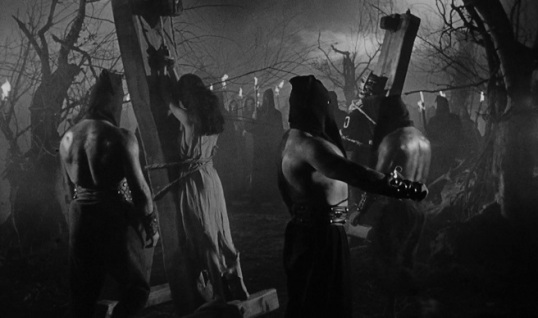
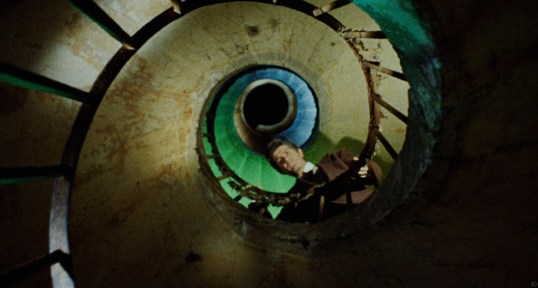
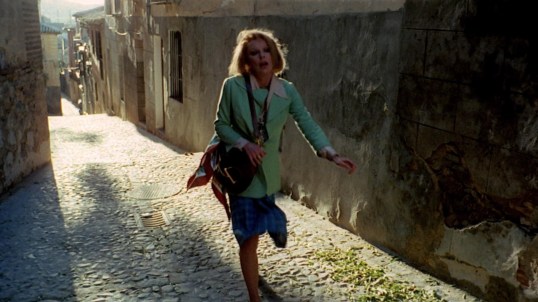
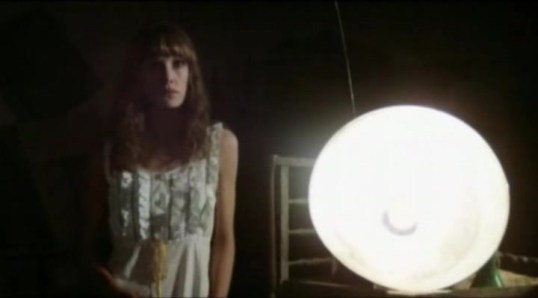
4 Or More Shots From 4 Or More Films is just what it says it is, 4 shots from 4 of our favorite films. As opposed to the reviews and recaps that we usually post, 4 Shots From 4 Films lets the visuals do the talking!

Today, we pay tribute to one of the greatest filmmakers of all time, the one and only Mario Bava!  It’s time for….

4 Shots From 4 Mario Bava Films

Black Sunday (1960, dir by Mario Bava)

Kill, Baby, Kill (1966, dir by Mario Bava)

Lisa and the Devil (1973, dir by Mario Bava)

Shock (1977, dir by Mario Bava)

A Blast From The Past: Shake Hands With Danger (dir by Herk Harvey)


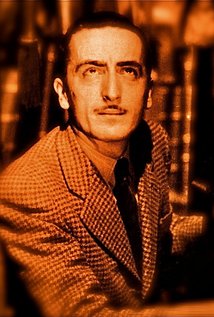
Director Herk Harvey

Since I’m going to be sharing Herk Harvey’s Carnival of Souls on Saturday, I’ve been preparing by showing some of the short films that Harvey directed before and after making his only feature. 1980’s Shake Hands With Danger was actually one of Harvey’s final films and, needless to say, it came out long after Carnival of Souls.

This short film is all about being safe while working with heavy machinery. If Candace Hilligoss had shown more caution, she wouldn’t have had to shake hands with danger in Carnival of Souls. See, it’s all connected! Welcome to the Herkiverse.

Here’s the film. Watch and learn:

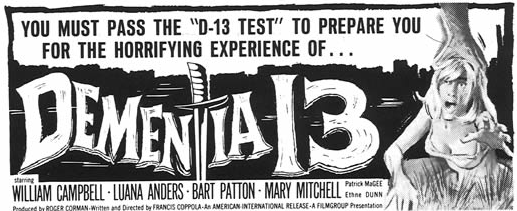
Horror Film Review: Dementia 13 (dir by Francis Ford Coppola)


So, imagine that the year is 1963 and you are the legendary producer/director Roger Corman. You’ve just finished shooting your latest film and it turns out that you didn’t spend all of the money that you had allocated to make it! You’ve got an Irish castle at your disposal and some extra cash. Why not assign your ambitious assistant to make a quick little movie that’s specifically designed to cash-in on the success of Psycho and it’s numerous imitators?

And that, of course, is how Francis Ford Coppola came to direct his first film. Today, of course, Coppola is best known for directing three of the best American films of all time, The Godfather, The Conversation, and The Godfather Part II. (Some people would include Apocalypse Now in that list, as well.) In 1963, he was just another aspiring filmmaker making his debut under the watchful eye of Roger Corman.

Coppola both wrote and directed Dementia 13. The film’s a pretty nifty little horror/mystery. Of course, the plot doesn’t make much sense if you give it too much thought but any fan of the Roger Corman-style of film making should be used to that by now.

Luana Anders plays Louise Haloran, the film’s greedy femme fatale. When we first meet her, she’s calmly watching her husband drop dead of a heart attack. After learning that she’s not going to be receiving any sort of inheritance because her husband died before his mother, Louise decides to invite herself to the Haloran family castle, where her mother-in-law, Lady Haloran (Eithne Dunne), is about to take part in an annual ceremony that is meant to pay tribute to Haloran’s dead daughter, Kathleen. Looking for a way to try to trick Lady Haloran into making Louise her heir, Louise tries to fool Lady Haloran into believing that Kathleen is trying to contact her from beyond the grave.

Got all that? Because I’m not going to try to type it out again.

Anyway, I don’t want to spoil the rest of the plot but let’s just say that it all leads to a midnight swim and a shocking axe murder. Who could be the killer be? Could it be one of Louise’s two brother-in-laws, Richard (William Campell) and Billy (Bart Patton)? Could it be the local doctor, Justin Caleb (Patrick Magee?) Or how about Richard’s fiancee, the oddly named Kane (Mary Mitchell?” Or how about Simon (Karl Schnazer), the local poacher? Or maybe Kathleen really has risen from the dead? Or how about….

Well, look, it could be a lot of people. Dementia 13 has a labyrinth plot and it’s got a few twists that you probably shouldn’t spend too much time thinking about. It’s very much a young director’s film but, at the same time, that’s also the film’s greatest strength. Coppola reportedly got in trouble when the film went overbudget (which is something that had never previously happened on a Corman film) but the end result is a film that features several spooky visuals, an ominous atmosphere, and one very shocking murder. You wouldn’t necessarily watch a film like Dementia 13 and think that the director would go on to make something as great as The Godfather. But Coppola’s talent, even if it’s a bit unformed, is still very much noticeable while watching his directorial debut.

Speaking of watching the film, it’s in the public domain so it’s very easy to watch! Pick up a Mill Creek 50-DVD box set and there’s a good chance you’ll find Dementia 13 included within. Or, you can just go over to YouTube and watch it for free!

Enjoy!

Horror On The Lens: Gammera The Invincible (dir by Noriaki Yuasu and Sandy Howard)


Okay, I’ll be the first to admit that 1966’s Gammera The Invincible is not really a horror film.  Maybe there was a time when people found the idea of a giant, fire-breathing turtle to be scary but I kind of doubt it.

But let’s think about this!  What better time is there to watch a movie about giant, fire-breathing turtle than in October?

Seriously, this is a fun movie and if you’ve got some time to kill this morning, I guarantee this movie will make you smile.

As I wrote in my 2014 review of this film, Gammera is one hell of a turtle.

Enjoy!