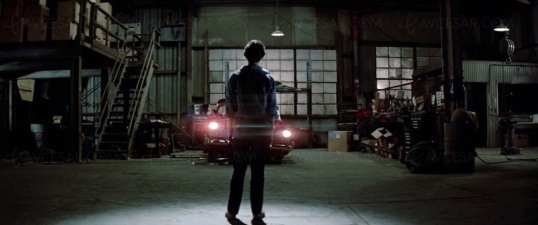
4 Shots From 4 Films is just what it says it is, 4 shots from 4 of our favorite films. As opposed to the reviews and recaps that we usually post, 4 Shots From 4 Films is all about letting the visuals do the talking.
This October, I am going to be using our 4 Shots From 4 Films feature to pay tribute to some of my favorite horror directors, in alphabetical order! That’s right, we’re going from Argento to Zombie in one month!
Today’s director in Lamberto Bava, one of the most underrated directors in the history of Italian horror cinema.
4 Shots From 4 Lamberto Bava Films
A Blade In The Dark (1983, dir by Lamberto Bava, DP: Gianlorenzo Battaglia)
Demons (1985, dir by Lamberto Bava, DP: Gianlorenzo Battaglia)
Midnight Killer (1986, dir by Lamberto Bava, DP: Gianlorenzo Battaglia)
Delirium (1987, dir by Lamberto Bava, DP: Gianlorenzo Battaglia)
The 1940 film, Black Friday, opens with Dr. Ernest Sovac (Boris Karloff), a once-respected scientist, being led out of his cell on Death Row and being taken to the electric chair. As he enters the death chamber, he hands one of the gathered reporters his journal. Dr. Sovac says that he wants the reporter to know the true story of how he came to be on Death Row. While the police strap Dr. Sovac into the electric chair, the reporter reads the journal.
It’s flashback time!
Months earlier, Dr. Sovac’s best friend, an befuddled English professor named George Kingsley (Stanley Ridges), is nearly fatally injured when he has the misfortune to get caught in the middle of an attempt to assassinate a gangster. In order to save George’s life, Sovac performs a brain transplant, giving George part of the gangster’s brain. George does recover but now he’s got the gangster inside of his head, trying to take control. Much like Dr. Jekyll, George continually switches identities and becomes a viscous hoodlum who is looking for revenge against those who betrayed him, including gang boss Eric Marnay (Bela Lugosi).
Dr. Sovac, however, is more concerned with the fact that, before he died, the gangster apparently hid a good deal of money somewhere. Sovac wants that money for himself so that he can build his own laboratory and hopefully help other people with otherwise incurable brain conditions. Sovac tells himself that, once he gets his hands on the money, he can find a way to rid George of his evil alternative personality. But until George finds the money, Sovac is content to allow George to continue turning into a murderous gangster. Things, however, come to a head when George starts to threaten Sovac’s daughter (Anne Gwynne).
Black Friday is yet another Universal Horror Film featuring Boris Karloff was a mad scientist. What makes Dr. Sovac a compelling character is that he starts out with the best of intentions. He just wants to save the life of his best friend and Sovac’s desperation is increased by the fact that George himself was just an innocent bystander when he was injured. Later, when Sovac starts searching for the gangster’s money, his intentions are again not necessarily bad. He sincerely wants to do some good with that money and he uses those good intentions to justify allowing George to do some very bad things. In the end, Sovac becomes so obsessed with being able to fund his laboratory that he loses sight of the price that both he and George are having to pay. Karloff does a great job of playing Sovac, showing how a kind man manages to lose track of his morals until it is too late. Stanley Ridges is also well-cast as George and does an excellent job of switching back and forth from being a befuddled professor to a ruthless gangster. There’s an excellent scene in which George, attempting to teach his class, suddenly hallucinates that all of his students have become gangsters. Ridges does a great job playing it.
Reportedly, the film was originally conceived with Karloff playing George and Bela Lugosi playing the role of Dr. Savoc. However, Karloff said that he would rather play Savoc and, as such, Lugosi lost a role for which he probably would have been very well-cast. Since Lugosi was a bit too naturally sinister for the role of George, he instead had to settle for a small role as a gang leader. Lugosi, it should be said, is a convincing gangster but it’s still hard not to be disappointed that, in this film, he and Karloff don’t share any scenes together.
In this film from 1936, Anna Lee plays Dr. Clare Wyatt, who leaves behind her reporter boyfriend (John Loder) so that she can accept a job working with the eccentric scientist, Dr. Laurience (Boris Karloff). Dr. Laurience lives in a spooky mansion with a sarcastic, wheelchair-bound assistant (Donald Calthorp). It turns out that Dr. Laurience believes that he has discovered how people can switch minds and bodies. The scientific community ridicules Dr. Laurience but soon, Laurience is putting his theories to the test. Dr. Laurience finds himself falling in love with Clare but he knows that she’s in love with her suspicious boyfriend. What if Dr. Laurience changed his mind?
This is an entertaining British production, featuring almost the entire cast playing more than one role as various minds are moved into different bodies. That said, the film is dominated by the great Boris Karloff, who gives one of his most enjoyable performances as the mad Dr. Laurience. Though Karloff became a star playing the Monster, he always seemed happier whenever he got to play the mad scientist.
Though the song’s title was taken from a 1964 B-science fiction film, the song itself was about the very real fear of nuclear war. To understand this song, it is important to remember that, in the 1980s, nuclear war was viewed as something that was destined to happen eventually. Teachers and school counselors were even specifically trained on how to talk to children who woke up one morning, saw the wrong story on the morning news, and came to school terrified that the bombs were going to drop at any moment. I guess the nearest equivalent of that today would be the fear that we only have ten years left due to climate change.
Luckily, after the collapse of the Soviet Union, it looked like nuclear war had been avoided. Over the past few years, though, I’ve seen a return of those earlier fears as more and more nations brag about developing their nuclear capabilities. As a results, songs like this will always feel more relevant than we may want them to.
“What does it take to light a madman’s fuse? Just a twinkle in a young girl’s eye?” The Hitchhiker (Page Fletcher) asks us. “If the hunger for love can drive a man to murder, well… that’s when a fellow really needs a friend.”
Tonight, on The Hitchhiker, two dangerous men form a combustible friendship. Trout (Bill Paxton) is wild and loud and rambunctious. Wax (Bud Cort) is a nerdy and mild-mannered serial killer. Trout and Wax bond and become unlikely friends but that friendship is threatened when they pick up a sex worker named Sunny (Jonelle Allen).
This episode, featuring excellent performances from Bill Paxton and Bud Cort, originally aired on April 14th, 1987.
1987’s Doom Asylum opens with a tragic auto accident. Attorney Mitch Hansen (Michael Rogen) is out for a drive with his girlfriend, Judy (Patty Mullen). When Mitch crashes his car, Kiki loses a hand and dies on the spot. Mitch lives but he’s so horribly disfigured that everyone assumes that he’s dead and he’s sent to the morgue. When two coroners attempts to slice him open, an angry Mitch responds by killing the coroners. Personally, I imagine that Mitch could have just sued them for malpractice because he was, supposedly, an attorney. Oh well, whatever. Mitch looks like crap now and he has a bunch of surgical tools. Now, he just needs a deserted asylum and a bunch of dumbass teenagers.
Ten years later, a bunch of dumbass teenagers show up at a deserted asylum. They want to have a picnic. Unfortunately, a local riot grrrrl band is already using the asylum for band practice. The two groups try to co-exist but it proves to be difficult. The band sees the teenagers as being sell-outs. The teens view the band as just being noisy and obnoxious. Water-filled condoms are tossed at the teens. Meanwhile, one of the teens shuts off the power so the band can no longer practice. One of the teens is played by Kristin Davis, years before she would find fame as Charlotte on Sex and the City. Another one of the teens is Kiki (Patty Mullen), the daughter of Judy.
Anyway, Mitch is also living in the asylum and he gets annoyed with both the band and the teens so soon, he’s following everyone around and using his stolen surgical tools to kill anyone that he manages to catch alone. Making Mitch’s job easy is the fact that everyone keeps wandering off by themselves, even though the asylum is obviously a dangerous place and it often doesn’t make any sense to wander off. It also helps Mitch that both the teens and the members of the band never seem to actually try to run or anything whenever Mitch shows up with a surgical drill or with a bone saw. Instead, they just kind of stand there while Mitch drills out their brains. Poor Kristin Davis actually sits down in a chair while Mitch is approaching her, as if she figured that she might as well be comfortable for whatever was about to happen. This being a late 80s slasher film, Mitch has a series of one-liner, the majority of which appear to be related to his former profession as an attorney. Unfortunately, the sound quality is so bad that I had a hard time understanding the majority of his quips.
Give credit where credit is due, the deserted asylum is a wonderfully creepy location and, just judging from all of the graffiti on the walls, I assume it was also an authentic location as well. The scenes were the camera prowls through the deserted hallways were genuinely effective. But, otherwise, the film can’t overcome the combination of bad acting, a seriously lame script, and some risible attempts at comedy. There’s a lot of blood but it ultimately doesn’t add up to anything more than another generic slasher.
1989’s Beware! Children At Play opens with a son and his father on a camping trip. They’re having a great time, up until the minute the father steps on a bear trap and ends up trapped on the ground. His son fails to open up the bear trap and, over the course of three days, his father slowly dies. With his dying breath, the father tells his son to cannibalize his body after he passes.
Ten years later, a small town in New Jersey has a problem. People, most of whom are children, are mysteriously vanishing. Sheriff Carr (Rich Hamilton) has no idea what’s happening, which is especially frustrating as his daughter Amy is among the missing. Sherriff Carr’s old friend, novelist John DeWolfe (Michael Robertson), comes to town for a visit and he discovers that the townspeople are being killed by their own children. The children have been brainwashed by a feral teenager who lives in the woods, a teenager who calls himself Grendel.
Even as John tries to track down Grendel’s compound, the townspeople prepare to go to war against the children who are living in the woods. Early on, an ill-destined traveling bible salesman refers to the town as being a part of the “New Jersey Bible Belt,” and it turns out that, just as the children are following Grendel, the adults are obsessed with their own idea of divine retribution. Can John save the children from both Grendel and the townspeople?
No, he cannot.
Beware! Children At Play opens with the Troma title card, which should be enough to frighten even the most resilient of audiences. Like most Troma films, it’s violent and, at times, surprisingly mean-spirited. The budget is low but the gore is grotesquely memorable, with characters getting chopped in half and used as scarecrows and every other horrible thing that you might expect to happen to someone on a farm. As for the performances, it’s a typical Troma film, with everyone either overacting or underacting. The townspeople shake with rage as they prepare to enter the woods in search of the children. Michael Robertson attempts to change their minds by shouting random insults at them. There’s a moment, at the start of the film, where John and his wife (Lori Romero) debates the merits of John’s books and the pedantic dialogue was so stiffly delivered that I nearly yelled at the screen.
That said, I don’t think anyone who sees this film will remember much about anything that happens before the film’s final ten minutes. At the end of the film, the adults finally find their children and set out to get their revenge. Those final ten minuets are considered to be some of the most controversial in the history of Troma, with Lloyd Kaufman claiming that they caused a mass walkout when the trailer for the film played at Cannes. One could argue that the finale is meant to suggest that the children learned their evil from their parents but, more realistically, this is a Troma film and Troma has always understood the power of controversy to sell tickets. The final ten minutes would be incredibly disturbing, if the actors were more convincing and if the special effects weren’t so cheap looking, particularly when compared to the gore effects seen earlier in the film.
Killer kids will always been creepy and they are certainly creepy in this film. In the end, though, this is still a Troma film and never as disturbing as a film about a cult of killer children should be. In the end, I could only ask myself, “Why does this stuff always happen in New Jersey?”
First released in 2010, Birdemic: Shock and Terror is a film that has a very specific reputation.
Chances are that, even if you haven’t watched the entire film, you’ve come across clips from Birdemic online. It’s the film where the birds attack humanity because of global warming. When the birds attack, they dive bomb the buildings below, exploding when they make contact. Whenever a bird attacks, it sounds like an airplane. Though the majority of the birds are described as being Eagles, they all sound like sea gulls. The birds themselves are all the result of cartoonish CGI, which leads to several scenes of the birds hovering in the air while the actors vainly shoot at them or try to wave them away with a clothes hanger.
Birdemic is famous for its bad acting. It’s famous for the conference room scene where a bunch of engineers and salespeople are told that they’ve all earned their stock options and they proceed to spend the next ten minutes or so applauding. Birdemic is famous for the scene where Damien Carter performs “Hanging With My Family” while the film’s stars dance in such a way that indicates that they couldn’t hear the song while they were filming. Birdemic is famous for director James Nguyen’s attempts to pay homage to Alfred Hitchcock, from the birds to the Vertigo-inspired scenes of people in San Francisco. Tippi Hedren is listed in the end credits, even though she only appears on television at one point.
Whenever I watch Birdemic, I’m struck by just how boring it is. Seriously, it takes forever to get to all of the stuff that the film is famous for. The birds don’t start attacking until nearly an hour into the film. Instead, the first part of the film is made up of awkward scenes of salesman Rod (Alan Bagh) dating aspiring model, Nathalie (Whitney Moore, giving the only adequate performance in the film). (In a typical example of their sparkling dialogue, Nathalie informs Rod that she’s just been hired by Victoria’s Secret. “I’m sure you’ll look great in their lingerie,” Rod replies.) We watch as Rod meets Nathalie’s mother and takes her to the movies and goes out to eat with her and eventually, they perform their infamous dance to Hanging With My Family. They also go to see An Inconvenient Truth, which really inspires Rod to think about what humanity is doing to the planet. Rod announces that he’s getting a hybrid.
The main thing that distinguishes Birdemic from other bad movies is just how seriously it takes itself. With all of its talk about the environment and how the birds are angry over what humans are doing to their planet, it becomes very obvious the Birdemic is a film with a message and James Nguyen sincerely believed that the solution to climate change was to get people to watch his movie. Birdemic was a film made to make people think, in much the same way that An Inconvenient Truth inspired Rod to think about getting a hybrid someday. Al Gore may have used a power point presentation to win an Oscar for himself. James Nguyen used some bad CGI birds and he didn’t win anything, other than the hearts of viewers.
It’s true that Birdemic is a film that caused people to think. Of course, few of those thoughts had to do with protecting the environment. Birdemic may have been too ambitious for its own good but it has still established a place for itself in our culture. Birdemic will never be forgotten.
In a nearly bare room, The Player (Abbi Butler) sits at a table. The Player is taking part in what she had been told is an international challenge. The Game Master (James J. Fuertes) tells her what task she is expected to do. If The Player accepts the task and is not the first person to drop out of doing the task, she’ll move on to the next round. If The Player refuses the task or fails, she’ll be out and who knows if she will even be allowed to leave the room.
The challenges start out as simple things, like holding her hand over an open flame for as long as she can. But as the game progresses, the challenges get more and more extreme. Burning her hand is nothing compared to chopping off her fingers.
The Game Master remains in the room with the Player the entire time, occasionally encouraging her and sometimes taunting her. With each challenge, he dares her to drop out of the competition. But is The Game Master in charge of the competition or is he just another competitor? The Player only has the Game Master’s word that there’s even a competition going on in the first place. With each escalating round, the Player and the Game Master attempt to manipulate each other and psychologically break the other one down.
Featuring a small cast and only one location, The Odds is stagey and sometimes draggy but it is redeemed by the performances of James J. Fuertes and Abbi Butler. Even though some of the dialogue feels overwritten, the movies does keep you guessing about what is actually happening in the room and what the Game Master is actually trying to accomplish by forcing The Player to torture herself. The final exchange between The Game Master and The Player is an effective mind screw that makes you reconsider everything that has happened up until that point. TheOdds is uneven but it holds your attention and keeps you thinking.