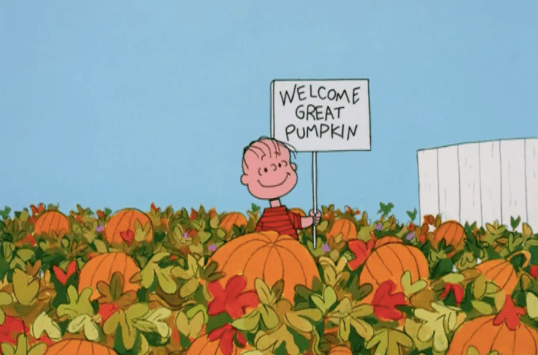
I don’t know about you but, after Game 5 of the World Series, I am praying to the Great Pumpkin for a Halloween miracle.
The Blue Jays are one game away from winning the World Series. Game 6 will be played tomorrow, on Halloween night. I want to spend my Halloween handing out candy and dancing the monster mash. (It’s a graveyard smash.) I do not want to spend it watching my least favorite baseball team win the World Series. The Blue Jays deserve a lot of credit for how they’ve played this season but, until they fully exorcise the spirit of Jose Bautista and his bat flip from the team, I cannot support them.
I know people don’t like the Dodgers. I don’t care. They’re the only thing keeping the Blue Jays from winning the World Series.
Tomorrow’s game is pivotal. If the Dodgers win, Game 7 will be played on November 1st and, if the Blue Jays do take the Series, at least it won’t happen on a holiday. If the Blue Jays win Game 6, it’s all over.
I’m going to be make sure this household is the most sincere in the neighborhood so that the Great Pumpkin will give me what I want.
In this video, Arnold Schwarzenegger is sent to the past to eliminate Guns N’ Roses but ultimately decides that it would be a waste of ammo. Obviously, he knew that fulfilling his mission would change history and the world would never get to hear Chinese Democracy.
This song (and this video) were used to promote Terminator 2: Judgement Day.
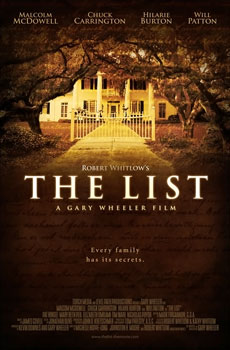
2007’s The List opens during the dying days of the American Civil War.
A group of wealthy plantation owners form a secret society. They pool together their fortunes and they each sign onto a list. Over the years, whenever a member of the Society passes away, their eldest male descendant replaces them on the List and also has access to the fortune that that the Society secretly holds.
In 2007, directionless attorney Renny Jacobsen (Chuck Carrington) is shocked when his father dies and leaves him next to no money. As Renny tells us over and over again, he really could have used some of his father’s fortune. However, his father does leave him a key the leads to Renny uncovering a tape that explains everything that he needs to know about the Society. All Renny has to do is sign his name to the List.
The Society is now run by Desmond Larochette (Malcolm McDowell) and we know that he’s evil because his name is Desmond Larochette and he’s played by Malcolm McDowell. Larochette seems to be more than happy to allow Renny to join the Society but he’s not quite as happy that another member of the group died and only left behind a female heir, Jo Johnston (Hilarie Burton). The members of the Society are faced with quite a quandary. Should they allow a woman to join their society? And, if not, what should they do now that she know about the Society’s existence?
When Jo goes to the mansion for the Society’s meeting, she spots a portrait of a gray-haired gentleman and asks who he is. Gus Eicholtz (Pat Hingle) explains that the painting is of John C. Calhoun, who served as Vice President under Andrew Jackson. “He looks angry,” Jo says and honestly, that was a piece of historical and artistic criticism that was so simple-minded that Jo really should have been disqualified from joining the Society at that very moment.
First off, how are you going to join a Southern secret society if you don’t know how John C. Calhoun is? Secondly, the portrait in question is actually a pretty famous one. George Alexander Haley painted it while Calhoun was Secretary of State. Even if you don’t know who John C. Calhoun is, chances are that you’ve seen the painting. Finally, there’s the claim that “He looks angry.” The painting was completed in 1845. Everyone looked angry in 1840s! Even the noted bon vivant Henry Clay looked angry in his 1848 State Department portrait. (And Clay actually had his picture taken for his official portrait. Imagine how furious he would look if someone had painted him?)
Anyway, Renny joins the society but Jo does not, But then Renny discovers that it’s not as easy to get his hands on the money as he thought and he spends the entire movie complaining about it. That’s pretty much it. There is some suggestion that Desmond might have demonic powers, but it’s not really explored. Another heir dies mysteriously and it seems like Jo is being targeted as well. Again, it’s not really clear why. In the end, Renny puts God before the money but it kind of comes out of nowhere. It’s a muddled story and, by the end of the film, it’s still a struggle to figure out what it all meant. At the very least, Malcolm McDowell seemed to be having fun, playing an evil character and speaking in an almost indecipherable accent.
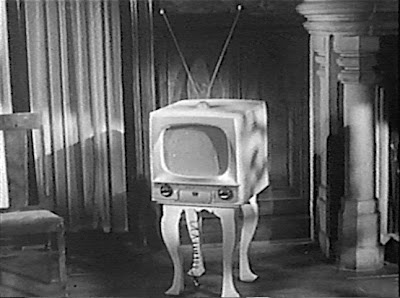
For today’s horror on television, we’re very happy to present to you, Dead of Night!
From 1977, this television film is a horror anthology, made up of three stories directed by Dan Curtis and written by Richard Matheson. In the first story, a youngish Ed Begley, Jr. travels through time. In the 2nd story, Patrick Macnee plays a man whose wife is apparently being menaced by a vampire. And in the third story, Joan Hackett plays a mother who brings her dead son back to life, just to discover that sometimes it’s best to just let sleeping corpses lies.
The entire anthology is good, though the third story is clearly the best and the most frightening. Not only is it scary but it’s got a great twist ending.
Hey, hey, wait just one second. Lifeforce is a movie everyone treasures. Here’s Arleigh’s take on the film. Check that out first and then double back here if you like.
Lifeforce (1985, dir by Tobe Hooper)
Tobe Hooper’s Lifeforce is one of those films that had a lot of play in my Grandmother’s house, primarily because of my younger Aunt, Puddin. Puddin was the other movie lover on my Dad’s side of the family, the youngest of his generation. While she couldn’t fully make the connections between actors or directors the way my father could, she loved films all the same. With films like Marnie, West Side Story, Conan the Barbarbian, she spent most of her free time immersed in movies. If you wanted to see her swoon, mention Sean Connery, Tyrone Power or Arnold Schwarzenegger in her presence. She had a habit of using movies she watched often as white noise when cleaning around the house. As a result, we saw Lifeforce a lot growing up. She adored the film mainly because the two heroes in it barely made any mistakes, but most importantly for Henry Mancini’s score. Besides, It’s a Cannon film. You know it’s good.
Lifeforce is the story of one of the greatest buddy pairings in of the 1980s. Yeah, Beck and Gallagher did awesome stuff in The Hidden. Riggs and Murtaugh solved the cases no matter how thin the leads were, and even with all his technology, Alex Murphy still needed Lewis for backup. These all pale in comparison to Lifeforce‘s Colonel Carlsen (Steve Railsback, Helter Skelter) and Colonel Caine (Peter Firth, The Hunt for Red October). The two characters’ laser focus and quick thinking help to keep the film moving, despite how crazy things can and do get. They also manage to have each other’s back in nearly every situation. They aren’t without troubles, however. Poor Carlsen is plagued with nightmares of making out with naked space vampires.
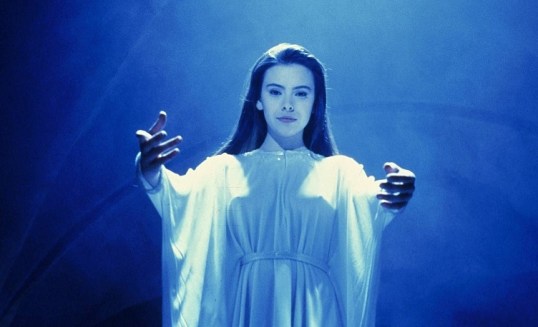
Halley’s Comet returns close to Earth. With it comes an incredibly large umbrella shaped ship that is discovered by the crew of the Churchill. Col. Carlsen, along with the other astronauts, find a series of sleeping humanoid bodies inside and bring 3 (two males and one female) on board. When the Churchill’s signal is lost, the Columbia is sent out to retrieve them. The crew is lost, Carlsen is missing, but the 3 alien bodies are brought back home to Earth for study. This goes about as well as one would hope, with the Space Girl (Mathilda May, Becoming Collette) waking up and causing havoc throughout the local Space Institute before walking away naked, into the night. Anyone she comes into contact with and kisses becomes an energy vampire, requiring a transfusion, else they shrivel and turn into dust.
Since we’re dealing with space vampires, I should inform you now that there’s quite a bit of nudity and maybe just a wee bit of sexual tension in Lifeforce. The lines between Rabid and Showgirls comes kind of close in all this. When Carlsen forces a possible suspect to divulge the location of the Space Girl, slapping her up a bit, he tells Caine he should leave. Caine’s response is that he’s “a natural voyeur”. Does much of it make sense? No. Was it entertaining? Sure. The third act of Lifeforce is the best part, with all of London just a mess. Despite all this, Carlsen & Caine split up to save the day.
The cast for the film is nice. In addition to Railsback and Firth, we’ve got a Dune crossover with both Freddie Jones and Patrick Stewart on hand. We also have a small cameo with Dragonslayer’s John Hallam as a nurse. The best role other than the leads go to Frank Finlay and to Mathilda May. Finley’s Doctor Fallada is kind of a Van Helsing like character, piecing together all of the clues so our heroes can take the proper action. May, though she’s not given a lot to say (or to wear, for that matter) makes for an impressive villain that talks with her eyes.
The effects for Lifeforce came by way of John Dykstra, who worked on Firefox and The Empire Strikes Back. He’d later go on to work on Invaders From Mars for Hooper. Musically, Henry Mancini’s score helps to carry the film along. Honestly, I’ve only ever known him from the Pink Panther scores, so I quite enjoyed it. I always let the end credits play through for the music. Overall, Lifeforce is a great watch if vampires are your thing and nudity isn’t too much of a problem. In my mind, The Adventures of Carlsen & Caine would rival some of the best supernatural tales.
In examining this, I also found that there are some connections between this and Hammer Films’ Five Million Years to Earth (a.k.a. Quatermass and the Pit). I’m still on the look out for that one.
In Tobe Hooper’s Lifeforce, Col. Carlsen & Col. Caine aren’t playing around.
2021’s 616 Wilford Lane is an odd film that has a twist ending that makes the entire film difficult review. The easy solution would be to just give away the ending but it’s actually a pretty good (if somewhat implausible) twist and I really don’t want to ruin it for anyone watching the movie. So, just take my word that there’s more to 616 Wilford Lane than meets the eye.
The films open Paranormal Activity-style, with grainy security footage of an apparently possessed young man killing his parents and his younger sister. The murders occur at 616 Wilford Lane, a lovely house in a wealthy town. The house sits empty for nearly a year until the real estate agent, Austyn (Jasmine Waltz), is able to sell it to Jim (John Littlefield). Jim explains that his wife just died and he’s looking for a nice house for himself and his teenage daughters, extrovert Randy (Jessica Chancellor) and intellectual Staci (Alyson Gorske). Austyn, realizing that she finally has chance to sell the murder house, doesn’t tell him about 616 Wilford Lane’s past.
No sooner have Jim, Randy, and Staci moved in then strange things start happening. Staci sleepwalks. Randy thinks that she sees someone looking through her window. There are strange sounds throughout the house. Staci starts to give lingering looks to the rifle that Jim owns but swears he has never fired. Jim seems as if he’s too busy sleeping with Austyn to notice what’s happening in his house. Meanwhile, the town’s mayor (Eric Roberts) warns Jim not to call the police every time something strange happens….
There are a few odd things about this film’s plot and specifically the way that some of the characters behave and talk to each other. When I was watching the movie, my first assumption was that it was just a case of an inconsistent script. However, the twist ending reveals that the film know exactly what it was doing. All of those strange moments — especially where Jim was concerned — suddenly made sense during the film’s final 10 minutes. Moments that I originally dismissed as just being a case of poor writing actually turned out to be clues as to what was going on in the house. 616 Wilford Lane is not a flawless film but it’s one that still turned out to be considerably more clever than I was expecting it to be.
Plus, the film feature Eric Roberts! And, for once, Roberts actually gets to play a real character. As the Mayor, Roberts is all smiles until he starts to suspect that Jim might bring some bad publicity to his town. Roberts gives a good performance here. Also giving good performances were Jessica Chancellor and Alyson Gorske, both of whom brought their characters to life in a way that made the twist ending all the more interesting. Randy had red hair, spent a lot of time talking about her boobs, and flirted with almost every guy she met so, for once, I felt represented in a movie.
I recommend 616 Wilford Lane. Make sure you stick around for the twist at the end.
Previous Eric Roberts Films That We Have Reviewed:
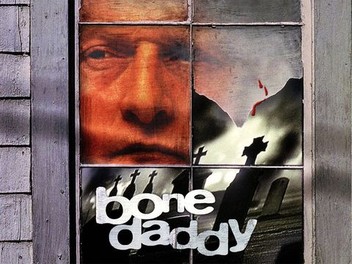
I became obsessed with the actor Rutger Hauer in the summer of 1990. I was about to go into my senior year of high school, and I was attending the Arkansas Governor’s School. I had seen Hauer before in films like THE HITCHER and WANTED: DEAD OR ALIVE, but as part of our curriculum, we all watched BLADE RUNNER and then broke up into smaller groups to analyze the film. Blown away by the film, Hauer’s powerful performance, and the opportunity to engage in a serious conversation about a movie with my peers, it was a rewarding experience, and I soon found myself seeking out every Hauer film I could find. I followed the charismatic Dutch actor’s career closely from that point forward, all the way up to his death in July of 2019. I was actually sitting on a beach in Florida when I read that he had passed away. Based on my extreme interest in every project that Hauer was associated with, I specifically remember when BONE DADDY premiered on HBO in 1998. I didn’t have HBO so I had to wait for a few months to catch it when it arrived on home video.
In BONE DADDY (1998), Rutger Hauer stars as Dr. Bill Palmer, a retired Chicago medical examiner turned bestselling author. Years earlier, Palmer investigated a series of brutal unsolved murders committed by a serial killer known as “Bone Daddy.” Retiring in frustration from not being able to solve the murders, Palmer pens the novel, “Bone Daddy,” a fictionalized account of the crimes where, unlike real life, the killer is caught and brought to justice. The book’s runaway success catapults Palmer to fame, but it also seems to pull the notorious Bone Daddy out of retirement. When his literary agent, the cocky, Rocky Carlson, is kidnapped and subjected to the killer’s signature torture, the surgical removal of bones from a living body, Palmer finds himself back on the case and teamed up with the no-nonsense police detective Sharon Wells (Barbara Williams). As the bones and the suspects pile up, Palmer is determined to make sure the killer is found and brought to justice this time around!
BONE DADDY is a pretty darn good entertainment option if you’re in the mood for an undemanding serial killer flick that’s in and out of your life in 90 minutes. It’s certainly not in the same league as SE7EN, but that doesn’t mean it can’t be enjoyed for what it is. The premise is pretty twisted, and the scenes where the killer is preparing to remove the bones of fully coherent victims is horrifying to say the least! There isn’t a lot of gore, but what’s there is pretty gross. This is B-movie territory and the lack of Hollywood gloss works in its favor. The film’s plot also has quite a bit of family drama between Dr. Palmer and his adult son Peter (Joseph Kell), who’s following in his dad’s professional footsteps in the medical field. It seems Dr. Palmer wasn’t the greatest dad and the current state of their relationship figures strongly throughout various portions of the film. This element of the story is actually handled quite well and adds some interesting tension as we move towards the end.
At the end of the day, the best thing about BONE DADDY is the presence of Rutger Hauer in the lead. He brings gravitas to the role of Dr. Palmer, a man who has had his share of successes and failures in the world. It’s his failures that continue to haunt him throughout this story and seems to put everyone around him in danger. Hauer, known for his ability to go over the top at times, plays the role completely straight with the quiet intensity and determination of a man trying to make up for past wrongs. It’s another solid performance in the career of the then-53 year old actor. I also want to give a special shout out to his nice, bushy mustache. I enjoyed it very much! The other primary performance of the film comes from Canadian actress Barbara Williams as the lead cop. In contrast to how much I enjoy Hauer, I’m just not much of a fan of Williams. She seems to be in a perpetual state of being offended in every role I’ve seen her in. She played Charles Bronson’s daughter in the FAMILY OF COPS series and her character was always on the ready to jump down someone’s throat for just about anything they said. It’s kind of the same here. I should probably try to look for some more of her work just to see if she ever smiles.
Overall, I think BONE DADDY is worth a watch, especially for fans of Rutger Hauer or movies about serial killers. The plot is predictable, and so is the identity of the killer if you’re paying attention, but you could definitely do a lot worse!
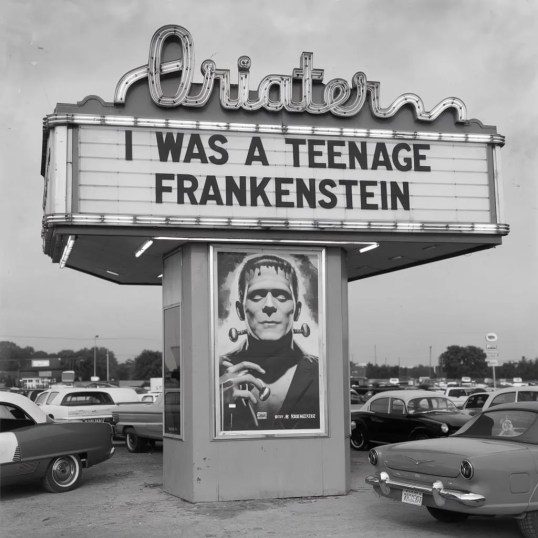
This film was produced as a direct result of the box office success of I Was A Teenage Werewolf. Just as in Teenage Werewolf, Whit Bissell plays a mad scientist who makes the mistake of trying to play God. (He also makes the mistake of keeping an alligator in his lab but that’s another story.) The end result …. Teenage Frankenstein!
The makeup on the Teenage Frankenstein is probably the best thing about this film. If nothing else, this film features a monster who actually looks like he was stitched together in a lab.
Since we’ve been talking a lot about the original Little Shop of Horrors today, it’s only appropriate to share a scene from the remake for today’s scene of the day.
From 1986’s Little Shop of Horrors, here is Steve Martin performing Dentist! Because there’s nothing scarier than going to the dentist, right?



 Through the Shattered Lens