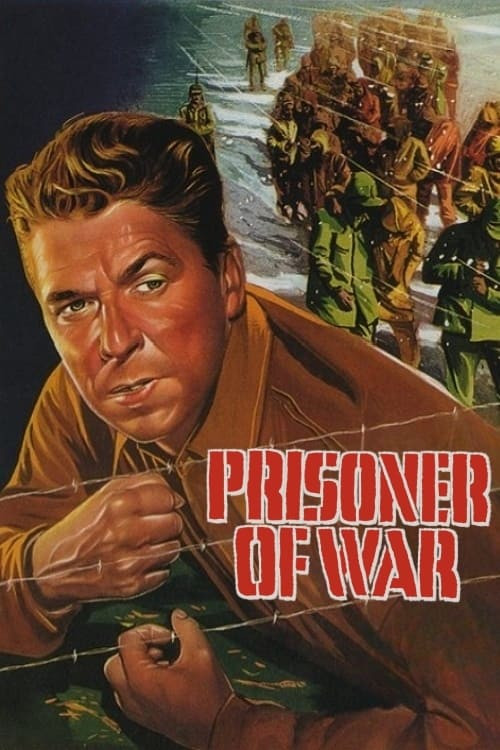
Prisoner of War (1954, directed by Andrew Marton)


The setting is the Korean War.  After getting information that American POWs are being tortured and brainwashed in North Korean prisoner-of-war camps, Major Hale (Harry Morgan) assigns Webb Sloane (Ronald Reagan) to go undercover.  After parachuting behind enemy lines, Webb spots a group of POWs being marched through the snow and joins the group.  From the minute that Webb joins the march, he begins to observe war crimes.  The death march itself, with the POWs being forced to move in freezing weather, is itself a war crime.  At the POW camp, Webb discovers the presence of an arrogant Soviet interrogator (Oscar Homolka) and a routine designed to break the POWs down until their ready to betray their native country.  Some POWS, like Captain Stanton (Steve Forrest), refuse to break.  Others, like cowardly Jesse Treadman (Dewey Martin), break all too quickly.  Webb sends the information back to Hale and eventually tries to make his escape.

It’s not terrible.  That the North Koreans and, later, the North Vietnamese tortured their POWs and forced some of them to denounce America is a matter of the historical record and, for a 1954 film, Prisoner of War doesn’t shy away from the brutality of the torture that POWs were often subjected too.  Of all of Reagan’s film, Prisoner of War had the strongest anti-communist message, though Reagan himself feels miscast as a hard-boiled secret agent.  (Reagan’s affability comes through even in a film set in a POW camp.)  Sending someone undercover into a prisoner of war camp and then hoping that they’ll find a way to escape doesn’t sound like the most efficient way to determine if the Geneva Convention is being violated.

The film features a dog who is found by one of the POWs.  Don’t get attached.

Scene That I Love: Jack Webb Sets The Hippies Straight


Today’s scene that I love comes from a 1968 episode of the iconic cop show, Dragnet.  A group of hippies want to leave the United States and start their own country.  Joe Friday (Jack Webb) and Bill Gannon (Harry Morgan) set them straight!

It’s always kind of easy to laugh a little at these episodes of Dragnet because it’s obvious that Webb had never actually met or dealt with any real hippies.  But I don’t know.  This episode, entitled The Big Departure, and this speech still feels relevant, even if I doubt it actually changed the mind of anyone planning on starting their own nation.


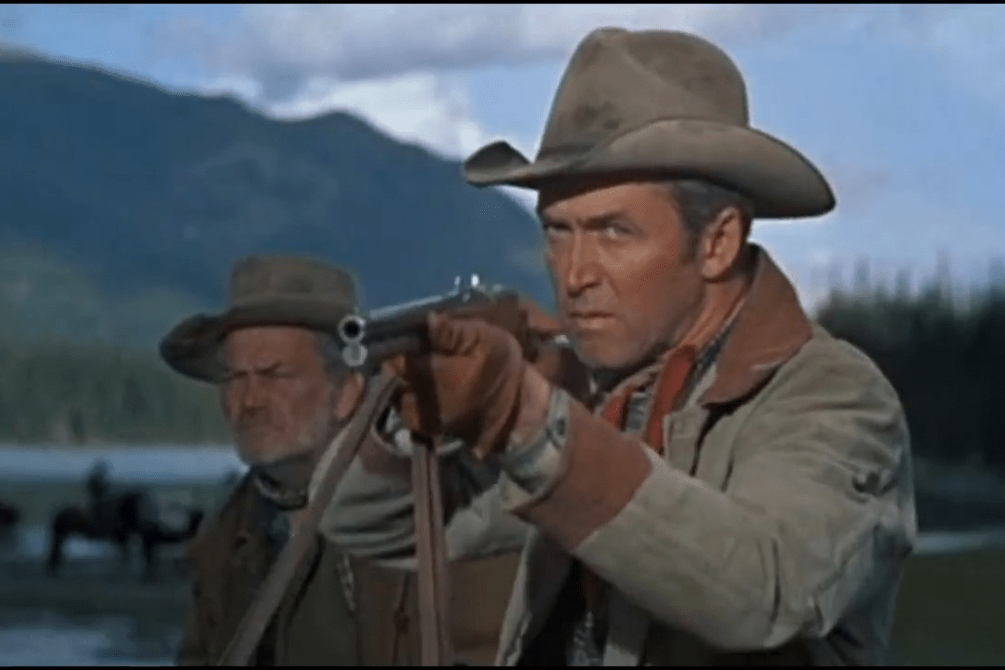
THE FAR COUNTRY (1954) – James Stewart and Walter Brennan head North to make their fortune!


James Stewart is one of the great movie stars of all-time. His work with Frank Capra (MR. SMITH GOES TO WASHINGTON, IT’S A WONDERFUL LIFE) and Alfred Hitchcock (REAR WINDOW, VERTIGO) is legendary. In my household, Stewart’s work with director Anthony Mann is celebrated just as much as those other classics. Mann and Stewart made five classic westerns, beginning with WINCHESTER ‘73 in 1950 and ending in 1955 with THE MAN FROM LARAMIE. I own them all on DVD and watch them quite often. It’s very cold in Arkansas today, so I decided to write about the Yukon-set THE FAR COUNTRY, from 1954. 

Jeff Webster (James Stewart) and his crusty ol’ coot of a partner Ben Tatem (Walter Brennan) head North towards Dawson City, in the Yukon Territory, with a herd of cattle. The two men encounter a variety of problems along the way, with the biggest being the corrupt Judge Gannon (John McIntire) of Skagway, Alaska. When Jeff finds himself in front of the judge for killing two cowhands who tried to steal his herd, Gannon acquits him on the charges but decides to keep his herd as payment for the court fees. With their cattle taken away from them, Jeff and Ben sign up to help business lady Ronda Castle (Ruth Roman) take supplies to Dawson City, where she plans to set up shop. After their first day on the trip, Jeff and Ben double back to Skagway and re-take their herd and take off towards Dawson as fast as they can go, with Gannon and his men in hot pursuit. They’re able to make it into Canada, so Gannon and his goons turn back, determined to hang the men if they ever come back through Skagway.

So Jeff and Ben make it to Dawson City with their cattle where they sell them off for $2 per pound to Ronda. Suddenly flush with cash, the two partners buy a gold claim and proceed to find some nice golden nuggets! When they head back into town, they find that Judge Gannon has now come to Dawson City and is in partnership with Ronda. Of course, that bastard immediately starts cheating the miners out of their claims, this time with gunman Madden (Robert J. Wilke) by his side, enforcing his corrupt actions with lead. Jeff and Ben decide they’re going to sneak out of town with their loot, but Gannon finds out about it and sends his men to stop them. Ben is killed in the process and Jeff is seriously injured. Jeff has tried his best up to this point to not get involved with the mess in Dawson City, but with his best friend now dead, he decides it’s time for Judge Gannon and his thugs to be stopped. 

James Stewart is just so good as Jeff Webster. The best thing about his work with Mann is how each of the movies would give him a meaty role that capitalized on his basic decency, while simultaneously making him a more complex, layered man, miles away from the likes of Mr. Smith or George Bailey. In THE FAR COUNTRY, he’s as tough as nails, but he really doesn’t want to get involved with the people around him. It takes the death of his best friend for him to finally commit to helping them stand up against the bad guys. Stewart’s work here, and in the other Mann westerns, ranks with his very best. 

The remainder of the cast is uniformly excellent. Three time Oscar winner Walter Brennan is always a welcome presence in a movie I’m watching. While he’d pretty much settled into the “old coot” role that would come to personify the later part of his career, his character is a valuable conscience for Stewart a couple of times in the story. I thought that John McIntire and Ruth Roman really stood out in their respective roles as the corrupt Judge Gannon and the stubbornly, independent businesswoman Ronda Castle. Both give excellent performances. The cast is rounded out with a who’s who of character actors like Jay C. Flippen, Harry Morgan, Robert J. Wilke, Royal Dano, and Jack Elam. It’s always nice seeing these familiar faces pop up in these old westerns.

I love it when movies are filmed on location in beautiful places. THE FAR COUNTRY was filmed at the Jasper National Park in Alberta, Canada, which added another interesting element to the film. The final thing I want to say about the film is that the screenplay for THE FAR COUNTRY was written by Borden Chase, who had penned RED RIVER a few years earlier. Not only would Chase write this movie, he would also write the screenplays for WINCHESTER ‘73 and BEND OF THE RIVER, both westerns that paired Anthony Mann and Jimmy Stewart. Chase was an excellent writer of western material, and his strong work in this group of films is crucial to their enduring success. 

Overall, I confidently recommend THE FAR COUNTRY to any person who enjoys westerns or Jimmy Stewart. I might rank THE NAKED SPUR and THE MAN FROM LARAMIE slightly above this one in the Mann / Stewart westerns, but the truth is that you can’t go wrong with any of them. 

I’m sharing the trailer for THE FAR COUNTRY below:

A Blast From The Past: Dragnet 1970 4.22 “D.H.Q.: Night School” (dir by Jack Webb)


Dragnet began as a radio program in 1949 before making it’s way over to television in 1951. Each episode starred (and the majority were directed by) Jack Webb, who played a no-nonsense cop named Joe Friday. Friday narrated every episode, dropping trivia about the history of Los Angeles while also showing viewers how the cops went about catching criminals. Despite what is commonly believed, Joe Friday never said, “Just the facts, ma’m,” but he did investigate each case with the cool determination of a professional who kept his emotions under control. The majority of Dragnet’s episodes were based on actual cases that were worked by the LAPD, hence the opening declaration of, “The story you are about to see is true.”

On television, Dragnet originally ran from 1951 to 1959, during which time Dragnet also became the first television series to be adapted into a feature film. Jack Webb decided to relaunch Dragnet in 1966 and he produced a made-for-television movie that followed Friday and his latest partner, the far more talkative Bill Gannon (Harry Morgan), as they worked multiple cases over the course of one long weekend.  That made-for-television movie led to a series that ran from 1967 to 1970.

The second television series is the best-remembered version of Dragnet, beloved for its scenes of Friday and Gannon debating the issues with a motely collection of hippies, campus radicals, and pipe-smoking academics.  Jack Webb viewed Friday as being the voice of the common American, who supported the troops, supported the president, and who wanted to spend the weekend grilling in peace.  Friday was the middle-aged suburbanite who wanted to the kids to stay off the grass, whether it was on his front lawn or being sold on a college campus.  These episodes were often campy.  It’s hard not to smile while listening to Friday and Gannon deadpan their way through conversations with flakey long-haired hippies.  It was often obvious that the writers of Dragnet had never actually had any experiences with the hippies, beyond what they saw on the evening news.  And yet, as silly as things often were, the show is an interesting time capsule of the era in which it was made.  If nothing else, it’s a chance to see the turbulent 60s through the eyes of the other side.

Last year, I shared my favorite episode of Dragnet.  For the new year, I’m sharing my second favorite, an episode that originally aired on March 19th, 1970.  In Night School, Joe Friday is attending a night class where he and his classmates sit in a circle and just “rap” about the issues of the day.  No one knows that Joe is a cop but Joe feels that he is still on duty and when he sees that the guy sitting across from him has a baggie of weed in his notebook, Friday makes an arrest.  The professor, who says “There’s nothing wrong with marijuana, I smoke it myself!,” attempts to kick Sgt. Friday out of his class.  “Would you rather be known as good ol’ friendly Joe, the class narc?” the professor asks.  Joe fights for his right to get an education and a man with an eyepatch emerges as an unlikely voice of reason.

Why do I like this episode?  There’s something undeniably entertaining about seeing straight-laced, deadpan Joe Friday attending a class with at least three hippies.  It always amuses me that, on this show, Joe Friday loosening up just means that Joe trades his suit for a sweater.  Also entertaining is Leonard Stone’s over-the-top performance as the villainous professor.  And how can you not smile at Bill Gannon’s weary claim of “I just knew there was no way you could get a B sitting around talking?”  Or Jack Webb’s delivery of the line, “That’s my thing, keeping the faith, baby?”  Or Jack Curtiss’s hyperactive performance as campus drug pusher Jerry Morgan?  “Hey, that’s just oregano!”  Whatever you say, Jerry.

Today’s blast from the past certainly does feel like a trip in a time machine.  Step on in and take a look at California in 1970!

Retro Television Review: The Love Boat 5.1 and 5.2 “The Expedition/Julie’s Wedding/The Mongala/Julie’s Replacement/The Three R’s/The Professor’s Wife”


Welcome to Retro Television Reviews, a feature where we review some of our favorite and least favorite shows of the past!  On Wednesdays, I will be reviewing the original Love Boat, which aired on ABC from 1977 to 1986!  The series can be streamed on Paramount Plus!
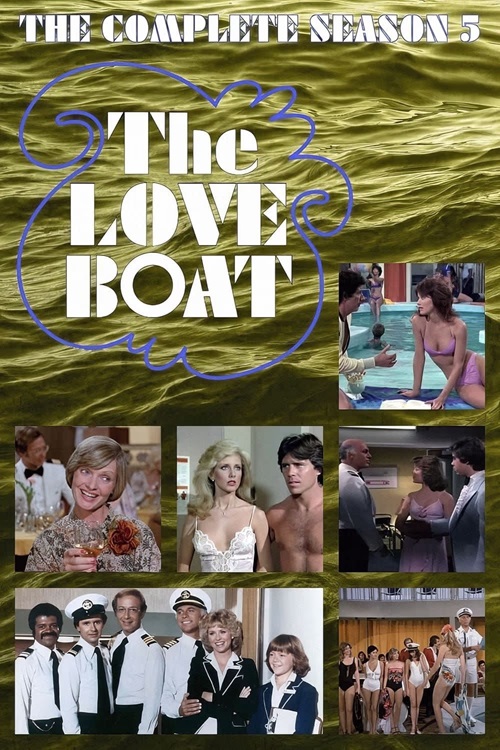
This week, we start season 5 of The Love Boat!

Episode 5.1 and 5.2 “The Expedition/Julie’s Wedding/The Mongala/Julie’s Replacement/The Three R’s/The Professor’s Wife”

(Dir by Roger Duchowny, originally aired on October 10th, 1981)

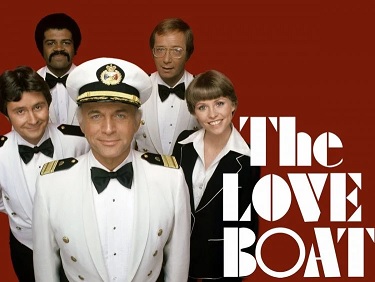
The fifth season of The Love Boat opens with a two-hour spectacular.  Our Love Boat crew is in Australia, where they will be guiding The Sea Princess on a voyage through the South Pacific.  It’s a bit odd to start off a season of The Love Boat on a different boat but I guess the plan was to show off all the different ships that sailed for Princess Cruise Lines.  This episode was actually shot on the boat during a cruise.  It’s interesting to see how different the Sea Princess is from the show’s usual location.  It has nicer hallways than the Pacific Princess and a much larger lobby.  However, I prefer the relative privacy of the Pacific Princess’s multi-level dining room to the wide open space provided by the Sea Princess.

Captain Stubing, Gopher, Isaac, and Doc are shocked when Julie does not board the ship.  She’s been on vacation with her boyfriend, Tony (Anthony Andrews), for the last few months. Tony lives in Australia so, really, it shouldn’t be too hard for Julie to make it to the ship. Instead, a substitute cruise director named Yvonne (Delvene Delaney) shows up.  Doc and Gopher are happy because it gives them a new co-worker to lust after.  Captain Stubing is upset because Julie has sent them all a letter in which she explains that she will be marrying Tony and retiring to the animal habitat where he works.  She asks Stubing to give her away and she invites Vicki to be a bridesmaid.  Gopher, Isaac, and Doc will be ushers.

Doc is briefly distracted from chasing Yvonne when he spots Barbara Carroll (Michelle Phillips) boarding the boat.  However, Barbara has eyes for Ralph Sutton (Patrick Duffy), a rancher who is blind without his glasses.  Unfortunately, that means that he can’t read the love letter that Barbara wrote him.  Because she wants Ralph for herself, Connie Walker (Jennilee Harrison) lies about what the letter says.  *GASP*  (Don’t worry, it all works out.)

Meanwhile, an expedition headed by shady Deke Donner (Jose Ferrer) goes to an island and captures a hairy man (Patrick Ward) who they believe is the Mongola, a.k.a., the missing link!  (Wait, what?)  They hide the ape-man in the ship’s cargo area (huh?) and try to keep anyone else from learning that they’re transporting a living thing.  Everyone acts like he’s a caveman but it’s kind of obvious that the Mongola is just a confused guy with a beard.  Dr. Jill McGraw (Donna Dixon) falls in love with the Mongola, much to the consternation of her colleague, Dr. Barry Mason (Gary Frank).  Meanwhile, Deke’s old friend, Prof. Milo Ender (Harry Morgan), is stunned to discover that the Mongola has a vaccination scar.  Milo’s wife, Vivian (Katherine Helmond), encourages Milo to keep the secret to himself so that they can at least make some money off of the Mongola.  (Like, seriously, what the Hell is even going on with this story?)  Milo agrees, though it doesn’t seem to occur to him that, if he could notice the vaccination scar, then pretty much anyone could notice the vaccination scar.  Eventually, the Mongola gets loose from his cage and jumps overboard.  “He’s shark food,” Deke says.  (What in the name of God is going on here?)  However, the Mongola apparently survives because the police are waiting to arrest Deke as soon as the ship docks in Australia.

But what about the wedding!? you’re saying.  Well, the wedding doesn’t happen.  It nearly happens.  Julie shows up at the church.  However, Tony finds out that he’s going to die in a month or two so he leaves Julie at the altar.  Julie flies back to Los Angeles with the rest of the Love Boat crew.

Seriously, this is the most morbid episode of The Love Boat that I’ve ever seen.

Still, morbid or not, it’s an entertainingly weird episode and the Australian and New Zealand scenery is lovely to look at.  (As with all of the two-hour episodes of The Love Boat, there’s a lot of travelogue padding.)  There’s something oddly appealing about seeing the usual Love Boat shenanigans mixed in with a story about the Missing Link and Julie discovering that the love of her life is terminally ill.  I mean, the song isn’t lying.  The Love Boat really does promise something for everyone.

I mean, in the end, we all know that Julie couldn’t get married because then she’d have to leave the show and that wouldn’t happen until Lauren Tewes’s cocaine use became a problem during the seventh season.  Tony could either cheat on her or he could die.  (Better he die than do what almost every man does at his bachelor party.)  The episode ends with Tony still alive so I guess the show’s writer were leaving their options open.  Maybe Tony will make a miraculous recovery, who knows?

Myself, I’m just happy that the crew is back together.  It’s time to set sail …. again!
A Blast From The Past: Dragnet 1968 3.1 “Public Affairs: DR-07” (dir by Jack Webb)


May 1st is a day of many holidays, including Law Day.

President Dwight D. Eisenhower first proclaimed May 1st to be Law Day in 1958 and apparently, it’s been celebrated every year since.  On Law Day, Americans are meant to reflect on the role of law in the foundation of the nation and also consider its importance to the social order.

To observe this year’s Law Day, I’m happy to present our readers with my favorite episode of Dragnet 1968.  

Dragnet began as a radio program in 1949 before making it’s way over to television in 1951. Each episode starred (and the majority were directed by) Jack Webb, who played a no-nonsense cop named Joe Friday. Friday narrated every episode, dropping trivia about the history of Los Angeles while also showing viewers how the cops went about catching criminals. Despite what is commonly believed, Joe Friday never said, “Just the facts, ma’m,” but he did investigate each case with the cool determination of a professional who kept his emotions under control. The majority of Dragnet’s episodes were based on actual cases that were worked by the LAPD, hence the opening declaration of, “The story you are about to see is true.”

On television, Dragnet originally ran from 1951 to 1959, during which time Dragnet also became the first television series to be adapted into a feature film. Jack Webb decided to relaunch Dragnet in 1966 and he produced a made-for-television movie that followed Friday and his latest partner, the far more talkative Bill Gannon (Harry Morgan), as they worked multiple cases over the course of one long weekend.  That made-for-television movie led to a series that ran from 1967 to 1970.

The second television series is the best-remembered version of Dragnet, beloved for its scenes of Friday and Gannon debating the issues with a motely collection of hippies, campus radicals, and pipe-smoking academics.  Jack Webb viewed Friday as being the voice of the common American, who supported the troops, supported the president, and who wanted to spend the weekend grilling in peace.  Friday was the middle-aged suburbanite who wanted to the kids to stay off the grass, whether it was on his front lawn or being sold on a college campus.  These episodes were often campy.  It’s hard not to smile while listening to Friday and Gannon deadpan their way through conversations with flakey long-haired hippies.  It was often obvious that the writers of Dragnet had never actually had any experiences with the hippies, beyond what they saw on the evening news.  And yet, as silly as things often were, the show is an interesting time capsule of the time in which it was made.  If nothing else, it’s a chance to see the 60s through the eyes of the other side.

My favorite episode was the show’s third season premiere.  It originally aired on September 19th, 1968 and it features Joe and Gannon appearing on a talk show.  The subject of the show: “The Fuzz Who Needs Them?”  Joe and Gannon argue on behalf of the fuzz.  Appearing on the other side of the panel are a pipe-smoking academic (Stacy Harris) and the publisher (Howard Hesseman, credited as Don Sturdy) of an underground newspaper.  Questions are asked from the audience.  John Dietz (played by Lou Wagner, who also plays Harlan Arliss on CHiPs) wants to know why drug are illegal.  Mondo Mabamba (Dick Anthony Williams) wears blue glasses and demands to know why the cops are always sitting in squad cars.  Overseeing the show is the evil Chuck Bligh (Anthony Eisley).  Friday struggles to hold back his disgust as the newspaper publisher throws a “Make Love Not War” pin at him.

This an interesting episode, if just because both sides are allowed to make their case and, in a rarity for Dragnet, neither Friday nor Gannon change anyone’s mind.  On the one hand, the academic and the publisher are both portrayed as being fairly obnoxious.  On the other hand, Howard Hesseman delivers his lines with such sharpness that his character cannot be as easily dismissed as the usual Dragnet hippie.  Chuck Bligh’s talk show predicts the political panel shows of today and it’s interesting to see how we’re still debating many of the same issues that were raised in this episode.

Here is today’s Blast From The Past:

Retro Television Reviews: Dragnet 1966 (dir by Jack Webb)


Welcome to Retro Television Reviews, a feature where we review some of our favorite and least favorite shows of the past!  On Sundays, I will be reviewing the made-for-television movies that used to be a primetime mainstay.  Today’s film is 1969’s Dragnet 1966!  It can be viewed on YouTube!

“This is the city….”

So begins Dragnet, a television movie version of the classic cop show that was the Law & Order of it’s day.  Dragnet began as a radio program in 1949 before making it’s way over to television in 1951.  Each episode starred (and the majority were directed by) Jack Webb, who played a no-nonsense cop named Joe Friday.  Friday narrated every episode, dropping trivia about the history of Los Angeles while also showing viewers how the cops went about catching criminals.  Despite what is commonly believed, Joe Friday never said, “Just the facts, ma’m,” but he did investigate each case with the cool determination of a professional who kept his emotions under control.  The majority of Dragnet’s episodes were based on actual cases that were worked by the LAPD, hence the opening declaration of, “The story you are about to see is true.”

On television, Dragnet originally ran from 1951 to 1959, during which time Dragnet also became the first television series to be adapted into a feature film.  Jack Webb decided to relaunch Dragnet in 1966 and he produced a made-for-television movie that followed Friday and his latest partner, the far more talkative Bill Gannon (Harry Morgan), as they worked multiple cases over the course of one long weekend.  The pilot movie did lead to a new show, one that lasted from 1967 to 1970 and which is today fondly remembered for scenes of Friday and Gannon debating the merits of the legal system with hippies.  However, for whatever reason, the 1966 pilot movie was not actually aired until 1969.

The made-for-TV movie features Friday and Gannon searching not for LSD dealers and draft dodgers but instead for a crazed photographer (Vic Perrin) who hires women to pose for him and then ties them up and takes their picture right before her murders them.  The photographer is based on real-life serial killer Harvey Glatman and Perrin is perfectly creepy in the role.  Though Friday never loses his composure, his disgust at the photographer and his crimes is palpable and it adds an extra charge to the scene where, in the middle of a drenching rain storm, Friday tries to sneak up on the trailer where he believes the photographer is holding his latest victim.  It’s actually a pretty exciting scene and definitely one that will take by surprise anyone who thinks of the 60s Dragnet as just being a campy exercise in establishment resentment.

Of course, catching a serial killer is not all that Friday and Gannon deal with.  It’s a long weekend so Friday and Gannon end up investigating the murder of a French tourist and Friday helps a younger, black detective deal with a racist criminal.  (The scene where Friday stands up to the racist was obviously meant to answer those who claimed the LAPD was a racist organization.)  At the start of the film, Joe almost gets collared into working security for a visiting Russian diplomat and the Russian’s paranoid security team is contrasted to the level-headed and capable men of the LAPD.  Some of these scenes are better than others.  The French tourist subplot features some truly risible acting and the scene with the racist is well-intentioned but still feels a bit condescending in its portrayal of the black detective needing Friday to help him deal with the suspect.  That said, I did enjoy listening to Bill Gannon talking about his plans for retirement and how working for the LAPD was destroying his teeth.  Harry Morgan’s folksy humor was always the perfect counterpart to Jack Webb’s perpetually rational Friday.

Finally, I appreciated that the movie featured a scene with Friday and Gannon went undercover at a lonely hearts club.  If you’ve watched the 1960s version of Dragnet, you know that, for all the times that Friday and Gannon went undercover, they never really put much effort into it.  I mean, they didn’t ever bother to take off their jackets!

Though I was disappointed by the lack of hippies, Dragnet 1966 was still not only a good police procedural but also a fun time capsule of its era.

Retro Television Reviews: The Feminist and the Fuzz (dir by Jerry Paris)


Welcome to Retro Television Reviews, a feature where we review some of our favorite and least favorite shows of the past!  On Sundays, I will be reviewing the made-for-television movies that used to be a primetime mainstay.  Today’s film is 1971’s The Feminist and The Fuzz!  It  can be viewed on YouTube!

At first glance, Jane Bowers (Barbara Eden) and Jerry Frazer (David Hartman) don’t have much in common.

Jerry is a cop, though he’s attending night school with the hope of someday becoming a lawyer.  Jerry is an old-fashioned law and order man.  He expects the law to be followed.  He’s also the type who definitely believes that there are clear differences between men and women.  As he explains it, there are some thing that men are just better at.  Jerry is dating Kitty (Farrah Fawcett), who works as a waitress at the local Playboy Club.

Dr. Jane Bowers is a pediatrician and a proud feminist, one who takes it personally when a cop like Jerry refuses to give her a parking ticket just because she’s a woman.  She wants to be treated as an equal in all matters.  She’s dating Wyatt Foley (Herb Edelman), an attorney who still lives with his mother and who constantly goes out of his way to let everyone know that he’s an ally.  Jane’s best friend is Dr. Debby Inglefinger (Jo Anne Worley), who has decided that it’s time to lead a protest at the Playboy Club.

The only thing that Jerry and Jane have in common is that they both desperately need an apartment but apparently, apartments were not easy to find in San Francisco in the early 70s.  Fortunately, a hippie (Howard Hesseman) has just been evicted from his apartment because the landlord (John McGiver) didn’t like the fact that he was constantly having overnight guests.  Jane and Jerry both end up at the apartment at the same time, with Jane getting offended by Jerry’s refusal to give her a traffic ticket.  (Jerry makes the mistake of saying that he’s going to let her off “with a warning.”  He wouldn’t give a warning to a man!  Seriously, though, who in their right mind would actually demand a ticket?  Those things cost money.)  Even though they take an instant dislike to each other, Jane and Jerry still decide to pretend to be husband and wife so that they can rent the apartment together.  With their busy schedules, they figure that they’ll never have to see each other.  They won’t even know the other is around.

Of course, it doesn’t work out like that.  Jane allows Debby to hold a consciousness raising meeting at the apartment.  (Future director Penny Marshall appears as a participant.)  Meanwhile, Jerry lets a prostitute (Julie Newmar) stay at the apartment, just to keep her off of the streets for the night.  The landlord is getting suspicious.  So, for that matter, is Jane’s father (Harry Morgan).  And, as you probably already guessed, Jerry and Jane are falling in love.

With its hippies and its militant feminists and its jokes about the Playboy Club, The Feminist and the Fuzz is a film that practically yells, “1971!”  Unfortunately, script’s attempt to turn the film’s rather predictable plot into a Neil Simon-style jokefest never quite works.  The “humorous” dialogue feels forced and the film’s 75-minute run time doesn’t do it any favors, as we never really have the time to get to know Jerry or Jane as human beings.  Instead, they just remain “The Fuzz” and “The Feminist.”  As a result, it’s not that easy to care about whether or not they actually get together.  Some of the supporting performances are amusing.  Barbara Eden manages to avoid turning Jane into a caricature of a humorless activist but poor David Hartman is stiff as a board and in no way convincing as a veteran cop.

The main thing I took away from this movie is that the Playboy Clubs were exceptionally tacky.  Way back in 2011, NBC actually tried to air a drama series that took place at a Playboy Club in the 60s.  (This was when every network was trying to come up with the next Mad Men.)  The pilot started with creepy old Hugh Hefner assuring the viewers that, “Everybody who was anybody wanted to be a member of the club.”  I mean, seriously?  What a strange world.

Retro Television Review: Love Boat 1.21 “Taking Sides/Going By The Book/A Friendly Little Game”


Welcome to Retro Television Reviews, a feature where we review some of our favorite and least favorite shows of the past!  On Wednesdays, I will be reviewing the original Love Boat, which aired on ABC from 1977 to 1986!  The series can be streamed on Paramount Plus!

It’s time to once again experience the magic of The Love Boat!

Episode 1.21 “Taking Sides/Going By The Book/A Friendly Little Game”

(Dir by Richard Kinon, originally aired on February 18th, 1978)

This week’s episode begins with the extremely nerdy Howard Wilson (Harvey Jason) preparing to board the ship.  Before he does so, he’s approached by his best friend, Bernie (Paul Sylvan).  Bernie gives Howard a book on how to talk to women.  Apparently, this is something that Howard’s not good at but Bernie swears that the book will change his life.  There’s a Roy Lichtenstein-style picture of a man and a woman kissing on the cover of the book so Howard decides that Bernie knows what he’s talking about.

On the boat, Howard immediately notices Sheila Lawrence (Georgia Engel).  However, Sheila’s overprotective father (Herb Voland) has specifically asked Captain Stubing to make sure that no one seduces his daughter.  The captain assigns Doc Bricker (Bernie Kopell) to keep an eye on her, which makes absolutely no sense.  Over the course of the last twenty episodes, Doc has yet to meet a woman who he has not hit on.  Doc is a walking HR nightmare and quite frankly, I would be kind of uncomfortable going to him for a medical examination.  He seems like he would be a little bit handsy, if you get my drift.

Anyway, Doc turns out to be pretty bad at his job because Howard still manages to hit on Sheila.  Of course, Howard’s just doing what the book tells him to do.  Eventually, though, he realizes that he doesn’t need the book and Shelia realizes that she needs to spend more time on her own happiness and stop worry about what her father wants.  Yay!  It’s another Love Boat success story,

Meanwhile, Scott (Robert Urich) and Ellen (Diana Canova) are newlyweds who seem to be totally in love until they make the mistake of having dinner with an old married couple, Max (Robert Mandan) and Gladys (Audrey Meadows).  Listening to Max and Gladys bicker soon leads to Scott and Ellen bickering and it looks like their marriage might be over.  But again, the magic of The Love Boat leads to everyone realizing that bickering is a part of marriage and that you can still love someone even if you disagree with them.  Yay!  Robert Urich and Diana Canova were such a cute couple.  They just looked like they belonged together.

Finally, poor old Wendell Snead (Harry Morgan) is taking his wife on a cruise that he can’t really afford.  In fact, he secretly took out a mortgage on their house in order to buy the tickets.  Wendell has plan, though!  He has a set of marked playing cards and he beats Gopher at several games of gin rummy.  When the crew discovers that he’s been cheating, their initial reaction is to cheat back.  But when they learn why he’s been cheating, they give him all the money from the ship’s emergency fund.  Awwwwww!

This was a sweet episode.  Yes, the stuff with the book and the overprotective father was pretty stupid but the other two stories were entertaining.  Harry Morgan’s melancholy performance was the episode’s stand-out.  The fact that the crew gave him money instead of calling the cops brought tears to my mismatched eyes.  Nicely done, Love Boat.

What will happen next week?  We’ll find out in seven days!

Star in the Dust (1956, directed by Charles F. Haas)


The time is the late 1800s and the place is the town of Gunlock.  Gunlock is split between the ranchers and the farmers, with the ranchers eager to buy all of the land around the town and the farmers refusing to sell.  Trying to keep the peace is Sheriff Bill Jorden (John Agar), who not only wants to keep war from breaking out in Gunlock but who also wants to live up to the example of his legendary father.

There’s a prisoner in the Gunlock city jail.  Sam Hall (Richard Boone) is a notorious gunman who has been convicted of killing three farmers.  He’s due to hang at sunset but everyone in town believes that Sam will somehow escape the executioner.  (They’re even taking bets down at the local saloon and casino.)  Everyone knows that Sam was hired by the ranchers but Sam has yet to name which rancher specifically invited him to come to town.  The farmers want to lynch Sam.  The ranchers want to break him out of jail and arrange for him to be killed in the resulting firefight.  Meanwhile, Sheriff Jorden insists that he’s going to carry out Sam’s sentence by the letter of the law.  Complicating matters for Jorden is that he’s engaged to Ellen Ballard (Mamie Van Doren), the sister of the main rancher, George Ballard (Leif Erickson).

I was really surprised by Star in the Dust, which turned out to be far better than I would normally expect a John Agar/Mamie Van Doren western to be.  Though Agar, Boone, and Van Doren get top-billing, Star in the Dust is really an ensemble piece, with several different people responding to the possible hanging of Sam Hall in their own way.  Sam’s girlfriend, Nellie Mason (Colleen Gray), tries to figure out a way to keep Sam alive.  One of the ranchers, Lew Hogan (Harry Morgan), is morally conflicted about whether or not to honor his word to help Sam escape, especially after he finds out that Sam tried to rape his wife (Randy Stuart).  Even the old deputies (played by James Gleason and Paul Fix) get a few minutes in the spotlight before the shooting begins.  The town of Gunlock comes to life and everyone, from the villains to the heroes, has a realistic motivation for reacting in the way that they do to Sam’s pending execution.

Mamie van Doren’s role is actually pretty small.  She doesn’t have enough screen time to either hurt or help the film overall.  John Agar is as stiff as always but, for once, it works for his character.  Sheriff Jorden isn’t written to be a bigger-than-life John Wayne type.  Instead, he’s just a small town lawman trying to do his job and keep the peace.  Not surprisingly, the film is stolen by Richard Boone, who brings a lot of unexpected shading and nuance to the role of Sam Hall.  Hall may be a killer but he has his own brand of integrity and, if he’s going to die, he’s determined to do it his way.

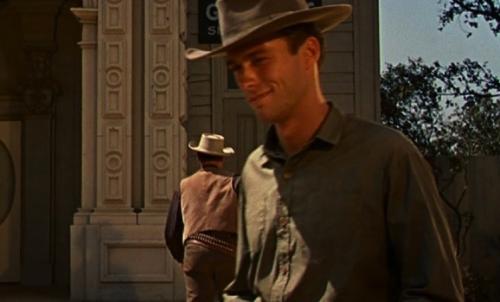
Produced by the legendary Albert Zugsmith, Star in the Dust is a surprisingly intelligent and well-acted B-western.  If you watch carefully, you might even spot Clint Eastwood playing a ranch hand named Tom who wants to know if he should put money down on Sam Hall being hanged.  Though he was uncredited in this tiny role, Star in the Dust was Eastwood’s first western.