Love On The Shattered Lens: Frank and Ava (dir by Michael Oblowitz)


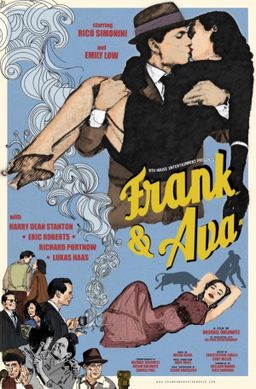
2018’s Frank & Ava tells the story of the tempestuous love affair and marriage of Frank Sinatra (Rico Simonini) and Ava Gardner (Emily Elicia Low).

The film opens with Sinatra at his lowest point.  His records are no longer selling.  His marriage to Nancy is in trouble.  The government is now investigating him for supposed communist sympathies (say it ain’t so, Frank!) and also his connections to the Mafia.  Hedda Hopper (Joanne Baron), Louella Parsons (Joanna Sanchez), and Walter Winchell (Richard Portnow) all pop up throughout the film, breathlessly reading the latest gossip into radio microphones.  Frank’s voice is weakening and it looks like he’s about to lose his fanbase to Eddie Fisher and Perry Como.  As for his acting career, everyone knows that he can’t act.  (At one point, even Frank’s friends laugh at the idea of Siantra ever winning an Oscar.)  Frank knows that he would be perfect for the role of Maggio in From Here To Eternity but the film’s director wants to cast someone like Harvey Lembeck or Eli Wallach.

As for Ava Gardner, she’s just gotten out of a relationship with Howard Hughes.  More famous for her then-scandalous personal life than her film roles, Gardner drinks too much, curses too much, and is too open about her affairs for the sensibilities of much of 1950 America.

When Frank and Ava meet, it’s love at first sight.  They drive around while drinking champagne straight from the bottle.  They crash cars.  When they’re arrested, they charm a local sheriff (Harry Dean Stanton, in his final film role).  They fight.  They make love.  They fight more.  They make love more.  Frank obsesses on the possibility of Ava being unfaithful to him while continually cheating on her with everyone from Lana Turner to Marilyn Maxwell.

The first thing that you notice about Frank & Ava is that it is full of references to real Hollywood gossip.  Names are dropped.  Real celebrities are depicted and the portrayals are not always positive.  The second thing that you notice is that, with the exception of Emily Elicia Low, no one is particularly convincing.  The actress who plays Marilyn Monroe not only looks nothing like Marilyn but her attempt to imitate Marilyn’s trademark voice made me laugh out loud.  Actors appear as Lana Turner, Montgomery Clift, Howard Hughes, and a host of mafiosos and none of them are the least bit convincing.  Much of the film is like attending a costume party where no one could spend more than five bucks on their costume.  Rico Simonini, who was so charming in My Dinner With Eric, is not particularly convincing as Frank Sinatra.  That said, Emily Elicia Low is well-cast as Ava Gardner and Eric Roberts shows up for two scenes as producer Harry Cohn.  In real life, Cohn was a notorious bully.  The old anecdote about everyone showing up at an unpopular man’s funeral to make sure that he’s actually dead is often said to have been inspired by Cohn.  In the film, Roberts plays Cohn as being a surprisingly reasonable guy.  If Fred Zinnemann wants Sinatra, he can have Sinatra.  If he wants Eli Wallach, he can have Eli Wallach.  Just make sure they aren’t communists!

Probably the most interesting thing about this film is its attempt to recreate the 50s without spending a good deal of money.  This is a low-budget movie and there’s an obvious artificiality to many of the sets and costumes that gives the entire film an oddly dream-like feel.  It’s less a recreation of the past and more a look at how the past might look in our fantasies.  All the men wear suits.  Ava dresses and talk as if she just stepped out of a parody of a film noir.  Famous scenes from Goodfellas and La Dolce Vita are awkwardly recreated by Santini and the cast.  The film, which was made by people who obviously loved the legend of Frank and Ava, ultimately transcends the conventional definition of good and bad and instead becomes a work of outsider art, a look into the hazier regions of the American cultural psyche.

Previous Eric Roberts Films That We Have Reviewed:

  1. Star 80 (1983)
  2. Blood Red (1989)
  3. The Ambulance (1990)
  4. The Lost Capone (1990)
  5. Love, Cheat, & Steal (1993)
  6. Voyage (1993)
  7. Love Is A Gun (1994)
  8. Sensation (1994)
  9. Dark Angel (1996)
  10. Doctor Who (1996)
  11. Most Wanted (1997)
  12. Mercy Streets (2000)
  13. Wolves of Wall Street (2002)
  14. Mr. Brightside (2004)
  15. Six: The Mark Unleased (2004)
  16. Hey You (2006)
  17. In The Blink of an Eye (2009)
  18. Enemies Among Us (2010)
  19. The Expendables (2010) 
  20. Sharktopus (2010)
  21. The Dead Want Women (2012)
  22. Deadline (2012)
  23. The Mark (2012)
  24. Miss Atomic Bomb (2012)
  25. Bonnie And Clyde: Justified (2013)
  26. Lovelace (2013)
  27. The Mark: Redemption (2013)
  28. Self-Storage (2013)
  29. This Is Our Time (2013)
  30. Inherent Vice (2014)
  31. Road to the Open (2014)
  32. Rumors of War (2014)
  33. Amityville Death House (2015)
  34. A Fatal Obsession (2015)
  35. Stalked By My Doctor (2015)
  36. Enemy Within (2016)
  37. Joker’s Poltergeist (2016)
  38. Prayer Never Fails (2016)
  39. Stalked By My Doctor: The Return (2016)
  40. The Wrong Roommate (2016)
  41. Dark Image (2017)
  42. Black Wake (2018)
  43. Stalked By My Doctor: Patient’s Revenge (2018)
  44. Clinton Island (2019)
  45. Monster Island (2019)
  46. The Savant (2019)
  47. Seven Deadly Sins (2019)
  48. Stalked By My Doctor: A Sleepwalker’s Nightmare (2019)
  49. The Wrong Mommy (2019)
  50. Exodus of a Prodigal Son (2020)
  51. Free Lunch Express (2020)
  52. Her Deadly Groom (2020)
  53. Top Gunner (2020)
  54. Deadly Nightshade (2021)
  55. The Elevator (2021)
  56. Just What The Doctor Ordered (2021)
  57. Killer Advice (2021)
  58. The Poltergeist Diaries (2021)
  59. The Rebels of PT-218 (2021)
  60. A Town Called Parable (2021)
  61. Bleach (2022)
  62. My Dinner With Eric (2022)
  63. Aftermath (2024)
  64. The Wrong Life Coach (2024)

Film Review: The Straight Story (by David Lynch)


Released in 1999, The Straight Story is one of the greatest films ever made about America.

Alvin Straight (Richard Farnsworth) is an elderly veteran of World War II.  He lives in Iowa, a kind but rather taciturn man who doesn’t have time for doctors and would rather live on his own terms.  That said, when his daughter (Sissy Spacek) finally does manage to drag Alvin to a doctor, he’s told to stop smoking and to start using a walker to get around.  Alvin refuses, though he does start using two canes.  Alvin is an old man.  He’s lived a long time and, in his opinion, he knows best about what he needs to do.

For instance, when Alvin hears that his long-estranged brother Lyle (Harry Dean Stanton), has had a stroke, Alvin decides that he need to go Wisconsin to see him.  The only problem is that Alvin can barely see and he can’t walk and there’s no way anyone is going to give him a car or even a driver’s license.  His solution is to ride a lawnmower from Iowa to Wisconsin.

It’s based on a true story and if The Straight Story sounds like a film that will make you cry, it is.  Richard Farnsworth was terminally ill when he was offered the role of Alvin and he accepted because he admired Alvin’s determination to live life his own way.  As portrayed in the film, Alvin is not one to easily betray his emotions.  He grew up as a part of that stoic generation.  He saw his share of violence and death while he was serving during World War II and one gets the feeling that his attitude has always been that, if he could survive that, he can survive anything.  (The closest Alvin gets to becoming openly emotional is when he meets another veteran in a bar and it becomes obvious that the two of them share a bond that, as people who seen and survived war, only they can really understand.)  Farnsworth so completely becomes Alvin Straight that it’s easy to forger that he was a veteran actor who had a long career before starring in The Straight Story.  Alvin may not show much emotion but Farnsworth communicates so much with just the weariness in his eyes and his slow but determined gait that we feel like we know everything about him.

The film follows Alvin on his way to Wisconsin.  Along the way, he meets various people and, for the most part, they’re all good folks.  Even the runaway hitchhiker (Anastasia Webb) turns out to be a kind soul.  When Alvin momentarily loses control of his lawn mower, a group of stranger run out to help him.  They don’t know who he is or why he was riding his lawnmower down the street.  All that matter is that, at that moment, he’s a person who needs help.  The Straight Story celebrates both the beauty and the people of America.  It’s one of the most sincere and life-affirming films ever made, one that contains not a trace of cynicism and which is all the better for it.  And while many people might be shocked to discover that this film was directed by David Lynch, the truth of the matter is that a strong love for America and Americana runs through all of Lynch’s films.  Lynch was an artist who believed that people could surprise you with their kindness and that’s certainly the case with The Straight Story.

The Straight Story was the only one of David Lynch’s films to receive a G-rating.  It was also the only film that Lynch made for Disney.  It’s interesting to look at Lynch’s filmography and see this heartfelt and deeply touching film sitting between Lost Highway and Mulholland Drive.  But The Straight Story really does feature David Lynch at his best.  It also reveals him as a filmmaker who could do something unexpected without compromising his signature vision.  There’s a lot of beautiful, Lynchian images in The Straight Story.  But there’s also a lot of heart.

Down Periscope (1996, directed by David S. Ward)


After being passed over twice as a result of both a “brushing incident” with a Russian submarine and an embarrassing tattoo, Lt. Commander Thomas Dodge (Kelsey Grammer, playing Dodge as being the laid back opposite of Frasier Crane) has finally been promoted and given his own submarine to command.  The catch is that the submarine is a rusty piece of junk from World War II and he’s been assigned a crew of misfits.  Captain Dodge is to take part in a war game.  Admiral Winslow (Rip Torn) wants Dodge to prove that even an out-of-commission submarine can be dangerous by infiltrating Charleston Harbor undetected and then blowing up a dummy warship in Norfolk Harbor.  If Dodge is successful, he’ll get a nuclear submarine to command.  If he fails, he’ll be assigned of desk job and probably leave the Navy.  While the sympathetic Winslow encourages Dodge to “think like a pirate,” the antagonistic Admiral Graham (Bruce Dern) pulls out all the stops to make sure Dodge fails.

I imagine that Down Periscope was probably pitched as Police Academy In The Navy and it follows the general rules of the Police Academy films, right down to casting Lauren Holly as the one woman on the submarine who has to overcome her own insecurities and prove herself to all the men.  Unfortunately, none of the misfits on the crew are as memorable as the cadets from Police Academy and the movie’s attempts to mix juvenile humor with suspenseful naval action are not at all successful.  Having Rob Schneider go totally over the top as Dodge’s second-in-command while having William H. Macy give a serious performance as the captain assigned to prevent Dodge from reaching the harbor indicates that Down Periscope has a definite identity problem.

Harry Dean Stanton plays Howard, who is the submarine’s chief engineer and who uses whiskey as a fuel to keep the submarine moving.  Toby Huss has a few amusing moments as the electrician who keeps electrocuting himself.  Grammer, Dern, and Macy have more than proven their talents in other projects and Rip Torn will always be remembered for bringing Artie to profane life on The Larry Sanders Show.  Director David Ward also directed Major League and wrote The Sting.  A lot of talent went into making Down Periscope so it’s a shame the film wasn’t more memorable.

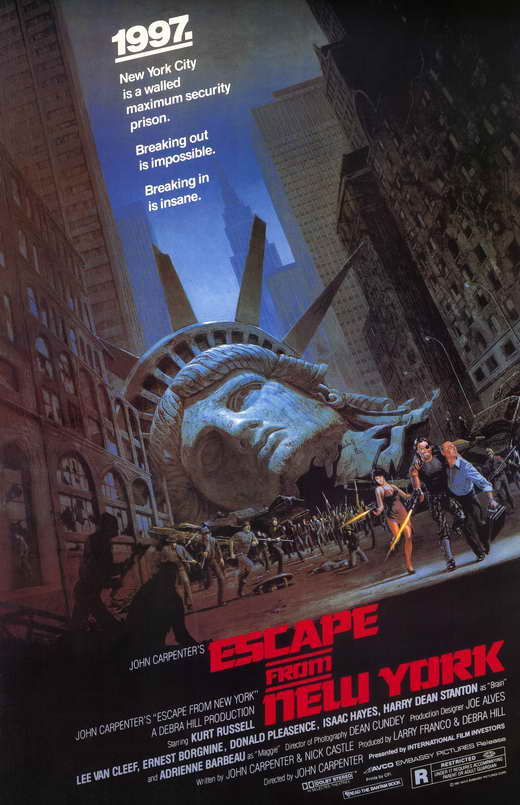
Scenes That I Love: The Duke Makes Quite An Entrance in Escape From New York


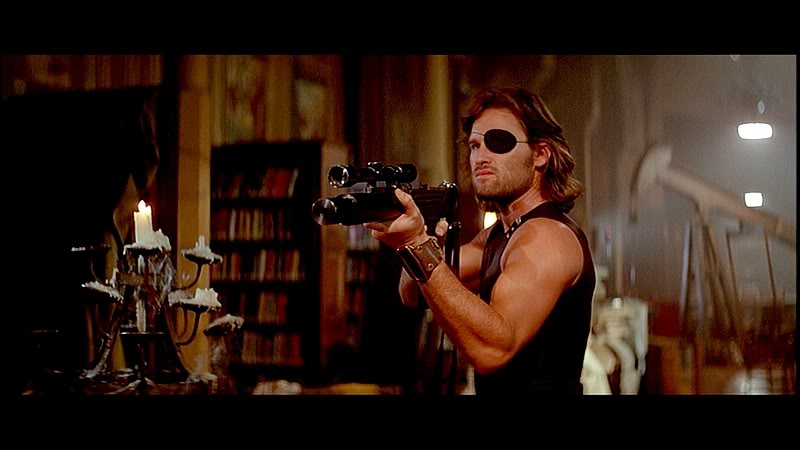
Continuing our celebration of John Carpenter’s birthday, today’s scene that I love comes from one of my favorite Carpenter movies, 1981’s Escape From New York.

In this scene, The Duke of New York makes quite an entrance.  Not only does he have an entourage but his car comes with its own chandeliers and a disco ball!  Along with writing and directing this film, Carpenter also composed the score.

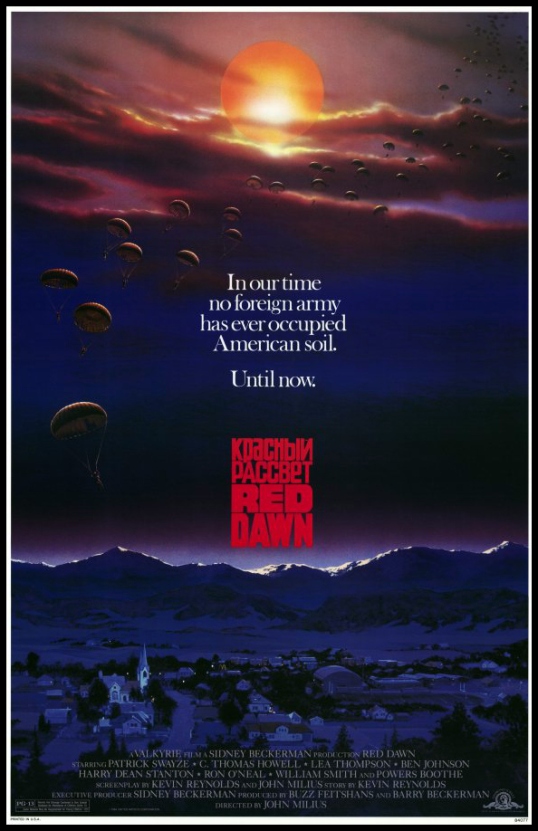
Scenes I Love: “Avenge Me!” from Red Dawn


Today, the Shattered Lens wishes a happy birthday to a true Hollywood iconoclast, John Milius!  In honor of Milius and his career and his legacy, today’s scene that I love comes from Milius’s 1984 film, Red Dawn.

After their small town is taken over by a combination of Cuban and Russian soldiers, a group of teenagers flee to the hills.  After a few months, they sneak back into town.  In this scene, two brothers (Patrick Swayze and Charlie Sheen) discover that their father (Harry Dean Stanton) is one of the many townspeople who have been sentenced to a reeducation camp.  Their dad says a few final words to them, knowing that he’ll probably never see them again.  He leaves them with one final instruction: “AVENGE ME!”  Not even the propaganda film playing in the background can cover the sound of their father demanding vengeance.

And, of course, they do get their revenge, sacrificing their lives so that America might once again be free.  It’s a classic John Milius moment and an appropriate scene with which to celebrate his birthday.

Lisa Reviews a Palme d’Or Winner: Paris, Texas (dir by Wim Wenders)


With the 2022 Cannes Film Festival coming to a close in the next few days, I’ve been watching some of the films that previously won the prestigious Palme d’Or.  They’re an interesting group of films.  Some of them have been forgotten.  Some of them are still regarded as classics.  Some of them definitely deserve to be seen by a wider audience.  Take for the instance that winner of the 1984 Palme d’Or winner, Paris, Texas. This is a film that is well-regarded by cineastes but it definitely deserves to be seen by more people.

Though released in 1984, Paris, Texas opens with an image that will resonate for many viewers today.  A dazed man stumbles through the desert while wearing a red baseball cap.  Though the cap may not read “Make America Great Again,” the sight of it immediately identifies the owner as being a resident of what is often dismissively referred to as being flyover country, the long stretch of land that sits between the two coasts.  Travis (Harry Dean Stanton) is lost, both figuratively and literally.  After he stumbles into a bar and collapses, he’s taken to a doctor (played by German film director Bernhard Wicki) who discovers that Travis has a phone number on him.  When the doctor calls the number, he speaks to Travis’s brother, Walt (Dean Stockwell).  Walt has not seen Travis for three years and the viewer gets the feeling that Walt spent those years assuming that Travis was dead.  Walt agrees to travel to West Texas to retrieve his brother and take him back to Los Angeles.

When Walt retrieves his brother, he’s annoyed that Travis refuses to explain where he’s been for the past three years.  In fact, for the first fourth of the film, Travis doesn’t say anything.  He just stares into space.  Finally, when he does speak, it’s to tell Walt that he wants to go to Paris.  Walt tells him that going to Paris might have to wait.  Travis elaborates that he wants to go to Paris, Texas.  He owns an empty parking lot in Paris, Texas.

It takes a while to learn much about Travis’s past.  Like many of Wim Wenders’s films, Paris, Texas moves at its own deliberate pace and it features characters who tend to talk around their concerns instead of facing them head-on.  What we do eventually learn is that Travis has a son named Hunter (Hunter Black).  Travis’s wife, Jane, (played by Natassja Kinski) disappeared first.  Travis disappeared afterwards, leaving Walt and his wife (Aurore Clement) to raise his son.  At first, when Travis arrives in Los Angeles, he struggles to reconnect with Hunter but eventually, he does.  He tries to be a father but, again, he sometimes struggles because, while Travis has a good heart, he’s also out-of-step with the world.

As for Jane, we eventually learn that she’s in Houston.  She’s working in a tacky sex club, one where the customers and the strippers are separated by a one-way mirror.  The customer can see and talk to the stripper but the stripper can’t see the customers.  It’s all about manufactured intimacy.  The customer can delude themselves into thinking that the woman is stripping just for him while the woman doesn’t have to see the man who is watching her.  There are no emotions to deal with, just the illusion of a connection.

Even as Travis begins to make a life for himself in Los Angeles, he finds himself tempted to return to Houston to search for his wife….

As I said, Paris, Texas is a deliberately paced film.  With a running time of 2 hours and 20 minutes, it feels like it’s actually three films linked together.  We start with Travis and Walt traveling back to Los Angeles.  The second film deals with Travis’s attempts to bond with his son.  And the third and most powerful film is about what happens when Travis finally finds Jane.  It all comes together to form a deceptively low-key character study of a group of lost souls, all of whom are dealing with the mistakes of the past and hoping for a better future.  The film’s most memorable moment comes when Travis delivers a long and heartfelt monologue about his marriage to Jane.  Beautifully written by Sam Shephard (who co-wrote the script with L.M. Kit Carson) and wonderfully acted by Harry Dean Stanton, it’s a monologue about regret, guilt, forgiveness, and ultimately being cursed to wander.

Despite the heavy subject matter, Paris, Texas is an undeniably joyful film.  In a rare leading role, Harry Dean Stanton plays Travis as someone who is full of regrets but who, at the same time, retains a spark of hope and optimism.  Life has beaten him down but he has yet to surrender.  Once he reaches Los Angeles and Travis starts to fully come out of his fugue state, there’s a playful energy to Stanton’s performance.  The scene where he dresses up as what he thinks a dad should look like is a highlight.  For Travis, being a responsible adult starts with putting on a suit and walking his son home from school.  Stanton’s excellent performance is matched by good work from Dean Stockwell and, especially, Natassja Kinski.

Visually, the film is all about capturing the beauty and the peculiarity of the landscape of the American southwest.  Like many European directors, Wim Wenders seems to be a bit in love with the combination of rugged mountains and commercialized society that one finds while driving through the west.  In the scenes in which Stanton wanders through West Texas, the landscape almost seems like it might consume him and, later, in Los Angeles and Houston, the garishness of the city threatens to do the same.  Wherever he is, Travis is slightly out-of-place and the viewer can understand why Travis is compelled to keep wandering.  At times, it seems like Travis will never fit in anywhere but the fact that he never gives up hope is comforting.  In many ways, Travis’s own journey mirrors Stanton’s career in Hollywood.  He had the talent of a leading man but the eccentric countenance of a great character actor.  He may have never been quite fit in with mainstream Hollywood but he never stopped acting.

The film itself never visits Paris, Texas.  Travis just talks about the fact that he owns an empty lot in the town and that he would like to see it.  Still, I like to think Travis eventually reached Paris and I like to think that he did something wonderful with that lot.

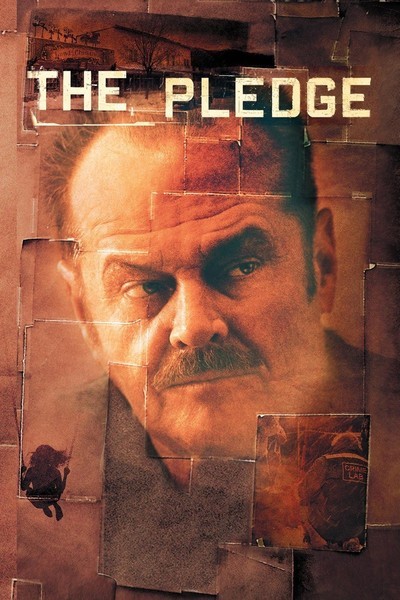
The Pledge (2001, directed by Sean Penn)


Jerry Black (Jack Nicholson) is a detective who, on the verge of retirement, goes to one final crime scene.  The victim is a child named Ginny Larsen and when Ginny’s mother (Patricia Clarkson) demands that Jerry not only promise to find the murderer but that he pledge of his immortal soul that he’ll do it, it’s a pledge that Jerry takes seriously.  Jerry’s partner, Stan (Aaron Eckhart), manages to get a confession from a developmentally disabled man named Jay Wadenah (Benicio del Toro) but Jerry doesn’t believe that the confession is authentic.  When Wadenah commits suicide in his cell, the police are ready to close the case but Jerry remembers his pledge.  He remains determined to find the real killer.

Even though he’s retired, the case continues to obsess Jerry.  He becomes convinced that Ginny was the latest victim of a serial killer and he even buys a gas station because it’s located in the center of where most of the murders were committed.  Jerry befriend a local waitress named Lori (Robin Wright) and, when Lori tells him about her abusive ex, he invites Lori and her daughter to stay with him.  Lori’s daughter, Chrissy (Pauline Roberts), is around Ginny’s age and when she tells Jerry about a “wizard” who gives her toys, Jerry becomes convinced that she’s being targeted by the same man who killed Ginny.  Even as Jerry and Lori fall in love, the increasingly unhinged Jerry makes plans to use Chrissy as bait to bring the killer out of hiding.

The Pledge was Sean Penn’s third film as a director.  As with all of Penn’s directorial efforts, with the notable exception of Into The Wild, The Pledge is relentlessly grim.  Freed, by virtue of his celebrity, from worrying about whether or not anyone would actually want to sit through a depressing two-hour film about murdered children, Penn tells a story with no definite resolution and no real hope for the future.  The Pledge is a cop film without action and a mystery without a real solution and a character study of a man whose mind you don’t want to enter.  It’s well-made and it will keep you guess but it’s also slow-paced and not for the easily depressed.

The cast is made up of familiar character actors, most of whom probably took their roles as a favor to Penn.  Harry Dean Stanton, Tom Noonan, Patricia Clarkson, Sam Shephard, Vanessa Redgrave, Helen Mirren, and Mickey Rourke have all got small roles and they all give good performances, even if it’s sometimes distracting to have even the smallest, most inconsequential of roles played by someone familiar.  Most importantly, The Pledge actually gives Jack Nicholson a real role to play.  Jerry Black is actually an interesting and complex human being and Nicholson dials back his usual shtick and instead actually makes the effort to explore what makes Jerry tick and what lays at the root of his obsession.

Though definitely not for everyone, The Pledge sticks with you and shows what Jack Nicholson, who now appears to be retired from acting, was capable of when given the right role.

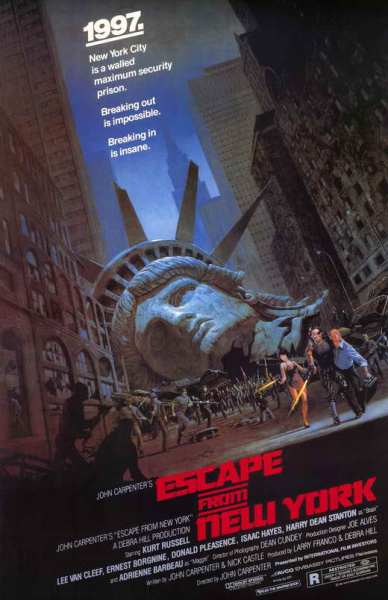
Escape From New York (dir. by John Carpenter)


escape-from-new-york-movie-poster-1981-1020189511Before you start, note that Escape From New York was recently showcased in Jeff’s 4 Shots from 4 Films post to celebrate Kurt Russell’s birthday. For another take on the film, check out Jeff’s review. Please check that out, and then double back here, if you want. 
When I was little, my Aunt would sometimes take my older brother and I with her into Manhattan. In a little movie theatre near 82nd Street, she’d get us a set of tickets for a film, help us get seated with snacks and then either stay for the movie or leave to perform housekeeping duties for someone nearby if she had work and we weren’t allowed to hang out on site. John Carpenter’s Escape From New York wasn’t a film she stayed for (she loved Raiders of the Lost Ark), but it was okay. I was introduced to Snake Plissken, who ended up being cooler than Han Solo to my six year old eyes. Instead of being the hero, here was a criminal being asked to a mission. It showed me that even the bad guys could be heroes, now and then (or better yet, not every hero is cookie cutter clean). The film became an instant favorite for me. As I also do with Jaws and The Fog, I try not to let a year go by without watching Escape From New York at least once. It was my first Carpenter film.

The cultural impact of Escape From New York is pretty grand, in my opinion. It had a major influence on Hideo Kojima’s Metal Gear video games and also spawned a few comics with Plissken, complete with Jack Burton crossovers with Carpenter’s Big Trouble in Little China.

Carpenter brought in most of the same crew he worked with in his previous movies. The film was the third collaboration between Carpenter and Debra Hill, who previously worked with him in 1978’s Halloween and 1980’s The Fog. Though Hill didn’t write this one, she was still the producer, along with Larry Franco. There’s also a bit of speculation on whether Hill performed the opening vocals describing New York or Jamie Lee Curtis handled that. Cinematographer Dean Cundey (who worked on most of Carpenter’s early films) returned to help give the movie it’s gritty look, which is helpful considering how much of it takes place either at night or in darkened rooms. Another interesting part of the production is James Cameron, who was the Director of Photography when it came to the effects and matte work. One of the best effects shots in the film has Plissken gliding over Manhattan, which was designed by Effects member John C. Wash. The shot on his plane’s dashboard of the city was made from miniature mock up with reflective tape that made it appear as if it were digital, which was pretty cool given that they weren’t on an Industrial Light and Magic budget. There’s a fantastic article on We Are The Mutants and on the Escape From New York/LA Fan Page that focus on Wash’s technical contributions to the film.

For Carpenter’s career, Escape From New York marked the start of a great working relationship with Alan Howarth. Howarth, who also worked on the sound in the film, assisted Carpenter with the soundtrack. I’ve always felt this brought a new level to Carpenter’s music overall. You can easily hear the difference when Howarth was involved. Where Carpenter excelled at general synth sound, Howarth’s touch added some bass and depth. Together, they’d work on Christine, Big Trouble in Little China, Halloween III: Season of the Witch, Prince of Darkness and They Live together. On his own, Howarth was also responsible for both Halloween 2, 4 and 5.

For the writing, Carpenter worked with Nick Castle, who played Michael Myers for him in the original Halloween. Escape From New York’s story is simple. In 1988, the crime rate for the United States rises 400 percent. As a result, someone had the notion to turn Manhattan into a prison for an entire country, setting up walls around the borough and mines in the waterways. When Airforce One crashes in the borough nearly a decade later, the recently arrested war hero / fugitive Snake Plissken (Kurt Russell) is given a mission. Go in, rescue the President and/or the tape he’s carrying in 22 hours, and Plissken receives a pardon for all his crimes. To ensure that he follows through, he’s injected with nano-explosives that will kill him when the deadline hits. What seems like a simple mission becomes a little complicated when Snake discovers the President was captured by The Duke of New York, played by Issac Hayes (I’m Gonna Git You Sucka). Given that I’ve commuted to Manhattan more times than I can count, the film holds a special place in my heart.  The concept of the entire borough being a prison was mind blowing as a kid. The concept still holds up for me as an adult.

For a film about New York, there were only two days of filming actually spent on location there, according to Carpenter’s commentary. Most of that was used for the opening shot at the Statue of Liberty. The bulk of the film was made in Los Angeles, Atlanta and St. Louis. At the time, there was a major fire in St. Louis. The damage made for a great backdrop for both the crash site and the city at night. The film does take some liberties with locations, though. For example, as far as I know, we don’t have a 69th Street Bridge in Manhattan, but as a kid, it didn’t matter much. From an action standpoint, it might not feel as intense as other films. Even when compared to other films in 1981 – like Raiders of the Lost Ark (released a month earlier) – Escape From New York doesn’t have a whole lot, though I still enjoy what it does provide.

escape_from_new_york

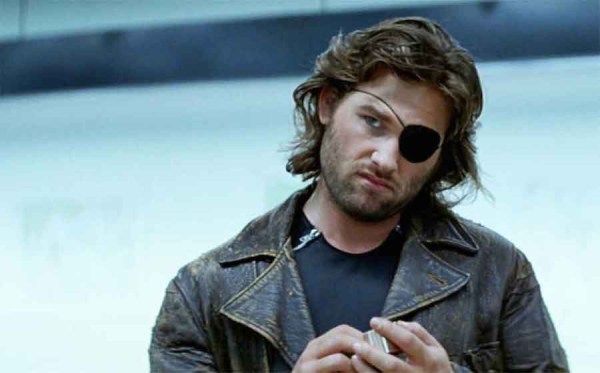
Snake Plissken (Kurt Russell) has 22 hours to save the President in John Carpenter’s Escape from New York.

Casting seemed to come easy for the film. Hill, Castle and Carpenter reached out to some friends.  Kurt Russell and Carpenter worked together on Elvis, that was easy enough. Russell’s work with Carpenter would continue on in The Thing, Big Trouble in Little China and Escape from L.A.  From Halloween, Donald Pleasance was brought on to play the President, along with Charles Cyphers and Nancy Stephens as one pissed off flight attendant. From The Fog, we have Tom Atkins as Nick and Adrienne Barbeau as Maggie, who happened to be married to Carpenter at the time. According to Carpenter on the film’s commentary track, the sequence for Maggie’s exit needed to be reshot and extended. The scene with her body on the ground was filmed in Carpenter’s garage and added to the film.

Ernest Borgnine’s (The Poseidon Adventure) Cabbie was a favorite character of mine. Like most cabbies, he knew the city well. He even prepared for some of its challenges with molotov cocktails. Harry Dean Stanton (Alien, Christine) played Brain, the smartest individual in the room and the supplier for gas for the Duke. If you look close, you’ll also catch Assault on Precinct 13’s Frank Doubleday as Romero, which his crazy looking teeth. To round it all out, Lee Van Cleef (The Good, The Bad & The Ugly) plays Hauk, who puts Snake on his mission. And of course, it wouldn’t be a Carpenter film without a George ‘Buck’ Flower cameo. Buck was kind of Carpenter’s lucky charm in the way Dick Miller was for Joe Dante’s films. Good Ol’ Buck plays an inmate who sings Hail to the Chief.

Overall, Escape From New York is a classic Carpenter film that’s worth the watch. Whether you do so while wearing an eyepatch or not, that’s on you. We all have our preferences.


Escape From New York (1981, directed by John Carpenter)


What’s your favorite John Carpenter film?

Halloween is an obvious choice.  It’s probably the film that John Carpenter is best-known for.  The Thing and Assault on Precinct 13 are two other popular choices.  Libertarians and anarchists have embraced They Live as a sacred text.  In The Mouth of Madness is one of the few films to capture the feel of a classic H.P. Lovecraft story.  Christine is one of the best of the Stephen King adaptations.  My techphobic father recently purchased a Blu-ray player just so he could watch Big Trouble In Little China whenever he felt like it.

For me, though, my favorite will always be Escape From New York.

Everything about this movie, from the premise to the execution to the darkly funny ending, is pure brilliance.  For those who have been living off the grid for the last 40 years, Escape From New York takes place in what was, at the time of the film’s initial release, the near future.  Due to a 400% increase in crime, Manhattan has been turned into a floating prison.  A wall has been built around the island.  The bridges are covered in mines.  All of the residents are prisoners who have been sentenced to a life term and the Chock Full O’Nuts is now literally full of nuts.

There’s a new resident of New York City.  He’s the President (Donald Pleasence!) and he was supposed to soon deliver a classified cassette tape to the Soviets.  Instead, with the world on the verge of war, Air Force One has crashed in Manhattan and the Duke of New York (Isaac Hayes!!) is holding him hostage.  Bob Hauk (Lee Van Cleef!!!) recruits notorious criminal Snake Plisskin (Kurt Russell!!!!) to sneak into the prison and retrieve the cassette and save the President, by any means necessary.  If Snake succeeds, he’ll get a pardon.  If Snake fails, he’ll die due to the microexplosives that have been injected into his system.

How unbelievably cool is Kurt Russell as Snake Plisskin?  Before fanfic was even known by that name, people were writing stories about Snake Plisskin’s past and how he lost his eye.  Delivering his lines in a Clint Eastwood-style rasp, Kurt Russell gives one of the best action hero performances of all time.  (Snake was the role that transformed Russell from being a clean-cut former Disney child star to being a cult film icon.)  Everything that Snake says is quotable and, even with tiny explosives circulating through his blood, Snake never loses his cool.  Sometimes, it doesn’t seem like Snake cares whether he lives or dies and that’s what makes Snake such a strong hero.  He’s wiling to take the risks that no one else would.  If he saves the President and the world, cool.  If he doesn’t, neither was probably worth saving anyways.  At the end of the film, Snake reveals that there are things that he does care about.  If you don’t appreciate the people who sacrificed their lives for you, don’t expect Snake to do you any favors.

Snake gets some help from a rogue’s gallery of familiar faces, all of whom have their own reasons for trying to save the President from the Duke.  Harry Dean Stanton is Brain while Adrienne Barbeau is Maggie.  Brain is the smartest man in Manhattan and Maggie’s good with a gun and it’s too bad that we never got a prequel about how they met.  My favorite of Escape from New York‘s supporting cast is Ernest Borgnine as Cabbie, who is the perfect New York taxi driver and whose taste in music plays off in an unexpectedly satisfying way.

Escape From New York is John Carpenter at his best, an exciting race against time full of memorable characters and thrilling action.  Whenever I go to New York and I cross over a bridge into Manhattan, I think about Snake, Cabbie, and the gang driving through a minefield.  Everyone who meets Snake says “I thought you were dead,” but we know better.  Snake Plisskin will never die and neither will my love for Escape From New York.

Lisa Recommends Fool For Love (dir by Robert Altman)


As the day draws to a close, I’m going to recommend one final film.

It’s not, by any means, a perfect film.  In fact, it’s pretty damn imperfect.  It’s a film that occasionally tries too hard to be profound.  It’s based on a play and it never quite escapes its theatrical origins.  What was undoubtedly exciting on the stage, drags a bit on the screen.  It’s a fairly obscure film.  I just happened to catch it on This TV a month ago and the main reason that I watched it was because of the cast.

But no matter!  I still think you should watch this film if you get a chance.

The name of that film is Fool For Love.

First released in 1985 and based on a play by Sam Shepard, Fool For Love takes place over the course of one long night at a motel in the Southwest.  Staying at the motel is May (Kim Basinger), who is hoping to escape from her past.  Not eager to allow her to escape is her former lover, Eddie (Sam Shepard).  An aging cowboy, Eddie shows up at the motel and tries to convince May to return with him to his ranch.  As they argue, clues are dropped to the terrible secret that haunts their past.  Martin (Randy Quaid), a buffoonish but well-meaning “gentleman caller,” shows up to take May on a date and finds himself sucked into the drama between her and Eddie.

Meanwhile, on the edge of every scene, there’s the Old Man (Harry Dean Stanton).  The Old Man watches Eddie and May and offers up his own frequently sarcastic commentary.  It becomes obvious that he not only knows about the secret in their past but that he’s determined that they not get together.  Is the Old Man really there or is he just a figment of everyone’s imagination or is he something else all together?

As I said earlier, the film never quite escapes its theatrical origins.  As well, while Shepard and Kim Basinger both give authentic and charismatic performance, they don’t quite have the right romantic chemistry to really convince us that Eddie would chase May all the way to that isolated motel.  It’s hard not to feel that if May had been played by Shepard’s then-partner Jessica Lange or his Right Stuff co-star, Barbara Hershey, the film would have worked better.

And yet, even if it never comes together as a whole, Fool For Love is a film that should be seen just for its display of individual talent.  Of the film’s five main creative forces, only Kim Basinger is still with us.  Director Robert Altman died in 2006 while Sam Shepard and Harry Dean Stanton both passed away in 2017.  While Randy Quaid is still alive, it’s doubtful he’ll ever again get the type of roles that earlier established him as one of America’s best character actors.  Whenever I read another snarky article about Quaid hiding out in Vermont and ranting about the “star whackers,” I can’t help but sadly think about the perfect performances that Quaid used to regularly give in imperfect films like this one.

So, definitely track down Fool For Love.  Watch it and pay a little tribute to all of the wonderful talent that we’ve lost over the last 10 or so years.  Watch it for Robert Altman’s ability to turn kitsch into art.  Watch it for the rugged individualism of Sam Shepard and the once-empathetic eccentricity of Randy Quaid.  Watch it for Harry Dean Stanton, the legendary actor who, more than any other performer, seemed to epitomize the southwest and Americana.

Watch it and spare a little thought for all of them.