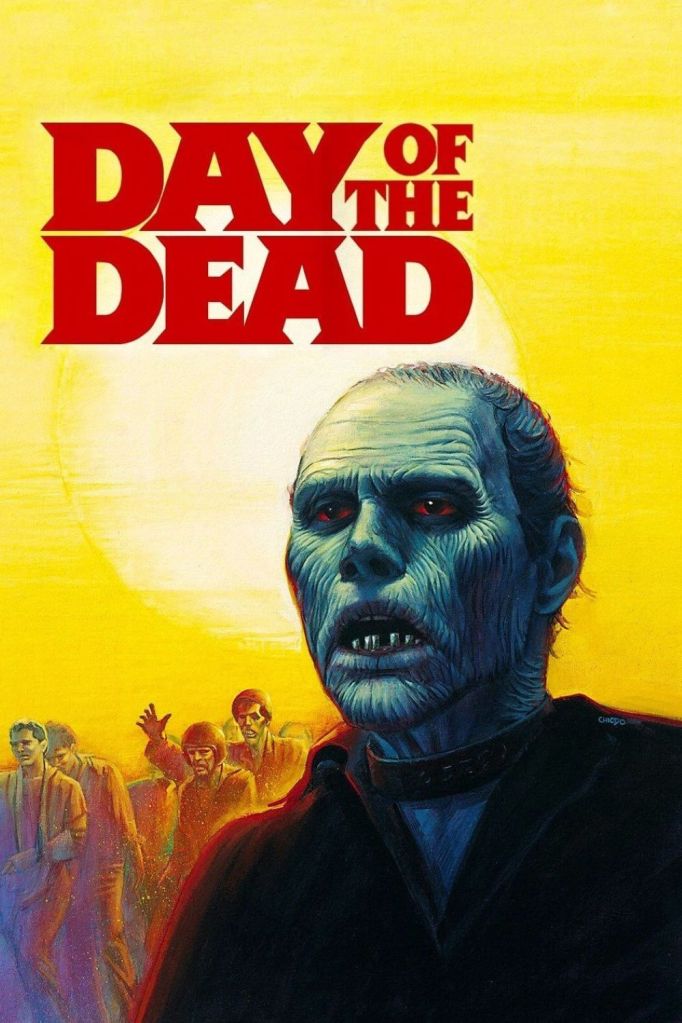
Horror Review: Day of the Dead (dir. by George A. Romero)


“You want to put some kind of explanation down here before you leave? Here’s one as good as any you’re likely to find. We’re bein’ punished by the Creator…” — John “Flyboy”

George A. Romero’s 1985 film Day of the Dead stands as an unflinching and deeply cynical meditation on the collapse of society amid a relentless zombie apocalypse, intensifying thematic and narrative complexities first introduced in Night of the Living Dead (1968) and Dawn of the Dead (1978).

Originally, Romero envisioned the film as an epic, describing it as “the Gone with the Wind of zombie films.” His screenplay featured above-ground scenes and a more expansive narrative, but budget cuts halved the original $7 million budget to $3.5 million, forcing a drastic paredown. While much grandiosity was lost, the trimming resulted in a tighter narrative and heightened the nihilistic tone, deepening the film’s focused exploration of humanity’s darkest aspects during apocalypse.

Set after civilization has collapsed, Day of the Dead places viewers in the suffocating confines of a missile silo bunker in Florida, where scientists and soldiers struggle for survival and solutions amid encroaching undead hordes. The claustrophobic atmosphere—born partly from the abandonment of Romero’s broader original sequences—intensifies the tension between the hopeful scientific pursuit of salvation and the harsh pragmatism of military authority. These competing ideologies escalate into authoritarian violence, embodying the fractured microcosm of a dying society.

Within this claustrophobic world, a third group—composed of characters Flyboy and McDermott—emerges as a stand-in for the rest of humanity. They observe the scientists and soldiers—institutions historically symbols of security and innovation—but witness how these deeply entrenched ways of thinking only exacerbate problems instead of solving them. This third faction characterizes humanity caught between rigid orders and doomed pursuits, reflecting Romero’s broader commentary on societal stagnation and fragmentation.

Central to this conflict are Dr. Logan, or “Frankenstein,” a scientist obsessed with controlling the undead through experimentation, and Captain Rhodes, the hardened soldier who believes survival demands ruthless control.

Logan’s controversial research seeks to domesticate and condition zombies, notably through his most celebrated subject, Bub—the undead zombie capable of rudimentary recognition and emotion—challenging assumptions about humanity and monstrosity.

Here the film benefits greatly from the extraordinary practical effects work of Tom Savini, whose contributions on Day of the Dead are widely considered his magnum opus. Savini’s makeup and gore effects remain unsurpassed in zombie cinema, continually influencing horror visuals to this day. Drawing from his experience as a combat photographer in Vietnam, Savini brought visceral realism to every decomposed corpse and violent injury. The close-quarters zombie encounters showcase meticulous practical work—detailed wounds, biting, and dismemberment—rendered with stunning anatomical authenticity that predates CGI dominance.

Bub, also a masterclass in makeup and animatronics, embodies this fusion of horror and humanity with lifelike textures and movements that blur the line between corpse and creature, rendering the undead terrifyingly believable.

The film captures the growing paranoia and cruelty as resources dwindle—food, ammunition, and medical supplies—and the fragile social order begins to shatter. The characters’ mounting desperation illustrates Romero’s thesis that humanity’s real enemy may be its own incapacity for cooperation.

The moral and social decay is vividly portrayed through characters like Miguel, whose mental breakdown sets destructive events in motion, and Rhodes, whose authoritarian survivalism fractures alliances and moral compass alike. Logan’s cold detachment and experiments push ethical boundaries in a world on the brink.

Romero’s direction combines claustrophobic dread with stark psychological terror, further amplified by Savini’s effects. The cinematography’s low lighting and tight framing create an oppressive environment, while graphic violence underscores a world irrevocably broken. The unsettling sound design—moans, silences, sudden outbreaks—immerses viewers in a relentless atmosphere of decay and fear.

Romero described Day of the Dead as a tragedy about how lack of human communication causes chaos and collapse even in this small slice of society. The dysfunction—soldiers and scientists talking past each other, eroding trust, spirals of paranoia—serves as a bleak allegory for 1980s America’s political and cultural fragmentation. Failed teamwork, mental health crises, and fatal miscommunication thrive as the bunker metaphorically becomes a prison of fractured humanity.

Though not as commercially successful as its predecessors, Day of the Dead remains the bleakest and most nihilistic entry in Romero’s Dead series. Its overall grim tone, combined with mostly unlikable characters, establishes it as the most desolate and truly apocalyptic film of the series. The characters often appear fractured, neurotic, and unable to escape their own destructive tendencies, making the story’s world feel even more hopeless and devastating.

Far beyond a simple gore fest, Day of the Dead serves as a profound social critique infused with psychological depth. It explores fear, isolation, authority abuse, and the ethical limits of science, reflecting enduring anxieties about society and survival. The film’s unsettling portrayal of humanity’s failings, embodied in broken relationships and moral decay, presents a harsh reckoning with what it means to be human when humanity itself is the ultimate threat to its own existence. This thematic complexity, combined with Romero’s unyielding vision and Savini’s unparalleled effects, crafts a chilling and unforgettable cinematic experience.

October Hacks: Intruder (dir by Scott Spiegel)


The 1989 film, Intruder, is often advertised as being a Bruce Campbell film but Bruce only appears in the final few minutes.  I’m pointing this out because Bruce himself has criticized, in the past, the way that some distributors have used his name to promote Intruder and to fool potential viewers into thinking that Intruder features Ash or takes place S-Mart.  Bruce Campbell’s chin-tastic profile is put to good use as a police officer who shows up at the scene of a very bloody crime but Intruder is hardly a Bruce Campbell movie.

What is Bruce doing in Intruder?  It probably has something to do with the fact that Intruder was the directorial debut of Scott Spiegel, who co-wrote the script for Evil Dead II and who was a good friend of Sam Raimi’s.  (That probably also explains the presence of Ted Raimi in a tiny role and Sam Raimi himself in a bigger role.)

That said, if you’re looking for a good and suspenseful slasher film to watch as Halloween approaches, you could certainly do worse than Intruder.  Bruce Campbell may only appear in a cameo but the film itself is good enough that you’ll enjoy it while waiting for Bruce to make his appearance.

The film takes over the course of the night shift at a large but financially struggling grocery store.  When cashier Jennifer Ross (Elizabeth Cox) is harassed by her ex-con boyfriend, Craig (David Byrnes), the entire night crew comes together to protect her and to chase Craig out of the store.  The police are called but, when they finally do arrive at the store, they reveal that there’s not much they can do.  With Craig still making angry phone calls to the store, the crew prepares for the next day of business.  The store’s owners hold a store meeting and, after announcing how proud they are of the way the night crew handled the Craig situation, they announce that the store will be closing and soon, everyone will be out of a job.

No one is happy about that, with co-owner Bill (Dan Hicks) rather pathetically saying that the store was his entire life.  That said, it doesn’t seem like anyone at the store is going to have much of a life left because someone is determined to kill the entire night crew before the sun comes up.  Soon, the employees are dying in various bloody ways (and I do mean bloody!) and the storeroom is full of body parts.  Has Craig returned?  Could it be the butcher, played by Sam Raimi?  Could it be one the owners?  Or could it be some random intruder?  Watch the film to find out.

Intruder is an effective slasher film, one that is fortunate to have an above average cast (with Elizabeth Cox especially giving a good performance), memorable characters who have a bit more depth than the jocks and cheerleaders who usually populate films like this, and an interesting location in the form of the dark and shadow-filled grocery store.  Intruder also had a lot of very graphic horror.  The gore effects were provided by the same people who would later work on The Walking Dead and I have to say that even I, being the Italian horror fan that I am, was a bit shocked by just how much blood ended up flowing down the aisles.  If you’re scared of trash compactors, this film isn’t going to do anything to make you feel better about them.

Intruder is a superior slasher film.  And hey …. Bruce Campbell’s in it for a minute!

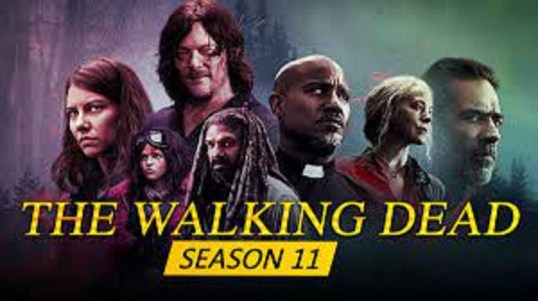
Horror TV Review: The Walking Dead 11.6 “On the Inside” (dir by Greg Nicotero)


Who is Connie?

I have to admit that, when I started watching the latest episode of The Walking Dead a few days ago, I had absolutely no idea who Connie was.  As I’ve stated before, I actually stopped watching the show after Carl Grimes shot himself during season 8.  With Carl dead, it really didn’t seem like it was going to be worth following the show to whatever bleak destination it was heading towards.  So, I sat out two and a half seasons.  I missed the final appearance of characters like Rick Grimes and Michonne.  I missed the death of Jesus during season 9, which was unfortunate since that was one character who really got on my nerves.  And, most importantly, as far as this week’s show was concerned, I missed the introduction of Connie.

And yet, despite not really knowing who she was, I was enthralled by her storyline.  Connie (played by Lauren Ridloff) and Virgil (Kevin Carroll) spent the majority of this week’s episode trapped in a house.  On the outside of the house, there were Walkers.  On the inside was something even more frightening, a group of feral human beings who, though still living, had reverted to mindless cannibalism.  For the first time in a long time, The Walking Dead was genuinely scary.  The Walkers, who are far too often treated as an afterthought on this show, were a legitimate threat and the feral people made me jump every time they emerged from the shadows.  I was frightened for Connie and Virgil, despite not being totally sure who they were.  For once, I cared about whether or not the film’s human characters would survive and it’s been a while since I’ve been able to say that about The Walking Dead or, for that matter, any other zombie-themed show or movie.

Director Greg Nicotero deserves a lot of credit for this episode.  He did a wonderful job maintaining suspense and an atmosphere of impending doom.  The scenes of Connie and Virgil in the house felt a bit like an homage to the Dead films of George Romero.  Beyond the location, the twin threats of the Walkers and the Ferals brought to mind one of the main themes of Romero’s work — i.e., there’s not that big of a difference between the dead and the living.  One could argue that the Ferals are just getting an early start on their eventual fate.

The Connie/Virgil storyline was so intense that I was actually happy for the somewhat more subdued scenes involving Darryl and the Reapers.  They have me a chance to catch my breath, even if the Reapers themselves still haven’t really established themselves as anything more than just this season’s group of misdirected bad guys.  Naturally, I felt bad for Frost but, at this point, I can’t really say that I’m surprised by his fate.  There’s been many Frosts over the past few years of The Walking Dead.

On The Inside was definitely a triumph.  It reminded me of why, way back in 2010, people were so excited about this show in the first place.  Hopefully, this will bode well for the rest of season 11.

TV Review: The Walking Dead 11.5 “Out of the Ashes” (dir by Greg Nicotero)


As opposed to what we’ve previously seen since the start of the 11th season, this week’s episode of The Walking Dead focused on multiple storylines.

At the Satellite Outpost, Negan and Maggie continued to argue about whether or not anyone else in their party would be smart, lucky, or brave enough to join them.  At this point, Maggie and Negan pretty much sound like an old married couple and, considering the chemistry between Lauren Cohan and Jeffrey Dean Morgan, that could very well be what they end up becoming by the time the show ends.  Sorry, Glenn!  Anyway, this time Maggie won the argument because Gabriel and Elijah eventually showed up and proved that people could be depended upon.  Yay, Maggie!  Unfortunately, if Gabriel’s the best you go, you probably have bigger problems to deal with than just a philosophical disagreement.

At Alexandria, Judith tried to keep the other kids from taunting the Walkers and potentially getting everyone killed.  Judith had a point but seriously, no one likes a snitch.

Aaron, Carol, Lydia, and Jerry returned to the ruins of Hilltop on a supply run.  It turned out that Hilltop was also being used as a home by the last surviving Whisperers!  Their leader, Keith, insisted that the Whisperers were no longer a threat.  Aaron didn’t quite buy that and he wanted to torture and then kill Keith.  Fortunately, Carol talked him out of it.  Keith lost an arm but he got to keep his life.  And he also told them where Connie’s hiding!  Now, of course, is where I should remind our readers that, until the start of this season, I hadn’t really watched the show since Carl died so I’m not exactly sure who Connie is.  But I guess I’ll soon find out.

Meanwhile, at the Commonwealth, Eugene and the crew got to watch a really neat presentation on VHS tape that welcomed them into the community.  Eugene then went for a walk with Stephanie and nearly screwed everything up when he broke into the radio room and tried to contact Alexandria!  Or did he?  See, my theory is that the Commonwealth is still setting Eugene up.  They’re manipulating him to reveal everything that he knows about Alexandria but they’re doing it in a way that makes it seem as if they actually don’t want to know anything about Alexandria.  They’re manipulating him into contacting Alexandria by pretending like it’s something they don’t want him to do.  It’s all very clever and it’s the type of thing that Eugene always seems to fall for, despite the fact that he’s the smartest guy on the show.

This week’s episode, which was directed by Greg Nicotero, was a definite improvement over the past few episodes.  I liked the fact that it focused on several different groups, as opposed to getting bogged down with one repetitive storyline.  I liked that it revisited the Whisperers and showed that, as far as they were concerned, they were the heroes and the Alexandrians were the villains.  (The show has always been at its best when it has acknowledged that even the bad guys are just scared, lonely, and trying to survive the end of the world.)  The Judith subplot was handled well and showed that some things — like obnoxious children –are never going to change.

Mostly, though, I just liked the Commonwealth stuff.  From the minute I saw that introduction on the VHS tape, I was all about the Commonwealth.  The intro may have looked cheap and all the happy scenes were obviously staged but, seriously, it’s easy to see why some people would find it appealing after spending years fighting other humans and trying to avoid Walkers.  I loved the way the tape went from celebrating community to celebrating “security.”  It felt very relevant to our current times, a true libertarian’s nightmare.  You want to have ice cream and watch your kids play?  Then you’ve got to accept the legion of armored men watching everything that you do.  And, as always, I loved the oddball intensity of Josh McDermitt in the role of Eugene.  I would seriously watch a spin-off that was just Eugene going to different communities and voicing his disappointment with their life choices.

This was a good episode, one that took a look at how different communities are trying to find some sort of normalcy in the face of the zombie apocalypse.  The remains of the Whisperers are just scrounging to survive.  Alexandria is trying to balance the needs of the collective with the need of every human being to be an individual.  And the Commonwealth is living in denial, embracing the myth that random chaos can be controlled by strictly enforced order.  

I’m looking forward to seeing where things to go.  After a few weak episodes, The Walking Dead might be able to reclaim some of its lost narrative momentum.  Here’s hoping!

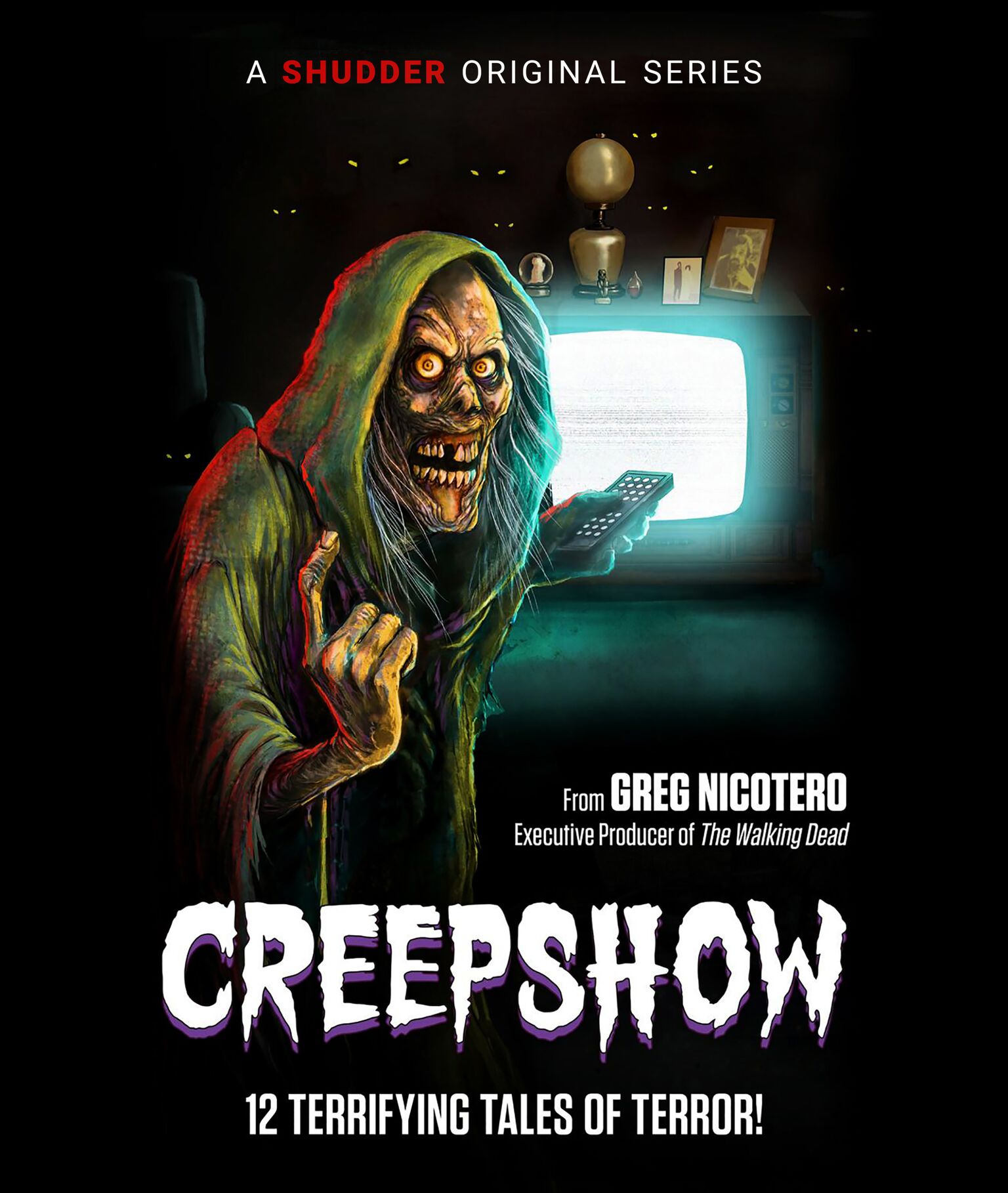
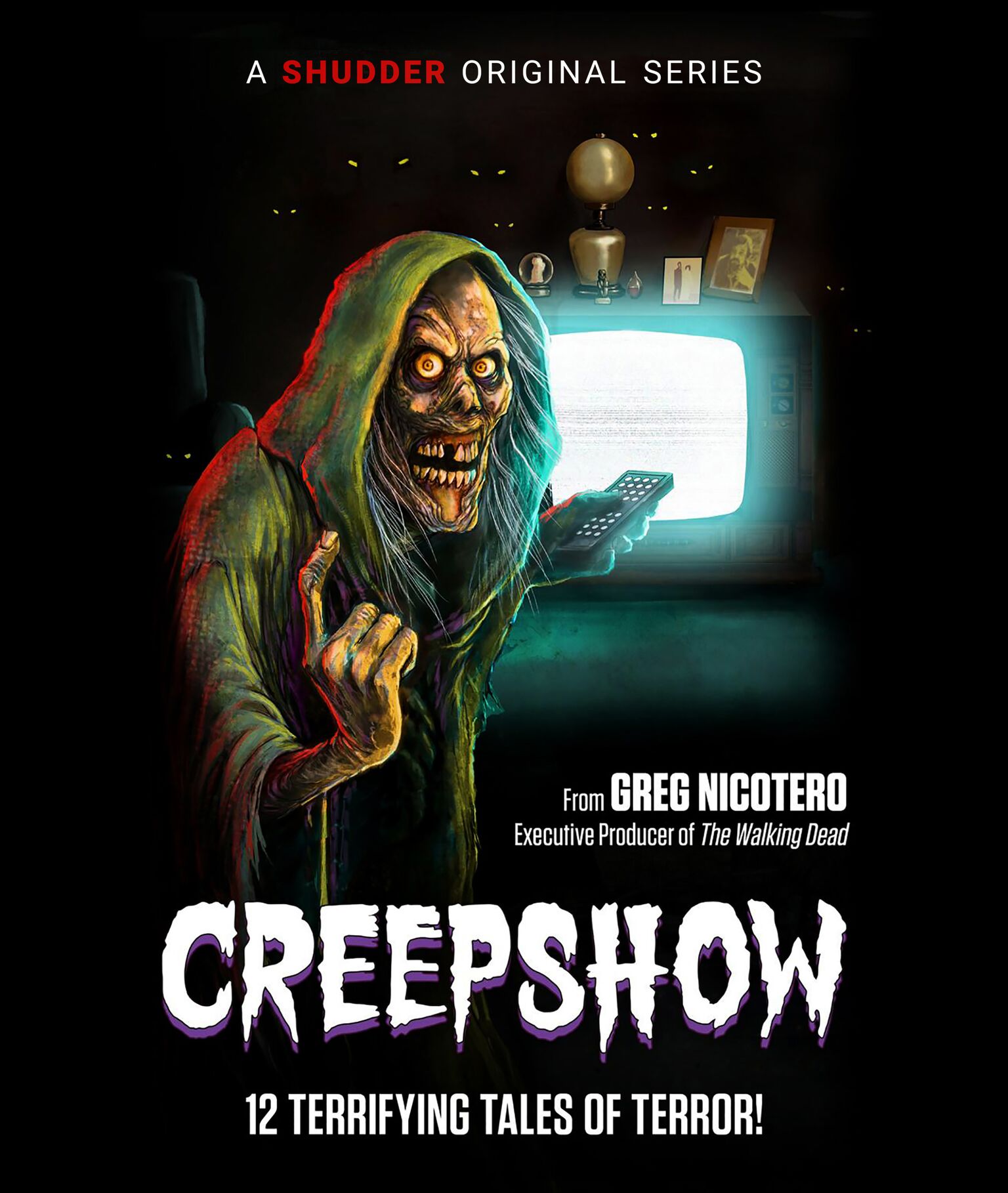
Creepshow, S1, Ep3, All Hallow’s Eve, The Man in the Suitcase, Review By Case Wright


Creepshow.jpg

Happy Horrorthon! I’m am once again reviewing Creepshow.  It is officially a true Guilty Pleasure, but come on, aren’t those all of our go to pleasures anyway? To the uninitiated, Creepshow is a GOOD horror anthology series, but really it’s a showcase for short-films.  How? It’s broken down into two stories and neither of them are over 23 minutes.  Aside from giving writers like Christopher Buehlman his big break (before this he’d only written skits for Renaissance Faires….really), they are the short short brought to life.

Many of Stephen King’s short stories are made into movies, but they are always lengthened into something (usually better) than their original quick-paced short story.  Creepshow keeps that fast pace…mostly.  Well, they keep it for the second story.  The second story is always the better story and moves at the quick pace that you’d expect in a short story.  Even at 22 minutes, the first story tends to drag.

All Hallow’s Eve follows 5 youths trick or treating in a terrified neighborhood.  It was obvious to anyone with a pulse that these kids were dead and out to cause trouble.  Turns out that during a vigorous D&D session in their treehouse, some bullies from the neighborhood thought it would be funny to set it on fire, with the D&D nerds in it.  As you do.  Well, their door gets stuck and they all die.  So, they haunt the neighborhood setting fire to one bully each Halloween until they are all briquettes.

The acting in story A is ….ok.  Story A is a bit slow-paced, which is really hard to do in 20 minutes, but here we are.  I still watched it and so should you.  It’s not like 2 Sentence Horror we are talking about, which is garbage wrapped in rotten bacon.

Story 2 was The Man in the Suitcase, which could’ve worked as a twilight zone episode.  Justin is a loser stoner who is dumped by his girlfriend and used by his roommate.  He is arriving home after visiting his family and he gets a carry-on from the airport and it’s not his stuff that’s inside; it’s a Middle-Eastern man bent so he can fit into the carry-on.  It turns out the Man wants to leave the suitcase, but every time Justin tries to move him, it causes the Man pain, which in turn causes the Man to spit out a gold coin.

Well, Justin isn’t sure what to do, but Justin’s roommate and his ex-girlfriend do and they all decide to torture the man in the suitcase so that he’ll spit out loads of gold.  The torture gets pretty gross, but Justin eventually has a change of heart and tries to free the Man, but his girlfriend and roommate want to keep the gold so she tries to kill Justin with a wrench, which is just lying about.  I won’t spoil what happens next because this was a lot of fun and really makes Shutter worth my subscription fee.

This story really had some good pacing.  Yes, it was predictable and very over the top, but that is just the Creepshow way.

Again, relax and enjoy!


Creepshow, S1 Ep2,Bad Wolf Down/The Finger, Review by Case Wright, Spoilers, but worth it!


Creepshow.jpg

Happy Halloween Havoc!!!! Is it enough for horror to just be fun and even funny?  YES! American Werewolf in London or anything by John Landis really proves that. Creepshow on Shudder is all about just sitting back and having some gory fun. This show is so wonderfully over the top that the 90s have returned. Let’s all put away our black turtle necks and put on some Hammerpants and watch some great horror.

Bad Wolf Down is a werewolves in World War II story…Really! It was a lot of fun.  Then, when I saw Jeffrey Combs (Re-Animator) playing a Nazi, I realized this show is THE AWESOMENESS! An american platoon gets trapped behind enemy lines and takes refuge in an abandoned police station.  They find a woman in the jail who is a french werewolf. This seems relevant because they really spend a lot of time translating.

The Head Nazi (Jeffrey Combs) finds the american platoon and will wipe them out, but the platoon gets the french werewolf to turn them into werewolves and they go and kill a bunch of Nazis.  That’s it…Really!

The Finger is your lonely guy adopts a self-regenerating-human-eating-Alien story.  I know…I know ..  another one?! Clark Wilson (DJ Qualls) is a twice divorced down and out guy who has nothing going for him- until he finds a finger.  The finger looks alien and when he spills beer on it, it re-generates into a medium-sized alien and becomes his pet.  He calls the alien Bob.  Bob becomes Clark’s best friend and as any best friend would do, Bob eats all of Clark’s enemies.  He also brings back body parts from the kill like my old cat did.  Sidenote: I had a cat who used to bring me squirrel heads.  He’d line them on my porch.  Bob is like that.  The police eventually arrest Clark for the murders, but Bob might break him out.

The finger is told by Clark in real-time narration, which really adds to the comedy. He looks dead into the camera, talking directly to us. Also, it’s especially fun watching DJ Qualls hang out with a bro-alien- Brolien. If you wanna chill, watch this!!!!

Creepshow, S1 Ep 1, “Gray Matter” “The House of the Head” Review by Case Wright


Creepshow

Happy Horrorthon! We are in the thick of it and it is AWESOME! Yes, I got another streaming subscription service, but I draw the line at Disney and CBS because they’re boring.  In 1982, Creepshow was a film written, produced, and directed by horror masters, including Stephen King.  The stories were an homage to the EC Horror Comics from the 1950s and 1960s.  The show has become reincarnated on the Shudder streaming service and I will review all of the episodes as they are released.

What’s great about these shows (except for Two Sentence Horror, which is a steaming pile of garbage) is that they give talented people a chance to direct or write when they haven’t had the opportunity prior. Also, because Greg Nicotero (Executive Producer Of The Walking Dead and friend to everyone in horror) is helming it, the show has tremendous access to great stories by Stephen King and actors like Tobin Bell (Saw) and Giancarlo Esposito (Breaking Bad).

The two stories in the premiere were Gray Matter – a Stephen King short story from Night Shift, Directed by Greg Nicotero and The House of the Head was the second story and was Directed by John Harrison, written by Josh Malerman.  The two stories and direction were completely different.

Gray Matter was what I expected: an over the top story with lots of gore that would have been totally at home in a Tales From the Crypt episode.  The House of the Head, on the other hand was genuinely TERRIFYING! I had trouble watching this story because it was so intense that I really worried about the characters and the figurines- I’ll explain later.

Gray Matter is about a son who’s trying to live with his alcoholic single dad.  Everyday the Dad promises to stop drinking and everyday it ends with both of them disappointed.

One day, the father drinks some tainted beer and turns into a slime monster with a craving for beer and people.  The son who enabled his father’s drinking now enables his father’s thirst for human flesh.

This enabling dooms mankind. In essence, the disease of alcoholism consumed the alcoholic and destroyed everyone around him. Sounds about right.

At this time in the 1980s, Stephen King was in the worst period of his cocaine and alcohol addiction and many of his stories revolve around the enabling and tragedy that followed his disease.  In an interview, he described how he put cotton balls up his nose from the frequent bleeds and he kept a sugar bowl filled with cocaine next to him while he wrote.

The symbolism in the episode was not that obvious; it was much into dramatic performances and gore. The monster was a classic Tom Savini art work.

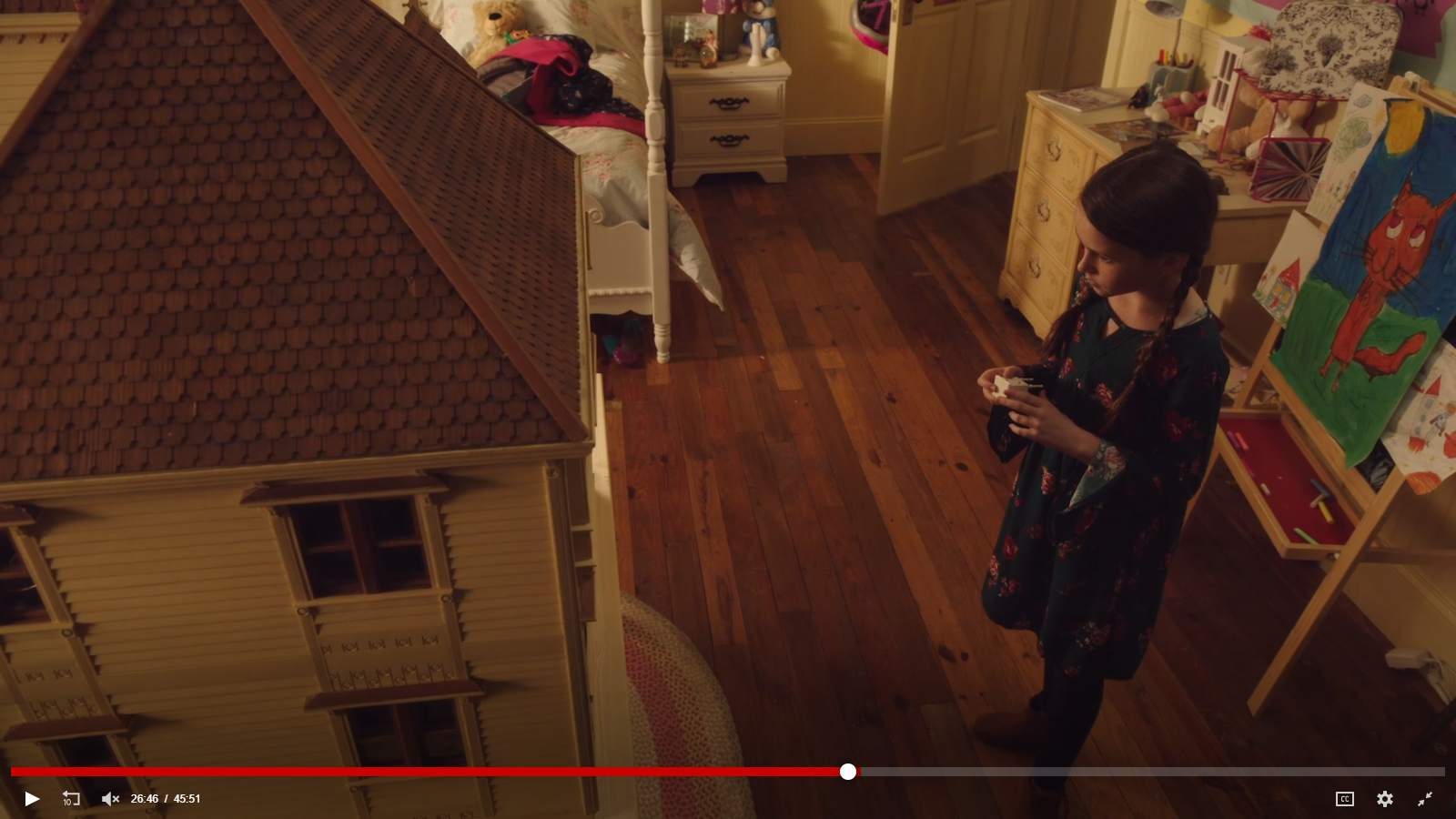
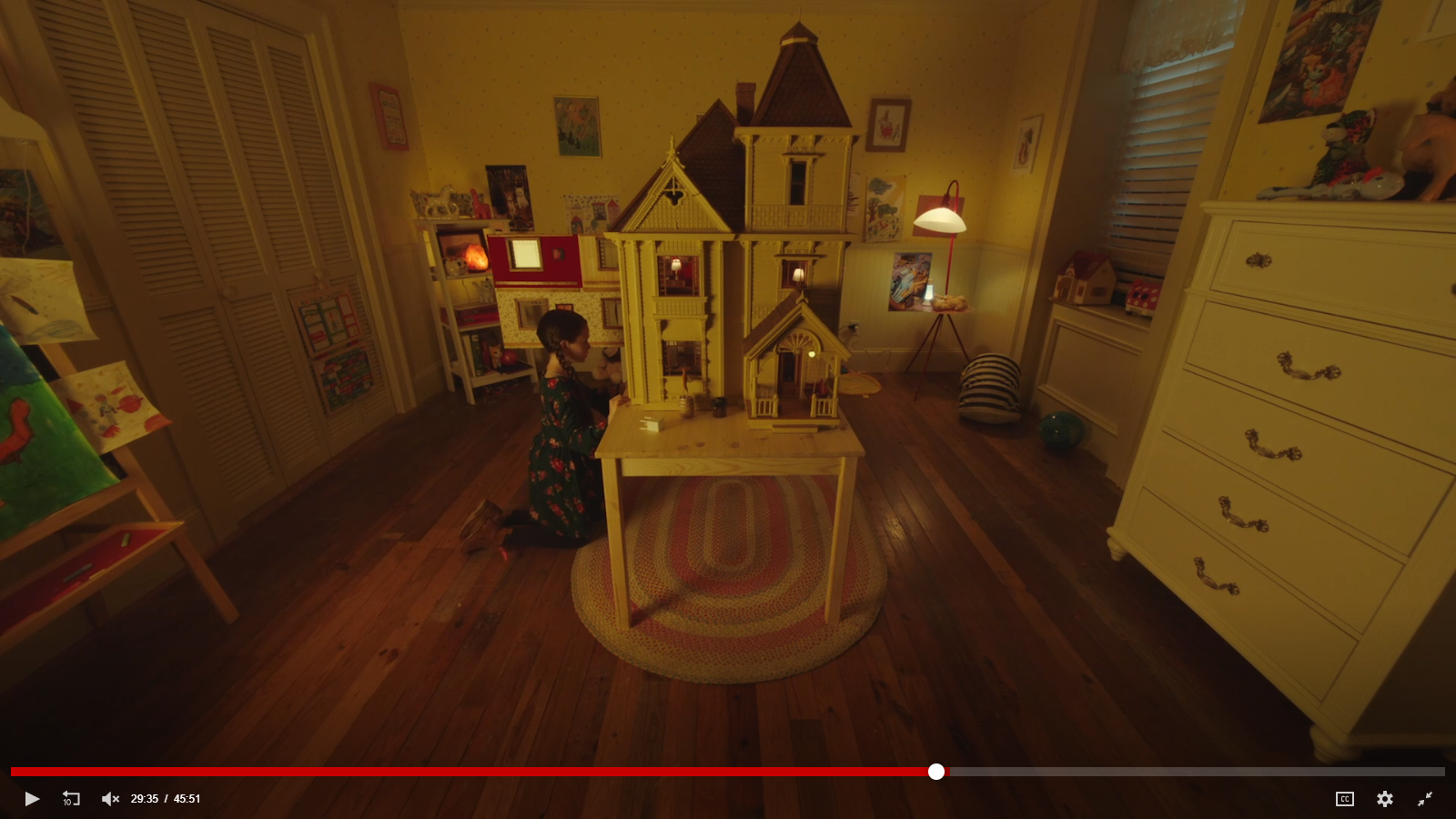
The House of the Head was amazingly unexpected.  It was tense, subtle, and had you on the edge of your seat for the entire episode.  Evie, the central protagonist in The House of the Head, is a nine year old girl whose father got her a dollhouse. Screenshot (98).png

The dollhouse is adorable with cute figurine parents and a child.

Screenshot (103).png

Unfortunately, the dollhouse is also haunted by a severed head!!!! Yikes!

Screenshot (102).png

The writing and direction ramps up the tension as we see that reality is being blurred by this supernatural entity.  The figurines in the dollhouse get terrorized and murdered by the severed head.  It’s real nightmare fuel.

The suspense/thriller writing and directing was also unexpected.  I thought it was going to be a Tales From the Crypt style story; instead John Harrison (Dir) and Josh Malerman (Writer) relentlessly pull the viewer into the haunted dollhouse where every shot is filled with uncertainty and terror.

Screenshot (101).png

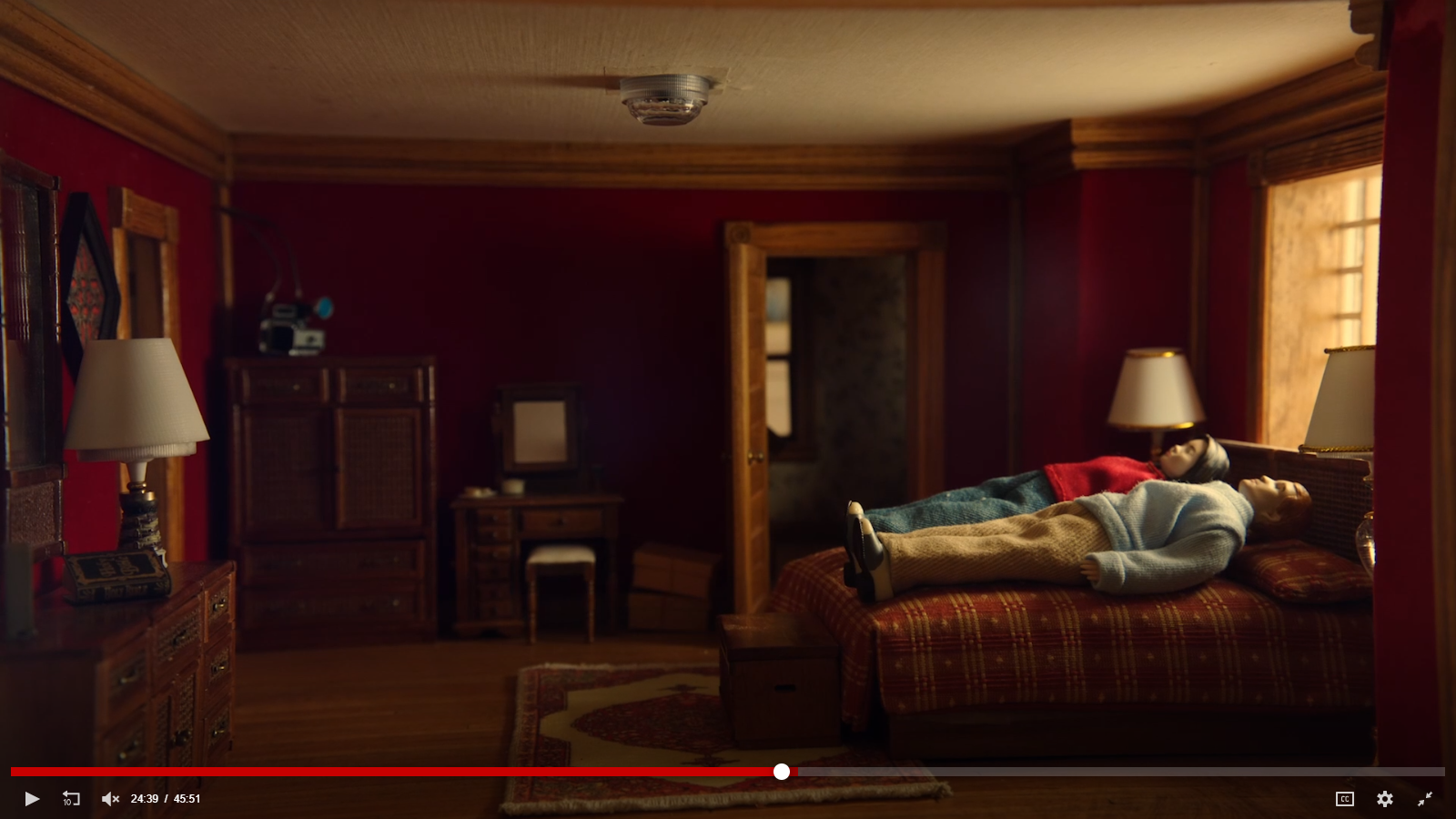
The dollhouse itself becomes a character and the viewer is forced to wonder if our protagonist and her parents are in fact figurines themselves with shots like this.

Screenshot (105).png

The parents are laying in an doll-like manner and the furniture also looks like a dollhouse’s accessories. Is the Head pulling them into a dollhouse world? Is it pushing its way into our reality? Much like the episode itself, you never really know. Every time Evie looks from one room to another, the camera pans back and the figurines have changed and it’s rarely good.

This show was a lot of fun and it’s great to see a horror anthology story done well!

It’s not really enough to recommend this show without recommending Shudder itself. It’s not a lot of money per month and has a lot of original programming.

The TSL’s Horror Grindhouse: Diary of the Dead (dir by George Romero)


I have to admit that I was a little bit hesitant about watching the 2007 film, Diary of the Dead.

It wasn’t that I don’t like zombie movies.  In fact, it was the complete opposite.  I love zombie films and Night of the Living Dead is one of my favorites.  George Romero, of course, went on to make several sequels to Night of the Living DeadDawn of the Dead, Day of the Dead, and Land of the Dead are certifiable horror classics.  However, I had heard mixed things about the two zombie films that Romero directed after Land of the Dead.  Seeing as how Diary of the Dead was Romero’s second-to-last film before he passed away in 2017, I was worried that I would watch the film and discover that I hated it.  I didn’t want experience anything that would tarnish Romero’s cinematic legacy.  It didn’t help my expectations that Diary of the Dead is a found footage film and the conventions of the found footage genre tend to get on my last nerve.

(Seriously, nothing makes me throw a shoe at a screen quicker than the sound of someone in a horror movie saying, “Are you filming this?”)

But you know what?

I did watch Diary of the Dead and it’s actually not bad.  It may not reach the heights of Romero’s other zombie films but it’s definitely a worthwhile companion piece.  It opens with news reports about the start of the zombie apocalypse, meaning that Diary of the Dead is meant to take place at roughly the same time as Night of the Living Dead.  (Never mind that Diary of the Dead is full of references to YouTube and blogs and other things that most people probably couldn’t even imagine when Night of the Living Dead first came out.)  A group of film students are in the woods, filming a terrible mummy movie when they first hear reports of the dead coming back to life.  Some say that there’s no way it could be true.  Others say that something must be happening but surely the dead aren’t actually coming back to life.  They soon discover that the dead have indeed returned.

We follow the students as they travel across Pennsylvania, trying to find a place that’s safe from the Dead and discovering that there’s literally no such place left in America.  Along the way, they also discover that the government has no intention of telling the people the truth about what’s happening.  In fact, a group of national guardsmen turn out to be just as dangerous as the zombies.  In their efforts to survive, the students are forced to rely on an underground network of bloggers and video makers.

Diary of the Dead has all of the usual zombie mayhem that you would expect from a film like this but, at the same time, it’s got a lot more on its mind than just the dead returning to life.  Much as he did with Land Of The Dead, Romero uses Diary of the Dead to comment on the state of America under the Patriot Act.  With the government using the zombie apocalypse as an excuse to suspend civil liberties and increase their own power, the film’s characters are forced to depend on new and independent information sources.  It’s not hard to see the parallel that Romero is making between the War on the Living Dead and the War on Terror.  As well, making all of the characters film students allows for some discussion about whether or not horror films should simply concentrate on being scary or whether they should also attempt to deal with real-world issues.  The film leaves little doubt where Romero came down on that issue.

On the negative side, Diary of the Dead struggles a bit to overcome the limitations of its low budget and none of the characters are as compelling as Ben in Night of the Living Dead or Fran in Dawn of the Dead.  At times, you find yourself wishing that Diary of the Dead featured just one actor who was as into their role as Duane C. Jones or Ken Foree were in Night of the Living Dead and Dawn of the Dead, respectively.  But Diary of the Dead still features enough zombies and enough of Romero’s trademark political subtext to be an acceptable addition to Romero’s vision of the apocalypse.

TV Review: The Walking Dead 8.9 “Honor” (dir by Greg Nicotero)


So, has everyone seen the latest episode of The Walking Dead?  If not, why are you reading this review?  I ask because, on another site that I write for, I’ve got two people bitching at me for revealing too many spoilers about the shows that I review and, as a result, I felt the need to post an apology to those people.  As far as apologies go, it was fairly passive-aggressive and I’d hate to have to be that insincere on this site.  So, in other words, if you haven’t watched the latest episode of The Walking Dead, don’t read this review.  Thanks!

(Okay, I think I’ve rambled on long enough that anyone who didn’t want spoilers should have left by now.)

On Sunday night, the eighth season of AMC’s The Walking Dead resumed and oh my God, I have got such mixed feelings about what I just watched.  Before I go any further, allow me to share something that I tweeted back in April of 2017:

In other words, I can’t say that I’m shocked that Carl’s dead.  In fact, to a certain extent, I kind of respect the show for following through as opposed to coming up with some last-minute contrivance to allow Carl to live.  At the same time, I do think that the death of Carl has robbed the show of some potentially intriguing future storylines.  In the comic, Carl is still alive and he’s even bonded a bit with Negan.  During Season 7, the show seemed to be laying the foundation for that storyline but apparently, Negan’s going to have to bond with some other kid now.  Maybe Henry.  Maybe Judith.

I guess the main thing that bothers me about Carl’s death is that I really do feel that it was mostly due to the fact that the show’s pace has slowed down to such an extent that Chandler Riggs was getting too old to play the role. The Walking Dead has been on the air for 8 seasons but how many years have actually passed in the show?  It’s hard to say but really, it doesn’t seem like Carl should be any older than 14 or maybe 15.  Meanwhile, Chandler Riggs is closing in on 19.  It’s hard not to feel that the show’s producers decided to kill Carl off rather than maybe just wrap up a few storylines and have season 9 open with a “Four years after the defeat of the Saviors” title card.

Myself, I’ve frequently gotten annoyed with Carl as a character, even though I’ve always appreciated Chandler Riggs’s performance.  That said, Carl was one of the few characters left on the show with room to grow.  Rick is never going to change.  If Negan does become the friendly gardener that we saw in Carl’s fantasy, it’s going to have more to do with expedience than anything else.  Carl, though, was still discovering who he was and what he believed.  The majority of the characters have spent the last three or four seasons in a rut.  By virtue of being young, Carl was one of the few characters who actually had a chance of breaking out of that rut.

I mean, to be absolutely honest, I always assumed that the show would end with Carl shooting Rick before he could reanimate.  If you go all the way back to season 1, that’s the ending that the show has appeared to be logically building up to.  Now, I guess Judith will have to do it.

As for the episode itself … again, my feelings were mixed.  This episode was determined to wring every last drop of emotion out of Carl’s passing.  When it worked, it was largely due to the performances of Riggs, Danai Gurira, and the always underrated Andrew Lincoln.  At the same time, there was a part of me that started to resent just how much the show dragged out Carl’s death.  I know that AMC likes to do “super-sized” episodes of The Walking Death but, in this case, I think this episode would have been more effective if it had just been an hour.  Yes, that single gunshot was heart-rendering but, up until I heard it, there was a part of me that feared the show was planning to drag Carl’s death out over the entire rest of the season.

While Carl was dying, Carol, Morgan, and a few other people went off to rescue Ezekiel.  Gavin, who was always one of the most obnoxious of the Saviors, is now dead and yay for that.  Morgan has apparently decided that he’s okay with killing people again.  Morgan also apparently now has Jason Voorhees-style super strength.

It wasn’t a bad episode, though it certainly didn’t carry the power that it would have carried if it had happened during the fourth or fifth season.  On the one hand, I’ve always appreciated the fact that anyone can die on The Walking Dead.  On the other hand, characters die so frequently (and then pop up on the Talking Dead to say goodbye) that it’s now easy to get cynical about the whole thing.

In fact, it may be too early to say whether The Walking Dead handled Carl’s death the right way.  It depends on how this all plays out.  Will the show use Carl’s death as an excuse to go off in an unexpected direction or will we promptly get back to Negan chuckling and Rick giving speeches?  I’m actually looking forward to next week, just because I’m interested in seeing which Rick we’re going to get.  Are we going to get the crazy Rick who appeared after Lori died or are we going to get the catatonic Rick who showed up after Negan executed Abraham and Glenn?  Or maybe it’ll be the return of the Stoic Rick who shot zombie Sophia because he knew he had no other choice.  Which Rick will it be?

We’ll find out next week … hopefully.


TV Review: The Walking Dead 8.3 “Monsters” (dir by Greg Nicotero)


Before watching tonight’s episode of The Walking Dead, I was starting to worry that I might be impossible to please.

I spent all last season complaining that The Walking Dead was too talky and slow-paced.  Then last week’s episode was pretty much nonstop action and I ended up getting bored out of my mind, largely because I didn’t feel like I had any sort of emotional stake in any of the characters.  When tonight’s episode started, I was literally wondering if perhaps I’m destined to never be truly satisfied with anything that happens on The Walking Dead.

When the episode started with the attack still going on and Morales and Rick still talking, I was a little bit concerned.  I was really worried that the entire episode was just going to be the two of them discussing what constitutes morality during the zombie apocalypse.  I honestly didn’t remember much about who Morales was so I have to admit that I wasn’t terribly affected by his tales of woe and death.  Morales explained that he lost everyone.  Rick mentioned that he had lost a lot of people that he cared about.  (Rick didn’t mention that most of them died as the result of Rick being a terrible strategist but no mater.)  I was really starting to get concerned that the conversation was never going to end but then Daryl showed up and killed Morales.  Thank you, Daryl.  From now on, whenever a minor character threatens to hijack an episode, Daryl kills them.  That’s the new rule.

The episode definitely picked up after the death of Morales.  In fact, thing got so much better after Morales died that I almost felt as if, by killing Morales, the show’s producers, writers, and directors were specifically telling us, “Don’t worry.  We learned our lesson last season.  We’re not going to let random characters wander in and take over the show this season.”

As for the rest of the episode, I know that many would probably say that the fight between Morgan and Jesus was a highlight and I’ll agree that it was a very well-done sequence.  (It helped that it was combined with scenes of Rick and Daryl fighting their own battle, for once giving us a chance to understand where all of these characters are in relation to each other.)  The scenes with Aaron and Eric were definitely the episode’s emotional high point and the sight of Eric wandering around as a walker served as nice reminder that, before it all became about Negan and Alexandria, The Walking Dead a show about … well, the walking dead.

For me, though, the best part of tonight’s episode was Gregory showing up at Alexandria and begging to be allowed to come back in.  Maggie, of course, immediately noticed that Gregory was driving Father Gabriel’s car.  Gregory lied and said that he had just found the car.  (Of course, we all know that he deserted Gabriel, leaving him with Negan.)  When Maggie said that Kal had told them that Gregory went to see Negan, Gregory announced that Kal couldn’t be trusted.

Suddenly, Kal leaned over the side of the wall.

Gregory looked up at him.  “Kal,” he sad.

Kal gave Gregory the finger.

Now, it may be a case of me being easily amused but that one hand gesture made the entire night for me.  It was so simple and yet so appropriate that it was pure genius.  If Gregory had been caught telling lies about Rick, Rick would have launched into a speech about why no one is allowed to lie in this new world.  If Gregory had been caught telling lies about Negan, we would have had to spend three episodes listening to Negan’s lecture.  Gregory got caught telling lies about Kal and Kal responded quickly, silently, and efficiently.  Everyone on The Walking Dead should try to be more like Kal.

Anyway, Maggie did let Gregory back into the compound.  Rick probably would have shot Gregory in the head.  Maggie does things differently.

Speaking of which, at the end of the show, Rick promised a savior that he would be allowed to escape if he would just tell Rick and Daryl where they could find a case of guns.  The savior told them and Daryl promptly shot him in the head.  I can’t say that I blame Daryl.  That’s just the way things work in the heartless world of The Walking Dead.

Anyway, despite a shaky start, this episode turned out pretty well.  It was certainly a huge improvement on the previous two episodes of this season.

Allow me to end this review with a question and prediction.

First, the question: “Where’s Carl?”

A prediction: The first half of season 8 will end with a zombiefied Carl walking towards Rick.  I know that would be a major departure from the comic book but, honestly, it makes sense.  On the show, only two or three years have passed since Rick woke up from that coma.  In the real world, it’s been nearly 8 years and Chandler Riggs isn’t getting any younger.

We’ll see what happens!