Embracing The Melodrama: Poseidon (dir by Wolfgang Petersen)


The plot of 2006’s Poseidon may sound familiar.

There’s this cruise ship.  It’s a luxury liner and it’s sailing across the ocean on New Year’s Eve.  There’s a lot of passengers on the liner.  Most of them are wealthy and the majority of them are played by familiar actors.  Everyone is in the ballroom, celebrating the upcoming new year.  They do the countdown.  They cheer when they hit zero.  Kisses are exchanges.  Dances are danced.  A blonde woman sings a song.  Suddenly, a tidal wave smashes into the Poseidon, turning it over.  Explosions rock the ship as it ends up floating upside down.  The majority of the crew and the passengers are killed immediately.  The survivors face a decision.  Do they stay in the ballroom or do they attempt to climb upwards to safety?

Yep, Poseidon is a remake of The Poseidon Adventure.  It tells basically the same story but with slightly better special effects and slightly less histrionic actors.  The original Poseidon Adventure had Gene Hackman and Ernest Borgnine yelling at each other for over two hours while Shelley Winters swam until she died.  “WHERE’S YOUR GOD NOW, PREACHER!?” Borgnine shouted while Hackman yelled, “ROGO!” over and over again.  (Rogo was Borgnine’s character.  Hackman shouted the name with a wonderful amount of loathing.)  It was a very loud and every entertaining movie.  The cast of Poseidon is a bit more low-key but Poseidon is also more interested in special effects than any sort of human (melo)drama.

For instance, Josh Lucas plays a Navy veteran-turned-professional gambler.  He gives a good performance as the de facto leader of the survivors but he never gets to yell as much as Gene Hackman did in the original.  Richard Dreyfuss plays an architect and you would think that Dreyfuss, of all people, would chew up the scenery in this disaster film with relish but Dreyfuss is oddly subdued.  Jacinda Barrett is the mother who tries to protect her son (played by Jimmy Bennett).  Fergie is the singer who embraces the ship’s captain (Andre Braugher) as the ballroom floods.  Emmy Rossum is the rebellious teenager.  Mike Vogel is her boyfriend.  And Kurt Russell plays the former mayor of New York City.  He also happens to be a former fireman.

It’s a good cast.  Kurt Russell is especially good in his role, believable as both a fireman (a role that he’s played in a few films) and as a politician.  It’s a talented group of actors but no one really goes overboard in the way that Gene Hackman, Ernest Borgnine, Shelley Winters, Stella Stevens, Roddy McDowall, and even Leslie Nielsen did in the first one.  The premise of the film is so silly that it really does require the cast and the director to fully embrace the melodrama.  As opposed to the original, this film only gives the melodrama a quick hug and instead concentrates on explosions, water, and flames.  The special effects overshadow the humans and that’s unfortunate because there’s a lot of interesting people in this movie.  A good performance can last a lifetime.  There’s a reason why we still talk about Kurt Russell in films like Escape From New York and The Thing.  Good special effects, on the other hand, still look incredibly dated after three years.

I’m not really sure that it was necessary to remake The Poseidon Adventure in the first place.  I’m just glad they left Beyond The Poseidon Adventure alone.

I Watched Dreamer (2005, Dir. by John Gatins)


Dreamer is based on the true story of a horse that did something that few horses have managed to do.  It broke a bone but it still managed to make a comeback as a racehorse.

I love horses, which is why I’m not a fan of horseracing.  I find horseracing to be cruel.  The horses, which have an innate need to follow the orders of whoever is riding it, will literally run themselves to death to try to keep their jockeys happy.  When you add that many racehorses are kept in deplorable conditions and that, with insurance, they are often worth more dead than alive, you have a sport that brings out the worst in a lot of people.  Horses are wonderful animals because they are so loyal.  That loyalty deserves better than being shot because they broke a leg due to their trainer’s negligence.

Given how I feel about horseracing, I’m amazed that I liked Dreamer when I saw it in the theaters and I was surprised that I still liked it when I watched it this weekend.  I guess it’s because the horse in Dreamer is not euthanized.  She would have been euthanized if not for the fact that her trainer (Kurt Russell) brought his daughter (Dakota Fanning) to work with him that day.  Russell loses his job but he does gain a horse.  After the horse recovers from its injury, Russell hopes to breed the horse.  It turn out that the horse cannot have a foal but it can still race.  With Russell and Fanning’s help, the horse returns to competition and shows up everyone who gave up on her.  Russell and Fanning refuse to give up on the horse and the horse doesn’t give up on herself.  Along the way, Russell and Fanning finally spend time together as father and daughter and Russell reconnects with his wife, Elisabeth Shue, and his father, Kris Kristofferson.  Everyone involved gives a good job.  The movie may be predictable but there aren’t any false notes in any of the performances.  I not only wanted the horse to get better but I wanted the family to grow closer and I was happy when both those things happened.

Dreamer is a good family movie.  If only every trainer was as kind and willing to admit his mistakes as Kurt Russell is in this film.  There’s nothing surprising about Dreamer but it’s still a movie that makes me cheer.  It makes me cheer in a way that a real horse race never would.


14 Days of Paranoia #5: Payback (dir by Brian Hegeland)


The 1999 film, Payback, opens with Porter (Mel Gibson) lying on a kitchen table while a grubby-looking doctor digs two bullets out of his back.  The scene takes place in almost nauseating close-up, with the emphasis being put on the amount of pain that Porter endures to get rid of those bullets.  Immediately, we know that Porter is not someone who can safely go to a regular hospital.  Porter is someone who exists in the shadows of mainstream society.

He’s also someone who spends a lot of time getting beaten up.  Even back when he was still a big star, Mel Gibson always seemed to spend a good deal of his films getting beaten up and tortured in various ways and that’s certainly the case with Payback.  Porter gets punched.  Porter gets shot.  Porter has a encounter with an over-the-top dominatrix (played by Lucy Liu).  At one point, Porter allows two of his toes to be smashed by a hammer, just so he can trick the his enemies into doing something dumb.  As played by Gibson, Porter stumbles through the film and often looks like he’s coming down from a week-long bender.  It’s interesting to think that Payback is a remake of 1967’s Point Blank, which starred Lee Marvin as Walker, an unflappable career criminal who never showed a hint of emotion or weakness.  Porter, on the other hand, is visibly unstable and spends the entire film on the verge of a complete mental collapse.  A lot of people try to kill Porter and Porter kills almost all of them without a moment’s hesitation.

(Of course, both Porter and Point Blank‘s Walker are versions of Parker, a career criminal who was at the center of several crime novels written by Donald “Richard Stark” Westlake.)

After helping to pull off a $140,000 heist from a Chinese triad, Porter was betrayed and left for dead by his former friend Val Resnick (Gregg Henry) and his wife, Lynn (Deborah Kara Unger).  Porter, who just wants the $70,000 cut that he was promised, starts his quest for the money by tracking down Val and Lynn, and then continues it by going after the three bosses (played by William Devane, James Coburn, and Kris Kristofferson) of “The Outfit,” a shadowy organization that Val had gotten involved with.  Along the way, Porter deals with a motely crew of corrupt cops, violent criminals, and sleazy middlemen.  (David Paymer has a memorable bit as a low-level functionary with atrocious taste in suits.)  Porter also hooks up with a prostitute named Rosie (Maria Bello), who might be the only person that he can actually trust.

I have mixed feelings about Payback.  (So did director Brian Hegeland, who was reportedly fired towards the end of shooting and later released a far different director’s cut.)  Though the film does a good job of capturing the visual style of a good neo-noir, the story itself is so violent and grim that it actually gets a little bit boring.  The film’s advertising encouraged audiences to “Get ready to root for the bad guy,” but there’s really no reason to root for Porter.  He’s an inarticulate and ruthless killer with no sense of humor.  If anything, the people that he kills seem to be far more reasonable and likable than he does.  In Point Blank, Lee Marvin may have been a bastard but he was good at what he did and you at least got the feeling that he wouldn’t go after any innocent bystanders.  In Payback, Porter is such a mess that his continued survival is largely due to dumb luck.  It’s hard to root for an idiot.

That said, the film does do a good job of capturing the feeling of people living on the fringes of society.  The Outfit is not a typical Mafia family but instead, a collection of businessmen who work out of nice offices and, in the case of William Devane’s Carter, come across as being more of a senior executive than a crime boss.  (James Coburn and Kris Kristofferson, meanwhile, come across as being two former hippies who made it rich on Wall Street.  They’re elderly versions of Abbie Hoffman and Jerry Rubin.)  The film does a good job of creating a world where no one trusts anyone and everyone is being watched by someone.  In one memorable scene, the three men sent to watch for Porter discover that he’s been watching them the entire time.  Never forget to look over your shoulder to see who might be following.

Flaws and all, this 1999 film does a good job of capturing the atmosphere of paranoia that, for many, would come to define the early part of the 21st Century.

14 Days of Paranoia:

  1. Fast Money (1996)
  2. Deep Throat II (1974)
  3. The Passover Plot (1976)
  4. The Believers (1987)

V/H/S/85 (dir. by Various Artists)


The full list of directors for Shudder’s V/H/S/85 includes David Bruckner (The Night House), Gigi Saul Guerrero (Bingo Hell), Scott Derrickson (The Black Phone), Natasha Kermani (The Imitation Girl), and Mike P. Nelson (2021’s Wrong Turn).

I’m not completely familiar with the V/H/S series. I stopped after the very first one, with the “I Like You” segment rattling me enough to never want to delve into that found footage mayhem again. It only caught my interest because Scott Derrickson (and by extension C. Robert Cargill and Gigi Saul Guerrero were involved. Cargill and Derrickson have worked together since Sinister (as far as I know). Guerrero’s Bingo Hell was a fun watch, as horror films go. While the found footage format still bothers me when used in large doses, the effect here really makes sense. You’re working in the 80s, pre-cell phones and most major technology. Home movies were common back then as well.

The format for the film is similar to most horror anthologies (like Tales From the Darkside), where there are 4 or 5 mini tales and another that you see in between those. David Bruckner covers the main story with “Total Copy”, where a strange specimen in a lab is kept under close study. Of all the stories in the group, this one really didn’t hold me very well, though it does work well as filler between the other, stronger tales.

Mike Nelson’s “No Wake” starts us off with a camping trip to a nearby lake. Despite discovering No Trespassing signs, the crew of young adults set out for a nice time in the water. This ends up becoming rather treacherous and the result leaves them wanting to take revenge on their perpetrators. It was a strange and refreshing take on a familiar tale that I liked, though it was somewhat short.

We move on to Gigi Saul Guerrero’s “God of Death”, which I enjoyed. This tale follows a cameraman during an earthquake in Mexico, as a rescue crew tries to evacuate a collapsing building. Guerrero is in this piece as the reporter, Gabriella, and if you watch close enough, you’ll see a picture of her father on one the walls, looking like the Mayor of the town. I thought that was sweet. There’s quite a bit of blood and gore, as much as Shudder likes to give.

Natasha Kermani’s “TKNOGOD” was the only one in the series that I didn’t care for. Not that I was bothered about the argument of God vs. Technology, but it felt more like those slam poetry sessions you find in Manhattan. I understand what it was trying to convey, and it does get somewhat chilling. Still, I kind of glossed over it and waited for the next entry. It was filmed well, at least. That I will give it.

“Ambrosia” brings us to a family reunion and celebration, though the family itself might not have the best intentions at heart. This one surprised me a bit and I liked the connection to earlier events.

And finally, we have a Sinister reunion of sorts with Director Scott Derrickson, writer C. Robert Cargill, and actor James Ransome (Deputy So & So himself) in “Dreamkill”. Working in a similar vein to Sinister, Dreamkill focuses on some deadly murders occurring in a town that also happen to be recorded on home video before the events take place. A detective (Freddy Rodriguez, Grindhouse’s Planet Terror) tries to piece together the clues before more victims are lost. This was the best of the bunch, by far, I felt.

Overall, if you can handle the shaky cam of the V/H/S films, 85 is a treat. While I personally wished some these weren’t using the cam, the film finds a way to keep the floating camera in the picture. It’s an interesting set of scares if you have the time to watch.

Quick Review – Grindhouse (dir. by Robert Rodriguez & Quentin Tarantino)


The following was posted on 4/6/2007 from my LiveJournal on Grindhouse (which is celebrating it’s 15th Anniversary). I’ll admit I respect Death Proof a bit more now than I did back then:

Gotta write fast. Have to jump into shower and head for work.

I got into the movie theatre at about 8pm, and spent the hour talking with a pair of film students from the School of Visual Arts. At 9 (an hour before the movie), the rest of the sold out crowd appeared. I was officially 3rd in line. Sweet. 🙂 I didn’t my preferred seat (the single one on the right reserved for patrons coming in with someone in a wheelchair), but did get a seat in the empty row (meaning I could stretch my legs, even better).

The short of it: Grindhouse is paying one low price for 2 bad movies, on purpose. You get 3 great built in trailers, and two mini movies. Between the two mini movies, I loved “Planet Terror” (the Rodriguez one) more than “Death Proof” (The Tarantino film), simply because Death Proof had too much of Tarantino’s conversational style that all of his films have. It’s like you’re listening to a conversation that absolutely doesn’t tie itself to any of the storyline’s major points. It’s just “cool” stuff, but I literally almost fell asleep until Kurt Russell showed up on screen. I think that if one knows to expect this from Tarantino, it comes across better. It’s like watching both Kill Bill volumes back to back. The first one’s cool and action packed, and the second one has some action (the chase scene alone in Death Proof had me wondering how they did that), but is so slow before getting there, you want to sigh.

Being a Charmed Fan, it was great to see Rose McGowan again, and there were so many cameos to laugh at. Fergie has a cameo, and Michael Biehn’s (“Hicks” from Aliens, Navy Seals) even in this. Where did they dig up these guys?

Grindhouse is easily a party film. I’d go see it again in the theatre, but I don’t see myself getting the DVD. It takes you back about a good 30 years, and does that really well. There are missing reels, serious jump cuts in the film and the sound sometimes cuts out. 🙂 In that sense, it’s really beautiful. The audience laughed and applauded, though there were some that at the end were like “Man, that sucked.” In the 60’s and 70’s, Grindhouse movies were pretty bad. I guess it’s like watching one of those old Hammer films, mixed in with a cheap horror flick. You have to walk into this movie not expecting “The Departed” for it to work. Just have fun with what you’re seeing and remember, this is what your parents sometimes saw in the movies (it should be noted that my parents went to something of a Grindhouse once – the movie they went to see was Night of the Living Dead. The other movie that was in the show was John Carpenter’s “Halloween”, which freaked my Dad out).

The music in particular is really great. Robert Rodriguez, Chingon, and a few friends come up with a sound for Planet Terror that’s in essence a John Carpenter like sound. If you have access to the Itunes Music Store, give it a listen (I bought it). Plus, if you’re a fan of some of the older movies out there, you’ll find references to some of Carpenter’s films in there (for example, one of the songs from “Escape from New York” is actually used in the film). The same occurs with the soundtrack from “Creepshow” – The story with the drowned couple. There are also tons of older Tarantino/Rodriguez references in there. One fellow actually yelled out a line, word for word, from what was on screen. It took me a second to realize the line came from “From Dusk Till Dawn”. Sweet.

The in betwen trailers are absolutely fantastic. If I were to get the DVD, it would probably be for this reason alone. You can tell that Rob Zombie, Edgar Wright (Shaun of the Dead) and Eli Roth (Hostel) really had fun with their pieces.

So, Grindhouse is worth seeing in theatre at least once with a bunch of friends, but know what you’re walking into. The movie can get gross at times and no young kid should even be brought near to this (we got carded to actually get into the theatre, and a Weinstein Rep. was on hand after the film to let us take surveys). Also before the movies, one of the teaser trailers is for Rob Zombie’s “Halloween”. I haven’t been so excited for a horror film like this since Zack Snyder’s version of “Dawn of the Dead”. This looks really good, and I’m wondering what Michael Myers is going to look like when someone like Tyler Mane (Sabretooth from the first X-Men movie) is playing him. That’s going to be creepy.

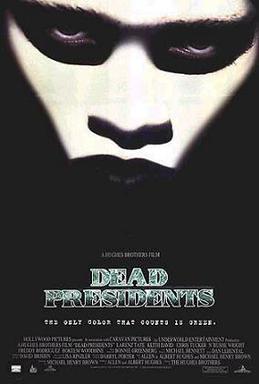
Dead Presidents (1995, directed by the Hughes Brothers)


In 1969, Anthony (Larenz Tate) graduates from high school in the Bronx and shocks his family by announcing that he will not be following in his brother’s footsteps by enrolling in city college but that he will instead be enlisting in the Marines and going off to fight in Vietnam.  While his friends taunt him for choosing to fight in a “white man’s war,” Anthony thinks that serving in the Marines will make him a man.  His two biggest heroes, his father and the local numbers boss, Kirby (Keith David), both served in Korea.  Kirby’s even lost his his leg in the war but he can still keep order in the neighborhood.

Vietnam doesn’t turn out to be what Anthony was expecting.  He serves two tours of duty and becomes an efficient killing machine but he is also forced to do things that will haunt him long after the war is over.  When Anthony finally returns to the Bronx in 1971, the old neighborhood has changed.  Crime, drugs, and poverty are destroying the community and Anthony struggles to support his girlfriend (Rose Jackson) and his daughter.

Finally, with no other opportunities available and feeling as if his country has abandoned him, Anthony agrees to take part in an armored car robbery.  Working with him are a few friends from the old days and a few members of the revolutionary Nat Turner Cadre.  Anthony thinks that he has the robbery planned out perfectly but nothing ever goes as planned.

In 1993, The Hughes Brothers made their directorial debut with Menace II Society, an incendiary film that holds up as one of the best feature debuts of any filmmaker.  Their follow-up to Menace II Society was Dead Presidents.  While Dead Presidents operates on a more epic scale than Menace II Society, it’s also a far more uneven film.  While the first part of the film (which follows Anthony and his friends during their final days of high school) is strong, things start to fall apart once the action moves to Vietnam.  The Hughes Brothers tried to recreate the Vietnam War on a Grenada Invasion budget and the action never feels credible.  When Anthony returns to the Bronx, Dead Presidents regains some of its footing but the eventual armored car heist is never as exciting as it could be.

Still, Dead Presidents has enough good moments that it’s always watchable.  Larenz Tate gives a good performance as Anthony and he’s surrounded by the some of the best black character actors of the 90s.  Keep an eye out for a young and incredibly obnoxious Terrence Howard, playing an aspiring gangster and getting a deserved beating at the hands of Anthony.  Though the movie often bites off more than it can chew, it does do a good job of seriously dealing with the issues that returning vets have to contend with when they come back home.  Anthony suffers from PTSD, which is something that a lot of people didn’t talk about in 1995, and the Hughes Brothers deserve much credit for their sensitive handling of the topic.  Dead Presidents may not be perfect but it’s impossible not to admire the film’s ambition.

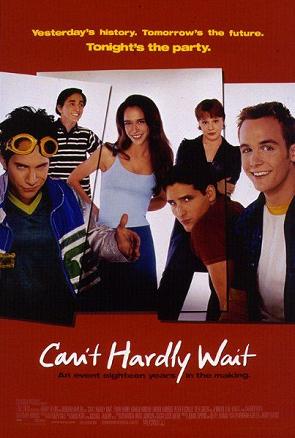
Back to School Part II #37: Can’t Hardly Wait (dir by Deborah Kaplan and Harry Elfont)


cant_hardly_wait_poster

Oddly enough, the late 90s and early 2000s saw a lot of movies about teenagers that all had strangely generic names.  She’s All That, Down To You, Drive Me Crazy, Head Over Heels, Get Over It, Bring It On … the list is endless.

And then you have the 1998 graduation party-themed Can’t Hardly Wait.  Can’t Hardly Wait has such a generic name that, when you first hear it, you could be forgiven for naturally assuming that it stars Freddie Prinze, Jr.  Of course, if you’ve actually seen the film, you know that it features almost everyone but Freddie Prinze, Jr.  This is one of those films where even the smallest roles are played by a recognizable face.  In fact, there’s so many familiar actors in this film that a good deal of them go uncredited.  Jenna Elfman, Breckin Meyer, Melissa Joan Hart, Jerry O’Connell, and Amber Benson may not show up in the credits but they’re all in the film.  In fact, you could argue that Melissa John Hart, playing an impossibly excited girl who is obsessed with getting everyone to sign her yearbook, and Breckin Meyer, playing an overly sensitive lead singer, provide the film with some of its comedic highlights.

(That said, perhaps the most credible cameo comes from Jerry O’Connell.  He plays a former high school jock who ruefully talks about how he can’t get laid in high school.  He’s so convincingly sleazy and full of self-pity that you find yourself wondering if maybe O’Connell was just playing himself.  Maybe he just stumbled drunkenly onto the set one day and started talking to anyone who would listen…)

Can’t Hardly Wait takes place at one huge high school graduation party, which is actually a pretty smart idea.  The best part of every teen movie is the party scene so why not make just make the entire movie about the party?  Almost every member of the graduating class is at this party and we get to see all of the usual types.  There’s the stoners, the jocks, the nerds, and the sarcastic kids who go to parties specifically so they can tell everyone how much they hate going to parties.  Eric Balfour shows up as a hippie.  Jason Segel eats a watermelon in the corner.  Sara Rue’s in the kitchen, complaining about how everyone’s a sheep.  Jamie Pressly drinks and assures her best friend that she’s at least as pretty as Gwynneth Paltrow.  (“And you’ve got way bigger boobs!” she adds, encouragingly.)  Outside, Selma Blair frowns as someone hits on her with bad line.

Of course, Mike Dexter (Peter Facinelli) and Amanda Beckett (Jennifer Love Hewitt) are the main topic of conversation at the party.  For four years, Mike and Amanda were the school’s power couple but Mike decides to dump Amanda right before they graduate.  Mike feels that he’s going to have a great time in college and he doesn’t need any old high school commitments holding him down.  His best friends all agree to dump their girlfriends too.  Mike spends the party watching, in horror, as all of his friends go back on their promise.  Amanda, meanwhile, wanders around and wonders who she is now that she’s no longer Mike Dexter’s girlfriend.

Preston Meyers (Ethan Embry) struggles to work up the courage to tell Amanda that he’s had a crush on her ever since the first day he saw her.  Meanwhile, Preston’s best friend — the reliably sarcastic Denise (Lauren Ambrose) — finds herself locked in an upstairs bathroom with Kenny “Special K” Fisher (Seth Green).  (Needless to say, Kenny is the only person who actually calls himself “Special K.”)  Kenny is obsessed with losing his virginity.  Denise, meanwhile, won’t stop talking about the sweet and dorky Kenny that she knew way back in elementary school.

And then there’s William Lichtner (Charlie Korsmo).  He’s spent his entire life being tormented by Mike and he specifically goes to the party looking for revenge.  However, he has a few beers and quickly becomes the most popular senior at the party.  He even gets a chance to bond with Mike…

Can’t Hardly Wait is a favorite of mine.  It’s one of those films that doesn’t add up too much but it’s so so damn likable that it doesn’t matter.  It’s full of smart and funny scenes and all the actors are incredibly likable.  If you’re not rooting for Preston and Amanda by the end of the movie then you have no heart.  In fact, Can’t Hardly Wait is a lot like Empire Records.  They may not be much depth to it but it’s so sincere and earnest that you can forgive it.

You can even forgive the generic name.

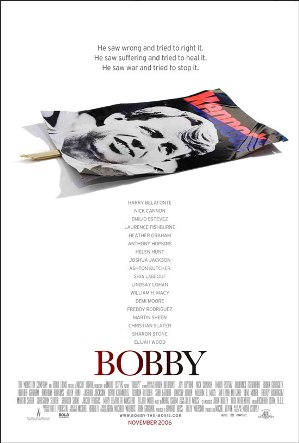
Shattered Politics #80: Bobby (dir by Emilio Estevez)


Bobby_poster

A few years ago, I was on twitter when I came across someone who had just watched The Breakfast Club.  

“Whatever happened to Emilio Estevez?” she asked.

Being the know-it-all, obsessive film fan that I am, I tweeted back, “He’s a director.”

Of course, I could not leave well enough along.  I had to send another tweet, “He directed a movie called Bobby that got nominated for bunch of Golden Globes.”

“Was it any good?” she wrote back.

“Never seen it,” I wrote back, suddenly feeling very embarrassed because, if there’s anything I hate, it’s admitting that there’s a film that I haven’t seen.

However, Shattered Politics gave me an excuse to finally sit down and watch Bobby.  So now, I can now say that I have watched this 2006 film and … eh.

Listen, I have to admit that I really hate giving a film like Bobby a lukewarm review because it’s not like Bobby is a bad film.  It really isn’t.  As a director, Emilio Estevez is a bit heavy-handed but he’s not without talent.  He’s good with actors.  Bobby actually features good performances from both Lindsay Lohan and Shia LaBeouf!  So, give Estevez that.

And Bobby is a film that Estevez spent seven years making.  It’s a film that he largely made with his own money.  Bobby is obviously a passion project for Estevez and that passion does come through.  (That’s actually one of the reasons why the film often feels so heavy-handed.)

But, with all that in mind, Bobby never really develops a strong enough narrative to make Estevez’s passion dramatically compelling.  The film takes place on the day of the 1968 Democratic California Presidential Primary.  That’s the day that Robert F. Kennedy won the primary and was then shot by Sirhan Sirhan in the kitchen of the Ambassador Hotel.  However, it never seems to know what it wants to say about Kennedy or his death, beyond the fact that Estevez seems to like him.

(Incidentally, it’s always interesting, to me, that Dallas is still expected to apologize every day for the death of JFK but Los Angeles has never had to apologize for the death of his brother.)

Estevez follows an ensemble of 22 characters as they go about their day at and around the Ambassador Hotel.  As often happens with ensemble pieces, some of these characters are more interesting than others.

For instance, Anthony Hopkins plays a courtly and retired doorman who sits in the lobby and plays chess with his friend Nelson (Harry Belafonte).  It adds little to the film’s story but both Hopkins and Belafonte appear to enjoy acting opposite each other and so, they’re fun to watch.

Lindsay Lohan plays a woman who marries a recently enlisted soldier (Elijah Wood), the hope being that his marital status will keep him out of Vietnam.  The problem with this story is that it’s so compelling that it feels unfair that it has to share space with all the other stories.

Christian Slater plays Darrell, who runs the kitchen and who spends most of the movie talking down to the kitchen staff, the majority of whom are Hispanic.  Darrell is disliked by the hotel’s manager (William H. Macy) who is cheating on his wife (Sharon Stone).

And then, you’ve got two campaign aides (Shia LaBeouf and Brian Geraghty) who end up dropping acid with a drug dealer played by Ashton Kutcher.  Unfortunately, Estevez tries to visualize their trip and it brings the film’s action to a halt.

Estevez himself shows up, playing the husband of an alcoholic singer (Demi Moore).  And Estevez’s father, Martin Sheen, gets to play a wealthy supporter of Kennedy’s.  Sheen’s wife is played by Helen Hunt.  She gets to ask her husband whether she reminds him more of Jackie or of Ethel.

(Actually, Martin Sheen and Helen Hunt are cute together.  Much as with Lohan and Wood, you wish that more time had been devoted to them and their relationship.)

And there are other stories as well.  In fact, there’s far too many stories going on in Bobby.  It may seem strange for a girl who is trying to review 94 films in three weeks to say this but Emilio Estevez really tries to cram too much into Bobby.

At the same time, too much ambition is better none.  Bobby may have been a misfire but at least it’s a respectable misfire.