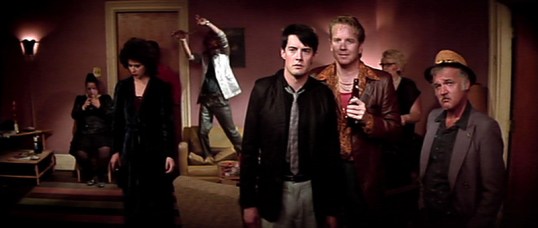
The TSL Grindhouse: Nomads (dir by John McTiernan)


1986’s Nomads opens with anthropologist Jean-Charles Pommier being rushed into an emergency room, badly beaten and struggling for his life.  Despite the best efforts of Dr. Eileen Flax (Lesley-Anne Down), Pommier dies in the ER.  Flax is shocked by Pommier’s death and, naturally, she’s upset that she couldn’t save him.  But, at the same time, people die in hospitals.  It happens to the best of doctors.

Except soon, Flax is seeing flashes of the events that led to Pommier’s death.  Pommier has somehow entered her mind and soon, she’s reliving his investigation into the origins of a group of destructive, urban nomads that Pommier witnessed causing havoc throughout Los Angeles.  Pommier often felt like he was the only person who was capable of seeing the nomads and he grew to be tortured by his fear that they were specifically stalking him.  We soon learn that there was reason for that….

Now, based on his name, you’re probably assuming that Pommier is meant to be French.  And he is!  He’s from France, though he considers himself to be a citizen of the world.  He’s traveled everywhere, taking pictures of different cultural rituals across the globe.  However, in Nomads, the very French Jean-Charles Pommier is played by Pierce Brosnan.  Pierce Brosnan is, needless to say, not French.  He’s Irish, even though a lot of people seem to be shocked when they first learn that.  Brosnan normally speaks with an accent that could best be described as a mix of posh London and mid-Atlantic American.  Everything about him screams the UK.  In short, Pierce Brosnan is one of the least convincing French people ever seen on film and he delivers his lines in an accent that sounds like every accent other than the French accent.  Watching this film, I found myself thinking about the Monty Python skit where Terry Jones and Carol Cleveland starred in a French movie.  (“I see you have a cabbage.”  “Oui.”)  Brosnan is not a bad actor and it’s entertaining to watch him overact in Nomads.  But there’s nothing French about him and every time that someone referred to him as being French, it totally took me out of the movie.

Which is a shame because Nomads may be narratively incoherent but it’s got some memorably surreal visuals and it does a good job of generating a properly ominous atmosphere.  Director John McTiernan (who later went on to do Predator, Die Hard, and The Hunt For Red October) makes smart use of slow motion and a handheld camera to keep the audience off-balance.  At its best, Nomads achieves a dream-like intensity that makes up for the fact that the story doesn’t make the least bit of sense.  The nomads themselves are a memorable and creepy.  While Adam Ant plays their leader (and the scene where he smiles as Brosnan attempts to throw him off a building is truly disturbing), the most frightening of the nomads is Mary Woronov as Dancing Mary.  Seriously, after I watched this film, I checked all the locks in the house.  No urban nomads were going to interrupt me in my sleep!

My suggestion to everyone is to do a Nomads/Nomadland double feature.  You’ll never get in another van.
April Noir: Blue Velvet (dir by David Lynch)


First released in 1986 and still regularly watched and imitated, Blue Velvet is one of the most straight forward films that David Lynch ever made.

For all the talk about it being a strange and surreal vision of small town America, the plot of Blue Velvet is not difficult to follow.  After his father has a stroke that leaves him confined to a hospital bed, Jeffrey Beaumont (Kyle MacLachlan) returns home from college.  Lumberton appears to be a quiet and friendly little town, with pretty houses and manicured lawns and friendly people.  Jeffrey, with his dark jacket and his expression of concern, appears a little out-of-step with the rest of the town.  He’s been away, after all.  One day, while walking through a field, Jeffrey discovers a rotting, severed ear.  Jeffrey picks up the ear and takes it Detective Williams (George Dickerson).  Detective Williams, who looks like he could have stepped straight out of an episode of Dragnet, is such a man of the innocent 1950s that his wife is even played by Hope Lange.

“Yes, that’s a human ear, alright,” Williams says, deadpan.

Blue Velvet (1986, dir by David Lynch, DP: Frederick Elmes)

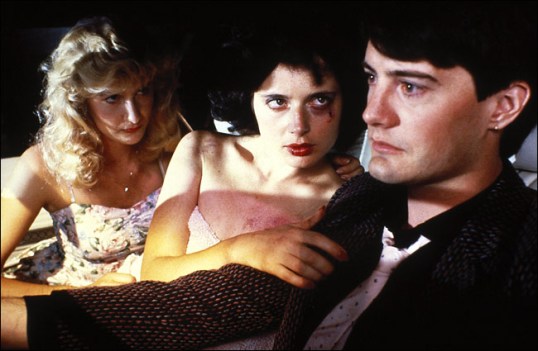
With the help of Detective Williams’s blonde and seemingly innocent daughter, Sandy (Laura Dern), Jeffrey launches his own investigation into why the ear was in the field.  He discovers that Lumberton has a teeming criminal underworld, one that is full of men who are as savage as the ants that we saw, in close-up, fighting over that ear in the field.  Jeffrey discovers that a singer named Dorothy (Isabella Rossellini) is being sexually blackmailed by a madman named Frank Booth (Dennis Hopper).  When Dorothy discovers Jeffrey hiding in her closet (where he had been voyeuristically watching her and Frank), it leads to Jeffrey and Dorothy having a sadomasochistic relationship.  “Hit me!” Dorothy demands and both the viewer and Jeffrey discover that he’s got his own darkness inside of him.  “You’re like me,” Frank hisses at Jeffrey at one point and, if we’re to be honest, it almost feels like too obvious a line for an artist like David Lynch.  Lynch once described the film as being “The Hardy Boys in Hell,” and the plot really is as straightforward as one of those teenage mystery books.

That said, Blue Velvet also features some of Lynch’s most memorable visuals, from the brilliant slow motion opening to the moment that the camera itself seems to descend into the ear, forcing us to consider just how fragile the human body actually is. The film goes from showcasing the green lawns and blue skies to Lumberton to tossing Jeffrey into the shadowy world of Dorothy’s apartment building and suddenly, the entire atmosphere changes and the town becomes very threatening.  We find ourselves wondering if even Detective Williams can be trusted.  That said, my favorite visual in the film is a simple one.  Sandy and Jeffrey walk along a suburban street at night and the camera shows us the dark trees that rise above them, contrasting their eerie stillness to Sandy and Jeffrey’s youthful flirtation.

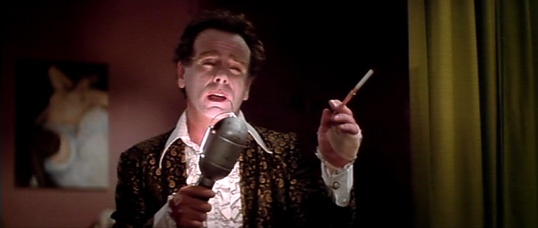
Dean Stockwell in Blue Velvet

Dean Stockwell shows up as Ben, an associate of Frank’s who lip-synchs to Roy Orbison’s In Dreams while Frank himself seems to have a fit of some sort beside him.  In retrospect, Blue Velvet played a huge role in Dennis Hopper getting stereotyped as an out-of-control villain but that doesn’t make him any less terrifying as Frank Booth.  Hopper, recently sober after decades of drug abuse and self-destructive behavior, summoned up his own demons to play Booth and he turns Frank into a true nightmare creature.  Isabella Rossellini is heart-breaking as the fragile Dorothy.  That said, the heart of the film belongs to Kyle MacLachlan and Laura Dern and both of them do a wonderful job of suggesting not only the darkness lurking in their characters but also their kindness as well.  For all the talk about Lynch as a subversive artist, he was also someone who had a remarkable faith in humanity and that faith is found in both Jeffrey and Sandy.  MacLachlan and Dern manage to sell moments that should have been awkward, like Sandy’s monologue about the returning birds or Jeffrey’s emotional lament questioning why people like Frank have to exist.  Both Jeffrey and Sandy lose their innocence but not their hope for a better world.

Blue Velvet is a straight-forward mystery and a surreal dream but mostly it’s an ultimately hopeful portrait of humanity.  The world is dark and full of secrets, the film says.  But that doesn’t mean that it can’t be a beautiful place.


Blue Velvet (1986, dir by David Lynch, DP: Frederick Elmes)

Days of Paranoia: Edmond (dir by Stuart Gordon)


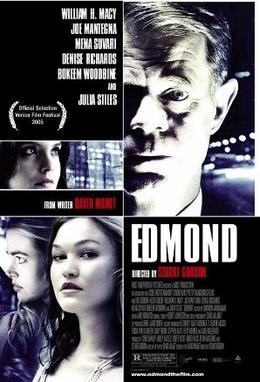
Based on a one-act play by David Mamet, 2005’s Edmond tells the story of Edmond Burke (William H. Macy).

Edmond shares his name (if not the actual spelling) with the philosopher Edmund Burke.  Edmund Burke was a strong believer that society had to put value in good manners to survive and that religious and moral institutions played an important role in promoting the idea of people treating each other with respect and decency.  Edmund Burke knew what he believes and his writings continue to influence thinks to this day.  Edmond Burke, on the other hand, doesn’t know what he believes.  He doesn’t know who he wants to be.  All he knows is that he doesn’t feel like he’s accomplished anything with his life.  “I don’t feel like a man,” he says at one point to a racist bar patron (played by Joe Mantegna) who replies that Edmond needs to get laid.

On a whim, Edmond steps into the shop of a fortune teller (Frances Bay), who flips a few Tarot cards and then tells Edmond that “You’re not where you’re supposed to be.”  Edmond takes her words to heart.  He starts the night by telling his wife (played by Mamet’s wife, Rebecca Pidgeon) that he’s leaving their apartment and he won’t be coming back.  He goes to the bar, where he discusses his marriage with Mantegna.  He goes to a strip club where he’s kicked out after he refuses to pay $100 for a drink.  He goes to a peep show where he’s frustrated by the glass between him and the stripper and the stripper’s constant demand that he expose himself.  He gets beaten in an alley by three men who were running a three-card monte scam.  Edmond’s problem is that he left home without much cash and each encounter leads to him having less and less money.  If he can’t pay, no one wants to help him, regardless of how much Edmond argues for a little kindness.  He pawns his wedding ring for $120 but apparently, he just turns around and uses that money to buy a knife.  An alley-way fight with a pimp leads to Edmond committing his first murder.  A one-night stand with a waitress (a heart-breaking Julia Stiles) leads to a second murder after a conversation about whether or not the waitress is actually an actress leads to a sudden burst of violence.  Edmond ends up eventually in prison, getting raped by his cellmate (Bookem Woodbine) and being told, “It happens.”  Unable to accept that his actions have, in one night, led him from being a businessman to a prisoner, Edmond says, “I’m ready to go home now.”  By the end of the film, Edmond realizes that perhaps he is now where he was meant to be.

It’s a disturbing film, all the more so because Edmond is played by the likable William H. Macy and watching Macy go from being a somewhat frustrated but mild-mannered businessman to becoming a blood-drenched, racial slur-shouting murderer is not a pleasant experience.  Both the play and the film have generated a lot of controversy due to just how far Edmond goes.  I don’t see either production as being an endorsement of Edmond or his actions.  Instead, I see Edmond as a portrait of someone who, after a lifetime of being willfully blind to the world around him, ends up embracing all of the ugliness that he suddenly discovers around him.  He’s driven mad by discovering, over the course of one night, that the world that is not as kind and well-mannered as he assumed that it was and it all hits him so suddenly that he can’t handle it.  He discovers that he’s not special and that the world is largely indifferent to his feelings.  He gets overwhelmed and, until he gets his hands on that knife, he feels powerless and emasculated.  (The knife is an obvious phallic symbol.)  It’s not until the film’s final scene that Edmond truly understands what he’s done and who he has become.

Edmond is not always an easy film to watch.  The second murder scene is truly nightmarish, all the more so because the camera remains on Edmond as he’s drenched in blood.  This is one of William H. Macy’s best performances and also one of his most disturbing characters.  That said, it’s a play and a film that continues to be relevant today.  There’s undoubtedly a lot of Edmonds out there.

Late Night Retro Television Reviews: CHiPs 1.11 “Name Your Price”


Welcome to Late Night Retro Television Reviews, a feature where we review some of our favorite and least favorite shows of the past!  On Mondays, I will be reviewing CHiPs, which ran on NBC from 1977 to 1983.  The entire show is currently streaming on Freevee!

This week, Ponch again fails to get rich.

Episode 1.11 “Name Your Price”

(Dir by Ric Rondell, originally aired on December 8th, 1977)

This week’s episode opens on an unusually somber note for CHiPs.  It begins in a cemetery.  A woman (Jaime Lynn Bauer) is dressed in chic funeral black and appears to be attending a service.  But it soon turns out that she’s actually just making sure that everyone is so distracted by mourning that they won’t notice her stealing a Rolls Royce!

It turns out that a Rolls is not quite as easy to steal as she thought and soon, she finds herself being pursued by Ponch and Baker.  It’s a chase that leads from the highway and into the city and, to Ponch and Baker’s shock, they lose sight of the stolen car.

“How does a Rolls Royce vanish!?” Ponch asks, in shock.

Ponch is a bit distracted himself this episode.  He has been accepted as a contestant on a game show called Name Your PriceName Your Price is obviously meant to be The Price Is Right and Ponch spends the majority of the episode memorizing the price tags on appliances.  Unfortunately, Ponch does not memorize the price tag of a motorcycle and therefore, he turns out to be a bit of a bust when he appears on the show.  As Baker and his date sneak out of the studio, Ponch is humiliated as the show’s host wonders how a motorcycle cop could not know how much a motorcycle costs.

Oh, Ponch — will you ever win!?

It’s not all bad for Ponch.  He and Baker pull over a car and Ponch is excited to discover that it’s occupied by the two stars of his favorite soap opera.  (Does Ponch do anything other than watch television?)  And Ponch also gets to help out when a chicken truck is involved in a minor accident and dozens of chickens end up running around the highway.  As usual, the main emphasis of this episode is on the idea of the members of the highway patrol working together and keeping the streets safe for chickens and humans.  Yes, this episode says, the CHiPs do chase car thieves and arrest criminals.  But usually, they’re just taking care of mundane tasks and getting little thanks and little pay.

This episode was entertaining.  I enjoyed looking at the cars that were stolen.  If you’re going to commit a crime, you might as well commit it for a Rolls Royce.  And the ending with the game show was a lot more effective than the typical CHiPs ending.  Ponch has spent the first 11 episodes of this show destroying motorcycles so it’s a nice bit of humor that a motorcycle would destroy his chance to get rich.  That’s karma!

Next week, Baker and Ponch continue to keep L.A. safe!

Horror Film Review: The Pit and the Pendulum (dir by Stuart Gordon)


AGCK!

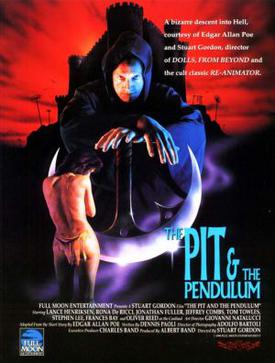
That was my reaction when I watched the 1991 film, The Pit and the Pendulum.  Based very narrowly on several Edgar Allan Poe short stories, The Pit and the Pendulum takes place at the height of the Spanish inquisition.  Despite the objections of the Pope, Grand Inquisitor Torquemada (Lance Henriksen) is leading a reign of terror though 15th Century Spain.  In his torture chambers, Torquemada forces confessions from accused witches and other criminals.  The dirty prison cells are full of starving and beaten partners.  Witches are burned at the stake and explode while the crazed citizenry calls for blood and Torquemada tests out new torture devices.

Torquemada presents himself as being a grim and emotionless man, someone who is above all sin and who is allowed to sit in judgment of the people who are brought before him.  However, Torquemada is hardly the sinless figure that he portrays himself as being.  His actions are fueled by his repressed lust and his anger.  Maria (Rona De Ricci) has been brought before him, accused of being a witch and Torquemada is determined to get her to confess.  Maria’s refusal to be broken by Torquemada only increases Toquemada’s anger but, at the same time, Torquemada has also decided that he’s in love with Maria.  While Maria waits in the prison and takes advice from the witch Esmerelda (Frances Bay), Maria’s husband, Antonio (Jonathan Fuller), attempts to break Maria out of prison.  When Antonio is captured, Torquemada decides to try out his latest device, a swinging and sharpened pendulum that hangs in a pit….

The Pit and the Pendulum is not always an easy movie to watch.  I have to admit that I spent the majority of the movie with my hands over my eyes, not wanting to watch the extremely graphic torture scenes.  Like many of director Stuart Gordon’s film, The Pit and the Pendulum is gripped by an atmosphere of pervasive corruption and the movie captures the feeling of not being able to escape from the worst place on Earth.  Poor Maria spends a good deal of the movie naked and chained to various devices but Rona De Ricci gives such a strong and such a committed performance as Maria that, instead of being offended by the obvious exploitation element of the scenes, you instead find yourself admiring Maria and her strength.

It’s probably not a coincidence that Oliver Reed shows up in the film as a Cardinal because The Pit and the Pendulum, with its portrayal of blood frenzy and hypocrisy, is definitely influenced by Ken Russell’s The Devils.  The imagery is graphic and often disturbing but the most memorable thing about the film is Lance Henriksen’s intense performance as the evil Torquemada.  Henriksen plays Torquemada as being a hateful and self-loathing figure, a man who deals with his own demons by bringing his fury down on the innocent.  It’s a truly frightening villainous performance, one that carries shades of Vincent Price’s excellent performance in The Witchfinder General.

The Pit and the Pendulum is not an easy film to watch and I doubt I’ll watch it a second time.  In the end, it’s a disturbing film but one that definitely leaves an impression.

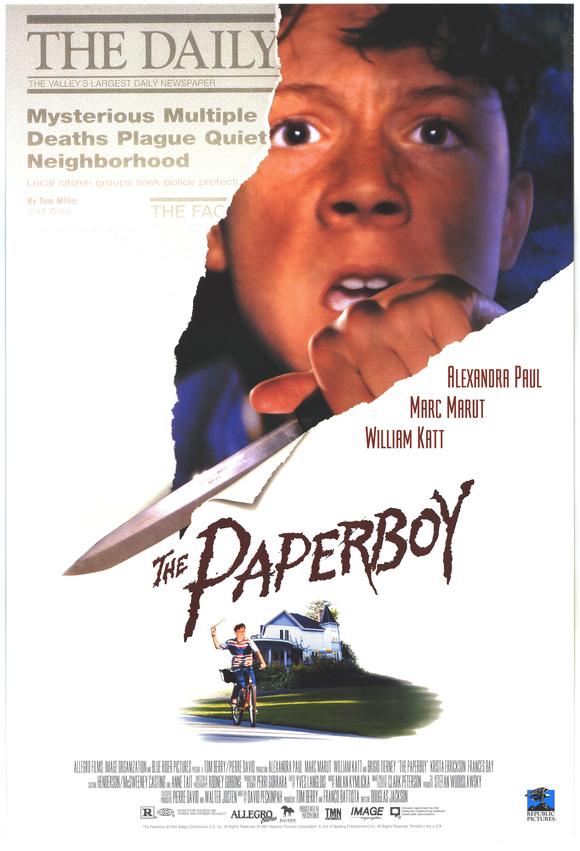
Cinemax Friday: The Paper Boy (1994, directed by Douglas Jackson)


12 year-old Johnny McFarley (Marc Marut) is a paperboy who desperately wants to be a part of a stable family.  He wants Melissa Thorpe (Alexandra Paul) to be his mother but Melisssa has moved to a different town.  Johnny solves that problem by suffocating Melissa’s mother with a plastic bag, which causes Melissa to return home.  That’s one way to do it!

As soon as Melissa and her daughter, Cammie (Brigid Tierney), move into Melissa’s mother’s old house, Johnny starts making himself indispensable by doing things like mowing the lawn for free.  He also does things like break into the house in the middle of the night, plant hidden cameras, and demand that Melissa bake him a pie.  He wants Melissa to be his mother and because Melissa feels sorry for him, she indulges Johnny and his mood swings.  Even after everyone else in the neighborhood tells her that Johnny is a little bit off, Melissa continues to allow him into the house.  Not even the crazy religious lady saying that Johnny has “the mark of Cain” can dissuade Melissa.

Johnny will do anything to make Melissa his new mother.  But then Brian (William Katt), Melissa’s boyfriend, shows up and Johnny really goes off the deep end.

The Paperboy is an adequate killer child film.  Marc Marut gives a good performance as the creepy and disturbed Johnny and the movie does make an attempt to provide him with a believable backstory to explain why he’s become the little killer that he is.  The kills are all imaginatively staged and all the more disturbing because they feature a child as the killer and that really is the whole point of the whole psycho kid genre.  The main problem with the movie is that Melissa keeps overlooking Johnny’s clearly unstable behavior.  At the point when just about anyone else would have told Johnny to stay away and perhaps even called the cops on the little bugger, Melissa keeps letting him back into her life.  By the time that Melissa finally realizes that maybe Johnny actually is as dangerous as everyone has been telling her, you’re too frustrated with her to care.

One good thing about The Paperboy is that it features William Katt in a supporting role.  If there’s ever a Late Night Cinemax Hall of Fame, William Katt will be entitled to an entire wing.  Even though he spent the majority of the 90s appearing in low-budgets movies like this one, Katt always gave a good performance, like he does here.


Horror Film Review: Single White Female (dir by Barbet Schroeder)


Allie Jones (Bridget Fonda) is an always fashionable software designer who is living in New York City and who has just broken up with her cheating lover, Sam (Steven Weber).  She has pretty hair, a big apartment, a closet full of nice clothes, and a totally devoted gay best friend.

Hedra Carlson (Jennifer Jason Leigh) is shy and socially awkward and in need of someone who will give her a cute nickname like “Hedy.”  She has pretty hair that’s just slightly less pretty than Allie’s, a job at a bookstore, a dead twin sister, a pair of really nice earrings, and a television that only seems to show old black-and-white movies.

Together …. THEY SOLVE CRIMES!

No, actually, they don’t.  Instead, Hedy answers an ad that Allie placed about needing a new roommate.  Even though Allie was thinking of asking another homeless woman to move in with her, Hedy impresses Allie by fixing her sink.  Seriously, how can you turn down a potential roommate who knows how to do simple plumbing?  Allie invited Hedy to live with her and, at first, everything is great.  Hedy even brings home a dog that Allie quickly falls in love with.  However, then Sam shows back up and we quickly discover just how obsessed Hedy has become with her roommate.

Single White Female was originally released way back in 1992 and, even if you’re viewing it for the very first time, you’ll probably feel a sense of deja vu while watching the movie.  This is one of those films that has been so endlessly imitated and has been unofficially remade so many times that you probably already know everything that happens in the film, regardless of whether you’ve actually sat through it or not.  A few years ago, there was a film called The Roommate that basically was Single White Female, just with a college setting and a bit less of a subversive subtext.  As well, I’ve lost count of the number of Lifetime films that have basically ripped off Single White Female‘s plot.  Any time that a new friend proves herself to be excessively clingy, chances are that she’s going to get compared to Jennifer Jason Leigh in this film.


And yet, despite all of the imitations, Single White Female still holds up surprisingly well.  A lot of that is because Single White Female was directed by Barbert Schroeder.  Schroeder started his career as a disciple of the French New Wave and, much like Paul Verhoeven, his American films tend to be genre films with just enough of a subversive subtext to stick in your mind afterwards.

For example, Single White Female is often describes as being a film about “the roommate from Hell” but what always seems to be missed is that, especially during the film’s first half, Allie is often as bad of a roommate as Hedy.  For instance, when Allie comes home late after spending two days with Sam, Hedy is pissed off and waiting for her.  On the surface, the scene is the first indication that Hedy has become obsessed with Allie.  But, at the same time, Hedy actually is making a valid point.  After repeatedly telling Hedy that she wants nothing to do with Sam, Allie runs off and spends two days with him without bothering to call home once.  Though Hedy may have been a bit too quick to yell, she still had every right to be annoyed.

In fact, Allie really is a bit of self-centered character.  She impulsively invited Hedy to live with her and then, just as impulsively, she gets back together with Sam and decides that it’s time for Hedy to move out.  Of course, then Hedy tosses a dog out of a window and you pretty much lose whatever sympathy you may have had for her.

Still, you can’t help but feel that, just as Hedy wants to be Allie, there’s a part of Allie that would like to be Hedy.  Hedy does all the things that Allie’s scared to do.  When Allie is sexually harassed and nearly raped by a client, Hedy’s the one who actually gets revenge.  While Allie tries to get over and suppress her anger at Sam, Hedy’s the one who acts on that anger.  Just Hedy seems to need Allie’s life to be happy, Allie seems to need Hedy’s anger to survive.  In short, there’s a lot more going on underneath the surface of Single White Female than its reputation might lead you to presume.

Not surprisingly, the film is dominated by Jennifer Jason Leigh’s performance.  When Hedy first appears, Leigh plays her as just being slightly off.  She has some obvious confidence issues but, at the same time, she comes across as being so innocent and naive that you can’t help but want to protect her.  You find yourself wondering how she could have possibly survived living in a city like New York.  It’s only as the film progresses that you start to discover that Hedy was never particularly naive and everything that she’s done and said has basically been about manipulating the people around her.  And yet, even after Hedy has started killing dogs and people, you can’t help but feel a strange empathy (though not necessarily sympathy) for her.  There’s an emptiness to Hedy, an emptiness that she attempts to fill by stealing the personalities of the people around her and Leigh does a great job of expressing the pain that would come from not having an identity of your own.  Plus, poor Hedy just seemed so happy with Allie said that she liked her earrings!  I mean, I just can’t imagine being that insecure but I get the feeling it would really suck.

(Fortunately, I’ve also never really had a truly bad roommate situation.  One advantage of having three older sisters is knowing that you’ll always have someone to stay with.)

Despite all of the imitations and rip-offs that have come out over the years, both Single White Female and Jennifer Jason Leigh’s performance hold up remarkably well.  I’d recommend watching it before inviting anyone to come live with you.  If nothing else, you’ll at least learn what stiletto heels are really for.


Film Review: Twin Peaks: Fire Walk With Me (dir by David Lynch)


“It was a dream!  We live in a dream!”

— Phillip Jeffries (David Bowie) in Twin Peaks: Fire Walk With Me (1992)

Even among fans of the show, Twin Peaks: Fire Walk With Me is controversial.

If you read Reflections: An Oral History of Twin Peaks, you’ll discover that many members of the television show’s cast either didn’t want to be involved in the film or didn’t care much for it when it came out.  Fearful of being typecast, Kyle MacLachlan only agreed to play Dale Cooper on the condition that his role be greatly reduced.  (Was it that fear of being typecast as clean-cut Dale Cooper that led to MacLachlan later appearing in films like Showgirls?)  Neither Lara Flynn Boyle nor Sherilyn Fenn could work the film into their schedules.

When Twin Peaks: Fire Walk With Me premiered at Cannes, it was reportedly booed by the same critics who previously applauded Lynch’s Wild at Heart and who, years later, would again applaud Mulholland Drive.  When it was released in the United States, the film was savaged by critics and a notorious box office flop.  Quentin Tarantino, previously a fan of Lynch’s, has been very outspoken about his hatred of Twin Peaks: Fire Walk With Me.  When I first told people that we would be looking back at Twin Peaks for this site, quite a few replied with, “Even the movie?”

And yet, there are many people, like me, who consider Twin Peaks: Fire Walk With Me to be one of David Lynch’s most haunting films.

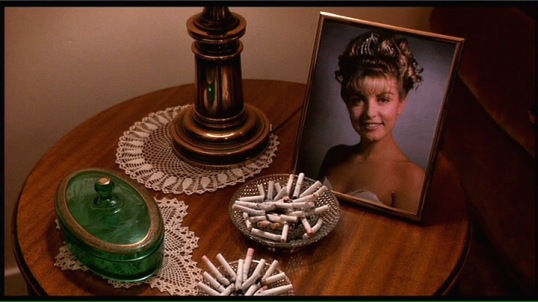
It’s also one of his most straight forward.  Twin Peaks: Fire Walk With Me is a prequel, dealing with the events leading up to the death of Laura Palmer.  Going into the film, the viewer already knows that Laura Palmer (Sheryl Lee) is full of secrets.  They know that she is using drugs.  They know that she is dating Bobby (Dana Ashbrook), while secretly seeing James (James Marshall).  They know about her diary and her relationship with the reclusive Harold (Lenny Von Dohlen).  They know that she is a friend to innocent Donna Hayward (Moria Kelly, somewhat awkwardly taking the place of Lara Flynn Boyle).  Even more importantly, they know that she has spent the last six years of her life being abused by BOB (Frank Silva) and that BOB is her father, Leland Palmer (Ray Wise).  The viewer starts the story knowing how it is going to end.

Things do get off to a somewhat shaky start with a nearly 20-minute prologue that basically plays like a prequel to the prequel.  Theresa Banks, who was mentioned in the show’s pilot, has been murdered and FBI director Gordon Cole (David Lynch) assigns agents Chester Desmond (Chris Isaak) and Sam Stanley (Kiefer Sutherland) to investigate.  Chester and Sam’s investigation basically amounts to a quick reenactment of the first season of Twin Peaks, with the agents discovering that Theresa was involved in drugs and prostitution.  When Chester vanishes, Dale Cooper is sent to investigate.  Harry Dean Stanton shows up as the manager of a trailer park and David Bowie has an odd cameo as a Southern-accented FBI agent who has just returned from the Black Lodge but otherwise, the start of the film almost feels like a satire of Lynch’s style.

But then, finally, we hear the familiar theme music and the “Welcome to Twin Peaks” sign appears.

“And the angel’s wouldn’t help you. Because they’ve all gone away.”

— Laura Palmer (Sheryl Lee), Twin Peaks: Fire Walk With Me (1992)

A year has passed since Theresa Banks was murdered.  The rest of the film deals with the final few days of the life of doomed homecoming queen Laura Palmer.  Laura smiles in public but cries in private.  She is full of secrets that she feels that she has to hide from a town that has literally idolized her.  She has visions of terrifying men creeping through her life and each day, she doesn’t know whether it will be BOB or her father waiting for her at home.  She knows that the world considers her to be beautiful but she also know that, within human nature, there is a desire to both conquer and destroy beauty.  When she sleeps, she has disturbing dreams that she cannot understand but that she knows are important.  At a time when everyone says she should be happy to alive, all she can think about is death.  Everywhere she goes, the male gaze follows and everything that should be liberating just feels her leaving more trapped.  For all the complaints that Twin Peaks: Fire Walk With Me is somehow too strange to be understood, it’s not a strange film at all.  This is David Lynch at his most straight forward.  Anyone who thinks that Laura’s story is incomprehensible has never been a 17 year-old girl.

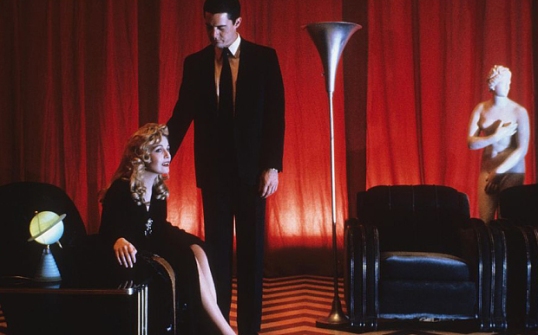
This is the bleakest of all of David Lynch’s films.  There is none of broad humor or intentional camp that distinguished the TV show.  After the show’s occasionally cartoonish second season, the film served as a trip into the heart of the darkness that was always beating right underneath the surface of Twin Peaks.  It’s interesting how few of the show’s regulars actually show up in Twin Peaks: Fire Walk With Me.  None of the characters who represented goodness are present.  There’s no Doc Hayward.  No Sheriff Truman.  No Deputies Andy or Hawk.  No Pete Martell.  No Bookhouse Boys.  Scenes were filmed for some of them but they didn’t make it into the final cut because their tone did not fit with the story that Lynch was seeking to tell.  The Hornes, Dr. Jacoby, Josie, none of them are present either.

Instead, there’s just Larua and her father.  As much as they try to deny it, Laura knows that she is going to die and Leland knows that he is going to kill her.  Killer BOB and the denziens of the Black Lodge may be scary but what’s truly terrifying is the sight of a girl living in fear of her own father.  Is Leland possessed by BOB or is BOB simply his way of excusing his own actions?  If not for Leland’s sickness, would BOB even exist?  When Laura shouts, “Who are you!?” at the spirit of BOB, she speaks for every victim of abuse who is still struggling to understand why it happened.  For all the talk of the Black Lodge and all the surreal moments, the horror of this film is very much the horror of reality.  Leland’s abuse of Laura is not terrifying because Leland is possessed by BOB.  It’s terrifying because Leland is her father

David Lynch directs the film as if it where a living nightmare.  This is especially evident in scenes like the one where, at the dinner table, Leland switches from being kindly to abusive while Laura recoils in fear and her mother (Grace Zabriskie) begs Leland to stop.  It’s a hard scene to watch and yet, it’s a scene that is so brilliantly acted and directed that you can’t look away.  As brilliant as Ray Wise and Grace Zabriskie are, it’s Sheryl Lee who (rightly) dominates the scene and the rest of the film, giving a bravely vulnerable and emotionally raw performance.  In Reflections, Sheryl Lee speaks candidly about the difficulty of letting go of Laura after filming had been completed.  She became Laura and gave a performance that anchors this absolutely terrifying film.

“Mr. Lynch’s taste for brain-dead grotesque has lost its novelty.”

— Janet Maslin

“It’s not the worst movie ever made; it just seems to be”

— Vincent Canby

If you need proof that critics routinely don’t know what they’re talking about, just go read some of the original reviews of Twin Peaks: Fire Walk With Me.

And yet, having just rewatched the show and now the movie, I can understand why critics and audiences were baffled by this film.  This is not Twin Peaks the TV show.  There is no light to be found here.  There is no comic relief.  (Even Bobby Briggs, who had become something of a goofy anti-hero by the time the series ended, is seen here shooting a man in the head.)  There is no exit and there is no hope.  In the end, the film’s only comfort comes from knowing that Laura was able to save one person before dying.  It’s not easy to watch but, at the same time, it’s almost impossible to look away.  The film ends on Laura’s spirit smiling and, for the first time, the smile feels real.  Even if she’s now trapped in the Black Lodge, she’s still free from her father.

Since this was a prequel, it didn’t offer up any answers to the questions that were left up in the air by the show’s 2nd season finale.  Fortunately, those questions will be answered (or, then again, they may not be) when the third season premieres on Showtime on May 21st.

Previous Entries in The TSL’s Look At Twin Peaks:

  1. Twin Peaks: In the Beginning by Jedadiah Leland
  2. TV Review: Twin Peaks 1.1 — The Pilot (dir by David Lynch) by Lisa Marie Bowman
  3. TV Review: Twin Peaks 1.2 — Traces To Nowhere (directed by Duwayne Dunham) by Jedadiah Leland
  4. TV Review: Twin Peaks 1.3 — Zen, or the Skill To Catch A Killer (dir by David Lynch) by Lisa Marie Bowman
  5. TV Review: Twin Peaks 1.4 “Rest in Pain” (dir by Tina Rathbone) by Leonard Wilson
  6. TV Review: Twin Peaks 1.5 “The One-Armed Man” (directed by Tim Hunter) by Jedadiah Leland
  7. TV Review: Twin Peaks 1.6 “Cooper’s Dreams” (directed by Lesli Linka Glatter) by Lisa Marie Bowman
  8. TV Review: Twin Peaks 1.7 “Realization Time” (directed by Caleb Deschanel) by Lisa Marie Bowman
  9. TV Review: Twin Peaks 1.8 “The Last Evening” (directed by Mark Frost) by Leonard Wilson
  10. TV Review: Twin Peaks 2.1 “May the Giant Be With You” (dir by David Lynch) by Leonard Wilson
  11. TV Review: Twin Peaks 2.2 “Coma” (directed by David Lynch) by Jedadiah Leland
  12. TV Review: Twin Peaks 2.3 “The Man Behind The Glass” (directed by Lesli Linka Glatter) by Jedadiah Leland
  13. TV Review: Twin Peaks 2.4 “Laura’s Secret Diary” (dir by Todd Holland) by Lisa Marie Bowman
  14. TV Review: Twin Peaks 2.5 “The Orchid’s Curse” (dir by Graeme Clifford) by Lisa Marie Bowman
  15. TV Review: Twin Peaks 2.6 “Demons” (dir by Lesli Linka Glatter) by Leonard Wilson
  16. TV Review: Twin Peaks 2.7 “Lonely Souls” (directed by David Lynch) by Jedadiah Leland
  17. TV Review: Twin Peaks 2.8 “Drive With A Dead Girl” (dir by Caleb Deschanel) by Lisa Marie Bowman
  18. TV Review: Twin Peaks 2.9 “Arbitrary Law” (dir by Tim Hunter) by Lisa Marie Bowman
  19. TV Review: Twin Peaks 2.10 “Dispute Between Brothers” (directed by Tina Rathbone) by Jedadiah Leland
  20. TV Review: Twin Peaks 2.11 “Masked Ball” (directed by Duwayne Dunham) by Leonard Wilson
  21. TV Review: Twin Peaks 2.12 “The Black Widow” (directed by Caleb Deschanel) by Leonard Wilson
  22. TV Review: Twin Peaks 2.13 “Checkmate” (directed by Todd Holland) by Jedadiah Leland
  23. TV Review: Twin Peaks 2.14 “Double Play” (directed by Uli Edel) by Jedadiah Leland
  24. TV Review: Twin Peaks 2.15 “Slaves and Masters” (directed by Diane Keaton) by Lisa Marie Bowman
  25. TV Review: Twin Peaks 2.16 “The Condemned Woman” (directed by Lesli Linka Glatter) by Leonard Wilson
  26. TV Review: Twin Peaks 2.17 “Wounds and Scars” (directed by James Foley) by Lisa Marie Bowman
  27. TV Review: Twin Peaks 2.18 “On The Wings of Love” (directed by Duwayne Dunham) by Jedadiah Leland
  28. TV Review: Twin Peaks 2.19 “Variations on Relations” (directed by Jonathan Sanger) by Lisa Marie Bowman
  29. TV Review: Twin Peaks 2.20 “The Path to the Black Lodge” (directed by Stephen Gyllenhaal) by Lisa Marie Bowman
  30. TV Review: Twin Peaks 2.21 “Miss Twin Peaks” (directed by Tim Hunter) by Leonard Wilson
  31. TV Review: Twin Peaks 22.2 “Beyond Life and Death” (directed by David Lynch) by Lisa Marie Bowman

Back to School Part II #16: The Karate Kid (dir by John G. Avildsen)


320px-Karate_kid

Finally, I am getting a chance to continue my series of Back to School reviews!

Earlier today, we had a pretty big storm down here in Texas and it knocked out the electricity for three and a half hours!  There I was, sitting in the dark and wondering if I would ever get a chance to review the 16th movie in this 56-film review series.

(Originally, I was planning on being done by this weekend but, as always seems to happen whenever I do a review series, I’m currently running behind so it’ll probably won’t be until the weekend after next that I post my final Back to School review.)

Fortunately, the Oncor truck eventually showed up in the alley.  I, of course, ran out into the back yard and started to shout at them, “I need power!  I have movies to review!”  They must have heard me because, suddenly, the power came back on.  And now, I can finally get around to sharing a few thoughts on the original, 1984 version of The Karate Kid!

Up until last night, believe it or not, I had never seen The Karate Kid before.  Certainly, I knew about it.  Much like Star Wars and Star Trek, The Karate Kid is one of those cultural landmarks that everyone knows about even if they haven’t actually sat down and watched the movie.  Even before I watched the film, I knew about Mr. Miyagi.  I knew about “wax on” and “wax off.”  I knew about the crane.  I even knew about “You’re alright, LaRusso!”

But I hadn’t actually seen the film and I have to admit that I was a little bit hesitant about doing so.  Everything I had heard about The Karate Kid made it sound like a thoroughly predictable and excessively 80s sports film.  I was expecting the film to be all about power ballads and training montages and uplifting dialogue and certainly, The Karate Kid had a lot of that.

But what took me by surprise is what a genuinely sweet movie The Karate Kid is.  Yes, it’s predictable and it’s full of clichés but dammit, it all works.  It still brought tears to my mismatched eyes.

The karate kid of the title is Daniel LaRusso (Ralph Macchio), who moves, with his mother, from New Jersey to California.  Daniel’s a nice kid who has learned a little karate from reading books but he’s still no match for the bullies at his new high school.  Daniel does get a girlfriend, Ali Mills (Elisabeth Shue, giving a performance that feels far more genuine than any of her more recent work), but even that leads to him getting in trouble.  It turns out that Ali’s ex-boyfriend is Johnny (William Zabka), the top student at Cobra Kai.  Oddly enough, Johnny’s teacher is also named John.  John Kreese (Martin Kove) is a Vietnam veteran who decorates his dojo with pictures of himself looking threatening.  Kreese, we soon discover, is a total psychopath.  “NO MERCY!” he shouts at this students.

When Johnny and his fellow Cobra Kai students beat up Daniel on Halloween, Daniel’s life is saved by Mr. Miyagi (Pat Morita).  Mr. Miyagi may appear to just be a simple maintenance man but he’s actually a total badass.  He teaches Daniel not only the moves of karate (“Wax on…wax off…”) but the philosophy as well.  He explains to Daniel that there are “No bad students.  Just bad teacher.”  In short, he is the exact opposite of Kreese.

Who is the better teacher?  That’s a question that will be answered when Daniel faces off against the Cobra Kai bullies at the Under-18 All-Valley Karate Tournament.  Can Daniel defeat Johnny, win Ali’s love, and earn the right to live free of harassment?

Well, it would be a pretty depressing movie if he didn’t…

Anyway, The Karate Kid turned out to be a really sweet and likable movie.  I was never surprised by the movie’s plot but I still found myself being drawn into the story and hoping that everything would work out for Daniel and Ali.  The character of Mr. Miyagi has been parodied in so many other films that I was a bit surprised to see just how good Pat Morita was in the role.  Yes, Morita gets to say a lot of funny lines but he also gets a rather harrowing dramatic scene where talks about how his wife and child died while he was away, serving in the army.

It’s interesting to note that, at the end of the film, even Johnny got to show a glimmer of humanity, suggesting that even the worst jerk in the world can be redeemed by a good ass-kicking.  That said, Kreese is pure evil from beginning to end and Johnny’s friend, Dutch (played by Chad McQueen), is about as scary a high school bully as I’ve ever seen.  But at least Johnny is willing to admit the truth.

LaRusso?

He’s alright.


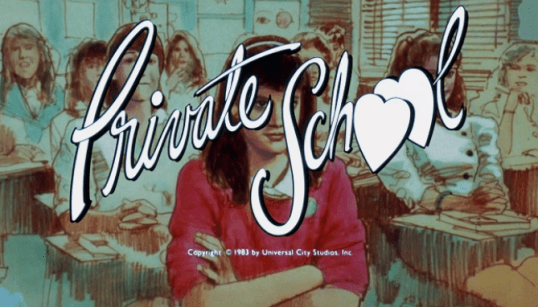
Back to School #29: Private School (dir by Noel Black)


ps-title

In my previous two Back To School reviews, I took a look at two classic teen comedies.  Fast Times At Ridgemont High and Risky Business both used and manipulated the standard teen comedy trappings to tell unusually nuanced stories about growing up.  These are films that used the audience’s familiarity with the genre to tell stories that ultimately challenged the viewer’s preconceived notions and expectations.  Having considered those two films, let us now consider Private School, a film that used all of the standard teen comedy clichés to make a very standard teen comedy.

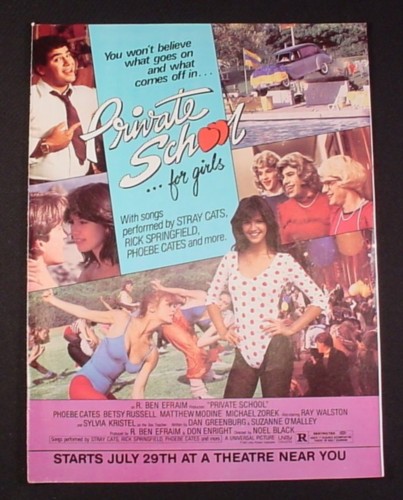
According to the film’s trivia page on the IMDB (how’s that for an authoritative source!?), Private School was “”was supposedly market researched from stem to stern in order to ensure mass teen appeal”.  And it’s true because there’s literally nothing in Private School that you couldn’t find in almost every other teen comedy released in the 1980s.  In fact, Private School often feels like a compilation of clips from other teen comedies.

For instance, the film tells the story of two groups of three.  There’s the three girls who attend Cherryvale Academy: good girl Christine (Phoebe Cates), bad (and rich) girl Jordan (Betsy Russell), and vaguely asexual tomboy Betsy (Kathleen Wilhoite).  And then there’s three guys who attend Freemount Academy.  There’s a fat guy named Bubba (Michael Zorek), a short guy named Roy (Jonathan Prince) and a nice guy named Jim (Matthew Modine).  Bubba is dating Betsy.  Christine is dating Jim.  Jordan is dating no one because she’s too busy trying to steal Christine’s boyfriend.  Roy is also single, largely because adding a fourth girl would throw off the film’s group-of-three dichotomy.

There’s also a lot of boobs, largely because Private School was made to appeal to teenage boys and you really have to wonder how many of them left the theater thinking that all they had to do to get a girl to disrobe was spill some fruit juice on her dress and then suggest that she take it off.  There’s even a scene where Jordan rides a horse naked because — well, why not?

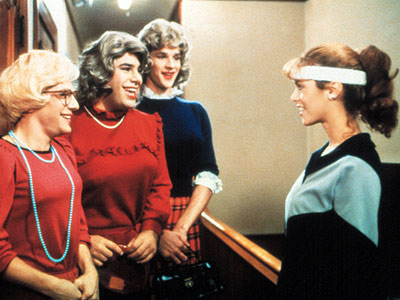
And then there’s an extended sequence where each of the three boys puts on a wig, a red dress, way too much lipstick and then sneak into the girl’s dormitory because cross-dressing is always good for a few easy laughs. Despite their best attempts to speak in falsetto voices,  Jim, Bubba, and Roy make for three of the least convincing women that I’ve ever seen but, to the film’s credit, that’s kind of the point.  It’s a stupid plan that leads to stupid results.

privschool_l

Of course, the film is also full of terrible adult authority figures.  And why not?  It’s not like anyone over the age of 18 was ever going to watch the film.  So, of course, Jordan’s father is going to be lecherous old perv with a trophy wife.  And, of course, all of Cherryvale’s teachers are going to be a collection of spinsters and alcoholics.  In the end, the only adult who isn’t a raging hypocrite is the friendly town pharmacist (played by Martin Mull) who, of course, is mostly present so he can make Jim feel nervous about buying condoms.

And, ultimately, Private School is one of those films that wants to be racy and dirty (in order to appeal to teenage boys) while also being sweet and romantic (in order to appeal to teenage girls).  The main plot revolves around Jim and Christine’s plans to go away for a weekend so that they can have sex for the first time and the film actually handles this pretty well.  Matthew Modine and Phoebe Cates both have a really sweet chemistry.  They’re a really cute couple and you hope the best for them.  But there’s just so many complications, the majority of which could have been avoided by Jim not being an idiot.  It never seems to occur to Jim that maybe he’d finally be getting laid if he wasn’t always doing things like dressing up in drag and trying to sneak into the girl’s dormitory.

That doesn’t necessarily mean that Private School is a terrible film.  As far as boob-obsessed teen sex comedies go, Private School is actually pretty well-done and watchable.  The cast is likable and director Noel Black keeps the action moving.  Even the film’s nominal villain is likable, with Betsy Russell playing Jordan as being more mischievous than spiteful.  But, ultimately, what makes Private School memorable is the fact that it is so predictable, that it does literally contain every single cliché that one would expect to find in a teen comedy.  This is a film so determined to not bring anything new to the genre that it becomes an oddly fascinated study in how to maintain a status quo.

In fact, perhaps the most innovative thing about Private School is the song that plays over the opening credits.  The song — which is called You’re Breakin’ My Heart and is performed by Harry Nilsson — starts with: “You’re breaking my heart/you’re tearing it apart/so fuck you…”

That’s about as close to being subversive as Private School ever gets.

4119046