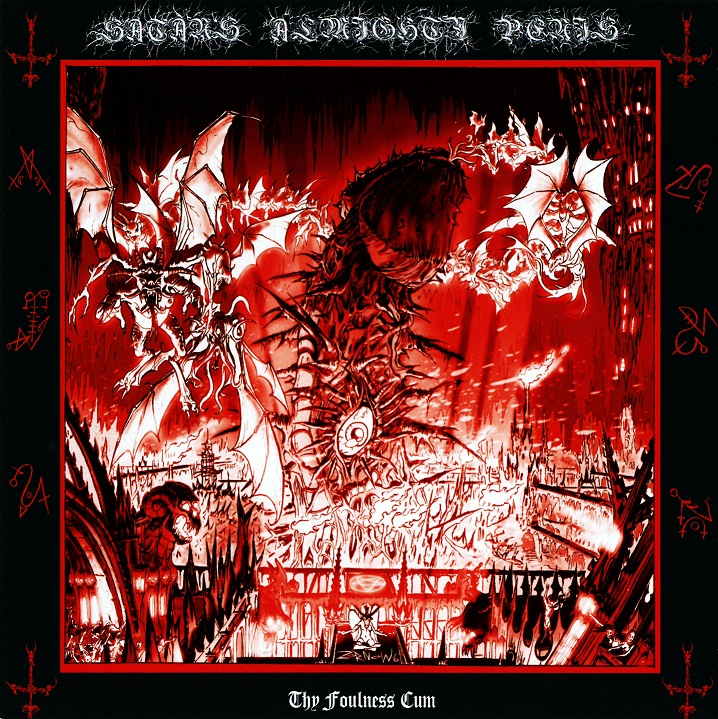
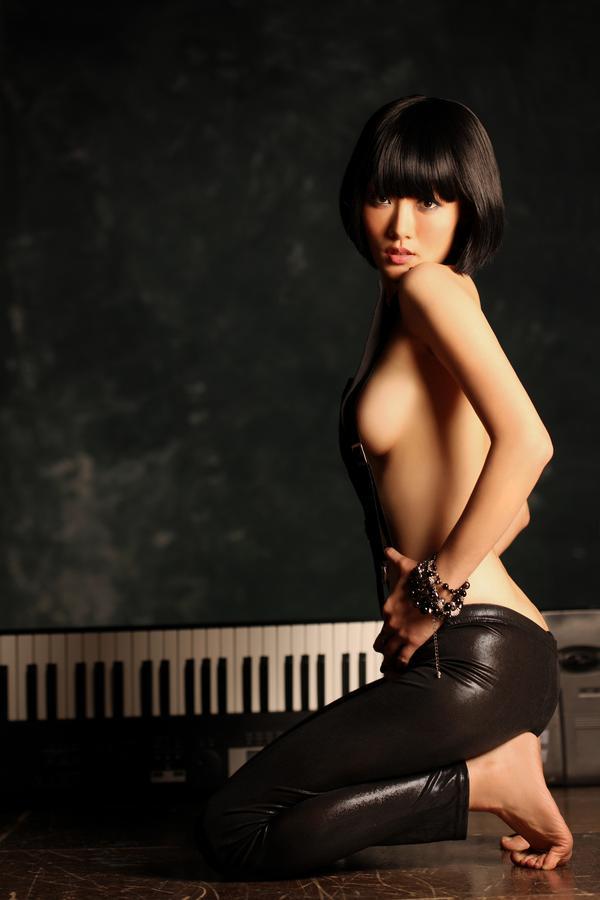
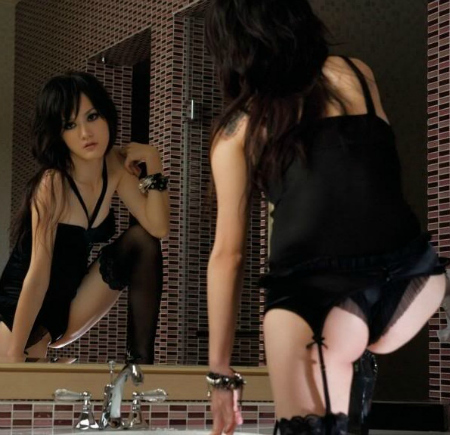
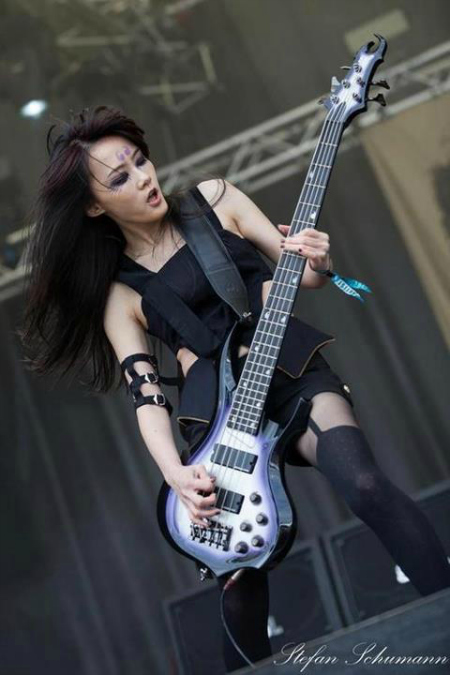
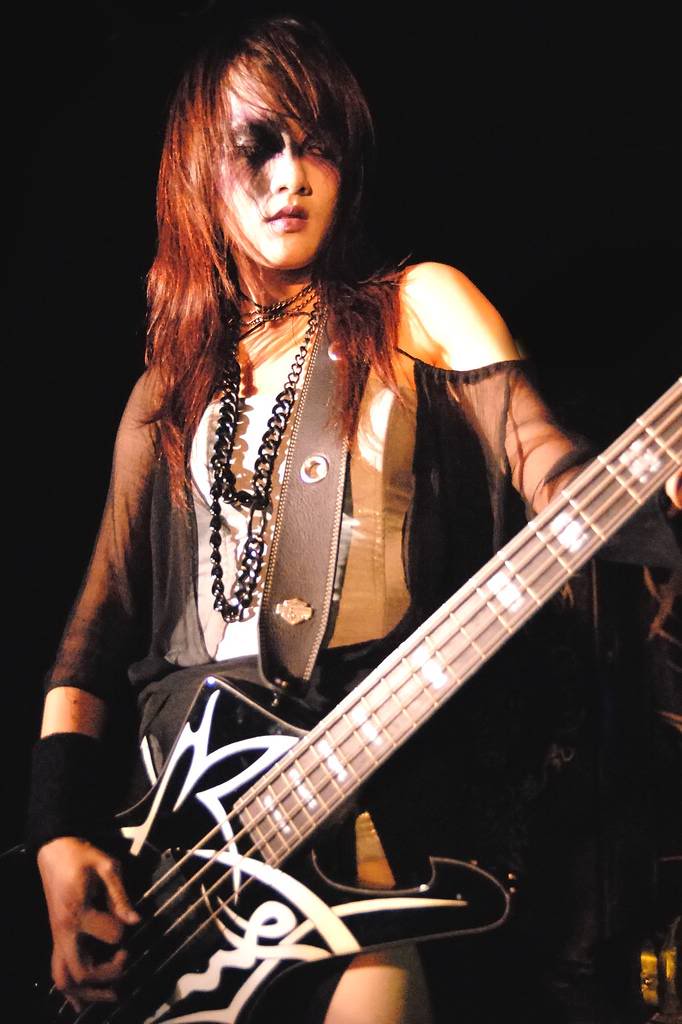
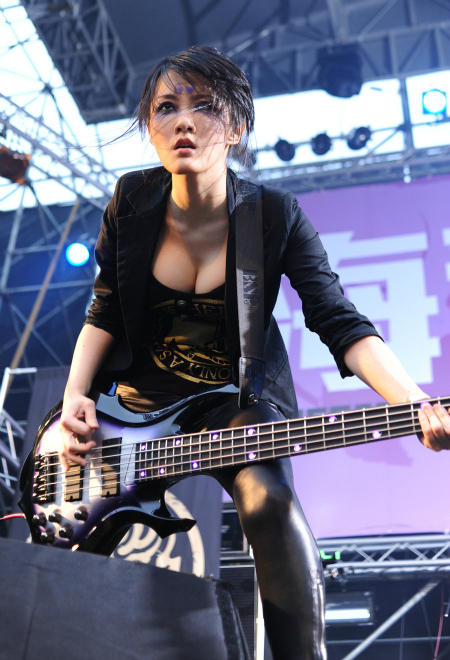
I had only the most honest of intentions when I stumbled upon Ms. Yeh. I was sampling the new album by Taiwanese black metallers 閃靈 (Chthonic), and I casually plugged them into Google image search. Grim frostbitten glamor shots immediately bombarded me with all the force of Satan’s Almighty Penis thrust into my lusting goatholes of blasphemy. Doris Yeh has been playing bass for the band since 1999. On top of being a great musician, she has effectively employed her phenomenal body to both market the band and garner attention towards their political activism. Chthonic are actively involved in promoting human rights in Taiwan and throughout Asia, speaking out against Chinese imperialism in Tibet and their home country and advocating a greater awareness of women’s rights. Visually, Doris Yeh stuns me most in more traditional black metal attire and on stage (the last two pictures in this compilation), but she’s just as gorgeous in her modeling and goth photo shoots.
Musically, Chthonic are better than most at what they play. I give them props for incorporating that delightful and underrepresented world of Asian folk into metal, but their glossy, high production, symphonic brand of black, melodic death, and folk metal isn’t really my style. Here is a sample track from their new album, 武徳 (Bú-Tik), if you’re curious:
Decade of last.fm scrobbling countdown:
40. Ensiferum (782 plays)
Top track (38 plays): One More Magic Potion, from Victory Songs (2007)
Ensiferum descended on metal in 2001 with a force sufficient to crush any lingering doubts that folk metal was a genre in its own right. Their self-titled debut coincided with the first instance in which I was aware enough of metal music to fully recognize the birth of something new, and for that I’ll always view them with a sense of nostalgia. When I was first encountering the likes of Finntroll and Thyrfing, metal in general was still something of a novelty for me. The fledgling trend towards incorporating folk-centric fantasy and pagan themes graced my ears uncontextualized and thus timeless. When I first heard Ensiferum, I finally realized that this was an emergent process. The clerics of musical trendiness had been persuaded to change allegiance, and Odin and Thor would have their day in place of Satan for a time.
Ensiferum’s discography is not the sort of thing that ought to necessarily make them the hallmark of that glorious and now fading trend we call folk metal. Their history is a bit more rocky, oscillating between excellence and something less. Iron (2004) frankly bored me, and I could never quite get beyond the feeling that From Afar (2009) was a collection of Victory Songs (2007) b-sides–outstanding to be sure, but extremely similar and never quite as perfect. Unsung Heroes (2012) stands taller, I think, and its negative reviews are likely a consequence of a forgivably weak ending and single-minded fans looking for Victory Songs 3.0. But no, it’s not consistency of quality that makes “Ensiferum” one of the first names to pop into my head when I think of folk metal. It’s more a matter of timeliness–of peaking when it mattered most. Ensiferum (2001) sounds a little washed out now, but it was a triumph in its day, and it appeared at the cusp of the genre’s transition from an underground pulsation to a self-declared musical movement. Victory Songs (2007), their best album (I think most fans can agree to this), emerged at the pinnacle of the genre, when the original artists were coming into their mid-career highs and the best of the bandwagoners were leaving their marks. It was supported by a grand-slam of folk metal tour bar none here in North America the following year: Ensiferum playing in the USA for the first time, closing for a mind-blowing opening line-up of Eluveitie, Týr, and Turisas at Paganfest 2008.
Unsung Heroes (2012) appeared in time to claim ownership of folk metal’s end. I’ve been getting the sad feeling lately that 2011 marked the style’s grand last hurrah. It was a loaded year for metal, with a huge number of releases. The new trend away from earthy folk towards ethereal post-black was ever present, 2000s legends duking it out for album of the year with metal newcomers like Krallice, Liturgy, Altar of Plagues, and Deafheaven–those bands I’ll wax nostalgic about ten further years from now. Ensiferum got their two cents in a year late, in a sense, but perhaps this amounts to the honor of writing the final post-script. Sure, folk metal bands aren’t going away, but the spark of collective musical inspiration has moved elsewhere. Ensiferum happened to leave their greatest marks in the opening chapter, climax, and epilogue.
I’ll leave you with a really beautiful song from Unsung Heroes: Burning Leaves.
Decade of last.fm scrobbling countdown:
46. Agalloch (653 plays)
Top track (147 plays): Odal (Demo), from The End Records Sampler: At the End of Infinity [Echoes & Thoughts of Wonder] (2002)
Featured track: Limbs, from Ashes Against the Grain (2006)
Throughout the first decade of this century, Agalloch stood at the forefront of some of the most progressive movements in metal. They were the product of a new generation of musicians exceptionally well informed on musical trends happening outside of their own genre. Citing such diverse influences as Katatonia, Ulver, and Godspeed You! Black Emperor, they endowed their first major release, Pale Folklore in 1999, with an entirely unique sound. Bleak neofolk guitar and piano merged with black metal as the two most dominant styles to paint a beautiful and desolate snowy landscape that demands the listener’s full attention from start to finish. The folk felt, to me at least, just as influenced by neofolk artists far beyond the metal spectrum like Current 93 and Death in June as by Ulver’s Kveldssanger.
The Mantle in 2002 took this diversity a step further, incorporating post-rock proper as a central structural theme for most of the album. But it was Ashes Against the Grain, in 2006, that really solidified their place as one of the most significant metal bands of the era. It got back to the heavier influences that The Mantle had left behind, offering a seamless fusion of folk, post-rock, and metal that would inspire dozens of bands in the years to follow. As a band first born of black metal, their developed sound helped pave the way for a new era in experimental bm that broke the restraints of the 1990s. These restraints, of course, had long been shattered by Ulver, with Enslaved and ex-Emperor frontman Ihsahn following close behind, but these artists’ credentials as legendary musicians were well established while formulaic black metal was still the norm. Agalloch, alongside Alcest, appeared to me as the next generation, born into a much broader gene pool of music and taking full advantage of their situations. As the seven years since Ashes Against the Grain have shown, progressive and post-black metal was the new wave–and perhaps one of the most outstanding waves in the history of metal in general. I can’t tell you whether Agalloch directly influenced the bands that followed them or not, but their open-minded ability to appreciate black metal for its unique sensory qualities without giving in to the corpse-paint drenched exclusiveness of its accompanying culture drastically expanded the genre’s exposure.
I would say today that Pale Folklore is my favorite Agalloch album, though Ashes struck me the most when I first heard it. The version of the song I’ve played the most in Agalloch’s library though does not appear on any of their albums. It was the first track I ever heard by the band–an edited pre-release version of Odal from The Mantle that The End Records had featured on a free sampler cd. The song is not appreciably different from its studio album variant, but it cuts out sizable chunks of the intro and outro to create a much more repeatable track. Odal immediately struck me as deliciously similar in atmosphere to Matt Uelmen’s Tristram from the Diablo series, and I am often inclined to put the two on repeat together. I’ll leave you with a video of the finalized cd version of the song:
This is embarrassing. Here it is 2013, and my 2012 collection consists of only 38 albums, the majority of which I’ve listened to twice at best. I never heard the new Neurosis. I never heard the new High On Fire. Hell, forget metal, I didn’t even listen to the new Shins and Godspeed albums. I can’t offer an experienced, informed opinion now the way I could at the end of 2011. But I’ve been posting up some sort of album of the year list somewhere for over a decade now, and I’ll be damned if I let the fact that I didn’t really listen to any albums in 2012 stand in my way.
Or something like that. Here we go.
10. Dawnbringer – Into the Lair of the Sun God (track: IV)
It’s not often I get into a standard heavy metal album, but Dawnbringer did everything right in 2012. The songs rock along with a bit of an Iron Maiden drive to them, the power and black metal tendencies are tastefully incorporated to enhance the drive without altering the vibe, and the vocals know their limit. If it sounds a bit generic, don’t let that fool you. Not too many bands can pull this off without giving into the temptation to be more “epic” or “extreme” than they really are. Dawnbringer pull it off without the flare–without ever going over the top–and their accessibility places Into the Lair of the Sun God among the best of the year.
9. Korpiklaani – Manala
I wouldn’t say Hittavainen was the heart and soul of Korpiklaani, but he was an essential component. The band would be at a total loss without Jonne Järvelä, and their consistent line-up over the years has contributed enormously to their success, but Juho Kauppinen’s accordion aside, the folk instrumentation was almost all a product of Hittavainen. When he left due to health issues after Ukon Wacka in 2011, I feared it was the end of an era. Korpiklaani never missed a beat recovering from the loss in 2012. In addition to picking up the highly qualified Tuomas Rounakari as their new violinist, Jonne Järvelä stepped up to fill in the void by recording the mandolin, flute, and whistle tracks. I think I can hear some nuance differences between his and Hittavainen’s playing style, but it might just as well be in my head; Manala sounds like a Korpiklaani album through and through. I don’t like it as much as Karkelo and Ukon Wacka–it’s a bit heavier, too much so for my taste in folk metal–but in the greater sphere of Korpiklaani’s discography it is certainly composed and performed to par.
8. Ensiferum – Unsung Heroes
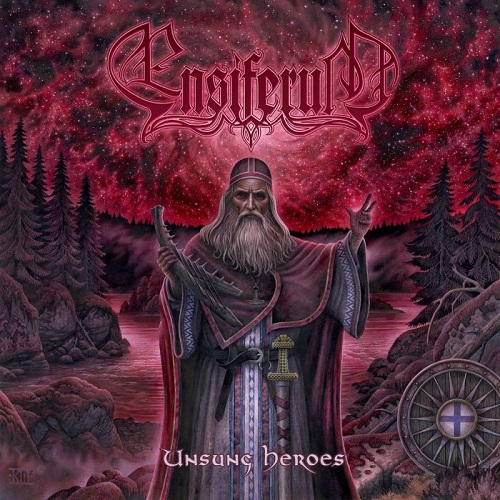
Ensiferum took a lot of slack for this album. I think a lot of people wanted to hear the over-the-top bombast that worked so effectively on Victory Songs, but in my opinion that was already growing stale on From Afar. Unsung Heroes is down to earth in a way they haven’t been since the 2001 self-titled debut, and I love it. They’re heading in exactly the direction I’d hoped for, and with the exception of the ugly mistake that is the album’s 17 minute closing track, Power Proof Passion, Unsung Heroes does not sound at all like a band past their prime. If they continue to push in the direction of tracks like Pohjola, they’re in position to trump Victory Songs and follow up Unsung Heroes with their best album to date.
7. Wodensthrone – Curse
I wish I’d taken the time to review this album earlier in the year, because I haven’t listened to it since the summer, and their flavor of epic black metal isn’t the sort of thing you can fully absorb in a quick last-minute listen. This is an album that can move nowhere but up in my charts over the months to follow, but for the time being I am content to place it somewhere in the middle. While busting out black metal that’s just as grim and unforgiving as the 1990s greats, Wodensthrone manage to infuse a tremendous amount of emotion that speaks of something beautiful hidden beneath the chaos. It’s buried a bit deeper than say, Femundsmarka by Waldgeflüster last year, but the feeling is similar.
6. Vattnet Viskar – Vattnet Viskar EP (song: Weakness)
If someone were to ask me what black metal sounded like in 2012, I might hand them this EP. It’s kind of cool getting to say that, because one of their members is a regular at the music forum where I get most of my recommendations. I wouldn’t have guessed back in March that they would be signed to Century Media by the end of the year, but I’m stoked to hear it. The whole notion of post-black metal has taken on a number of different flavors in these formative years, and Vattnet Viskar expand the genre by incorporating a lot of the all-encompassing guitar tones I associate with post-rock acts like Mono and This Will Destroy You. Top-notch stuff that’s really at the forefront of an emergent genre I’ve been anticipating for years.
5. Enslaved – RIITIIR
How Enslaved have aged so well is beyond me, but their last three albums have been their best three albums, and 22 years after the formation of this band they remain at the forefront of metal. Their viking-infused progressive black sound of late has done as much to shape the future of the genre as any new-found participant in the current popular trend towards black metal that has been taking shape over the past four years. RIITIIR is another outstanding output by the one classic early 90s black metal band that has managed to weather the ages unscathed.
4. Blut aus Nord – 777: Cosmosophy
The review I wrote of 777: Cosmosophy last month was one of the most thorough I’ve done all year, and there is nothing I care to say about the album that I haven’t said already. It is outstanding in its own right, but it does not feel like an entirely complete finale to their already classic 777 series. The first and third tracks, breathtaking though they may be, don’t seem to sufficiently progress from where the second album in the trilogy, The Desanctification, left off. The second track moreover, Epitome XV, is the weakest link on all three albums. The last two tracks compensate greatly by concluding in proper form, and I certainly think Cosmosophy is excellent. It can only be said to have “shortcomings” in so far as I expected it to be the best album of 2012. Fourth place isn’t too bad.
3. Torche – Harmonicraft (song: Reverse Inverted)
Calling Torche metal at this point is really pushing the limits of the definition. Since their early days writing crushing stoner anthems, they have evolved into a bizarre amalgamation equal parts metal and pop. But it’s not just the uniqueness of the happy, smiley-face hammers Harmonicraft beats you down with that makes it so appealing. Torche have become by all rights the heirs of the 1990s. These guys have more in common with the Smashing Pumpkins than they do with any of their stoner metal contemporaries. This is the sort of thing that 15 years ago we could have just labeled “alternative rock” and gone on enjoying without any need for classifications. While forging an entirely unique, original sound of their own, Torche have managed to capture a song-writing ethos that has been dead for a generation, and Harmonicraft is the cleanest breath of fresh air I’ve inhaled in years.
2. Krallice – Years Past Matter (song: Track 2)
Krallice is my favorite band making music today, and I dare say last year’s Diotoma might be my favorite album by any band ever. Seldom if ever has a band followed up such a masterpiece with something of equal worth, and I was shocked that Krallice had the energy left to release anything at all this year. Years Past Matter is an outstanding post-black metal outing in the vein of Dimensional Bleedthrough. The tracks took longer than usual to grow on me, and usual for Krallice entails dozens of listens, but the payout is always worth the time, and the slow process of appreciation is enjoyable in its own right. Mick Barr and Colin Marston’s dual tremolo is the grand ultimate ear-candy, and so long as they never compromise their commitment to that they will probably remain my favorite band. (Track 3 is my favorite song on Years Past Matter so far, but it was not available on youtube. Track 2 is a worthy substitute.)
1. Panopticon – Kentucky (song: Killing the Giants as They Sleep)
The fact that I didn’t review this album is almost embarrassing, because much like Aesthethica by Liturgy last year, it is an album that absolutely demands a thorough investigation to properly appreciate. I can’t easily tell you why I placed it this high, because frankly I don’t know yet myself. When I first read that a Louisville, Kentucky-based band called Panopticon had released a bluegrass black metal album, all sorts of thoughts ran through my head. Kentucky sounds like none of them. Do ignore the cliche “blackgrass” labels; while Austin Lunn listened to plenty of bluegrass in the process of recording this, he does not actually incorporate the genre as we might think of it. Instead he interweaves traditional Appalachian folk–not bluegrass particularly–as distinct tracks separated from the black metal. What folk does emerge in the bm is more akin to Waylander, and certainly far from “bluegrass”. That’s not a bad thing, just an–I think–important distinction to be made, because otherwise we might be left searching for genre stereotypes which simply aren’t present here. What Kentucky really accomplishes is a merging of a musical themes which perfectly juxtapose a beautiful landscape and a totally destitute human condition. The first half of “Killing the Giants as They Sleep” for instance generates landscape imagery with a degree of effectiveness similar to Femundsmarka by Waldgeflüster. (Have I referenced that album twice now? I think it’s time I paid it another visit.). You take a look around, take a deep breath, and really appreciate the natural beauty that surrounds you. About half way through the dialogue begins, and the explosion around 9:15 serves to draw you fully into the atrocities taking place here, both in the exploitation of workers and the desecration of the environment.
I don’t think Austin Lunn intended to make any sort of political statement here, but in succeeding so comprehensively to depict elements of Appalachia and its outskirts, he effectively did so. At a time when the working class of America is inexplicably becoming staunch supporters of big capital, this album hits a bulls-eye on all of the thoughts that have been forefront on my mind of late. His bleak renditions of union anthems like “Which Side Are You On?”, recently covered with such optimism by the likes of Dropkick Murphys, strike me as a painfully realistic reminder that the entire notion of equality as an American ideal is becoming antiquated.
But that might be seen as secondary. Wherever our ideas may lead us, Kentucky is the sort of album that inclines us to form them. It’s an album that makes me think. Like Aesthethica by Liturgy and Diotima by Krallice last year, it forces me to set aside my mundane daily routines and really engage the human experience. That alone, all other considerations aside, suffices to render it my favorite album of 2012.
I read so many negative reviews of Unsung Heroes that I actually avoided listening to it for four months. My acquaintance with Ensiferum goes all the way back to their 2001 full-length debut, and I was in no hurry to hear such an essential and formative band for me fall by the wayside. I finally gave it a spin for the first time last night, and frankly I don’t know what everyone is bitching about.
In My Sword I Trust
I mean, sure, Unsung Heroes isn’t the explosive powerhouse of Victory Songs and From Afar. But was I the only person who got the feeling on From Afar that their standard formula was growing really stale really fast? Ensiferum may have set the standard for folk metal as we know it today, but beneath the fist-pumping and epic folk interludes of even tracks like Twilight Tavern and Stone Cold Metal I got the sneaking suspicion that they were beginning to succumb to the very genre stereotype they established. Victory Songs certainly stands as my favorite Ensiferum album to date, but I kind of felt like From Afar was riding too much on its success. Almost every song followed the formula that made Victory Songs so great, and while this certainly facilitated a fresh batch of great songs, it was less than I’d hoped from a band that had consistently paved their own way over the years.
Is Unsung Heroes a washed out version of Victory Songs and From Afar? Only if you claim that those albums capture exactly what Ensiferum ought forever more to sound like. I for one think it’s a breath of fresh air. It reminds me, if anything, of their 2001 self-titled. It humors the possibility of rocking out without lightspeed double bass. It dares to occasionally divorce overbearing synth and “epic” orchestrated overlays from the folk passages. It drops, I think, the degree of pretentiousness that concerned me on From Afar. I have no interest in listening to the musical equivalent of 300 spin-offs ad nauseam. The total testosterone indulgence of Victory Songs was exciting in its day, but in music and film alike it grows old quickly.
Pohjola
I really feel like Unsung Heroes is Ensiferum’s most mature work to date. That doesn’t make it their best; Victory Songs was just too perfect and the self-titled too nostalgic to be trumped any time soon. But on Unsung Heroes I can again feel like I’m listening to a band who share my nerdy lust for all things fantasy. There’s none of the glam and special effects that dazzled me on Victory Songs but made me begin to feel distanced from the band on From Afar. I’m absolutely thrilled to be able to connect with these guys again in the more personal way I felt on their first album.
And really, what can you possibly complain about on a track like Pohjola save that it doesn’t fall into the formula of their last two albums? I’ve heard people say they’re becoming a Turisas knock-off. That’s absolutely ridiculous. Post-Battle Metal Turisas has served as the ultimate Hollywood blockbuster band–glossy and refined, if Victory Songs was Ensiferum’s 300, Varangian Way was Turisas’s Lord of the Rings. Tracks like Pohjola might have epic operatic vocals and orchestration, but the surrounding atmosphere is completely different from either of those works. The viking metal riffs that really start to pick up at the 3 minute mark ought to be a revealing sign that this song is all about the steady drive. The orchestration ebbs and flows without many hard, dramatic stops. The synth whistle that accompanies the main riff in the earlier stages of the song gives it a light-hearted, positive feel that carries throughout. The acoustic guitar outro is beautiful, but it’s also accessible. It’s something you the listener could pick up your guitar and play.
Unsung Heroes isn’t perfect. Sami Hinkka’s clean vocals leave a bit to be desired, especially on “Last Breath” where they take center stage. That, the ninth track, is really the first moment on the album where I begin to see where any complaints might have a leg to stand on. If the 17 minute-long closer which follows–“Passion Proof Power”–was as good as we’ve come to expect from an Ensiferum grand finale, any petty complaints about “Last Breath” might be easily forgotten. The problem is that “Passion Proof Power” is frankly pretty bad. It starts off a lot slower than the rest of the album’s non-acoustic tracks, more inclined to bore me than build anticipation. When it does pick up there’s no clear direction as to what’s going on. The song gives way into some really, really lame progressive rock, coupled with boring, unconvincing spoken passages and completely misplaced operatic vocals. The song never really builds up into anything. There are moments here and there where you might find yourself drawn back in–at the 13 minute mark for instance–but as the song continues to go nowhere you’ll forget about it again soon enough. I can’t make any excuses here; “Passion Proof Power” is a waste of 17 minutes, and if you skipped ahead to it expecting to hear Ensiferum’s finest effort–a reasonable thing to do considering how they’ve concluded past albums–you may well be left with the impression that Unsung Heroes is terrible. Follow that up with an embarrassing bonus track cover of Gypsy Kings’ Bamboleo and yeah, you definitely have a right to demand the last 20 minutes of your life back.
Burning Leaves
In conclusion, this is perhaps Ensiferum’s most down to earth album to date. It’s all about moderation and maintaining a steady drive while never over-extending or burning out into a bore. It doesn’t crush or dazzle; it rocks along, and does so with some really compelling orchestration that’s uniquely accessible. I think there’s this common misconception that fantasy-themed music has to sound larger than life, but for me that’s a detriment in all but the most perfect, Victory Songs/Varangian Way-level instances. If it sounds fake it’s not doing a very good job of creating fantasy now, is it? Unsung Heroes paces itself and transitions in ways that feel legitimate. I love it, at least for the first 40 minutes. It doesn’t so much progressively decline from there as stall mid-air and nose dive; they should have put “Last Breath” before “Pohjola” and made the latter the finale. “Passion Proof Power” and “Bamboleo” are garbage B-sides better suited for some bonus disc on a collector’s edition. (I suppose Bamboleo technically is a “bonus” track.) To say Unsung Heroes is a great album while chucking out a full 20 minutes of its content is a bit of a stretch, but because the weak points are condensed on the fringe rather than interspersed throughout the album, and because 40 minutes of outstanding new Ensiferum is certainly sufficient, I am content to delete the last two tracks from my playlist and call it a success.
Latvia’s Skyforger have been around for ages. They first formed in 1991 as a folk-leaning death metal band called Grindmaster Dead, but by 1995 they changed their name to Skyforger and turned their attention to black metal. After leaving their mark on both the second generation of black metal and the formative years of pagan metal, they turned their attention to Latvian folk traditions unconditionally. Zobena Dziesma, translated as “Sword Song”, was released in 2003. It left metal at the door, and presented, in coordination with the Culture Capital Foundation of Latvia, an outstanding compilation of songs in traditional Latvian style.
“Skyforger is not a professional Folk group, and we are traditionally known for playing Folk/Pagan Metal. We started playing Folk music as amateur enthusiasts, only for ourselves. However, our friends and fans expressed a desire to hear more of these songs, and that led to the creation of this album. Most of the songs you can hear on this recording are taken from the repertoire of well known local Folk groups. Others are reworked versions of material from our previous albums. Our passion is to play olden songs of the war and mythology of our forefathers. In that respect, this album is no different from those we have recorded in the past. It is our tribute to ancient Latvian history, culture and folklore.”
Skyforger translate Zviegtin’ Zviedza Kara Zirgi as “Neighed the Battle Horses”. It’s the track that has always stood out to me most on the album. It is exceptionally visual. It’s one of those songs that transports you to another place and time, and allows you to engage an ancient world trapped somewhere between history and fantasy.
An unrelenting, wild ride through everything that makes Slavic pagan metal amazing, Масленица Широкая (Maslenitsa Shirokaya) is one of the finest songs in the entire genre. Anyone familiar with Russian pagan metal gods Pagan Reign should find the sound entirely familiar. When Pagan Reign broke up in 2006, Твердь (Tverd’) formed from the ashes. Guitarist Vetrodar and drummer Demosthen were the only returning members, but stylistically Tverd’s only album to date, Вслед за Солнцеворотом (Vsled Za Solntsevorotom), is such a direct continuation that it would be hard to understand Tverd’ as anything but a legitimate continuation of Pagan Reign. Even the band’s name is the title to Pagan Reign’s final album. It is also a reference, I would imagine, to their hometown Tver, just north of Moscow.
The quality of this song is just impeccable. It carries all of the epic glory of Pagan Reign’s Новгородские Пляски (Novgorodian Folk Dance), but with a more mature approach to the madness and the addition of a fantastic vocal performance by Svetlana Lebedeva. The song is structured, much like Novgorodian Folk Dance, to eschew standard composition and confront the listener with one bombastic movement after another, thriving in a state of constantly progressing triumphant climax. It lacks all of the frustration and anger that so many Slavic bands reflect in their recognition that the culture they’re preserving exists only in scattered embers. Maslenitsa Shirokaya is a pure celebration with no baggage. Cheers.
From the perspective of a guy who doesn’t speak a word of German, this has to be the second greatest band name ever after Helfahrt. But then, “Slartibartfass” apparently refers to a fictional character with an intentionally absurd name. To the best of my knowledge Helfahrt is a legitimate false cognate. HELFAHRT!
This is not Helfahrt. This is Slartibartfass, who paint a delightful vision of super-cute munchkins tying you up in your sleep and harvesting your kidneys. Tanz der Kobolde makes no pretense to anything more than what its name suggests. The death metal vocals are deliciously hokey (the only sort of context in which I actually like death metal vocals), and yes, the drummer is simulating stomping gremlin feet.
Kobolds are little Germanic sprites, typically invisible and inhabiting homes, caves, and ships. They’re fairly ambivalent little fellows. Some will do household chores for a pittance, and they say if you stab one to death it can drop gold. When annoyed by their human cohabitants they tend towards dismemberment. They don’t much care for clothing. The element cobalt is named after them; they often give it, laden with arsenic, to miners as a playful prank.
Slartybutt are from the Baden-Württemberg region of Germany. Tanz der Kobolde appears on their first album, Nordwind, released in 2006. It is definitely…. entertaining.
I said I’d make it weird for the last week leading up to Halloween. Here’s some true kvlt kazoo metal to kick things off.
I have no idea if that’s actually what Odroerir are playing (I mean, Finntroll did it) or if it’s some medieval woodwind similar to what Stary Olsa use in the Drygula song I recently featured, but either way the “wtf” factor was probably not lost on them. Odroerir are a folk metal band with medieval tendencies hailing from the Thuringia region of Germany. They formed in 1998, and Präludium is the opener to their 2001 debut full-length Laßt Euch Sagen Aus Alten Tagen. The band’s name is a German variant of Icelandic Óðrerir, the name of the chalice of mead imbued with the knowledge of wisdom and poetry in Norse mythology. I don’t know that much wisdom went into crafting this song, but you can bet plenty of mead was involved.
From the sweeping, epic introduction to the wild guitar solos falling somewhere between power metal and melodic death, Ворон (Voron) is one of those songs that struck me like a brick the very first time I heard it. Смута (Smuta) are yet another band out of Russia, hailing from Rybinsk in Yaroslavl Oblast. I don’t know much about the band, and I’ve been too hopelessly distanced from anything but my (relatively) mainstream folk metal connections to keep up with them lately, but their 2007 debut full-length, Смута Крови (Smuta Krovi), was a surprisingly well-informed album for a band that doesn’t appear to have any connections to the bigger names of the genre.
The death metal vocals are the only consistent factor throughout the album, with musical themes that incorporate Finntroll-esque folk metal, Pagan Reign/Твердь-styled Slavic pagan metal, some power metal and melodic death guitars, and a uniquely tame approach to black metal. It’s got nothing on Falconer’s Armod for perfecting a merger of the myriad metal subgenres, but it’s a worthy effort, and it grants them a unique sound which, with better production and a little more edge, could evolve into something really amazing. They’ve released two albums since Smuta Krovi that I’ve yet to hear, and revisiting the band here has certainly peaked my curiosity.
Voron is definitely the stand-out track of the album, and the intro says it all. It’s the one track in which their lack of an edge can definitely count as a good thing. The brief opening segment is enough to give a solid fantasy essence to a song that really doesn’t fit that bill beyond the thirty second mark, placing it in the odd context of bearing sort of formal, almost royal imagery that you can somehow pull off your best air guitar imitation to.







 Through the Shattered Lens