If there’s anything that I’ve learned from my long history of watching Lifetime films, it’s that having a real job just isn’t worth the trouble.
Just consider what Melanie (Jessica Morris) goes through in The Wrong Mommy. She’s got a real job. She also has a handsome husband (Jason-Shane Scott), an adorable daughter (Jillian Spitz), and a mother (Dee Wallace) who enjoys going on exotic cruises. Melanie also has a really nice and really big house, the type of house that would probably be the “slightly more than you’re willing to pay” house on an episode of House Hunters. But can she enjoy it? No, of course not! It’s all because she’s got a real job. She can’t pick up her daughter after school. She can’t go out at night. She can’t do anything because she’s got a real job.
However, during the first few minutes of The Wrong Mommy, Melanie gets some good news! She’s been promoted! She’s now a senior executive or whatever it is that you get promoted to when you’ve got a real job. Along with having real responsibilities, Melanie is also about to get a real assistant!
Here’s another thing that I’ve learned from my long history of watching Lifetime films, as well as from my own past experience in the administrative professional field. Be very careful about hiring an assistant. Especially if she only has one obscure reference on her resume. Even if she’s willing to babysit your daughter for you, be careful. Don’t look the other way when she flirts with your husband. And, for the love of everything holy in this world, don’t tell her the one secret that could lead to you losing a big account!
Unfortunately, Melanie doesn’t exercise caution about any of that and, as a result, she ends up hiring Phoebe (Ashlynn Yennie). Even before Phoebe shows up for her interview, we’ve already seen her following Melanie around town and spying on her. In fact, even before the opening credits conclude, Phoebe is breaking into Melanie’s house and planting spy cameras. We know better than to trust Phoebe and soon, Melanie discovers that she made a mistake hiring her. However, it may be too late to do anything about it….
Now, to the film’s credit, Phoebe isn’t just some random psycho bitch trying to ruin someone else’s life. It turns out that she has a backstory, one that actually does involve Melanie. I won’t spoil anything by revealing it but it’s a pretty good backstory. Ashley Yennie appears to be having a lot of fun in the role of Phoebe. If you’re going to be in a Lifetime movie, you definitely want to play the villain. They usually get all the good lines and get to wear all the pretty clothes.
Like most of Lifetime’s “Wrong” films, this one was directed by David DeCoteau, who know exactly the right tone to take for a film like this. He plays up the melodrama while never allowing the film to take itself too seriously. (Just check out the scene where Dee Wallace shouts out the film’s title.) As with all the “Wrong” films, Vivica A. Fox shows up as a no-nonsense authority figure. (This time, she plays Melanie’s boss.) The great Eric Roberts also shows up for a few minutes, playing a sleazy client. Roberts doesn’t have much screen time but, as usual, he makes memorable use of what he gets.
The Wrong Mommy is an enjoyably silly film. It doesn’t take itself too seriously and neither should you.
Okay, so apparently, some people find the just-released trailer for Cats to be kinda creepy.
Speaking for myself, the trailer pretty much looks like what I would expect a film version of Cats to look like. I mean, the entire point of the stage production is that everyone dresses up like a cat and sings their heart out! The cat costumes and the makeup are a part of the production so I don’t know what everyone’s complaining about….
Well, okay, I will admit that I cringed when Rebel Wilson showed up but that’s just because it was so inevitable that Rebel Wilson would be in this movie. She’s like the female version of James Corden and …. oh wait, he’s in the film too?
Listen, I’m going to say it right now. Cats is going to be great. Well, maybe not great but it’s definitely going to be something that you’re going to want to be able to tell your children that you witnessed firsthand. A friend of mine hasn’t done shrooms in like ten years but he’s planning on indulging for one night only, the night that he sees this film. That’s type of cultural phenomena that Cats has the potential to be! (That said, he won’t be seeing the movie with me because I don’t want to be around if he has a bad trip. I’m never really sure what my exact obligation is in a situation like that.) Some people are going to hate this film but I like the whole idea of the film encouraging people to believe in something more than just pure cynicism, I just wish the film starred actual cats.
Anyway, here’s the trailer. Taylor Swift’s in it so you know the movie’s going to be a financial success no matter what the critics say.
If there’s anything that can definitely be said about Lifetime films, it’s that they always feature the nicest houses.
Take Trapped Model, for instance. Now, this film is also known as The Model Murders and A Model Kidnapping so, right away, you know that it’s not going to be a happy story about how wonderful it is to be a model. No, this is a film about a young woman named Grace (Lucy Loken) who runs away to Florida so that she can have her picture taken by a seemingly reputable photographer named Hunter (Wes McGee). Hunter, of course, is charming at first but he soon turns out to be a total sleaze who, with the help of his assistant Nicole (Katherine Diaz), takes Grace prisoner and forces her to strip on camera for a worldwide audience of pervs and incels. That’s a nightmarish story, one that’s made all the more disturbing by the fact that it’s very plausible. I mean, I’ve met more than a few real-life Hunters and I saw pieces of all of them in Wes McGee’s unnerving and menacing performance. And yet, as I watched the movie, I couldn’t stop thinking about how nice Hunter’s house was.
I mean, seriously! This place was huge and it had a pool and, even more importantly, it was totally spotless. Remember that mansion where Al Pacino kept his mountain of cocaine in Scarface? That place had nothing on Hunter’s home. In the film, Hunter used his mansion to give himself legitimacy. Grace was lured into trusting Hunter by all of his visible signs of success. Now, of course, those of us in the audience knew better. We’ve seen enough Lifetime films to know better than to trust anyone who is as superficially charming as Hunter. But still, even though we were all like, “Don’t trust him! Don’t agree to stay overnight! Stay out the guest house!,” it was impossible not to appreciate that house.
“Wow,” I exclaimed as I watched the film, “Maybe it’d be worth getting kidnapped just to live in that house!”
“That’s not funny, Lisa Marie!” came the replies and technically, I guess it wasn’t. Still….
The other thought that I had as I watched Trapped Model was that it was unfortunate that Grace wasn’t Liam Neeson’s daughter. I mean, we all know that no one gets away with kidnapping a member of the Neeson family. Unfortunately, Grace has to depend on the investigative skills of her mother (Kiki Harris) and her boyfriend (Seth Goodfellow), neither one of whom has been trained to thwart kidnappings. Instead, they have to go to the police, who turn out to be fairly ineffectual. Usually, I kind of roll my eyes at the incompetent cops who populate Lifetime films but, in this case, the film made good use of the trope. As soon as Grace is kidnapped, it’s obvious that she’s going to have to be the one to figure out a way to escape her captors. You find yourself cheering her every success and dreading her every setback.
For the most part, Trapped Model was just as impressive as Hunter’s house. This was a well-executed melodrama, featuring brisk direction from Damian Romay and excellent performances from Lucy Loken, Wes McGee, and Katherine Diaz. In the end, Trapped Model is one of the better Lifetime films that I’ve seen this year and I’m not just saying that because of the house.
Played by Eric Roberts, Albert Beck is the anti-hero at the center of the Stalked By My Doctor films. He was once a brilliant heart surgeon, up until he grew obsessed with one of his patients and was forced to go on the run. That happened in 2015’s Stalked By My Doctor. Stalked By My Doctor was so successful that it has inspired, to date, three sequels. Each film features the same basic plot, in which Dr. Beck assumes another doctor’s identity, becomes obsessed with another patient, and ends up murdering the usual collection of dumb boyfriends and nosy coworkers. Ever since the third film, Dr. Beck has spent a lot of time talking to himself, which the franchise usually represents literally by having two Doctor Becks appear on screen at the same time and arguing with each other. The real Dr. Beck usually wears a suit and a lab coat and is prone to thinking that he’s finally going to find true love. The imaginary Dr. Beck wears a Hawaiian shirt and is always holding a tropical drink. Of course, this means that you get twice as much Eric Roberts as advertised!
And indeed, Eric Roberts is the main reason why this franchise has thrived. Lifetime is full of movies about stalkers but only the Stalked By My Doctor franchise features Eric Roberts at his most demented. (We make a lot of jokes about Eric Roberts on this site but the truth of the matter is that he’s actually a very good actor and he’s given some very good performances over the course of his long career. If nothing else, he’s a more consistently interesting actor than his better-known sister, Julia.) In the role of Dr. Beck, Eric Roberts never makes any attempt to be the least bit subtle and that’s exactly why the films work. If you take every creepy doctor and touchy-feely male friend that you’ve ever had to deal with and combined them into one ubercreep, the end result would be Dr. Beck. He’s arrogant. He’s condescending. He’s got the creepiest smile in the world. And yet, despite his personal issues, he’s also a lot of fun to watch. Eric Roberts always seems like he’s having fun in these movies as he discovers new ways to communicate the fact that Dr. Beck is an absolute creep.
There are two things that I especially like about the Stalked By My Doctor films:
Number one, they take place in a world where someone who looks and sounds like Eric Roberts can somehow evade detection despite making absolutely no effort to disguise his appearance or change his voice. For instance, in the franchise’s fourth film, Stalked By My Doctor: A Sleepwalker’s Nightmare (which aired on Lifetime this weekend), we find Dr. Beck working as a server at a roadside diner. As in the previous films, he’s still frequently distracted by wild fantasies and elaborate schemes for revenge. But what’s hilarious is that Dr. Beck is apparently one of the most wanted men in America but none of the customers at this seemingly busy diner ever says, “Hey, that mysterious server looks just like that murderer who was all over the news!” To the film’s credit, it also makes it clear that the film itself is in on the joke. We’re supposed to enjoy the rather odd sight of Eric Roberts pouring coffee and awkwardly flirting with his customers. We’re not supposed to worry about whether or not it’s a plausible development.
Number two, I love the fact that there’s literally nothing that Dr. Beck cannot do. Seriously, Dr. Beck has got to be the most brilliant medical mind of all time because there’s not a single field of medical care that he cannot conquer. When we first met Dr. Beck, he was a heart surgeon. In the fourth film, he steals the identity of a specialist in sexsomnia. He manages to do all of this without missing a beat or giving himself away. All you have to do is give Dr. Beck a lab coat and he can basically do anything!
This time around, Dr. Beck is obsessed with the niece (Angeline Appel) of one of his patients, Michelle (Emilie Ullerup). Once again, Dr. Beck is breaking hearts and ending lives while, at the same time, arguing with his Hawaiian shirt-wearing alter ego. And again, there’s murder, love, and melodrama. It wouldn’t be a Stalked By My Doctor movie, otherwise!
And it’s all lot of fun. Just when you think that the franchise has run out of gas, Eric Roberts adds another layer of quirkiness to his performance and you find yourself enthralled again. As I hinted at above, the best thing about the Stalked By My Doctor films is that they know that they’re ludicrous and they make no apologies for being what they are. Much like A Deadly Adoption, the Stalked By My Doctor films poke fun at the Lifetime format while still showing enough respect for the audience that no one watching is going to feel as if they’re being condescended to. The film is totally over-the-top and silly but it’s Eric Roberts so who cares? What else would you expect? Are you not amused?
When watching Stalked By My Doctor: A Sleepwalker’s Revenge, keep an eye out for Felissa Rose. Rose plays one of Beck’s colleagues. Horror fans know her best from her starring role in the original Sleepaway Camp. Her casting is one of those touches that sets Stalked By My Doctor: A Sleepwalker’s Revenge apart from other Lifetime films.
In its way, the Stalked By My Doctor franchise has the potential to be Lifetime’s equivalent of the Sharknado films. Personally, I can’t wait to see where Dr. Beck turns up next!
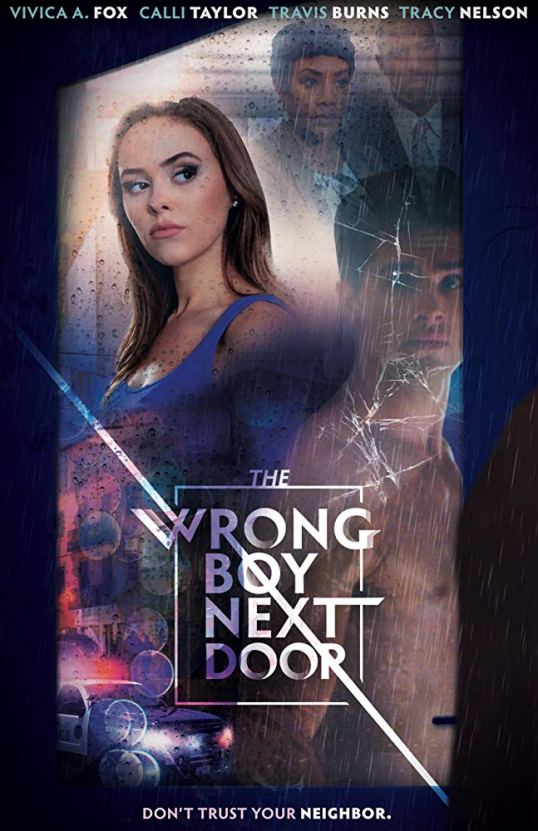
“Don’t trust your neighbor,” proclaims the tagline for The Wrong Boy Next Door and that’s certainly true when it comes to Lifetime films.
Seriously, in a Lifetime movie, your neighbor is either going to be a seemingly nice woman who is going to end up trying to steal your baby or else a really hot guy who never wears a shirt and who is secretly plotting to kill you and your friends. In the case of The Wrong Boy Next Door, we get the hot psycho who is always wandering outside without a shirt on. John (Travis Burns) may be intriguing but he’s also dangerous. It might be fun to watch him while he’s out in his garage but if he starts watching you back …. look out!
The Wrong Boy Next Door really does capture an essential truth. Bad boys are sexy and the more dangerous the better. While watching the film, it was easy for me to yell that Katie (played by Calli Taylor) was making a huge mistake by trusting John but, honestly, I probably would have made the same mistake back when I was in high school. First off, there’s the fantasy of being the one girl who can reform a bad boy. Secondly, there’s the fact that, when you’re a teenager, you do stupid things because you think you’re smarter than you actually are. I mean, really, that’s the whole appeal of being young. It’s the only time in your life that you can get away with being totally dumb and irresponsible. That’s why there are people in their 30s who are already feeling nostalgic for high school.
Having watched the film, I can say that Katie is one of the greatest Lifetime heroines ever. From the minute the movie starts, she’s getting in trouble. First, she gets caught vaping at school and this leads to her being suspended for a few days. It’s during that time that she first spots John walking around outside. She invites him inside and, two minutes later, they’re kissing. Then, when Katie returns to school, one of her teachers spots her checking her phone in class. When the teacher demands the phone, Katie throws it at her and literally knocks the teacher to the ground! (The school’s principal later says that the teacher looks like she got hit in the face by a baseball.) Go Katie!
So now, Katie’s under house arrest! That means that she has to wear one of those ankle bracelets that beeps if you leave your front yard. The detective in charge of Katie’s house arrest is played by none other than Vivica A. Fox so you know that if Katie breaks the rules, she’s going to be in a lot of trouble. Unfortunately, being stuck in her house is kind of a problem because Katie suspects that John might be as good a guy as he’s pretending to be. But how can she investigate without going outside!?
The Wrong Boy Next Door was a hell of a lot of fun, largely due to Calli Taylor’s energetic and sympathetic performance as Katie and Travis Burns’s menacing turn as John. As is typical of Lifetime’s “Wrong” films, director David DeCoteau kept the action moving at a brisk pace and Vivica A. Fox brought her usual flair to yet another no-nonsense authority figure. All in all, The Wrong Boy Next Door is one for which to keep an eye out.
First released way back in 1972, Payday tells the story of Maury Dann (played by the late, great Texas actor, Rip Torn).
Maury is a country singer. He sings songs about wholesome values and good country girls. His music isn’t exactly ground-breaking but his fans still love him and it’s easy to see why. The movie opens with Maury performing in a small, country club and his charisma is undeniable. He has a good singing voice and he easily dominates the stage. Between songs, he flashes a friendly but slightly mischievous smile. After his performance, he is perfectly charming when he meets his older fans. And, when he meets a younger fan, he takes her outside and has sex with her in the backseat of his Cadillac. He does this while her boyfriend is wandering around the parking lot looking for her.
Maury is a man who is in control when he’s on stage. However, when he’s off-stage, the real Muary comes out. When he’s not singing and basking in the applause of his fans, Maury is …. well, he’s a total mess. Actually, mess doesn’t quite do justice to just how screwed up Maury Dann is. He cheats on his girlfriend. He pops pills constantly. He treats the members of his band with a casual cruelty. When Maury’s off-stage, that charming smile changes into a rather demented smirk. Just when you think Maury’s done the worst possible thing that he could do, he does something even worse.
Payday follows Maury as he is driven through the South, singing songs and ruining lives. Along the way, he gets into a fight with his mother and then a fight with his ex-wife and eventually, a fight with the boyfriend of that younger fan from the start of the movie. We watch as Maury drinks, bribes DJs, and frames his employees for all sorts of crimes. It’s an episodic film about a man who seems to understand that he’s destined to self-destruct no matter what he does.
Payday is very much a film of the early 70s. Though the film may be about a self-destructive country star, it’s hard not to suspect that — as with most of the films from that era — Maury and his adventures were meant to be a metaphor for America itself. Country Western is a uniquely American genre and by showcasing the damage that Maury does to everyone around him, the film seems to be suggesting that Maury’s sins are also America’s sins. The people who idolize Maury and make him a star despite all of his flaws are the same people who reelected Richard Nixon and supported sending young men to die in Vietnam.
It’s all a bit much for one film to carry on its shoulders and spending two hours with Maury Dann is not exactly a pleasant experience but the film works because of the performance of Rip Torn. When Torn died earlier this week, there was a lot of discussion about which performance was his best. Quite a few people on twitter cited his roles in Defending Your Life and The Larry Sanders Show. I personally mentioned The Man Who Fell To Earth and Maidstone. But if you really want to see what made Rip Torn such a great actor, you simply must watch Payday. Maury is a jerk with little in the way of redeeming qualities but Torn gives such a fearless and cheerfully demented performance that it’s impossible not to get caught up in his story. As much as you want to look away, you can’t because Rip Torn keeps you so off-balance that you cannot stop watching. Torn is smart enough to play Maury with just enough self-awareness that the character becomes fascinatingly corrupt as opposed to just being a self-centered jerk.
Finally, Payday simply feels authentic. The film was made way before my time but I’m a Southern girl who has spent enough time in the country to know that the backroads of rural America haven’t changed that much over the past few decades. At times, while watching Payday, I felt like I was back on my granduncle’s farm in Arkansas, walking through high grass and listening to the cicadas while watching the sun go down.
Payday is definitely a film that’s worth the trouble to track down. Watch it and appreciate the fearless genius of the great Rip Torn.
She’s a former high school outcast who can now legally carry a gun. How much of an outcast was Penny? She was such an outcast that she was humiliated at a school dance by a bunch of popular kids who tied her down to a chair, made her up to look like a pig, and then displayed her in front of the entire class. Seriously, how do teenage bullies come up with stuff? I mean, I was never one to take part in bullying but, even if I was, my ADD would make it impossible for me to pull off most of the elaborate schemes that always seem to take place in movies like this.
Anyway, Penny was traumatized by the whole incident but she still managed to graduate and eventually become a cop. That’s right. Penny is upholding the law and she’s got an entire department to back her up in case she happens to shoot anyone and …. well, can you see why this might be a problem for her former high school classmates?
One night, Penny is called out to investigate a home invasion. After Penny shoots the home invader dead, she meets with the home’s owner and it turns out to be a former classmate, Tara (Kaitlyn Black)! Tara, who seems to have no memory of Penny’s life being destroyed in high school, is soon hanging out with her old classmate. She invites her to a party. She and Penny go out to the desert for target practice. The whole time, of course, Penny keeps imagining that she’s surrounded by the taunting laughter of her former classmates. Penny’s going to get her revenge, even if it means coming up with a scheme that’s even more ludicrously elaborate as the one that embittered her in the first place.
Hometown Killer is a classic Lifetime film, one that full embraces every melodramatic possibility of its storyline. Penny may be a dishonest murderer but you still feel sorry for her because of what she went through in high school. This is one of those films that makes you think, “Y’know, she probably she shouldn’t be doing this but maybe she should.” Director Jeff Hare adds enough little quirky touches to distinguish Hometown Killer from other, similar films. I especially liked the way the he took us in and out of Penny’s mind, always keeping us off-balance as to whether or not we were seeing what was really happening or if we were instead seeing what Penny thought was reality. It kept the audience off-balance and, as a result, Hometown Killer generated a lot more suspense than the average Lifetime film.
The success of a film like this pretty much hinges on the actress playing the killer and Ashley Gallegos did a great job of making Penny both sympathetic and frightening. Perhaps her greatest moment in the film is when she simply watches the chaos that she’s created and allows herself a slightly satisfied smirk. It’s a small moment but it tells us everything that we need to know about what’s going on in her head. Also impressive was Kelly Marcus, who was wonderfully obnoxious as the prototypical high school bully who never adjusted to life in the real world.
Hometown Killer aired on Lifetime and, Lifetime being Lifetime, it will undoubtedly air again. Keep an eye out for it!
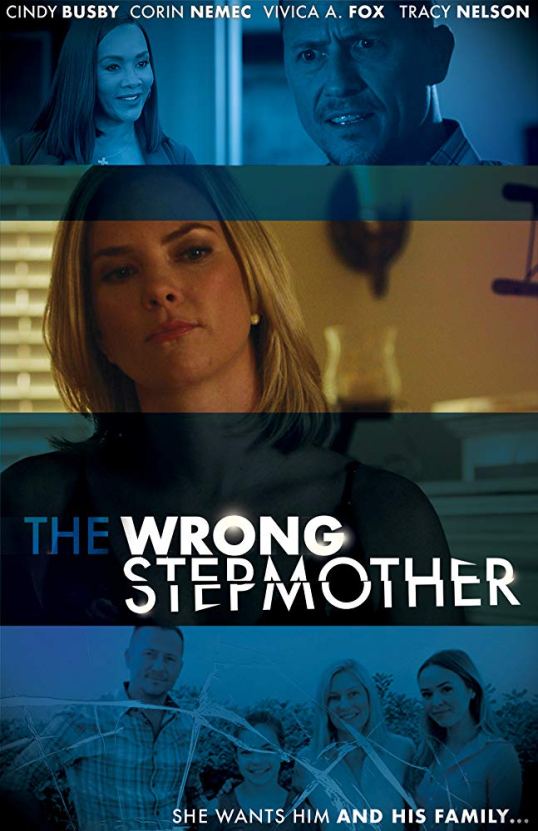
Actually, Maddie (Cindy Busby) is not a mother, though she would like to be. She not even a stepmother, despite what the title says. Instead, she’s just dating the recently widowed Michael (Corin Nemec). If she does end up marrying Michael, Maddie will become a stepmother — perhaps even a WRONG stepmother — to his two daughters, Lilly (Calli Taylor) and Nicole (McKinley Blehm).
It doesn’t take Lilly long to realize that there’s something off about Maddie. For one thing, she catches Maddie trying to check her social media. Then she overhears Maddie claiming to be her mother. And finally, Maddie changes up Lilly’s college admission essay. See, Lilly wrote about how much her late mother influenced her. Maddie, however, changes it into an essay about how much Lilly loves her future stepmother.
Yes, Maddie has some issues. As we discover at the start of the film, she has a history of stalking people. About halfway through the film, she murders two people. Whenever you’re watching a film on Lifetime, you know someone’s going to get murdered at exactly halfway through the film. You can set the time by it.
As with all of Lifetime’s “Wrong” films, Vivica A. Fox has a small role. In this one, she plays Ms. Price, the high school guidance counselor who is extremely unimpressed by Lilly’s college admissions essay. When Ms. Price confronts Lilly about how unimpressive her essay was, Fox delivers the lines with such subtle fury and annoyance that it brought back a lot of high school memories for me. As played by Fox, Ms. Price is the type of high school counselor who scares you to death but who also changes your life for the better. If Ms. Price had been my counselor, I definitely wouldn’t have spent so much time skipping class and shoplifting makeup at Target.
Anyway, the main complaint that you always hear about Lifetime films is that they’re all exactly the same but that’s actually their appeal. They’re fun to watch, precisely because 1) they’re predictable and 2) the viewer is always going to be smarter than the people in the movie. I mean, we can take one look at Maddie and say, “Okay, don’t let her in the house.” However, Michael’s not that smart and, if he was, we really wouldn’t have a movie. Sometimes, you just have to stop crying about plausibility and enjoy what you’re watching.
The Wrong Stepmother gets a big boost from the casting of the always likable Corin Nemec as Michael. I mean, it’s pretty much impossible not to root for a character played by Corin Nemec, even if that character is way too trusting of someone who he met on a dating app. Meanwhile, Cindy Busby is properly psychotic as Maddie and, of course, you’ve got Vivica A. Fox changing lives as Ms. Price.
The Wrong Stepmother is an entertaining Lifetime film. Watch it with your snarkiest friends.
According to the good people at Checkiday, the proper way to celebrate National Bikini Day is to put on a bikini and head to the beach! Unfortunately, I don’t live anywhere near the beach so instead, I’ve just been cleaning the house and taking out a wasp nest while wearing a bikini, which is an experience that’s both frightening and empowering at the same time.
(Seriously, we had a huge wasp nest that showed up overnight over the front door. I went outside and sprayed the nest, which resulted in the porch getting covered with dying and angry wasps. Of course, that’s when I realized that, because of the whole bikini thing, I had put on a t-shirt but I’d forgotten to put on shoes so I was barefoot, the backdoor was locked, and I didn’t have my keys on me, again because of the whole bikini thing. Rather than walking in bare feet across a porch covered by angry wasps, I literally crawled through a window to get back in the house, at which point I put on my shoes, went outside, and swept up all the wasps and the nest. It’s been quite a day!)
Anyway, as we often do here at the Shattered Lens, we’re going to recognize both this holiday and four of our favorite movies! Here, in honor of National Bikini Day, are….
The other night, I watched 2018’s The House That Jack Built on Showtime and I have to say that, sitting here the morning afterwards, I kind of wish that I hadn’t. It’s a well-made film and there’s a bit more going on underneath the surface that some other reviews might lead you to suspect but, at the same time, it’s also deeply unsettling and, even by the standards of Lars von Trier, disturbing. It’s not a film to watch right before you go to bed, nor is it a film to watch at the beginning of a long week. I’m still feeling the after effects of having watched this movie and I imagine I’ll probably be jumpy for the next few days.
The title character, Jack (Matt Dillon), is someone who loves to talk about himself. He’s an engineer but he wishes he was an architect. He thinks of himself as being an artist and an intellectual and he has no hesitation about informing you that he’s smarter than just about everyone else on the planet. He’s annoyed that he’s not better-known. He feels that his work is underappreciated.
The House that Jack Built runs two and a half hours and, as a result, we spent a lot of time listening to Jack talk. One thing that quickly becomes apparent is that Jack knows a lot but he understand very little. He spends a lot of time talking about Glenn Gould, Goethe, and Nazi architecture but his thoughts on them are rather shallow and predictable. When we see flashbacks to Jack’s youth, we don’t see any signs of the intelligence that he claims to possess as an adult. Instead, we just see a scowling country boy who used to abuse animals. Jack may insist on calling himself “Mr. Sophistication” but there’s really nothing sophisticated about him and one gets the feeling that his faux intellectualism is something that he developed to justify the fact that he’s a sociopath and a serial killer. Jack claims to have murdered at least 60 people and he also says that each murder was a work of art. If art reflects the time and place in which it was made than how can we condemn Jack for reflecting the soullessness and cruelty of the real world in his own creations? The answer, of course, is that we can very easily condemn Jack. Jack uses the state of the world to justify his actions but that doesn’t mean we have to buy what he’s selling.
The House That Jack Built is built around a lengthy conversation between Jack and an enigmatic character named Verge (Bruno Ganz). Jack shows Verge the “five incidents” that, over the course of 12 years, have defined who Jack is as a person and a serial killer. The five incidents feature Jack killing everyone from a stranded motorist (Uma Thurman) and a grieving widow (Siobhan Fallon Hogan) to a terrified mother and her two sons. Jack has a brief and toxic relationship with one of his victims (heart-breakingly played by Riley Keough) and it leads to an act of violence that’s so disturbing that I don’t even want to relive it long enough to write about it. Throughout it all, Jack tries to justify himself while Verge continually calls him out on his bullshit. Watching the film, I found myself very thankful for Verge. The film would have been unbearable if it has just been Jack bragging on himself, unchallenged. Verge not only calls out Jack but also anyone who would idolize someone like Jack. At times, the film itself seems to be ridiculing the whole idea of the Hannibal Lecter-style serial killer. There’s nothing suave or witty about Jack. He’s just a loser with no soul.
Even though I was watching the R-rated version (as opposed to the unrated director’s cut), the murders were still disturbingly graphic. But what really made the film unsettling was its peek into Jack’s nihilistic worldview. As much as he may try to convince you otherwise, it soon becomes clear that there’s nothing going on inside of Jack’s head. When Jack isn’t suffering from delusions of grandeur, he’s mired in self-pity. (Listening to Jack, one is reminded of the infamous BTK Killer, who spent hours in court describing his murders without a hit of emotion but who later broke into tears when informed that he would be spending the rest of his life in prison.) Unlike most movie serial killers, Jack doesn’t have a flamboyant origin story or any sort of trauma-related motive for his crimes. He kills because he wants to. Jack is capable of being superficially charming. As a sociopath, he’s learned how to put people at ease. But there’s nothing behind that charm. When he performs some post-mortem surgery to give one of his victims a permanent smile, the results are grotesque because Jack has no idea what a real emotion looks like. (Jack weakly waves at the body, as if he’s trying to teach himself how to act like a normal person.)
Throughout the film, we get a lot of stock footage. (It’s justified by the fact that Jack is talking about art and history, two subjects about which he only has a surface knowledge.) Interestingly enough, we also get several clips that were lifted from Von Trier’s previous films. At one point, Jack passes a cabin that some viewers will recognize from Antichrist. While Jack tries to dispose of a body, David Bowie’s Fame plays on the soundtrack and it’s hard not to be reminded of how Bowie’s Young Americans played over the closing credits of both Dogville and Manderlay. We’re left to wonder if Jack is meant to be, in some way, a stand-in for Von Trier. Much like Jack, Von Trier is often accused of using his own artistic pretensions to justify a nihilistic and misogynistic worldview. It’s easy to imagine Verge as a stand-in for some of Von Trier’s fiercest critics. What then are we to make of the fact that the film also portrays Verge as being correct and Jack as being (literally) bound for Hell? Is Von Trier telling us that, as much as some people may dislike him and his work, at least he’s not a serial killer like Jack? Is Von Trier attacking himself? Or is Von Trier perhaps satirizing his own controversial persona? Perhaps all three are correct.
By the film’s end, Jack is in Hell. Interestingly enough, the portal to Hell is found in a house that’s made up of the bodies of Jack’s many victims. Verge — short for Virgil, of course — gives him a tour. When Jack sees a broken bridge, Virgil informs him that it once led to Heaven but it can’t be crossed now. However, Jack is convinced that he can climb over a cliff and make his way to Heaven. Virgil assures Jack that many have tried but none have succeeded. Jack, of course, tries and, needless to say, he doesn’t make it. In the end, redemption is impossible and yet you wonder how, in a world with Heaven and, one assumes, God, Jack even came to exist in the first place. If Jack had channeled his sociopathic nature into something more productive than murder, would he have been allowed into Heaven?
As I said, it’s a well-made film but it’s also deeply unsettling. I’m probably going to be jumping at my own shadow for at least a week or two. At the very least, I’m not answering the door for anyone….









 Through the Shattered Lens