30 More Days of Noir #3: Guns, Girls, and Gangsters (dir by Edward L. Cahn)


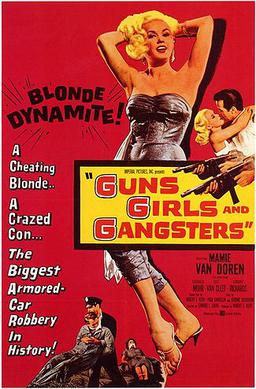
Guns, Girls, and Gangsters!  The title of this 1958 film pretty much sums it all up.

Now, technically, I guess you could debate whether or not the criminals in this film really qualify as gangsters.  When I hear the term “gangster,” I tend to think of the big Mafia chieftains, like Al Capone and the Kennedys.  Maybe it’s because I’ve seen The Godfather too many times but I always associate gangsters with wealth, big mansions, elaborate weddings, and aging crooners who need someone to chop off a horse’s head in order to get a role in From Here To Eternity.  However, the gangsters in this film are all basically small-time criminals.  One of them does own a nightclub but it’s not a very impressive nightclub.  If anything, they’re wannabe gangsters.  However, Guns, Girls, and Wannabes just doesn’t have the same ring to it.

Chuck Wheeler (Gerald Mohr) has a plan.  He wants to rob an armored car.  It’s a Vegas armored car, so of course it’s going to be full of money and since Michael Corleone killed Moe Greene three years before, there shouldn’t be too many repercussions from hijacking it.  (Sorry, I’m still thinking about The Godfather.)  To enlist the aid of a nightclub owner, he enlists the aid of a singer named Vi (Mamie Van Doren).  Vi just happens to be the wife of Chuck’s former prison cellmate, Mike (Lee Van Cleef).  Vi has been demanding a divorce for a while but Mike won’t grant it because he’s insanely jealous.  He probably wouldn’t be happy to find out that Chuck and Vi are now a couple but, fortunately, he’s locked up.

Except, of course, Mike escapes from prison around the same time that Chuck and the gang manage to hijack that armored car.  As you can guess, this leads to mayhem and havoc.  That’s where the guns of the title come into play….

Guns, Girls, and Gangsters is an entertaining little B-noir.  It’s only 70 minutes long so the film doesn’t waste any time getting to the action.  (There’s also a narrator who serves to fill in any plot holes and to keep the audience entertained with his rather self-important delivery.)  Gerald Mohr is a bit on the dull side as Chuck but you better believe that Lee Van Cleef is 100% menacing and oddly charismatic as the as the always angry Mike.  Van Cleef brings a charge of very real danger to the film.  (Perhaps he’s the gangster that the title was referring to, though I would still think of him as being more of an outlaw than a gangster.)  And, of course, you’ve got Mamie Van Doren, playing yet another tough dame in dangerous circumstances.  Van Doren gets to perform two musical numbers in Guns, Girls, and Gangsters and they both have a low-rent Vegas charm to them.  Watching this film, it occurred to me that Van Doren may not have been a great actress but she had the perfect attitude for films like this.  She played characters who did what they had to to do survive and who made no apologies for it and it’s impossible not to be on her side when she’s having to deal with creeps like Chuck or sociopaths like Mike.

Guns, Girls, and Gangsters is an entertaining B-noir.  There’s enough tough talk, cynical scheming, and deadly double crosses to keep noir fans happy.
30 More Days of Noir #2: Blonde Ice (dir by Jack Bernhard)


1948’s Blonde Ice tells the story of Claire Cummings (Leslie Brooks), the society columnist for a San Francisco newspaper.  Almost every man that Claire meets falls in love with her.

Les Burns (Robert Paige), the paper’s cynical sports reporter?  Les is so in love with Claire that he keeps getting involved with her despite the fact that she cheats on him with almost every man that she meets.

Al Herrick (James Griffith)?  Yep, he’s still in love with her too.

Carl Hanneman (John Holland), one of the wealthiest men in San Francisco?  Carl is so in love with Claire that he’s willing to marry her even after he catches her kissing Les on the day of the wedding!

Congressional candidate Stanley Mason (Michael Whalen)?  He’s so in love with Claire that he’s willing to sacrifice his political career just to be with her.

How about Blackie Talon (Russ Vincent), the pilot who witnesses Claire doing some things that she probably wouldn’t want the world to know about?  Well, Blackie never gets around to declaring his love for Claire but his obsession with blackmailing her is probably just his way of dealing with the massive crush that he has on her.

The only person who doesn’t appear to be in love with Claire is Dr. Kippinger (David Leonard), a psychiatrist who immediately picks up on the fact that Claire is cold and manipulative.  There’s a reason why Les refers to her as being …. can you guess? …. “Blonde Ice!”

Of course, even with all of these men falling in love with her, no one loves Claire as much as Claire loves herself.  Claire is a narcissist and a sociopath and she has no problem killing one lover and framing another for the crime.  In fact, it’s something that she attempts to do several times over the course of Blonde Ice.  Claire, it has to be said, is pretty clever about it too.  Her natural ability to manipulate, combined with her total lack of empathy for anyone but herself, makes Claire a dangerous character.

Blonde Ice is somewhat obscure as noirs go.  It was clearly a poverty row production, with only a 74-minute running time and a cast largely made up of obscure contract players.  And yet, Blonde Ice is a personal favorite of mine, largely because of the ferocious performance of Leslie Brooks.  Brooks rips into the role of the femme fatale, delivering her cynical lines with aplomb and murdering anyone who gets in her way.  Considering that this film was made in 1948, I was actually a bit shocked at just how high the body count climbed in just an hour and a few minutes.  Claire is basically willing to kill anyone and the film often seems to take a perverse delight in showing how easily she can convince others of her innocence.  Perhaps the most interesting thing about the film is that Claire attempt to frame the same man for not one but two murders and, even after all that, he still doesn’t seem to be emotionally capable of telling her to get out of his life.  In a world of weak men, Claire comes in, takes control, and offers up no apologies.

Obscure though the film may be, Blonde Ice is an enjoyable noir and can be found on YouTube.

30 More Days Of Noir #1: Bunco Squad (dir by Herbert I. Leeds)


Welcome to Noirvember!

Yeah, yeah, I know.  That sounds kinda silly, doesn’t it?  However, November is traditionally the month that classic film bloggers tend to concentrate on writing about film noir.  It provides a bit of grit and cynicism in between the horror fun of October and the holiday schmaltz of December.

I have to admit that I’m a little bit torn when it comes to taking part in Noirvember.  On the one hand, I love a good film noir and there’s quite a few obscure and underrated ones available on YouTube right now.  On the other hand, as a natural-born contrarian, I don’t like the idea of hopping on any bandwagons.

In the end, my love of film noir won out.  So, welcome to my first entry in 30 More Days of Noir.

The 1950 film, Bunco Squad, tells the story of Tony Weldon (Ricardo Cortez), a con man who specializes in using a phony psychic routine to swindle rich people out of their money.  He runs a fake enlightenment center and he claims that he can speak to the dead.  His latest target is the wealthy Jessica Royce (Elisabeth Risdon).  After he finds out that her son was killed during the invasion of Normandy, he and his associates go out of their way to trick her into believing that Tony can contact her son and that her son wants her to leave all of her money to Tony’s organization.  It’s actually kind of interesting watching as Tony and his gang manage to track down information about Jessica and her son, asking the most mundane of questions to find out things that Jessica believes only her son would know.  Watching Tony operate, I was reminded of those documentaries and news reports that you see about phony faith healers and other people who claim they can speak to the dead but who actually just go on very vague fishing expeditions.  (“I’m sensing something about the letter L.  Does that mean anything to you?”)

Tony is not just a con artist.  He’s also a murderer, one who specializes in cutting brake lines on cars.  If you try to expose Tony, you’re probably going to end up driving off of a cliff.  I guess you can get away with that when you’re a con artist in California.  Myself, I live in North Texas where the land is totally flat.  Someone could cut my brake lines and I would probably just keep going forward until I eventually ran out of gas.  Once that happened, someone would probably pull over and offer to give me a lift to the nearest gas station.  That’s one reason why someone like Tony Weldon could never pull off any of his crimes in my home state.

Fortunately, the detective of the LAPD’s Bunco Squad know what Tony’s doing.  The only problem is that they have to get some proof that Tony is swindling Ms. Royce and they have to manage to do it before Tony gets a chance to tamper with all of their brakes.  Leading the Bunco Squad is Steve Johnson (Robert Sterling) and you better believe that there’s no way someone named Steve Johnson is going to be anything other than honest and upright.  Working with a real-life magician named Dante, Johnson attempts to expose all of Tony’s tricks.

It’s probably open for debate whether or not Bunco Squad is a true noir.  On the one hand, Tony and his schemes are very noirish.  On the other hand, Steve and the members of the Bunco Squad are so upright that there’s none of the ambiguous morality that you find in the best film noirs.  I guess I would call this a half-noir.

The best thing about Bunco Squad is that it’s only 67 minutes long, which is all the time that it needs to tell a compact and occasionally interesting story.  There’s no excessive padding to try to force the story out to an unwieldy 90 minutes.  Instead, Bunco Squad jumps right into its story and it doesn’t let up until things come to an end.  The other good thing about Bunco Squad is that you’ve got Ricardo Cortez, giving a charmingly evil performance as Tony Weldon.  The film’s heroes are a pretty dull bunch but Cortez brings a nice charge of danger to the proceedings.

Bunco Squad is an obscure film but it moves quickly and the story is interesting enough to hold your attention for an hour.  It can be found on YouTube.

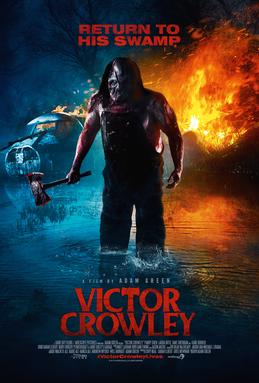
The TSL’s Horror Grindhouse: Victor Crowley (dir by Adam Green)


“Hey, did I mention that I recently watched Victor Crowley as a part of the Last Drive-In on Shudder?”

“Who’s Victor Crowley?”

“It’s a movie! About a killer named …. well, Victor Crowley. He’s played by Kane Hodder and he kills people in the swamp in various gruesome ways.”

“Oh, is that the guy from the Hatchet films?”

“Yes, the same.”

“And aren’t those the slasher films that are really bad but you’re not supposed to care because they wink at the audience and acknowledge that the suck?”

“Yep, exactly. Victor Crowley is the latest installment in the Hatchet series. It came out in 2017. An airplane crashes in a swamp. All of the passengers are in some way connected to the previous Hatchet films. Victor kills them all one-by-one.”

“Was it any good?”

“I personally didn’t care much for it.”

“What as wrong with it?”

“It took forever for the action to actually get going and the humor often felt forced, even by the standards of the Hatchet films. Some of the deaths were creative but since the characters were all pretty much just cardboard figures, it was hard to really care about it. Kane Hodder was an imposing killer, though. He’s definitely the best thing about the film.”

“I like Kane Hodder.”

“Me too. It’s funny. He’s always killing people but he seems like such a nice guy in real life. To be honet, the best thing about watching Victor Crowley on The Last Drive-In was that Joe Bob Briggs would interrupt every few minutes and share his thoughts on the film. Joe Bob, I should mention, liked the film far more than I did.”

“So, do you or do you not recommend Victor Crowley?”

“Well, it’s funny. I didn’t like it but I can understand why some people do like it. Because it’s over-the-top and intentionally silly and it doesn’t make any apologies for being what it is. It’s kind of like the slasher version of a good Lifetime film. So, I can’t really sit here and totally trash the film. It wasn’t for me but if you’re a fan of the Hatchet movies, it’ll give you exactly what you’re expecting — i.e., blood, humor, and Kane Hodder ripping off Felissa Rose’s arm.”

“So, you’re recommending the film?”

“To fans of the Hatchet series, yes.”

“I hope they enjoy it.”

“Me too. Isn’t that what life’s all about?”

Horror Film Review: The Crazies (dir by George Romero)


Ah, The Crazies.  The original Crazies.

This 1973 film is one of George Romero’s best non-Dead films, though it never seems to get the respect that it really deserves.  Even today, the original is often overlooked in favor of the remake.  And don’t get me wrong — the remake of The Crazies is good and it features several effective jump scares.  But the remake is a slick Hollywood film and, watching it, you always have the safety of knowing that you’re watching a slick Hollywood film.  The original, though, is rough and low-budget and it looks and it feels real.  As a result, it sticks with you long after the haunting final scenes.

The storyline is simple but effective.  People in a small Pennsylvania town are going crazy and murdering each other.  Usually, it’s impossible to tell who is infected until they’re already attacking you.  The infected are just like the zombies from Night of the Living Dead with one key difference.  The crazies may be as relentless as the Dead but they’re also human beings.  They think.  They plan.  They scheme.  And when they die, they die like humans and we’re reminded that, just a few short hours ago, they were friendly and, more or less, harmless.

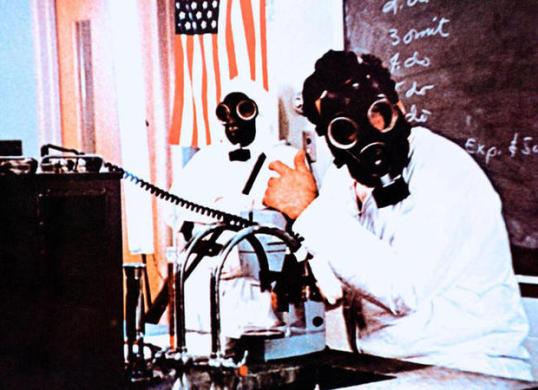
The government, of course, shows up in the town and tries to contain the outbreak.  The main image that most people will carry away from The Crazies is of men in white hazmat suits, walking through small-town America and killing almost everyone they see.  As is typical for a Romero film, the so-called solution often seems to be worse than the problem.  We also get the typical conflict between the scientists and the military.  The  military wants to destroy the infected.  The scientists want to cure them.  The film is bleakly cynical as the one man who knows how to cure the disease is ignored and finally killed in a stampede of quarantined citizens.

The film follows six people as they attempt to escape from the town and avoid getting sick themselves.  Needless to say, it’s not as easy as it sounds.  The characters who everyone seems to remember are Artie (Richard Liberty) and his daughter, Kathy (Lynn Lowry).  What happens to them is perhaps the most disturbing moment in a film that’s full of them.  The other members of the group can only hope to survive, even as they slowly lose their grip on sanity.

It’s a disturbing film, precisely because it’s not slick.  The actors are not movie star handsome and the attacks are not perfectly choreographed.  The grainy cinematography gives the entire film a documentary feel and serves as a reminder that Romero made industrial films before he revolutionized the horror genre.  The Crazies works because it feel like it could be happening in your community or your back yard.  And, ultimately, it offers up no solution.  Mankind could save itself, Romero seems to be saying, if only mankind wasn’t so stupid.

Needlessly to say, a film as bleak as The Crazies was not a hit in 1973.  But it’s lived on and continued to influence other horror makers.  It’s one of Romero’s best.

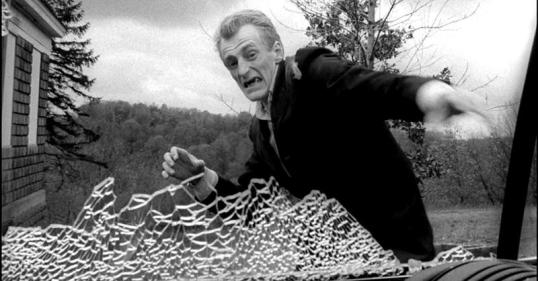
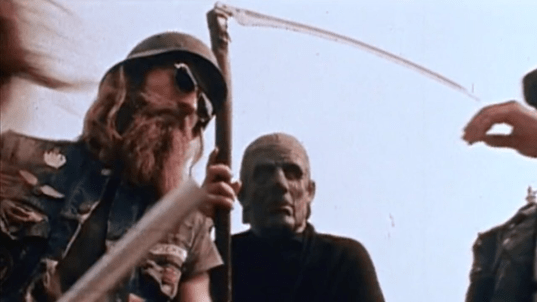
4 Shots From 4 George Romero Films: Night of the Living Dead, The Amusement Park, The Crazies, Day of the Dead


4 Shots From 4 Films is just what it says it is, 4 shots from 4 of our favorite films. As opposed to the reviews and recaps that we usually post, 4 Shots From 4 Films lets the visuals do the talking.

This October, we’ve been using 4 Shots from 4 Films to pay tribute to some of our favorite horror filmmakers!  Today, we honor the father of modern horror, George Romero!

4 Shots From 4 George Romero Films

Night of the Living Dead (1968, dir by George Romero)

The Amusement Park (1973, dir by George Romero)

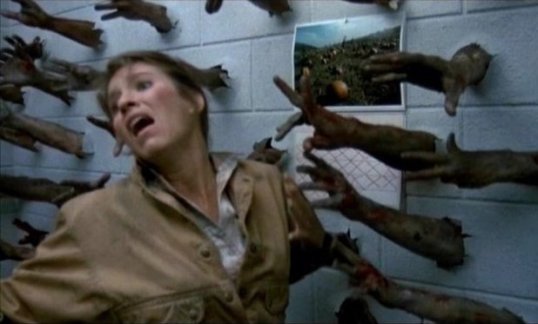
The Crazies (1973, dir by George Romero)

Day of the Dead (1985, dir by George Romero)


Horror Film Review: Eye of the Devil (dir by J. Lee Thompson)


If you thought Bohemian Rhapsody was overedited, you wait until you see the 1966 British horror flick, Eye of the Devil.

Seriously, I lost track of average number of of cuts that were used in each scene.  It was like, “There’s Deborah Kerr!  There’s Deborah Kerr from another angle!  There’s Donald Pleasence staring at something!  There’s David Hemmings in a corner.  There’s Deborah Kerr again!  There’s an overhead shot of the entire room!  Hemmings again, staring off to the left.  Now, a different shot of Hemmings staring off to the right.  Pleasence!  Kerr!  Hemmings!  There’s Sharon Tate, was she there the whole time?  Another overhead shot.”  All in five minutes.

Now, I will admit that the frantic editing style was a bit more effective in Eye of the Devil than in Bohemian Rhapsody, if just because Eye of the Devil was meant to be a bit of a filmed dream.  The whole movie was set up to be a surreal journey into the heart of French darkness so the disorientating visual style was effective, even if it did kind of give me a headache while I was watching it.

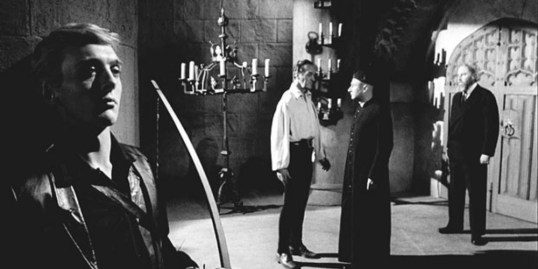
In the film, Deborah Kerr play Catherine, who is the wife of Philippe (David Niven), who owns a vineyard and who is perfectly charming and David Niven-like until he returns to the vineyard.  Then he suddenly becomes withdrawn and cold.  It turns out that the vineyard is struggling a bit.  It’s the dry season, which I guess is a bad thing when you’re making wine.  While Philippe tries to keep morale up among the peasants, two siblings — Christian (David Hemmings) and Odile (Sharon Tate) — wander around the castle.  Christian carries a bow and arrow and seems to be kind of arrogant.  Odile smiles enigmatically and turns frogs into doves.  Meanwhile, Donald Pleasence plays the vineyard priest, who appears to believe that something drastic needs to be done to reverse the dry season.

Soon, Catherine is stumbling across strange ceremonies and discovering that no one seems to care about her concerns that Christian and Odile are going to be a bad influence on the children.  She’s especially upset when Christian points an arrow at her.  Philippe, meanwhile, just laughs off her concerns.  Obviously, it was just a joke! he says.

Eye of the Devil is about as enjoyably pretentious as a British film from 1966 can be.  It’s not just that the movie is edited to the point of chaos.  It’s also that characters have a bad habit of going off on discussions about relationship between magic and reality.  And yet, it’s so pretentious and so silly and so overdirected that you can’t help but love it.  It’s just such a film of its era that it’s impossible not to get something out of it.  Add to that, Sharon Tate and David Hemmings share an otherworldly beauty as the two siblings.  Deborah Kerr shows that she could make even the silliest of situations of compelling.  David Niven is surprisingly effective as a non-charming character.  And then you’ve got Donald Pleasence, making enigmatic statements and showing off the intense stare that would later make Dr. Sam Loomis an icon of horror.

Eye of the Devil may be a mess but it’s a beautiful mess.

Horror on the Lens: Night of the Living Dead (dir by George Romero)


Happy Halloween everyone!

Well, as another horrorthon draws to a close, it’s time for another Shattered Lens tradition!  Every Halloween, we share one of the greatest and most iconic horror films ever made.  For your Halloween enjoyment, here is George Romero’s Night of the Living Dead!

(Be sure to read Arleigh’s equally famous review!)

Here’s The Trailer For Smiley Face Killers!


Okay, everyone — one last trailer before calling it a night.

There’s currently a conspiracy theory out there that states that, since the late 80s, a cult has been murdering athletic, drunk college students and dumping their bodies in rivers.  Supposedly, the cult’s calling card is that they paint a smiley face near every crime scene.

It’s a bullshit theory that makes absolutely no sense.  The truth of the matter is that frat boys binge drink and are therefore vulnerable to stumbling into rivers, lakes, and creeks.  It’s sad but that’s just the truth of the matter.  As for the smiley faces — well, there are smiley faces everywhere.  And seriously, if you’re a cult killing people in secret, why would you give away your existence with a smiley face?  It’s really a dumb theory so, of course, there are a lot of people who believe it.  Dr. Phil even did a show about it.

Anyway, it appears that the theory has inspired a film.  Below is the trailer for Smiley Face Killers, which will be released on December 4th.  Just in time for Oscar consideration!