Film Review: Detective Knight: Rogue (dir by Edward Drake)


Once upon a time, Casey Rhodes (Beau Mirchoff) was a football star.  He was a quarterback.  Everyone expected great things from him.  He was going to be the next Tom Brady.  But then a knee injury took him out of the game and a subsequent drug addiction took him out of mainstream society.  Now, Casey makes his living pulling off robberies.  He may be a criminal but he’s not a bad-hearted one.  He may carry a gun but he tries not to shoot anyone who doesn’t shoot at him first.  Working with him are a former baseball player named Mike (Trevor Getzky) and Nikki (Keeya King), who is the smartest member of the crew.

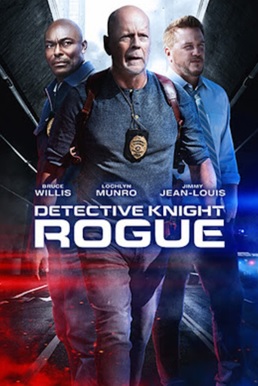
Despite Casey’s attempts to do his job with as little violence as possible, a gunfight does break out during one robbery in Los Angeles.  When Detectives James Knight (Bruce Willis) and his partner, Eric Fitzgerald (Lochlyn Munro), interrupt the robbery, Fitzgerald ends up getting shot multiple times as Casey and his crew make their escape.  With Fitzgerald in the hospital, Knight decides to follow the crew to New York and take out both them and their boss, a former Internal Affairs officer named Winna (Michael Eklund).  It turns out that there’s a history between Knight and Winna.  Knight wants his revenge on Winna but, at the same time, Winna knows some dark secrets from Knight’s past.

Though it works as a stand-alone film, 2022’s Detective Knight: Rogue is actually the first part of a trilogy that follows the adventures of Detective Knight.  (Detective Knight: Redemption was released at the end of 2022 while Detective Knight: Independence came out last month.)  The Detective Knight films were among the last of the movies in which Bruce Willis appeared before announcing his retirement.  It can be strange to watch Willis’s final films, knowing what we know about what he was going through at the time that he made them.  Though he’s definitely the star of the film, Willis is used sparingly in Detective Knight: Rogue and there’s little of the cocky attitude that we tend to associate with Willis’s best roles.  Instead, he’s a grim avenger, determined to get justice for both his partner and himself.  Willis is convincing in the role, even if the film is edited in such a way that the viewer gets the feeling that a stand-in may have been used for some of the long-shots involving Detective Knight.  That said, Willis still looks convincing carrying a badge and a gun and it’s nice to see a Willis film where he’s again playing a hero instead of a villain.

As the football player-turned-thief, Beau Mirchoff gets more screentime than Willis but, fortunately, Casey is an interesting character and Mirchoff gives a strong performance as a criminal who would rather be a family man and who is desperately looking for a way to make up for the mistakes of his past.  Towards the end of the film, he does a flawless job delivering a surprisingly well-written monologue about how he went from being a football star to being a common thief.  Mirchoff’s strong performance adds a good deal of ambiguity to the film.  The criminals aren’t necessarily that bad at heart and, as we learn, the good guys haven’t always been angels in the past.  Detective Knight: Rogue becomes more than just another low-budget thriller.  It becomes a meditation of regret and redemption.

Detective Knight: Rogue took me by surprise.  As directed by Edward Drake (who was also responsible for another effective late Bruce Willis starrer, Gasoline Alley), it’s an intelligent thriller and it’s one that pays tribute to Bruce Willis as an action icon.  It’s proof that a good story can sometimes be found where you least expect it.

Live Tweet Alert: Watch Absentia with #ScarySocial


As some of our regular readers undoubtedly know, I am involved in a few weekly live tweets on twitter.  I host #FridayNightFlix every Friday, I co-host #ScarySocial on Saturday, and I am one of the five hosts of #MondayActionMovie!  Every week, we get together.  We watch a movie.  We tweet our way through it.

Tonight, for #ScarySocial, ArtAttackNYC will be hosting 2011’s Absentia!

If you want to join us on Saturday night, just hop onto twitter, start the film at 9 pm et, and use the #ScarySocial hashtag!  The film is available on Prime.  I’ll be there co-hosting and I imagine some other members of the TSL Crew will be there as well.  It’s a friendly group and welcoming of newcomers so don’t be shy.


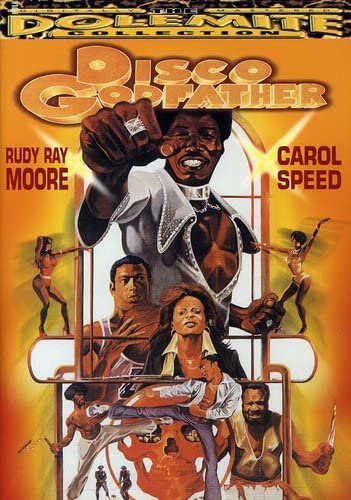
The TSL’s Grindhouse: Disco Godfather (dir by J. Robert Wagoner)


“Put your weight on it!” Tyrone Williams (Rudy Ray Moore) shouts at the start of 1979’s Disco Godfather.  It’s a phrase that he regularly employs as he encourages everyone at the local disco to hit the dance floor and show off their moves.  All Tyrone has to do to get people to dance is to shout out his catch phrase.  He’s such a beloved figure in the community that most people just call him, “Godfather.”

The Godfather is the uncle of Bucky Williams (Julius Carry), a promising young basketball star who seems to have his entire future ahead of him.  However, what the Godfather doesn’t know is that Bucky has fallen in with the wrong crowd and they’ve been pushing him to smoke …. ANGEL DUST!  Bucky’s girlfriend tries to warn him that he’s been smoking too much of “the whack” but Bucky doesn’t heed her warning.  Suddenly, Bucky is in the middle of the dance floor, freaking out as he imagines being attacked by zombie basketball players and a sword-wielding witch.  He also sees the Disco Godfather, telling him to calm down, but suddenly the Godfather is transformed into a skeleton!

After Bucky is subdued and taken down to the local PCP recovery center (which is full of users who are all screaming, rolling around on the floor, and generally acting whacked out), the Godfather decides that he can no longer stand by while his community is victimized by the PCP dealers.  With the help of Noel (Carol Speed), the Godfather starts a group called Angels Against Dust and starts a campaign to “attack the whack!”  While the Godfather tracks down the dealers, Noel holds a rally where, at one point, she announces that everyone is going to have to come together and “whack the attack.”

The fact that this obviously flubbed line was included in the final film tells you much about what makes Disco Godfather such an interesting viewing experience.  The film was shot very quickly and with very little money and, as such, second takes were a luxury that the film couldn’t afford.  However, there’s also an undeniable charm to the film’s low-budget style.  It’s amateurish but it’s amateurish in the most likable way possible.  Even in the case of the “whack the attack” line, it’s hard not to appreciate that Carol Speed didn’t let that one flub stop her from giving the rest of her speech.  By that same token, it’s also hard not appreciate that, later in the film, a never-before-seen character suddenly helps the Godfather fight off a bunch of pushers.  This character was played by Moore’s karate instructor and his appearance is totally random and yet totally appropriate.  In the world of Disco Godfather, the chaotic plotting is the point.  The more random the film becomes, the more it suggests a universe ruled by chance and coincidence.  The total lack of logic starts to make sense.  Werner Herzog would probably love this film if he ever saw it.

Rudy Ray Moore, of course, was a famously raunchy comic who was best-known for playing Dolemite in three films.  However, Disco Godfather finds him in a bit more of a dramatic mood, as he tours the local PCP ward and tells everyone he meets that they have to “attack the whack,”  Compared to the Dolemite films, there’s considerably less sex and profanity to be found in Disco Godfather.  There are several fight scenes and Rudy Ray Moore gets to show off his karate moves but the violence is never as over the top as it was in Dolemite.  The problem, however, is that Rudy Ray Moore was a natural-born comic and, as a result, every line that he utters, regardless of how serious the topic, sounds like its building up to a punchline.  Moore gets to do some dramatic acting at the end of the film, when the Godfather is himself force fed the whack and he starts to hallucinate various disturbing images.  “That’s not right, mama!” the Godfather says at one point and indeed, the trip sequence is the strongest part of the film, a genuinely surreal trip into the subconscious of a man who just wanted to encourage people to dance.

Disco Godfather is one of those films that you just have to see.  When Disco Godfather isn’t learning about PCP, he’s telling everyone to “put your weight on it” and, as a result, this film not only features a lot of anti-drug hysteria but it also features a lot of dancing.  This is very much a film of its time.  In one the film’s few deliberately funny moments, the album cover for the Saturday Night Fever soundtrack is seen covered in cocaine.  Of course, the Disco Godfather doesn’t need cocaine to have a good time and he certainly doesn’t need the whack.  He just needs the music and people willing to put their weight on it.

Disco Godfather was not a box office success when it was originally released, with Moore later saying that he made a mistake by toning down his persona for the film.  Moore was probably correct but, seen today, Disco Godfather is an enchantingly berserk time capsule.  Watch it and then be sure to watch Eddie Murphy play Rudy Ray Moore in the Netflix biopic, Dolemite Is My Name.

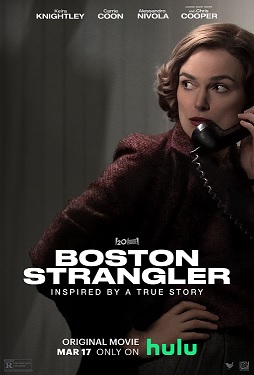
Film Review: Boston Strangler (dir by Matt Ruskin)


In the Boston of the early 1960s, Loretta McLaughlin (Keira Knightley) is a reporter for the Boston Record American.  Loretta is frustrated with a newsroom that is dominated by a boys club of aging, overweight, sexist old timers.  When she thinks that she’s discovered that there is a murderer targeting and strangling elderly women in Boston, she goes to her editor, Jack Maclaine (Chris Cooper), and asks to be allowed to write up a story about her suspicions.  Jack would prefer that Loretta write a story about the new toaster that’s been released by Sunbeam.

So, Loretta does some investigating on her own and she discovers that the police suspect that all of the recent murders are being committed by one man.  The story that she writes ends up on the front page and it even leads to her sharing a sip of whatever alcohol Jack has in his flask.  The Boston police initially deny Loretta’s story and it looks like Loretta is going to spend the rest of her career reviewing kitchen appliances.  But then the police just as suddenly confirm Loretta’s story and Loretta is back on the Strangler beat.  She’s partnered with a veteran reporter named Jean Cole (Carrie Coon).

Together, Loretta and Jean battle sexism while investigating not just the Strangler but also the police department’s incompetence.  Their reporting makes them local celebrities, with many people coming to them with the leads that the police couldn’t be bothered to follow up on.  Despite Jean’s warnings about getting too involved with the case, Loretta obsesses over the Strangler’s crimes.  Could the murderer be Daniel Marsh (Ryan Winkles), the boyfriend of one of the victim’s?  Could it be George Nassar (Greg Vrostros), a criminal who reportedly has a genius IQ?  Or could it be Albert DeSalvo (David Dastmalchian), the man who confesses to the crimes under the condition that his confession cannot be used in court and the belief that his family will be sent the reward money that would otherwise go to someone who helped the police to catch the Boston Strangler?  DeSalvo, who was given a life sentence for a series of rapes that he committed before and after the murders began, is never convicted of any of the murders but, with his confession, the murders are declared to be solved.  But are they?  Loretta is not so sure.

Boston Strangler is not the first film to be made about the murders but I think that it might be the first to seriously explore the theory that DeSalvo was lying when he confessed to the majority of the murders.  (As the film points out, DeSalvo’s cellmate just happened to be the same George Nassar who was also a suspect in the murders.)  1968’s The Boston Strangler, for instance, explained away the inconsistencies in DeSalvo’s confessions by suggesting the DeSalvo suffered from dissociative identity disorder and that DeSalvo himself didn’t understand what he was doing.  This latest version of the story, however, presents DeSalvo as being a streetwise, lifelong criminal who confessed because his lawyer, F. Lee Bailey, convinced him that he would get a book deal and that he would be sent to a mental hospital as opposed to a prison.  A title card at the end of the film informs us that DNA testing has confirmed that DeSalvo committed one of the 13 murders to which he confessed but that the other 12 murders remain unsolved.  While one might wonder why anyone would confess to a murder that they didn’t actually commit, it’s actually something that has happened on more than a few occasions.  Typically, the false confession will come from someone who, like DeSalvo, is already looking at a life sentence and who has nothing to lose by helping the police close the book on some unsolved crimes.  The confessor gets a little extra notoriety and maybe some special treatment and the cops get to increase their clearance rate.  In Boston Strangler, it’s suggested that DeSalvo’s confession was accepted because everyone wanted the crimes and the fear that went with them to just magically go away.

It’s an intriguing theory and one that has more evidence to back it up than the majority of conspiracy theories that one comes across online.  Unfortunately, Boston Strangler really doesn’t do the story much justice because it focuses on the least interesting part of it.  We don’t learn much about the investigation, DeSalvo, or the lives of the Strangler’s victims.  Instead, the film gets bogged down with newsroom politics, as Loretta demands to be taken seriously and Jean offers advice on how to play the political game.  Every journalism cliché is present, from the crotchety old editor to the afterwork bar to the publisher who doesn’t want to upset the city’s power brokers.  Admittedly, when it comes to journalists, there’s probably a good deal of truth to be found in all of those clichés but the film still leans a bit too heavily into them.  Every time we see Chris Cooper looking at the front page and taking a sip from his flask, we’re reminded that we’ve seen the exact same scene in a hundred other movies about newspapers.

As directed by Matt Ruskin, Boston Strangler has the washed-out, shadowy look that David Fincher used to good effect in Zodiac. The difference is that, in Zodiac, the shadows created a feeling of an all-enveloping evil slowly consuming the world.  Zodiac’s visual style felt as if it was showing the viewer a true picture of the heart of darkness.  In Boston Strangler, the visual style just leads the viewer to suspect that the director watched Zodiac before filming.  The film’s visuals are so washed-out that it actually becomes a bit boring to look at.  This is the rare film that makes Boston seem bland.  Interestingly, when the action briefly moves to Michigan, the visuals suddenly become much more colorful and interesting.  Perhaps by design, there’s a vibrancy to the Michigan scenes that is missing from the rest of the film.  Unfortunately, those Michigan scenes are very brief.

The cast is full of talent but the majority of the performers are let down by a script that doesn’t allow anyone to have more than one or two personality traits.  Keira Knightley speaks with a convincing Boston accent and has a few good scenes in which she shows that Loretta is coming to understand the true horror of the story she’s covering but the script itself doesn’t allow Loretta to have much of a personality beyond being outraged.  Carrie Coon, cast as potentially the most interesting character in the film, also feels underused.  As for Chris Cooper, he glowers with the best of them but the film can’t figure out much to do with him beyond having him drink from his flask.

There’s an interesting moment in the film in which it is suggested that DeSalvo built a false confession out of the details that he came across in Loretta and Jean’s stories about the crimes.  It’s a moment that suggests that the media itself has some culpability when it comes to the crimes of men like Albert DeSalvo and whoever else may or may not have been strangling women in 1960s Boston.  It’s perhaps the most honest moment of the film but it’s also a moment that’s not followed up on.  That’s a shame because it suggests the movie that Boston Strangler could have been if it hadn’t gotten so bogged down with all the journalism film clichés.  (Again, I would mention Zodiac as the prime example of how to do this type of film effectively.)  Boston Strangler hints at the bigger story but it never really goes far beneath the surface.
Scenes That I Love: Kurt Russell Kicks Elvis


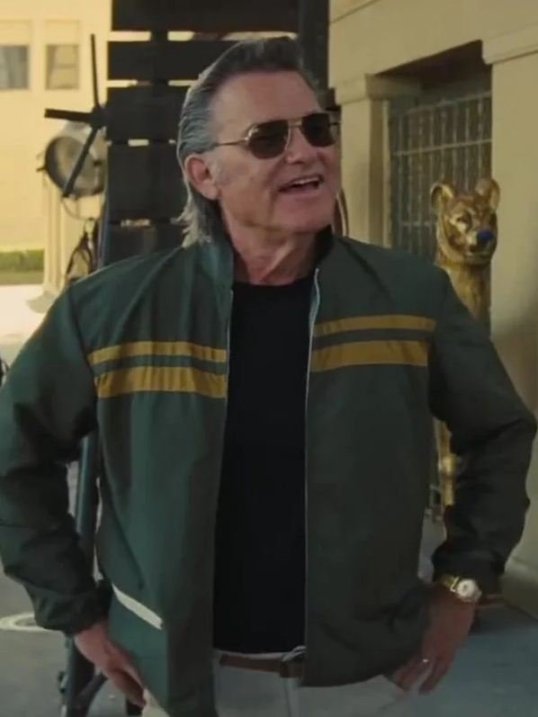
Today, the Shattered Lens wishes a happy birthday to one of our favorite actors, Kurt Russell!

Here’s Kurt, at the age of 11, making his film debut and kicking Elvis Presley in 1963’s It Happened At The World’s Fair!  Reportedly, they had to do fifteen takes of this scene so Kurt got to kick Elvis a lot.

Later, of course, Kurt Russell would become one of the first actors to play Elvis when he starred in John Carpenter’s 1979 film of the same name.  Carpenter was so impressed with Russell’s performance that he went on to cast Kurt in Escape From New York and The Thing.  Kurt would also go on to provide the voice of Elvis in the 1994 Best Picture winner, Forrest Gump.

Live Tweet Alert: Join #FridayNightFlix for Raiders of the Lost Ark!


As some of our regular readers undoubtedly know, I am involved in a few weekly live tweets on twitter.  I host #FridayNightFlix every Friday, I co-host #ScarySocial on Saturday, and I am one of the five hosts of #MondayActionMovie!  Every week, we get together.  We watch a movie.  We tweet our way through it.

Tonight, at 10 pm et, #FridayNightFlix has got 1981’s Raiders of the Lost Ark!

Oh Heck yeah!  It belongs in a museum! 

If you want to join us this Friday, just hop onto twitter, start the movie at 10 pm et, and use the #FridayNightFlix hashtag!  It’s a friendly group and welcoming of newcomers so don’t be shy.

Raiders of the Lost Ark is available on Prime and Paramount Plus!  See you there!


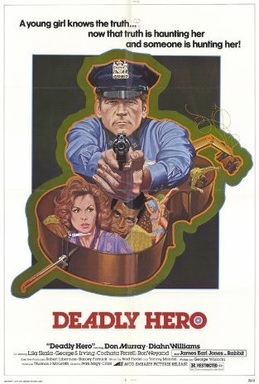
Film Review: Deadly Hero (dir by Ivan Nagy)


First released in 1975, Deadly Hero tells the story of Edward Lacy (Don Murray).

Lacy is an 18-year veteran of the New York Police Department and a proud family man.  Lacy is clean-cut, handsome in a blandly pleasant way, and he has a wife and several children.  He’s a member of the Knights of Columbus and there are times when he imagines himself pursuing a career in politics.  One of the first things that we see Lacy do is introduce an anti-crime mayoral candidate named Reilly (George S. Irving) at a Knights of Columbus rally.  Lacy goes out of his way to make sure that he and his family make a good impression but Reilly barely seems to notice him.

Lacy is also a racist who enjoys pulling and using his gun.  He was once a detective but a long string of brutality complaints has led to him being demoted back down to being a patrolman.  He and his partner (Treat Williams, making his film debut) spend their time patrolling the streets of New York City, getting dirty looks and verbal abuse from the people who they are supposed to be protecting.  Much like Travis Bickle in the following year’s Taxi Driver, Lacy obsesses on the crime and the decay that he sees all around him.

Sally (Diahn Williams) lives a life that is a hundred times different from Lacy’s.  She’s a cellist and a conductor.  She spends her days teaching and her nights conducting at an avant-garde theater.  Sally and Lacy have little in common but their lives become intertwined when Sally is attacked and briefly held hostage by a mentally disturbed mugger named Rabbit (James Earl Jones).  Responding to a call put in by Sally’s neighbor (Lila Skala), Lacy discovers Rabbit holding a knife to Sally’s throat in the hallway of Sally’s apartment building.  At first, Lacy handles the situation calmly and he manages to talk Rabbit into not only releasing Sally but also dropping his knife.  However, instead of arresting the now unarmed and docile Rabbit, Lacy shoots and kills him.

Knowing that he’s about to be investigated and that he’s made enemies in the department due to his political activities, Lacy convinces the still-shocked Sally to lie and say that she witnessed Rabbit lunging for Lacy’s gun before Lacy fired.  Lacy is proclaimed a hero and soon, Reilly is inviting him to appear at rallies with him.  Lacy’s political dreams seem to be coming true but Sally starts to feel guilty about lying.  Realizing that Sally is planning on revealing the truth about what happened, Lacy goes to extreme measures to try to keep her quiet.

Deadly Hero is an interesting film, one that is certainly flawed but which ultimately works as a portrait of the authoritarian mindset.  Ivan Nagy directs without much visual flair and, especially at the start of the film, he struggles to maintain a consistent pace.  For instance, the scene where Rabbit initially menaces Sally seems to go on forever, long beyond whatever was necessary to convince the audience that Rabbit was a dangerous guy.  (With the amount of time that Nagy lingers over shots of Sally being menaced by Rabbit, I was not surprised to read that Nagy and Dianh Williams apparently did not get along during filming.)  That said, the film’s low budget actually works to its advantage, with the grainy cinematography giving the film a gritty, documentary feel.  The film was shot on location in New York City and it’s interesting to watch the actors interact with real New Yorkers.  While Lacy is never a sympathetic character, seeing the actual streets of New York does go a long way to explaining why he’s so paranoid.  This is one of the many 70s films in which the overriding message seemed to be that New York City was the worst place on the planet.

The film is dominated by Don Murray, who plays Lacy as being a blue-collar fascist who has learned how to hide his anger and his hatred behind a quick smile and an outwardly friendly manner.  Feeling confident that everyone will back him up, he has no hesitation about executing an unarmed black man.  Even when it becomes obvious that Sally is not going to continue to lie about what happened, Lacy is still arrogant enough to assume that he can charm her into changing her mind.  When that doesn’t work, Lacy becomes increasingly unhinged and vindictive.  The film’s final ambiguous image suggests that there really is no way to escape the Edward Lacys of the world.

With its portrayal of a violent cop who is convinced that he will be protected by the system, Deadly Hero feels extremely relevant today.  Of course, Deadly Hero also suggests that the same system that Lacy is exploiting can be used to take him down, with Lacy eventually being investigated by both Internal Affairs and the District Attorney’s office.  The film leaves it ambiguous as to whether or not the rest of the police are as dangerous as Lacy.  Is Lacy a product of the system or is he just someone who has figured out how to exploit the system?  To its detriment, that’s a question that the film doesn’t answer.  Still, much like Harvey Hart’s similarly underappreciated Shoot, Deadly Hero is an always-interesting and occasionally insightful look at the authoritarian mindset.

Film Review: Luther: The Fallen Sun (dir by Jamie Payne)


A serial killer (Andy Serkis) is terrorizing London.

With the help of a worldwide network of hackers, the Killer is able to spy on random people and catch them doing and saying things online that they wouldn’t want their friends, families, and coworkers to find out about.  The Killer than blackmails his targets, forcing them into committing bigger and bigger crimes for him.  The Killer pushes his victims to their limits and then he arranges for them to die.  Sometimes, he kills them.  Sometimes, he forced them to kill themselves.  The Killer is a smirking sadist, a force of chaos who is empowered by the isolation and loneliness of the modern world.

The Killer’s latest victim is a young cleaner who disappears on a rainy night.  Assigned to the case is DCI John Luther (Idris Elba), a detective who is famous for both his brilliance and his determination.  Luther promises the missing cleaner’s mother (Hattie Morahan, giving a poignant performance in a small but important role) that he will find her son.  The Killer is frustrated to discover that Luther doesn’t spend much time online and, hence, cannot be blackmailed.  However, the Killer’s associates discover that Luther has frequently broken the law in order to catch criminals.  When this information is released to the press, Luther is not only kicked off the force but he also ends up in prison.  All of his fellow prisoners want to kill him.  The police view him as being a disgrace.  Luther has very few allies left in the world but he’s determined to keep the promise that he made to the cleaner’s mother.  When the Killer himself starts to send taunting messages to Luther, Luther decides that his only option is escape from prison and bring the Killer to justice himself.

Luther: The Fallen Sun is a follow-up to the BBC television series, which followed Luther as he worked for London’s Metropolitan Police Service and as he struggled with his own personal demons.  The film begins by bringing Luther’s career as a police detective to a close but it also ends with the suggestion of new career path for John Luther.  In between, we watch as Luther chases the Killer through London and eventually across Europe.  Sometimes opposing  him and sometimes helping him is his former boss, Martin Schenk (Dermot Crowley), and his replacement, DCI Odette Raine (Cynthia Erivo).

Luther: The Fallen Sun is at its best when the action is centered on Luther searching for the Killer in London.  A confrontation between the two in Piccadilly Circus is especially well-done and it leads to genuinely exciting chase through the London Underground.  Idris Elba displays both his fierce intelligence and his exciting physicality, while also doing a good job of suggesting that Luther is always just a frustration or two away from mentally snapping.  Elba is entertaining to watch, a perfect hero for these chaotic times.  Andy Serkis, meanwhile, plays the Killer without a hint of subtlety but that approach works for the character.  The Killer is someone who is evil because he enjoys it.  And, throughout the majority of this film, the Killer really does seem to be having the time of his life.

The film gets off to a good start, with plenty of action and atmosphere.  (This is one of those films where nothing happens unless it’s also raining.)  The aerial shots of London capture a certain neon grandeur that suggests a city that is in the process of transitioning into a brightly lit dystopia.  Serkis’s crimes are genuinely disturbing, with a scene involving a burning building feeling nightmarish in its intensity.  Unfortunately, the film loses its way a bit when the action moves away from England and into Europe.  The more that is revealed about Serkis’s plans, the less sense they make and the more the viewer is forced to suspend their disbelief.  In the end, the film’s third act feels as if it belongs in a totally different movie from everything that came before it.

That said, the mystery is still an intriguing one and Luther: The Fallen Sun actually does have something relevant to say about the illusion of privacy in our extremely online world.  One of the better scenes features hundreds of hackers, all sitting at their cubicles and watching as random people across the world go about their lives.  (“Potential target,” one hacker types.)  Andy Serkis is appropriately creepy and Idris Elba shows off the tough but sensitive screen presence that made him a star.  Luther: The Fallen Sun serves as both an effective continuation of the show and, for the viewers who may be meeting him for the first time, an intriguing introduction to John Luther.

A Blast From The Past: The Holy Roman Empire


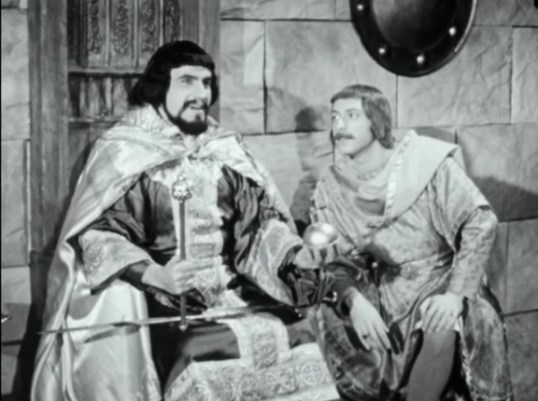
It may seem strange to celebrate the Ides of March by sharing an educational film about The Holy Roman Empire, seeing as how it was famous for being neither holy nor Roman nor an Empire.  But then again, the fact that the name “Roman Empire” was still being appropriated into the 19th century shows you just how powerful a hold the Roman Empire had over people’s imaginations.  Everyone wanted to be Roman and everyone wanted to be a part of an empire.  Of course, there would have been no Roman Empire if not for the Ides of March.

Add to that, this 1961 film features not only a teacher but also historical reenactments.  I love cheap looking historical reenactments!

Here, for your educational viewing, is a blast from the past.  From 1961, it’s a look at The Holy Roman Empire!

The Eric Roberts Collection: Road to the Open (dir by Cole Claassen)


In 2014’s Road to the Open, Eric Roberts and John Schneider play, respectively, Tim and Rob Gollant.

The Gollant brothers are wealthy, smug, and athletic.  At the local country club, they’re not only the best golf players but also the best tennis players.  They’re the type who taunt their opponents while they’re losing.  No one really likes the Gollant brothers but people put up with them because the Gollant brothers are extremely rich.  When they tell you to get off of their bench at the club, it’s because it really is their bench.  Their names are literally on the bench.

The Gollant Brothers aren’t exactly likeable but they are fun to watch, specifically because they’re played by John Schneider and Eric Roberts.  Roberts and Schneider give perfect performances as two men who have never actually had to grow up.  They’re the type of overage high school bullies who wouldn’t stand a chance in the real world but who, fortunately, can spend all of their time hiding out at their country club.

Of course, the Gollants are not the heroes of Road to the Open.  Instead, they’re the obstacle standing in the way of Jerry McDonald (Troy McKay) and Miles Worth (Philip DeVova).  Jerry and Miles are lifelong friends who enjoy playing tennis together.  Overweight, balding, and mild-mannered, Jerry is not a typical athlete and he knows it.  Haunted by the death of his wife and raising his daughter on his own, Jerry doesn’t so much fear losing as much as he fears letting everyone down.  Miles, meanwhile, is a typical athlete, right down to the anger management issues.  Fortunately, Miles has been seeing a somewhat eccentric therapist (Judd Nelson) and he may have finally learned how to control his temper.

There’s a lot of tennis in Road to the Open but, ultimately, it’s about Jerry and Miles’s friendship and Jerry trying to find the strength to move on with his life.  Even though he meets and falls in love with Sam (Michelle Gunn), Jerry still feels as if he’s betraying the memory of his wife and, at times, he feels guilty for feeling any sort of happiness.  There’s a lot of comedy to be found in Road to the Open but, ultimately, this film is a heartfelt and rather sweet testament to friendship and love.  It’s also a well-acted film, with McKay, DeVova, and Gunn bringing a lot of likable energy to their roles.

I watched Road to the Open on Tubi.  It turned out to be a nice surprise.

Previous Eric Roberts Films That We Have Reviewed:

  1. Star 80 (1983)
  2. Blood Red (1989)
  3. The Ambulance (1990)
  4. The Lost Capone (1990)
  5. Love, Cheat, & Steal (1993)
  6. Love Is A Gun (1994)
  7. Sensation (1994)
  8. Doctor Who (1996)
  9. Most Wanted (1997)
  10. Mr. Brightside (2004)
  11. Six: The Mark Unleased (2004)
  12. Hey You (2006)
  13. In The Blink of an Eye (2009)
  14. The Expendables (2010) 
  15. Sharktopus (2010)
  16. Deadline (2012)
  17. Miss Atomic Bomb (2012)
  18. Lovelace (2013)
  19. Self-Storage (2013)
  20. Inherent Vice (2014)
  21. Rumors of War (2014)
  22. A Fatal Obsession (2015)
  23. Stalked By My Doctor (2015)
  24. Stalked By My Doctor: The Return (2016)
  25. The Wrong Roommate (2016)
  26. Stalked By My Doctor: Patient’s Revenge (2018)
  27. Monster Island (2019)
  28. Seven Deadly Sins (2019)
  29. Stalked By My Doctor: A Sleepwalker’s Nightmare (2019)
  30. The Wrong Mommy (2019)
  31. Her Deadly Groom (2020)
  32. Top Gunner (2020)
  33. Just What The Doctor Ordered (2021)
  34. Killer Advice (2021)
  35. The Poltergeist Diaries (2021)
  36. My Dinner With Eric (2022)