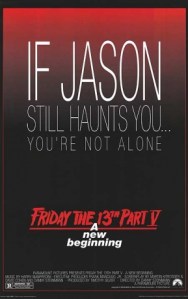
Film Review: Friday the 13th: A New Beginning (dir. by Danny Steinmann)


(Spoilers Ahead.  So there.)

So, imagine that you’ve got a huge film franchise that was built around one iconic character.  And guess what?  In the previous installment of your huge film franchise, that iconic character was killed so graphically that there’s no possible way that he could just pop up and go, “It was just a flesh wound.”  What do you do?

This is the problem that was facing Paramount Pictures when it came to making a fifth Friday the 13th film.  The previous installment made a lot of money but it also ended with Jason pretty decisively dead.  Paramount’s solution?   Friday the 13th without Jason.  Released (much like me) in 1985 and directed by Danny Steinmann, Friday the 13th: A New Beginning remains a controversial film among fans of the franchise.  A lot of people claim that it’s the worst installment.  Myself, I consider it to be one of the best.

Friday the 13th: A New Beginning opens (like many great B-movies) with a cemetery in the rain.  Wearing a yellow raincoat,   Tommy Jarvis (played in a cameo by Corey Feldman) approaches a grave that is marked “Jason Voorhees.”  Suddenly, two rather moronic gravediggers come running up.  While Tommy hides in the nearby bushes, the gravediggers dig Jason up.  “Yee-haw!” one of them shouts.

(I know this because I turned on the close captioning as I watched the film.  It’s one thing to hear the dialogue in a Friday the 13th film being spoken.  It’s another thing to see it actually written out at the bottom of your screen.)

Suddenly, Jason — complete with hockey mask and machete — pops out of the grave and kills the two grave robbers.  He walks over to where Tommy is hiding, lifts up his machete, and — suddenly, Tommy(now played by a brooding and sexy John Shepherd) wakes up!  It turns out that several years have passed and Tommy, after spending five years in a mental asylum, is now on his way to Pinehurst, a halfway house that just happens to be located in the Crystal Lake area.

A New Beginning has such a bad reputation that it’s often forgotten that this opening sequence is one of the few genuinely scary sequences to be found in the entire franchise.  Everything from the ominous dark skies to the lushly green bushes that Tommy hides in to the artful way the lightning storm is used to punctuate the sense of danger contributes to making this sequence feel very ominous and genuinely nightmarish.  It’s a bit shocking (yet undeniably effective) to go from the impressionistic lushness of Tommy’s dream to the rather harsh and grainy look of the rest of the film. 

(For those of you who are familiar with Italian horror, it almost feels like the dream was directed by Dario Argento while the rest of the film was done by Joe D’Amato.)  

Anyway, Tommy gets dropped off at Pinehurst where he meets the two liberal do-gooders who are in charge of the facility, Matt (Richard Young) and Pam (Melanie Kinnaman).   He also meets “Reggie the Reckless” (Shavar Ross), the bratty little grandson of Pinehurst’s cook, as well as the other residents of Pinehurst.  Pam and Matt inform Tommy that Pinehurst has no rules.  Or as they inform him, “It’s an honor system.”

It quickly becomes apparent that they might want to reconsider that honor system because not only do Eddie (John Robert Dixon) and Tina (DebbiSue Voorhees) get caught having sex on the neighbor’s property but Vic (played by Mark Venturini, who was all sexy and dangerous in his 2 minutes of screen time) ends up hacking the annoying Joey (Dominick Brascia) up into little pieces with an axe. 

(In Vic’s defense, he looked really good with an axe and Joey was really annoying.)

While Vic is whisked off to jail (Sadly, never to be seen again) two paramedics scoop up remains of Joey.  One of the paramedics — Roy (Dick Wieand) — stares at the body for a long time and doesn’t seem to find his coworkers jokes humorous.  Hmmm…wonder what’s up with that?

As tragic as the death of Joey is, it does lead to one of my favorite lines of all time when, the morning after the murders, the remaining residents of Pinehurst gather for breakfast and they notice that two extra places have been set for the dead Joey and the incarcerated Vic.  Stuttering Jake (Jerry Pavlon) exclaims, “You don’t set a place for a dead person!”  And you know what?  He’s right.

Soon, people all over town are getting murdered.  The guys who talks to himself while snorting cocaine (played, in a rather funny performance, by Bob DeSimone) gets an axe to the forehead.  The waitress (Rebecca Wood-Sharkey) who flashes her boobs at a mirror and goes, “It’s showtime!” gets murdered as she leaves work.  Two Jersey Shore wannabes are killed when their car stalls.  The Sheriff (Marco St. John) looks over one crime scene and says, “What the Hell’s going on here?”  Roy, standing behind him, says, “You talking to me, Sheriff?”  Hmmm…it’s odd how Roy keeps popping up in the movie for no reason…

The Mayor (played by Ric Mancini) confronts the Sheriff and demands to know who is killing everyone in town.  “Jason Voorhees,” the Sheriff slowly responds.  “Jason Voorhees is dead!  He was cremated” the Mayor screams as he empties on ashtray on the sheriff, “THIS IS JASON VOORHEES!”  This is probably my favorite scene in the entire movie because St. John underplays his entire role while Mancini overplays and delivers every line as if he’s in a community theater production of Lost in Yonkers.

That gets to the heart of what I really enjoy about A New Beginning — not only does this film have the largest body count of any film in the series, it also has the most genuinely eccentric cast of characters.  Absolutely nobody in this film behaves like a conventional human being.  It goes beyond just the normal odd slasher movie behavior.  Instead, watching this film is like peering into some sort of parallel universe where some minor shift in the Earth’s tilt has caused everyone to go a little crazy.  Probably the closest the film comes to a normal person is poor traumatized Tommy and he only says about ten lines in the entire film.  (That said, John Shepherd did a really good job and had a lot of presence of Tommy.  There’s an oddly eerie scene about halfway through the film where Tommy stares up at a neon sign and, as I looked at his face illuminated by the glowing blue of the sign, I realized that what I had always heard about good acting — that it all starts with expressive eyes — was true.) 

(In a perfect world, Tommy would have eventually ended up with Vi — played by Tiffany Helm — the new wave girl who spends almost the entire movie dancing in her room.  Seriously, they would have made a cute couple.)

Anyway, once our killer has gotten through killing random townspeople, he starts to kill off the residents at Pinehurst.  After taking part in one of the most explicit sex scene in the history of the franchise, Eddie and Tina are rather brutally killed off.  (That’s a shame because Voorhees and Dixon both had a really good and fun chemistry together and were both likable actors.  Unfortunately, their characters were sex-crazed and you know what that means…)  While Matt goes off to try to find the missing Eddie and Tina, Tommy, Pam, and Reggie go off to hang out with Reggie’s rather odd brother Demon (played by Miguel Nunez, Jr.) who wears more jewelry than I do and sings a duet with his girlfriend while he’s sitting on the most disgusting toilet in the history of film.  (Seriously, I had to look away…) 

Anyway, the remaining residents of Pinehurst are all killed by a seemingly resurrected Jason (however, Jake and Robin — played by Juliette Cummins —  do get to watch A Place In The Sun before they die so at least something good happened to them that night) and Pam ends up spending almost the entire rest of the movie running around in the rain and tripping in the mud whenever Jason shows up.  Jason eventually corners Pam, Tommy, and Reggie in a barn but then ends up falling out of a window and landing on some conveniently placed spikes.  Jason’s hockey mask falls off and — surprise! — it wasn’t Jason after all.  Instead, it was Roy, the weird Paramedic who kept showing up randomly and looking around kinda guilty-like whenever anyone mentioned anything about the murders.  Wow!

One of my favorite films book is Peter M. Bracke’s Crystal Lake Memories: The Complete History of Friday the 13th.  Taking on the series on a film-by-film basis, Crystal Lake Memories is a fascinating oral history that is full of all sorts of interesting behind-the-scenes facts.  Reading the chapter on Friday the 13th: A New Beginning, one is left with the impression that 1) everyone on the film was constantly snorting cocaine and 2) director Danny Steinmann is perhaps the most enigmatic figure in the history of the films.

In Crystal Lake Memories, depending on who is being interviewed, Danny Steinman comes across as either a maniac, a bully, or an underappreciated genius.  Quite a few people claim that Steinmann was out-of-control.  However, actress DebiSue Voorhees (who you would expect to have all sorts of unpleasant stories about the film since she’s the one who had to spend an entire shooting day laying on the ground naked in front of a bunch of strangers) is a lot more complimentary, saying that Steinmann was a “gentleman” throughout the entire shoot.  What everyone seems to agree on is that he was the son of wealthy art dealer and that he got his start as a director by making a hardcore porn film before moving on to make two wonderfully trashy exploitation films — The Unseen and Savage Streets.  Steinmann was apparently hired to bring a certain rough edginess to A New Beginning and he obviously did just that as A New Beginning had more violent deaths and more nudity than any previous installment of the series.  Because of the need to get an R rating, a lot of bloody footage hit the cutting room floor but what was left is surprisingly effective.   (Pictures of what was cut can be found on several sites online and yes, it’s all pretty gruesome.)

Unlike most people, I actually think that A New Beginning is one of the best films in the franchise, precisely because it is so ludicrous and over-the-top.  What Danny Steinmann did with this film was that he took everything that one expected from a Friday the 13th film and he pushed it all to its most logical extreme.  Everyone knew that, regardless of whether the film was being made by a major studio or not, the Friday the 13th films were meant to trashy, ludicrous, sleazy, and fun.  Steinmann was just the only one who had the guts to admit it by making a film that not only admitted what it was but celebrated it as well.  Friday the 13th: A New Beginning is the most openly grindhouse of all of the Friday the 13th films and for that, it deserves more credit than it’s gotten.   

Despite upsetting a lot of fans (not to mention the critics), Friday the 13th: A New Beginning was a box office success which could only mean that there would be another installment in the franchise.  Coming tomorrow: my review of Friday the 13th: Jason Lives.
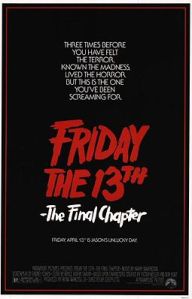
Film Review: Friday the 13th: The Final Chapter (dir. by Joseph Zito)


(spoilers below)

Today, continuing our look at the Friday the 13th horror franchise, we consider the misnamed Friday the 13th — The Final Chapter.  Originally released in 1984, this film apparently was really sold as being the final chapter and Tom Savini even returned to do the gore effects because, supposedly, he wanted to kill off his most famous creation.  To be honest, that all sounds like a lot of hype and hucksterism to me but, regardless of the title’s insincerity, The Final Chapter is one of the best (some would say the best) installments in the series.

The Final Chapter begins less than an hour after the end of Part 3.  (One of the curious things about the Friday the 13th series is that the 2nd, 3rd, and fourth films all occur during the same long weekend.  It never seems to disturb anyone in the 3rd or 4th film that a bunch of people have just been murdered in the same general area.)  Jason, who was killed by the terrible Chris Higgins at the end of Part 3, is taken down to the county morgue where he promptly turns out to not be dead after all.  He kills a nurse and an orderly and then, instead of continuing to seek vengeance on Chris (with whom he was pretty much obsessed in Part 3) , he decides to go kill a whole bunch of other people who have just shown up at Crystal Lake for the weekend. 

Those other people are a group of dorky but rather likable college students who have rented a house on the lake.  This is probably the most quirky group of vacationers ever to come to Crystal Lake and it’s a credit to an unusually strong (and unsung) ensemble cast that you actually do believe that these people are friends.  In the group, we have Doug (a dreamy Peter Barton), shy virgin Sarah (Barbara Howard, who is so believable as a nice girl that I felt bad for her when she died), Paul (Alan Hayes), Paul’s slutty girlfriend Samantha (Judie Aronson), and finally heterosexual life partners Jimmy (Crispin Glover) and Ted (Lawrence Monoson).  Jimmy and Ted provide the film with its “comic relief,” the majority of which is pretty weak but Crispin Glover gives such an odd performance that he’s enjoyable nonetheless.  Eventually, our vacationers meet two twins, Tina and Terri (Camilla and Carey Moore) and then they all go back to the house to watch old nudie films and Crispin Glover does a hilariously spastic dance before losing his virginity to one of the twins.  (“Was I a dead fuck?” he asks after, with an aching sincerity.)  And then Sarah gets ready to lose her virginity to Doug but then that defender of purity, Jason (played here by Ted White), pops up and kills everyone.  Seriously, Jason had a busy weekend.

Unfortunately for Jason, Trish Jarvis (Kimberly Beck) and her little brother Tommy (Corey Feldman, who gives a pretty good performance here even if Tommy is kind of a brat when you get right down to it), happen to live next door.  Trish is prepared for Jason because she has previously met yet another camper — Rob (Erich Anderson),who specifically came up to Crystal Lake to track down and kill Jason because Jason killed his sister Sandra in Part 2.  (Of course, by the series chronology, Sandra only died two days ago so I guess Rob moves pretty quickly.)  Also unfortunate for Jason, Tommy is an aspiring makeup artist who makes himself up to look like Jason and, in the surprisingly exciting finale, uses his skills to fool Jason and then hack him up while screaming, “DIE!” all the while.

Plotwise, Friday the 13th: The Final Chapter is a pretty standard slasher film and, at times, it asks the audience to suspend its disbelief just a little bit too much.  Whenever I see the scene where Tina is pulled out the second story window, I always find myself wondering 1) how Jason managed to climb up the side of the house in the rain, 2) why did he decide to do that when, in the previous scene, he was already inside the house, and 3) why didn’t anyone inside the house hear Tina crashing into the station wagon below.  And yet, despite this, Friday the 13th: The Final Chapter is considered by many (including me) to be the best of the series. 

To me, this film succeeds because of two men — Joseph Zito and Tom Savini.    Whereas later Friday the 13th directors often times seemed to be ashamed of the films they were making, Zito was an exploitation vet who had already directed one of the most brutal slashers of all time, The Prowler.  As a director, Zito specialized in telling simple stories as brutally and efficiently as possible.  That’s certainly what he does here and the end result is a fast-paced Friday the 13th that — as opposed to Part 3 — didn’t suffer from any excessive filler.  As well, Zito also does a good job in framing and executing the film’s many tracking and p.o.v. shots, continually keeping the audience off-balance as to whether we’re seeing the camera’s point-of-view or Jason’s. Meanwhile, Tom Savini’s gore effects are just as realistic and disturbing as in the first film.  This is an undeniably bloody film that, at the same time, never slips into tedious “torture porn,” and both Zito and Savini deserve a lot of credit for that.

(Incidentally, here’s a little trivia for all of you Maniac fans — did you know that Joe Spinell’s loathsome Frank Zito was actually named after Joe Zito, who was apparently friends with William Lustig.)

Of all the Friday the 13th films, The Final Chapter probably features the strongest cast.  It certainly features one of the best “final girls”, with Kimberly Beck giving the type of strong performance  that Dana Kimmell failed to supply in Part 3.  Though only Corey Feldman and Crispin Glover would go on to any greater fame, the entire cast is likable and, as opposed to previous and future installments, no one gives a weak performance.  (Even the gimmicky twins do well enough.)  Though I know several people will laugh at this, I sincerely believe that there is an art to giving an effective performance in a film like Friday the 13th.  The key, I think, is to be likable enough that people will watch you and wish you well yet, at the same time, to be bland enough that nobody will be traumatized by your eventual death.  If anything, the cast of The Final Chapter isn’t quite bland enough.  Everyone brings almost too much life to these thinly drawn characters and, as a result,  it’s hard not to feel a little bit traumatized when they start dying.  Crispin Glover, for instance, gave such a quirky and interesting performance that I was actually pretty depressed to see him get that meat cleaver buried in his face.  As well, Peter Barton and Barbara Howard make such a cute couple that it’s upsetting that neither one of them survives to the end of the film. 

Despite the film’s title, the fourth installment of the Friday the 13th franchise was hardly the final chapter and it’s pretty obvious that it was never meant to be.  While I know that some people do complain about the cynicism behind the film’s title, I happen to love it.  It’s like a throwback to the classic old exploitation films that were always sold with sordid titles — like Too Young To Die and Arrested at 17 — that in no way reflected the actual content of the film.  Slasher films are the direct descendants of movies like Reefer Madness and Dwain Esper’s Maniac and it’s nice to see that heritage honored with the false promise of a final chapter.

Though the film’s ending was clearly set up to allow Tommy to eventually take Jason’s place (and, seriously, imagine how disturbing that could have been), Jason would eventually return.  But first, the series would take a major detour with its most over-the-top chapter yet.  We’ll talk about the infamous Friday the 13th — A New Beginning tomorrow.

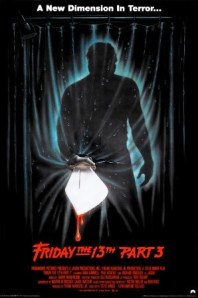
Film Review: Friday the 13th Part 3 (dir. by Steve Miner)


Today, we continue to consider the Friday the 13th film franchise with Friday the 13th Part 3, a film that many (like me) consider to be one of the worst slasher films ever made.  Certainly, it’s a contender for the title of the worst Friday the 13th film.

Taking place a day after the end of Part 2 (and with John Furey still nowhere to be seen), Friday the 13th Part 3 tells the story of Chris Higgins (Dana Kimmell), her annoying friends, and their weekend at Crystal Lake.  Her friends include pregnant Debbie (Tracie Savage) and her boyfriend Andy (Jeffrey Rogers), who is cute but for some reason is always walking on his hands.  There’s also the fat and rather depressing Shelly (played by Larry Zerner) and Vera Sanchez (Catherine Parks), who comes from the wrong side of the tracks and has been recruited to serve as Shelly’s date.  And then finally, there are two hippies (David Katims and Rachel Howard) who appear to be in their late 30s and who appear to just pop up mysteriously in the back of Andy’s van at one point.  Seriously, I’ve seen this film a few dozen times and I’ve never figured out just why the hippies are there.

Anyway, once at Crystal Lake, Chris goes off with her ex-boyfriend Rick (Paul Kratka) while her friends spend their time having sex, smoking weed, and dealing with three angry bikers who apparently belong to the Red Herring Motorcycle Gang.  Chris tells Rick about how, two years previously, she was attacked by a disfigured maniac  who just happens to hang out around Crystal Lake…

Anyway, pretty much what you would expect to happen happens.  Soon Jason Voorhees (played in this one by Richard Brooker, who is very physical and intimidating in the role) is killing everyone.  Along the way, he puts on his hockey mask for the first time and the legend, as they say, is born.

Friday the 13th Part 3 was originally filmed in 3-D and was apparently initially released under the title Friday The 13th 3-D.  This makes it a somewhat weird experience to watch the film on video because you spend the whole time spotting scenes that were obviously included just to exploit the 3-D.  Sometimes, the scenes shot for the 3-D are still effective even in 2-D.  The scenes where an arrow flies straight at the camera and poor old Rick’s eye literally pops out of his head remain surprisingly effective.  However, for the most part, the film is made up of scenes where Andy plays with a yo-yo or some weird kid points a softball bat the camera.  Seen in 2-D, the majority of these scenes feel weird but yet they still have an oddly ludicrous appeal to them.  If nothing else, spotting these scenes make for a fun drinking game.

So, why is Friday the 13th Part 3 widely considered to be the worst of the Friday the 13th films?  There are several reasons but a lot of it comes down to the fact that the film is badly acted even by the standards of Friday the 13th.   Whereas previous (and future) installments featured casts that, at the very least, seemed to be trying to at least keep things interesting, the cast of this one seems to be incredibly bored with the whole thing.  (In their defence, I’m sure the filming was more about getting the 3-D right than worrying about crafting an interesting ensemble dynamic.)   As portrayed by Dana Kimmell, Chris Higgins is probably one of the least sympathetic final girls in the history of the slasher genre.  Essentially, she drags all of her friends off to a place that she knows is inhabited by a maniac (though she apparently doesn’t bother to say anything about it until they’re already there) and then — surprise, surprise — all of her friends get killed!  Good job, Chris.  Way to go.

Oddly enough, everything I’ve read about Friday the 13th Part 3 seems to suggest that Dana Kimmel actually played a surprisingly large role in the production of this film.  Kimmel was reportedly pretty religious and somehow talked the filmmakers into removing several scenes of excessive violence and gratuitous sex, which kind of seems to defeat the whole purpose of making a film like Friday the 13th in the first place.  Strangely, even after the film was watered down, it’s still probably the most mean-spirited of the entire franchise.  This after all is the film where Jason kills a pregnant girl, an outspoken chicana who has bravely defied her mother just so she can take part in the Chris Higgins Weekend of Death, a poor fat kid who is desperate to be loved, and not one but two comic relief hippies. 

Director Steve Miner, who did such a good job keeping Part 2 creepy and exciting, seems to have been bored when he directed this film and the whole thing has a harsh, YouTube feel to it.  Some of that may be due to the fact that the film was originally done in 3D but it’s hard to deny that Friday the 13th Part 3 is exactly everything that its many critics claim it to be.  Luckily, in the next chapter of the Friday the 13th saga, a new director would breathe new life into the franchise even as he attempted to kill it for good.

Coming tomorrow…my review of Friday the 13th: The Final Chapter.

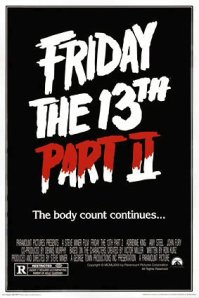
Film Review: Friday the 13th Part 2 (dir. by Steve Miner)


(Spoilers Below)

This the one where the nice guy in the wheelchair gets a machete to the face.

There’s a lot of different ways that you can describe Friday the 13th Part 2.  It’s a horror movie, a slasher flick, and a sequel.  It’s the first Friday the 13th movie to feature Jason Voorhees as the killer.  It’s also one the best installments in the franchise.  However, to me, this will always be the movie where the nice guy in the wheelchair gets a machete to the face.

Originally released in 1981, Friday the 13th Part 2 is, of course, about more than just the nice guy in the wheel chair getting a machete to the face.  The film opens with Alice (Adrienne King), the sole survivor from the first film, struggling to get on with her life a year after the massacre.  She has a small apartment that, in a nice touch, is full of drawings of the disfigured boy who attacked her at the end of the previous film.  One night, Alice’s cat startles her by jumping out of a closet and shouting, “Watch out, there’s a mysterious killer in here.”  Foolishly, Alice ignores her cat and ends up getting an ice pick rammed into her head. 

(If only people listened to their cats…)

Five years later, Camp Crystal Lake is once again reopening, this time under the direction of alpha male Paul Holt (John Furey).  Paul and his annoying sidekick Ted (Stu Charro) tell everyone not to worry about any old rumors about some mysterious murderer killing anyone who goes to Crystal Lake.  Meanwhile, Crazy Ralph (Walt Gorney) is wandering around, going all “You’re all doomed!” and then watching as Paul’s girlfriend Ginny (Amy Steel) undresses in her cabin.  Bad Crazy Ralph!  Luckily, Crazy Ralph then gets strangled with barbed wire.  (Ouch!  I guess he was the one who was doomed, huh?  Get it?  Anyway…)

Paul, Ginny, annoying Ted, and the rest of the counselors decide to head into town so they can spend the night getting drunk.  However, a few counselors decide to remain at the camp.  (Again, this just goes to prove that slasher films are not only about punishing people for having sex and doing drugs.  If the majority of this installment’s victims had simply been willing to go get drunk, they would have survived.)  Remaining at the camp: horny couple Jeff and Sandra (Bill Randolph and Marta Kober),  Terry (Kirsten Baker), who for some reason refuses to wear underwear, Scott (Russell Todd), who is obsessed with Terry but could do so much better, sweet-natured Vicki (Lauren-Marie Taylor), and finally Mark (Tom McBride), the nice guy in the wheelchair.

Anyway, if you’ve ever seen a slasher film than you can guess what pretty much happens.  Jason (played here by Steve Daskawisz) shows up and kills everyone until eventually Ginny and Paul return to the camp.  (Annoying Ted stays behind to keep drinking and somehow manages to survive the film.  It’s an odd slasher film where the nice guy in the wheelchair gets killed but the obnoxious, dorky guy somehow makes it through.)  There’s a big, genuinely exciting final battle with Ginny and Paul on one side and Jason on the other.  Ginny survives, Jason escapes, and Paul … well, who knows?  One moment, Paul’s there and the next he’s gone.  I’m still trying to figure that one out.

Friday the 13th Part 2 is controversial among many horror fans because so many of the killings are identical to the killings from an earlier slasher film, Mario Bava’s brilliant Bay of Blood (a.k.a. Twitch of the Death Nerve).  One especially obvious example is the double impalement of Jeff and Sandra and when I say obvious, I mean that the exact same scene can be found in Bay of Blood.  In Peter M. Bracke’s history of the franchise, Crystal Lake Memories, Part 2’s self-important screenwriter, Ron Kurz, claims to have never heard of Bay of Blood.  And to that, I say, “Whatever, Ron Kurz.  You’re either a liar or you actually don’t know who Mario Bava is.  Either way, you suck.”

Though Friday the 13th Part 2 is obviously a rather derivative film and frequently doesn’t make much sense, it’s also a personal favorite of mine as far as 80s slasher films are concerned.  The cast is likable and attractive (especially Russell Todd, who gets killed way too early as far as I’m concerned) and some of the kill scenes are genuinely well done.  Amy Steel, much like Adrienne King before her, make for a strong heroine and her final battle with Jason is actually pretty exciting.  The true star of the film, however, is director Steve Miner who fills each scene with a sense of genuine menace that goes a long way to making up for Ron Kurz’s sloppy script.  As opposed to Sean Cunningham (who directed the first film), Miner shows a genuinely inventive visual sense.  My favorite shot in the film is a rather minor one of a bunch of cars driving down a shadowy road.  The scene doesn’t really add anything to the story and it almost feels like filler but it’s still effectively eerie.

It could be argued that Friday the 13th Part 2 is the first true Friday the 13th because it’s the first film to actually feature Jason Voorhees killing camp counselors.  The character of Jason makes even less sense in this film than he did when he was just some kid living underwater in the first film.  It’s impossible to watch the film and not wonder how 1) Jason suddenly went from being a 13 year-old living in a lake to a 40 year-old living in a shack in the woods, 2) how Jason managed to track down Alice, 3) how Jason managed to then walk all the way to Alice’s new home and then all the way back to Crystal Lake without anyone noticing him, and 4) why exactly has Jason been hiding in the woods all this time and apparently allowing his mother to believe that he was dead.  That said, I actually think that Jason is probably at his scariest in Friday the 13th Part 2.  A lot of that has to do with the fact that, instead of wearing that famous hockey mask, Jason spends most of the movie with a burlap sack over his head.  As opposed to the hockey mask (which makes Jason look rather Canadian), both the sack and Jason’s odd overalls make him look like a faceless demon that’s sprung, full of fury, out of rural folklore.

Though it made less than the first film, Friday the 13th Part 2 was a financial success.  Audiences ignored the film’s many critics and they flocked to see it.  Not surprisingly, Paramount Pictures immediately called for a sequel.

The end result — Friday the 13th Part 3 — would be one of the worst horror films ever made.

We’ll deal with that tomorrow.   

Trailer: The House At The End of the Street


I saw this trailer two weeks ago when I went to see Hunger Games.  I like the title (which is an obvious homage to the classic House On The Edge of the Park) and Jennifer Lawrence is like the best but I’d feel better about this film if it wasn’t rated PG-13.  Seriously, that PG-13 rating is quickly becoming the kiss of death as far as horror is concerned.

Film Review: Friday the 13th (dir. by Sean S. Cunningham)


(Warning: Spoilers Below)

This month, the 13th is going to fall on a Friday so I figured what better time would there be to watch and review the Friday the 13th franchise?  Through April 13th, I’ll be reviewing each film in the franchise.  Some of these reviews will be positive and quite a few of them will not.  Let’s get things started with the one that started it all, the original 1980 Friday the 13th.

Is there anyone out there who does not know the plot of Friday the 13th?  For those who don’t, here’s a spoiler-filled refresher.  In the late 50s, at the rather crummy looking Camp Crystal Lake in New Jersey, two counselors sneak off from a sing-along so that they can do whatever it was that young people used to do in the 50s.  Suddenly, someone else walks into the room.  “Uhmm, we weren’t doing anything,” one of the counselor says right before a machete is plunged into his stomach.

Jump forward 25 years.  Annie (Robbi Morgan), a bubbly young woman who won’t stop talking about how much she loves children, hitchhikes into Crystal Lake.  She tells the townspeople that she’s looking for a ride to Camp Crystal Lake and everyone give her that “Oh no you didn’t” look.  Crazy old Ralph (played by Walt Gorney) tells her, “You’re doomed.”  Since this is a slasher film, Annie ignores him and ends up getting her throat slashed in the woods by an unseen assailant wearing black gloves.

Meanwhile, at Camp Crystal Lake, the somewhat jerky Steve Christy (played by an actor named Peter Brouwer who never gets enough credit for giving a good performance here) is working hard to get the long-since deserted camp up and ready for its grand reopening.  Helping him out are his fellow camp counselors — lovers of life and fun Marcie (Jeannine Taylor) and Jack (The Kevin Bacon, who is like such a total hottie in this film I don’t even know where to start), boring Bill (Harry Crosby), bossy meanie Brenda (Laurie Bartram), obnoxious practical joker Ned (Mark Nelson), and finally Steve’s girlfriend, Alice (Adrienne King).  Steve tells his counselors to get the camp ready and then heads off to pick up supplies in town.  (Or at least, that’s what Steve says he’s doing.  As far as I can tell, the only thing he does when he gets to town is head over to the local diner and start flirting with the 90 year-old waitress…)

With jerky old Steve gone for the day, the counselors decide to spend their time swimming (and, in Ned’s case, pretending to drown), having sex, smoking pot, and eventually getting killed one-by-one by an unseen murderer.  Eventually, once Alice is the only counselor left alive, she runs into a nice, older woman named Pamela Voorhees (played, with a lot of genuine menace, by Betsy Palmer).  When Alice explains that everyone’s dead, Pamela responds by mentioning that her own son — Jason — drowned at the camp 25 years ago because the counselors were too busy “making love.”  Pamela then tries to kill Alice and Alice ends up chopping Pamela’s head off and then floating out onto the lake in a canoe.  (Meanwhile, the camp is nowhere close to being ready for opening day.)

The next morning, Alice wakes up in the canoe and spots a bunch of police officers on the shore.  As she starts to call out to them, a deformed boy suddenly jumps out of the water and grabs her.  This, of course, is one of the most famous scenes in the history of horror and one that has been parodied and ripped off numerous times.  However, when I first saw Friday the 13th, that scene made me scream and, even today, I still find my heart racing  just a little bit faster whenever I know that it’s coming up.

The first time I ever saw the original Friday the 13th, I was either 8 or 9 and it was all incredibly daring because I was staying up way too late with my older sisters and watching a  cable station for grownups that I knew I wasn’t supposed to be watching.  We didn’t want to wake up mom or dad so we had the volume turned down as low as it would go and we whispered our comments of “Ewwww!” and “Agck!”  (Yes, even at the age of 8, I was already saying “agck.”)  Even though I couldn’t hear the film, I could see it and the end result was thatm when I did eventually go to sleep, I was awake after about an hour, screaming because I had a Friday-inspired nightmare.  I doubt that the movie would scare me as much today because today,I know who Tom Savini is and, if I need proof that Kevin Bacon was actually not killed by Mrs. Voorhees hiding underneath the bed, I can watch my DVD of Crazy,Stupid Love.  But when I was younger, Friday the 13th was the fuel of nightmares and, seeing as I’ve always had my little morbid streak, I think that’s why the franchise continues to interest me.

If there’s one thing that everyone seems to agree about when it comes to Friday the 13th, it’s that the true stars of the film were the disturbingly plausible gore effects designed Tom Savini.   Even when I rewatched the film before writing this review, I was surprised by not only just how bloody a movie Friday the 13th was but also at how realistic it all looked (especially when compared to the intentionally over-the-top gore effects that Savini provided for Dawn of the Dead).  There’s a surprising brutality to the film that reminds us that — unlike future installments in the franchise — the original Friday the 13th was not made for mainstream audiences but instead for the audiences who populated New York grindhouses and dark Southern drive-ins.  The special effect that every other reviewer always seems to point out is the scene where the arrow bursts through Kevin Bacon’s neck.  While that scene is indeed shocking (and sad too, because it’s Kevin Bacon dying), I’m always more disturbed by the scene that immediately follows, where Marcie gets hit in the face with the axe.  That’s the scene that showed up in my nightmare after I watched the film for the first time.

Director Sean Cunningham has said, in numerous interviews, that he was inspired to make Friday the 13th largely because of the box office success of Halloween and there are some pretty obvious similarities between the two films.  What is less often commented upon is just how much of the original Friday the 13th was inspired by the Italian giallo films of Mario Bava and Dario Argento.  Whether it’s the focus on the killer’s black gloves or the use of Harry Manfredini’s iconic theme to signal when something bad is about to happen, the giallo influence is pretty obvious.  Sean Cunningham was hardly an innovative director but when he stole, he stole from the best and the end result, crude as it may have sometimes been, was undeniably effective.

In Peter Bracke’s fascinating history of the franchise, Crystal Lake Memories, there’s an interesting quote from Jeannine Taylor, the actress who  played Marcie.  When discussing her reaction after first reading the script, Taylor says, “To me, this was a small independent film about some very carefree teenagers who are having a great time at summer camp where they happen to be working as counselors.  Then they just happen to get killed.”  Taylor’s comment gets at one reason why Friday the 13th — out of all the slasher films to come out after Halloween — continues to be watched by even people like me who weren’t even alive when it was first released.  Uniquely among the films in the franchise, Friday the 13th is a true ensemble film and, though the performances are somewhat uneven and the characters are pretty one-dimensional, the cast has an easy and likable chemistry.  Watching the film today, it’s a bit hard not to concentrate on the fact that you’re seeing Kevin Bacon in a low-budget slasher film but once you get over that, you realize that Bacon and the entire cast are totally believable as bunch of likable, carefree kids who end up in the wrong place at the wrong time.  A lot of critics have complained that the first half of the film drags as we just watch everyone goofing off around camp.  To me, those early scenes make the film because they get us to care about the characters just enough so that we don’t necessarily want to see them killed.

Another frequent critical complaint is that it’s difficult to have much sympathy for characters who consistently do stupid things that ultimately lead to them getting killed.  Viewers tend to shake their heads as they watch Ned go wandering into a deserted cabin or when Brenda just happens to wander out on the archery range.  Myself, I always tend to roll my eyes whenever the film reaches the point that Marcie decides to run out into the rainy night in just her panties and a shirt.  I always find myself going, “Yeah, like anyone’s really that stupid…”

Of course, even as I type this review, I’m thinking about how, a few nights ago, I thought I heard a catfight at 3 in the morning and my immediate response was to run outside and walk up and down in the alley, wearing only a t-shirt and a thong, calling my cat’s name.*  Even as I searched for our cat, I found myself muttering, “This is like a slasher movie waiting to happen.”  However, I still kept wandering around that alley in my half-naked state because, at the time, I was pretty confident that there weren’t any masked maniacs around.

That’s what people who criticize films like Friday the 13th for featuring stupid characters refuse to admit.  We all do more stupid things than we care to admit because we’re usually pretty confident that there won’t be any negative consequences to our stupidity.  We all know that there are evil psychopaths out there but we’re also confident that we won’t run into them.  The reason why the slasher genre has remained popular is because it forces us to confront our deepest fear, which is that we might not be as safe or have as much control over our fate as we tell ourselves.

Not surprisingly, Friday the 13th and its subsequent sequels has never been as popular with critics as they have with audiences.  In fact, critical reaction upon the initial release of Friday the 13th was so hostile that one critic even printed Betsy Palmer’s address and invited outraged filmgoers to write her letters of protest.  The standard critical complaint about Friday the 13th was that it presented death as a punishment for having sex and smoking weed and here I would say that the critics were mistaken.  While it is true that Jack and Marcie die after doing both of these things, I think there’s actually a far more relevent message to be found within the film.  Consider this: Ned dies after he spots someone in a deserted cabin and says, “Can I help you?”  Steve Christy is killed because he spots someone out in the rain and approaches them, saying, “What are you doing out in this mess?”  Brenda thinks that she hears a child crying for help outside of her cabin and foolishly goes walking around in the middle of hurricane in her nightgown, calling out, “Hello!?” until she’s killed off-screen.  What the critics, so caught up in their moral panic, failed to understand was that the message of Friday the 13th is not that people shouldn’t have sex.  The message is that people shouldn’t offer to help random strangers.

Despite the amount of critical scorn heaped upon it, Friday the 13th was a box-office success and the 18th highest grossing film of 1980.   At the time, for a low-budget, independent film, this was highly unusual.  Despite the fact that Friday the 13th ended with Mrs. Voorhees losing her head and Jason still in that lake, there would be a Friday the 13th Part 2.

We’ll deal with that tomorrow.  Until then, don’t help any random strangers…

——

*Doc, our cat, was fine, by the way.  It turned out, he was sitting in the kitchen the whole time I was outside desperately searching for him.

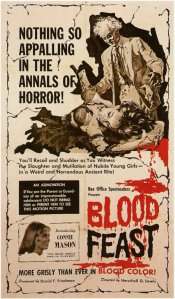
Grindhouse Classics : “Blood Feast”


Tell me, friends, have you ever had — AN EGYPTIAN FEAST?

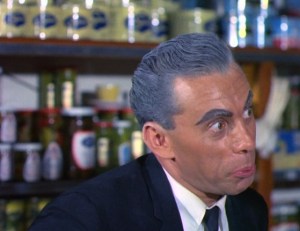
It doesn’t matter how you answer that question, the important thing is in how you ask it. You’ve gotta get all bug-eyed, swerve your neck outwards like a crane, and pause dramatically between  “hand” and “an” before raising your voice for the final three words. Then you, too, can look and sound just like Mal Arnold, the decidedly non-Egyptian “actor” (and I use that term loosely) who plays Egyptian serial-killer/caterer in director Herschell Gordon Lewis’ 1963 classic Blood Feast, and know that you’ll be faithfully imitating a slice of movie history.

And no, I don’t take the phrase “movie history” lightly — but in this case it most certainly applies. Which is not to say that Blood Feast is in any way a good film — heck, in many respects it isn’t even really a competent one (wait, didn’t I just refer to it as a “classic?” — bear with me, all will be explained), but for what it did, and when it did it, well — like it or not, it really does represent a couple of important firsts.


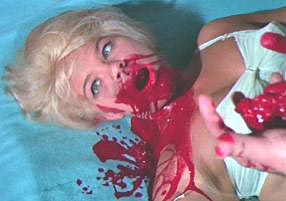
And speaking of firsts — first, a bit of a plot rundown, not that such a thing is really all that necessary. A nubile young female strips down to take a bath while listening to a radio report about a series of brutal, unsolved killings in her area. She gets naked, opens up a book called “Weird Ancient Religious Rituals,” lays back in the tub —and is hacked to pieces by a freaky-looking intruder of vaguely foreign appearance, who leaves what’s left of her to  slowly bleed to death while he makes of with her amputated leg.

Cut to the catering shop of one Fuad Ramses, the killer from the previous scene (no mystery here folks, sorry!), who is conversing with a customer, one Mrs. Dorothy Fremont (Lyn Bolton), who is planning a birthday dinner for her daughter, Suzette (eventual 1963 Playboy Playmate of the Year Connie Mason). Ramses suggests an Egyptian feast (hence our opening quote), and Mrs. Fremont agrees that would be a lovely idea given that her daughter is taking a night class on Egyptian history and culture.

The cops, led by one Detective Pete Thornton ( Lewis regular William Kerwin, operating here under the pseudonym of “Thomas Wood”) are hot on the trail of the killer, of course. We’re informed that the “entire force” is working around the clock on tracking the psychopath down, and even though said “entire force” apparently consists of only two guys, they follow the leads they’ve got pretty well, and those leads —- uhhmmmm — lead them to the aforementioned Egyptian studies night class, where our good detective takes an instant liking to our Ms. Fremont The Younger. Of course, in between trying to make time with the wealthy young socialite, he’s still got a case to work, and a couple more bodies (of the female variety, naturally) pile up, one with its tongue removed, the other sans its brain (both shown in lovingly agonizing detail by Lewis, with the tongue scene especially being a standout for hardened gore-hounds to this day — and yes, the rumors are true, they used a sheep tongue procured from a local butcher shop), and of course both unfortunate ladies are connected with that apparently-cursed night-school class (which makes you wonder why everybody doesn’t just drop the course, but I digress).

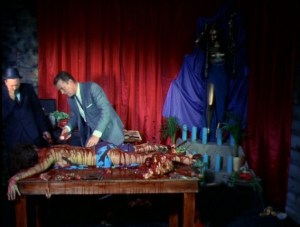
Anyway, as events play out, clues finally lead the cops right to Ramses’ doorstep — or, more specifically, to the back room of his shop, where he’s got an impromptu shrine set up to the supposedly Egyptian goddess of death, Ishtar. The ever-enterprising Fuad is apparently attempting to serve up a bunch of body parts from different victims to people at the Fremont party as a cannibalistic sacrifice to his savage goddess  in order to facilitate her reincarnation upon the Earth into human form. Or something. And he’s got Suzette in mind as his final victim. Or to be Ishtar’s new human hostess. Or something.

I suppose none of it really matters because Fuad walks with a comically over-pronounced limp and isn’t gonna get too far once the cops show up (he makes it into the back of a garbage truck in his feeble escape attempt and is compacted therein, with Thornton intoning that he ended up exactly where he belonged because he’s nothing but human garbage anyway — whoops, sorry to give away the ending), and it’s not for its gripping and dramatic story that anyone cared — or, for that matter, still cares — about this movie anyway.

Nor, frankly, is it due its performances, most of which fall below even community theater standards,  that Blood Feast is still talked about to this day . Oh, sure, Arnold’s all kinds of fun if you can get past the blatant offensiveness inherent in the idea of a guy of course being a bloodthirsty maniac because he’s disabled, vaguely effeminate, and even — gasp! shudder! — an immigrant. He’s clearly playing the whole things for laughs (as is Lewis himself, for that matter), but the same charitable view really can’t be extended to the truly awful non-acting of Connie Mason, whose “talents” were best summarized by HGL when he famously said “I’ve often thought that if one took the key out of Connie’s back, that she’d simply stand still” — nor to Bolton, who, if anything, is even worse in her turns as Mason’s cinematic mother. Neither actress emotes in the slightest, nor are they aware enough of their own shortcomings to intentionally over-do things — they’re just basically reciting dialogue, and not even doing that very well.

So what does at leave us with? Why, surely the answer’s right in the title — blood, and lots of it (and specially-concocted blood at that — Lewis didn’t care for how any of the standard-at-the-time stage blood looked on camera, so he had a local Miami (like most of HGL’s flicks, this was lensed in the South Florida area) cosmetic company come up with a new blend just for this film that he would end up using on all his subsequent efforts — on the plus side it was entirely edible, on the minus side the base ingredient was Kaopectate) . And brains. And tongues. And entrails. And limbs. But mostly, just lots and lots — and lots! — of blood.

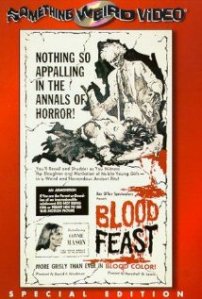
All of which is pretty much standard stuff these days, of course, but it certainly wasn’t back in 1963. This is well and truly the first “gore film,” and while that fact has been justly acknowledged by the horror community at large, what’s less talked about, but no less true, is the fact that Blood Feast is also the first modern slasher film. Oh, sure, Lewis and producer David F. Friedman make a big deal of pointing this out on numerous occasions on the occasionally-self-congratulatory-but-on-the-whole-pretty-lively-and-enthralling commentary track that accompanies this film’s DVD and Blu-Ray releases from Something Weird Video (it’s presented full frame with mono sound and also includes the standard “Gallery Of Herschell Gordon Lewis exploitation artwork” that all these come with), but for some reason the largely-self-appointed gatekeepers of horror-dom don’t seem to want to go there. It’s almost as if they’re willing to give Blood Feast some “props,” but not too many. You want us to admit you were the first gore flick? Fine. We can do that. But the first slasher? No way. We’ve gotta save that for a more “respectable” picture, thank you very much. It’s gotta be Halloween. Or Black Christmas. Or —

Well, folks, I’m here to call bullshit on that. Horror on the whole is already marginalized and ghetto-ized by the (again, largely self-appointed) arbiters of all that is right and good in “mainstream” cinema — to see the same thing done on a “micro” level within horror fandom itself as is done to the genre on a more “macro” level reeks of hypocrisy of the highest order. Let’s give Blood Feast its due. I’m not here to tell you it’s a great example of the slasher subgenre, or frankly even of the gore subgenre, but it did ’em both first, and everyone who came along later owes a debt of gratitude to what Lewis and Friedman did here, even if they didn’t necessarily do it all particularly well. Besides, numerous and readily-apparent flaws aside, this is good, solid, brainless fun. If more horror flicks were to put their various pretenses aside and just embrace the sense of good-time movie-making that Blood Feast positively revels in, maybe — just maybe — the genre as a whole wouldn’t find itself in the mess it’s in today. Just a thought.

6 Trailers To End March With


Hi!  It’s Saturday and that means that it’s time for yet another edition of Lisa Marie’s Favorite Grindhouse and Exploitation trailers.  Enjoy!

1) The Omega Man (1970)

“Charlton Heston IS the Omega Man!”  This movie is the second of three film adaptations of Richard Matheson’s classic novel I am Legend.

2) Last House On Dead End Street (1977)

This film is reportedly one of the most purely grindhouse films ever made.  It’s also next to impossible to see.  The Trash Film Guru has seen it and I’m insanely jealous.  As for this trailer, it’s short but rather effective.  It’s also perhaps the hundredth trailer to feature the “It’s only a movie” tagline.

3) Deranged (1974)

“A man so obsessed with death that he became…DERANGED!”

4) Equinox (1970)

I own the Criterion edition of this film.  It’s actually kind of fun in its own silly way.

5) Vengeance of She (1971)

This is a Hammer film.  I love how increasingly excited the narrator gets as he talks about vengeance.

6) Endgame (1983)

Finally, let’s end this entry with yet another look at a post-apocalypse future.  From the iconic Italian director Joe D’Amato, it’s Endgame.

Film Review: Grey (dir. by Darshan Patel)


I want to take a few paragraphs to recommend a 20-minute film that I recently saw.  The name of the film is Grey and it can be viewed here.

Grey is a harrowingly honest but ultimately hopeful film about depression.  Opening with Raphael sleeping on his couch while his wife Lea lies alone in their bed, Grey is a near-documentary look at a couple whose lives are currently ruled by depression.  While Lea spends her days in bed (getting up only to close the curtains), Raphael struggles to carry on with his life.  He goes to work, he exercises in the park, and every day he comes home and tries (unsuccessfully) to get his wife to eat.  Though Raphael obviously loves his wife, it’s obvious that he’s nearly at the end of his rope. 

Speaking as someone who has to deal with depression her entire life, I can say that Grey gets it right and for that, I’m thankful.  Far too often, cinematic depression is just portrayed as just a plot device, a condition that has a very specific cause and, therefore, a very specific solution.  Though Grey gives us some hints as to what exactly has triggered Lea’s depression, it very wisely leaves the reason for her condition ambiguous and instead, it focuses on the day-to-day experience of both Lea and Raphael.  It acknowledges and illustrates the fact that depression affects more than just the person who is depressed while never playing down just how difficult it is to find oneself trapped in that condition.  Grey perfectly captures the strange stillness that comes with depression and the numbness that results from it. 

In the pivotal roles of Raphael and Lea, both James Parsons and Chiara Grioni give strong and sympathetic performances but the real star of the film is director Darshan Patel.  It’s a difficult thing, making a film about depression that is both honest and watchable but Patel has managed to largely succeed.  Wisely, he takes a hand-held, almost documentary-like approach here that allows us the viewer to make up our own minds regarding what we’re watching.  Instead of manipulating us to make us feel sorry for Raphael and/or Lea, he instead casts us in the role of detached observers who can do little more than simply watch life unfold.  As a director, Patel captures the feeling of isolation that comes with being depressed and, even in the scenes where Raphael interacts with others, you’re left with no doubt that he’s a man who feels that, without Lea, he is totally alone in the world.  I think the scene that most vindicates Patel’s technique is in the disturbing scene where Lea matter-of-factly considers slitting her wrists.  A lesser director would have played the scene with a lot of ominous music and flashy editing and the end result would have been a lot less effective than Patel’s straight forward approach.

In the end, Grey is the perfect title for this film.  Too often, films about depression either give into melodrama or they provide a bunch of easy answers.  Anyone who has ever had to deal with depression knows that the truth is never quite as simple.  Depression truly is a state of being grey, a state of being where the only feelings are ones of numbness, apathy, and hopelessness.  With an unflinching eye, Patel captures that feeling in this film and, it is to his credit, that Grey ends on a note of hope that feels totally earned. 

If you’ve ever suffered from depression or if you’ve had to deal with and/or take care of someone who suffers from depression, you’ll find Grey to be a powerful film and one that deserves to be seen.  You can watch the film for yourself here.

A Roughie With Lisa Marie: Scum of the Earth (dir. by Herschell Gordon Lewis)


If there’s any exploitation director that deserves a critical re-evaluation, it’s Herschell Gordon Lewis.  Over the course of two decades, Lewis dabbled in every genre of low-budget filmmaking and even invented one with his 1963 “gore” film Blood Feast.  Many film critics tends to dismiss Lewis as being one of the worst directors of all time.  I would argue that, far from being the worst, Lewis was a unique filmmaker who, working with low budgets and mainstream support, always managed to create movies that had their own unique cinematic aesthetic.  Much like the great French director Jean Rollin, Lewis made dream-like films that — though initially dismissed for their lack of slick production values — have managed to survive the test of time and remain as interesting and oddly watchable now as the day they were first released.  That certainly not the accomplishment of “the worst director of all time.”

(Add to that, the worst director of all time is Garry Marshall.  Seriously, New Year’s Eve will be forever tainted, thanks to Mr. Marshall.)

Though Lewis is best known for his “gore” films like Blood Feast and the Gruesome Twosome, he dabbled in just about every genre of film.  Last night, I watched one of his non-gore films,  Scum of the Earth.  Filmed in 6 days in 1963, Scum of the Earth was released at the same time as Lewis’s better-known Blood Feast.

“Only an alert society can protect itself from those who prey on the weak — the scum of the earth.” — Closing Narration of Scum of the Earth.

Like many of the classic grindhouse film, Scum of the Earth presents itself as a warning to mainstream society about the evil lurking just underneath the facade of normalcy.  In this case, that evil is the “dirty picture” underground and the film starts with a montage of various “teenagers” selling pictures of a topless woman.  I like to think that, with this little pre-credits sequence, Herschell Gordon Lewis establishes that Scum of the Earth is nothing less than a black-and-white, low-budget version of The Wire.

Much like The Wire and Traffic, Scum of the Earth goes from showing us how the product is distributed to showing us how and why the product comes into being in the first place.  Mr. Lang (Lawrence Wood) is a cheerful man who spends his time sitting in a small office and sending out his henchmen, evil Larry (Mal Arnold) and the moronic Ajax (Craig Maudsplay), to distribute explicit photos of the innocent victims that he lures into his sordid web. (Indeed, they are truly the scum of the earth…)  The pictures are taken by disillusioned artist Harmon (Thomas Kerwin) and most of them feature Sandy (played by Sandy Sinclair).  It’s quickly revealed that both Sandy and Harmon hate what they’ve become but they’re both being blackmailed by the jovial Mr. Lang.

However, Sandy’s pictures are no longer selling as well so Lang offers her a proposition.  Sandy can retire from the business if she recruits a replacement.  For the rest of the 72-minute film, we watch as Sandy and Harmon recruit innocent Kim (played all wide-eyed and breathless by Vicki Miles) who desperately needs 500 dollars to be able to pay her college tuition.  Oddly enough, that’s the same way I paid my college tuition which, incidentally, was a lot more than 500 dollars.

Anyway, Kim soon finds herself in over head because 1) she’s incredibly stupid and 2) she’s dealing with the scum of the earth.  If Kim stop posing for topless pictures, she knows that copies will be sent to her kindly but slow-witted father.  (“You’re the best father I ever had!” Kim tells her dad at one point.)  Even worse, Ajax and Larry want to take some pictures of their own with her.  Whatever is a girl to do!?

 As a director Herschell Gordon Lewis has always struck me as being a bit of American Jess Franco.  Much like Franco, he made film that can charitably be called terrible.  Between performances that ranged from histrionic to living dead and a filming technique that seemed to mostly consist of little more than turning on the camera, it’s easy to dismiss Lewis and his films.  It’s only on repeat viewings — after you’ve gotten a previous taste of the Lewis aesthetic — that you start to notice that quirky details and the occasionally inspired visuals that give evidence to the fact that Lewis does not deserve his reputation for being one of the worst directors of all time.  Even in an admittedly lesser work like Scum of the Earth, there’s enough intentional strangeness to hold your interest.  To cite one example, the villainous Mr. Lang appears to love toys and he gives quite a few of his evil speeches while looking down at two nodding bobble heads.  As static as the majority of the film is, the final chase (in which two police officers pursue the portly Mr. Lang through a rather slummy strip mall) is a lot of fun to watch.  The best visual in the film comes when Kim is posing topless for the first time and Lewis gives us a shot, from her point of view, of the oppressively bright lamps shining down on her and casting the rest of the studio into total darkness.  It’s a scene that is full of genuine menace.

The cast is full of actors who will be recognizable to anyone who has seen any of Lewis’s other films.  Out of the cast, William Kerwin comes the closest to giving an actual performance, bringing a real sense of sadness and regret to the role of Harmon the Photographer.   Kerwin also appeared in Blood Feast, playing the dedicated cop who pursues the evil Faud Ramses who was played by yet another Scum of the Earth alum, Mal Arnold. 

In Scum, Arnold plays Lang’s henchman, Larry.  In 1963, Arnold was 30 years old and he looked like he was 40.  However, he was cast here as a character who tells everyone that he meets that he’s under 17 and therefore, he doesn’t have to worry about going to prison for distributing dirty pictures.  Or, as Arnold puts it, “Not me, Daddy-O!  I’m a minor!”  What makes this especially amusing is that in Blood Feast (which was, again, released that same year), Arnold is playing a character who is 5,000 years old.  What also makes Arnold’s performance as Larry enjoyable to those of us who are familiar with Lewis’s cinematic career is that Arnold essentially gives the same over-the-top performance here that he would later give in Blood Feast.  I kept expecting him to ask Kim if she wanted an Egyptian feast.

However, the film truly belongs to Lawrence Wood, who plays Mr. Lang with such an insane joy that it’s impossible not to root for the sleazy old pornographer.  Whether he’s giggling as a toy monkey somersaults across his desk or he’s politely explaining why nothing is actually his fault, Wood appears to be having such a good time that it’s just infectious.  Wood’s best moment comes when Kim expresses some reluctance about modeling for more pictures and suddenly, Mr. Lang starts to shout at her about how she (and all the other kids) are hypocrites.  “You’re damaged merchandise and this is a fire sale!” he shouts as sweat streams down his face and Lewis zooms in for a close up of his mouth, “You’ll do what I tell ya!” Wood screams, “Do you hear!?”  It’s a scene of lunatic genius that, in the best tradition of both Herschell Gordon Lewis and the grindhouse in general, comes out of nowhere and is all the more effective because of it. 

For this scene alone, Scum of the Earth deserves to be seen.