Review: Abraham Lincoln: Vampire Hunter (dir. by Timur Bekmambetov)


Timur Bekmambetov is one filmmaker that can never be said to hold things back visually on any of his films. He has a style that can be called a combination of the Wachowski Brothers and Zack Snyder. Now one can read that and just groan. The Wachowskis and Snyder are not what one would call the paragon of the filmmaking community. What they do tend to do are create pop-friendly and consumer-friendly films. Whether thse films are of high quality is another thing altogether.

Bekmambetov is an interesting filmmaker from Kazakhstan (who could easily pass for what we imagine Genghis Khan to look like if he was still alive) whose brand of action films tend to focus on all style with little to no substance. For some audiences this just means dumb, brainless fare that has no reason to be paid to see, but I tend to think these same people who shout loudest about how these type of films are dumbing down it’s audiences secretly watch them like crack addicts once they’re on cable. Bekmambetov’s latest film, Abraham Lincoln: Vampire Hunter, definitely follows his unique action and storytelling template he’s established with past films as Nightwatch, Daywatch and Wanted.

The film lives and dies on the simple conceit that one of the United States’ greatest Presidents was also vampire hunter of some skill. We see how an encounter with the vampire which led to the death of Abe’s mother (who had died of the condition known at the time as milk sickness) propels him through the intervening years to plot revenge on the same vampire. It’s during a failed attempt at revenge that he’s noticed by one Henry Sturgess (played by Dominic Cooper) who sees another potential vampire hunter in the young man (adult Lincoln played by one Benjamin Walker who could easily pass for a very young Liam Neeson). We get the usual training montage where Sturgess teaches Abe the finer points in vampire hunting and killing. It’s only proper that Abe would end up picking the rail-splitting axe he’s more comfortable in using than the more practical firearms.

Abraham Lincoln: Vampire Hunter is almost a straight adaptation of Seth Grahame-Smith’s novel of the same name. Some minor subplots are discarded to keep the film moving in the one path the filmmakers and screenwriter (Grahame-Smith himself) decided to concentrate on. It’s this one thing that really pushes the film into a level that would win an audience to it’s cause or lose them altogether. This thing I speak of is the idea that slavery was due to the vampires who have set themselves as the so-called shadow aristocracy of the South and needed a ready source of food to keep themselves hidden from the humans. Yes, slavery was started and made into a near industrial level by vampires. This in turn moves Lincoln to move beyond just vengeance on the vampires who have affected his life from such an early age and instead go towards abolishing slavery from the country as a way to destroy the vampires once and for all.

These are heady ideas that doesn’t seem to fit well with historical facts and figures. Yet, the film does a good enough job of keeping things serious with just the right amount of over-the-top action sequences that Bekmambetov has become well-known for. One such action sequence involves Lincoln and a vampire having a chase scene involving a huge horse stampede. They fight in and amongst the stampeding equines and then on and above them. It’s a sequence that’s equal parts exciting and ludicrous that one just has to either sit back and enjoy it or stand up and walk out. Which is the film in a nutshell. One either goes all-in on the film’s story or folds mentally.

This is not to say that the film has no flaws. It has some glaring flaws that threatened to push the film over the edge of being a fun action flick into all-out dreck. For starters the vampires themselves made for good villains, but Rufus Sewell as the leader of the American vampires (who happens to call himself Adam) looked bored with the whole proceedings. There were brief moments when the charm that we expect from vampire leaders show, but it’s far and few between. Most of the time Sewell looks to be just standing in a particular scene looking bored. The rest of his clan of vampires are no better though Marton Csokas asBart, one of Adam’s lieutenants and main supplier of slaves, did such an over-the-top performance that one wouldn’t be surprised to catch a glimpses of scenery stuck between his teeth.

It’s really the performance by Benjamin Walker in the title role that keeps the film afloat. He has a commanding presence on the screen and he’s able to be convincing as Lincoln both as a young man and then as the elder statesman (some very good old man make-up effects that put the elder Peter Weyland make-up in Prometheus to shame). Mary Elizabeth Winstead as Mary Todd Lincoln also does a good job in what could’ve been a thankless role, but she didn’t look out of place in this peculiar period piece.

The action sequences themselves were choreographed well even though Bekmambetov was still relying a lot of his own brand of slo-mo to accentuate the cool kills Lincoln makes with his silver-coated axe. After awhile this gimmick began to get repetitious, but then again one shouldn’t be surprised to see such a thing over-used in a Bekmambetov film. If one has seen his three previous films then they should know what to expect. Yet, even this doesn’t detract from what this film ultimately turned out to be and that’s just plain fun despite lacking in the acting in certain roles and the sensational, some would say tasteless, use of the Civil War and slavery to tell a story about a vampire-killing President.

Abraham Lincoln: Vampire Hunter will not make filmmakers like Christopher Nolan, Lars Von Trier and Michael Haneke quake in their shoes. It’s not a film that was made to win awards (though I can see it being nominated for best fight sequence in the MTV Movie Awards). What this film does seem to succeed enough in doing is be a fun and exciting film that rises above it’s source material on the strength of it’s lead and the action created by it’s filmmaker. For a genre film it certainly did a better job of mashing together disparate ideas than last year’s Cowboys & Aliens. Maybe if this film is enough of a success we’ll finally get some movement in the planned film adaptation of Seth Grahame-Smith’s other literary classic mash-up: Pride and Prejudice and Zombies. One can only hope.

The Girl With The Dragon Tattoo (dir. David Fincher)


I’ve probably gone back and rewritten this review multiple times over the past few hours. I’ve been struggling to come to a final conclusion to how I felt about the film. On one hand it is a hollow crime thriller, all polish and no substance, and on the other it is an exceptionally crafted dark and mysterious tale of sex, corruption and murder that oozes with atmosphere. One could make the case for either, and many critics have argued in favor of one side or the other. After a lot of contemplation, I’ve come to decide that it actually seems to rely on both being hollow and atmospheric, but what continues to conflict me is whether the former can truly be overlooked even if crucial to the final product.

‘The Girl With The Dragon Tattoo’ stars Daniel Craig as Mikael Blomkvist, a journalist who has recently come under a lot of scrutiny after being accused of making up a story about a wealthy executive and losing the case of libel brought upon him. Facing financial and credibility problems he is hired by Henrik Vanger (Christopher Plummer) a wealthy entrepreneur  who wants Mikael to solve a ‘cold case’ that has haunted him for forty years, that being the disappearance of his grand-niece Harriet who he believes was murdered by a member of his corrupt family filled with Nazis and recluses. As Mikael delves deeper into the mystery of her disappearance he hires the assistance of Lisbeth Salander, a goth-hacker with a dark past who has her own personal issues to deal with, specifically a financial guardian who wants sexual favors in order for her to access her money. When they are finally brought together they discover the dark secrets of the Vanger family and its links to a serial murderer case that begins to threaten their own lives.

David Fincher, who directed ‘Zodiac’ and ‘Se7en’, is no stranger to graphic and dark thrillers so it is no surprise that he handles the creation of ‘The Girl With The Dragon Tattoo’ with a level of competence few other directors could have. Along with the help of cinematographer Jeff Cronenweth and being set in Sweden the film has a very dark and cold (often literally) tone, making an atmosphere just as chilling as the subject matter and beautiful to look at. Sadly under the gorgeous and dark visuals and the bleak and mysterious atmosphere there isn’t much to be had. There is a real lack of emotion and soul.

I can only assume that Fincher’s intentions from the beginning were to avoid any real substance, and to make a film just as hollow and sadistic as the story is was trying to tell. There is just about no emotion and so no reason to be attached to anyone except Lisbeth, but our empathy for her stems more from the vial acts we see acted upon her and less from truly knowing who she is, and why she is so emotionally restrained. It is not until the last twenty minutes that she gets any sort of development, but was it too little too late? Again I cannot decide. One could argue that this insight into the character earlier on would have made us care for her more, which I can understand. But I also question whether or not she could have even opened up the way she does at the end without having first gone through the events of the film, in particular the relationship she has with Mikael. Either way, I’m just glad Fincher went with Rooney Mara to play Lisbeth.

It is hard not to compare both film versions of the Lisbeth character, and even harder to choose which was better. This is mainly because both films, although similar in many ways, have very different tones. The Swedish version is a much more straight forward thriller and Rapace’s Lisbeth fits that film in being just a strong and tough individual, though there doesn’t seem to be too much below her surface and most of the development of her past is shown. Mara’s Lisbeth is a much more complex character, and although the film doesn’t give her much depth in terms of story until the very end, Mara gives off hints of a disturbing past just in the way she talks and moves, especially when men get too close to her. In reality she is a much weaker character than in the Swedish version. I personally liked that soft side because it makes her feel more like a vulnerable woman so when she fights back it feels more powerful.

It is this humanization that really helps propel Fincher’s adaptation over the Swedish version in my eyes. Even Daniel Craig, who put on a very good performance, is given a lot more to do and a much more interesting personality. He gives the character a bit of charisma, and wasn’t just a monotonous individual, like in the original, making it easier for us to care for both him and Lisbeth. It also makes their odd but provocative relationship seem more genuine and intimate.

All of this stuff I loved…but then I fall back to feeling like it was all for nothing. I mean it looks pretty, and the mystery is intriguing and the atmosphere is dark and cool, but once it is all over nothing really sticks other than the technical aspects. This isn’t helped by the fact that it over stays its welcome for the last few minutes, even if it adds to the characters. Luckily the pacing is done well enough to never make it feel boring but it does end up being rather anti-climactic. But I feel a second viewing is necessary.

With that said, as conflicted I am about everything else one thing that I can say for certain was fantastic is the score. It was crucial in the creation of the moody and dark atmosphere. Trent Reznor and Atticus Ross, who did the Oscar winning score for ‘The Social Network’, continue to impress and help give the film a pounding and chilling heartbeat. Also the ‘Bondesque’ opening credits, a brilliant animation of dark tar, leather and gothic imagery set to Karen O’s cover of Led Zeppelin’s ‘Immigrant Song’, was absolutely stunning.

So overall I will say that it is an incredibly well-crafted and dark thriller with fantastic visuals and a wonderful performance by Rooney Mara and because of that it certainly deserves a lot of credit but below the surface it is a rather hollow and anti-climactic story making it hard for me to love it as much as I might have wanted to. It also did not help that going into it my anticipation was at an all-time low due to the hype that was built up around it and by how much I liked the original. So for now I’ll just say I enjoyed it for what it was, it certainly is well crafted enough to deserves the praise it is getting, but a second viewing will determine whether or not I truly thought it was a great film. Still I recommend it for those interested.

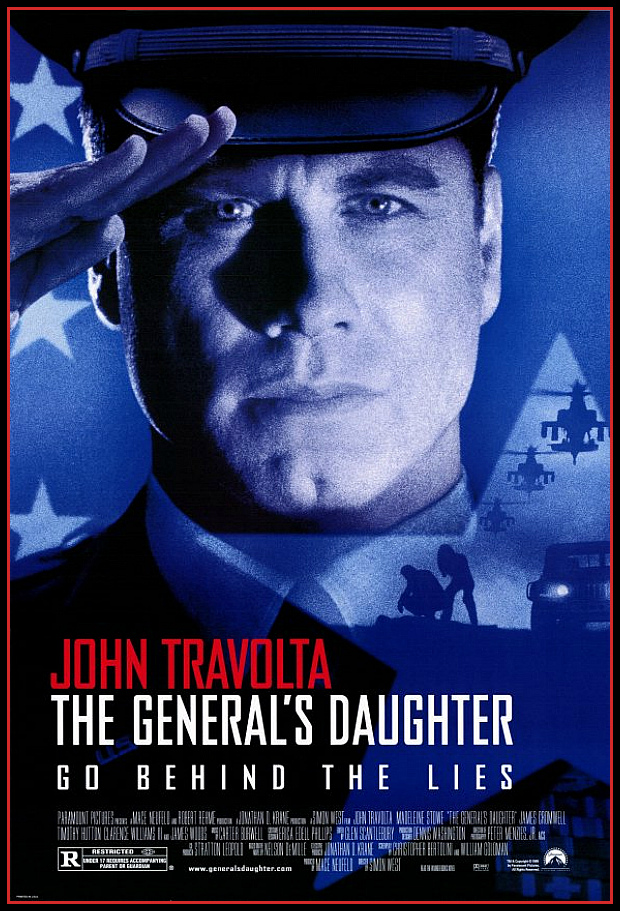
Quickie Review: The General’s Daughter (dir. by Simon West)


The time around the late 1990’s saw a slew of filmmakers who seemed to have been influenced by the filmmaking style of one Michael Bay. In 1998 one such film which had a certain Michael Bay look to it was the crime thriller The General’s Daughter by filmmaker Simon West (fresh off his success from the previous year’s Con-Air). This film adaptation of the Nelson DeMille novel of the same name starred John Travolta when he was still enjoying the second renaissance of his career brought on by his role in Pulp Fiction.

The General’s Daughter was pretty much a crime procedural wrapped around the secretive and insular world of military life. It has Chief Warrant Officer Paul Brenner (played by Travolta) of the Army’s CID investigating what seems to be the apparent rape and murder of a female officer who also happens to be the daughter of the base’s commandant and political-minded general. Brenner’s soon joined by another CID agent, Sara Sunhill (Madeleine Stowe), who must now navigate the insular world which makes up the officer ranks of the military. They find suspects cropping up faster than they could handle and the one prime suspect in base psychologist Col. Moore (James Wood in an over-the-top performance) has secrets about the victim that could jeopardize the lives and career of not just most of the officers on the base but the victim’s own father. This set-up and the basic understanding of the plot should make for a great thriller, but the by-the-numbers direction by Simon West and the over-the-top performances by too many of the characters in the film sinks The General’s Daughter before it could soar.

The story in of itself really has nothing to drag down the film. From the beginning the screenplay does a great job in tossing red herrings to keep the true murderer secret until the very end. It’s these red herrings which manages to bring out the ultimate reason as to the death of Capt. Elisabeth Campbell (Leslie Stefanson) and how a traumatic event in her past became the one major link which would lead to her death early in the film. It’s how these events were acted out which brings down the script. It’s been said that great performances could raise a mediocre script, but the same could be said for the opposite. Very average to bad performances could drag down a great script.

Travolta’s performance was good enough most of the time. He’s especially good when pouring on the Southern charm to try and gain an advantage over those he’s interacting with, but when he suddenly switches over to tough Army investigator that he goes from just beyond campy to over the line into full-blown camp. The same could be said for pretty much everyone in the film from Stowe’s character who manages to just stand around doing nothing but act as a sort of “gal Friday” for Travolta’s character until the very end when she suddenly becomes a crack investigator to help move the plot along. Clarence Williams III really hams it up as the base general’s right-hand man and one would wonder if he realized he wasn’t actually in a grindhouse or exploitation film when it was time to act.

Despite the performances dragging the film down I must admit that The General’s Daughter was quite watchable and entertaining to a certain level. It’s the film’s inadequacies which also makes it quite a disposable fare that should’ve been more. One wonders how the film would be done today with a different set of actors and a filmmaker who knew the nuances of how to navigate around a thriller. Until the inevitable remake from Hollywood gets greenlit (the way things get remade now it’s bound to happen) it’s this version of The General’s Daughter that’d be on record and it’s a film that has too many bad performances for a great screenplay to overcome. A film that ultimately remains mildly entertaining but forgettable in the end.

Review: The Midnight Meat Train (dir. by Kitamura Ryuhei)


There’s a certain number of books when I was much younger that I thought would’ve made for some great horror films. They were the early works by Clive Barker. Short stories collected into several volumes aptly dubbed his Books of Blood. While several short stories from these volumes were adapted to film in the intervening years most were not worth the time to watch them. So, lo and behold that when I finally saw the latest short story adapted from these collections I was genuinely surprised at how well-made and entertaining it turned out to be. The Midnight Meat Train by Japanese filmmaker Kitamura Ryuhei was a fine piece of horror filmmaking that dripped in atmosphere and a growing sense of existential dread right up to it’s very surprising end.

The Midnight Meat Train is quite a simple story when one really breaks it down to it’s component parts. It’s a crime thriller wrapped in the bloody layers of an extreme horror film. There’s a certain noirish quality to it’s storytelling as we see the film’s protagonist in Leon (Bradley Cooper). He’s a photographer struggling to find the inspiration for his next set of photographs and decides to wander the train stations at midnight to find that inspiration. It’s during one visit at night that he begins to suspect that he might’ve come across one of the latest missing persons who might’ve become a victim of the so-called “Subway Butcher”. The film shows his growing obsession in finding out if the urban legend of this so-called serial killer is actually true.

His mental state only deteriorates as the reality about the “Subway Butcher” (Vinnie Jones in one of his best roles to date) catches up to the truth on one midnight ride on the subway train. His witnessing of the killer at work brings him into a hidden world the rest of the city seems unaware or incapable of acknowledging despite the hundreds of people who go missing year in and year out for almost a hundred years. His girlfriend Maya (Leslie Bibb) and best friend Jurgis (Roger Bart) soon become drawn into Leon’s nightmarish situation and must confront the very boogeyman who has begun to haunt Leon’s waking life.

The film is Kitamura Ryuhei’s first Hollywood film and it doesn’t diminish the talent for some creative visuals he earned while directing horror and genre films in his native Japan. He makes great use of the nighttime setting and the stark environs of the subway trains at midnight to give The Midnight Meat Train an almost black and white look punctuated by vivid splashes of visceral red during the many inventive killings by Vinnie Jones’ mute Mahogany character. Kitamura showed that he was able to squeeze as much as was possible from a script that was average at best. Especially considering that the script had to adapt one of Barker’s shorter tales.

The performances by the ensemble group led by Bradley Cooper ranged from good to excellent with the aforementioned Vinnie Jones leading the pack. Even Bradley Cooper as the tormented protagonist Leon handled the role well. I’ve never warmed to Cooper as an actor as he always came across as a smirking douchebag in almost every role he played prior to this one. He quickly shed some of that reputation for me with his performance in this film and continues to do so with every one since this film. The smirk is still there but he has managed to drop the douchebag aspect of it. I also must point out a nice turn by veteran genre actor Tony Curran as the train conductor who exuded a sense of the otherworldly and a character who held the answers to the questions brought up by the film.

Since this is a horror film one must mention it’s horrofic aspects and this film fills it’s quota of horror. The scenes where Jones’ Mahogany dispatches the unwary last riders of the train at midnight were shot extremely well and with some visual flairs Kitamura has gained a reputation for. There’s nothing cartoony about these kills unlike other slasher films of it’s type. The kills are done in a brutal fashion as meat tenderizers smash into skulls and backs. Then there are the dressing of the kills which gives meaning to the film’s title. The only part of this film which seemed so out of place, but was necessary in the film’s overall narrative was the make-up effects in the end of the dead-end tunnel where Leon finally sees the truth of why Mahogany has been killing passengers on the subway train. It’s here that the film’s budget shows. At least Kitamura was smart enough to film these scenes in very low light to hide some of the zippers and laces on the costuming.

Overall, The Midnight Meat Train was one horror film in 2008 that deserved to have been seen by more people. It’s a shame that the handling of this film’s distribution by Lionsgate bordered on the criminal as it failed to be screened  by many theaters which led to it’s failure in the box-office. This was a horror film that delivered on the goods without pandering to the torture porn crowd who had begun to dominate the scene due to the popularity of the Saw franchise. Kitamura’s first work in America showed that he brings a fresh new voice to Western horror. The film also ends up becoming the best of all the Books of Blood short story adaptations and shows that Barker’s earlier grand guignol writing phase could be adapted well to the bigscreen.

Here’s to hoping that the failure of this film in the box-office (Again, I say fuck you Lionsgate) doesn’t keep other up-and-coming horror filmmakers from tapping into Barker’s volumes of short stories for their projects. There’s horror gold to be found there and Kitamura’s The Midnight Meat Train was one gleaming example of it.

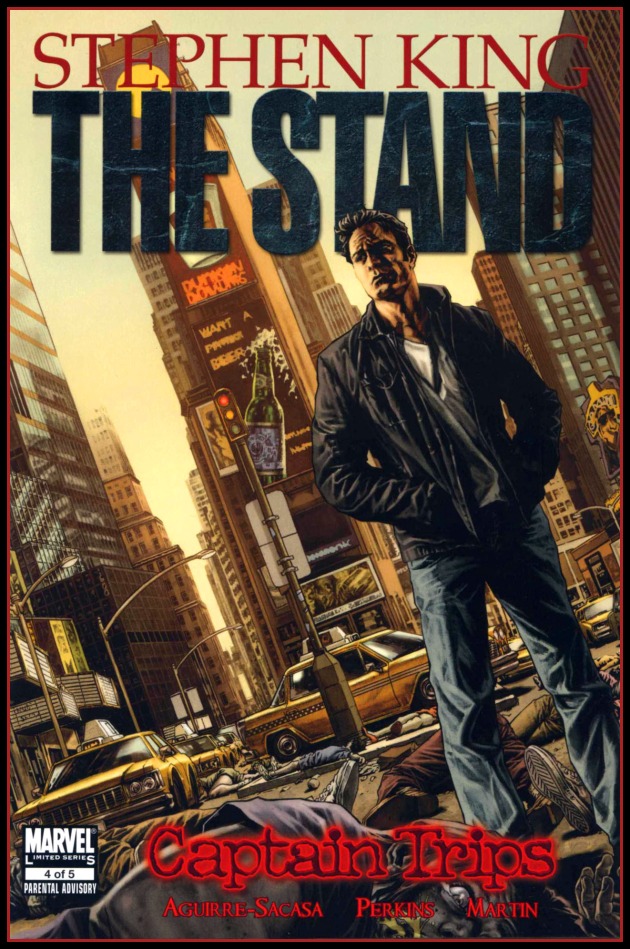
Stephen King’s The Stand to Trip Up Onto the Big-Screen


Stephen King properties sure has been heating up around Hollywood of late. For the past month or so we’ve had almost weekly news about Ron Howard’s plans for King’s massive book series, The Dark Tower. Today news that the role of Roland Deschain, the Gunslinger, has been offered to Spanish-actor Javier Bardem shows that the planned film adaptation of The Dark Tower is moving forward.

Now, according to The Hollywood Reporter blog Heat Vision, Warner Brothers and CBS Films are planning to co-produce the film adaptation of another Stephen King property and one many of his fans consider as their favorite. I consider myself one of those fans and I’m actually quite excited that these two studios are looking to adapt the epic, apocalyptic novel The Stand.

The novel already was adapted into a mini-series by Mick Garris in 1994, but that adaptation didn’t satisfy the book’s fans as its producers were hoping for. This planned film adaptation looks to give The Stand a grand stage to be shown to its old and new fans. While trying to adapt a novel that is over 1200 pages long might seem daunting the same was said about trying to adapt a novel that was three times it’s length and that one succeeded beyond anyone’s expectations. If Peter Jackson can take The Lord of the Rings and create an epic masterpiece out of such a dense piece of literature I think King’s The Stand should make just as good a transition.

Here’s to hoping that this particular apocalyptic project gets on the fast track and doesn’t get bogged down in development hell the way another apocalypse-themed film project has found itself in: Max Brook’s zombie epic novel, World War Z.

Source: The Hollywood Reporter