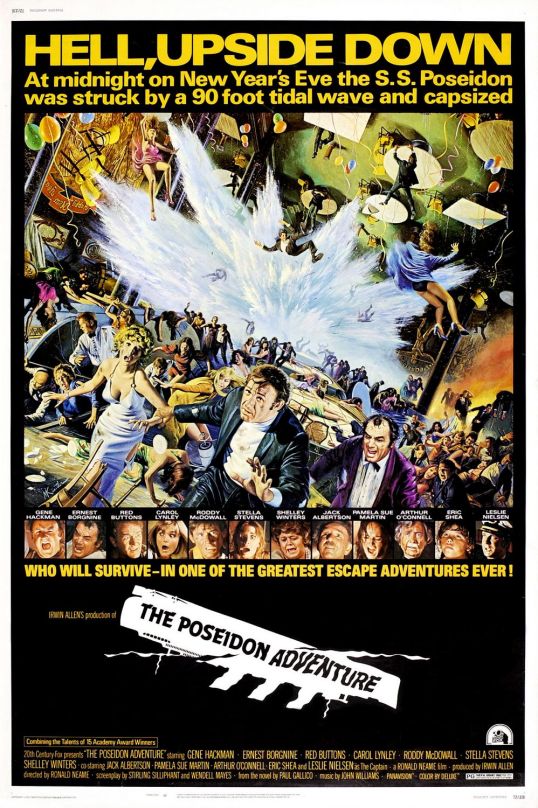
Ernest Borgnine, that great character actor, was born 104 years ago today. In tribute, today’s scene that I love comes from one of my favorite Borgnine films, 1972’s The Poseidon Adventure.
Borgnine was a great yeller and, in The Poseidon Adventure, he even manages to outyell the great Gene Hackman.
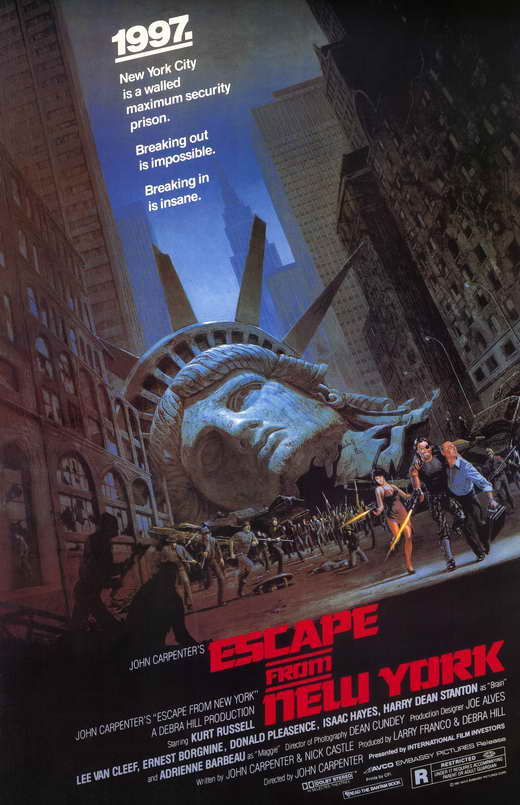
Continuing our celebration of John Carpenter’s birthday, today’s scene that I love comes from one of my favorite Carpenter movies, 1981’s Escape From New York.
In this scene, The Duke of New York makes quite an entrance. Not only does he have an entourage but his car comes with its own chandeliers and a disco ball! Along with writing and directing this film, Carpenter also composed the score.
So, you think you can just ignore the law, huh? Well, the Super Cops have got something to say about that! This film was based on the “true” adventures of two widely decorated NYPD cops. The cops were so good at their job that they were even nicknamed Batman and Robin. Of course, long after this movie came out, it was discovered that they were both corrupt and were suspected of having committed more crimes than they stopped. Amazingly, this film was directed by the same man who did Shaft. The Super Cops are kind of annoying, to be honest.
2. Super Fuzz (1980)
Far more likable than The Super Cops was Super Fuzz. Terence Hill plays a Florida cop who gets super powers! Ernest Borgnine is his hapless partner. The film was directed by Sergio Corbucci, of Django fame.
3. Miami Supercops (1985)
In 1985, Terence Hill returned as a Florida cop in Miami Supercops. This time, his old partner Bud Spencer accompanied him.
4. Miami Cops (1989)
Apparently, Miami needed a lot of cops because Richard Roundtree decided to join the force in 1989. Unfortunately, I could only find a copy of this trailer in German but I think you’ll still get the idea.
5. The Soldier (1982)
In order to celebrate loyalty, here’s the trailer for 1982’s The Soldier! They’re our government’s most guarded secret …. or, at least, they were. Then someone made a movie about them.
And finally, what better way to celebrate both Loyalty and Law Day than with a film that pays tribute to the Molokai Cops? From Andy Sidaris, it’s….
As some of our regular readers undoubtedly know, I am involved in a few weekly live tweets on twitter. I host #FridayNightFlix every Friday, I co-host #ScarySocial on Saturday, and I am one of the five hosts of #MondayActionMovie! Every week, we get together. We watch a movie. We tweet our way through it.
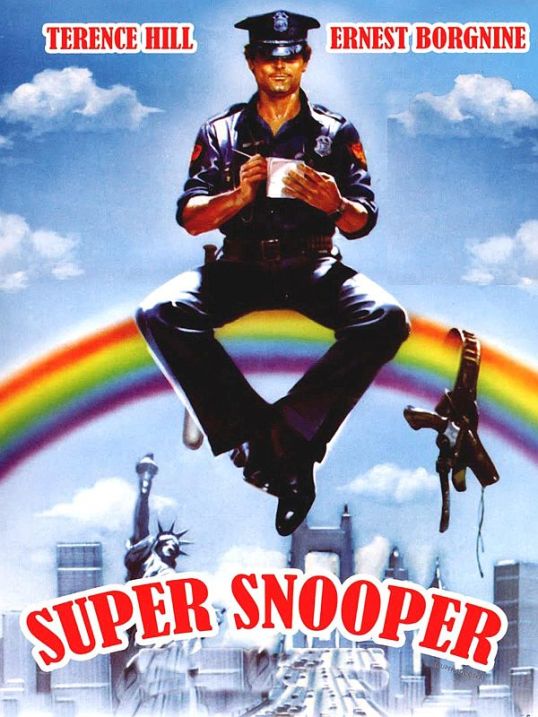
Tonight, at 10 pm et, #FridayNightFlix has got 1981’s Super Snooper!
Directed by Sergio Corbucci and starring Terence Hill and Ernest Borgnine, Super Snooper is the story of an amiable Florida cop who can do just about anything. The film is better known as Super Fuzz but, for some reason, Prime is going with Super Snooper. Whatever. We’re going to live tweet the Heck out of it, regardless of which title it’s under.
If you want to join us this Friday, just hop onto twitter, start the movie at 10 pm et, and use the #FridayNightFlix hashtag! It’s a friendly group and welcoming of newcomers so don’t be shy.
Super Snooper is available on Prime and YouTube! See you there!
With 2023 coming in like a tidal wave, it only seem fitting that the first scene that I love for this year should come from 1972’s The Poseidon Adventure. Just as how Die Hardhas recently been acclaimed as one of the great Christmas films, The Poseidon Adventures is one of the best of the New Year’s Day films. It’s also perhaps the only film in which Gene Hackman managed to overact more than even Ernest Borgnine. I mean, don’t get me wrong. It’s a strong competition between two great actors, neither of whom was known for being particularly subtle when it came to barking out their lines. But, in the end, Hackman still managed to take the overacting crown for this film.
(That said, what’s New Year’s Day without Borgnine shouting, “Where’s your God now, Preach-ah!?”)
In the scene below, the passengers ring in the new year while Leslie Nielsen faces the tidal wave that will soon turn the boat upside down. Whatever else you may want to say about this particular film, it does a great job of contrasting the celebrations in the ballroom with the dread on the bridge. While everyone else is counting down and celebrating and mugging for the camera, Nielsen can only stare in stoic horror as the wave approaches. He does the only thing that a captain can do. He sounds the alarm. He sends out an S.O.S. Unfortunately, the alarm can barely be hard over the celebrations of the new year and the S.O.S. man is quickly swept away by the crashing of the wave.
The scene goes from celebrating the future to highlighting the type of old-fashioned, nature-fueled destruction that has been wiping out civilizations since the beginning of time. It doesn’t matter how many plans you’ve made. It doesn’t matter how rich you are. It doesn’t matter how safe you feel or how much you cling to the furniture as the world turns upside down. Fate, whether it’s in the form of a wave or some other natural disaster, is pitiless. That’s one reason why disaster movies, as melodramatic as they could often be, so entranced audiences. Everyone knew that it would just as easily happen to them. Just as no one expected the tidal wave on New Year’s, no one would be expecting to leave the theater to be confronted by an earthquake or a tornado. But it could definitely happen. Life, like society, is a fragile thing. If not even Gene Hackman, Stella Stevens, Shelley Winters, and Roddy McDowall could make it to the end of the movie, what hope is there for anyone? Of course, the thing to remember is that they may not have made it but Ernest Borgnine, Red Buttons, Carol Lynley, and a few others did. They survived, though I imagine they spent the rest of their lives dreading January 1st.
Needless to say, neither the passage of time nor the wave can be escaped. As much as we may have things left to do in 2022, it’s too late now. 2023 is here and the world has moved on.
Was I the only one who was relieved that William Shatner didn’t die this week?
Seriously, when I heard that the 90 year-old Shatner was going to be taking a trip on one of the Amazon rockets, I was really worried. First off, you’re taking a 90 year-old into space. Secondly, you’re doing it with a rocket that people don’t really know that much about. And third, that 90 year-old is a cultural icon and one who probably played no small role in causing people like Jeff Bezos and Elon Musk to become obsessed with conquering space in the first place. With the exception of George Takei, everyone loves William Shatner. (And, at this point, Takei’s constant sniping about Shatner is coming across as being just a little bit petty. Move on, George! People love you, too.)
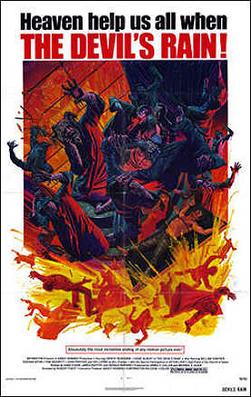
As I watched Shatner land back on Earth, I found myself thinking about The Devil’s Rain, a film from 1975 that starred William Shatner as a man whose exploration of the unknown led to a far less triumphant result.
In this film, Shatner plays Mark Preston, a youngish man who lives on ranch with his father (George Sawaya) and his mother (Ida Lupino). For some reason, the Preston family owns a book that is full of evil magic. Satanic high priest Jonathan Corbis (Ernest Borgnine) wants the book and when the Prestons refuse to hand it over, he makes it his mission to destroy them. He gets things started by turning Mark’s father into a weird, waxy zombie who melts in the rain. Not wanting the same fate to befall the rest of the family, Mark grabs the book and heads to a desert ghost town that has been taken over by Corbis and his followers. Mark never returns.
Mark’s older brother, Tom (Tom Skerritt) then shows up in town, searching for Mark. Accompanying him are his wife (Joan Prather) and a paranormal researcher (Eddie Albert). Tom discovers that Corbis is transforming his followers into zombies who have no memories and who exist only to …. well, I’m not sure what the point of it all is but I guess it basically comes down to Corbis needing something evil to do. Not only has Mark become one of his Corbis’s followers but, if you keep an eye out, you might spot a very young John Travolta in the background. This was Travolta’s film debut. According to the end credits, the character he plays is named Danny. Danny Zuko, perhaps? That would serve him right for making Sandy doubt herself.
The Devil’s Rain is one of the many low-budget movies that William Shatner did between the end of the Star Trek TV show and the start of the Star Trek movies. It’s a bit of an disjointed film, as I think any film starring William Shatner and Tom Skerritt as brothers would have to be. Skerritt gives a very laconic performance, playing his character as if he was the star of a Western. Shatner, meanwhile, does that thing where he randomly emphasizes his words and gets the full drama out of every sentence and facial expression. But, as much as Shatner overacts, you can’t help but enjoy his performance because he’s William Shatner and that’s what he does. The same is true of Ernest Borgnine, who overacts in his role just as much as you would expect Ernest Borgnine to overact when cast as an evil cult leader. For that matter, Eddie Albert isn’t exactly subtle as the paranormal researcher. Don’t even get me started on Keenan Wynn, playing yet another small town sheriff. Let’s just say that, with the exception of Tom Skerritt, the cast of The Devil’s Rain is not necessarily full of actors noted for their restraint. That said, there’s something rather charming about everyone’s attempts to steal every scene in which they appear.
The Devil’s Rain is a deeply silly film but that doesn’t make any sense but it’s hard not to get caught up in it. Even if the fact that this film is perhaps your only opportunity to see John Travolta melt on screen isn’t enough to make you watch, Shatner vs. Borgnine with Skerritt approaching in the distance is just too entertaining to resist! Thankfully, Shatner survived appearing in this film and revitalized his career through a combination of Star Trek movies and Canadian tax shelter flicks. He’s a survivor. In fact, I guess I shouldn’t have been surprised that, even at the age of 90, Shatner has no trouble going into space. William Shatner’s going to be around forever.
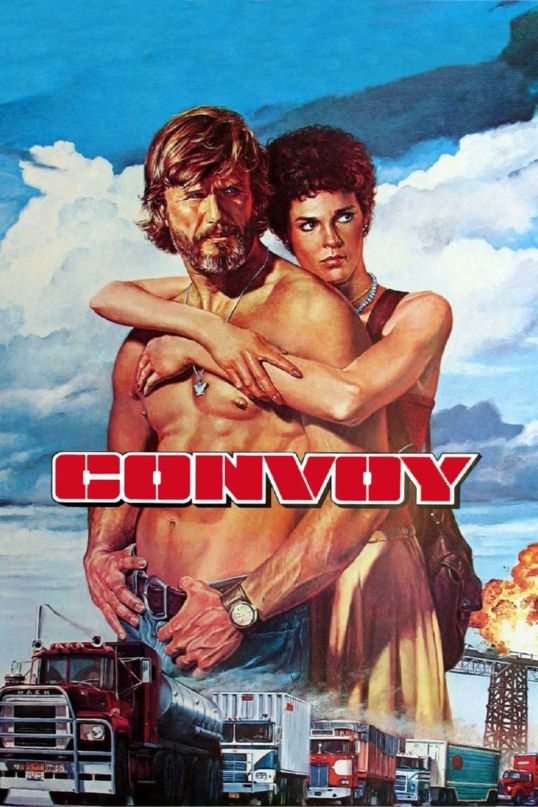
The 1978 film Convoy opens with the image of a truck passing by some hills that have been covered with snow. At a certain point, it actually looks like the truck is descending into a sea of white powder. It’s an appropriate image because, to film lovers and cinematic historians, Convoy will always be associated with cocaine.
Convoy was meant to be a relatively small-scale B-movie, one that was meant to capitalize on the popularity of a novelty song, as well as the recent success of other car chase films. Instead, it became a notoriously troubled production that went famously overbudget and overschedule as director Sam Peckinpah turned Convoy into a personal statement about modern cowboys and independence. When the film was finally released, it was the biggest box office hit of Peckinpah’s storied career. However, because so much money had been spent making the film, it still failed to make a profit and the film is regularly described as being one of the many flops of the late 70s that eventually led to the power in the film industry shifting away from the directors and over to the studio executives. Many in Hollywood grumbled that it was Peckinpah’s well-known cocaine use that led to him having such trouble with what should have been a simple B-movie. That’s probably a bit unfair to Peckinpah as it’s been written that just about everyone in Hollywood was using cocaine in 1978.
Add to that …. Convoy‘s not that bad.
Convoy tells the story of Rubber Duck (Kris Kristofferson), a legendary trucker who has never joined the Teamsters. He’s an independent. Rubber Duck’s nemesis is Sheriff Dirty Lyle (Ernest Borgnine), who is also an independent. He’s never joined the policeman’s union. As Rubber Duck puts it, “There’s not many like us anymore.”
Anyway, for reasons that are only vaguely defined, Rubber Duck leads a convoy of trucks across the southwest while being pursued by the police. It has something to do with protesting the law enforcement tactics of Dirty Lyle, despite the fact that Rubber Duck appears to kind of like Lyle. Soon hundreds of other independent truckers are joining Rubber Duck’s convoy, all to protest law enforcement. Among those in the convoy are Pig Pen (Burt Young), Widow Woman (Madge Sinclair), and Spider Mike (Franklyn Ajaye), who just wants to get home to his pregnant wife. Traveling with Rubber Duck is Melissa (Ali MacGraw), who is supposed to be some sort of photojournalist. Rubber Duck and Melissa fall in love but there’s only so much you can do with a love story when it centers around two of the least expressive stars of the 70s. During the chase, Rubber Duck picks up some non-truckers supporters, including some religious fanatics in a microbus. He and the truckers also drive through and destroy a lot of buildings, which kind of makes it look like the cops might have had a point.
What sets Convoy apart from other chase films of the 70s is just how seriously it takes itself. There’s an undercurrent of melancholy that runs through the entire film. Rubber Duck seems to know that America is changing and as people become more comfortable with the idea of sacrificing their freedoms, his days as an independent trucker are numbered. Dirty Lyle also seems to be stuck in a permanent existential crisis, taking no joy in being a crook but still forced to do so by being a part of an inherently corrupt government system. There’s a scene where a truckstop waitress offers herself up as a gift to Rubber Duck on his birthday and Peckinpah films it as if he’s making an Italian neorealist drama about Rome after the war. When Spider Mike says that he has to get home to his wife, he says it with the pain of a man who knows that the system only cares about control and not happiness. These aren’t just truckers. These are men and women who are on the front lines battling a creeping culture of oppression.
Surprisingly enough, the film’s serious tone actually works to its advantage. You may not fully understand why Rubber Duck is leading that convoy but you hope that it succeeds because you get the feeling that the world might end if it doesn’t. When the film ends with Ernest Borgnine laughing like a maniac, it comes across less like a moment of amusement and more like an acknowledgment that the universe is a tragic farce. Life is a riddle wrapped inside an engima and only Rubber Duck and Dirty Lyle seem to understand that fact.
Add to that, this is a film about independents refusing to allow themselves to be limited by the regulatory state. In its way, it’s one of the most sincerely Libertarian films ever made and, with all of us currently living under “lockdowns” and hoping that our governors don’t join those who have already surrendered their better instincts to their inner tyrant (sorry, Michigan, Kentucky, and New Jersey), Convoy remains an important film. Go, Rubber Duck, go!
When I was little, my Aunt would sometimes take my older brother and I with her into Manhattan. In a little movie theatre near 82nd Street, she’d get us a set of tickets for a film, help us get seated with snacks and then either stay for the movie or leave to perform housekeeping duties for someone nearby if she had work and we weren’t allowed to hang out on site. John Carpenter’s Escape From New York wasn’t a film she stayed for (she loved Raiders of the Lost Ark), but it was okay. I was introduced to Snake Plissken, who ended up being cooler than Han Solo to my six year old eyes. Instead of being the hero, here was a criminal being asked to a mission. It showed me that even the bad guys could be heroes, now and then (or better yet, not every hero is cookie cutter clean). The film became an instant favorite for me. As I also do with Jaws and The Fog, I try not to let a year go by without watching Escape From New York at least once. It was my first Carpenter film.
The cultural impact of Escape From New York is pretty grand, in my opinion. It had a major influence on Hideo Kojima’s Metal Gear video games and also spawned a few comics with Plissken, complete with Jack Burton crossovers with Carpenter’s Big Trouble in Little China.
Carpenter brought in most of the same crew he worked with in his previous movies. The film was the third collaboration between Carpenter and Debra Hill, who previously worked with him in 1978’s Halloween and 1980’s The Fog. Though Hill didn’t write this one, she was still the producer, along with Larry Franco. There’s also a bit of speculation on whether Hill performed the opening vocals describing New York or Jamie Lee Curtis handled that. Cinematographer Dean Cundey (who worked on most of Carpenter’s early films) returned to help give the movie it’s gritty look, which is helpful considering how much of it takes place either at night or in darkened rooms. Another interesting part of the production is James Cameron, who was the Director of Photography when it came to the effects and matte work. One of the best effects shots in the film has Plissken gliding over Manhattan, which was designed by Effects member John C. Wash. The shot on his plane’s dashboard of the city was made from miniature mock up with reflective tape that made it appear as if it were digital, which was pretty cool given that they weren’t on an Industrial Light and Magic budget. There’s a fantastic article on We Are The Mutantsand on theEscape From New York/LA Fan Pagethat focus on Wash’s technical contributions to the film.
For Carpenter’s career, Escape From New York marked the start of a great working relationship with Alan Howarth. Howarth, who also worked on the sound in the film, assisted Carpenter with the soundtrack. I’ve always felt this brought a new level to Carpenter’s music overall. You can easily hear the difference when Howarth was involved. Where Carpenter excelled at general synth sound, Howarth’s touch added some bass and depth. Together, they’d work on Christine, Big Trouble in Little China, Halloween III: Season of the Witch, Prince of Darkness and They Live together. On his own, Howarth was also responsible for both Halloween 2, 4 and 5.
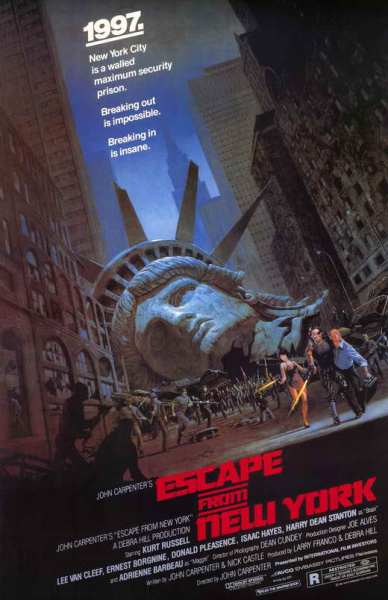
For the writing, Carpenter worked with Nick Castle, who played Michael Myers for him in the original Halloween. Escape From New York’s story is simple. In 1988, the crime rate for the United States rises 400 percent. As a result, someone had the notion to turn Manhattan into a prison for an entire country, setting up walls around the borough and mines in the waterways. When Airforce One crashes in the borough nearly a decade later, the recently arrested war hero / fugitive Snake Plissken (Kurt Russell) is given a mission. Go in, rescue the President and/or the tape he’s carrying in 22 hours, and Plissken receives a pardon for all his crimes. To ensure that he follows through, he’s injected with nano-explosives that will kill him when the deadline hits. What seems like a simple mission becomes a little complicated when Snake discovers the President was captured by The Duke of New York, played by Issac Hayes (I’m Gonna Git You Sucka). Given that I’ve commuted to Manhattan more times than I can count, the film holds a special place in my heart. The concept of the entire borough being a prison was mind blowing as a kid. The concept still holds up for me as an adult.
For a film about New York, there were only two days of filming actually spent on location there, according to Carpenter’s commentary. Most of that was used for the opening shot at the Statue of Liberty. The bulk of the film was made in Los Angeles, Atlanta and St. Louis. At the time, there was a major fire in St. Louis. The damage made for a great backdrop for both the crash site and the city at night. The film does take some liberties with locations, though. For example, as far as I know, we don’t have a 69th Street Bridge in Manhattan, but as a kid, it didn’t matter much. From an action standpoint, it might not feel as intense as other films. Even when compared to other films in 1981 – like Raiders of the Lost Ark (released a month earlier) – Escape From New York doesn’t have a whole lot, though I still enjoy what it does provide.
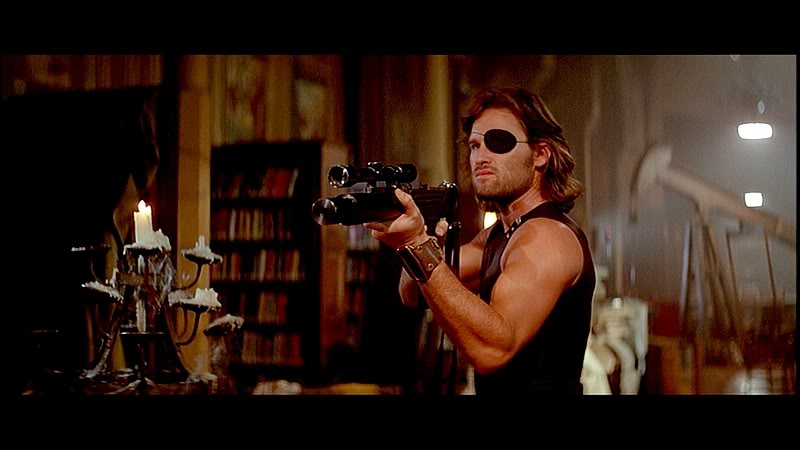
Snake Plissken (Kurt Russell) has 22 hours to save the President in John Carpenter’s Escape from New York.
Casting seemed to come easy for the film. Hill, Castle and Carpenter reached out to some friends. Kurt Russell and Carpenter worked together on Elvis, that was easy enough. Russell’s work with Carpenter would continue on in The Thing, Big Trouble in Little China and Escape from L.A. From Halloween, Donald Pleasance was brought on to play the President, along with Charles Cyphers and Nancy Stephens as one pissed off flight attendant. From The Fog, we have Tom Atkins as Nick and Adrienne Barbeau as Maggie, who happened to be married to Carpenter at the time. According to Carpenter on the film’s commentary track, the sequence for Maggie’s exit needed to be reshot and extended. The scene with her body on the ground was filmed in Carpenter’s garage and added to the film.
Ernest Borgnine’s (The Poseidon Adventure) Cabbie was a favorite character of mine. Like most cabbies, he knew the city well. He even prepared for some of its challenges with molotov cocktails. Harry Dean Stanton (Alien, Christine) played Brain, the smartest individual in the room and the supplier for gas for the Duke. If you look close, you’ll also catch Assault on Precinct 13’s Frank Doubleday as Romero, which his crazy looking teeth. To round it all out, Lee Van Cleef (The Good, The Bad & The Ugly) plays Hauk, who puts Snake on his mission. And of course, it wouldn’t be a Carpenter film without a George ‘Buck’ Flower cameo. Buck was kind of Carpenter’s lucky charm in the way Dick Miller was for Joe Dante’s films. Good Ol’ Buck plays an inmate who sings Hail to the Chief.
Overall, Escape From New York is a classic Carpenter film that’s worth the watch. Whether you do so while wearing an eyepatch or not, that’s on you. We all have our preferences.
Halloween is an obvious choice. It’s probably the film that John Carpenter is best-known for. The Thing and Assault on Precinct 13 are two other popular choices. Libertarians and anarchists have embraced They Live as a sacred text. In The Mouth of Madness is one of the few films to capture the feel of a classic H.P. Lovecraft story. Christine is one of the best of the Stephen King adaptations. My techphobic father recently purchased a Blu-ray player just so he could watch Big Trouble In Little China whenever he felt like it.
For me, though, my favorite will always be Escape From New York.
Everything about this movie, from the premise to the execution to the darkly funny ending, is pure brilliance. For those who have been living off the grid for the last 40 years, Escape From New York takes place in what was, at the time of the film’s initial release, the near future. Due to a 400% increase in crime, Manhattan has been turned into a floating prison. A wall has been built around the island. The bridges are covered in mines. All of the residents are prisoners who have been sentenced to a life term and the Chock Full O’Nuts is now literally full of nuts.
There’s a new resident of New York City. He’s the President (Donald Pleasence!) and he was supposed to soon deliver a classified cassette tape to the Soviets. Instead, with the world on the verge of war, Air Force One has crashed in Manhattan and the Duke of New York (Isaac Hayes!!) is holding him hostage. Bob Hauk (Lee Van Cleef!!!) recruits notorious criminal Snake Plisskin (Kurt Russell!!!!) to sneak into the prison and retrieve the cassette and save the President, by any means necessary. If Snake succeeds, he’ll get a pardon. If Snake fails, he’ll die due to the microexplosives that have been injected into his system.
How unbelievably cool is Kurt Russell as Snake Plisskin? Before fanfic was even known by that name, people were writing stories about Snake Plisskin’s past and how he lost his eye. Delivering his lines in a Clint Eastwood-style rasp, Kurt Russell gives one of the best action hero performances of all time. (Snake was the role that transformed Russell from being a clean-cut former Disney child star to being a cult film icon.) Everything that Snake says is quotable and, even with tiny explosives circulating through his blood, Snake never loses his cool. Sometimes, it doesn’t seem like Snake cares whether he lives or dies and that’s what makes Snake such a strong hero. He’s wiling to take the risks that no one else would. If he saves the President and the world, cool. If he doesn’t, neither was probably worth saving anyways. At the end of the film, Snake reveals that there are things that he does care about. If you don’t appreciate the people who sacrificed their lives for you, don’t expect Snake to do you any favors.
Snake gets some help from a rogue’s gallery of familiar faces, all of whom have their own reasons for trying to save the President from the Duke. Harry Dean Stanton is Brain while Adrienne Barbeau is Maggie. Brain is the smartest man in Manhattan and Maggie’s good with a gun and it’s too bad that we never got a prequel about how they met. My favorite of Escape from New York‘s supporting cast is Ernest Borgnine as Cabbie, who is the perfect New York taxi driver and whose taste in music plays off in an unexpectedly satisfying way.
Escape From New York is John Carpenter at his best, an exciting race against time full of memorable characters and thrilling action. Whenever I go to New York and I cross over a bridge into Manhattan, I think about Snake, Cabbie, and the gang driving through a minefield. Everyone who meets Snake says “I thought you were dead,” but we know better. Snake Plisskin will never die and neither will my love for Escape From New York.
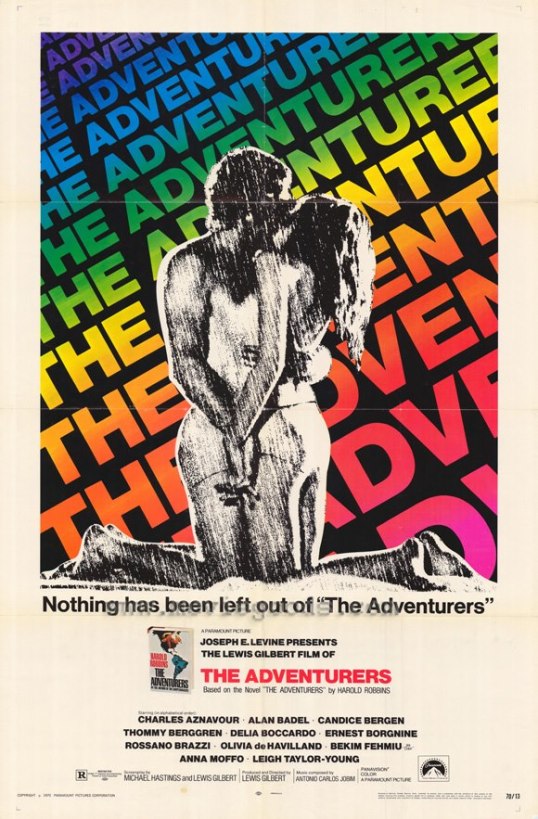
The 1970 film, The Adventurers, is a film that I’ve been wanting to watch for a while.
Based on a novel by Harold Robbins, The Adventurers was a massively expensive, three-hour film that was released to terrible reviews and even worse box office. In fact, it’s often cited as one of the worst films of all time, which is why I wanted to see it. Well, three weeks ago, I finally got my chance to watch it and here what I discovered:
Yes, The Adventurers is technically a terrible movie and Candice Bergen really does give a performance that will amaze you with its ineptitude. (In her big scene, she sits in a swing and, with a beatific look on her face, begs her lover to push her “Higher! Higher!”)
Yes, The Adventures is full of sex, intrigue, and melodrama. Director Lewis Gilbert, who did such a good job with Alfieand The Spy Who Loved Me, directs as if his paycheck is dependent upon using the zoom lens as much as possible and, like many films from the early 70s, this is the type of film where anyone who gets shot is guaranteed to fall over in slow motion, usually while going, “Arrrrrrrrrrrrgh….” A surprisingly large amount of people get shot in The Adventurers and that adds up to a lot of slow motion tumbles and back flips. Gilbert also includes a sex scene that ends with a shot of exploding fireworks, which actually kind of works. If nothing else, it shows that Gilbert knew exactly what type of movie he was making and he may have actually had a sense of humor about it. That’s what I choose to believe.
Despite the fact that The Adventurers is usually described as being a big-budget soap opera, a good deal of the film actually deals with Latin American politics. For all the fashion shows and the decadence and the scenes of Candice Bergen swinging, the majority of The Adventures takes place in the Latin American country of Cortoguay. If you’ve never heard of Cortoguay, that’s because it’s a fictional country. Two hours of this three-hour film are basically devoted to people arguing and fighting over who is going to rule Cortoguay but it’s kind of impossible to really get to emotionally involved over the conflict because it’s not a real place.
Ernest Borgnine plays a Cortoguayan named — and I’m being serious here — Fat Cat. Seriously, that’s his name. And really, how can you not appreciate a movie featuring Ernest Borgnine as Fat Cat?
Fat Cat is the guardian of Dax Xenos (Bekim Fehmiu). Dax’s father is a Cortoguayan diplomat but after he’s assassinated by the country’s dictator, Dax abandons his home country for America and Europe. While he’s abroad, Dax plays polo, races cars, and has sex with everyone from Olivia de Havilland to Candice Bergen. He also gets involved in the fashion industry, which means we get two totally 70s fashion shows, both of which are a lot of fun. He marries the world’s richest heiress (Bergen) but he’s not a very good husband and their relationship falls apart after a pregnant Bergen flies out of a swing and loses her baby.
Throughout it all, Fat Cat is there, keeping an eye on Dax and pulling him back to not only Cortoguay but also to his first love, Amparo (Leigh Taylor-Young), who just happens to be the daugther of Cortoguay’s dictator, Rojo (Alan Badel). In fact, when Fat Cat and Dax discover that an acquaintance is selling weapons to Rojo, they lock him inside of his own sex dungeon. That’s how you get revenge! And when Dax eventually does return to Cortoguay, Fat Cat is at his side and prepared to fight in the revolution. Incidentally, the revolution is led by El Lobo (Yorgo Voyagis), who we’re told is the son of El Condor.
The Adventurers is melodramatic, overheated, overlong, overdirected, and overacted and, not surprisingly, it’s eventually a lot of fun. I mean, the dialogue is just so bad and Lewis Gilbert’s direction is so over the top that you can’t help but suspect that the film was meant to be at least a little bit satirical. How else do you explain that casting of the not-at-all-Spanish Bekim Fehmiu as a Latin American playboy? Candice Bergen plays her role as if she’s given up any hope of making sense of her character or the script and the rest of the cast follows her lead. Ernest Borgnine once said that The Adventurers was the worst experience of his career. Take one look at Borgnine’s filmography and you’ll understand why that’s such a bold statement.
The Adventurers is three hours long but it’s rarely boring. Each hour feels like it’s from a totally different film. It starts out as Marxist agitprop before then becoming a glossy soap opera and then, once Fat Cat and Dax return home and get involved in the revolution, the film turns into “modern” spaghetti western. It’s a film that tries so hard and accomplishes so little that it becomes rather fascinating.
And, if nothing else, it reminds us that even Fat Cat can be a hero….
 Before you start, note that Escape From New York was recently showcased in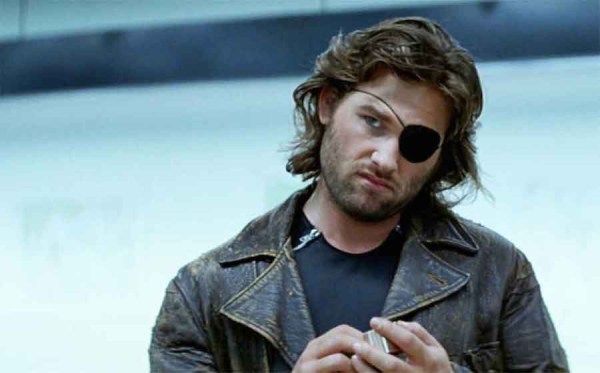


 Through the Shattered Lens