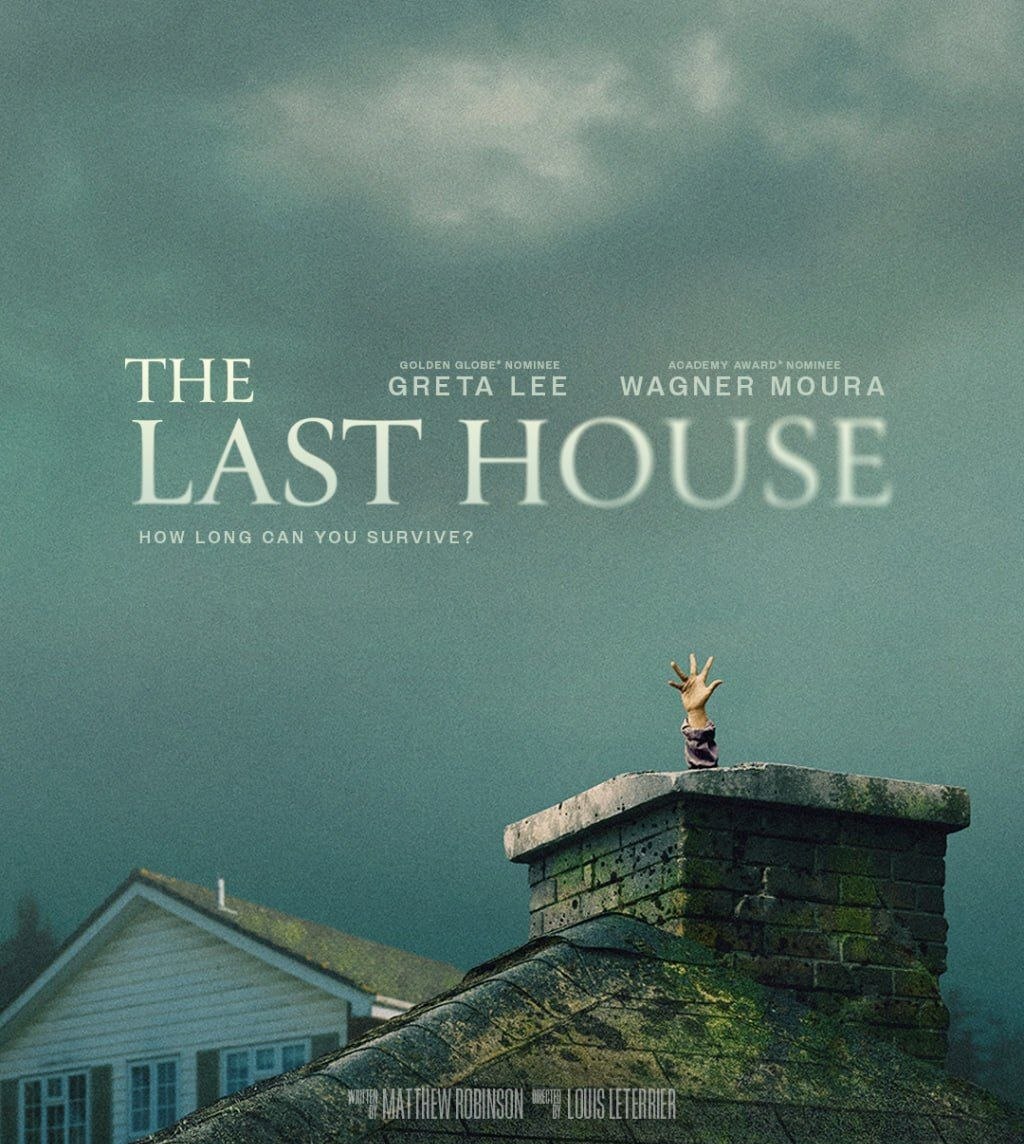
“The day the rains came, we learned we were not alone.” — Ruth Delgado
The Last House has the kind of premise that is immediately effective: a family wakes up to find that their home has become an inescapable prison. Doors refuse to open, windows cannot be broken, and the outside world is suddenly as unreachable as it is threatening. Directed by Louis Leterrier, the Netflix thriller gets plenty of mileage out of that simple idea. It turns a comfortable suburban house into a claustrophobic survival space, pushes a family toward desperation, and gives its familiar setting a creeping sense of hostility. Still, while the movie is often tense and well-acted, it eventually becomes too crowded with ideas to make any one of them land as strongly as it should.
Wagner Moura and Greta Lee play Jason and Ann Delgado, parents trying to keep their two children calm while they figure out why they have been sealed inside their own home. The film wisely does not waste much time getting to the central crisis. Once the family realizes that no amount of force can open a door or shatter a window, the atmosphere shifts quickly from confusion to panic. At first, there is still a practical logic to their reactions. They test the house’s boundaries, look for tools, try to contact the outside world, and ration what they have. But as each option fails, the family begins to understand that this is not a temporary inconvenience. It is a situation that may outlast their food, water, patience, and ability to trust one another.
That is where The Last House is at its strongest. The film understands how quickly a normal home can become frightening once its basic purpose changes. Kitchens, bedrooms, closets, and hallways are not inherently scary spaces, but the movie makes them feel smaller and more oppressive as the Delgados lose their sense of control. A stocked pantry becomes a countdown. A closed bedroom door no longer offers privacy. The family’s routines and minor annoyances, which initially make the house feel lived-in, become sources of friction when nobody has the option to leave. The production design effectively captures that deterioration, gradually turning an ordinary family home into a cramped, stale environment defined by empty shelves, dim rooms, and blocked exits.
Moura is the film’s standout. Jason begins as someone who wants to solve the problem through force of will and practical action, but that confidence wears down as he realizes that the situation is beyond him. Moura gives the character a believable mix of frustration, fear, and stubbornness. He is not simply an action-thriller father trying to save the day; he is a man whose sense of usefulness begins to collapse when he cannot protect his family or even provide a way out. Greta Lee is also good as Ann, particularly when the film allows her to show the exhaustion of having to steady everyone else while quietly processing the danger herself. However, Ann is not written with quite as much specificity as Jason, and Lee is sometimes left carrying scenes that ask her to reassure or react rather than reveal more about who she is.
The children help maintain the emotional stakes, though their roles are less developed. Their fear and frustration make sense, and the film does a decent job of showing how confinement affects them differently than it affects their parents. But they often function more as pressure points for Jason and Ann than as characters with their own fully formed perspectives. The family dynamic is convincing enough to keep the story grounded, yet the screenplay never digs quite deeply enough into their shared history or unresolved tensions. There are signs of financial strain, parental guilt, and marital distance, but the movie tends to introduce these ideas without fully following through on them.
The film also brushes against an interesting nature-versus-civilization theme. The Delgados’ home represents the ordinary comforts that make modern life feel secure: stocked food, electricity, sturdy walls, private rooms, and the assumption that help is available when something goes wrong. Once the house becomes sealed, those comforts lose their meaning. The family is forced to focus on the basics—food, water, shelter, sleep, and cooperation. Their home no longer separates them from danger; it contains them inside it. The movie’s best thematic moments come from that reversal, as it suggests that civilization is much more fragile than people like to believe.
Unfortunately, The Last House complicates this solid foundation by adding another mysterious danger from the depths. The threat remains vague for much of the story, and that uncertainty creates an unnatural, ominous feeling around the family’s confinement. It gives the film an extra layer of dread, making the Delgados’ problem feel bigger than a sealed house or an isolated storm. But it also pulls attention away from the more compelling material already in place. The family’s struggle to survive, their conflict over dwindling resources, and their gradual loss of trust are strong enough to sustain the movie without needing such an elaborate additional mystery.
That is ultimately the film’s main weakness: it keeps expanding its scope when it should be tightening its focus. The intimate story of a family stuck together under impossible conditions is more powerful than the larger explanation the movie slowly reaches for. As the plot adds more questions about the source of the danger, it risks making the situation feel less immediate. The best scenes are not necessarily the ones that hint at what is happening beyond the walls. They are the ones where the Delgados must decide who gets the last resources, whether to take a reckless chance, or how much truth the parents should tell their children. Those moments make the house feel like a real emotional battleground rather than simply the setting for a mystery.
Leterrier keeps the pacing moving well enough, especially in the first half, and the rainy exterior, muted lighting, and increasingly worn-down interiors give the film a consistently uneasy mood. Even when the screenplay starts to overreach, the movie remains watchable because it knows how to frame the house as a hostile space. It is not a deeply original visual concept, but it is effective. The sense of enclosure becomes almost physical as the family’s world shrinks to a few rooms and the possibility of escape starts to feel less real with every failed attempt.
In the end, The Last House is a decent, occasionally gripping survival thriller that does not fully live up to the potential of its premise. Moura and Lee give it enough emotional weight, and the movie’s domestic setting gives the tension a relatable edge. Yet the script does not always trust its strongest idea: that being trapped with the people you love can become frightening when there is no exit, no help, and no certainty that normal life will return. By piling a mysterious external danger onto its family drama and survival story, The Last House becomes more ambitious without becoming more meaningful. It is worth watching for its atmosphere, performances, and early suspense, but it would have been stronger as a leaner, more focused film about a family discovering how quickly safety can turn into confinement.

