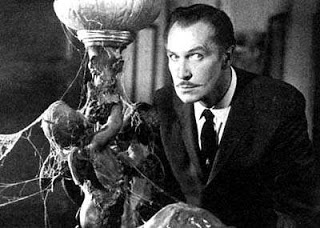
For today’s horror on television, we’re very happy to present to you, Dead of Night!
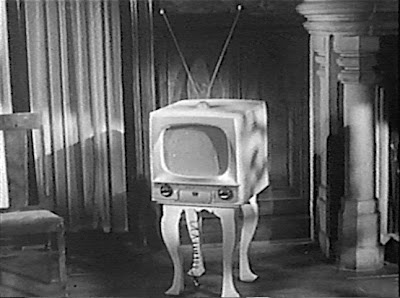
From 1977, this television film is a horror anthology, made up of three stories directed by Dan Curtis and written by Richard Matheson. In the first story, a youngish Ed Begley, Jr. travels through time. In the 2nd story, Patrick Macnee plays a man whose wife is apparently being menaced by a vampire. And in the third story, Joan Hackett plays a mother who brings her dead son back to life, just to discover that sometimes it’s best to just let sleeping corpses lies.
The entire anthology is good, though the third story is clearly the best and the most frightening. Not only is it scary but it’s got a great twist ending.
Long before he achieved holiday immortality by playing the father in A Christmas Story, Darren McGavin played journalist Carl Kolchak in the 1972 made-for-TV movie, The Night Stalker. Kolchak is investigating a series of murders in Las Vegas, all of which involve victims being drained of their blood. Kolchak thinks that the murderer might be a vampire. Everyone else thinks that he’s crazy.
When this movie first aired, it was the highest rated made-for-TV movie of all time. Eventually, it led to a weekly TV series in which Kolchak investigated various paranormal happenings. Though the TV series did not last long, it’s still regularly cited as one of the most influential shows ever made.
The Night Stalker is an effective little vampire movie and Darren McGavin gives an entertaining performance as the rather nervous Carl Kolchak.
First released in 1959 and starring the great Vincent Price, the original House on Haunted Hill is a bit of a Halloween tradition here at the Shattered Lens.
The House on Haunted Hill features Price as a millionaire who invites five people to a party that he and his wife are throwing in a supposedly haunted house. Price explains that anyone who can actually make it through the entire night will receive $10,000. (That’s the equivalent of a $110,000 today.) Is the house truly haunted? The groundskeeper (Elisha Cook, Jr.) certainly seems to think so!
This is a classic haunted house movie, featuring Price at his best and a number of genuinely fun twists. Even if you’ve seen it a hundred times, you need to watch it again. Here is …. THE HOUSE ON HAUNTED HILL!
I can still remember the first time that I saw the 1973 film, Messiah of Evil.
It was on a Monday night, many years ago. I had recently picked up a 10-movie DVD box set called Tales of Terror and I was using the movies inside to try to deal with a bout of insomnia. I had already watched The Hatchet Murders (a.k,a. Deep Red) and The House At The Edge of the Park and, at two in the morning, I was faced with a decision. Should I try to sleep or should I watch one more movie?
Naturally, I chose to watch one more movie and the movie I picked was Messiah of Evil. So, there I was at two in the morning, sitting at the edge of my bed in my underwear and watching an obscure horror movie while rain fell outside.
And, seriously — this movie totally FREAKED me out!
Messiah of Evil opens with a man (played by future director Walter Hill) stumbling through the night, obviously trying to escape from something. A mysterious woman appears and kills him. We’re left to wonder who the man was supposed to be as the film doesn’t ever really return to his murder. In most films this would be a weakness but it feels appropriate for Messiah of Evil, a film that plays out with the visual style and fragmented logic of a particularly intense nightmare.
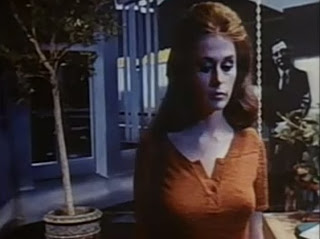
The rest of the story tells the story of Arletty (Marianna Hill), a neurotic woman who drives to an isolated California town in order to visit her father. Her father is an artist who specializes in painting eerie pictures of large groups of black-clad people. However, once she arrives at his home, Arletty discovers that her father has vanished and left behind a diary where he claims that a darkness has overtaken the town. Meanwhile, it sometimes appear as if the people in the paintings are moving or threatening to come out of the walls.
Meanwhile, one crazed man (Elisha Cook, Jr.) explains that “the dark stranger” is returning. An albino (Bennie Robinson) drives a truck up and down the street and talks about how he likes to listen to “Wagner.” The back of the truck is full of blank-faced people staring at the sky and the Albino eats a rat. Finally, a mysterious man named Thom (Michael Greer) is wandering about town with two groupies (played by Anitaa Ford and Joy Bang) and interviewing random townspeople. After meeting Arletty, they all end up moving into her father’s house.
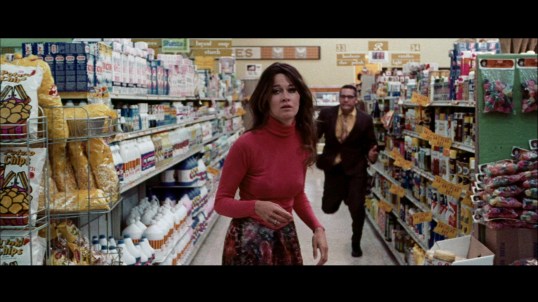
Messiah of Evil is literally one of the strangest films that I’ve ever seen. It’s shot in a dream-like fashion and the much of the film is left open to the viewer’s interpretation. Joy Bang goes to see a Sammy Davis, Jr. western and doesn’t notice as the theater slowly fills up with pale, red-eyed townspeople. Anitra Ford goes to a grocery store late at night and discovers the townspeople indulging in their appetites. If the film was only distinguished by those two scenes, it would still be worth saying. However, Messiah of Evil is a total and complete experience, a film where every scene matters and the audience is tasked with putting the puzzle together.
This film was directed by Gloria Katz and Willard Huyck, two longtime associates of George Lucas. (They wrote the screenplay for American Graffiti and Huyck directed Howard The Duck.) There’s absolutely nothing else in their filmography that is as surreal as Messiah of Evil, leading me to suspect that the film itself might be a very fortunate accident. Apparently, the production ran out of money before Katz and Huyck finished principal photography, which is what led to the film’s disjointed nature. Accident or not, Messiah of Evil is a masterpiece of surreal horror.
Messiah of Evil (1973, directed by Willard Huyck and Gloria Katz)
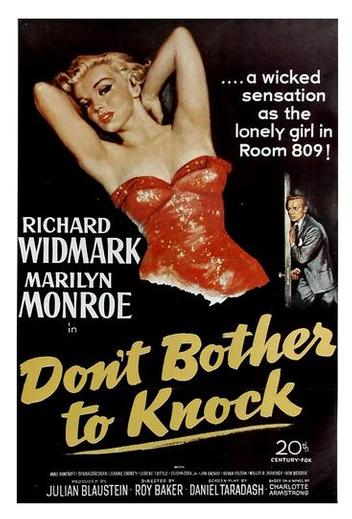
For Marilyn Monroe’s birthday, I’m going to share a scene from one of her earlier films, 1952’s Don’t Bother To Knock. In this film, Marilyn plays an unstable woman who is staying at a hotel. Her cousin (played by Elisha Cook, Jr.) gets her job as a babysitter but is shocked to find out that Marilyn has been trying on her employer’s clothes. After getting admonished by her cousin and pretending to be sorry, she proceeds to then summon another gust (played by Richard Widmark) over to her room.
It’s a simple scene but it’s wonderfully played by Monroe. This was one of her first truly dramatic roles and she does a good job with it.
From Don’t Bother To Knock, here is a scene that I love:
It’s Tax Day, which means that it’s a good day to remember that the IRS is not your friend.
That can sometimes be hard to forget, with all the talk of making people “pay their fair share” and all the drama that seems to accompany any suggestion that federal bureaucracy should be reduced. Back in 2003, there was a big story about how the IRS was going to hire 3,000 new employees and it amazed me how the media tried to frame this as being a good thing to which no one could possibly object. Whenever I turned on the news, I would see government official bragging about how they were going to bring in even more IRS agents to make “the billionaires” pay their fair share. (They may say “billionaires” but one can be sure that those 3,000 IRS agents weren’t going to anyone near anyone who donated to the right people.) In the recent election, I was always amused by analysts who were shocked to discover that many voters, especially those were struggling to pay their bills, weren’t enthusiastic about the idea of a supercharged IRS.
The fact of the matter is that people hate the IRS. The IRS exists to make people’s live difficult. The IRS exists to take our money away from us, money that we earned but which we are apparently not worthy of keeping. The IRS is an agency that demands that you do you own taxes but then threatens to throw you in jail if you make a mistake. When people hear 3,000 new IRS agents, they imagine 3,000 more people looking to take their money and toss them in prison for forgetting to carry the one. I often think that if the IRS simply sent people a bill every year, people would actually get a lot less upset about having to pay taxes. I get a property tax bill from the country and I have no problem paying it because it gives me an exact amount. Instead, the IRS says, “We know how much you owe but we’re not going to tell you. If you pay too much, you won’t get a refund and if you pay too little, we’ll destroy your life.”
On days like this, watching a film like 1981’s Harry’s War can be a cathartic experience. The film stars Edward Herrmann (yes, the History channel guy) as Harry, a postman who was raised by Beverly Payne (Geraldine Page), an eccentric woman who collects military memorabilia and whose property is listed as being a church and is therefore tax exempt. In her will, Beverly has named Harry as her heir. Arrogant IRS district director Ernie Scelera (David Ogden Stiers) is convinced that Beverly is hiding a fortune from the IRS and he proceeds to harass both her and Harry in court until Beverly drops dead of a heart attack. Harry inherits Beverly’s property and also her tax bill. However, Harry has also inherited all of her military stuff and soon, he’s crashing Ernie’s press conference with a tank and then engaging in a lengthy stand-off with the government. The film is a dramedy and you never really doubt that Harry will somehow triumph (even if his victory is ultimately a symbolic one) but the film still reminds us of how quickly the government will turn on its citizens when it’s being defied and the final few moments bring to mind some of the worst ATF and FBI excesses of the past 30 years. That said, Harry is quick to point out that he’s not waging war on the government. He’s waging war on the unelected bureaucrats who have forgotten that civil servants are supposed to work for the people and not against them. “All that power in one place,” Harry says scornfully about the IRS and it’s hard to deny that he has a point. It’s hardly a perfect film but, in this day and age, it’s a film that will leave you cheering.
With only a few days left until Halloween, I wanted to make sure that I continued an important tradition here at the Shattered Lens by sharing this film with our faithful and wonderful readers. Messiah of Evil was first released in 1973 and, since it’s in the public domain, it has since been included in a countless number of bargain box sets from Mill Creek.
I can still remember the first time that I saw Messiah of Evil. It was on a Monday night, many years ago. I had recently picked up a 10-movie DVD box set called Tales of Terror and I was using the movies inside to try to deal with a bout of insomnia. I had already watchedThe Hatchet Murders (a.k,a. Deep Red) and The House At The Edge of the Parkand, at two in the morning, I was faced with a decision. Should I try to sleep or should I watch one more movie?
Naturally, I chose to watch one more movie and the movie I chose was Messiah of Evil. So, there I was at two in the morning, sitting at the edge of my bed in my underwear and watching an obscure horror movie while rain fell outside.
And, seriously — this movie totally FREAKED me out!
Messiah of Evil tells the story of Arletty (Marianna Hill), a neurotic woman who drives to an isolated California town in order to visit her father. Her father is an artist who specializes in painting eerie pictures of large groups of black-clad people. However, once she arrives at his home, Arletty discovers that her father has vanished and left behind a diary where he claims that a darkness has overtaken the town.
Meanwhile, a mysterious man named Thom (Michael Greer) is wandering about town with two groupies (played by Anita Ford and Joy Bang) and interviewing random townspeople. One crazed man (Elisha Cook, Jr.) explains that “the dark stranger” is returning. After meeting Arletty, they all end up moving into her father’s house.
But that’s not all. There’s also an odd albino man who shows up driving truck and who eats mice….
Messiah of Evil is literally one of the strangest films that I’ve ever seen. It’s shot in a dream-like fashion and the much of the film is left open to the viewer’s interpretation. There are two classic scenes — one that takes place in a super market and one that takes place in a movie theater and the movie’s worth watching for these two scenes alone.
Messiah of Evil is a film that will be appreciated by all lovers of surrealism and intelligent horror and I’m happy to share it with you today.
For today’s horror on the lens, we have a real treat! (We’ll get to the tricks later…)
Long before he achieved holiday immortality by playing the father in A Christmas Story, Darren McGavin played journalist Carl Kolchak in the 1972 made-for-TV movie, The Night Stalker. Kolchak is investigating a series of murders in Las Vegas, all of which involve victims being drained of their blood. Kolchak thinks that the murderer might be a vampire. Everyone else thinks that he’s crazy.
When this movie first aired, it was the highest rated made-for-TV movie of all time. Eventually, it led to a weekly TV series in which Kolchak investigated various paranormal happenings. Though the TV series did not last long, it’s still regularly cited as one of the most influential shows ever made.
The Night Stalker is an effective little vampire movie and Darren McGavin gives a great performance as Carl Kolchak.
The original The House on Haunted Hill is a classic and one that we make it a point to share every Halloween. And since October is now halfway over, now seems like the perfect time to do so!
Welcome to Retro Television Reviews, a feature where we review some of our favorite and least favorite shows of the past! On Sundays, I will be reviewing the made-for-television movies that used to be a primetime mainstay. Today’s film is 1984’s Pigs vs. Freaks! It can be viewed on YouTube.
In the late 1960s, a small town is divided between the conservative older generation and their rebellious hippie children. Former high school football star Doug Zimmer (Patrick Swayze) has just returned from fighting in Vietnam and, unlike many of his former classmates, he is firmly on the side of the establishment. He wears his hair short. He has a job as a cop. He tries to keep his younger sister, Janice (Penny Peyser), from hanging out with hippies like his former best friend, Neal (Grant Goodeve).
Neal is also the son of the local police chief, Frank Brockmeyer (Eugene Roche). Though Frank and Neal have different political beliefs and Frank is always telling Neal to get a haircut, they still have a respectful relationship. When Neal complains that cops like Doug and his partner, Sgt. Cheever (Brian Dennehy), are always harassing the hippies who want to play football in park, Frank suggests a football game between the hippies and the police. When Neal agrees, the game becomes known as “Pigs vs. Freaks.”
While Frank coaches the Pigs and signs a few former athlete as police reservists, Neal recruits his former little league coach, a bearded guru who now goes by the name of Rambaba Organimus (Tony Randall) to serve as the Freak’s coach. He also places a call to a former football star named Mickey South (Adam Baldwin) and talks him into coming down from Canada to play in the game. Of course, Mickey is wanted by the FBI for dodging the draft so it might not seem like a great idea for him to risk federal prison for an exhibition football game but no matter! Who cares that there are now two federal agents watching the Freaks practice? There’s a game to be won!
Pigs vs. Freaks is an amiable mix of comedy and drama. Some of the comedy, like Tony Randall’s bearded guru and Stephen Furst’s perpetually frantic hippie linebacker, is a bit too broad but there’s enough moments of dramatic insight that it’s easy to overlook those flaws. I appreciated the fact that both the Freaks and the Pigs are treated fairly, with both sides getting a chance to make a case for themselves. When they first appear and start harassing the hippies for playing football in the park, it’s easy to dismiss both Doug and Cheever as fascists but a later scene, which is very well-played by both Brian Dennehy and Patrick Swayze, establishes them as just being two men who are confused by the direction of the world. Swayze, in particular, gives a strong performance that reveals the vulnerability underneath Doug’s tough exterior. As for the hippies, Mickey South is no self-righteous crusader but instead someone who feels the Vietnam War is wrong but who is also someone who both misses and loves his home country. Adam Baldwin does a wonderful playing him and is well-matched with Grant Goodeve, who plays the most reasonable hippie that one could hope to meet.
It’s a likable film and well-intentioned, a portrait of two opposing groups brought together by the love of one game. Some will cheer for the Pigs. Some will cheer for the Freaks. I cheered for both.