October True Crime: Murder So Sweet (dir by Larry Peerce)


1993’s Murder So Sweet, also known a Poisoned By The Love: The Kern County Murders (seriously, try to say that ten times fast), tells the story of Steven David Catlin.

Steven David Catlin lived in Bakersfield, California.  Catlin was a career criminal who was married six times and who found some personal redemption for himself as a member of the pit crew for a professional race car driver in Fresno.  Trust me, I’ve lived in enough small, country towns to know that people will overlook a lot as long as someone knows how to work on a car.

One thing that people noticed about Catlin is that the people around him had a habit of dying of mysterious illnesses.  Multiple wives, his adoptive parents, they all died with fluid in their lungs and they left behind not only a medical mystery but also quite a bit of money for Steven David Catlin.  Catlin would always insist on holding a cremation just days after his loved ones passed away.  Not only did that allow Catlin to move on but also kept anyone from being able to do a thorough autopsy.

Eventually, the police figured out that Catlin was just poisoning anyone who got on his nerves or threatened to divorce him.  He wasn’t even a particularly clever poisoner.  He used paraquet, a highly toxic herbicide and he kept the bottle sitting in plain view in his garage.  He might as well have just labeled it his “Poisoning Thermos.”  Catlin was convicted of multiple murders and he was sentenced to die in 1990.  Of course, this being California, Catlin is sill alive and sitting in San Quentin.  This really is a case of “If you lived in Texas, you’d be dead by now.”

In Murder My Sweet, Catlin is played Harry Hamlin, who steals the film as a dumb but charming redneck who walks with a confident swagger and has no fear of hitting on his ex-wife, even after he realizes that she’s trying to convince the police that he’s a murderer.  Helen Shaver played Edie Bellew, the ex who knows better than to trust Catlin.  Her current husband is played by Terence Knox and there’s plenty of scenes of him telling Edie that she needs to back off and that everyone knows that Steve Catlin isn’t a murderer.  In many ways, this is the ultimate Lifetime film in that Edie Bellew not only gets to put her ex-husband in prison but she also proves that her current husband doesn’t know what he’s talking about.

Murder My Sweet takes place in rural California and, as a result, everyone in the film speaks with a shrill country accent and we spend a lot of time in a really tacky beauty parlor.  Indeed, the film portrayal of country eccentricity is so over-the-top that I was tempted to say that it seemed as if the director was trying to rip-off David Lynch.  However, Lynch may have made films about eccentric characters but he never portrayed them as being caricatures.  Lynch loved his eccentrics while this film takes a bit of a condescending attitude towards them.  Still, it’s worth watching for Harry Hamlin’s sleazy turn as Steve Catlin, a guy who enjoys fast cars and making ice cream.

Just don’t eat that ice cream….
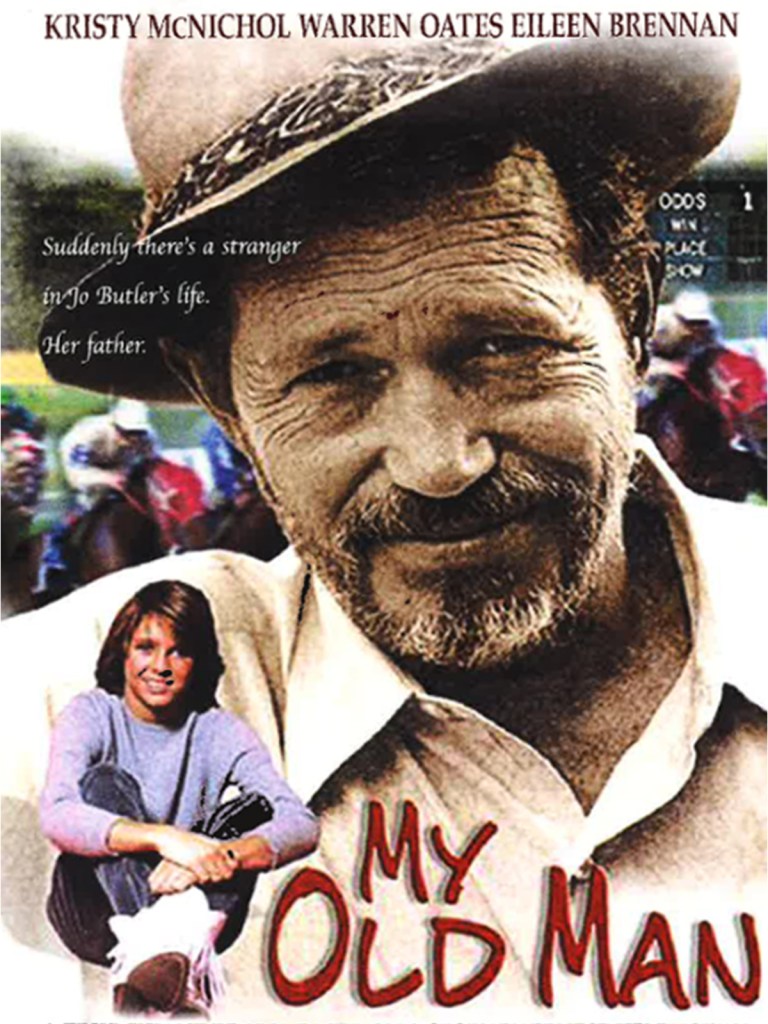
Brad reviews MY OLD MAN (1979) – starring Warren Oates and Kristy McNichol! 


In my continuing celebration of Warren Oates’ birthday, I decided to check out his 1979 TV movie MY OLD MAN, with Kristy McNichol. Based on a 1923 short story from Ernest Hemingway, Oates stars as Frank Butler, an alcoholic horse trainer and compulsive gambler, who goes to see his 16-year-old daughter, Jo (Kristy McNichol) after the death of her mother. In an effort to have some sort of relationship with Jo, Frank asks her to spend the summer with him, where he introduces her to his world of horse racing, as well as his old flame Marie (Eileen Brennan). Things get off to a rocky start, but with time the two start to develop a loving and meaningful relationship. Frank’s notorious bad luck even changes for the better for a while, and he’s able to buy Jo her own racehorse. Unfortunately, just as things are starting to go well, Frank suffers a life threatening injury in the horse stables, and Jo is faced with the possibility of having to take on life without her mother or her father… 

For a 1979 TV movie, I enjoyed MY OLD MAN. I like Warren Oates as the grizzled father who wants a relationship with his daughter but who also has no idea of how to go about it. He’s cranky and not happy to have someone else to answer to, but he also shows just enough vulnerability that we believe that he has a chance to be a caring dad. Kristy McNichol also does a good job as the 16 year old daughter who wants to get to know a dad that she’s only been told about thus far in her life, with most of those things not being very good. For this movie to work, their relationship has to work. I think both Oates and McNichol effectively express their characters’ desires to connect with each other simply because they’re father and daughter and that means something. As the father of a daughter myself, I know firsthand that our bond is truly special and one of the most important things in my life. And I’ll do anything to keep it that way. 

Aside from the central relationship between Frank and his daughter Jo, I also like the relationship between Frank and his old flame, the waitress Marie (Eileen Brennan). Brennan is very good in the role and effectively conveys her character’s strong love for Frank. Frank needs her and even tells his daughter at one point, “No matter what was going on with me, she never lost her respect for me, and she never stopped caring about me. To me, that shows a lot of class.” From my perspective, I know that all of us guys need someone like Marie in our lives. I’m extremely blessed to have my own “Marie,” even if she does go by a different name. I do want to mention one more relationship in the film that’s interesting, and that’s between Frank and his former jockey George, played by a young Michael Jeter. The two have a bad past that rears its head over the course of the film, and Jeter acquits himself quite well acting against the seasoned veteran. 

Overall, I enjoyed MY OLD MAN as it worked its way through its themes of family reconciliation and personal redemption. The last 20-30 minutes wasn’t quite as effective for me when the TV movie melodrama really kicked in. It still had some good moments, but it felt a little more forced once the focus shifted away from the relationships being developed by the central characters. With that said, I watched this movie in celebration of Warren Oates, and he’s just as great as I had hoped. He’s more than enough reason to watch the film even if it’s not perfect. 

Film Review: The Great Smokey Roadblock (dir by John Leone)


First released in 1977, The Great Smokey Roadblock tells the story of Elegant John Howard (Henry Fonda).

Elegant is not really his first name.  It’s a nickname, one to let us know that, in the world of independent truckers, John Howard was one of the good guys.  He never crashed his rig.  He never overcharged for a job.  He always arrived on time and in good shape.  John Howard was a good man but then he turned 60 and he got sick.  He spent months in the hospital, unable to work.  His truck was repossessed.  The movie starts with John sneaking out of his hospital room, stealing back his truck, and hitting the road in search of one final job.  Though John says he just wants to make enough money to get his truck back, the truth is that John is terminally ill.  If he’s going to die, he wants to die doing what he loves.  Of course, dying while driving could lead to some trouble for anyone else who happens to be on the road at the time but still, you have to respect John’s determination.  He’s a true American, independent to his core.

(My Dad occasionally made a living driving a truck so perhaps that’s why I’m partial to films like this one.)

John picks up a hitchhiker, a religious young man named Beebo Crozier (Robert Englund).  John picks Beebo up because Beebo was walking through the desert in a suit.  Beebo claims that he’s walking to Florida but John tells him that he can’t do that.  John will drive Beebo to Florida.  Of course, John also expects Beebo to pay for the gas that his truck uses because it’s not like John has any money.  At first, Beebo accuses John of cheating him.  (Henry Fonda cheating someone!?  Perish the thought!)  Soon, however, John has become Beebo’s mentor.

Everyone respects John but no one wants to hire him.  The only offer that John gets is from sleazy Charlie Le Pere (Gary Sandy), who has an agenda of his own.  Finally, John visits his old friend, Penelope (Eileen Brennan).  Penelope is a madam whose brothel has just been closed down.  John agrees to transport Penelope and her girls (including Susan Sarandon) to a new location on the East Coast.  Penelope offers to help John pay the bills.  Elegant John’s a pimp now!  (I was about to say that this seemed like an odd turn-of-events for Henry Fonda but then I remembered that he starred in The Cheyenne Social Club with Jimmy Stewart.)

There’s not really much of a plot to The Great Smokey Roadblock.  John, Beebo, Penelope, and the girls travel from one location to another.  They get thrown in jail by a notoriously corrupt deputy named Harley Davidson (Dub Taylor).  After they escape, they become minor celebrities.  Two counterculture journalists (played by Austin Pendleton and John Byner) show up and help them broadcast their story and the film comes to a halt while Pendleton and Byner exchange what sounds like improvised dialogue.  The police attempt to set up a roadblock to stop Elegant John and his Six Mystery Women.  I guess that’s the Great Smokey Roadblock of the title.

It’s a weird movie, in that the humor is extremely broad and often crude but Henry Fonda is playing a man who is not only terminally ill but who actually looks like he’s terminally ill.  (Henry Fonda himself was reportedly very ill during the filming of The Great Smokey Roadblock.)  As such, it’s a rather melancholy comedy, one in which every joke seems like it might be the last one that Elegant John will ever hear.  In the 70s, not even a trucker comedy could have a happy ending and, as such, The Great Smokey Roadblock feels like a drive-in film for the existential set.  The film’s plot doesn’t really add up to much and is full of plot holes that serve as evidence of a troubled production.  That said, there’s something rather charming about seeing a pre-Nightmare On Elm Street Robert Englund playing a gentle guy who ends up as Henry Fonda’s protegee.  Fonda and Englund play off each other well and their scenes together are the best thing about The Great Smokey Roadblock.

Retro Television Review: Playmates (dir by Theodore J. Flicker)


Welcome to Retro Television Reviews, a feature where we review some of our favorite and least favorite shows of the past!  On Sundays, I will be reviewing the made-for-television movies that used to be a primetime mainstay.  Today’s film is 1972’s Playmates!  It  can be viewed on YouTube.

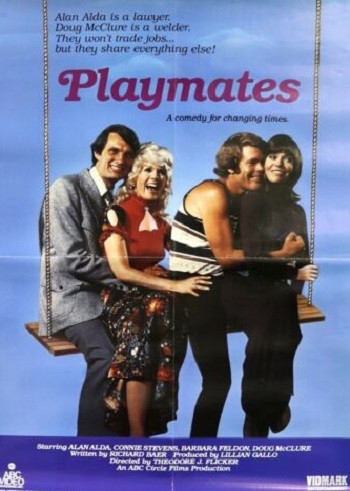
Playmates tells the story of two divorces.

Marshall Barnett (Alan Alda) is an attorney.  He went to Yale and Harvard.  He has a successful career.  He has rich and educated friends.  He has a nice bachelor pad.  He also pays hundreds of dollars in alimony.  He and Lois (Barbara Feldon) got divorced 3 years ago and Marshall is still bitter.  He’s bitter that he has to pay her so much money.  He’s bitter that he only gets to see his son on the weekends.  He’s bitter that he can’t seem to start a new, meaningful relationship with anyone.  He’s bitter that his wife still asks him to critique her modernist paintings.

Kermit Holvey (Doug McClure) is a blue collar welder.  He has only been divorced for a few months and his relationship with ex-wife Patti (Connie Stevens) is nowhere near as contentious as Marshall’s relationship with Lois.  Still, Kermit is struggling to adjust to being single and to only seeing his son on the weekends.

Marshall and Kermit meet one weekend while they are both taking their sons to the Kiddieland Amusement Park.  Marshall is so overjoyed to meet someone else who is dealing with divorce that he comes on a bit strong in trying to get to know Kermit.  Kermit, however, does eventually get over his initial weariness and soon, he and Marshall are best friends.  It doesn’t matter that Marshall has a tendency to be a little bit condescending and that Kermit often can’t follow what Marshall is talking about.  They spend most of their time talking about their ex-wives.

But then Kermit meets Lois and he discovers that her paintings really aren’t as bad as Marshall made them out to be.  And Marshall meets Patti and he discovers that she’s not as dumb as Kermit made her out to be.  Soon, Kermit is secretly dating Lois and Marshall is secretly dating Patti and anyone who has ever watched a comedy before knows that there is a big mess waiting in the future.

Playmates was one of those films that pretended to be a lot naughtier than it actually was.  For all the winking and the occasional sly smiles, all that happens is that Kermit and Marshall both end up going out with women with whom they really don’t have much in common.  And while it’s tempting to read a lot into how quickly Kermit and Marshall become friends and how they both end up dating the other’s female equivalent, I think that might be giving this film too much credit.  (If it were made today, things might be different.)  In the end, the film really has more to say about class than it does marriage, as both Marshall and Lois obviously view spending time with Kermit and Patti as being a way of slumming and building up some working class bona fides without actually having to be working class.  Patti, to her credit, calls Marshall out on this.  Marshall admits that she has a point but he still come across as if he’s talking down to her, largely because he’s played by Alan Alda, an actor who is a master at being somehow both likable and condescending at the same time.

Playmates is a well-acted film and there are some funny lines.  The four main characters are all ultimately likable, even if they all have their moments where you can tell why they would be difficult to live with.  It deserves some credit for following its story through to its natural conclusion, with one couple realizing that they still love each other while the other realize that they are better off divorced.  The film may not be as radical as it pretends to be but it still doesn’t cop out on the ending.  In the end, Playmates is probably best watched as a time capsule.  It’s here if you ever want to experience 1972 firsthand.

Retro Television Review: The Death of Richie (dir by Paul Wendkos)


Welcome to Retro Television Reviews, a feature where we review some of our favorite and least favorite shows of the past!  On Sundays, I will be reviewing the made-for-television movies that used to be a primetime mainstay.  Today’s film is 1977’s The Death of Richie.  It  can be viewed on YouTube!

It’s not a spoiler to tell you that this film ends with the death of a teenager named Richie.  It’s right there in the title.  We start the film knowing that Richie is going to die.  The only question is how it’s going to happen and who, if anyone, is going to be held responsible for it.

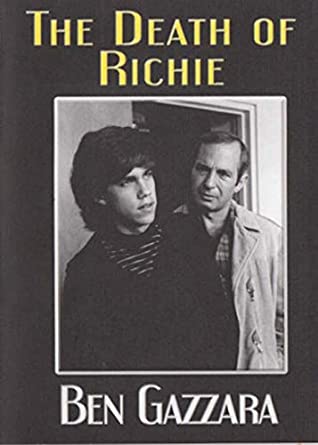
Played by Robby Benson, Richie Werner is a sensitive teenager living in the suburbs.  He’s painfully shy and he deals with that shyness by taking the drugs that are supplied to him by friends like Brick (Charles Fleischer) and Peanuts (Clint Howard, yes that Clint Howard).  His parents, George (Ben Gazzara) and Carol (Eileen Brennan), knows that Richie is struggling with both drugs and school.  However, neither one of them have a clue as to how to help him.  Carol spends most of the film silently hoping that things will somehow just magically get better.  Meanwhile, George can’t understand his son and, even worse, he makes no attempt to understand him.  George holds back his feelings and he’s obviously uncomfortable with his emotional son.  George is the type who retreats to his basement when he needs to get away from the world and yet, he can’t understand why his son needs a similar sanctuary.  When he discovers that Richie has set up a mini-bedroom in his closet, George destroys it.

Throughout the film, Richie tries to get his life straightened out.  He gets a job working at a restaurant but he quits after his friends laugh at his dorky uniform.  He tries to date a girl named Sheila (Cindy Eilbacher) but is heartbroken when he discovers that she’s going out with someone else.  When Richie tries to talk his dad, George refuses to listen.  When George tries to talk to Richie, Richie tells him to get out of his room.  Finally, after Richie crashes his car one last time, it leads to an act of shocking violence.  After all, the film is called The Death of Richie.

It’s also based on a true story, though there’s some debate over whether or not the film gets the story correct.  In real life, Richie’s named was George Richard “Richie” Diener and he lived in Long Island.  (The film appears to take place in a generic California suburb.)  Richie’s death inspired a magazine article and book, both of which inspired this film.  While I was doing research for this review, I came across a website about Richie’s death, one that argued that both the film and the book were too sympathetic to George’s version of what happened the day that Richie died.  The site has comments from many of the people who knew Richie and I recommend it to anyone who watches this film and want to know the other side of the story.

As for the film itself, it’s well-directed, intense, and, at times, rather heart-breaking.  As portrayed in the film, Richie is so desperate for some sort of approval that your heart just goes out to him.  Robby Benson is one of those actors who you come across in a lot of 70s films.  I’ve always found his performances to be a bit inconsistent and that’s certainly the case here.  He’s good when he’s allowed a quiet moment or two but there are other times when he gets so shrill that it takes you out of the reality of the film.  Ben Gazarra does a good job playing George as someone who loves his family but who is incapable of understanding his son’s pain.  Gazarra adds just a hint of ambiguity to his anger toward Richie.  Is he upset because Richie keeps getting trouble or has he reached the point where he’s just looking for an excuse to get Richie out of the family’s life?  According to the comments that I read at the blog mentioned above, both the film and the subsequent book based solely their portrayal of the last minutes of Richie’s life on George’s account.  Many people felt that there was more to what happened.

The film is a bit quick to blame all of Richie’s problems on the drugs.  While the drugs probably didn’t help, there are times when the film seems to suggesting that Richie would have been a happy, go-lucky kid if he had never taken that first Seconal.  Watching the film today, it’s obvious that there was a lot more going on with Richie than just weed and pills and it’s also obvious that calling the cops having them search his room while he watched was not the solution either.  Richie needed someone to talk to and, in the film at least, that was apparently the one thing that he could not get.  As the song says, things get a little easier once you understand.

Film Review: Clue (dir by Jonathan Lynn)


It was a dark and stormy night in 1954….

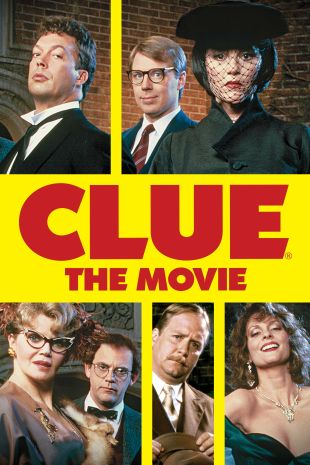
The 1985 comedy, Clue, opens with a set of six strangers arriving at an ominous mansion in New England.  They’re meet by Wadsworth (Tim Curry), an oddly charismatic butler who explains that all six of the strangers have a few things in common.  They all work in Washington D.C.  They are all, in some way, involved with the government.  And they’re all being blackmailed by Mr. Boddy (Lee Ving), the owner of the house.

The six strangers have all been assigned nicknames for the night.

Miss White (Madeleine Khan) is the enigmatic widow of a nuclear physicist who may have had communist sympathies.  Actually, Miss White is a widow several times over.  All of her husbands died in circumstances that were a bit odd.  Is Miss White a black widow or is she just unlucky?  And what about the flames of jealousy that she occasionally mentions?

Professor Plum (Christopher Lloyd) is a psychiatrist who once worked for the World Health Organization and who has an unfortunate habit of sleeping with his patients.

Mr. Green (Michaele McKean) explains that he works for the State Department and that he is also secretly gay.  If his secret got it, he would be deemed a security risk or perhaps even a communist agent.

Mrs. Peacock (Eileen Brennan) is the wife of a U.S. Senator who forced to resign after getting caught up in a bribery scandal.

Colonel Mustard (Martin Mull) is a somewhat stuffy war hero-turned-arms dealer.

And finally, Miss Scarlet (Lesley Ann Warren) is Washington D.C.’s most powerful and most witty madam.

Once everyone is in the house, Wadsworth explains that the police have been called and will arrive in 45 minutes, at which point Mr. Boddy will be arrested and everyone’s secrets will be exposed.  Mr. Boddy’s solution is to suggest that one of the six kills Wadsworth.  After tossing everyone a weapon, Mr. Boddy turns out the lights.  When the lights come back on, Wadsworth is still alive but Mr. Boddy is not.  But who murdered Mr. Boddy?  And in what room?  And with what weapon?  And what to make of the other people who were either in the house or show up at the front door, like the maid, Yvette (Collen Camp), or the motorist (Jeffrey Kramer) who shows up to use the phone or the traveling evangelist (Howard Hesseman)?  Can the mystery be solved before the police show up and presumably arrest everyone?

Based on the old board game, Clue is a hilariously exhausting film, one that mixes smart wordplay and broad physical comedy to wonderful effect.  It’s not often that you see a film that gets equal laughs from two people colliding in a hallway and from characters accusing each other of being communists.  In fact, it’s so easy to marvel at the physical comedy (especially the lengthy scene where Tim Curry runs from room to room while explaining his theory about who committed the murders) that it’s easy to forget that the film is also a sharp satire on political corruption, national paranoia, 50s morals, and the McCarthy era in general.  Since all of the characters are already convinced that they’re either surrounded by subversives or in danger of being accused of being a subversive themselves, it’s not a great leap for them to then assume that any one of them could be a murderer.  I mean, if you’re willing to betray your country than who knows what you might be willing do in the study with a candlestick?

The cast is full of comedy veterans, all of whom know how to get a laugh out of even the mildest of lines and none of whom hold back.  Madeline Kahn, in particular, is hilarious as Miss White though my favorite suspect, in both the game and the movie, has always been Miss Scarlet.  Not only is she usually portrayed as being a redhead in the game but, in the movie, her dress is to die for.  In the end, though, it’s perhaps not a surprise that the film is stolen by Tim Curry’s energetic performance.  The film’s final 15 minutes are essentially a masterclass in physical comedy from Tim Curry but he’s just as funny when he’s delivering his frequently snarky dialogue.  Both Wadsworth the character and Tim Curry the actor appear to be having a blast, running from room to room and shouting out accusations.

When Clue was originally released, it was released with three different endings.  Apparently, the audience wouldn’t know which ending they were going to get before the movie started.  I guess that the idea was to get people to go the movie three times to see each ending but I imagine few filmgoers had the patience to do that and who knows how many viewers went to multiple showings just to discover that the randomly selected ending was one that they had already seen.  I’m surprised that I haven’t come across any reports of riots breaking out.  Fortunately, the version of Clue that is now available for viewing features all three endings.  Of course, none of the endings make much sense.  Hercule Poirot would demand a do-over, especially if he was being played by Kenneth Branagh.  But the fact that it’s all so ludicrous just adds to the comedy.  I watched Clue two Fridays ago with a group of friends and we had a blast.  It’s definitely a movie that’s more fun when you watch it with other people.

(That said, as far as incoherent solutions are concerned, the third one was my favorite and I think Poirot would agree.)

As for the board game itself, I used to enjoy playing it when I was a kid.  We had really old version from the 60s and I always used to imagine what all of the suspects were like when they weren’t being accused of murder.  I always imagined that Mr. Green and Miss Scarlet probably had something going on.  Today, I’ve got a special Hitchcock edition of the game.  It’s all good fun, this never-ending murder mystery.

Lisa Reviews a Palme d’Or Winner: Scarecrow (dir by Jerry Schatzberg)


With the 2021 Cannes Film Festival underway in France, I thought this would be a good opportunity to spend the next few days looking at some of the films that have won the Palme d’Or in the past.  As of this writing, 100 films have won either the Palme d’Or or an earlier version of the award like the Grand Prix du Festival International du Film.  Some of those films — like Parasite, The Tree of Life, The Piano, Pulp Fiction — went on to huge box office success and Oscar renown.  Others, like 1973’s Scarecrow, did not.

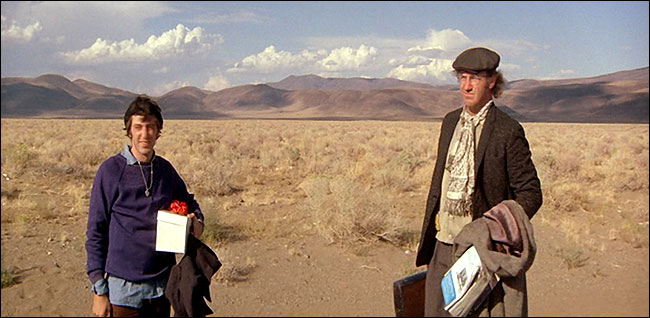
Scarecrow is an example of a type of film that was very popular in the 70s.  It’s a road film, one in which two or more people take a journey across the country and discover something about themselves and, depending upon how ambitious the film was, perhaps something about America as well.  Scarecrow centers on two drifters, who just happen to meet on a dusty road while they’re trying to hitch a ride.  Max (Gene Hackman, fresh off of winning an Oscar for The French Connection) is an ex-convict with a bad temper and a huge chip on his shoulder.  Lion (a young Al Pacino, fresh off of The Godfather) is an ex-sailor who views the world with optimism and who appears to be sweet-natured but simple-minded.  To be honest, it’s a little bit hard to believe that the perpetually resentful Max and the always hopeful Lion would ever become friends but they do.  They travel around the country, talking about their dreams of opening a car wash together.  They meet up with ex-girlfriends and ex-wives.  Eventually, they even end up in a prison farm together, where Lion, temporarily estranged from Max, is taken advantage of by a sadistic prisoner named Riley (Richard Lynch).

Scarecrow is an episodic film, one that moves at its own deliberate pace.  (If that sounds like a polite way of saying that the film is slow-moving …. well, it is.)  Director Jerry Schatzberg was a photographer-turned-director and, as a result, there’s several striking shots of Max and Lion standing against the countryside, waiting for someone to pick them up and give them a ride.  Whenever Max and Lion end up in a bar, the scene is always lit perfectly.  At the same time, Schatzberg also attempts to give the film a spontaneous, naturalistic feel by letting scenes run longer than one would normally expect.  There’s several scenes of Hackman and Pacino just talking while walking down a country road or a city street.  On the one hand, you have to appreciate Schatzberg’s attempt to convince us that Max and Lion are just two guys with big dreams, as opposed to two Oscar-nominated actors pretending to be societal drop-outs.  On the other hand, Schatzberg’s approach also leads to an interminably long scene of Gene Hackman eating a piece of chicken and if you think that Gene Hackman was the type of actor who wasn’t going to act the Hell out of gnawing on and gesturing with a chicken bone, you obviously haven’t seen many Gene Hackman films.

The main appeal of the film, for most people, will probably be to see Gene Hackman and Al Pacino, two of the top actors of the 70s, acting opposite of each other.  Reportedly, both Hackman and Pacino went full method for the film and spent their prep time on the streets of San Francisco, begging for spare change.  The end result is a mixed bag.  There are a few scenes — like when they first meet or when they’re in prison — in which Hackman and Pacino are believable in their roles and you buy them as two lost souls who were lucky enough to find each other.  There are other scenes where they both seem to be competing to see who can chew up the most scenery.   Sometimes, Pacino and Hackman are compelling acting opposite each other.  Other times, it feels like we’re just watching an Actors’ Studio improv class that someone happened to film.  Too often, Hackman and Pacino seem to be so occupied with showing off their technique that the film’s reality seems to get lost under all of the method showiness.  In the end, neither one of the film’s stars makes as much of an impression as Richard Lynch, who is genuinely frightening in his small but key role.

Scarecrow is an uneven film, one that is occasionally effective but also a bit too studied for its own good.  It wears it influences — Of Mice and Men, Midnight Cowboy, Five Easy Pieces — on its sleeve but it also fails to exceed or match any of those previous works.  That said, the film does have its fans.  (Schatzberg has been working on a sequel for a while.)  Certainly, the 1973 Cannes Jury (headed by none other than Ingrid Bergman) liked it enough to give it the Palme.

Scarecrow 2

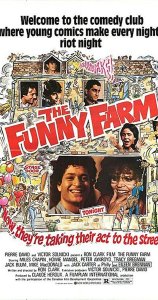
A Movie A Day #240: The Funny Farm (1983, directed by Ron Clark)


Mark Champlin (Miles Chapin) is a fresh-faced, aspiring comedian from Cleveland who drives across the country, listening to tapes of Steve Martin.  He arrives in Los Angeles, hoping to become a star.  Despite being too naive and trusting, Mark starts to find success in the cut-throat entertainment industry.  Soon, he is performing at the Funny Farm, a comedy club owned by Gail Corbin (Eileen Brennan, giving the exact same performance that Melissa Leo gave in Showtime’s I’m Dying Up Here).  Mark befriends the other comedians, finds love, and hopes for his big break.
There have been several movies and television shows about the drama that goes on behind the scenes in the world of comedy.  It’s rare that they ever turn out well.  For every successful movie about the struggle to make a living by telling jokes, there are a hundred movies like Punchline or this one.  Whereas Punchline tried to pass Sally Field off as an up-and-coming stand-up comic, The Funny Farm was full of actual comedians.  Almost everyone in the film is playing a thinly disguised versions of themselves and snippets of their acts are used throughout the movie.  (Probably the best known member of the cast is Howie Mandel.)  Unfortunately, none of their acts seem to be very funny.  Miles Chapin comes across like every forgettable comic who ever bombed on The Tonight Show.

Eileen Brennan does a good job as the club owner, even if she is underused.  There is also a good scene where the younger comedians meet a legendary, older comic who turns out to be a racist asshole.  During this scene, The Funny Farm actually has something to say about the way comedy progressed and changed over time.  Otherwise, The Funny Farm is forgettable.

A Movie A Day #182: FM (1978, directed by John A. Alonzo)


Hey, California!  Are you ready to soft rock!?
That is the question asked by FM, a movie about rock that tries to stick it to the man with some of the safest, least revolutionary music ever recorded.

FM is centered around Q-Sky, an FM radio station in Los Angeles.  Because the laid back station manager (Michael Brandon) allows his DJs to program their own music with little commercial interruption, Q-Sky has become one of the most popular radio stations in California.  The corporate suits, though, demand that Q-Sky play less music and air more commercials, especially one that is specifically designed to get mellow Californians to join the Army.  When Brandon refuses, he is fired.  Outraged, Q-Sky’s motley crew of DJs (who include Martin Mull, Cleavon Little, Eileen Brennan, and even former football great Alex Karras) barricade themselves in the station and lead a protest by playing their music without commercials.

That would all be well and good except that the DJs spend most of their time playing songs by such noted rockers as Jimmy Buffett, Billy Joel, and REO Speedwagon.  A major set piece of the film is Q-Sky’s attempt to secretly broadcast a Linda Ronstadt concert that is being sponsored by a rival station.  At a time when Johnny Rotten was still singing Anarchy in the UK,  Q-Sky’s idea of rebellion was to go from Bob Seger to James Taylor with limited commercial interruption.

The always reliable Martin Mull is always good for some laughs and this was the only movie directed by award-winning cinematographer John A. Alonzo so, if nothing else, FM always looks good.  With its ensemble cast and episodic narrative, FM tries hard to be an Altmanesque satire but, ultimately, it fails because the revolution is not going to sound like The Doobie Brothers.

(Even though The Doobie Brothers clearly rock.)

“Who likes The Doobie Brothers?”

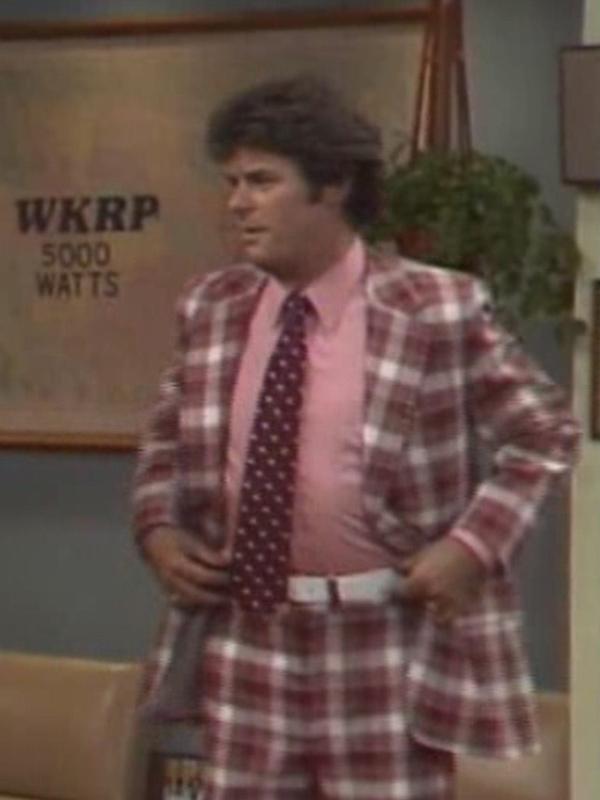
Because Michael Brandon looked like Gary Sandy and Martin Mull possessed a passing resemblance to Howard Hesseman, some reference books state that FM was the inspiration for WKRP in Cincinatti.  However, the first season of WKRP was already in production before FM was released to theaters and FM was such a financial flop that it is doubtful it inspired anything.

Add to that, while Venus Flytrap probably could have made it work, Dr. Johnny Fever would never have fit in at Q-Sky.  Johnny’s frequent acid flashbacks would have unnerved the mellow Q-Sky vibes.  Herb Tarlek, on the other hand…

“It must be a struggle to match the belt with the shoes.”
“Sometimes, I can’t do it.”


Lisa Reviews an Oscar Winner: The Sting (dir by George Roy Hill)


Earlier tonight, as a part of their 31 Days of Oscar, TCM aired The Sting, the film that the Academy selected as being the best of 1973.  I just finished watching it and what can I say?  Based on what I’ve seen of the competition (and there were a lot of great films released in 1973), I would not necessarily have picked The Sting for best picture.  However, the movie is still fantastic fun.

The Sting reunited the director (George Roy Hill) and the stars (Robert Redford and Paul Newman) of Butch Cassidy and the Sundance Kid and told yet another story of likable criminals living in the past.  However, whereas Butch Cassidy largely satirized the conventions of the traditional Hollywood western, The Sting is feels like a loving homage to the films of 1930s, a combination of a gritty, low-budget gangster film and a big budget musical extravaganza.  The musical comparison may sound strange at first, especially considering that nobody in The Sting randomly breaks out into song.  However, the musical score (which is famously dominated by Scott Joplin’s The Entertainer) is ultimately as much of a character as the roles played by Redford, Newman, and Robert Shaw.  And, for that matter, the film’s “let-pull-off-a-con” plot feels like an illegal version of “let’s-put-on-a-show.”

The film takes place in the 1936 of the cultural imagination, a world dominated by flashy criminals and snappy dialogue.  When con artists Johnny Hooker (Robert Redford) and Luther Coleman (Robert Earl Jones) inadvertently steal money from a gangster named Lonnegan (Robert Shaw), Lonnegan has Luther murdered.  Fleeing for his life, Hooker goes to Chicago where he teams up with Luther’s former partner, veteran con man Henry Gondorff (Paul Newman).  Gondorff used to be one of the great con artists but he is now living in self-imposed obscurity, spending most of his time drinking and trying to avoid the FBI.  Hooker wants to get revenge on Lonnegan by pulling an elaborate con on him.  When Gondorff asks Hooker why, Hooker explains that he can either con Lonnegan or he can kill him and he doesn’t know enough about killing.

The rest of the film deals with Hooker and Gondorff’s plan to con Lonnegan out of a half million dollars.  It’s all very elaborate and complicated and a bit confusing if you don’t pay close enough attention and if you’re ADHD like me.  But it’s also a lot of fun and terrifically entertaining and that’s the important thing.  The Sting is one of those films that shows just how much you can accomplish through the smart use of movie star charisma.  Redford and Newman have such great chemistry and are so much fun to watch that it really doesn’t matter whether or not you always understand what they’re actually doing.

It also helps that, in the great 70s tradition, they’re taking down stuffy establishment types.  Lonnegan may be a gangster but he’s also a highly respected and very wealthy gangster.  When Newman interrupts a poker game, Lonnegan glares at him and tells him that he’ll have to put on a tie before he’s allowed to play.  Lonnegan may operate outside the law but, in many ways, he is the establishment and who doesn’t enjoy seeing the establishment taken down a notch?

As entertaining as The Sting may be and as influential as it undoubtedly is (Steven Soderbergh’s Ocean films may be a lot more pretentious — which makes sense considering that Soderbergh is one of the most pretentious directors in film history — but they all owe a clear debt to The Sting), it still feels like an unlikely best picture winner.  Consider, for instance, that The Sting not only defeated American Graffiti and The Exorcist but Ingmar Bergman’s Cries and Whispers as well.  On top of that, when you consider some of the films that were released in 1973 and not nominated — Mean Streets, Badlands, The Candy Snatchers, Day of the Jackal, Don’t Look Now, Jesus Christ Superstar, and The Long Goodbye — it’s debatable whether The Sting should have been nominated at all.  That’s not a criticism of The Sting as much as it’s an acknowledgement that 1973 was a very good year in film.

So, maybe The Sting didn’t deserve its Oscar.  But it’s still a wonderfully entertaining film.  And just try to get that music out of your head!