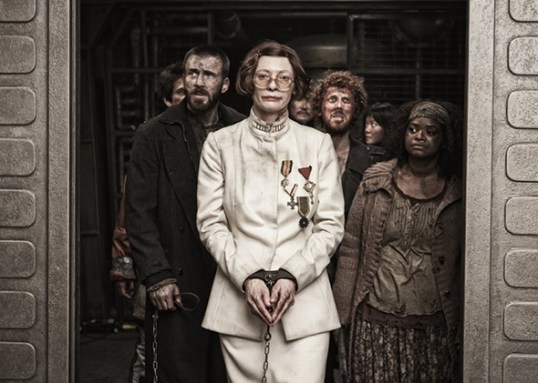
Trailer: Snowpiercer (Red Band)


Bong Joon-ho is a name that genre fans know well. He has made a name for himself in his home country of South Korea with such critically-acclaimed films as Memories of Murder, The Host and Mother. In 2013, Bong co-wrote and directed the adaptation of the French graphic novel Le Transperceneige. The film is his first English-language film and it has garnered much acclaim when it was released in South Korea in 2013.

Snowpiercer as the film has been titled will now make it’s North American premiere this year and with months of buzz following it’s Asian release many genre fans have been awaiting its arrival. It’s premise is simple enough and involves a train that never stops moving that circles the globe that’s going through a new Ice Age that has killed off most of the planet’s population save those riding on the global train.

It’s a film that explores that ever-popular subject of the “have’s versus the have not’s”. It’ll be interesting to see what new idea Bong Joon-ho brings to an old idea.

Snowpiercer is set for a US release on June 27, 2014.

44 Days of Paranoia #30: Nixon (dir by Oliver Stone)


For our latest entry in the 44 Days of Paranoia, we take a look at Oliver Stone’s 1995 presidential biopic, Nixon.

Nixon tells the life story of our 37th President, Richard Nixon.  The only President to ever resign in order to avoid being impeached, Nixon remains a controversial figure to this day.  As portrayed in this film, Nixon (played by Anthony Hopkins) was an insecure, friendless child who was dominated by his ultra religious mother (Mary Steenburgen) and who lived in the shadow of his charismatic older brother (Tony Goldwyn).  After he graduated college, Nixon married Pat (Joan Allen), entered politics, made a name for himself as an anti-communist, and eventually ended up winning the U.S. presidency.  The film tells us that, regardless of his success, Nixon remained a paranoid and desperately lonely man who eventually allowed the sycophants on his staff (including James Woods) to break the law in an attempt to destroy enemies both real and imagined.  Along the way, Nixon deals with a shady businessman (Larry Hagman), who expects to be rewarded for supporting Nixon’s political career, and has an odd confrontation with a young anti-war protester who has figured out that Nixon doesn’t have half the power that everyone assumes he does.

Considering that his last few films have been W., Wall Street: Money Never Sleeps, and SavagesI think it’s understandable that I’m often stunned to discover that, at one point in the distant past, Oliver Stone actually was a worthwhile director.  JFK, for instance, is effective propaganda.  Nixon, which feels a lot like an unofficial sequel to JFK, is a much messier film than JFK but — as opposed to something like Savages — it’s still watchable and occasionally even thought-provoking.  Thanks to Hopkins’ performance and, it must be admitted, Stone’s surprisingly even-handed approach to the character, Nixon challenges our assumptions about one of the most infamous and villified figures in American history.  It forces us to decide for ourselves whether Nixon was a monster or a victim of circumstances that spiraled out of his control.  If you need proof of the effectiveness of the film’s approach, just compare Stone’s work on Nixon with his work on his next Presidential biography, the far less effective W.

(I should admit, however, that I’m a political history nerd and therefore, this film was specifically designed to appeal to me.  For me, half the fun of Nixon was being able to go, “Oh, that’s supposed to be Nelson Rockefeller!”)

If I had to compare the experience of watching Nixon to anything, I would compare it to taking 10 capsules of Dexedrine and then staying up for five days straight without eating.  The film zooms from scene-to-scene, switching film stocks almost at random while jumping in and out of time, and not worrying too much about establishing any sort of narrative consistency.  Surprisingly nuanced domestic scenes between Anthony Hopkins and Joan Allen are followed by over-the-top scenes where Bob Hoskins lustily stares at a White House guard or Sam Waterston’s eyes briefly turn completely black as he discusses the existence of evil.  When Nixon gives his acceptance speech to the Republican Convention, the Republican delegates are briefly replaced by images of a world on fire.  Familiar actors wander through the film, most of them only popping up for a scene or two and then vanishing.  The end result is a film that both engages and exhausts the viewer, a hallucinatory journey through Stone’s version of American history.

Nixon is a mess but it’s a fascinating mess.

Other Entries In The 44 Days of Paranoia 

  1. Clonus
  2. Executive Action
  3. Winter Kills
  4. Interview With The Assassin
  5. The Trial of Lee Harvey Oswald
  6. JFK
  7. Beyond The Doors
  8. Three Days of the Condor
  9. They Saved Hitler’s Brain
  10. The Intruder
  11. Police, Adjective
  12. Burn After Reading
  13. Quiz Show
  14. Flying Blind
  15. God Told Me To
  16. Wag the Dog
  17. Cheaters
  18. Scream and Scream Again
  19. Capricorn One
  20. Seven Days In May
  21. Broken City
  22. Suddenly
  23. Pickup on South Street
  24. The Informer
  25. Chinatown
  26. Compliance
  27. The Lives of Others
  28. The Departed
  29. A Face In The Crowd

Film Review: Man on a Ledge (dir. Asger Leth)


The newly released film Man on a Ledge is about a man (played by Sam Worthington) who checks into a hotel room in New York City and then climbs out on a ledge and threatens to jump off unless a specific hostage negotiator is brought in to talk him off the ledge.  We quickly discover that Worthington isn’t just a depressed jumper.  Instead, he’s got a really lengthy and overly complicated back story.  It turns out that he’s a former detective who used to moonlight for a venture capitalist and then one day, he was accused of stealing a priceless diamond and destroying it.  This resulted in him getting sentenced to 25 years in prison but when his father is reported to have died, Worthington is released from jail for a day so he can attend the funeral.  So, Worthington escapes and then ends up out on a ledge as part of a massively complicated plan to prove his innocence.  His name, by the way, is Nick because people named Alvin are never the stars of action movies.

Meanwhile, the cop that Nick demands to speak with is a hardened, veteran hostage negotiator and she’s played by Elizabeth Banks.  Yes, you read that correctly.  Anyway, Nick asks for her because he knows that the last guy she tried to talk out of jumping apparently jumped off a bridge.  Since Banks failed her last time out, her efforts to talk Nick off the ledge are cautiously observed by another detective, this one played by Edward Burns.  Banks is totally and completely miscast here and she has next to no chemistry with Sam Worthington.  However, she does have really good chemistry with Edward Burns.  Seriously, they would make a really cute couple and I would buy any issue of Us Weekly that had them on the cover.

Meanwhile, the guy that Nick is accused of stealing from just happens to be in a building across the street where he’s conducting some sort of generically evil business deal.  He’s a painfully thin, almost sickly man and, whenever he was on screen, I found myself wondering how his head managed to stay balanced on his body.  At first, I thought maybe it was the Red Skull waiting for the sequel to Capt. America to start filming.  However, on closer inspection, he turned out to be respected character actor Ed Harris.  In this film, Harris plays a ruthless capitalist who would have gone bankrupt if not for the insurance money he got as a result of Nick supposedly destroying that diamond.  Anyway, Harris appears to be enjoying playing a bad guy and he’s so over-the-top in his evil that you don’t really mind that he’s another one of those “I-should-kill-you-now-but-first-we-talk” type of villains.

Meanwhile, there’s two other people who are taking advantage of all the chaos caused by the man on the ledge to break into Harris’s building.  They’re played by Jamie Bell (who looks a lot like Casey Affleck in this film) and telenova veteran Genesis Rodriguez.  As you watch Bell and Rodriguez sliding down heating ducts and scaling elevator shafts, you can’t help but marvel at just how overly complicated everyone is making things.  Still, Bell and Rodriguez have a lot of chemistry and they’re fun to watch.

Meanwhile, NYC television reporter (played by Kyra Sedgwick) is running around the streets of New York, asking random bystanders how they feel about the prospect of Nick jumping.  Apparently, she is an old enemy of Elizabeth Banks’ though that whole plot line is dropped as soon as its brought up.  Still, the audience in my theater chuckled when Sedgwick dramatically rolled her r’s while introducing herself as “Suzie Morales.”

Meanwhile, there’s a bearded guy watching Nick up on the roof and he suddenly decides to go all Occupy Wall Street on the movie’s ass and starts shouting, “Attica!  Attica!” before then blaming it all on the 1%.  Unfortunately, he doesn’t put on Guy Fawkes mask at any point during all of this.

Meanwhile, the entire city of New York is obsessed with the man on the ledge and, if nothing else, they all end up acting exactly the way that people who have never been to New York City (like me) assume that people in New York act.  By that, I mean all the extras are all like, “Yo, Paulie!  There’s some man on a ledge!  Stop breaking my balls!” 

Meanwhile, there’s one final twist to the film’s plot that I can’t share without spoiling the film.  So, I’ll just say that it involved someone working at the hotel and I figured out the twist about 3 minutes after this character first appeared.  This is one of those twists that if you can’t figure out on your own then you need to hang your head in shame.  Seriously.

This film packs a lot of plot into 90 minutes of screen time and, not surprisingly, the end result is a bit of a mess.  This is one of those films where every single character attempts to solve his or her problems in the most needlessly complicated and implausible way possible.  Still, almost despite myself, I enjoyed Man on a Ledge.  It’s just all so silly and stupid that it becomes oddly likable.  The film also has two nicely done chase scenes and some of the scenes where Nick attempts to manuever about on the ledge made me go, “Agck!”

Seriously, I don’t do heights.

Review: A History of Violence (dir. by David Cronenberg)


“In this family, we do not solve our problems by hitting people.” — Tom Stall

David Cronenberg’s A History of Violence opens like a familiar American story but soon transforms into something far darker and more complex—a meditation on how violence reshapes identity and reality itself. The film begins in small-town Indiana where Tom Stall, a mild-mannered diner owner, becomes an overnight hero after killing two violent spree killers who attempt to rob his restaurant. These killers—Billy and Leland—serve as the initial violent intrusion that shatters Tom’s peaceful world and propels the narrative forward. Their actions attract the attention of Carl Fogarty, an East Coast mobster whose relentless pursuit gradually forces Tom and his family to confront a buried, violent history. This confrontation unravels the fragile facade of domesticity and sets the stage for the film’s profound exploration of identity, perception, and the primal tensions beneath civilization.

Cronenberg’s direction is a study in restraint and precision. Far from glamorizing violence, the film presents it as brutally efficient and intimately physical. Cronenberg himself described the action sequences as neither choreographed nor aestheticized but raw, unembellished, and quick—realistic portrayals of violence drawn from street-fighting techniques rather than cinematic spectacle. This choice heightens the emotional impact, making every outbreak of violence feel sudden, close, and devastatingly human. The opening extended shot of the spree killers, for example, follows them in a languid, almost eerie calm before revealing their cold-blooded brutality, establishing an unsettling tone early on. Cronenberg’s camera work—often tight and intimate—immerses viewers in moments where violence erupts not as a fantasy but as a harsh reality, forcing the audience to reckon with its consequences rather than its thrill.

Viggo Mortensen anchors the film with a layered performance that seamlessly navigates the duality of Tom Stall—a man striving for peaceful normalcy—and the darker instincts touched by his mysterious past. Mortensen’s portrayal moves fluidly between the affable family man and the capable, restrained force beneath, embodying the film’s exploration of how violence shapes identity and perception. His physicality and subtle shifts in tone reveal a man perpetually caught between two worlds, never fully belonging to either. Maria Bello as Edie complements Mortensen beautifully, delivering a performance rich in emotional complexity. Her character oscillates between nurturer and survivor, revealing a raw, sometimes unsettling vulnerability beneath her composed exterior. Bello’s nuanced acting gives weight to the evolving dynamics of fear, desire, and trust within their marriage, especially evident in scenes that contrast tender intimacy with underlying tension.

The supporting cast enriches the film’s moral landscape. Ed Harris brings a quiet menace to Carl Fogarty, embodying violence as a cold, business-like inevitability rather than a source of pleasure or spectacle. William Hurt’s portrayal of Richie Cusack is especially memorable—his eight-to-ten-minute screen time is electrifying, providing a darkly charismatic figure who embodies familial loyalty intertwined with brutal pragmatism. Hurt’s performance deftly balances charm and cruelty, offering one of the film’s starkest reminders of violence’s cyclical nature within families. These actors contribute to the film’s thematic depth, portraying violence as a heritage passed down and a force that both defines and corrodes.

Cronenberg’s screenplay, coupled with Howard Shore’s minimalist score, emphasizes mood and psychological tension over action set pieces. The film refuses to indulge in excessive gore or prolonged combat; instead, it presents violence as a disruptive force that shatters normalcy and forces internal reckonings. A notable subplot involving Tom’s teenage son and a school bully underscores the generational transmission of violence and fear, reinforcing the idea that violence’s impact extends beyond immediate events to shape social and familial identities.

One of the film’s most powerful effects is the way it forces viewers to reconsider notions of safety, civility, and identity. Tom’s line, “In this family, we do not solve our problems by hitting people,” starkly contrasts with his son’s chilling rejoinder, “No, in this family, we shoot them.” This exchange encapsulates the film’s core tension—the desire to reject violence while simultaneously being shaped by its inescapable presence. Moments of quiet domesticity are undercut throughout by an ever-present undercurrent of menace, illustrating Cronenberg’s thesis that violence is not merely an event but a contagion of perception and reality.

Ultimately, A History of Violence is a film of dualities—between past and present, civility and savagery, love and fear. Cronenberg’s direction delicately balances these tensions, crafting a film that is at once a taut thriller and a profound psychological study. The performances, especially those of Mortensen and Bello, give the film its emotional resonance, while the supporting cast strengthens its examination of violence’s personal and social ramifications. By the film’s haunting conclusion, viewers are left with a haunting question: can anyone truly escape the shadows cast by violence, or are we forever altered by its imprint?