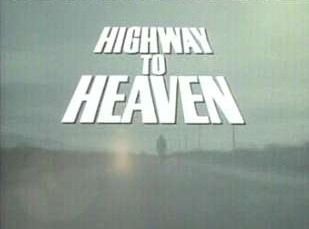
Welcome to Late Night Retro Television Reviews, a feature where we review some of our favorite and least favorite shows of the past! On Thursdays, I will be reviewing Highway to Heaven, which aired on NBC from 1984 to 1989. The entire show is currently streaming on Tubi and several other services!
This week’s episode is massively confusing.
Episode 4.18 “We Have Forever: Part Two”
(Dir by Michael Landon, originally aired on February 17th, 1988)
Picking up from last week, an embittered Jonathan is no longer an angel. Instead, he’s a mortal man who can’t get a job because he doesn’t have any references. (The idea is that Jonathan can’t explain that he’s spent the last 40 years working for God. But, over the past four and a half seasons, he’s had numerous jobs where he helped people out. Couldn’t he have listed some of those people are references?) However, Jonathan is happy because he’s fallen in love with Jennifer (Leann Hunley), the woman that he saved from drowning last week.
Meanwhile, Mark is actually making an effort to help people by working at the camp for the blind where he and Jonathan worked earlier in the season. (Actually, why couldn’t Jonathan ask for a job at the camp? The more I think about it, Jonathan not being able to get a job makes less and less sense.)
Jennifer, however, has a secret of her own. At the end of the episode, she leaves Jonathan a note, in which she explains that she’s actually Joan, Jonathan’s late wife. Jonathan was upset because he felt God was keeping him from seeing Joan in Heaven. Instead, it turns out that Joan — like Jonathan — has been assigned to work on Earth as an angel. So, the two months that Jonathan spent with Jennifer was actually God giving Jonathan a chance to spend time with Joan but, for some reason, no one told Jonathan that was what was happening so Jonathan got mad and walked out on God. But then, Jonathan changes his mind after learning that Joan is Jennifer but instead of asking to work with Joan/Jennifer, Jonathan goes back to working with Mark.
Seriously, I’m having a hard time following some of the logic here.
That said, despite all the lapses in logic, this episode still made me cry. Admittedly, I’ve been feeling under the weather today so maybe that’s why I was so emotionally susceptible to this episode. Or maybe it’s just the fact that Highway to Heaven is such an overwhelmingly earnest and sincere show that even the episodes that shouldn’t work somehow do. All I know is that I was sobbing by the end of this episode.
The important thing is that, at the end of the episode, Jonathan and Mark have a new assignment and drive off. Wait, I thought Mark had a job. Way to abandon all those blind children, Mark!
Perhaps it’s best not to think too hard about this episode and just accept it for being the tear jerker that it was.
Welcome to Late Night Retro Television Reviews, a feature where we review some of our favorite and least favorite shows of the past! On Thursdays, I will be reviewing Highway to Heaven, which aired on NBC from 1984 to 1989. The entire show is currently streaming on Tubi and several other services!
This week, Jonathan loses his powers.
Episode 4.17 “We Have Forever: Part One”
(Dir by Michael Landon, originally aired on February 10th, 1988)
When Jonathan’s former wife (Dorothy McGuire) dies, Jonathan assumes that God will release him of his duties and bring him to Heaven to be with her. Instead, Jonathan is told that he is still needed on Earth and that he has an assignment. Jonathan gets upset and uses some language that one doesn’t always expect to hear from an angel. God responds with thunder and lightning.
Long story short, Jonathan loses his angelic powers. He becomes a human again. But since Jonathan died 40 years ago, shouldn’t taking away his powers cause him to drop dead on the spot? I’m a bit confused on how this works but then again, it’s also pretty obvious that God is trying to teach him a lesson as opposed to just punishing him.
Jonathan runs away from Mark, refusing to speak to him. He sees a movie theater that is showing Heaven Can Waitand he proceeds to throw beer bottles at the marquee until all of the letters have fallen. Jonathan ends up in jail but Mark manages to track him down and gets him released. Jonathan borrows some money from Mark so that he can go get drunk.
Later, walking along the beach, Jonathan sees a young woman named Jennifer (Leann Hunley) who looks just like his wife did when they first got married. Jennifer attempts to commit suicide by walking into the ocean. Jonathan saves her life. It turns out that Jennifer is suicidal because her boyfriend dumped her. Jonathan tells her that her boyfriend isn’t going to care that she killed herself. In fact, he’ll probably brag about it to all of his friends.
Long story short, it’s obvious that Jonathan and Jennifer are falling in love. Meanwhile, Mark is looking for some way to occupy himself and considers accepting a job at the camp for the blind that he and Jonathan visited earlier in the season. Finally, this is a two-parter so we’ll see how everything works out next week!
I will say that this was a nice change-of-pace for the series. Seeing Jonathan finally get mad after four seasons of doing whatever he was assigned to do was interesting and Michael Landon’s anger and sadness felt very real. Victor French also did a good job of portraying Mark’s sadness over not being able to help his best friend. This was an episode where Highway to Heaven‘s unabashedly earnest and emotional approach really paid off.
Welcome to Retro Television Reviews, a feature where we review some of our favorite and least favorite shows of the past! On Tuesdays, I will be reviewing the original Fantasy Island, which ran on ABC from 1977 to 1984. Unfortunately, the show has been removed from most streaming sites. Fortunately, I’ve got nearly every episode on my DVR.
This week, the Island is kind of dull. Tattoo is missed.
Episode 7.6 “Second Time Around/Three’s A Crowd”
(Dir by Philip Leacock, originally aired on November 19th, 1983)
Love is in the air again at Fantasy Island! Remember when this show used to feature mermaids and Greek Gods and ghosts and gothic mansions and stuff like that? Those were good times!
Kate Tucker (Cristina Ferrare) comes to the Island to confront her husband, Gary Tucker (Geoffrey Scott, the quarterback from 1st and Ten), about his infidelity. Roarke decides to bring Gary’s mistress, Helen (Michelle Phillips, who once played the mermaid on this very show), to the Island as well! It’s all a part of Roarke’s plan to show both women that Gary’s not worth all the trouble. Kate realizes she doesn’t want Gary and Helen doesn’t want him either. Kate leaves the Island a single woman. Good for her!
Meanwhile, widowed Joan (Dorothy McGuire) comes to the Island and falls for handsome Alan Reynolds (Craig Stevens). Joan’s son (Stuart Damon) is upset at the idea of Joan marrying someone else. Eventually, he comes to see the error of his ways and smiles as Joan and Alan find happiness.
This may have been an episode of Fantasy Island but it felt more like The Love Boat. Roarke helped everyone find true love and Lawrence …. Lawrence was just kind of there. At this point, I kind of feel that, if they were determined to get rid of Tattoo, they should have just had Roarke running the Island by himself. Lawrence’s presence doesn’t accomplish anything beyond making the viewer miss Tattoo.
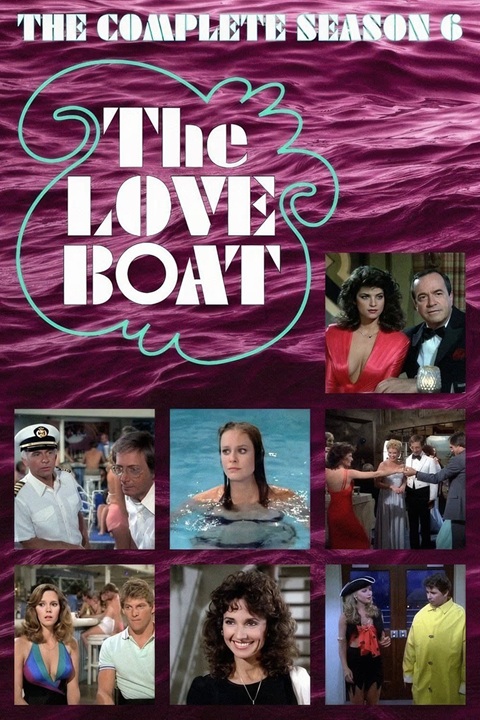
Welcome to Retro Television Reviews, a feature where we review some of our favorite and least favorite shows of the past! On Wednesdays, I will be reviewing the original Love Boat, which aired on ABC from 1977 to 1986! The series can be streamed on Paramount Plus!
Come aboard….
It’s a holiday….
THE LOOOOOOOOOOVE BOAT
Episode 6.9 “The Thanksgiving Cruise/The Best of Friends/Too Many Dads/Love Will Find A Way”
(Dir by Richard Kinon, originally aired on November 20th, 1982)
It’s Thanksgiving and the Love Boat crew is not getting along!
It all starts when Gopher makes a joke about Doc being a womanizer. Doc, who has spent five seasons bragging about being a womanizer, gets offended and stops talking to Gopher. Isaac tries to give Gopher some advice but Gopher offends him by saying that he’s sick of hearing stories about the wisdom of Isaac’s grandfather. (I have never heard Isaac mention his grandfather in the past.) Julie gets mad when Doc says that he didn’t care much for some of her past hairstyles. (Julie’s hair does look terrible this episode.) Everyone is fighting …. except for Captain Stubing and Vicki. They do have an argument but Stubing refuses to take it personally and Vicki says she could never stay angry with her father. Awwwww!
(I think it’s seriously irresponsible to raise someone on a cruise ship but I still tear up at the Stubing/Vicki scenes. Can you tell I’m missing my Dad?)
I have to admit that it kind of upset me to see the Love Boat crew fighting. The passengers come and go but the crew has remained the same for six seasons and their likable chemistry has always been one of the show’s greatest strengths. Julie getting mad at Doc? No, it can’t happen! We all know Julia and Doc are secretly in love! I was really concerned that the crew was going to have a bad Thanksgiving but luckily, everyone forgave everyone else in time for Thanksgiving.
I was so worried about the crew that I barely paid attention to the other two stories. Lorne Greene and Dorothy McGuire played parents who were initially alarmed when their daughter (Wendy Schaal) announced that she was going to marry a paraplegic (Jim Knaub). Luckily, they saw the error of their ways. Meanwhile, Michael Lembeck boarded the boat with a court order that stated that he had been given legal custody of B.J. Lewis (Christian Jacobs), who was traveling with his stepfather, Roger (Richard Hatch). In the end, everyone agreed that Roger was the better father and B.J.’s biological father gave up custody which …. I don’t know. That doesn’t seem like something that would happen in real life. I mean, if you go through the trouble of hiring expensive lawyers and then storm a cruise ship, I don’t think you’re just going to shrug and give up.
“Now I have two Dads!” BJ announces.
Kid, one of your Dads just rejected you.
Oh well! It’s Thanksgiving! And I’m giving thanks that the Love Boat crew all learned an important lesson about friendship. That’s what life is all about.
Welcome to Late Night Retro Television Reviews, a feature where we review some of our favorite and least favorite shows of the past! On Thursdays, I will be reviewing Highway to Heaven, which aired on NBC from 1984 to 1989. The entire show is currently streaming on Freevee and several other services!
This week’s episode made me cry.
Episode 2.16 “Keep Smiling”
(Dir by Michael Landon, originally aired on February 5th, 1986)
One night, seven year-old me asked my mom, “After someone dies, will they be able to come back to visit us?”
My mom told me that they would but that we wouldn’t be able to see them. But we would know that they were there. We would feel it in our hearts. And maybe we would see them in our dreams.
I relate this anecdote because I think it’s important to understand my current state of mind as I watch and review this show. My mom passed away nearly 16 years ago. My Dad passed away nearly a month ago. I’m still very much in mourning right now. My logical side can look at an episode of Highway to Heaven and say that it was an extremely sentimental and, at times, rather manipulative show. But my emotional side, the side that leads with my heart and that hopes to see my mom and dad every night in my dreams, that side watches this show in tears.
And there’s nothing wrong with that. Sometimes, it’s important to cry. For someone like me, who tends to put up walls whenever I’m upset, watching a show like this can actually be very helpful.
This week’s episode features Jonathan and Mark helping out Jane Thompson (Dorothy McGuire), a lonely widow who has never really gotten over the death of her husband, Arthur. Arthur died of lung cancer nearly forty years ago. Now, Jane lives alon in their house. It’s been a while since even her daughter has come to visit. Jonathan and Mark stop by the house, looking to rent out Jane’s spare room. Jane says she would prefer a woman to be her roommate. Jonathan says he understands and then tells her, “Keep smiling.” Hearing the phrase causes Jane to change her mind about renting the room to Jonathan and Mark. “Keep smiling,” was something that Arthur always used to say.
That’s because, before he became an angel, Jonathan was Arthur Thompson! (Jonathan explains to Mark that angels come back in a “different form” than how they appeared when they died.) While Jonathan tries to cheer up the depressed Jane and get her to embrace life, Mark tries to convince Jane’s daughter to pay her a visit. When Mark doesn’t have any luck, Jonathan throws on a white jacket and a pair of ray-bans and, pretending to be a gigolo, he tells his daughter that he’s going to marry Jane for her money. That may sound a little extreme but hey, it works!
This episode made me cry. What can I say? Right now, emotionally, I’m just at a point where anything that is sentimental and well-acted will bring tears to my eyes. This show may be a tad manipulative but, at its best, there’s an aching sincerity to this show that simply cannot be dismissed. Sometimes, that type of sincerity is exactly what is needed.
The 1954 Best Picture nominee, Three Coins In The Fountain, tells the story of three American women living in Rome. They’re all employed by the same secretarial agency. Maria Williams (Maggie McNamara) is young and hoping that she’ll stay in Rome for at least a year and that she’ll meet her future husband. Anita Hutchins (Jean Peters) is not-so-young and is planning on returning to America so that she can meet her own future husband. Miss Frances (Dorothy McGuire) is middle-aged and has spent the last 15 years working for the man that she wishes could be her future husband.
If you’re getting the feeling that there’s not much to our leads beyond a desire to get married, you’re not wrong. However, Anita swears that it’s impossible to find a husband in Rome because the only Italians who are interested in “secretaries” are too poor to be good husbands which …. well, like I mentioned before, this film is from 1954. Just the fact that the film featured three single women living together in a foreign country was probably considered to be daring back in 1954.
The three women eventually end up at the Trevi Fountain, where Maria and Frances throw in their coins and make their wishes. Anita, however, does not toss in a coin because apparently, she’s not scared of offending God. No sooner have the three women visited the fountain than things begin to happen. Soon, all three of them are in love but each has to deal with a compliction.
Miss Frances may have finally convinced her employer, writer John Frederick Shadwell (Clifton Webb), to marry her but when he discovers that he’s terminally ill, he tries to call off the engagment.
Maria meets Prince Dino di Cessi (Louis Jourdan) but will the Prince still want to be with her after he discovers that she’s been lying about being interested in the same things that he’s interested in?
Anita falls for Giorgio (Rossano Brazzi) but he’s poor! Plus, he also works for the agency and apparently, there’s some sort of weird 1954 rule that forbids the American employees from fraternizing with the Italian employees. Is Anita willing to lose her job just so she can marry someone who doesn’t have any money?
That’s pretty much it. Other than John Shadwell wrestling with his own mortality, there’s really not a whole lot of drama to be found in Three Coins In The Fountain. This is a film about pleasant people doing pleasant things and having pleasant conversations. It’s a rather chaste romance, one of those films where you have no doubt that everyone involved will wait until marriage and that all of the women will quit their jobs and settle down as soon as the right ring gets put on their finger. In other words, this is very much a film of its time and watching it today can be bit of an odd experience. This is ultimately the type of film that works best as a travelogue. Rome looks beautiful. There’s a striking shot of the sunset reflected in the canals of Venice. The Trevi Fountain truly does look like it can grant wishes. (It’s amusing to compare the reverence that the American-made Three Coins In The Fountain shows towards The Trevi Fountain to the way that Rome-native Federico Fellini used the fountain in La Dolce Vita.) One gets the feeling that, even in 1954, people flocked to this film more to see Rome than to really worry about whether or not the Prince would eventually propose.
In fact, one of the main reasons why I watched this film tonight is because I spent one of the greatest summers of my life in Italy. I’ve been to Rome. I’ve thrown coins into the Trevi Fountain and I’ve made wishes. I loved Rome. I loved the people. I loved the culture. I loved the buildings. I loved the feeling of walking through history. I loved looking out at the horizon and feeling as if I was somehow in a living painting. (I actually went into a bit of daze when I was in Florence. Stendhal Syndrome is for real.) If you can’t find romance in Rome then you’re obviously not looking. For me, the main appeal of Three Coins In The Fountain was being able to watch it and say, “I’ve been there!” I imagine for audiences in 1954, the appeal was probably to be able to watch it and say, “I’m going to go there!”
How did this perfectly pleasant but otherwise unmemorable film end up as a best picture nominee? I imagine a lot of it had to do with the fact that the film was a box office success. It’s certainly not because it was a better film than either Rear Window or Sabrina, both of which were not nominated for Best Picture despite being nominated for Best Director. In the end, the 1954 Best Picture Oscar was won by On The Waterfront, a film that appears to be taking place in an entirely different universe than Three Coins In A Fountain.
First released in 1950, Mister 880 is a wonderful surprise.
The film opens like a typical 50s crime drama. We’re told that counterfeiting is a serious crime and that the dedicated agents of the Secret Service are working very hard to try to wipe out the scourge of fake money. We’re also told that Mister 880 is based on a true story and that it was produced with the full cooperation of the U.S. Treasury Department. As a result, modern viewers will probably be expecting Mister 880 to be a work of pro-government propaganda, where wholesome treasury agents track down and stop soulless thieves. Instead, Mister 880 turns out to be a wonderfully charming portrait of a criminal who doesn’t mean to cause anyone any harm.
Burt Lancaster stars as Steve Buchanan, a Treasury agent who is well-known for never letting a case go. He’s developed a personal obsession with tracking down a counterfeiter who, for the last ten years, has been passing phony one dollar bills around a certain New York neighborhood. The Treasury Department has named him Mister 880. Mister 880 is definitely an amateur. The money that he prints is sloppy. At the same time, he also only prints one dollar bills and it appears that he only does so on occasion. Just as no one can figure out his identity, everyone is also baffled by his motivation. If he was looking to get rich through printing his own money, he would surely print more than just a bunch of sloppy one dollar bills.
Investigating the neighborhood that he believes to be Mister 880’s base of operations, Buchanan meets and falls in love with Ann Winslow (Dorothy McGuire). He also happens to meet Ann’s neighbor, Skipper Miller (Edmund Gwenn). Skipper is an elderly man, a Navy veteran who lives with a dog and who says that he is financially supported by a rich cousin who nobody has ever met. Skipper is a junk dealer and he’s a genuinely nice man. Everyone in the neighborhood, including Ann, loves Skipper. Buchanan soon comes to like the old eccentric as well.
Of course, as you’ve probably already guessed, Skipper is the counterfeiter. He is Mister 880. He doesn’t mean to cause any harm, of course. He only prints money when he absolutely needs to and he always makes sure to not use too much of it. He doesn’t want to steal from anyone. He’s just an elderly man who wants to live out his days in peace and who doesn’t want to be a bother to anyone.
When Buchanan discovers the truth about Skipper, he’s faced with a dilemma. Skipper is hardly a master criminal but Buchanan has sworn an oath and he has a job to do. Not making things any simpler is that Skipper doesn’t deny what he’s done and he also says that he’ll plead guilty to his crime because …. well, he is guilty. Skipper’s not a liar, despite the fake money. Both Buchanan and Ann know that Skipper won’t survive spending years behind bars. What do you do with a man who has broken the law but who, at heart, is not really a criminal? Can a crime be forgiven just because the man who committed it is really, really likable?
Mister 880 is a sweet-natured comedy, one that doesn’t necessarily argue that Skipper’s crime should have been forgiven but which, at the same time, does make the case that not all law-breakers are created equal. Gwenn, who is best-known for playing Santa Claus in the original Miracle on 34th Street, gives a wonderful performance as Skipper. It’s hard not to love Skipper. It’s not just that Skipper doesn’t make any excuses for being a counterfeiter. And it’s not just that Skipper is an eccentric who loves his dog and has his own unique way of looking at the world. It’s that Skipper is just a genuinely kind man. He’s someone who would rather go to prison than be too much of a burden to the people who he cares about. He’s the sweetest criminal you could ever hope to meet.
Gwenn was rightfully nominated for an Academy Award for his work in this film. Not nominated but equally strong were Burt Lancaster and Dorothy McGuire. Even though they don’t get any big, show-stopping moments like Gwenn does, both Lancaster and McGuire bring their characters to wonderful life and both do a great job of capturing their own mixed feelings about what should be done about Skipper. Lancaster, in particular, is convincing as the by-the-book agent who is torn between his professional obligations and his feelings for both Ann and Skipper.
Mister 880 is one of my favorite movies, a wonderfully and unexpectedly good-hearted film about a real-life criminal who wasn’t the bad of a guy. Emerich Juenetter, the real-life counterfeiter who served as the model for Skipper, reportedly made more money from the release of this film than he ever did over the course of his counterfeiting career. After watching Mister 880, it’s hard not to feel that he earned every cent of it.
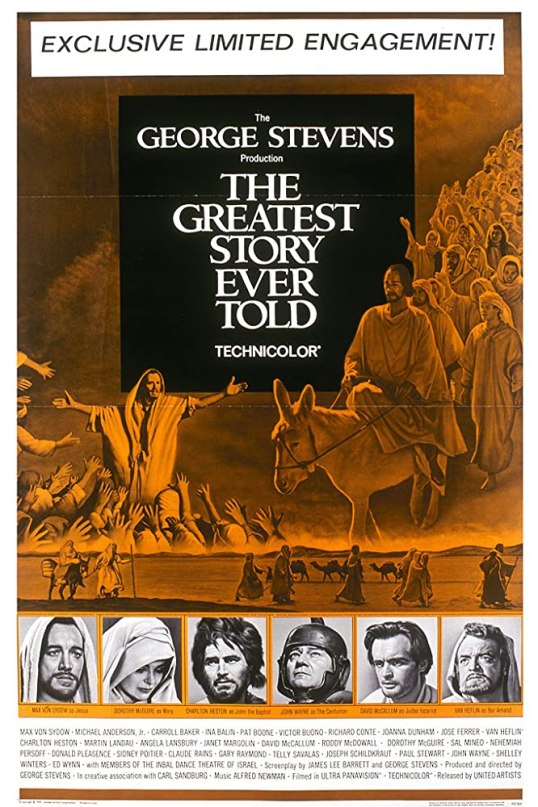
The 1965 biblical epic, The Greatest Story Ever Told, tells the story of the life of Jesus, from the Nativity to the Ascension. It’s probably the most complete telling of the story that you’ll ever find. It’s hard to think of a single details that’s left out and, as a result, the film has a four hour running time. Whether you’re a believer or not, that’s a really long time to watch a reverent film that doesn’t even feature the campy excesses of something like The Ten Commandments.
(There’s actually several different version of The Greatest Story Ever Told floating around. There’s a version that’s a little over two hours. There’s a version that’s close to four hours. Reportedly, the uncut version of the film ran for four hour and 20 minutes.)
Max von Sydow plays Jesus. On the one hand, that seems like that should work because Max von Sydow was a great actor who gave off an otherworldly air. On the other hand, it totally doesn’t work because von Sydow gives an oddly detached performance. The Greatest Story Ever Told was von Sydow’s first American film and, at no point, does he seem particularly happy about being involved with it. von Sydow is a very cerebral and rather reserved Jesus, one who makes his points without a hint of passion or charisma. When he’s being friendly, he offers up a half-smile. When he has to rebuke his disciples for their doubt, he sounds more annoyed than anything else. He’s Jesus if Jesus was a community college philosophy professor.
The rest of the huge cast is populated with familiar faces. The Greatest Story Ever Told takes the all-star approach to heart and, as a result, even the minor roles are played by actors who will be familiar to anyone who has spent more than a few hours watching TCM. Many of them are on screen for only a few seconds, which makes their presence all the more distracting. Sidney Poitier shows up as Simon of Cyrene. Pat Boone is an angel. Roddy McDowall is Matthew and Sal Mineo is Uriah and John Wayne shows up as a centurion and delivers his one line in his trademark drawl.
A few of the actors do manage to stand out and make a good impression. Telly Savalas is a credible Pilate, playing him as being neither smug nor overly sympathetic but instead as a bureaucrat who can’t understand why he’s being forced to deal with all of this. Charlton Heston has just the right intensity for the role of John the Baptist while Jose Ferrer is properly sleazy as Herod. In the role Judas, David McCallum looks at the world through suspicious eyes and does little to disguise his irritation with the rest of the world. The Greatest Story Ever Told does not sentimentalize Judas or his role in Jesus’s arrest. For the most part, he’s just a jerk. Finally, it’s not exactly surprising when Donald Pleasence shows up as Satan but Pleasence still gives a properly evil performance, giving all of his lines a mocking and often sarcastic bite.
The Greatest Story Ever Told was directed by George Stevens, a legitimately great director who struggles to maintain any sort of narrative momentum in this film. Watching The Greatest Story Ever Told, it occurred to me that the best biblical films are the ones like Ben-Hur and The Robe, which both largely keep Jesus off-screen and instead focus on how his life and teachings and the reports of his resurrection effected other people. Stevens approaches the film’s subject with such reverence that the film becomes boring and that’s something that should never happen when you’re making a film set in Judea during the Roman era.
I do have to admit that, despite all of my criticism of the film, I do actually kind of like The Greatest Story Ever Told. It’s just such a big production that it’s hard not to be a little awed by it all. That huge cast may be distracting but it’s still a little bit fun to sit there and go, “There’s Shelley Winters! There’s John Wayne! There’s Robert Blake and Martin Landau!” That said, as far as biblical films are concerned, you’re still better off sticking with Jesus Christ Superstar.
Earlier today, as I was watching the 1947 film, Gentleman’s Agreement, I found myself thinking about a conversation that I had in 2006.
This was when I was in college. I was having lunch with some friends from one of my classes. As we were eating, the conversation turned to the war in Iraq. That, in itself, was not surprising because, in 2006, it seemed like every conversation somehow turned to what was happening in the Middle East.
One of the people with whom I was having lunch was Olivia, self-styled intellectual who fancied herself as the most knowledgeable person on campus. To be honest, I can’t think of anyone who liked her that much but she had a skill for subtly weaseling her way into almost every conversation. She was one of those incredibly pretentious types who started every sentence with “Actually….” and who had embraced Marxism with the shallow vapidness of someone who had grown up in Highland Park and who would never have to struggle to pay a bill.
On that day, Olivia announced to us all that the only reason we were in Iraq was because we were doing the bidding of Israeli lobbyists and then she went on to talk about how 9-11 was an inside job. She repeated the old lie about Jews calling in sick on 9-11 and claimed that five MOSSAD agents were arrested in New York for celebrating after the collapse of the Twin Towers.
After Olivia said this, there was the briefest silence as everyone else tried to figure out how to react. Finally, someone tried to change the subject by making a joke about our professor. Realizing the no one was going to openly disagree with Olivia and risk an argument, I said, “That’s not true.”
“What’s not true?” Olivia asked.
“About Jewish people calling in sick on 9-11 and celebrating after the Towers fell. That’s not true.”
Olivia looked a little bit surprised that she was being openly challenged. Finally, she said, in a surprisingly sincere tone of voice, “I’m sorry. I didn’t realize you were Jewish.”
I’m not Jewish. I’m Irish-Italian-Spanish and pretty much all of my immediate ancestors were Catholic. But, as far as Olivia was concerned, I had to be Jewish because why else would I object to her repeating an anti-Semitic conspiracy theory? When she apologized (and, make no mistake, there was not a hint of sarcasm in her tone when she said she was sorry), it wasn’t for being a bigot. Instead, it was for being a bigot in front of the “wrong” person. It didn’t occur to her that I was upset because what she said was bullshit.
Anyway, I wish I could say that I threw a drink in Olivia’s face or that I stood up on the table and delivered an impassioned speech but, once again, the other people at the table hastily changed the subject. Anything to avoid a conflict, I suppose. That was the last time I ever had a conversation with Olivia. For the rest of the semester, I ignored her and I felt pretty proud of myself for shunning her. It’s only been recently that I realized that Olivia also didn’t really make any effort to really talk to me after that conversation. I shunned her because of her bigotry and I can only assume that she shunned me because of her misconception about my ancestry.
Gentleman’s Agreement is about a Gentile reporter named Phillip Green (Gregory Peck) who, while researching a story about anti-Semitism, poses as a Jew and discovers that the world is full of people like Olivia. His own fiancee, a self-declared liberal named Kathy (Dorothy McGuire), reacts to Phil’s plan by asking him, “But you’re not really Jewish …. are you?” By the simple act of telling everyone that his last name is actually “Greenberg,” Phil discovers that he suddenly can’t get a hotel reservation. People stop returning his calls. When he and Kathy have an engagement party in a wealthy community in Connecticut, many of Kathy’s friends stay away. (Kathy, meanwhile, begs Phil to let her tell her family that she’s not actually engaged to a Jew.) When Phil’s son, Tommy (Dean Stockwell), is harassed at school, Phil is shocked to hear Kathy tell Tommy that he shouldn’t listen to the bullies not because they’re a bunch of bigots but because “you’re not actually Jewish.”
Meanwhile, Phil’s friend, Dave Goldman (John Garfield), has returned from serving in World War II, just to discover that he can’t even rent a home for his family because many landlords refuse to rent to Jews. When Phil learns that Katy owns a vacant cottage, he suggests that she rent it out to Dave. Despite her sympathy for Dave, Kathy is shocked at the suggestion. What will the neighbors think?
Gentleman’s Agreement was produced by Darryl F. Zanuck, who took on the project after he was refused membership in the Los Angeles Country Club because the membership committee assumed that Zanuck was Jewish. It was considered to be quite a controversial film in 1947, as it not only dealt with American prejudice but it also called out two prominent elected anti-Semites — Sen. Theodore Bilbo and Rep. John E. Rankin — by name. Zanuck often claimed that the other studio moguls asked him to abandon the project, saying that a film would only inspire more of what it was trying to condemn. Still, Zanuck stuck with the project and it was not only a box office hit but it also won the Oscar for Best Picture.
Seen today, Gentleman’s Agreement has its flaws. In the lead role, Gregory Peck is a bit of a stiff and Elia Kazan’s directs in an efficient but bland manner. Because this film was made in 1947 and a happy ending was a must, Kathy is given a rather convenient opportunity at redemption. The film’s most compelling performers — John Garfield, Celeste Holm, and June Havoc (playing Phil’s Jewish secretary, who had to change her last name before anyone would even consider hiring her) — are often underused.
And yet, with all that in mind, Gentleman’s Agreement is still a very effective film. Gentleman’s Agreement understand that there’s more to prejudice than just the morons who go to rallies or the degenerates who shout slurs across the street. Gentleman’s Agreement understands that, for prejudice to thrive, it also needs people like Kathy or Olivia, people who have that prejudice so ingrained in their system that they don’t even think twice about it and Dorothy McGuire does a very good job of playing a self-satisfied liberal who is blind to her own prejudice. Gentleman’s Agreement understands that bigotry isn’t just about the openly hateful. It’s also about the people who silently tolerate it and who refuse to stand up against it. It’s about the people who respond to prejudice not with outrage but who instead attempt to change the subject.
In the UK, one of the two major political parties has basically surrendered itself to anti-Semitism. Here in the US, Congress can’t even bring itself to condemn the frequently anti-Semitic comments of two of its members. Elected leaders and pundits only offer up the weakest of condemnation when Jewish people are viciously attacked in the streets. When a man attacked a group of Jews on Hanukkah, many excused the man’s attack by trying to say that he was just upset about gentrification. For many reasons, Gentleman’s Agreement is still relevant and important today.
Shortly after this 1961 film begins, 17 year-old Susan Slade (Connie Stevens) announces, “We’ve been sinful!”
She’s talking to her first lover, Conn White (Grant Williams). You would think that anyone — even someone as unbelievably naive and innocent as Susan Slade — would know better than to ever trust someone named Conn White but no. From the minute that Conn and Susan met on an ocean liner heading from South America to California, it was love at first sight. In fact, Susan was so sure of her love that she spent the night in Conn’s cabin, fully knowing that it would mean surrendering her status as an Eisenhower era good girl.
Conn laughs off her concerns about sin. He also tells her that it makes perfect sense for her not to tell her parents (played by Dorothy McGuire and Lloyd Nolan). “When we’re married,” he asks, “are you going to tell your mother every time that we make love?”
Wow, Conn still wants to get married even though he’s already had sex with her!? And he’s also extremely wealthy and stands to inherit control of a multinational corporation! He sounds like the perfect guy! Way to go, Susan!
Unfortunately, it turns out that Conn does have one flaw. He really, really likes to go mountain climbing. In fact, he’s planning on scaling fearsome old Mt. McKinley. While Susan and her family settle into life in Monterey, California, Conn heads up to Alaska. He promises Susan that he’ll keep in touch but, when she doesn’t hear from him, she fears the worse. Has he abandoned her? Was he lying when he said he wanted to get married? Then one day, she gets a call from Conn’s father, informing her that Conn fell off the mountain and died. Susan’s almost father-in-law tells her that Conn’s body cannot be retrieved from the mountain. Though it’s neither confirmed nor denied by the film, I decided that this was because Conn faked his own death to get out of having to spend any more time listening to Susan talk about sin.
Anyway, Susan’s single again but, fortunately, she does not lack for suitors. For instance, there’s the spoiled Wells Corbett (Bert Convy), who is kind of shallow and arrogant but who has a lot of money. And then there’s Hoyt Brecker (played, in reliably vacuous style, by Troy Donahue), who is poor but honest and who is also an aspiring writer. “Someday,” Susan declares,”they’ll say that Robert Louis Stevenson, Jack London, and Hoyt Brecker wrote here!” Who will Susan chose? The sensitive artist who loves her unconditionally or the arrogant rich boy who smirks his way through the whole film?
Complicating matters is the fact that Susan is …. pregnant! That’s right, this is another one of those movies from the early 60s where having sex outside of marriage always leads to an unplanned pregnancy. And, because this movie is from 1961, the only solution is for the Slades to move down to Guatemala for two years, just so they can fool the people on Monterey into believing that the baby is actually McGuire’s and that Susan Slade is not an unwed mother but is instead an overprotective older sister. Will either of Susan’s two suitors be waiting for her when she and her family return to California?
Now, please don’t get me wrong. I do understand that there’s a big difference between 1961 and 2019 and that there used to be a lot more scandal attached to sex outside of marriage and unwed pregnancy. In fact, I guess that difference is really the only thing that makes Susan Slade interesting to a modern viewer. As soon as we see that this film was directed by Delmer Daves (the poor man’s Douglas Sirk) and that it stars Troy Donahue, we know who poor Susan is going to end up with so it’s not like there’s any real surprises lurking in the film’s plot. And none of the actors, though Connie Stevens sometimes to be trying, seems to be that invested in the film’s story. Instead, Susan Slade is mostly useful of a time capsule of the time in which it was made, a time when sex outside of marriage was unironically “sinful” and the only possible punishment was either pregnancy, death, or both. Indeed, Susan Slade is less concerned about the hypocrisy of a society that would force Susan to lie about her new “brother” and more about whether bland lunkhead Troy Donaue will still be willing to marry Susan even if she’s no longer eligible to wear white at their wedding. The film seems to be asking, “After being sinful, can Susan Slade become a good girl again?” As a movie, it’s fairly turgid but as a cultural artifact of a time in which everyone was obsessed with sex but no one was willing to talk about it, Susan Slade is occasionally fascinating.
Poor Susan Slade! If only she had gotten pregnant in a 1971 film instead of one made in 1961, her story could have been so different. But no, she was sinful in the early 60s and that means she’ll be have to settle for Troy Donahue.





 Through the Shattered Lens