The First Police Story: Slow Boy (1973, directed by William A. Graham)


Long before The Wire, Homicide, Chicago PD, NYPD Blue, or even Hill Street Blues, there was Police Story.

Co-created by cop-turned-writer Joseph Wambaugh, Police Story aired on NBC from 1973 to 1978.  It was an anthology series, with each episode following a different member of the LAPD as they deal with crime and social issues in Los Angeles.  For its time, it was ground-breaking in its realistic approach to the life and work of the police.  Interestingly, the show wasn’t always blindly pro-cop.  Often the cops featured were deeply flawed and the war on crime was frequently portrayed to be unwinnable.  Over the course of its run, Police Story was a regular Emmy nominee and won the award for Best Drama Series in 1976.

Police Story started, in 1973, with a two-hour TV movie.  At the time it aired, the pilot was called Stakeout but it has since aired in syndication under the title Slow Boy.  Vic Morrow stars as Sgt. Joe LaFrieda, a plainclothes detective who can’t keep his marriage together but who can take criminals off the street.  LaFrieda is the second-in-command of a special squad of detectives who specialize in watching and taking down high-profile criminals.  Their methods frequently come close to entrapment but they usually work.  Their current target is Slow Boy (Chuck Conners), the son of a mafia chieftain, who enjoys robbing stores.  When LaFrieda’s first attempt to put Slow Boy in jail is thwarted by a liberal judge and departmental bureaucracy, he and the squad come up with a second, less-than-legal plan to take Slow Boy down.

Considering the involvement of Joseph Wambaugh, it’s no surprise that plot is secondary to exploring the day-to-day lives of the blue-collar cops trying to take Slow Boy down.  The heart of the movie is in the scenes of the cops shooting the breeze and trying to keep each other amused during length shakeouts.  Their humor is often grim and the fascinating dialogue is cynical, dark, and, even by today’s standards, surprisingly raw.  One of the detectives (played by Harry Guardino, who specialized in loud-mouth city cops) is an unapologetic racist.  Though he gets a comeuppance of sorts, the way the film and the rest of his squad handle his racism will undoubtedly make modern audiences uncomfortable, even if it is authentic to the era in which Slow Boy was made.

The underrated Vic Morrow gives one of his best performances as the tough but sympathetic LaFrieda, who is bad at everything but his job.  He is ably supported by a host of familiar character actors.  Ed Asner plays LaFrieda’s reactionary lieutenant while Sandy Baron is great in the role of an informant.  Diane Baker was also perfectly cast as LaFrieda’s potential girlfriend.  (She first meets the detective while Slow Boy is holding a gun to her head.)  Finally, Chuck Conner is as intimidating as always as the sadistic Slow Boy.

Slow Boy is a tough and uncompromising police procedural and it provided a great start for Police Story.  Reruns of Police Story currently air on H&I on Sunday morning.

Halloween Havoc!: Joan Crawford in STRAIT-JACKET! (Columbia 1964)


gary loggins's avatarcracked rear viewer

It’s time once again to revisit Joan Crawford’s later-day career as a horror star, and this one’s a pretty good shocker. STRAIT-JACKET! was Joan’s follow-up to WHATEVER HAPPENED TO BABY JANE, the first in the “Older Women Do Horror” genre (better known by the detestable moniker “Psycho-Biddy Movies”). Here she teams for the first time with veteran producer/director William Castle , starring as an axe murderess released after twenty years in an insane asylum, becoming the prime suspect when people begin to get hacked to bits again.

The film itself begins with a 1940’s prolog depicting the gruesome events that occurred when Lucy Harbin (Joan) catches her husband (Lee Majors in his uncredited film debut) in bed with another woman. Joan, all dolled up to resemble her MILDRED PIERCE-era self, grabs the nearest axe and CHOP! CHOP! CHOP! goes hubby and his squeeze into itsy-bitsy pieces. The act is witnessed…

View original post 371 more words

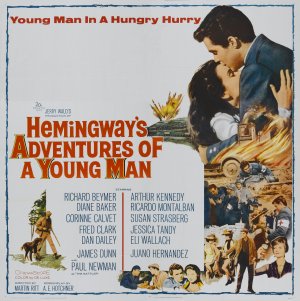
Lisa Cleans Out Her DVR: Hemingway’s Adventures Of A Young Man (dir by Martin Ritt)


(Lisa is currently in the process of cleaning out her DVR!  It’s going to take a while.  She recorded this 1962 literary adaptation off of FXM on January 30th!)

Hemingway’s Adventures Of A Young Man is one of those films that you just know was made specifically to win Oscars.  It’s a big prestige production, complete with a historical setting, an epic scope and big, all-star cast.  That most of those stars appear in relatively small roles was undoubtedly meant to evidence of the film’s importance.

“Look!” the film seems to shout at times, “This is such an important film that even Paul Newman was willing to stop by for a day’s work!”

The film is based on ten short stories by Ernest Hemingway and, loosely, A Farewell to Arms.  The stories all dealt with the early life of Nick Adams, who was a literary stand-in for Hemingway.  Since the Nick Adams stories were autobiographical (and, for that matter, so was A Farewell to Arms), the film can also be viewed as biopic.  Richard Beymer (who, a year earlier, had starred in West Side Story and who is currently playing Ben Horne on Twin Peaks) may be playing Nick Adams but the film leaves little doubt that he was actually meant to be playing Ernest Hemingway.

The film opens with Nick hunting with his father, Dr. Harold Adams (Arthur Kennedy).  He is present when his father travels to an Indian camp and helps to deliver a baby.  He respects his father but Nick wants to see the world and the film follows him as he explores America, working odd jobs and meeting colorful characters along the way.  Paul Newman shows up as a punch-drunk boxer and proceeds to overact to such an extent that he reminded me of Eric Roberts appearing in a Lifetime film.  Nick meets rich men, poor men, and everything in between.  He works as a journalist.  He works as a porter.  Eventually, when World War I breaks out, Nick enlists in the Italian army and the film turns into the 100th adaptation of A Farewell to Arms.

And really, I think it would have been an enjoyable film if it had been directed by someone like Otto Preminger, George Stevens, or maybe even Elia Kazan.  These are directors who would have embraced both the pulpy potential of the Nick Adams stories and the soapy melodrama of the war scenes.  A showman like Preminger would have had no fear of going totally and completely over the top and that’s the approach that this material needed.  Instead, Hemingway’s Adventures Of A Young Man was directed, in a painfully earnest style, by Martin Ritt.  Ritt tries to imitate Hemingway’s famously understated style with his understated direction but, cinematically, it’s just not very interesting.  Ritt portrays everything very seriously and very literally and, in the end, his direction is more than a little dull.

Sadly, the same can be said for Richard Beymer’s performance in the lead role.  Beymer comes across as being the nice guy who everyone says you should marry because he’ll be able to get a good and stable job and he’ll probably never go to jail.  Two months ago, when I watched and reviewed Twin Peaks, I really loved Beymer’s performance as Ben Horne.  He just seemed to be having so much fun being bad.  Unfortunately, in Hemingway’s Adventures Of A Young Man, he never seemed to be having any fun at all.  No wonder he temporarily put his film career on hold so that he could fully devote himself to working as a civil rights activist.

In the end, this is a movie that’s a lot more fun to look at than to actually watch.  Visually, the film is frequently quite pretty in an early 1960s prestige movie so sort of way.  And there are some good performances.  Eli Wallach, Ricardo Montalban, Susan Strasberg, Arthur Kennedy — there’s a whole host of performers doing memorable supporting work.  Unfortunately, even with all that in mind, this well-intentioned film largely falls flat.

Shattered Politics #61: Murder at 1600 (dir by Dwight H. Little)


Murder_at_sixteen_hundred_ver2Wow.

I have to admit that, seeing as how I was only 11 going on 12 back in 1997, I really wasn’t paying much attention to what was going on in the world at the time.  But, whatever it was, it must have been something big and scary and it must have left people feeling deeply suspicious of the government.  How else do you explain the fact that 1997 not only saw the release of Absolute Power, a film in which the President is a murderer, but Murder at 1600 as well.

Murder at 1600 opens with a White House maid finding the dead body of Carla Town (Mary Moore), an intern whose sole goal in life was apparently to have sex in every single room in the Executive Mansion.  (And, before you judge, that happens to be my goal in life as well.  So there.)  Streetwise homicide detective Harlan Regis (Wesley Snipes) is on the case!

And he’s certainly got a lot of suspects.  Could it be the Vice President (Chris Gillett)?  Or maybe Alvin Jordan (Alan Alda), the National Security Advisor?  Or how about Nick Spikings (Daniel Benzali), the bald-bef0re-bald-was-cool head of the Secret Service?  Or maybe it the President’s son (Tate Donavon)?  Or maybe even the President (Ronny Cox) himself!?

Fortunately, Regis is assigned a partner, Secret Service agent Nina Chance (Diane Lane).  When Regis first meets her, he’s all, “Oh my God, you’re a woman!”  And then Nina’s all, “I also won an Olympic medal for sharp shooting!”  And then Regis is like, “I bet that will be a relevant plot point before the film ends!”

Of course, Regis already has a regular partner, as well.  His name is Detective Stengel and he’s played by Dennis Miller, which just seems strange.  Stengel basically looks like Dennis Miller, sounds like Dennis Miller, and acts exactly like Dennis Miller, except for the fact that he’s a cop.  His jarringly out-of-place presence in this film just adds to Murder at 1600‘s general air of weirdness.

Meanwhile, it turns out that the North Koreans are up to no good and the President is being pressured to take military action.  However, he’s being distracted by this whole criminal investigation thing.  Will the country survive or did its future die at 1600?

(And why doesn’t the President just send in Team America to take care of the situation?  Or maybe James Franco and Seth Rogen.  There are way to deal with the North Koreans….)

(By the way, have you noticed how brave everyone online is when it comes to being snarky about the one country in the world that doesn’t have internet access?  If Kim Jong Whatevuh ever gets a twitter account, I bet everyone will start following him and asking him for retweets.)

Murder at 1600 is an enjoyably ludicrous thriller.  It’s one of those films that you’ll enjoy as long as you don’t take it seriously.  Take it seriously and you’ll end up asking question like why the FBI isn’t involved in the investigation and whether or not the solution to the film’s mystery is a bit too convoluted to make any logical sense.  However, if you simply decide to enjoy Murder at 1600 for what it is, an extremely pulpy thriller that’s full of nonstop melodrama, overwritten dialogue, and a healthy distrust of the government*, then you’ll find this to be an entertaining thriller.

At the very least, a White House full of potential murderers is probably a lot more realistic than anything that you might see in The American President.  

http://www.youtube.com/watch?v=q-CZrYOy_gI

—–

* Oh, everyone knows the government sucks…