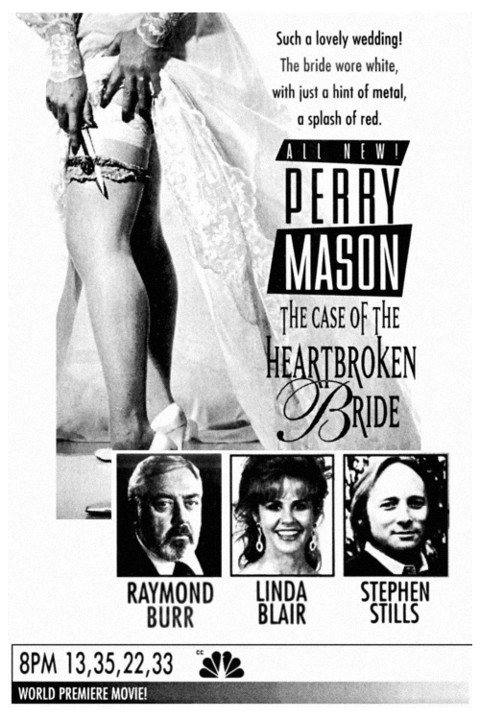
Perry Mason (Raymond Burr) can’t even go to a wedding without someone getting killed! Kaitlynn Parrish (Heather McAdam) is the daughter of Max (Ronny Cox) and Diane Parrish (Diane Baker). Diane used to work for Perry and it’s implied that they used to be more than just colleagues. (I think that means that it is safe to assume that Kaitlynn is actually Perry’s daughter.) At the wedding, Alonzo Hawkes (Beau Starr), the uncle of the groom, gets into an argument with Max and accuses Max of embezzlement. Kaitlynn says she could kill Alonzo. A few hours later, Alonzo is found dead and Kaitlynn is arrested.
This was the 23rd Perry Mason television movie and it’s very predictable. I didn’t care much for the mystery or the scenes of Ken (William R. Moses) looking for clues. Once again, Ken gets in trouble with organized crime. It’s as if the movies ran out of plot lines for Ken so he just has to keep doing the same thing over and over again. All Ken really has to do is track down Suzy Richards (Merle Kennedy), a wedding crasher who witnessed the murder but it takes him forever to do it. Paul Drake, Jr. would have found her in the time it takes to snap your fingers.
I still recommend this one because of the cast. Along with Ronny Cox, the cast also includes Linda Blair, Paul Dooley, and musician Stephen Stills and they’re all really good. Paul Dooley plays the district attorney in this one. He really has no patience for Perry’s courtroom theatrics and Perry has a lot of them in this movie. It’s a good thing Perry was always able to get people to confess on the stand because otherwise, he probably would have gotten in a lot of trouble.
Welcome to Retro Television Reviews, a feature where we review some of our favorite and least favorite shows of the past! On Tuesdays, I will be reviewing the original Fantasy Island, which ran on ABC from 1977 to 1984. Unfortunately, the show has been removed from most streaming sites. Fortunately, I’ve got nearly every episode on my DVR.
This week, we have two fantasies that seem very familiar.
Episode 7.9 “Fantasy Island Girl/Saturday’s Child”
(Dir by Leslie H. Martinson, originally aired on December 10th, 1983)
Actress Marion Sommers (Stella Stevens) comes to the Island. Lawrence is a huge fan and can’t imagine what fantasy she could possibly have. Roarke explains that Marion wants to be reunited with her children. The twist is that her children don’t know that Marion is their mother. They think that their mother died and that they were adopted by Fran Woods (Diane Baker).
Marion is told that, because of the way she phrased her fantasy, she’ll get to meet her children on the island but she can’t tell them that she’s their mother. The children have spent the last few years with Ms. Woods as their mother. Marion agrees but she doesn’t keep her word and, by the end of her fantasy, she’s told both Bill (David Kaufman) and Ellie (Amy Linker) that she is their mother and that she wants them to come with her. Bill and Ellie reject her, saying that Ms. Woods will always be their mother. However, they would like it if Marion would be their friend.
Lawrence asks Marion to give him her autograph so he can give it to his niece. Then, after Marion leaves, Lawrence tells Roarke that he doesn’t have a niece….
This fantasy seemed awfully familiar. I don’t really have the time to go back and reread every FantasyIsland review that I’ve written but I’m pretty sure that this show has already gone to the “I’m a famous actress who wants to meet the children that I gave up” well more than a few times. In this case, it just felt like everyone was going through the motions.
As for the other fantasy, it involved the Fantasy Island Girl Beauty Pageant and, again, I’m pretty sure I’ve seen several versions of this pageant fantasy in the past. This time, it’s the pageant’s producer, Nick Gleason (Paul Burke), who has a fantasy. It seems that Nick has a reputation for fixing his pageants so his fantasy is to run a totally “clean” and honest pageant. It seems like he could have just done that on his own without even having to go to Fantasy Island. Since when have fantasies become about doing things that most people would just do naturally?
Nick’s daughter, Tina (Audrey Landers), enters the pageant and suddenly, Nick finds himself tempted to fix the pageant for her. When Roarke explains this to Tina, Tina withdraws from the pageant and Nick doesn’t fix the pageant. Nick is so happy that he finally put on a honest pageant but the only reason he didn’t fix the pageant was because Tina dropped out. If she hadn’t dropped out, he totally would have rigged it. So, I’m not really sure that Nick has anything to brag about. It’s kind of like bragging about not robbing a bank because it was closed on Sunday.
Lawrence is appointed as one of the judges for the beauty pageant. You know who really enjoyed beauty pageants? Tattoo. This would have been a fun fantasy for Tattoo. Instead, we just get Lawrence looking all huffy and puffy.
Welcome to Retro Television Reviews, a feature where we review some of our favorite and least favorite shows of the past! On Tuesdays, I will be reviewing the original Fantasy Island, which ran on ABC from 1977 to 1984. Almost the entire show is currently streaming on Daily Motion, YouTube, Plex, and a host of other sites.
It’s time for another trip to the Island!
Episode 5.4 “The Last Cowboy/The Lady and the Monster”
(Dir by Don Chaffey, originally aired on October 31st, 1981)
For the second week in a row, Tattoo is notably absent in this episode. He is seen in the stock footage that opens each episode of FantasyIsland. Shortly afterwards, his pre-recorded voice is briefly heard when Mr. Roarke explains to Julie that Tattoo has been turned invisible so that he can help with the fantasy of another guest who is also invisible. Seriously, that’s the excuse that the show goes with. Tattoo is “there” but he can’t be seen. I can only imagine what was going on behind-the-scenes with Herve Villechaize. It’s easy to assume that Villechaize was holding out for more money but, to be honest, it’s almost too easy to assume that. It’s also possible that Villechaize may have just asked for some time off to pursue his career as a singer.
As for the fantasies, the better of the two featured Lynda Day George as scientist Carla Frankenstein, who comes to the island because she wants to clear her ancestor’s reputation for being mad. Fortunately, the castle of Baron Frankenstein just happens to be on the Island! In the castle, Carla finds evidence that, rather than trying to bring the dead back to life, the Baron was instead working on ways to extend the average lifespan. She also discovers that the Baron’s monster (played by veteran character actor William Smith) is still living in the castle!
The Monster is a dignified old soul who has been mistreated every time that he’s left the Castle. Carla befriends him but again, the Monster is forced to confront the pettiness of the outside world when a corporate spy (Ken Swofford) tries to take both Carla and Julie hostage. After Carla and Julia are rescued, the Monster retreats to the Castle but Carla promises that she will not only return to see him but that she will also continue her ancestor’s research. In fact, her company is going to build a lab on the Island and presumably employ the one or two Islanders who aren’t already employed by Mr. Roarke.
This was a Halloween episode so a Frankenstein fantasy feels appropriate. William Smith played the role of the Monster with a wounded dignity that was actually quite touching. His lonely existence was quite sad and I was actually glad when Roarke suggested that he and Julie would, from now on, be joining the Monster for dinner.
As for the other fantasy, Joe Campbell (Stuart Whitman) is yet another city slicker who wants to be a cowboy. Joe thinks that Roarke is going to send him to the old west, as he has done for so many other people with the exact same fantasy. Instead, Roarke gets all technical and says that Joe’s specific fantasy was to be a cowboy and not to travel to the old west. Joe finds himself working as a hired hand on a modern-day ranch. Once Joe stops whining (and it takes a while), he falls in love with widow Margaret Blair (Diane Baker), becomes a surrogate father to Jimmy Blair (Jimmy Baio), and he chasess off an evil biker (Robert Tessier). In the end, Joe asks for permission to remain at the ranch and Fantasy Island. Roarke agrees, probably so Joe can potentially replace Julie if she ever asks for a raise like Tattoo did.
This fantasy felt a bit too familiar. It’s always weird how Roarke will arbitrarily decide to be strict with some guests while letting others do whatever they want.
Welcome to Retro Television Reviews, a feature where we review some of our favorite and least favorite shows of the past! On Tuesdays, I will be reviewing the original Fantasy Island, which ran on ABC from 1977 to 1986. Almost the entire show is currently streaming is on Youtube, Daily Motion, and a few other sites.
This week, we get one good fantasy and one bad fantasy and a reminder that anything can happen on Fantasy Island!
Episode 4.8 “Crescendo/Three Feathers”
(Dir by Michael Preece, originally aired on December 20th, 1980)
This episode confirms that Fantasy Island is the strangest place on Earth.
Our first fantasy features Toni Tennille as a world-famous singer named Susan Lohmann. Susan has been invited meet her favorite composer and songwriter, Edmund Dumont (Monte Markham). Dumont lives in seclusion on Fantasy Island, in an estate that is surrounded by wild animals and where he is tended by a blind butler (James Hong).
Susan is excited to meet Edmund, until she walks in on him playing his piano and discovers that he’s a …. BEAST! Though he has the body of a human, he has the face of a wolf. It turns out that Edmund lives in seclusion because he feels that the world would never accept his appearance. And Susan promptly proves him correct by screaming and demanding to leave. Susan flees the estate.
Susan’s manager is glad that Susan is free because now she can appear in concert in London. However, Mr. Roarke informs Susan that Edmund suffers from a curse and the only thing that could have cured him would have been the love of Susan. Edmund is now determined to die, surrounded by the animals on his estate, the only creatures who accepted him. Susan, realizing that she was a little bit hard on a guy who couldn’t help his appearance, returns to the estate, gives Edmund a kiss, and Edmund turns into a handsome guy. Yay!
So, there’s a huge problem here. Susan Lohmann is incredibly unlikable. Yes, Edmund may look different. But all Edmund did was invited her to his estate so that he could express his appreciation for the way the she sings his songs. Susan claims that Edmund should have told her, in advance, about the way he looked. Yes, Susan, God forbid someone unattractive appreciate your talent or have any talent of his own. Seriously, Susan was the worst.
Slightly more likable is Alan Colshaw (Hugh O’Brian), a pilot who has spent a year feeling like a coward. He was piloting a plane that crashed in the jungle. Alan went for help and, according to the three other passengers (played by Diane Baker, James Wainwright, and Peter Lawford), he never returned and, instead, he ran off with a stash of diamonds that was on the plane. Alan says that he is sure he didn’t intentionally desert them but he can’t remember for sure because he’s been suffering from memory loss.
Mr. Roarke gives Alan a medallion, one that will allow him and the others to see what happened when the plane crashed. As for Alan, he brings along three white feathers, which he plans to give to each of the survivors as a way to symbolize that he’s not the coward that they think he is. (Yes, it doesn’t make much sense to me, either.)
Lena (Diane Baker) is the first to forgive Alan. Alan realizes that he’s in love with Lena and he tells Mr. Roarke that he wants to change his fantasy. He just wants to spend the rest of his life with Lena. Roarke informs Alan that he can’t do that because …. ALAN IS DEAD! He died while trying to get help after the crash. Alan has come back to life for the weekend so that his spirit can find peace.
That’s a pretty neat twist and, to its credit, the show sticks with it. Alan eventually proves that he wasn’t a coward and that another one of the passengers stole the diamonds and then he vanishes into the afterlife.
“Boss,” Tattoo says, “you mean he was a …. g-g-ghost!?”
“Oh, Tattoo!” Roarke snaps, “Please do not tell me that you are prejudiced!”
Fantasy Island may be a strange place but some things — like Roarke passive aggressively attacking Tattoo — never change.
Welcome to Retro Television Reviews, a feature where we review some of our favorite and least favorite shows of the past! On Wednesdays, I will be reviewing the original Love Boat, which aired on ABC from 1977 to 1986! The series can be streamed on Paramount Plus!
Today, we wrap up season one of The Love Boat! All aboard!
(Dir by Alan Baron, originally aired on May 20th, 1978)
As I sat down to watch this episode on Paramount Plus, I was once again confronted with that weird commercial featuring P!nk and Michael Phelps tossing a big red COVID germ at each other. I’ve seen this commercial a few times. It’s popular not only on Paramount Plus but also on Hulu and Peacock. For a commercial that’s all about the terrors of COVID, I have to say that representing the risk by using a big rubber ball feels a bit …. well, counterproductive. (Actually, perhaps silly would be a better way to describe it.) To be honest, P!nk and Michael Phelps look like they’re almost having too much fun tossing COVID at each other. Someday, someone will actually take a serious look at how and why the combined efforts of the media and the advertising industry struggled to convince people to take the vaccine and this commercial will hopefully be remembered. Considering that it’s the elderly who are at the greatest risk when it comes to COVID, it’s interesting that almost all of the vaccination commercials that I’ve seen have been stylistically aimed at older millennials. Michael Phelps saying that his depression puts him at a greater risk of COVID is not the sort of thing that’s going to convince an 80 year-old to get a booster.
Speaking of commercials, the first season finale of The Love Boat featured Antonio Fargas as an advertising exec named Lee Graham. When we first see him, he’s saying goodbye to his wife as he boards the ship. He tells her that he’ll miss her and that the only reason he’s going to be on the boat is because he’s working on ad campaign for the cruise company. Of course, he’s lying. He’s actually taking the cruise so that he can spend some time with his mistress, Andrea (Jonelle Allen). Lee and Andrea are excited to finally have a few days where they can be with each other without feeling like they have to hide for everyone. However, Lee soon discovers that his nosy neighbors (played by Kaye Bass and Elias Jacob) are also on the boat! As a result, Lee doesn’t get a chance to cheat on his wife and, at the end of the cruise, he and Andrea realize that they don’t want to continue their adulterous ways. Fortunately, it turns out that Lee’s wife already knew about the affair and is incredibly forgiving. I’m not really sure why she’s so forgiving but hey, it was the 70s! It’s not like The Love Boat is going to end with a divorce. That’s more of a 90s thing.
While this is going, ruthless business tycoon Mr. Yamashiro (Pat Morita — yes, you read that correctly) is determined to convince Ruth Newman (Diane Baker) to sell him her late husband’s factory. Yamashiro even orders his assistant, Ken Davis (Gary Collins), to trick Ruth by pretending to fall in love with her. However, Ken really does fall in love with her and he loses his job as a result. Fear not, though. Ruth hires him and agrees to invest in a special, voice-activated word processor that he’s created. Yamashiro is so impressed that he agrees to invest as well. Yamashiro says that they can consider his investment to be a wedding present. Ruth and Ken have only known each other for a few days but sure, why shouldn’t they get married? I mean, it’s the 70s! People get married about knowing each other for a weekend and then they forgive each other for cheating. Love is all around, no need to waste it. They’re all going to make it, after all.
However, none of those stories can compare to what happens to Gopher. After starting the cruise in a bad mood because he feels that Captain Stubing doesn’t respect him, Gopher falls for a young communist named Vanessa! And Vanessa is played by Eve Plumb. That’s right! This episode features the original Jan Brady filling Gopher’s head with a bunch of Marxist nonsense! Vanessa is traveling on the boat with her wealthy father (Don Porter) and she sure does resent all of the money that’s being spent on the cruise. When she tells Gopher that he should stop taking orders from the Captain because, as “members of the Personhood,” no one has any right to order anyone else around, Gopher takes her words to heart and he ended up getting fired for insubordination! Fortunately, it doesn’t take long for both Vanessa and Gopher to see the errors of their ways and the Captain hires Gopher back, with the understanding that Gopher will never again bring a certain impractical economic theory. It’s a bit like that episode where the Captain told Isaac that he was spending too much time learning about black history. The Captain’s not going to let his purser go down the Marxist rabbit hole!
And so, the first season comes to a close. This was a good episode with which to end the season. Though his storyline was undeniably icky, Antonio Fargas proved himself to be a talented physical comedian as he tried to keep his neighbors from noticing his girlfriend. The second story was a bit bland but Pat Morita transcended his stereotypical role. And seriously, how can you not enjoy Eve Plumb radicalizing Gopher?
When The Love Boat began, the crew was unsure of how to react around Captain Stubing. As the first season comes to a close, they’ve learned that Stubing will always have their back, as long as they don’t talk about Black History or Marxism. What will the crew discover about their captain during season 2? We’ll find out soon!
Welcome to Retro Television Reviews, a feature where we review some of our favorite and least favorite shows of the past! On Tuesdays, I will be reviewing the original Fantasy Island, which ran on ABC from 1977 to 1986. The entire show is currently streaming on Tubi!
This week, Mr. Roarke proves himself to be the expert at granting fantasies and teaching lessons. One group of visitors deals with international diplomacy. The other group deals with taking care of children. It’s time for …. FANTASY ISLAND!
Episode 1.12 “King For A Day/Instant Family”
(Directed by George McGowan, originally aired on May 6th, 1978)
There are a lot fantasies in this episode.
For instance, Ernie Miller (David Doyle) is a plumber who wants to be treated like a king. When he arrives on Fantasy Island, he is informed that he is now the King of Carpathia and that he is married to Queen Auroroa (Diane Baker). What Ernie doesn’t realize is that there actually is a country called Carpathia and that he just happens to look exactly like the nation’s recently deceased king. It turns out that Aurora is not just an actress hired to pretend to be the Queen. Instead, she actually is the Queen! Aurora had a fantasy of her own. She wanted the king to come back to life so that he could prevent the country by being taken over by the sinister Ambassador Soro (Theodore Bikel).
Roarke combines their two fantasies into one. Ernie gets to become king, on the condition that he abandon his former life and identity. (That’s something that Ernie has no problem with and, quite frankly, actor David Doyle wasn’t exactly the most convincing plumber that I’ve ever seen. Some actors were just meant to play men who wore suits to the office and David Doyle was one of them.) Aurora gets her husband back, except of course it’s not actually her husband. It’s just someone who looks like him. But Aurora is cool with that. This is kind of a weird fantasy. One has to wonder what would have happened in Ambassador Soro had announced that his fantasy was to conquer Carpathia. WHAT THEN, MR. ROARKE!?
As for the other fantasy, it involves a woman named Gail Grayson (Melinda Naud), whose fantasy is to get a job working for the world’s number one expert on how to raise children. Gail, it turns out, has written a thesis about how housewives are unnecessary and how being a mother isn’t as difficult as everyone says. (It’s hard for me to imagine any woman actually writing something like that but whatever. We’ll just go with it.) Gail gets to put her thesis to the test when she discovers that she’s been hired to act as a babysitter! It turns out that the world’s number one expert on raising children has several unruly children of his own.
Accompanying Gail is her mother, Mildred Grayson (Jane Wyatt). It turns out that Mildred didn’t appreciate Gail’s thesis (and really, who can blame her?) and her fantasy is for Gail to discover firsthand just how difficult it is to take care of a house and several bratty children. Again, Mr. Roarke decided to combine everyone’s fantasies. Gail gets to work for her mentor and Jane gets to watch as Gail is humiliated by the children. Eventually, Mildred comes to feel guilty about wishing so much trouble on her own daughter but everything work out in the end. Gail gets her dream job and Mildred gets to say, “I told you so.”
Yay! Everything works out for everyone!
This is one of those episodes where you really have to wonder if Mr. Roarke actually had a plan or if he was just making it all up as he was going along. If Ernie hadn’t agreed to become the king in real life, Carpathia would have been conquered by the communists. If Gail hadn’t realized her thesis was wrong, one of the children could have died on the island. Sometimes, I just think that there are better ways to teach people a lesson than taking them to a mystical island that is ruled in a somewhat arbitrary manner by a friendly but occasionally condescending host. That said, I would totally go to Fantasy Island if it did exist. I imagine the same was true of the majority of the people who watched the show when it first aired.
Welcome to Retro Television Reviews, a feature where we review some of our favorite and least favorite shows of the past! On Sundays, I will be reviewing the made-for-television movies that used to be a primetime mainstay. Today’s film is 1971’s A Little Game. It can be viewed on YouTube!
Twelve year-old Robert Mueller (played by 13 year-old Mark Gruner, who would later go on to play one of Chief Brody’s kids in Jaws) just hasn’t been the same since his father died. Robert idolized his father, who was an architect who built bridges and reportedly pushed his workers to take a lot of dangerous risks to get the job done. Perhaps that explains why Robert is not getting along with his new stepfather, Paul Hamilton (Ed Nelson). Robert’s mother, Elaine (Diane Baker), is convinced that Robert will eventually come to accept Paul but Paul isn’t so sure.
Robert is a student at a private military academy. When he comes home for the holidays, he brings his “best friend” with him. Stu Parker (Christopher Shea) is friendly and polite but he’s also easily led and has a difficult time standing up for himself. Paul immediately sees that Robert is bullying Stu. Elaine, however, thinks that Paul is being too critical. That’s just the way boys are!
In his diary, Robert has written that he killed someone and that he’s sure that he got away with it. When Paul comes across the entry, he worries that Robert might be telling the truth. Paul goes as far as to hire a private detective (Howard Duff) to investigate whether there’s been any mysterious deaths at Robert’s school. Stu, meanwhile, explains that he and Robert sometimes play “a little game” where they imagine that best way to murder someone and get away with it. But Stu assures Paul that it’s just a game. They don’t actually kill anyone.
Is Stu telling the truth or is Robert just as dangerous as his deceased father, a man who Paul claims was a psychopath? Or is Paul himself the one who has become delusional with jealousy of his stepson?
The answer to those questions is pretty obvious from the minute that Robert and Stu show up at the house. In fact, it’s so obvious that it kind of leaves the viewer wondering how everyone else in the film could be so clueless. On the one hand, it’s understandable that Elaine would not want to admit that there is something seriously wrong with her son. On the other hand, how many times can anyone close their eyes to a very obvious truth? From the minute that Robert shows up, wearing his uniform and curtly ordering around the family’s maid (played by High Noon‘s Katy Jurado, who deserved a better role), he might as well have psychopath tattooed on his forehead.
That said, evil children movies are always somewhat effective, even the ones that are a bit too obvious in their approach. Psychologically, we’ve been conditioned to always associate children with innocence, optimism, and hope. Children are the future, so the saying goes. As such, it does carry some impact when they’re portrayed as being a force of danger. As I watched this film, I did find myself wondering if there was any hope for Robert. With all that he had done, could someone still reach him and turn him around? Or was he destined to go from being an evil child to an evil adult? It really does get to the question of whether evil is a real, almost supernatural force or if it’s something that’s created by a combination of environment and social taboos. Was Robert born evil or did he become evil? A Little Game doesn’t answer that question but I doubt that anyone could. Some questions are destined to be forever unanswered.
King Xerxes (David Farrar), the ruler of Persia, is leading his armies across the ancient world, conquering every nation that he comes to. Xerxes is quick to proclaim that his vision is to have “one world ruled by one master” but really, he’s mostly just trying to prove that he’s as fearsome a conqueror as his father was. Like most authoritarians, he’s really just dealing with his own psychological issues.
When Xerxes sets his eyes on Greece, he assumes that he’ll easily be able to conquer the country. Greece, after all, is divided into several city states and everyone knows that the cities are rarely willing to work together. However, 300 Spartan warriors — led by King Leonidis (Richard Egan) — are willing to stand their ground and hold off Xerxes’s forces for as long as possible. Despite the fact that they’re outnumbered and have no way of knowing if reinforcements will ever arrive, the 300 Spartans are willing to do whatever it takes to protect their freedom. They know that they probably won’t survive the battle but none of them are going to surrender. Better to die than be enslaved.
If the plot of 1962’s The 300 Spartans sounds familiar, that’s probably because it’s based on the same historical events that inspired 300. The 300 Spartans essentially tells the same story and even has many of the same themes as Zack Snyder’s later film. The main difference, of course, is that The 300 Spartans tells it story in a much less stylized manner. Indeed, while 300 tended to kind of take place in a dream-world, one that was designed to highlight the legendary elements of the story, The 300 Spartans very much takes place in the real world, with the actors playing the ancient warrions standing on the same ground that Leonidis and his 300 Spartans once stood upon. It’s a choice that works well, giving The 300 Spartans a far more authentic feel than a lot of the other historical epics that came out in the 50s and 60s.
The 300 Spartans has everything that you might expect from a film like this: dancing, harems, swords, armor, a lot of talk of omens and honor, and of course several speeches about the importance of freedom. That said, even if some elements of the story are predictable, the film is well-acted with Richard Egan giving a strong performance as Leonidis while David Farrar turns Xerxes into a villain who you’ll enjoy rooting against. Anne Wakefield is also well-cast as Artemesia, Xerxes’s consort and his main advisor. Perhaps best of all is Ralph Richardson, playing the general Themistocles with the grim determination of a warrior who has learned better than to depend on omens and prophecy.
At the end of the film, the narrator grandly declares that the actions of the 300 Spartans were more than an example of Greek bravery. They were also, “a stirring example to free people throughout the world of what a few brave men can accomplish once they refuse to submit to tyranny!” Maybe a few years ago, I would have said that the narration went a bit overboard but, after the past few years, I’m now more convinced than ever that a lot of people would be fine living in an authoritarian state as long as their side was the one with all of the authority. At a time like this, any film that celebrates freedom is to be appreciated.
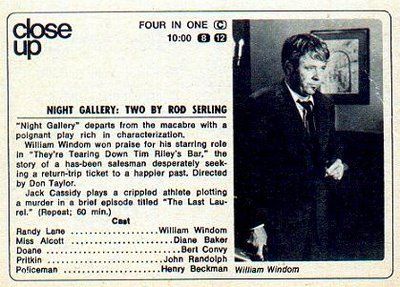
The first season of Night Gallery came to a conclusion on January 20th, 1971. Though the first season was undoubtedly uneven, it did end on a high point. The first segment in the 6th episode, They’re Tearing Down Tim Riley’s Bar, is widely considered to be the best episode of Night Gallery and one of Rod Serling’s best teleplays. It also brought Night Gallery one of it’s few Emmy nominations when it was nominated for Outstanding Single Program of the year. (It lost to The Andersonville Trial, a theatrical adaptation that was produced for PBS.)
They’re Tearing Down Tim Riley’s Bar (dir by Don Taylor, written by Rod Serling)
They’re Tearing Down Tim Riley’s Bar tells the story of Randy Lane (William Windom). In 1945, Sgt. Randy Lane returned home from serving in World War II, a war hero who had a wonderful future ahead of him. He had just gotten married. He had just gotten a good job at an up-and-coming company called Pritzker Plastics. When he came home, the first place he went was Tim Riley’s Bar, where his father and the other bar patrons toasted him and told him to look forward to the future.
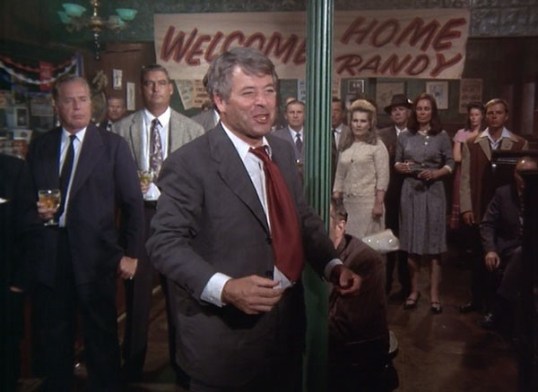
Twenty-five years later, the middle-aged Randy Lane is looking at his life and asking, “Is this as good as it gets?” He’s now a sales director at Pritzker Plastics but his boss (John Randolph) doesn’t appreciate him, his assistant (Bert Convy) is plotting to steal his job, and the only person who seems to care about him is his sympathetic secretary (Diane Baker). Randy’s wife died in 1952, while Randy was out of a sales call. Randy now lives alone. Even his neighborhood bar — Tim Riley’s Bar — has closed and been abandoned. With the bar schedule to be torn down, Randy wonder what happened to all of the promise and happiness of the past.
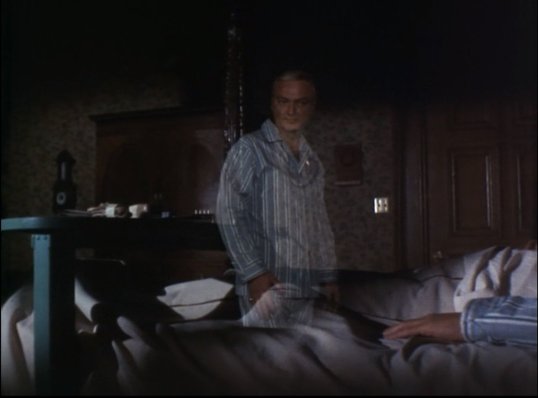
When Randy goes by the deserted bar and looks through the front window, he’s shocked to see all of his old friends and his father waving at him. But when Randy rushes into the bar to join them, he discovers the bar is deserted. Later, Randy is at work when suddenly, he sees Pritzker Plastics the way it was back in 1948. Even later, when he enters his house, he finds himself standing in a hospital hallway in 1952, once again getting the news that his wife has died.
In many ways, They’re Tearing Down Tim Riley’s Bar is an atypical Night Gallery segment. Though there are hints of the supernatural throughout the story, it’s hardly a work of horror. Instead, it’s a rather melancholy meditation on aging, disappointment, and regret. Is the past forever lost? Can things ever be as good as they once were? These are the questions that are raised in this well-directed and well-acted segment.
The Last Laurel (dir by Daryl Duke, written by Rod Serling)
Clocking in at 8 minutes, The Last Laurel is yet another segment about a bitter man (in this case, Jack Cassidy) who suspects that his wife (in the case, Martine Beswick) is cheating on him with his doctor (in this case, Martin E. Brooks) so he teaches himself a supernatural skill in order to get revenge. In this case, it involves astral projection. Not surprisingly, it ends with a twist that’s pretty much dependent on one of the characters doing something extremely stupid.
The Last Laurel is well-acted but predictable. It’s not bad but, especially when compared to something like They’re Tearing Down Tim Riley’s Bar, it feels rather insubstantial. It feels like filler.
The first season of Night Gallery came to an end with an excellent episode. Starting tomorrow — season 2!
From 1942 to 1944, a teenage girl named Anne Frank lived in hiding.
She and her family lived in what was sometimes called The Secret Annex, three stories of concealed rooms that were hidden behind a bookcase in an Amsterdam factory. At first, it was just Anne, her older sister Margot, and their parents. Eventually, they were joined by another family and eventually a dentist, with whom Anne did not get along. Life was not easy in the concealed space and tempers often flared. As the months passed, Anne had a romance-of-sorts with Peter, the teenage son of the other family, but she wondered if she truly felt anything for him or if it was just because they were stuck together. Anne looked forward to someday returning to school and seeing all of her old friends, again. However, she knew that she could not leave the Annex until the Nazis had finally been forced out of the Netherlands. She and the other occupants had to remain in hiding and they had to remain perfectly quiet eight hours a day because they were Jewish. If they were discovered, they would be sent to the camps. So, they waited and Anne kept a diary.
Tragically, the Nazis did eventually discover the Secret Annex. Of the 8 occupants, only Anne Frank’s father, Otto, would survive the war. The rest died in various concentration camps. Anne Frank’s mother starved to death in Auschwitz. Her older sister, Margot, was 19 when she fell from her bunk and, because she was in such a weakened state, was killed by the shock. Anne Frank, it is believed, died a few days after Margot. She died at the Bergen-Belsen Concentration Camp, one of the 17,000 prisoners to succumb to Typhus. Before she died, Anne Frank spoke with two former schoolmates who were also being held at Bergen-Belsen. She told them that she had believed her entire family was dead and that she no longer had any desire to go on living.
However, Otto Frank did survive and, at the end of the war, he returned to the Secret Annex. That’s where he discovered Anne’s diary. After editing it (a process that Anne, who aspired to be a journalist, had already started doing shortly before she was arrested), Otto arranged for the publication of the diary. The Diary of A Young Girl (or, as it was titled in some countries, The Diary of Anne Frank) was a bestseller and has remained one ever since it was first published. Along with being recognized as being one of the most important books ever written, it’s also been adapted for both stage and screen.
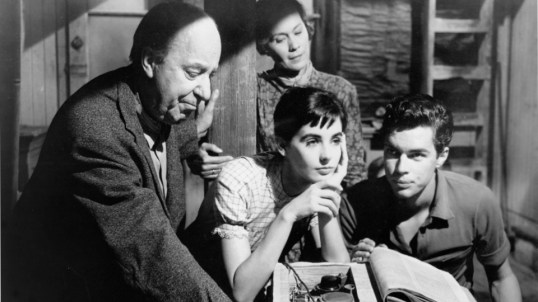
The first such screen adaptation was in 1959. It was directed by George Stevens and it starred 20 year-old Millie Perkins as Anne. (Perkins bore a great resemblance to Audrey Hepburn, who was reportedly Otto Frank’s preferred choice for the role. Hepburn turned him down, saying she would have been honored to have played the role but believed that she was too old to believable as a 14 year-old.) Joseph Schildkraut played Otto while Diane Baker played Margot and Gusti Huber played Edith Frank. The Van Daans were played by Shelley Winters and Lou Jacobi while Richard Beymer played their son (and Anne’s tentative boyfriend), Peter. Ed Wynn, who was best known as a comedian, played the role of Albert Dussell, the dentist to whom Anne took a dislike. (The surviving family of Fritz Pfeffer — who was renamed Dussell in Anne’s diary — objected to the way he was portrayed in both the book and the film.)
As a film, it has its flaws. George Stevens specialized in big productions but that was perhaps not the proper approach to take to an intimate film about a teenage girl coming-of-age under the most difficult circumstances imaginable. Because this was a 20th Century Fox production from the 50s, The Diary of Anne Frank was filmed in Cinemascope, which made the annex itself look bigger than it should. Scenes that should feel claustrophobic often merely come across as being cluttered.
But, in the end, the story is so powerful and so important that it doesn’t matter. Though the Annex was recreated on a Hollywood sound stage, the exteriors were actually filmed in Amsterdam. When we see the outside of the factory where the Frank family lived, we are seeing the actual factory. When we see repeated shots of the uniformed Nazi police patrolling the streets at night, we know that we’re seeing the actual view that Anne Frank undoubtedly saw many a night from the Annex. And because we know the story, we begin the film knowing how it’s going to end and that adds an even greater weight to each and every scene. It’s impossible not to relate to Anne’s hopes for the future and it’s just as impossible to not mourn that Anne never lived to see that future.
Stevens originally planned for the film to end with a scene of Anne at Bergen-Belsen. To their discredit, 20th Century Fox removed the scene after preview audiences complained that it was too upsetting. People should be upset while watching (or, for that matter, reading) The Diary of Anne Frank. Even today, there are people who still seem to struggle with acknowledging the enormous evil that was perpetrated by the Nazis and their allies. As a result, it’s not uncommon to find people who, when they don’t outright deny that it happened, try to minimize the Holocaust. It’s a disgusting thing. There was recently a viral video, which was released by NowThis that featured a student at George Washington University saying, “What’s going to happen if there’s another Holocaust? Well, we’re seeing what’s happening. We’re seeing people die at the border for lack of medical care. That’s how Anne Frank died. She didn’t die in a concentration camp, she died from typhus.” NowThis later said that the student meant to say that Anne Frank “didn’t die from a concentration camp, she died from typhus,” and you really have to wonder just how fucking stupid someone has to be to think that 1) that’s somehow an improvement on what was originally said and 2) that typhus and the concentration camp were not essentially the same thing. Even if one accepts that the student misspoke, it would seem that her main complaint was the the concentration camp didn’t have proper medical care, as opposed to the fact that it was specifically created to imprison and kill Jewish people. It’s an astounding combination of ignorance and antisemitism. NowThis later edited her comments out of the video, which again seems to miss the point of why people were upset in the first place. Instead of just saying, “Hey, this idiot is a Holocaust denier and, regardless of whether she hates Trump as much as we do, we want nothing to do with her,” NowThis instead said, “Well, if that comment offends you, we’ll take it out and you won’t have to hear it.” To me, that’s why The Diary of Anne Frank is still important and why it should still be read and watched and studied. There are too many ignorant people and craven, weak-willed organizations out there for us to turn our backs on teaching history.
The Diary Anne Frank was nominated for best picture of the year. While Shelley Winters won the Oscar for Best Supporting Actress, the Best Picture Oscar went to Ben-Hur. Interestingly enough, Ben-Hur’s director, William Wyler, was originally interested in directing The Diary Anne Frank before George Stevens was brought on board.
 Perry Mason (Raymond Burr) can’t even go to a wedding without someone getting killed! Kaitlynn Parrish (Heather McAdam) is the daughter of Max (Ronny Cox) and Diane Parrish (Diane Baker). Diane used to work for Perry and it’s implied that they used to be more than just colleagues. (I think that means that it is safe to assume that Kaitlynn is actually Perry’s daughter.) At the wedding, Alonzo Hawkes (Beau Starr), the uncle of the groom, gets into an argument with Max and accuses Max of embezzlement. Kaitlynn says she could kill Alonzo. A few hours later, Alonzo is found dead and Kaitlynn is arrested.



 Through the Shattered Lens