Horror Review: Bone Tomahawk (dir. by S. Craig Zahler)


“What is sacred to a bunch of goddamned savages ain’t no concern of the civilized man! We got permission!” — Buddy

Bone Tomahawk (2015) begins in quiet dread. A still horizon, the whisper of wind across rock, a hint of bone under the dust—the American frontier looms like an unfinished thought. This silence sets the tone for S. Craig Zahler’s remarkable debut, a film that wears the form of a Western only to strip it down to nerve and marrow. It’s a story of decency under siege, of men pushing past the last borders of civilization and discovering that what lies beyond is not the unknown, but the origin of everything they thought they’d overcome.

At first glance, the premise seems familiar. When several townspeople vanish from the small settlement of Bright Hope, Sheriff Franklin Hunt (Kurt Russell) leads a rescue expedition into the desert. Riding with him are three others: the injured but determined Arthur O’Dwyer (Patrick Wilson), whose wife has been taken; his tender-hearted deputy, Chicory (Richard Jenkins), whose chatter and old-fashioned kindness soften the film’s bleak austerity; and the self-assured gunman John Brooder (Matthew Fox), a man equal parts gallant and cruel. Together, they represent the moral cross-section of a civilization still trying to define itself—duty, love, loyalty, arrogance.

Their journey outward becomes one of inward descent. Zahler’s script unfolds at a deliberate pace, steeped in stillness and exhaustion. The first half moves like ritual—meandering conversations, humor worn thin by weariness, the small comforts of campfire fellowship flickering against the vast emptiness around them. It’s here that Bone Tomahawk begins its slow transformation. What starts as a rescue Western gradually becomes something deeper and older. By stripping away the romance of exploration, Zahler reveals the frontier not as a space of discovery, but as a place of reckoning—a mirror of the instincts civilization pretends to have tamed.

The film’s most haunting element is its portrayal of the so-called “troglodytes,” the mysterious group believed to be responsible for the kidnappings. They are less a tribe than an incarnation of the wilderness itself—nameless, wordless, and utterly beyond cultural translation. Covered in ash, communicating through the eerie hum of bone instruments embedded in their throats, they seem less human than ancestral, as though the land itself had dragged them upward from its own depths. Zahler refuses to frame them anthropologically or politically; instead, they represent the primal truth the American frontier sought to bury under its myths of order and progress.

Western films, for more than a century, have mythologized the wilderness as an external force—something to conquer. But the “troglodytes” in Bone Tomahawk feel like the soil’s memory of what came before conquest: the savage necessity that built the very myths used to conceal it. They are the frontier’s unspoken ancestry—what remains after all the churches, taverns, and codes of decency are stripped away. Civilization needs them to remain hidden in the canyons, out of sight and unspoken, because their existence contradicts everything the polite narrative of the Old West stands for. They are what progress denies but cannot erase.

Zahler’s restraint strengthens this allegory. He shoots the desert not as backdrop but as evidence—a geographical wound extending beyond the horizon. The wilderness looks stunning but predatory, its stillness full of threat. Even when the posse’s odyssey is free of immediate danger, there’s the growing sense of being consumed: by the sun, by exhaustion, by the quiet knowledge that the world they’re riding into has no use for their notions of law and virtue. Civilization, here, is a pocket of light surrounded by something much older and hungrier.

That hunger, the need to conquer and consume, connects Bone Tomahawk to its spiritual predecessor, Antonia Bird’s Ravenous (1999). Bird’s film transformed the Donner Party’s historical ghosts into an allegory of Manifest Destiny, equating cannibalism with American expansion—the act of devouring land, life, and self under the guise of progress. Zahler continues that lineage with deliberate starkness. For him, violence in the frontier isn’t just literal; it’s foundational, the unacknowledged currency of civilization. Where Ravenous expressed its critique with mordant humor, Bone Tomahawk speaks in solemn tones, observing how every civilized act—the enforcement of law, the defense of home—rests upon the refusal to see what was consumed to create it.

The “troglodytes” embody that refusal incarnate. They are not villains in the traditional sense; Zahler grants them no ideology or explanation, only the primal fact of their survival. In doing so, he flips the Western’s moral equation: the barbarians at the edge of civilization are not invaders, but reminders of its origins. They are ghosts of the violence that founded the frontier, the unspoken proof that the West was never as far from savagery as it claimed. To look upon them is to glimpse the beginning—the raw, lawless reality America buried beneath the idea of itself.

Kurt Russell, magnificent in his restraint, anchors this tension. His Sheriff Hunt evokes a fading kind of decency: measured, fair, and unwavering even in futility. Russell plays him not as a Western hero but as a man committed to honor in a world that no longer rewards it. His calm authority softens only around those he loves and hardens in the face of what he doesn’t understand. In that measured decency lies the film’s aching question: what happens when morality meets something that does not recognize it?

Patrick Wilson’s O’Dwyer embodies faith’s physical agony—a man driven by devotion, limping through a landscape that punishes his determination. Richard Jenkins provides heart and subtle tragedy; his rambling, almost comical musings on aging and loneliness become the story’s moral texture, the sound of humanity scraping against extinction. And Matthew Fox, in his most precise performance, gives voice to the arrogance of the civilized killer—a man who fashions violence as virtue, believing his elegance excuses his cruelty.

Together, the four men form a living cross-section of the West’s moral mythos. Their journey exposes how fragile those ideals become once separated from the safety of town limits. They embody the dream of order confronting the truth of chaos—and the cost of looking too long into the void beyond it.

Zahler’s filmmaking is remarkably self-assured for a debut, and what stands out most is his willingness to trust stillness. There is no manipulated rhythm, no swelling score to guide emotion. The soundscape is shaped by wind, hoofbeats, crackling fires, and quiet voices rattled by exhaustion. The silence itself becomes a spiritual presence, pressing down on the travelers until conversation feels like resistance. Each scene builds tension not through action, but through waiting—the dread of what remains unseen, what civilization has pretended not to hear.

The violence, when it erupts, is unforgettable. Zahler does not linger voyeuristically, yet the weight of what happens lands with moral precision. The horror feels earned—an eruption of the primal into the civilized. Its purpose is not to shock, but to remind: the line between the men of Bright Hope and the people they fear is thinner than they want to believe. The frontier, as Zahler presents it, is not an untouched wilderness but the graveyard of an ongoing denial—the myth of progress stacked atop the bones of the devoured.

In that way, Bone Tomahawk moves beyond the idea of genre blending. It is not merely a “horror Western,” but a meditation on how those two sensibilities spring from the same source. Both depend on the confrontation between safety and the unknown, belief and disbelief. Both are rituals of fear, structured to reassure yet always at risk of unveiling the truth. Zahler’s greatest achievement is the way he strips away that reassurance. By the film’s final stretch, the promises of civilization—hope, faith, righteousness—have been exposed as fragile constructions built atop an ancient void.

And yet, through all its darkness, Zahler allows a flicker of grace. The film’s humanity endures in small gestures: a conversation interrupted by laughter, a hand extended in kindness, the stubborn persistence of dignity in impossible circumstances. Bone Tomahawk never preaches or offers catharsis, but it does something harder—it bears witness. It shows men maintaining decency not because it protects them, but because it defines them. In that endurance lies the film’s quiet heartbeat.

Like Ravenous before it, Bone Tomahawk reimagines cannibalism and frontier brutality not as aberrations, but as mirrors reflecting a truth about the American project: that every step westward demanded erasure, and that what was erased refuses to stay buried. The “troglodytes” linger not only in the canyons but within the culture that feared them—proof that civilization’s polish has always covered the rough, enduring shape of appetite.

By the end, what remains is not revelation or redemption, but silence—the kind that comes after myth collapses. Zahler’s film leaves its characters and viewers alike to confront the space where civilization ends and something older begins. The desert remains untouched, vast and timeless, holding the secret at the center of all Western stories: that progress has always been haunted by the primitive, that the world we built never left the wilderness—it merely disguised it.

Measured, brutal, and strangely tender, Bone Tomahawk stands as both a reclamation and an undoing of the Western myth. It listens to the echoes of the Old West and answers them not with triumph, but with reckoning. In its dust and silence lies a truth older than law or legend: civilization may light its fires, but there will always be something in the dark watching, waiting—the part of us it never truly left behind.
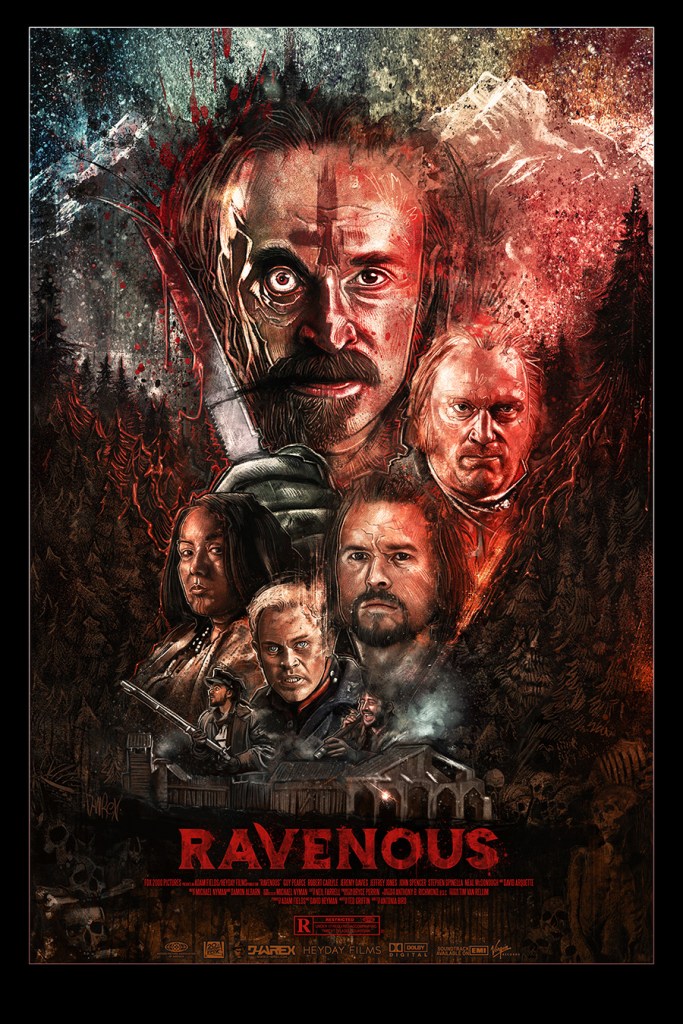
Horror Review: Ravenous (dir. by Antonia Bird)


“Morality… is the last bastion of a coward.” — Colonel Ives

Ravenous remains one of the most fascinating and thematically daring horror films of the late 1990s—a layered meditation on hunger, morality, and the consuming appetite of empire disguised as a tale of survival. Set against the punishing winter backdrop of the Mexican-American War, the film centers on Lieutenant John Boyd, a soldier burdened by cowardice and guilt, sent to an isolated military outpost in the Sierra Nevadas. When a frostbitten stranger stumbles into camp with a horrifying tale of survival, the line between the living and the devoured—and between humanity and monstrosity—begins to blur.

At first glance, Ravenous is a dark horror film about cannibalism in a remote frontier fort. What distinguishes it is the way it transforms that premise into a meditation on civilization and consumption. The screenplay, written by Ted Griffin, draws inspiration from historical accounts such as the Donner Party and Alfred Packer—stories of pioneers who resorted to cannibalism to survive brutal winters. Griffin threads these historical horrors into a broader allegory about 19th-century American expansionism: a national hunger for land, power, and progress that consumes everything in its path, including its own humanity.

The mythological backbone of Ravenous lies in the inclusion of the wendigo, a spirit from Native American folklore. In Algonquin and Ojibwe tradition, the wendigo is born of greed and gluttony, a monstrous being that grows stronger and more grotesque with each act of consumption. The tale served as a warning against selfishness, warning that those who devour others—figuratively or literally—lose their humanity in return. Bird and Griffin seamlessly integrate this legend into the film’s themes, using the wendigo to mirror the psychological and cultural costs of empire. The story implies that the wendigo is not confined to mythic forests but lives in the blood of every nation that feeds on others to survive.

The fort where the story unfolds functions as both a stage and symbol: an outpost of civilization planted in the wilderness, claiming righteousness while sustained by exploitation. As starvation and moral decay take hold, the soldiers’ pretense of order crumbles. The isolated setting reflects the broader American project—civilization advancing through conquest yet losing its moral center in the process. The Native nations displaced and destroyed during expansion, reduced to resources or obstacles, become the unseen victims of this devouring drive. The film reframes cannibalism as a metaphor for Manifest Destiny itself—the act of consuming people, land, and spirit under the guise of progress.

That central metaphor gains power through the film’s performances. Guy Pearce delivers a subdued yet deeply expressive performance as Boyd, embodying the moral paralysis of a man trapped between guilt and survival. His silences, glances, and hesitations speak louder than any dialogue, conveying an internal conflict between virtue and instinct. Through him, the film explores how the will to endure can erode the boundaries of conscience.

Robert Carlyle, as Colonel Ives, stands in vivid contrast—charismatic, witty, and terrifyingly self-assured. He plays the role with the infectious energy of a man liberated by his own monstrosity, wearing sin as philosophy. For Ives, cannibalism is not horror but a revelation—a means to transcend weakness and embrace dominance. His eloquent justifications turn atrocity into ideology, echoing the rationalizations of expansionist politics. It is no coincidence that his confidence parallels Boyd’s doubt; the two men form mirror halves of a single corrupted ideal.

Director Antonia Bird’s touch elevates Ravenous from a historical thriller to a surreal moral fable. She handles violence and absurdity with equal precision, oscillating between grim horror and deadpan humor in a way that keeps viewers uneasy yet enthralled. Her direction never treats the horror as spectacle alone—every moment of gore carries weight, testing the limits of empathy and survival. Moments of unexpected humor punctuate the brutality, serving as a reminder that even atrocity can become ordinary when normalized by power.

While the fusion of dark comedy and horror lends the film its originality, it may also unsettle some viewers. The tonal shifts—helped by Michael Nyman and Damon Albarn’s strange, minimalist score—create an atmosphere that feels intentionally dissonant. This mix may challenge those expecting a traditional horror film, but it reinforces Bird’s vision of moral chaos. The unease generated by those shifts mirrors the absurdity of history itself: how horrors can coexist with banality, how laughter can accompany destruction.

The wendigo myth binds all these elements together. Bird portrays it less as a creature and more as a condition—one that spreads through ideology, greed, and the illusion of progress. The spirit of the wendigo thrives wherever ambition turns men into predators and justifies their violence as destiny. In this sense, every character becomes a reflection of national hunger, caught in a metaphorical cycle of consumption. The act of eating flesh becomes a stand-in for the broader devouring inherent in colonization: of land, of native culture, of moral identity.

By framing the frontier as an arena of both physical and spiritual starvation, Ravenous reimagines American history as a feast of self-destruction. It suggests that survival is often indistinguishable from conquest—both are rooted in the urge to consume. Even at its most surreal or ironic moments, the film refuses to let its viewers forget that the hunger at its center is not merely for sustenance but for dominion.

Though underappreciated upon release, Ravenous has since earned recognition as a rare film that wields gore and satire to expose deeper truths. Bird’s control of tone, Griffin’s allegorical writing, and the actors’ opposing energies fuse into something that transcends genre. The result is a story that both horrifies and compels, holding a cracked mirror to the myth of progress.

The wilderness of Ravenous is vast, beautiful, and pitiless—a perfect reflection of the American spirit it depicts. It is a land that promises renewal but demands devouring, a landscape haunted by the ghosts of all it has consumed. The film endures not simply as a parable of survival, but as a meditation on empire, appetite, and the fragile line separating civilization from savagery.

Both grotesque and profound, Ravenous gnaws not only at flesh but at the conscience, forcing us to confront what happens when hunger—whether for life, for power, or for victory—becomes the only morality left.

October True Crime: Mob Town (dir by Danny A. Abeckaser)


In 1957, the Commission — the governing board that regulated organized crime in America — seemed like it was on the very of collapsing.  Bugsy Siegel was dead.  Lucky Luciano had been exiled to Sicily.  Meyer Lansky was more concerned with running his casinos in Cuba than with keeping track of who was angry with who in America.  The ruthless Vito Genovese was moving in on everyone’s business and was suspected of being behind the assassination of Albert Anastasia and the shooting of Frank Costello.

Genovese, looking to solidify his control and perhaps bring some peace to the warring factions, called for a summit in upstate New York, at the estate of Joseph Barbara.  Bosses from across the country gathered in Apalachin, New York.  It started out as a nice weekend, with stories being told and fish being grilled.  But then, suddenly, the cops showed up and 50 of the country’s most powerful mobsters made a run for it.  Many of them ducked into the woods, where they were subsequently rounded up by the cops.

In the end, several mobsters were arrested and convicted of various crimes.  All of those convictions were overturned on appeal.  However, the arrests revealed to America that the Mafia wasn’t just an urban legend.  Up until the bust at Apalachin, FBI director J. Edgar Hoover insisted that there was no such thing as the Mafia.  After the bust, Hoover not only acknowledged that the Mafia existed but he also started a special division of the FBI to deal with it.

(Not that it did much good, of course.  Being exposed still didn’t stop the Mafia from fixing the vote in Illinois during the 1960 presidential election.)

The 2019 film Mob Town details the events leading up to the Apalachin Conference.  Robert Davi is properly intimidating as the ruthless Vito Genovese.  The film’s director, Danny A. Abeckaser, plays Joseph Barbara while Jami-Lyn Sigler plays Barbara’s wife, tasked with putting together a dinner for a growing list of guests.  Josephine Barbara goes from being happy about her husband working his way up the ranks of the mob to growing increasingly frustrated as the number of expected bosses rises from 30 to 50 and I have to say that I could very much relate to Josephine.  Finally, David Arquette plays Edgar Croswell, the New York state trooper who figured out that something big was happening at the Barbara place.  Croswell spends most of the film trying to get people to take him seriously.  At the end of the film, he gets a congratulatory call from President Eisenhower.  I’m enough of a history nerd that I appreciate any film that ends with a congratulatory call from President Eisenhower.

Mob Land was obviously made for a low-budget and it doesn’t always move as quickly as one might like.  When Croswell isn’t trying to expose the mob, he’s pursuing a romance with Natalie (Jennifer Esposito) and Arquette’s permanently dazed expression doesn’t always make him the most convincing state trooper.  It’s an uneven movie that traffics in almost every mob cliche but I can’t be too critical of it.  Robert Davi was a more convincing Genovese than Robert De Niro was in Alto Knights.  I appreciated the scenes of the Barbaras trying to get their place ready for the meeting.  That was mob action to which I could relate.

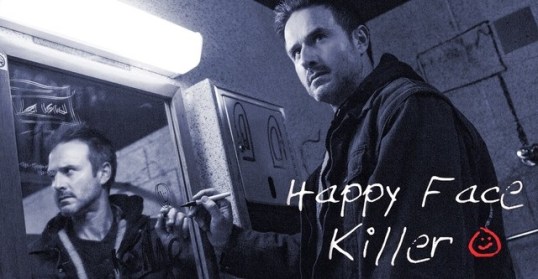
October True Crime: Happy Face Killer (dir by Rick Bota)


2014’s Happy Face Killer is loosely-based on the real-life crimes of Keith Hunter Jesperson.

Jesperson was a truck driver who, in the early 90s, murdered at least eight women in six different states.  (Jesperson later claimed that he murdered over 160 but no one knows if that’s true or not.  For his part, Jesperson has a habit of retracting his confessions shortly after giving them.)  The product of an abusive childhood, Jesperson’s trademark was drawing a smiley face on either the bodies of his victim or on the locations where he dumped them.  A good deal of Jesperson’s crime spree was inspired by anger that someone else had falsely confessed to one of his murders.  Jesperson left graffiti in truck stops all over Oregon, letting people know that the “Happy Face Killer” was still out there.

In The Happy Face Killer, Jesperson is played by David Arquette.  The film makes good use of Arquette’s naturally goofy screen persona, showing how a serial killer like Jesperson could convince someone to climb into his truck in the first place.  Arquette plays Jesperson as someone who comes across as being maybe a little bit nerdy and little but off-center but who still manages to present himself as being a likable guy.  It’s only once he has his victim alone in his truck that Jesperson allows the mask to slip and reveals his true self.  Whether making overly glib videos in which he brags about being a murderer or considering whether he should let one potential victim live because she has a baby, Arquette portrays Jesperson as being an all-too plausible and familiar monster.  The film’s best moments are the ones where Jesperson is struggling to hold up his façade of normality.  It’s those scenes that make the viewers realize that we’ve all probably known a Keith Jesperson or two.  Indeed, I think one reason why serial killers have such a hold on the culture right now is because it’s totally possible that anyone of us might know one.  Who knows what their neighbors or their co-workers are really doing behind closed doors?

Where the film falters is in its portrayal of the investigation that led to Jesperson’s eventual capture.  In real life, Jesperson panicked after the police questioned him about reports that he had been seen with some of the Happy Face Killer’s victims.  Afraid that he was going to be arrested, Jesperson twice attempted (and failed) to commit suicide before eventually turning himself in and confessing to the crimes in hopes of getting a lenient sentence.  In the film, the investigation is headed up by a tough-as-nails FBI agent (played by Gloria Ruben), who is haunted by the murder of her sister and who spends a lot of time apologizing to dead bodies and fighting the forces of the patriarchy.  The scenes with Ruben feel a bit too derivative of every other serial killer film that has ever been made and Ruben’s flat performance fails to bring much depth to her one-note character.  The scenes of Ruben snapping at the condescending men who think that a woman can’t catch a serial killer feel less like empowerment and more like pandering.

The Happy Face Killer is at its most effective when it focuses on the loneliness of the late night truck stop and the danger hiding behind the smiling face of the seemingly friendly man offering you a ride.  David Arquette gives a frightening performance as the soulless Jespersen.  In real life, Keith Jespersen is currently serving four life sentences and will hopefully never see the outside of a prison again.

Ghostface returns in the new Scream trailer!


From the directors of Ready or Not comes yet another chapter in Wes Craven’s Scream series. I’ll admit I’m liking the cast in this one. We have Melissa Barerra (In the Heights), Jenna Ortega (Yes Day), Dylan Minnette (30 Reasons Why), Jack Quaid (The Boys), Marley Shelton (Planet Terror), Kyle Gallner (Jennifer’s Body), and Mikey Madison (Once Upon a Time…In Hollywood)

Then you have the returning cast, which includes Neve Campbell, Courtney Cox and David Arquette. Most importantly, it appears that Roger L. Jackson is voicing the Ghostface again! On a side note, Jackson was also responsible for Mojo Jojo’s voice in The Powerpuff Girls. (“Curses!”)

January movies don’t always do very well, but we’ll see what happens with this one.

Scream releases in cinemas on January 14th, 2022.

3000 Miles to Graceland (2001, directed by Demian Lichtenstein)


Five thieves show up in Vegas to rob a casino.  The casino is also hosting an Elvis convention so the criminals all dress up like Elvis before trying to pull off their heist.  Since one of the criminals is played by Kurt Russell and Russell famously played Elvis in a made-for-TV movie, it’s a meta joke.  The worst of the criminals is played by Kevin Costner because, in 2001, Costner’s career was dead in the water and he was trying to reinvent himself as some sort of badass character actor.

As a result of a shootout and series of personal betrayals, Russell and Costner are the only two thieves who survive the heist.  Kurt Russell ends up taking all of the money for himself and running off with single mother Courteney Cox.  (Yes, Cox’s then-husband, David Arquette, does have a small role in the movie.)  Costner pursues them, killing anyone who he comes in contact with until it all leads to one final shoot out.

3000 Miles to Graceland is a stupid, stupid movie that was made at the time when every director was still trying to remake Reservoir Dogs and The Usual Suspects.  If you need any proof of how bad this movie is, just consider that it is one of the few Kurt Russell films to never develop a cult following.  There are people who would jump into the mouth of a volcano if Kurt Russell told them to and even they won’t watch 3000 Miles to Graceland.  Even the worst 90s crime films have at least a few people willing to defend them but 3000 Miles to Graceland has been abandoned on the ash heap of crime film history.  Despite having a once-in-a-lifetime supporting cast — Christian Slater, Bookeem Woodbine, Kevin Pollack, Jon Lovitz, Howie Long, Ice-T, and even Paul Anka — 3000 Miles to Graceland has never even received a direct-to-video sequel.

Why is 3000 Miles to Graceland so forgettable?  The heist storyline has been done to death and this film doesn’t bring anything new to the genre.  The only new wrinkle that 3000 Miles to Graceland brings to its familiar story is that the thieves are all dressed like Elvis and that gets old pretty quick.  The other problem is that Kevin Costner is miscast as the psycho villain.  Michael Madsen could have handled the role.  So could Tom Sizemore or Woody Harrelson or just about other actor out there.  But Kevin Costner, who first found fame as a sort of modern-day Gary Cooper, never seems comfortable playing a cold-hearted sociopath.  He makes up for this discomfort by trying too hard.  Comparing his performance here to his more nuanced turn as another criminal in A Perfect World shows just how miscast he was in 3000 Miles To Graceland.

Fortunately, better things were ahead for almost everyone involved in this movie.  Kevin Costner has recently returned to playing the type of roles that made him a star to begin with and Kurt Russell has become an American idol.  Fortunately, 3000 Miles to Graceland is remembered, if at all, as just an unfortunate detour in their otherwise distinguished careers.

Horror Film Review: Buffy the Vampire (dir by Fran Rubel Kuzui)


Watching this movie was such a strange experience.

Now, of course, I say that as someone who grew up watching and loving the television version of Buffy the Vampire Slayer.  Back when Buffy was on TV, I was always aware that the character had first been introduced in a movie but every thing I read about Buffy said that the movie wasn’t worth watching.  It was a part of the official Buffy mythology that Joss Whedon was so unhappy with what was done to his original script that he pretty much ignored the film when he created the show.

So, yes, the 1992 movie version of Buffy the Vampire Slayer showed how Buffy first learned that she was a slayer, how she fought a bunch of vampires in Los Angeles, and how her first watcher met his end.  But still, Joss Whedon was always quick to say that the film should not be considered canonical.  Whenever anyone on the TV show mentioned anything from Buffy’s past, they were referencing Joss Whedon’s original script as opposed to the film that was eventually adapted from that script.  (For instance, on the tv series, everyone knew that Buffy’s previous school burned down.  That was from Whedon’s script.  However, 20th Century Fox balked at making a film about a cheerleader who burns down her school so, at the end of the film version, the school is still standing and romance is in the air.)  In short, the film existed but it really didn’t matter.  In fact, to be honest, it almost felt like watching the movie would somehow be a betrayal of everything that made the televisions series special.

Myself, I didn’t bother to watch the film version of Buffy the Vampire Slayer until several years after the television series was canceled and, as I said at the start of the review, it was a strange experience.  The movie is full of hints of what would make the television series so memorable but none of them are really explored.  Yes, Buffy (played here by Kristy Swanson) has to balance being a teenager with being a vampire slayer but, in the film, it turns out to be surprisingly easy to do.  Buffy is just as happy to be a vampire slayer as she is to be a cheerleader.  In fact, one of the strange things about the film is just how quickly and easily Buffy accepts the idea that there are vampires feeding on her classmates and that it’s her duty to destroy them.  Buffy’s watcher is played by Donald Sutherland and the main vampire is played by Rutger Hauer, two veteran actors who could have played these roles in their sleep and who appear to do so for much of the film.  As for Buffy’s love interest, he’s a sensitive rebel named Oliver Pike (Luke Perry).  On the one hand, it’s fun to see the reversal of traditional gender roles, with Oliver frequently helpless and needing to be saved by Buffy.  On the other hand, Perry and Swanson have next to no chemistry so it’s a bit difficult to really get wrapped up in their relationship.

I know I keep coming back to this but watching the movie version of Buffy is a strange experience.  It’s not bad but it’s just not Buffy.  It’s like some sort of weird, mirror universe version of Buffy, where Buffy starts her slaying career as a senior in high school and she never really has to deal with being an outcast or anything like that.  (One gets the feeling that the movie’s Buffy wouldn’t have much to do with the Scooby Gang.  Nor would she have ever have fallen for Angel.)  Kristy Swanson gives a good performance as the film version of Buffy, though the character is not allowed to display any of the nuance or the quick wit that made the television version a role model for us all.  Again it’s not that Buffy the movie is terrible or anything like that.  It’s just not our Buffy!

A Movie A Day #219: Wild Bill (1995, directed by Walter Hill)


The year is 1876 and the legendary Wild Bill Hickok (Jeff Bridges) sits in a saloon in Deadwood and thinks about his life (most of which is seen in high-resolution, black-and-white flashbacks).  Hickok was a renowned lawman and a sure shot, a man whose exploits made him famous across the west.  Thanks to his friend, Buffalo Bill Cody (Keith Carradine), he even appeared on the New York stage and reenacted some of his greatest gun battles.  Now, Hickok is aging.  He is 39 years old, an old man by the standards of his profession.  Though men like Charlie Prince (John Hurt) and California Joe (James Gammon) continue to spread his legend, Hickok is going blind and spends most of his time in a haze of opium and regret.
Hickok only has one true friend in Deadwood, Calamity Jane (Ellen Barkin).  He also has one true enemy, an aspiring gunslinger named Jack McCall (David Arquette).  McCall approaches Hickok and announces that he is going to kill him because of the way that Hickok treated his mother (played, in flashback, by Diane Lane).  Hickok does not do much to dissuade him.

Based on both a book and a play, Wild Bill is a talky and idiosyncratic Western from Walter Hill.  Hill is less interested in Hickok as a gunfighter than Hickok as an early celebrity.  There are gunfights but they only happen because, much like John Wayne in The Shootist, Hickok has become so famous that he cannot go anywhere without someone taking a shot at him.  Almost the entire final half of Wild Bill is set in that saloon, with Hickok and a gallery of character actors talking about the past and wondering about the future.

At times, Wild Bill gets bogged down with all the dialogue and philosophizing.  (To quote The Good, The Bad, and the Ugly: “When you have to shoot, shoot.  Don’t talk.”)  Luckily, the film is saved by an intriguing cast, led by Jeff Bridges.  In many ways, his performance was Wild Bill feels like an audition for his later performance in True Grit.  David Arquette is intensely weird as the jumpy Jack McCall and Ellen Barkin brings the film’s only underwritten role, Calamity Jane, to life.  Smaller roles are played by everyone from Bruce Dern to James Remar to Marjoe Gortner.

United Artist made the mistake of trying to sell Wild Bill as being a straight western, which led to confused audiences and a resounding flop at the box office.  Ironically, years after the release of Wild Bill, Walter Hill won an Emmy for directing the first episode of HBO’s Deadwood, an episode the featured Wild Bill cast member Keith Carradine in the role of Hickok.

A Movie A Day #88: Where The Day Takes You (1992, directed by Marc Rocco)


This month, since the site is currently reviewing every episode of Twin Peaks, each entry in Move A Day is going to have a Twin Peaks connection.  Where The Day Takes You is a movie that has not just one but two connections to Twin Peaks.

Where The Day Takes You is an episodic film about young runaways living on the streets of Los Angeles.  Led by 22 year-old King (Dermot Mulroney), who ran away from home when he was 16, the runaways form a surrogate family.  While being constantly harassed by both the police and well-meaning social workers, some of the runaways get addicted to drugs while others turn to prostitution in order to survive.  Some find love.  Some find death.  They all go where the day takes you.  (Not sure if that was the movie’s tag line but it should have been.)

Where The Day Takes You is a gritty and often tough film, though it’s effectiveness is undercut by a predictable ending and the presence of too many familiar faces in the cast.  The runaways are made up of a who’s who of prominent young actors from the 1990s.  Balthazar Getty plays King’s second-in-command.  Sean Astin plays an obviously doomed drug addict.  Alyssa Milano and David Arquette play prostitutes.  Ricki Lake and James Le Gros play comedic relief.  Will Smith, in his film debut, plays a wheelchair-bound runaway.  Christian Slater and Laura San Giacomo show up as social workers while the police are represented by Rachel Ticotin and Adam Baldwin.  Everyone gives a good performance but the film would have worked better with unknown actors or even real runaways.  No matter how good a performance Sean Astin gives as a heroin addict, he is always going to be Sean Astin and it is always going to be difficult to look at him without saying, “I might not be able to carry the ring but I can carry you!”

The movie’s first Twin Peaks connection is that Lara Flynn Boyle, who played innocent Donna Hayward on Twin Peaks, plays innocent runaway Heather in Where The Day Takes You.  The role is cliché but Boyle shows the same charm that she showed while playing Donna.

The movie’s second Twin Peaks connection is more unexpected.  Kyle MacLachlan is effectively cast against type as Ted, the drug dealer who keeps most of the runaways hooked on heroin and who is perfectly willing to leave an overdosed junkie in a garbage bin.  Ted is about as far from Dale Cooper as you can get.

Horror Trailer: Bone Tomahawk


Bone Tomahawk

We never have enough horror set in the Old West. It’s a setting that should be rife with infinite possibilities for some very scary storytelling.

When we do get Old West horror they tend to be direct-to-video and low-budget affairs. Now don’t get me wrong low-budget horror sometimes are some of the most effective. The closer it gets to it’s grindhouse roots the better. Then again some do end up being a pile of turds that end up getting relegated in the dollar bin at supermarkets.

My hope is that the latest Old West horror starring Kurt Russell will be the former and not the latter.

Bone Tomahawk made it’s premiere at this year’s Fantastic Fest and from all intents and purpose had a very positive reception to it’s genre mash-up of cowboys vs cannibals. Now what better way to follow-up The Green Inferno but with another cannibal fare set in the dusty plains and canyons of the Old West.