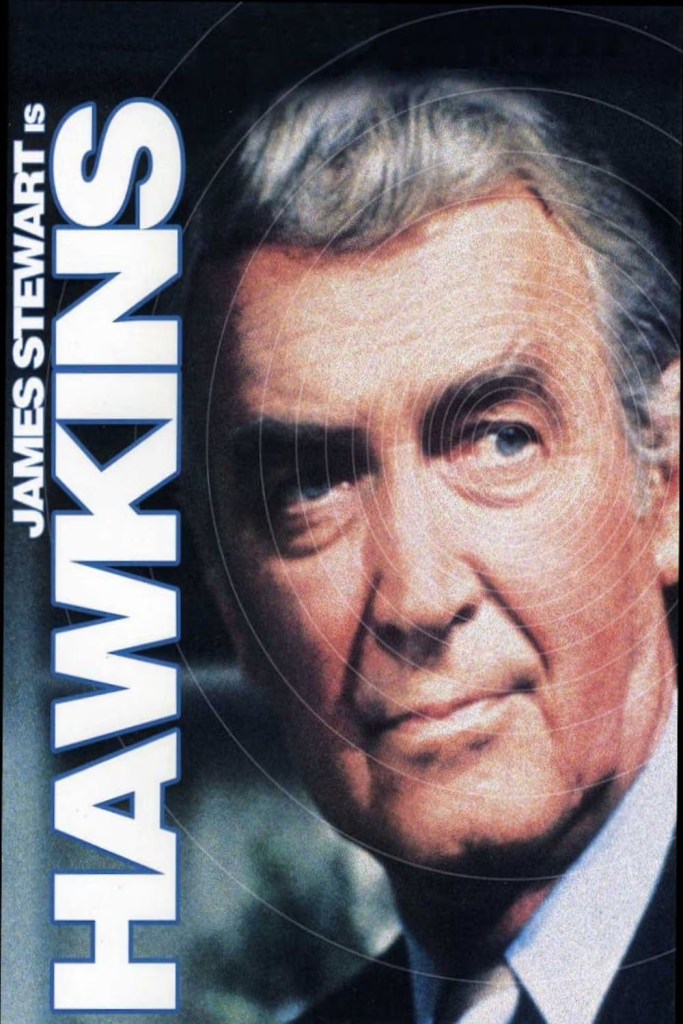
HAWKINS: Death and the Maiden (1973) – starring Jimmy Stewart!


In this pilot episode of the TV-Movie series HAWKINS, Jimmy Stewart plays Billy Jim Hawkins from the fictional town of Beauville, West Virginia, who just happens to be the best defense lawyer in the business. A former prosecutor who changed sides, he has a perfect record for getting his clients off. Billy Jim gets a call to come out to Los Angeles when an heiress, Edith Dayton-Thomas (Bonnie Bedelia), is charged with the murder of her dad, stepmom, and stepdaughter. Billy Jim and his team, which is basically just his cousin R.J. Hawkins (Strother Martin), set about getting to know all the people in her life. There’s the family lawyer Carl Vincent (Robert Webber) who’s been dipping his hand in the family till while also carrying on an affair, much to the chagrin of his wife Vivian (Antoinette Bower). There’s Edith’s aunt Julia (Kate Reid), who doesn’t seem to have a very strong opinion of her now deceased brother in law and was seen arguing with him on the day of his murder. And there’s Edith herself, whose diary would indicate that she hated her dad and her stepmom so much that she wanted them dead. She also just happens to have the reputation for being a little strange and / or crazy. The evidence seems to be stacked against Edith, but Billy Jim doesn’t get to charge those extremely high legal fees for nothing. If anyone can get to the bottom of the case, it’s him. 

I’ll just go ahead and say that Jimmy Stewart and the character of Billy Jim Hawkins are a match made in heaven. Any person who has seen him in the classic Otto Preminger film ANATOMY OF A MURDER (1959) knows how great he is at playing a down home defense attorney. He excels in the role, and he’s reason alone to invest in the DVD collection from Warner Brothers Archive like I did several years back. It’s so fun watching him question people in his easy going, slow talking, country boy way which almost always leads to the discovery of exactly what he needs to know. And Strother Martin is perfect as his cousin and associate, one of 174 first cousins, according to Billy Jim himself. You see, one of the interesting things about Billy Jim’s family is that he’s one of 14 kids, with 52 nieces and nephews to go along with all those first cousins. That’s some fun character history for a guy like me, whose mom is one of 15 kids, and I also have tons of first cousins. Stewart and Martin are a perfect duo, and their sharing of different theories as the episodes progress make up some of the best scenes. Add to Stewart and Martin a solid group of guest stars in this episode including Bonnie Bedelia (DIE HARD), Robert Webber (THE DIRTY DOZEN), Kate Reid (THIS PROPERTY IS CONDEMNED), and Antoinette Bower (THE EVIL THAT MEN DO), and you can’t help but have an entertaining show. There’s never any doubt that Stewart is going to uncover the murderer, but the fun of course is in seeing how he puts all the clues together. 

HAWKINS: Death and the Maiden is the first of eight “Hawkins” TV movies starring Jimmy Stewart in 1973 and 1974. The character of Billy Jim Hawkins is a clear pre-cursor to the character of Matlock that Andy Griffith would have so much success with a little over a decade later. In a strange move at the time, CBS chose to alternate HAWKINS on Tuesday nights with a series of SHAFT TV movies. Imagine wanting to watch SHAFT only to turn on your TV to discover Jimmy Stewart and Strother Martin solving murder mysteries, or Vice-Versa. Conventional wisdom suggests that this release strategy was probably confusing to the respective audiences for the shows based on their vastly different demographics. I personally think they both sound awesome, but I can see how pairing such different shows in this way could have been a problem for the ratings. Regardless of its short lived tenure, if you’re a fan of Jimmy Stewart, you need to watch HAWKINS. Each episode is a joy to behold. 
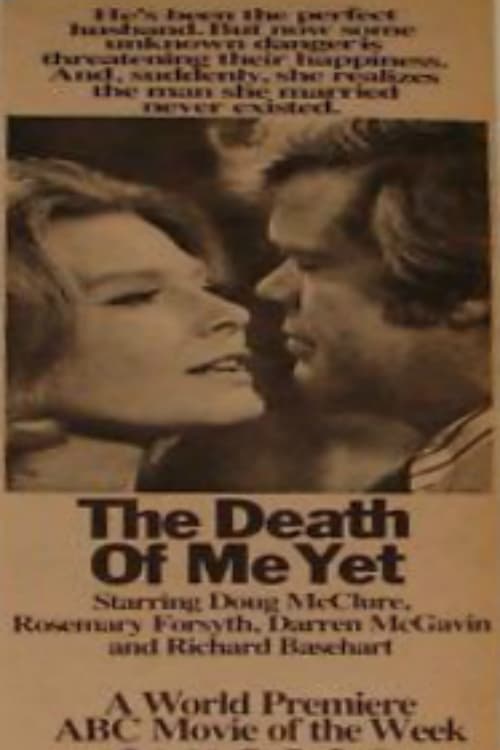
Retro Television Review: The Death Of Me Yet (dir by John Llewellyn Moxey)


Welcome to Retro Television Reviews, a feature where we review some of our favorite and least favorite shows of the past!  On Sundays, I will be reviewing the made-for-television movies that used to be a primetime mainstay.  Today’s film is 1971’s The Death Of Me Yet!  It  can be viewed on YouTube.

Welcome to Middletown!

Middletown is a nice, comfy, and friendly little town.  As you might guess from the name, it seems just like the type of town that you would expect to find in the middle of the country.  Edward Young (Doug McClure) is a friendly and popular citizen of the town.  Everyone loves to see Edward walking around Middletown with his girlfriend, Alice (Meg Foster, of the otherworldly eyes).  But one day, Edward comes home to find a message waiting for him.  He has been “activated” and it’s time for him to leave Middletown and head to …. THE UNITED STATES!

You see, Middletown is in the middle of a country.  It’s in the middle of Russia, to be exact.  It’s a KGB training center, where sleeper agents learn how to pass for Americans.

Edward heads to America, where he takes on the name of Paul Towers.  Over the years, Paul settles in a town that looks a lot like Middletown.  Paul becomes a newspaper publisher and he comes to love America.  He also marries Sibby (Rosemary Forsyth), the sister of defense contract Hank Keller (Dana Elcar).  When one of Hank’s executives dies under mysterious circumstances, Hank offers to bring Paul into the business.

Paul is reluctant, both because he doesn’t know if he could pass the background check that the FBI is going to run on him and also because he suspects that someone is trying to kill him!  When he sees Alice and his former KGB handler (Richard Basehart) in town, Paul realizes that he’s going to have to pick a side and face the consequences of all of his actions.

The Death of Me Yet is an enjoyably twisty thriller, one that embraces the melodrama while having some fun with the idea of a bunch of sleeper agents doing business in a generic American town.  Doug McClure’s natural earnestness makes him an odd choice for the role of a lifelong spy but the casting works in that it explains why no one has ever suspected Paul in the past.  As always, Darren McGavin is a welcome presence as the FBI agent who assures Paul that he will be doing a thorough background check.  Richard Basehart makes for a good villain and Meg Foster’s enigmatic screen presence keeps the viewer guessing as to what her ultimate goal may be.

The film ends with the hint of continued adventures for Paul.  It wouldn’t surprise me if this movie was made with an eye on turning it into a weekly series.  As far as I know, that series never happened, though The Americans would later feature many of the same themes and ideas found in The Death of Me YetThe Death of Me Yet holds up as an entertaining espionage thriller.

Retro Television Review: Quarterback Princess (dir by Noel Black)


Welcome to Retro Television Reviews, a feature where we review some of our favorite and least favorite shows of the past!  On Sundays, I will be reviewing the made-for-television movies that used to be a primetime mainstay.  Today’s film is 1983’s Quarterback Princess.  It  can be viewed on YouTube!

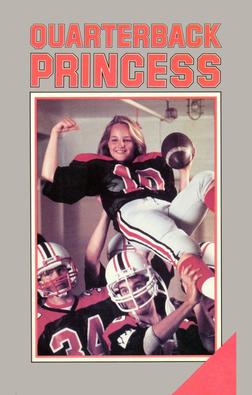
Quarterback Princess begins with Ralph Maida (Don Murray) dropping in on the coach of a high school football team in the small town of Minnvile, Oregon.  Ralph explains that he and his family are going to be relocating to the town from Canada.  His eldest child wants to play football and Ralph is curious as to when the team will be holding the tryouts.  The coach asks what position Ralph’s son plays.  Ralph explains that Tami is his daughter and she plays quarterback.  After an awkward moment of silence, the coach explains that he’ll have to talk to the school board.

Yes, Quarterback Princess is one of those films.  It’s an only girl on the team film, in which an athletic teenager has to convince not only her male teammates but also all of the stodgy old people that she can play just as well as the boys.  On the one hand, films (and shows, as Degrassi had an entire storyline about Jane trying to get on the school’s football team) like this are usually entertaining because it’s fun to watch a girl succeed while all of the men sputter with outrage until the team starts winning.  On the other hand, they’re always a little bit difficult for me to relate to because I would honestly have no interest in doing what Tami’s doing and it’s hard for me to understand why anyone else would either.  I mean, seriously why would anyone want to live in Oregon when Montana’s just a short drive away?

Quarterback Princess is based on a true story.  In real life, Tami Maida was 14 year old when she joined her high school football team as their quarterback.  That season, the team had a record of 7-1 and they won the state championship.  Tami was also elected Homecoming Queen that seem year.  The parts of the movie that seem like the type of thing that only a screenwriter could come up actually happened.  Helen Hunt, who was 20 years old at the time, plays Tami.  When I watched the film, I thought Hunt did a good job in the scenes off field but I thought she was a bit unconvincing when she was actually playing the game and throwing the ball.  Fortunately, I did some research before I actually wrote this review and I discovered that Tami served as Helen Hunt’s stand-in during the film and, in most of the game scenes, that actually is Tami throwing the ball and running around the field.  That shows you how much I know about football.

Quarterback Princes is definitely a made-for-television production.  These are the only high school football players in existence who neither drink nor curse.  For that matter, the coaches are surprisingly nice as well.  That said, it isn’t bad.  The best scenes are the ones that feature Tami and her family adjusting to Tami’s sudden fame.  Daphne Zuniga gives a sympathetic performance as Tami’s sister, who is not particularly happy about how Tami’s sudden fame has changed everyone’s lives.  The always likable John Stockwell plays Tami’s boyfriend and the two of them are a believable couple.  Noel Black, who also directed Pretty Poison, does a good job of keeping the action moving at a steady pace.  Probably the worse thing you can say about this film is that it was a bit predictable but, in this case, all of the predictable stuff actually happened so what can you do?

The Bravos (1972, directed by Ted Post)


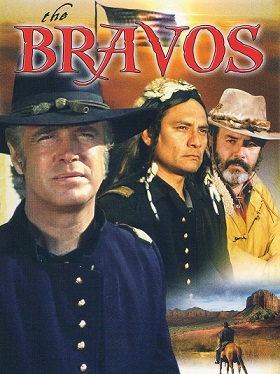
Major John David Harkness (George Peppard) is the commander of Fort Bravo, a small and ill-equipped frontier fort.  Despite having only 77 soldiers and not many supplies, Harkness has managed to keep an uneasy peace between the local Indian tribes and the settlers who move through the area.  The peace, however, is disturbed when an arrogant wagon master (Pernell Roberts) kills the son of the tribal chief.

That’s not all that Harkness has to worry about.  A German outlaw (Bo Svenson) is hiding out at the camp.  His head scout (L.Q. Jones) suspects that something is forcing the local tribes out of the area.  Two settlers from Missouri (played by Barry Brown and Belinda Montgomery) are at the fort and trying to decide whether they should continue westward or return to Missouri.  Finally, Harkness’s 12 year-old son, Peter (Vincent Van Patten), has been expelled from his New England boarding school and is being sent to Fort Bravo to live with his father.  When Major Harkness refuses to turn the wagon master over to the Indians, they kidnap his son instead.

The Bravos was made for television and originally aired on ABC in 1972.  It was apparently meant to serve as the pilot for a television series, one that would have followed the daily adventures of the Major, his son, and all of the men at Fort Bravo (who were played by television mainstays like Dana Elcar, Randolph Mantooth, and George Murdock.)  For all intents and purposes, Pernell Roberts, Bo Svenson, Belinda Montgomery, and Barry Brown are all “special guest stars” and are meant to serve as examples of the type of television-friendly actors who would visit Fort Bravo on a weekly basis.  That the pilot didn’t lead to a series isn’t surprising.  TV westerns may have dominated the ratings in the 50s and the 60s but they quickly went out of fashion in the 70s as networks realized that they could make more money selling ad space for Norman Lear sitcoms and cop shows.  In the 70s, the people that advertisers were wanting to reach were watching Archie Bunker and Starsky and Hutch, not George Peppard.

Because of its TV origins, The Bravos is a fairly bland western.  It would be a few years before George Peppard would reinvent himself as a grizzled character actor and he’s sincere but fairly dull here.  Pernell Roberts is more effective as the headstrong wagon master and perhaps The Bravos would have worked better if Roberts and Peppard had switched roles.  In the end, the main reason to see the film is for the chance to see L.Q. Jones play a heroic role for once.  A member of Sam Peckinpah’s stock company, Jones brings some authentic grit to his role as the fort’s only scout.  Jones played a lot of villains but I always preferred him as one of the good guys.

The Bravos ends with a few major subplots unresolved.  Maybe they would have been resolved during the show’s first season but it was not to be.

Film Review: The Last Flight of Noah’s Ark (dir by Charles Jarrott)


I recorded the 1980 film, The Last Flight of Noah’s Ark, off of TCM because I looked at the title and the fact that it starred Elliott Gould and I figured that it would be a film about an expedition to recover the actual Noah’s Ark.  I figured that it would feature scenes of Elliott Gould and Christopher Plummer (who I just assumed would be in the movie) climbing Mount Ararat and having comical disagreements about all of the snow.  I also assumed that the movie would end with the real Noah’s Ark sliding down the mountain while Gould and Plummer tried to steer it.

Seriously, it sounded like fun!

Of course, it turned out that I was wrong.

http://www.youtube.com/watch?v=YwA4JZAcmlE

It turns out that The Last Flight of Noah’s Ark is about an out-of-work pilot named Noah Dugan (Elliott Gould) who has a gambling problem and owes a lot of money to the mob.  Normally, you’d be worried that this means Dungan has a contract out on his life but instead, it just means that a bald guy named Benchley (Dana Elcar) keeps popping up and saying that Dugan’s got a week to come up with the money.

Since this film was made before our current socialist moment, Dugan is forced to get a job.  Unfortunately, the only one that he can get involves flying a missionary (Genevieve Bujold) and a bunch of animals to a South Pacific island.  Dugan agrees but, because the plane is an old World War II bomber, he ends up having to make an emergency landing on a remote and uncharted desert isle.

Of course, it quickly turns out that Dugan, the missionary, and the animals aren’t alone!  First off, it turns out that two orphans (played by Ricky Schroder and Tammy Lauren) stowed away on the airplane.  And then, we discover that there are two Japanese soldiers stranded on the island as well!  They’ve been there since World War II!  Fortunately, one of them is named Cleveland (John Fukioka) and can speak English.

(As for Christopher Plummer, he’s nowhere to be seen because he’s not in the movie.)

Anyway, can you guess what happens?  If you think that Noah and the gang turn the plane into a big boat, you’re on the right track.  If you think that cynical Noah turns out to actually have a soft spot when it comes to children, you’re right.  If you think that Noah and the missionary embark on the most chaste romance in movie history …. oh my God, have you seen this movie before!?

Here’s the thing with The Last Flight of Noah’s Ark — the animals are cute.  I mean, the animals really are adorable.  There’s this one duck who has more screen presence than every human in this movie.  And normally, I’d say that cute animals can save just about any movie but this might be the exception to the rule.

I mean, I get it.  This was a movie for kids and that’s great.  But my God, this is a slow movie.  We start with Dugan getting threatened by the gamblers and then it’s another 25 minutes before Dugan even starts the engine on that plane.  I get that this is a family film but I imagine that even families in 1980 would have been bored to death by it.  Elliott Gould certainly seems to be bored, as he gives a performance that all but screams, “Where’s my paycheck!?”

What would have improved The Last Flight of Noah’s Ark?

Christopher Plummer, dammit.

The Conquering Hero: Baby Blue Marine (1976, directed by John D. Hancock)


The year is 1943 and America is at war.  All young men are expected to join the Marines and fight for their country but the Corps is not willing to accept just anyone.  Marion (Jan-Michael Vincent) wants to continue a family tradition of service but, as his drill sergeant (Michael Conrad) puts it, Marion just is not pissed off enough to be a Marine.  Marion is kicked out basic training and told to go home.  He is given a blue uniform to wear on his jury so that anyone who sees him will know that he couldn’t cut it.

Ashamed of his failure and in no hurry to confront his family, Marion takes the long route home.   While having a drink in California, he meets a Marine (Richard Gere) who did not get kicked out of basic training.  Though not yet 30, this shell-shocked Marine already has a head of gray hair, which he says he got from the horrors of war.  The Marine is due to return to the fighting in Europe but, upon meeting Marion, he sees a way out. When Marion gets drunk, the Marine knocks him out, switches uniforms with him, and goes AWOL.

When Marion comes to, he discovers that everyone that he meets now judges him by his new uniform.  Strangers buy him drinks.  Other servicemen try to pick fights with him.  When he stops off in a small Colorado town, a local waitress (Glynnis O’Connor) falls in love with him and nearly everyone that he meets assumes that he must be a hero.  Marion doesn’t exactly lie about his past.  Instead, he simply allows people to believe whatever they want to believe about him.  It seems like an idyllic situation until three prisoners from a nearby Japanese internment camp escape and the towns people expect Marion to help capture them.

Loosely plotted and sentimental, Baby Blue Marine is a dramatic version of Preston Sturges’s Hail The Conquering Hero.  Though the film has a gentle anti-war message, it’s actually more about nostalgia for a simpler and more innocent time.  If the film had been made at height of the Vietnam War, it might have been more angrier and more cynical.  But, instead, this is one of the many post-Watergate films that wistfully looked back upon the past.  When Marion settles into the town, he finds what appears to be a perfect and friendly home.  Only the nearby internment camp and the town’s hysteria over the escape prisoners serve as reminders that things are never as ideal as they seem.  Jan-Michael Vincent gives one of his best performances as the well-meaning Marion and actors like Richard Gere, Bert Remsen, Katherine Helmond, Dana Elcar, Michael Conrad, Bruno Kirby, and Art Lund all make strong impressions in small roles.

One of the few films to be produced by television mogul Aaron Spelling, Baby Blue Marine is not easy to find but worth the search.

A Movie A Day #174: St. Ives (1976, directed by J. Lee Thompson)


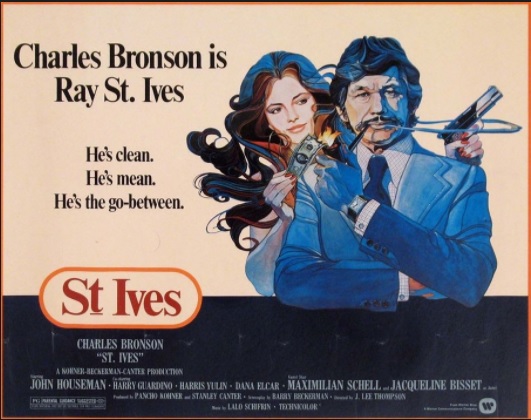
Raymond St. Ives (Charles Bronson) is a former cop-turned-writer who desperately needs money.  Abner Procane (John Houseman) is a wealthy and cultured burglar who needs someone to serve as a go-between.  Five of Procane’s ledgers have been stolen.  The thieves are demanding a ransom and Procane believes that St. Ives is just the man to deliver the money.  But every time that St. Ives tries to deliver the money, another person ends up getting murdered and St. Ives ends up looking more and more like a suspect.  Who is the murderer?  Is it Janet (Jacqueline Bisset), the seductive woman who lives in Procane’s mansion?  Is it Procane’s eccentric psychiatrist (Maximillian Schell)?  Could it be the two cops (Harry Guardino and Harris Yulin) who somehow show up at every murder scene?  Only Ray St. Ives can solve the case!

Charles Bronson is best remembered for playing men of few words, the type who never hesitated to pull the trigger and do what they had to do.  St. Ives was one of the few films in which Bronson got to play a cerebral character.  Ray St. Ives may get into his share of fights but he spends most of the film examining clues and trying to solve a mystery.  The mystery itself is not as important as the quirky people who St. Ives meets while solving it.  St. Ives has a great, only in the 70s type of cast.  Along with those already mentioned, keep an eye out for Robert Englund, Jeff Goldblum, Dana Elcar, Dick O’Neill, Daniel J. Travanti, Micheal Lerner, and Elisha Cook, Jr.  It’s definitely different from the stereotypical Charles Bronson film, which is why it is also one of my favorites of his films.  As this film shows, Bronson was an underrated actor.  In St. Ives, Bronson proves that, not only could he have played Mike Hammer, he could have played Philip Marlowe a well.

St. Ives is historically significant because it was the first Bronson film to be directed by J. Lee Thompson.  Thompson would go on to direct the majority of the films Bronson made for Cannon in 1980s, eventually even taking over the Death Wish franchise from Michael Winner.

A Movie A Day #85: Blue Skies Again (1983, directed by Richard Michaels)


As Lisa said in her review of Night Game, Erin asked for baseball reviews today and there is no way you can turn down Erin.  So, I watched Blue Skies Again on YouTube.
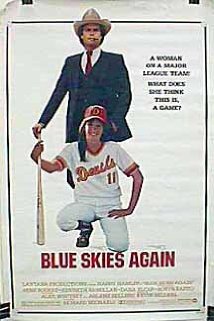
The Denver Devils is a minor league baseball team that is coming off of its worst season ever.  The new owner (Harry Hamlin) is only concerned with making money and does not know anything about baseball.  The veteran coach (Kenneth McMillan) does not have the respect of his players.  Teammates like Ken (Andy Garcia), Calvin (Joseph Gian), and Wall Street (Cylk Cozart) are worried that they could lose their place on the team at any moment.  The only good news is that two sports agents (Mimi Rogers and Dana Elcar) have found the perfect prospect for the Devils.  This player can play second base.  This player can catch a grounder and turn it into a double play.  This player can hit the ball out of the park.  The only problem?  The player’s name is Paula (Robyn Barto) and she’s a girl!

Robyn Barto was asked to audition after a casting director saw her playing softball for her community college.  Blue Skies Again was her first film role.  In the role of a professional baseball player, Barto was a very convincing softball player.  But Barto was likable and had an engaging screen presence so it’s too bad that this movie was not only her first but also her last.  In the publicity leading up to the release of Blue Skies Again, Barto got to throw out the opening pitch at a Dodger game but that was it for her time in the spotlight.  According to one article that I found that was written ten years after the release of Blue Skies Again, Barto never regretted not having a film career and ended up coaching the softball team at her old high school.

Blue Skies Again was not only the debut of Robyn Barto but also the first feature film for both Mimi Rogers and Andy Garcia.  Garcia does not get to do much but Mimi Rogers shows off the sexy and fun screen presence that always makes me wonder why she never really became a big star.

Blue Skies Again is an okay movie but it does not add up to much.  No one wants to play with a girl but then she gets a hit so everyone changes their mind.  It’s the type of movie that, today, would be made for Hallmark or the Family Channel.  It’s a nice baseball movie but it can’t compare to the real thing.


Lisa Reviews an Oscar Winner: The Sting (dir by George Roy Hill)


Earlier tonight, as a part of their 31 Days of Oscar, TCM aired The Sting, the film that the Academy selected as being the best of 1973.  I just finished watching it and what can I say?  Based on what I’ve seen of the competition (and there were a lot of great films released in 1973), I would not necessarily have picked The Sting for best picture.  However, the movie is still fantastic fun.

The Sting reunited the director (George Roy Hill) and the stars (Robert Redford and Paul Newman) of Butch Cassidy and the Sundance Kid and told yet another story of likable criminals living in the past.  However, whereas Butch Cassidy largely satirized the conventions of the traditional Hollywood western, The Sting is feels like a loving homage to the films of 1930s, a combination of a gritty, low-budget gangster film and a big budget musical extravaganza.  The musical comparison may sound strange at first, especially considering that nobody in The Sting randomly breaks out into song.  However, the musical score (which is famously dominated by Scott Joplin’s The Entertainer) is ultimately as much of a character as the roles played by Redford, Newman, and Robert Shaw.  And, for that matter, the film’s “let-pull-off-a-con” plot feels like an illegal version of “let’s-put-on-a-show.”

The film takes place in the 1936 of the cultural imagination, a world dominated by flashy criminals and snappy dialogue.  When con artists Johnny Hooker (Robert Redford) and Luther Coleman (Robert Earl Jones) inadvertently steal money from a gangster named Lonnegan (Robert Shaw), Lonnegan has Luther murdered.  Fleeing for his life, Hooker goes to Chicago where he teams up with Luther’s former partner, veteran con man Henry Gondorff (Paul Newman).  Gondorff used to be one of the great con artists but he is now living in self-imposed obscurity, spending most of his time drinking and trying to avoid the FBI.  Hooker wants to get revenge on Lonnegan by pulling an elaborate con on him.  When Gondorff asks Hooker why, Hooker explains that he can either con Lonnegan or he can kill him and he doesn’t know enough about killing.

The rest of the film deals with Hooker and Gondorff’s plan to con Lonnegan out of a half million dollars.  It’s all very elaborate and complicated and a bit confusing if you don’t pay close enough attention and if you’re ADHD like me.  But it’s also a lot of fun and terrifically entertaining and that’s the important thing.  The Sting is one of those films that shows just how much you can accomplish through the smart use of movie star charisma.  Redford and Newman have such great chemistry and are so much fun to watch that it really doesn’t matter whether or not you always understand what they’re actually doing.

It also helps that, in the great 70s tradition, they’re taking down stuffy establishment types.  Lonnegan may be a gangster but he’s also a highly respected and very wealthy gangster.  When Newman interrupts a poker game, Lonnegan glares at him and tells him that he’ll have to put on a tie before he’s allowed to play.  Lonnegan may operate outside the law but, in many ways, he is the establishment and who doesn’t enjoy seeing the establishment taken down a notch?

As entertaining as The Sting may be and as influential as it undoubtedly is (Steven Soderbergh’s Ocean films may be a lot more pretentious — which makes sense considering that Soderbergh is one of the most pretentious directors in film history — but they all owe a clear debt to The Sting), it still feels like an unlikely best picture winner.  Consider, for instance, that The Sting not only defeated American Graffiti and The Exorcist but Ingmar Bergman’s Cries and Whispers as well.  On top of that, when you consider some of the films that were released in 1973 and not nominated — Mean Streets, Badlands, The Candy Snatchers, Day of the Jackal, Don’t Look Now, Jesus Christ Superstar, and The Long Goodbye — it’s debatable whether The Sting should have been nominated at all.  That’s not a criticism of The Sting as much as it’s an acknowledgement that 1973 was a very good year in film.

So, maybe The Sting didn’t deserve its Oscar.  But it’s still a wonderfully entertaining film.  And just try to get that music out of your head!

Shattered Politics #23: Fail-Safe (dir by Sidney Lumet)


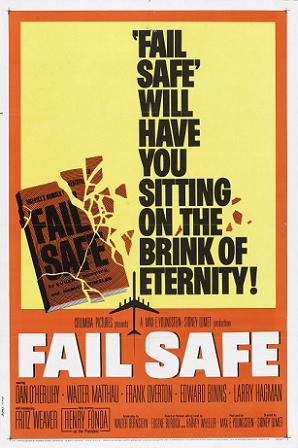
Fail_safe_moviep

After watching Dr. Strangelove, you may find yourself asking what that film would have been like if it had treated its doomsday scenario seriously.  Well, you can find out by watching yet another film from 1964, Sidney Lumet’s Fail-Safe.

What’s Fail-Safe about?  Well, basically, it tells the exact same story as Dr. Strangelove, except without the humor.  Once again, an American bomber is accidentally ordered to launch a nuclear attack against Russia.  Again, the President (played, somewhat inevitably, by Henry Fonda) has to have an awkward conversation with the leader of Russia.  Again, a sinister defense advisor (this time played by Walter Matthau) argues that the world can survive a nuclear war.

Admittedly, there is no equivalent to George C. Scott’s Buck Turgidson in Fail-Safe.  However, there is a General Black (Dan O’Herilihy) who has a recurring nightmare about watching a bullfight while the sky around him glows with radiation.

Fail-Safe has the same plot as Dr. Strangelove but none of the humor.  In fact, Fail-Safe has absolutely no humor at all.  It’s one of the most somber films that I’ve ever seen.  It has a good opening with General Black’s nightmare and an effective ending that makes excellent use of freeze frames but the middle of the film is basically just a collection of endless debates.

And I’m sure that approach made sense at the time because, after all, Fail-Safe was dealing with a serious theme, it was directed by a serious filmmaker, and it featured a bunch of serious actors.  And maybe if I had never seen Dr. Strangelove, Fail-Safe would not seem like such a slow and boring movie.  But I have seen Dr. Strangelove and, as a result, it’s impossible to watch Fail-Safe without wanting to hear Henry Fonda say, “You can’t fight here!  This is the war room!”