Film Review: The Doors (dir by Oliver Stone)


I like The Doors.

That can be a dangerous thing to admit, about both the band and Oliver Stone’s 1991 film.  Yes, both the band and the film could be a bit pretentious.  They both tended to go on for a bit longer than necessary.  They were both centered around a guy who wrote the type of poetry that I used to love back in my emo days.  It’s all true.

But, with The Doors as a band, I find that I can’t stop listening to them once I start.  Even if I might roll my eyes at some of the lyrics or if I might privately question whether any blues song really needs an organ solo, I can’t help but love the band.  They had a sound that was uniquely their own, a psychedelic carnival that brought to mind images of people dancing joyfully while the world burned around them.  And say what you will about Jim Morrison as a poet or even a thinker, he had a good voice.  He had the perfect voice for The Doors and their rather portentous style.  From the clips that I’ve seen of him performing, Morrison definitely had a stage presence.  Morrison died young.  He was only 27 and, in the popular imagination, he will always look like he’s 27.  Unlike his contemporaries who managed to survive the 60s, Morrison will always eternally be long-haired and full of life.

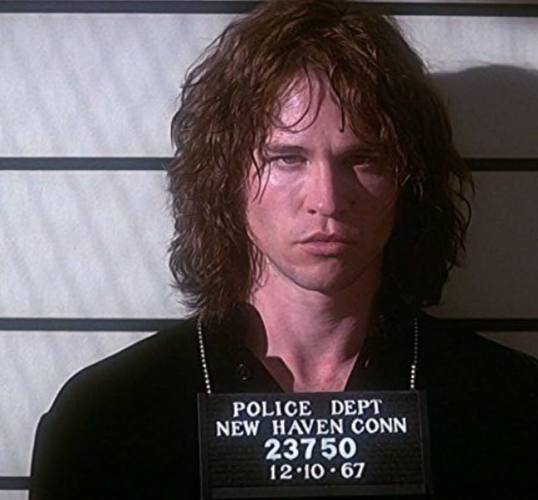
As for The Doors as a movie, it’s definitely an Oliver Stone film.  It’s big.  It’s colorful.  It’s deliberately messy.  Moments of genuinely clever filmmaking and breath-taking visuals are mixed with scenes that are so heavy-handed that you’ll be inspired to roll your eyes as dramatically as you’ve ever rolled them.  Stone loved the music and that love comes through in every performance scene.  Stone also loves using Native Americans as symbols and that can feel a bit cringey at times.  Why would Jim Morrison, whose was of Scottish and Irish ancestry, even have a Native American spirit guide?  At its best The Doors captures the chaos of a world that it’s the middle of being rebuilt.  The 60s were a turbulent time and The Doors is a turbulent movie.  I’ve read many reviews that criticized The Doors for the scene in which Morrison gets involved in a black magic ceremony with a journalist played by Kathleen Quinlan.  I have no idea whether or not that scene happened in real life but the movie is so full of energy and wild imagery that the scene feels like it belongs, regardless of whether it’s true or not.  Stone turns Jim Morrison into the warrior-artist-priest that Morrison apparently believed himself to be and the fact that the film actually succeeds has far more to do with Oliver Stone’s  enthusiastic, no-holds-barred direction and Val Kilmer’s charismatic lead performance than it does with Jim Morrison himself.

The Doors spent several years in development and there were several actors who, at one time or another, wanted to play Morrison.  Everyone from Tom Cruise to John Travolta to Richard Gere to Bono was considered for the role.  (Bono as Jim Morrison, what fresh Hell would that have been?)  Ultimately, Oliver Stone went with Val Kilmer for the role and Kilmer gives a larger-than-life performance as Morrison, capturing the charisma of a rock star but also the troubled and self-destructive soul of someone convinced that he was destined to die young.  Kilmer has so much charisma that you’re willing to put up with all the talk about opening the doors of perception and achieving a higher consciousness.  Kilmer was also smart enough to find the little moments to let the viewer know that Morrison, for all of his flamboyance, was ultimately a human being.  When Kilmer-as-Morrison winks while singing one particularly portentous lyric, it’s a moment of self-awareness that the film very much needs.

(When the news of Kilmer’s death was announced last night, many people online immediately started talking about Tombstone, Top Gun, and Top Secret.  For his part, Kilmer often said he was proudest of his performance as Jim Morrison.)

In the end, The Doors is less about the reality of the 60s and Jim Morrison and more about the way that we like to imagine the 60s and Jim Morrison as being.  It’s a nonstop carnival, full of familiar faces like Kyle MacLachlan, Michael Madsen, Crispin Glover (as Andy Warhol), Frank Whaley, Kevin Dillon, and a seriously miscast Meg Ryan.  It’s a big and sprawling film, one that is sometimes a bit too big for its own good but which is held together by both Stone’s shameless visuals and Val Kilmer’s charisma.  If you didn’t like the band before you watched this movie, you probably still won’t like them.  But, much like the band itself, The Doors is hard to ignore.
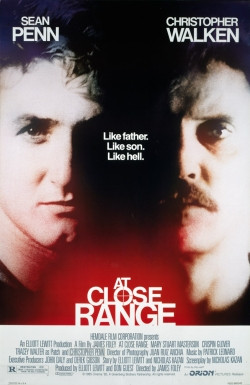
At Close Range (1986, directed by James Foley)


Brad Whitewood, Sr. (Christopher Walken) is known as Big Brad, a rural crime lord who rules the backwoods of Pennsylvania.  When his son, Little Brad (Sean Penn, trying too hard to be James Dean), comes to live with him, Big Brad goes out of his way to try to bring the teenager into his criminal lifestyle.  At first, Little Brad loves being a part of the family business but witnessing a murder and falling in love with Terry (Mary Stuart Masterson) caused Little Brad to start to move away from his father.  With the FBI closing in on the Whitewood family, Brad Sr. starts to eliminate everyone who he considers to be a threat, including the members of his own family.

Based on a true story, this neo-noir features a great cast, including Chris Penn, Millie Perkins, Kiefer Sutherland, Crispin Glover, David Strathairn, Tracey Walter, and Mary Stuart Masterson.  Unfortunately, the movie itself moves at a plodding pace.  There are some good and disturbing scenes, like the montage where Big Brad starts to eliminate the members of his gang.  The film does a good job of showing how seductive Big Brad’s criminal lifestyle can be to a bunch of kids who have basically been written-off by society.  But the story itself is so bleak that most people will end up tuning out long before Little Brad finally turns against his father.

Whatever other flaws it may have, At Close Range does feature one of Christopher Walken’s best performances.  Walken is chillingly evil as Big Brad.  He’s got enough charisma to be believable as someone who could bring a gang together but he’s also frightening as he starts killing anyone who he thinks might talk to the police or the FBI.  Big Brad is a remorseless killer and Walken plays him as being a classic sociopath, someone who cannot understand why the members of his gang and family would get upset when he starts killing some of them.  To Big Brad, that just goes with the territory.  It’s a part of doing business.  With his distinct way of speaking and his trademark tics, Walken is someone who has inspired many impersonators and it can be easy to forget that he’s also a damn good actor.  Films like At Close Range remind us of just how talented Walken actually is.

October True Crime: Smiley Face Killers (dir by Tim Hunter)


“Okay, you need to go back on your meds….”

“Kaeen, I am on my meds.”

That exchange, between college student Jake (Ronen Rubinstein) and his girlfriend, Keren (Mia Serafino), pretty much sums up 2020’s Smiley Face Killers.  It’s a study of modern paranoia, in which Jake thinks — with good reason — that he’s being stalked and all of his friends think that he just needs to take more of his meds.  The fact that a lot of very weird things are happening to Jake doesn’t really matter to his friends.  They’ve decided that any and all problems are linked somehow to taking meds.  “Take your meds” is the only solution that they can offer up.  It’s empty advice but it’s also advice that makes them feel absolved about going to parties and obsessing on their own petty dramas while Jake essentially loses his mind.

Jake suspects that he’s being stalked and that his phone is being hacked and that someone wants to kill him.  He’s absolutely right about that.  The majority of the film follows Jake as he tries to get someone — anyone — to accept that he’s right to be paranoid.  The film may have been sold as Eli Roth-style torture porn or as a postmodern slasher movie but, instead, it’s a study in isolation.  Jake is being stalked by the Smiley Face Killers for reasons that are never made particularly clear.  That said, one gets the feeling that, if the Smiley Face Killers didn’t get Jake, some other group of homicidal lunatics would have.  It’s a dangerous world out there and Jake has obviously pissed off the forces of fate.

Who are the Smiley Face Killers?  The film’s opening credits refer to them as being an urban legend, though I think that gives the whole Smiley Face Killer thing too much credit.  Over the years, there have been several incidents of college students drowning.  All of the students were male.  All of them were athletic.  The majority of them were members of fraternities.  Two retired homicide cops noted that smiley face graffiti was present at many of the “crime scenes” and they came up with a theory that these students were being purposefully drowned by a cult who used the smiley face as their calling card.  It’s a ludicrous theory but one that was embraced by some grieving parents who were still trying to understand how their child could have possibly died when he had his entire future ahead of him.

Of course, it’s far more probable that there is no cult.  The fact of the matter is that the smiley face is a universal symbol and it’s one that you can find drawn or painted just about anywhere.  As well, the majority of the victims were described as being drunk when last seen alive.  College students — especially frat boys — have a tendency to drink more than they can handle.  When a college happens to be near a river or even a creek, it’s a sad of fact of life that there’s a chance of someone stumbling into the water during the night.  That’s especially true if that person is drunk.  No parents wants to admit that their child died because he didn’t know when to say when, leaving them susceptible to conspiracy theories about cults.  Dr. Phil did an entire show on the Smiley Face Killer theory.  Oprah’s network aired an entire docuseries about the theory and pretty much presented it as a fact.  Both of them exploited the grief of the parents for ratings.  Shame on both of them.

As for the movie, it’s actually weirdly effective.  Screenwriter Bret Easton Ellis and director Tim Hunter (who also did the similarly dark River’s Edge) do a good job of capturing the paranoia of everyday life.  Jake is pretty much doomed from the minute we see him but the film holds our interest by showing how everyone but Jake has essentially closed their eyes to what’s happening in front of them.  In the end, Jake has no control over his fate, whether he’s taking his meds or not.

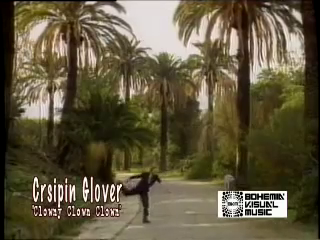
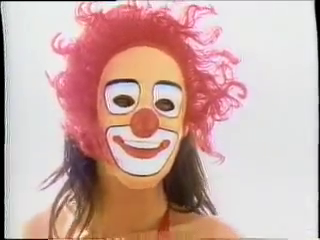
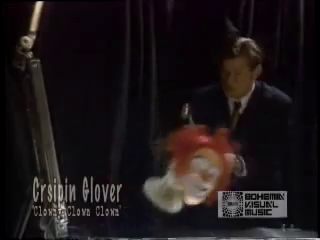
Music Video of the Day: Clowny Clown Clown by Crispin Hellion Glover (1989, directed by Crispin Glover)


Let’s start 2021 with Crispin Glover.

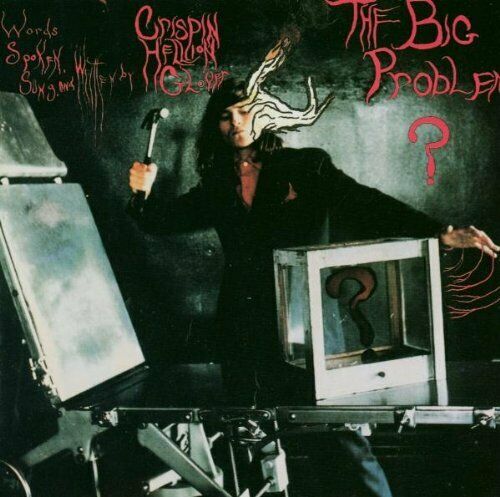
The song Clowny Clown Clown comes from Glover’s first album, The Big Problem ≠ The Solution. The Solution = Let It Be.  The album, which also featured Glover covering songs like These Boots Are Made For Walking and The Daring Young an On The Flying Trapeze, was released in 1989 and the liner notes invited anyone who could figure out what the “Big Problem” was to give Glover a call.  The liner notes included a phone number that you could call, which was apparently Crispin’s phone number at the time.  The number has since been disconnected so don’t waste your time trying to give Crispin a call.

Before making this video, Glover was best-known for playing George McFly in Back to the Future and for nearly kicking David Letterman in the head during an interview in 1987.  Much like Joaquin Phoenix’s infamous later appearance on Letterman, it is believed that Glover was attempting an Andy Kaufmanesque stunt during his first appearance, as well as trying to promote an upcoming film.  (The film was Rubin and Ed, which was filmed in ’87 but wouldn’t be released until 1991.)  On March 28th, 1990, Glover returned to Letterman’s show, where he discussed his music and where a clip from the Clowny Clown Clown video was shown.

Below is Glover’s first appearance on Letterman:

Here is Glover’s subsequent performance, in which he attempts to explain himself and shows a clip of this video:

While I think it’s clear the Glover was playing a role in both of his appearances, I’m not sure if Letterman was in on the joke as he seems to be genuinely annoyed during both interviews.  Of course, back then, genuinely annoyed was Letterman’s default interview style.

Back to Glover’s album, if anyone knows the Big Problem or its solution, let us know in the comments and we’ll try to get word to Crispin.

Enjoy!

Music Video of the Day: Clowny Clown Clown by Crispin Glover (1989, dir. Crispin Glover)


Move over, David Lynch. Decades before you and your Crazy Clown Time, George McFly did Clowny Clown Clown.

Glover brought us this glorious piece of songwriting and the corresponding music video to us earthlings in 1989. Well, at least that’s when his album, The Big Problem ≠ The Solution. The Solution = Let It Be, came out. I’m assuming the video came out at the same time.

I love the genre listed on Wikipedia: Outsider music. I had no idea that was a label given to some music.

That’s it! As much cult success as this video seems to have had over the years, much like David Hasselhoff’s cover of Hooked On A Feeling, I can’t find anything on this.

Enjoy!

30 Days Of Surrealism:

  1. Street Of Dreams by Rainbow (1983, dir. Storm Thorgerson)
  2. Rock ‘n’ Roll Children by Dio (1985, dir. Daniel Kleinman)
  3. The Thin Wall by Ultravox (1981, dir. Russell Mulcahy)
  4. Take Me Away by Blue Öyster Cult (1983, dir. Richard Casey)
  5. Here She Comes by Bonnie Tyler (1984, dir. ???)
  6. Do It Again by Wall Of Voodoo (1987, dir. ???)
  7. The Look Of Love by ABC (1982, dir. Brian Grant)
  8. Eyes Without A Face by Billy Idol (1984, dir. David Mallet)
  9. Somebody New by Joywave (2015, dir. Keith Schofield)
  10. Twilight Zone by Golden Earring (1982, dir. Dick Maas)
  11. Schism by Tool (2001, dir. Adam Jones)
  12. Freaks by Live (1997, dir. Paul Cunningham)
  13. Loverboy by Billy Ocean (1984, dir. Maurice Phillips)
  14. Talking In Your Sleep by The Romantics (1983, dir. ???)
  15. Talking In Your Sleep by Bucks Fizz (1984, dir. Dieter Trattmann)
  16. Sour Girl by Stone Temple Pilots (2000, dir. David Slade)
  17. The Ink In The Well by David Sylvian (1984, dir. Anton Corbijn)
  18. Red Guitar by David Sylvian (1984, dir. Anton Corbijn)
  19. Don’t Come Around Here No More by Tom Petty And The Heartbreakers (1985, dir. Jeff Stein)
  20. Sweating Bullets by Megadeth (1993, dir. Wayne Isham)
  21. Clear Nite, Moonlight or Clear Night, Moonlight by Golden Earring (1984, dir. Dick Maas)

Dance Scenes That I Love: Crispin Glover in Friday the 13th: The Final Chapter


As proof that any movie — regardless of genre, storyline, or budget — has room for a dance number, check out this dance scene that I love from Friday the 13th: The Final Chapter!

Here’s hoping that everyone’s having a wonderful Crazy Ralph Day!

Back to School #43: River’s Edge (dir by Tim Hunter)


In his film guide, Heavy Metal Movies, Mike McPadden describes the disturbing 1987 teen crime drama River’s Edge as being “666 Candles“.  It’s a perfect description because River’s Edge appears to not only be taking place in a different socio-economic setting than Sixteen Candles and The Breakfast Club but perhaps on a different planet as well.

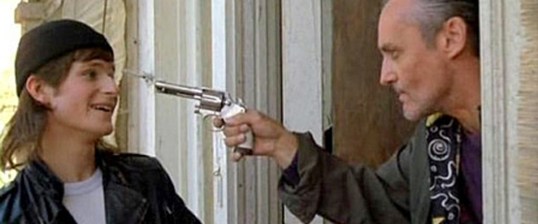
River’s Edge opens with a close-up of a dead and naked teenage girl lying on the edge of a dirty, polluted river and it gets darker from there.  The dead girl was the girlfriend of the hulking John Tollet (Daniel Roebuck, playing a character who is miles away from his role in Cavegirl).  As John explains to his friends, he strangled her for no particular reason.  His friends, meanwhile, respond with detachment.  Their unofficial leader, the hyperactive Layne (Crispin Glover), insists that since nothing can be done about the dead girl, their number one concern now has to be to keep John from getting caught.  While Layne arranges for John to hide out with a one-legged drug dealer named Feck (Dennis Hopper), two of John’s friends, Matt and Clarissa (played by Keanu Reeves and Ione Skye), consider whether or not they should go to the police.  Oddly enough, John really doesn’t seem to care one way or the other.

Seriously, River’s Edge is one dark film.  If it were made today, River’s Edge would probably be directed by someone like Larry Clark and, in many ways, it feels like a distant cousin to Clark’s Bully.  The teenagers in River’s Edge live in a world with little-to-no adult supervision.  Matt’s mom is more concerned with whether or not Matt has been stealing her weed than with the fact that Matt might be covering up a murder.  The local high school teacher is a former hippie who won’t shut up about how much better his generation was compared to every other generation.  In fact, the only adult with any sort of moral code is Feck and he’s usually too busy dancing with a sex doll to really be of much help.  It’s a world where no one has been raised to value their own lives so why should they care about a dead girl laying out on the banks of the river?

The film features good performances from Keanu Reeves, Ione Skye, and Daniel Roebuck but really, the entire movie is stolen by Crispin Glover and Dennis Hopper.  In the role of Layne, Glover is a manic wonder, speaking quickly and gesturing even when he isn’t making a point.  When Layne first shows up, he seems like he’s just overly loyal to his friend John but, as the film progresses, it becomes more apparent that he’s less concerned about protecting John and more interested in ordering other people to do it.  For Layne, protecting John is ultimately about maintaining power over Matt, Clarissa, and the rest of their friends.

As for Dennis Hopper — well, this is one of those films that you should show to anyone who says that Hopper wasn’t a great actor.  The role of a one-legged drug dealer who lives with a sex doll sound like exactly the type of role that would lead Hopper to going totally over-the-top.  Instead, Hopper gave a surprisingly subtle and intelligent performance and, as a result, he provided this film with the moral center that it very much needs.

Glover and Hopper


Back to School #37: Back to the Future (dir by Robert Zemeckis)


back-to-the-future

Well, this is certainly intimidating.

Earlier today, I was sitting at my day job and I happened to glance down at my to-do list to see what I was scheduled to review next in my Back To School series and there, listed at #37, was a somewhat popular film from 1985.  The name of the film was Back To The Future and…

Oh, you’ve heard of it?  And you already know what the movie’s about because literally everyone on the planet has either seen Back to The Future or knows someone who has seen Back To The Future and loves it so much that they can tell you every little detail about the adventures of Marty McFly, Doc Brown, and that time-traveling DeLorean?

Well, just be quiet and bear with me.  I always like to give a plot synposis in my reviews.  For one thing, it’s a good way to let you know who plays who in the film.

mcfly

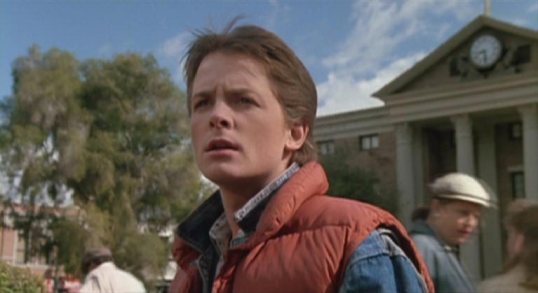
So, Marty McFly (Michael J. Fox) is, despite his somewhat embarrassing last name, a perfectly normal American teenager.  He lives in a nice, small town.  He has a pretty girlfriend (Claudia Wells).  He likes to ride his skateboard.  He likes to play guitar (though he’s deemed to be “too loud” by at least one of his teachers).  The high school’s principal (James Tolkan) often gives him a hard time for being late but other than that, Marty seems to be a pretty regular guy…

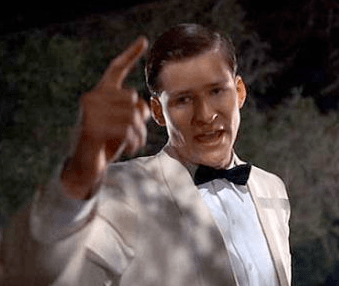
Except his family has some major issues.  His mother Lorraine (Lea Thompson) is an alcoholic who won’t stop talking about how she first met her husband George (Crispin Glover) after her father hit him with his car. George, meanwhile, is a total wimp who is continually bullied by his boss, Biff (Thomas F. Wilson).  Marty’s older siblings (Marc McClure and Wendie Jo Sperber) are both living directionless lives and Marty has every reason to fear that he might end up following them.

49663309_michaeljfox1

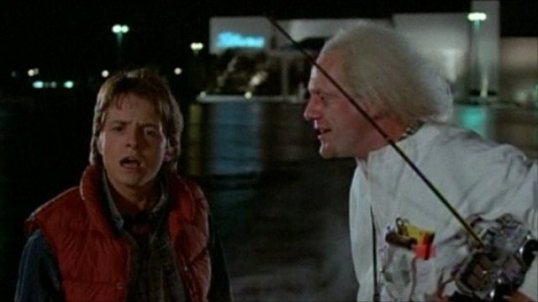
Fortunately, Marty has a best friend named Doc Brown (Christopher Lloyd) who has built a time machine inside of a luxury vehicle.  Late one night, Doc recruits Marty to help him test out the machine but what Doc didn’t mention is that in order to power his time machine, he had still plutonium from a group of terrorists.  Those terrorists show up and kill Doc.  Marty flees in the car and soon finds himself trapped in 1955.

Marty manages to track down the younger version of Doc Brown and the two of them start trying to work out how to get Marty back to the future.  (We have a title!)  Marty, of course, wants to warn Doc about what’s going to happen in 1985 but Doc insists that Marty tell him nothing about the future.  Doc also tells Marty that he has to be very careful, while in the past, not to change the future.

McFly!

Too late!  Marty has already met teenage Lorraine.  See, Marty happened to spot George up in a tree, peeping on Lorraine as she undressed.  (“He’s a pervert!” Marty exclaims.)  When George falls out of the tree and lands in the street, Marty pushes him out of the way of an approaching car.  Marty gets hit by the car, which is being driven by his own grandfather.  So now, Marty has essentially prevented his parents from meeting and, as a result, the McFly children are slowly fading from existence.

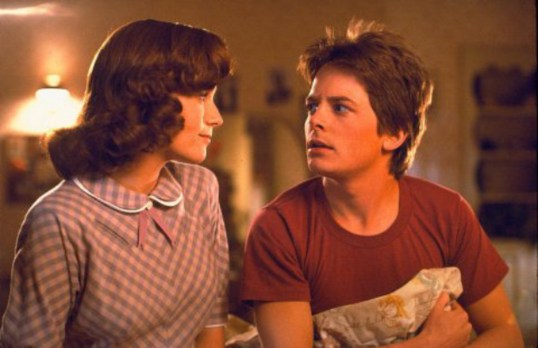
So, before Marty can go back to 1985, he has to get George and Lorraine back together.  The main problem, of course, is that Lorraine now has a crush on her own son…

michael-j-fox-back-to-the-future-screenshot

Wow, that’s a lot of plot there.  There’s a lot going on in Back to the Future and there are times when it almost feels like a dozen different films in one.  It’s a science fiction film, with Doc and Marty spending a lot of time trying to figure out how to make a time machine work with 1955 technology and weather.  It’s an action film, with Marty fleeing terrorists in 1985 and Biff in 1955.  It’s a romance, with the always endearingly weird Crispin Glover and Lea Thompson making for an odd but cute couple.  (Thought it’s wrong on so many levels, Thompson and Fox also have a lot of chemistry and are cute together, as long as you ignore the fact that they are playing mother and son!)  It’s a frequently hilarious comedy, with the entire cast giving heartfelt performances.  It’s an anthropological study, comparing the 50s and the 80s.  It’s a satirical look at how teenager’s tend to view their parents, with Marty discovering that everything that he’s assumed at his mom was basically incorrect.  And finally, it’s a surprisingly subversive film, with Marty and Lorraine’s 1955 relationship constantly running the risk of turning into an Oedipal nightmare.

And yet the entire film flows together so perfectly that you’re never aware of just how busy it all really is.  Between director Robert Zemeckis’s sure-handed direction, the clever script by Zemeckis and Bob Gale, and a uniformly excellent cast, Back to the Future is one of those films that verges on being flawless.

And, for that reason, it can be very intimidating to review.

I just don’t know how I’m going to do it…

550w_movies_dsma_back_to_the_future_03

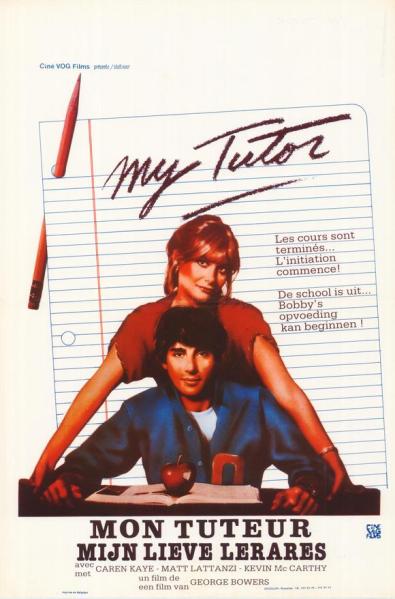
Back to School #30: My Tutor (dir by George Bowers)


my-tutor

It’s the house.

I was recently trying to figure out what it was exactly that I enjoyed about the 1983 teen comedy My Tutor and I finally realized that it all came down to the house.  Like almost every other teen film released in the 1980s, My Tutor is about rich people.  The main character, recent high school graduate and frustrated virgin Bobby Chrystal (Matt Lattanzi), lives in an absolutely gorgeous house.  There’s a huge pool in back and even the guest house appears to be bigger than any place that I’ve ever lived.  Bobby lives in the type of mansion that I’ve always wanted to live in.  For me, the best parts of My Tutor are the scenes that simply follow Bobby as he walks around the grounds of his home.

I just like seeing where people live.

I first came across My Tutor about two years ago when I got the Too Cool For School DVD box set from Mill Creek Entertainment.  My Tutor was one of the 12 movies included in the box set and it was one of the first that I watched, just because the title seemed to promise all sorts of sordid fun.  Looking back on the first time that I ever watched the film, my main impressions were that the film’s central plot — the affair between Bobby and his French tutor, Terry (Caren Kaye) — was actually handled with a surprising amount of sensitivity, that the great Kevin McCarthy was ideally cast as Bobby’s wealthy but sleazy father, and that the house was really nice.

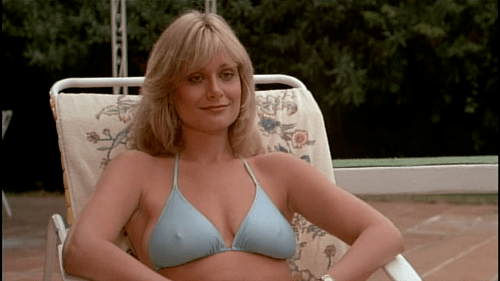
Is that really proper teacher attire?

Is that really proper teacher attire?

When I rewatched the film for this review, I quickly discovered that I had either forgotten or managed to block from my mind about 5o% of the movie.  Because, before Bobby and Terry take the fateful midnight swim that leads to their affair, the movie largely focuses on the efforts of Bobby and his friend Jack (the reliably weird and nerdy Crispin Glover) to each lose his virginity.  The first half of the film is pretty much dominated by cartoonish scenes of Bobby passing out drunk at a brothel and Jack and his brother Billy (Clark Brandon) trying to pick up two female mud wrestlers.  (If you have bondage fantasies about Crispin Glover, I guess this is the film to see.)  At one point, all of the film’s action stops so that Bobby can have an elaborate fantasy about having sex with a girl that we’ve barely seen before and will never see again.

Bobby has problems beyond just his virginity.  A recent high school graduate, he still has to retake and pass a French exam if he’s going to have any hope of getting into Yale.  (Yale was where his father went to college.  Bobby says he wants to go to UCLA and study the skies, even though he doesn’t ever say anything about astronomy beyond that he wants to major in it.)  Bobby’s father hires him a tutor.  Terry is only ten years older than Bobby and has just recently broken up with her boyfriend.  She enjoys nude midnight swims, riding on motor scooters, and aerobic exercise.  Before you know it, Terry and Bobby are having an affair, Bobby’s father is hitting on Terry, and Terry’s ex-boyfriend keeps coming up to the house searching for her.

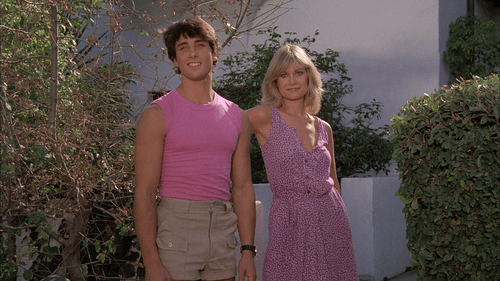
The perfect couple

The perfect couple

And what’s surprising is that, once Bobby and Terry become lovers, the film changes.  Well, it changes a little.  Don’t get me wrong — it doesn’t suddenly turn into a great (or even a good) movie or anything like that.  But the film really does make an attempt to realistically deal with the relationship between Bobby and Terry.  Terry doesn’t suddenly abandon her dreams or her plans just because she’s now secretly sleeping with Bobby.  Instead, Terry remains just as independent as before and, unlike a lot of films of the period, the film doesn’t condemn her for wanting a life of her own.  If anything, the film chastises Bobby whenever he gets overly possessive of her.  In the end, the movie suggests that the most important lessons Bobby learned weren’t about sex but instead, were about Terry’s right to live her own life.

Oddly enough, hiding within this typical teen comedy, there’s a surprisingly bittersweet film.  Perhaps less surprisingly, this film — like The Young Graduates, The Teacher, Trip With The Teacher, Coach, and Malibu High — was yet another teacher-student-sex film produced by Crown International Pictures.  Nobody handled potentially icky exploitation with quite the wit and grace of  Crown International.

CIP_Logo


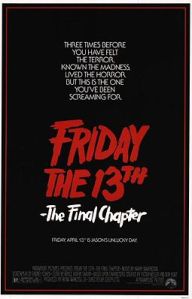
Film Review: Friday the 13th: The Final Chapter (dir. by Joseph Zito)


(spoilers below)

Today, continuing our look at the Friday the 13th horror franchise, we consider the misnamed Friday the 13th — The Final ChapterOriginally released in 1984, this film apparently was really sold as being the final chapter and Tom Savini even returned to do the gore effects because, supposedly, he wanted to kill off his most famous creation.  To be honest, that all sounds like a lot of hype and hucksterism to me but, regardless of the title’s insincerity, The Final Chapter is one of the best (some would say the best) installments in the series.

The Final Chapter begins less than an hour after the end of Part 3.  (One of the curious things about the Friday the 13th series is that the 2nd, 3rd, and fourth films all occur during the same long weekend.  It never seems to disturb anyone in the 3rd or 4th film that a bunch of people have just been murdered in the same general area.)  Jason, who was killed by the terrible Chris Higgins at the end of Part 3, is taken down to the county morgue where he promptly turns out to not be dead after all.  He kills a nurse and an orderly and then, instead of continuing to seek vengeance on Chris (with whom he was pretty much obsessed in Part 3) , he decides to go kill a whole bunch of other people who have just shown up at Crystal Lake for the weekend. 

Those other people are a group of dorky but rather likable college students who have rented a house on the lake.  This is probably the most quirky group of vacationers ever to come to Crystal Lake and it’s a credit to an unusually strong (and unsung) ensemble cast that you actually do believe that these people are friends.  In the group, we have Doug (a dreamy Peter Barton), shy virgin Sarah (Barbara Howard, who is so believable as a nice girl that I felt bad for her when she died), Paul (Alan Hayes), Paul’s slutty girlfriend Samantha (Judie Aronson), and finally heterosexual life partners Jimmy (Crispin Glover) and Ted (Lawrence Monoson).  Jimmy and Ted provide the film with its “comic relief,” the majority of which is pretty weak but Crispin Glover gives such an odd performance that he’s enjoyable nonetheless.  Eventually, our vacationers meet two twins, Tina and Terri (Camilla and Carey Moore) and then they all go back to the house to watch old nudie films and Crispin Glover does a hilariously spastic dance before losing his virginity to one of the twins.  (“Was I a dead fuck?” he asks after, with an aching sincerity.)  And then Sarah gets ready to lose her virginity to Doug but then that defender of purity, Jason (played here by Ted White), pops up and kills everyone.  Seriously, Jason had a busy weekend.

Unfortunately for Jason, Trish Jarvis (Kimberly Beck) and her little brother Tommy (Corey Feldman, who gives a pretty good performance here even if Tommy is kind of a brat when you get right down to it), happen to live next door.  Trish is prepared for Jason because she has previously met yet another camper — Rob (Erich Anderson),who specifically came up to Crystal Lake to track down and kill Jason because Jason killed his sister Sandra in Part 2.  (Of course, by the series chronology, Sandra only died two days ago so I guess Rob moves pretty quickly.)  Also unfortunate for Jason, Tommy is an aspiring makeup artist who makes himself up to look like Jason and, in the surprisingly exciting finale, uses his skills to fool Jason and then hack him up while screaming, “DIE!” all the while.

Plotwise, Friday the 13th: The Final Chapter is a pretty standard slasher film and, at times, it asks the audience to suspend its disbelief just a little bit too much.  Whenever I see the scene where Tina is pulled out the second story window, I always find myself wondering 1) how Jason managed to climb up the side of the house in the rain, 2) why did he decide to do that when, in the previous scene, he was already inside the house, and 3) why didn’t anyone inside the house hear Tina crashing into the station wagon below.  And yet, despite this, Friday the 13th: The Final Chapter is considered by many (including me) to be the best of the series. 

To me, this film succeeds because of two men — Joseph Zito and Tom Savini.    Whereas later Friday the 13th directors often times seemed to be ashamed of the films they were making, Zito was an exploitation vet who had already directed one of the most brutal slashers of all time, The Prowler.  As a director, Zito specialized in telling simple stories as brutally and efficiently as possible.  That’s certainly what he does here and the end result is a fast-paced Friday the 13th that — as opposed to Part 3 — didn’t suffer from any excessive filler.  As well, Zito also does a good job in framing and executing the film’s many tracking and p.o.v. shots, continually keeping the audience off-balance as to whether we’re seeing the camera’s point-of-view or Jason’s. Meanwhile, Tom Savini’s gore effects are just as realistic and disturbing as in the first film.  This is an undeniably bloody film that, at the same time, never slips into tedious “torture porn,” and both Zito and Savini deserve a lot of credit for that.

(Incidentally, here’s a little trivia for all of you Maniac fans — did you know that Joe Spinell’s loathsome Frank Zito was actually named after Joe Zito, who was apparently friends with William Lustig.)

Of all the Friday the 13th films, The Final Chapter probably features the strongest cast.  It certainly features one of the best “final girls”, with Kimberly Beck giving the type of strong performance  that Dana Kimmell failed to supply in Part 3.  Though only Corey Feldman and Crispin Glover would go on to any greater fame, the entire cast is likable and, as opposed to previous and future installments, no one gives a weak performance.  (Even the gimmicky twins do well enough.)  Though I know several people will laugh at this, I sincerely believe that there is an art to giving an effective performance in a film like Friday the 13th.  The key, I think, is to be likable enough that people will watch you and wish you well yet, at the same time, to be bland enough that nobody will be traumatized by your eventual death.  If anything, the cast of The Final Chapter isn’t quite bland enough.  Everyone brings almost too much life to these thinly drawn characters and, as a result,  it’s hard not to feel a little bit traumatized when they start dying.  Crispin Glover, for instance, gave such a quirky and interesting performance that I was actually pretty depressed to see him get that meat cleaver buried in his face.  As well, Peter Barton and Barbara Howard make such a cute couple that it’s upsetting that neither one of them survives to the end of the film. 

Despite the film’s title, the fourth installment of the Friday the 13th franchise was hardly the final chapter and it’s pretty obvious that it was never meant to be.  While I know that some people do complain about the cynicism behind the film’s title, I happen to love it.  It’s like a throwback to the classic old exploitation films that were always sold with sordid titles — like Too Young To Die and Arrested at 17 — that in no way reflected the actual content of the film.  Slasher films are the direct descendants of movies like Reefer Madness and Dwain Esper’s Maniac and it’s nice to see that heritage honored with the false promise of a final chapter.

Though the film’s ending was clearly set up to allow Tommy to eventually take Jason’s place (and, seriously, imagine how disturbing that could have been), Jason would eventually return.  But first, the series would take a major detour with its most over-the-top chapter yet.  We’ll talk about the infamous Friday the 13th — A New Beginning tomorrow.