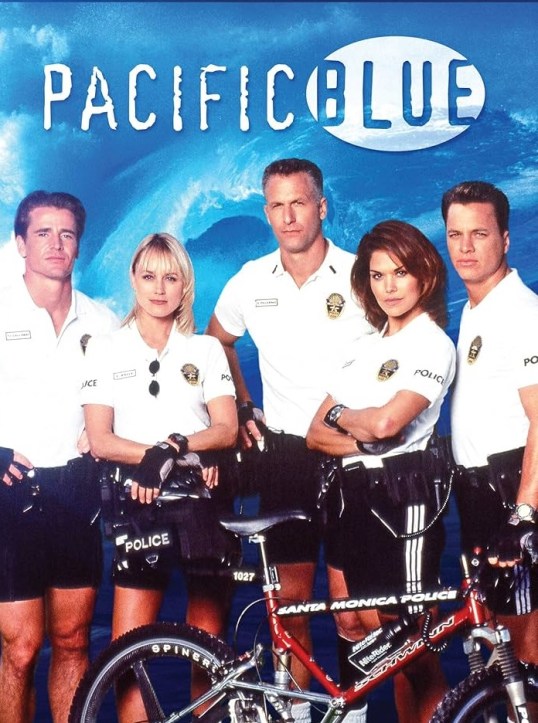
Late Night Retro Television Review: Pacific Blue 3.5 “Excessive Force”


Welcome to Late Night Retro Television Reviews, a feature where we review some of our favorite and least favorite shows of the past! On Tuesdays, I will be reviewing Pacific Blue, a cop show that aired from 1996 to 2000 on the USA Network!  It’s currently streaming everywhere, though I’m watching it on Tubi.

Earlier tonight, I was thinking I might get to bed early as a way to battle my depression over the election in New York City.  Then I suddenly remembered that I still had to review this stupid show.

Episode 3.5 “Excessive Force”

(Dir by Michael Levine, originally aired on September 7th, 1997)

A bank is robbed in Santa Monica so Chris and Victor ride their little bicycles really fast to the scene of the crime.  Victor gets shot in the behind and he spends the rest of the episode with everyone laughing about the fact that it’s excruciatingly painful for him to sit down.  (Wow, what a great group of people.)  Chris shoots one of the robbers in the neck so he swears revenge on her.

Meanwhile, Palermo’s ex-wife is married to an abusive police detective.  She briefly moves back in with Palermo, they end up going at it on the couch, and their daughter gets upset.

As is almost always the case with this show, it’s hard to get involved in the human drama because all of the humans are pretty dull.  Chris ends up staying at TC’s apartment for her own safety and there’s a lot of “will-they-or-won’t-they” tension but it doesn’t add up to anything because TC is boring and Chris is equally boring so who cares?  Meanwhile, Lt. Palermo just comes across as being the volleyball coach from Hell.

Oddly, this episode had a really impressive guest cast.  Dey Young played Palermo’s ex-wife.  Cliff de Young played her new husband.  John Hawkes — as in future Oscar nominee John Hawkes — played the brother of the guy who wanted to kill Chris.  Even Dorian Gregory, from the weird second season of Baywatch Nights, showed up as an FBI agent.  The guest stars were the lucky ones.  None of them had to pretend to be excited about riding a bicycle.

What a silly show.

October Positivity: Last Flight Out (dir by Jerry Jameson)


The 2004 film, Last Flight Out, tells the story of Dan (Richard Tyson) and Anne (Bobbie Phillips).

Once upon a time, Dan and Anne were in love.  Perhaps they were attracted by the fact that their names rhymed.  “Dan and Anne” is just one of those phrases that just rolls off the tongue.  Unfortunately, it takes more than rhyming names to make a relationship work.  Dan was a cynic and Anne wanted to make the world a better place and, in the end, she decided she could do that better without him than with him.

Now, Anne is  missionary, working with Dr. Matteo Barrero (Adriano Gonzalez) at a village in a South American country that is, more or less, ruled by a drug cartel.  And Dan is a pilot, flying missions throughout the world and trying not to get emotionally connected with anyone.  Anne’s mentor, Tony Williams (Cliff de Young), approaches Dan with a job.  The village where Anne is working is currently under siege from a drug lord who demands that all the villagers come to work for him.  The payment that drug lord offers for their work is simple.  If they work for him, he will reward them by not killing them.  If they don’t work for him …. well, you get the idea.

Dan flies to the village, mostly to try to get Anne to safety.  But Anne explains that she won’t abandon the villagers to the drug lord.  Eventually, Anne is able to convince the village’s chief that the entire villages needs to be moved to safety.  That’ll mean putting all twenty of them on Dan’s plan and flying them away from the drug lord’s army.  Dan explains that, even if they take all the seats out of the plane, they’ll still be overweight and unable to take off.  Both Anne and Matteo tells Dan to have a little faith.

And, while the drug lord’s army fires at them from the ground, the plane does manage to take off!  But Matteo is left behind.  Back in civilization, everyone is convinced that Matteo is dead.  Dan, however, is determined to go back and, if possible rescue Matteo.  That, of course, will mean flying straight back into the gunfire and once again, risking his life for another person.  And, in this case, his name doesn’t even rhyme with Matteo’s!

Last Flight Out isn’t a bad little film.  Of course, those tempted to watch the film on Tubi should be aware that it is a faith-based production, so Matteo is very outspoken in his belief in God and the film does feature prayers while in flight.  Naturally, Dan is the atheist who changes his position after witnessing the bravery of the missionaries.  That said, the film is smart to emphasize action over preaching and Richard Tyson gives a likable performance as Dan.  In the end, one need not be filled with faith to know that slave labor is wrong.  Director Jerry Jameson, who directed a host of disaster films in the 70s and the 80s, keeps the action moving at a steady pace and, the end result, is a watchable action film.

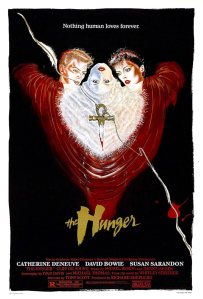
Horror Film Review: The Hunger (dir. by Tony Scott)


Whoa! Hold your horses! This isn’t the only review for The Hunger. Take a look at Lisa’s Review and if you’re so inclined, feel free to double back here.

It seems fitting that we start our descent towards Halloween with Tony Scott’s first feature film, The Hunger. As a fan of Vampires in general, it may not be a great film, but I feel like it does have a place in history where creatures of the night are concerned.

When I think of Whitley Streiber, Wolfen comes to mind and anyone who knows me also knows how much I adore that film. I don’t usually associate him with Vampires, but 1983’s The Hunger is pretty interesting. To me, there’s a nice beauty and mystery to the film as the undead involved could just be regular people asking the same questions about mortality we do, all to some beautiful movie throughout. They are practical vampires. There’s no real explanation as to how John and Miriam move about through the day. Rather than biting, they use small knives to acquire blood. The powers they wield are subtle, putting the story on par with Kathryn Bigelow’s Near Dark when it comes to avoiding vampire cliches. Additionally, this film also never mentions the word ‘vampire’.

Miriam (Catherine Deneuve, Belle de Jour) and John Baylock (David Bowie, Labyrinth) are vampires living in present day Manhattan. Enjoying their existence as any member of the undead would, they spend their nights mingling among the living and discarding bodies by dawn. What seems like a great unlife takes a turn when John finds himself unable to sleep. This restlessness escalates as he finds he’s losing his hair and gaining more wrinkles. The pair stumble on the Park West Sleep Clinic, and Dr. Sarah Roberts’ (Susan Sarandon, Blue Beetle) studies on sleep and aging. For me, one of the best scenes of the film was a parallel between John’s rapid aging while waiting in the Clinic alongside a lab monkey that is also suffering a similar issue. Sarah doesn’t really get to check in on John (who ages a quick 15 years during the wait), but their meeting does eventually introduce her to Miriam.

Miriam eventually loses John after he falls into a near mummified state. Although he becomes incredibly old, he’s still far from death’s touch. I love her explanation for him: “Humankind die one way, we another. Their end is final. Ours is not. In the earth, in the rotting wood, in the eternal darkness, we will see and hear and feel.” We also learn that this has happened with all of Miriam’s former lovers over the ages. Miriam then turns her sights on Sarah, which blossoms into a mix of a romance at first. Trivia fans will recognize the piano piece Miriam plays for Sarah (Lakme by Delibes), which Scott reused for True Romance. That was a nice touch. Needing a new partner, Miriam’s approaches become more predatory after Miriam’s true nature is revealed.

The cast in The Hunger all do well, but let’s face it, the real draw here was always Bowie (at least for me, anyway). It’s a shame his character doesn’t stay on screen for long, but he makes good use of the scenes he has and he’s there for at least half the movie. The film essentially belongs to Deneuve, who brings some charisma to Miriam’s character. Whether she’s being playfully flirtatious or deadly serious, she seems to be in control. I don’t have anything particular against Susan Sarandon as an actress. She’s quite good in this, but part me kind of imagined Lesley Ann Warren (Clue) doing all this a bit better.

Tony’s directing style is beautiful but slightly disjointed, with flashbacks giving an idea to Miriam’s past. On the one hand, they aren’t enough to be too revealing, but they’re also accompanied with some strange sound zingers that could be a bit off-putting. He moves quickly between scenes, but the general ideas of immortality and her longevity are suggested. Cinematographer Stephen Goldblatt (Outland) would go on to work on the Lethal Weapon films and Schumacher’s Batman films. There are some good uses of shadow and light here.

The music a mix of classical pieces, mixed with what sounds like either wind chimes and synth keyboards. The classical music stands out. The score, not so much. It’s not a terrible thing by any means, but it’s a strange selection of sounds. Other than the music, I was bothered by the film’s ending. What occurs seems like it could have happened at any time, and why it does is never explained in any way. I guess it worked. By the end, though, I felt like I watched something where the first 3 acts were fully thought out and the production team threw a dart at a board full of possible endings.

Overall, The Hunger is a interesting film to watch if you catch it late at night. Every director has to start somewhere, and while it’s a little sketchy in the end, there’s some style and grace to it all.

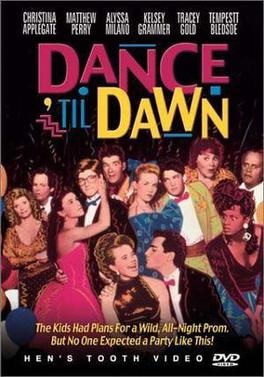
Retro Television Review: Dance ‘Til Dawn (dir by Paul Schneider)


Welcome to Retro Television Reviews, a feature where we review some of our favorite and least favorite shows of the past!  On Sundays, I will be reviewing the made-for-television movies that used to be a primetime mainstay.  Today’s film is 1988’s Dance ‘Til Dawn!  It  can be viewed on YouTube.

It’s prom time and the seniors at Herbert Hoover High School are excited!  Patrice Johnson (Christina Applegate) is especially excited because not only did she organize the prom but she’s also the leading  contender to be elected prom queen.  She’s looking forward to having a wonderful night with her boyfriend, Roger (Matthew Perry).

Patrice is especially excited because her only real competition for prom queen, Shelley (Alyssa Milano), has broken up with her jock boyfriend, Kevin (Brian Bloom).  Shelley has declared that she will instead be attending a very mature and very fun college fraternity party.  Meanwhile, Kevin will be attending prom but he will be coming with Angela (Tracey Gold), who has a reputation for being a bit nerdy.  Kevin only asked Angela to prom because he was under the false impression that she’s easy but he soon finds himself falling for her for real.

Meanwhile, Shelley doesn’t really have a party to attend.  Instead, she decides to spend prom night avoiding her friends and watching an old movie at the town’s movie theater.  Shelley is convinced that no one from school will be at the theater.  Instead, she runs into nerdy Dan (Chris Young), who also came to the theater because he didn’t have a prom date.  Dan and Shelley end up having a fun time hanging out together.

While this is going on, all of the parents are having dramas of their own.  Patrice’s embarrassing parents (Cliff de Young and Mary Frann) relive their own youth.  Dan’s father (Alan Thicke) is convinced that Dan is not only the most popular kid at school but that Dan is also having a wonderful prom.  And Angela’s parents (Edie McClurg and Kelsey Grammer) are so paranoid about the idea of Kevin trying to sleep with their daughter that they actually sneak into the prom to try to keep them from getting too close.  Of course, they are mistaken for waiters and are immediately put to work.

I watched this two weeks ago, when I was still struggling to process the shock of Matthew Perry’s passing.  Unfortunately, Matthew Perry is not in much of the film and it’s not really until the end of the film that he really gets a chance to show any of the sardonic wit for which he was best known.  That said, Christina Applegate appears to be having fun as the snooty mean girl and she and Perry do make for a cute couple.  Actually, all of the couples in the film are cute, with Alyssa Milano and Chris Young especially making for an adorable couple.  This is a pleasant and, for many, nostalgic diversion, as long as you’re willing to accept that there is absolutely nothing go on beneath the film’s slick and occasionally colorful surface.  The humor is broad, the messages are obvious, and, as always, it’s amusing to watch Kelsey Grammer running around in a panic.

Dance Til Dawn doesn’t really bring anything new to the high school genre but it’s still worthy of the name of Herbert Hoover.

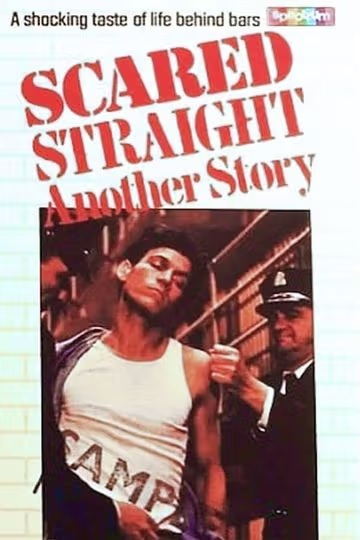
Cleaning Out the DVR: Scared Straight! Another Story (dir by Richard Michaels)


Who is ready to be scared straight … again!?

Scared Straight!  Another Story is a made-for-television movie from 1980.  As you can tell by the name, the movie was inspired by the documentary Scared Straight! and the addition of Another Story to the title would lead one to suspect that this was actually a follow-up or continuation to that documentary and I guess it kind of is.  A group of teenagers, all of whom have been in trouble with the law, are sent to a prison where they are finger-printed, forced to stay in a cell, and then yelled at by a bunch of prisoners who assure them that they don’t have what it takes to survive in prison.  Then, just as in the documentary, the teenagers leave the prison.  Some of them continue to get in trouble and some of them are scared straight.  As for the prisoners, they remain imprisoned.

The main difference is that, instead of featuring real prisoners and real delinquents, Scared Straight! Another Story is a dramatization.  As a result, the prisoners are saying the same thing that they said in the first Scared Straight! but now the prisoners themselves are played by actors who will be familiar to anyone who has watched enough old TV shows.  The prisoners may be yelling about how much life sucks but the viewer knows that they are all actors and, as a result, Scared Straight!  Another Story lacks the rough authenticity of the first film.  (It also doesn’t help that most of the profanity from the original documentary has been replaced with softer expressions of disgust.)  The film again makes the argument that the Scared Straight program can turn someone’s life around but it’s not as effective because, again, the troubled teens are all actors.  The viewer knows that they’re actors.  Their lives have already been turned around.

Surprisingly, the scenes of the prisoners yelling are the least effective parts of this film.  Instead, Scared Straight!  Another Story works best when it is exploring everyone’s life before and after the trip to the prison.  Stan Shaw, in particular, is effective as a prisoner who is inspired to take part in the program after he comes across the body of an inmate who has been driven to suicide.  Also well-cast is Terri Nunn, playing Lucy, the girlfriend of a small-time drug dealer.  Both she and her boyfriend are scared straight but it turns out to be too little too late as her boyfriend is eventually sent to jail for the crimes that he committed before the program.  (There’s an interesting scene, one that I wish had been explored in greater detail, where Lucy’s father observes the scared straight program and, instead of understanding that prison is a terrible place to send a kid, reacts by saying that the prisoners are all getting what they deserve.)  Finally, Cliff De Young, who has played a lot of corrupt government agents and out-of-touch teachers over the course of his career, gets a sympathetic role as Paul, the idealistic juvenile probation officer who sends three of his clients to the program.  The program works for two of them while the other eventually ends up joining the inmates who previously tried to warn him.  If nothing else, the film deserves some credit for admitting that the Scared Straight program isn’t going to magically reform everyone who attends.

Despite some good performances, Scared Straight! Another Story lacks the rough edged authenticity of the documentary.  It’s just not as effective when you know that everyone, including the prisoners, could go home at the end of the day.  Today, this is one of those films that is mostly interesting as a historical artifact.  Apparently, there really was a time when anything could inspire a TV movie.

Horror Film Review: The Hunger (dir by Tony Scott)


“Bela Lugosi’s dead….” Peter Murphy sings at the start of 1983’s The Hunger and, in the case of this film, it’s as much of a challenge as a tribute.

Bela Lugosi and Dracula are gone, the film announces, and so is the old-fashioned vampire movie.  Here’s a new look at an old favorite….

Of course, seen today, The Hunger doesn’t seem new.  Since The Hunger‘s release, there’s been  a countless number of films in which vampires have been decadent and chic aristocrats, hanging out in dark nightclubs and looking at the world with ennui-stricken eyes.  By today’s standards, the stylish decadence of The Hunger can seem almost quaint.  Much like Paul Schrader’s remake of Cat People, The Hunger is such a film of the 80s that you half-expect someone to offer you a line coke while you’re watching it.  Also, like Cat People, it’s such a glorious tribute to excess that there’s no way you can’t watch it once it starts.  It’s hypnotic in its excess.

In The Hunger, our vampires are Miriam Blaylock (Catherine Deneuve) and her lover, John (David Bowie).  Miriam has been a vampire since at least the time of the ancient Egyptians.  Rather than sinking her fangs into the necks of her victims, Miriam uses an Ankh pendant to slit their throats.  John was once a cellist in 18th century France.  Now, they live in an expensive New York townhouse, where they teach classical music and occasionally murder anyone that they can convince to come up to see them.

When they first met, Miriam promised John that he would have eternal life but she didn’t promise him eternal youth.  Unfortunately, it takes 200 years for John to notice.  When he starts to rapidly age, he seeks out aging expert Dr. Sarah Roberts (Susan Sarandon) for help.  Though Dr. Roberts is originally dismissive of his claims, she is shocked to see John age several years in just an hour.

When an angry and desperate John kills the music student (Beth Ehlers) that Miriam was hoping to transform into her next lover, Miriam is forced to search elsewhere.  When Sarah shows up, searching for the man who aged years in an hour, Miriam feels that her search may be over.

As one might expect from a film directed by Tony Scott, The Hunger is an extremely stylish film, to the extent that the film’s story is often secondary to the way that Scott chooses to tell it.  The set design is so ornate and every scene is so precisely lit and shot and that, at times, the movie feels a bit like a commercial for vampirism.  It’s easy to imagine Britney Spears singing “Work Bitch” in the background of some of the scenes.  (“You want a hot body?  You want a Bugatti?  You Want a Maserati?  You better work vamp.”)  Throughout the film, New York glows like a neon wonderland while John and Miriam coolly look out over the world like 18th century French aristocrats who have no idea that they have a future date with the guillotine.  At times, it’s a film that becomes almost ludicrous in its celebration of grandeur and style.  One could imagine Jean Rollin telling the same story just as effectively while spending a lot less money.

And yet, it’s that very embrace of the over-the-top ludicrousness of it all that makes The Hunger a memorable film.  The film’s a tribute to excess, with an ending that falters precisely because it attempts to reject precisely what it’s spent the past hour and a half celebrating.  The Hunger doesn’t add up too much but its hypnotically stylish and well-acted by a cast who does their best to keep up with Tony Scott’s camera.


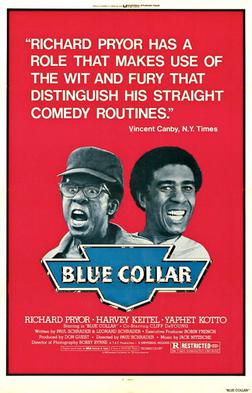
A Movie A Day #153: Blue Collar (1978, directed by Paul Schrader)


Three Detroit auto workers (played by Harvey Keitel, Yaphet Kotto, and Richard Pryor) are fed up.
It’s not just that management is constantly overworking them and trying to cheat them out of their money.  That’s what management does, after all.  What really upsets them is that their union is not doing anything to help.  While the head of the union is getting rich off of their dues and spending time at the White House, Keitel is struggling to pay for his daughter’s braces, Kotto is in debt to a loan shark, and Pryor is lying to the IRS about the number of children that he has.  (When a social worker shows up unexpectedly, Pryor’s wife recruits neighborhood children to pretend to be their’s.)  Kotto, Pryor, and Keitel plot to rob the union but instead, they just discover evidence of the union’s ties to the mob.  The union bosses will do anything to keep that information from being revealed, from trying to turn the friends against one another to committing murder.

Blue Collar was the directorial debut of screenwriter Paul Schrader.  Schrader has said that the three main cast members did not get along during the filming, with Richard Pryor apparently bringing a gun to the set and announcing that there was no way he was going to do more than three takes of any scene.  The tension between the lead actors is visible in the film, with all three of them giving edgy and angry performances.  That anger is appropriate because Blue Collar is one of the few films to try to honestly tackle what it’s like to be a member of the “working class” in America.  While management is presented as being a bunch of clowns, Blue Collar reserves its greatest fury for the corrupt union bosses who claim to represent the workers but who, instead, are just exploiting them.  The characters in Blue Collar are pissed off because they know that nobody’s got their back.  To both management and the union, the workers are worth less than the cars that they spend all day putting together and the money that can be subtracted from all their already meager pay checks.

Since it’s a Paul Schrader film from 1978, the action in Blue Collar does come to a halt, 40 minutes in, for a cocaine-fueled orgy that feels out of place.  While Keitel and especially Kotto give believable performances, Pryor sometimes seems to be struggling to keep up.  Still, flaws and all, Blue Collar has a raw and authentic feel to it, something that few other movies about the working class have been able to capture.  Perhaps because it never sentimentalizes its characters or their situation, Blue Collar was not a box office success but it has stood the test of time better than many of the other films that were released that same year.  Sadly overlooked, Blue Collar is a classic American movie.


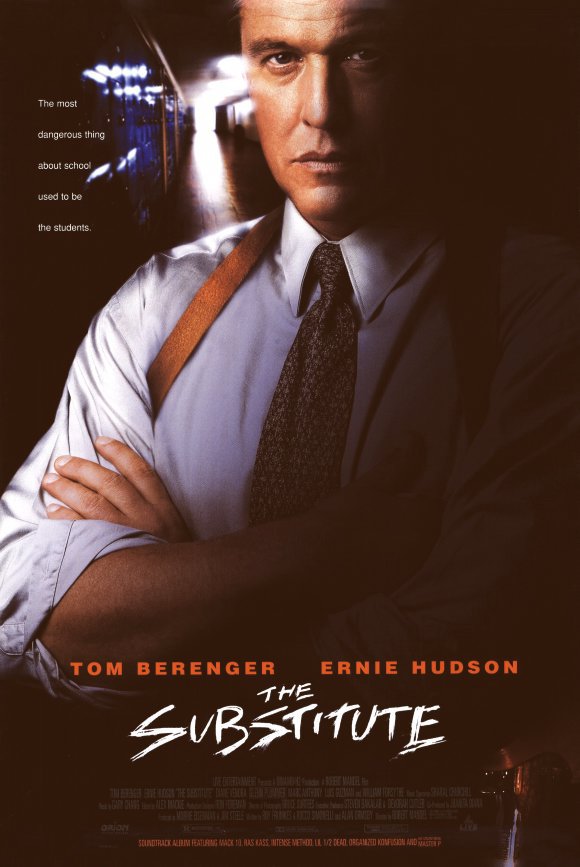
Guilty Pleasure No. 10: The Substitute (dir. by Robert Mandel)


the-substitute-movie-poster-1996-1020204941

The most recent entry in the Guilty Pleasure series had Lisa Marie waxing poetically about the idealistic teacher in the “jungle” film The Principal. I counter and follow this up with a similar-themed film called The Substitute that came and went very quickly in the theaters (I’m not even sure if it did or just went straight to video) in 1996.

The Substitute stars veteran actor Tom Berenger (you may remember him in such films as Platoon, Major League and Sniper) as a Vietnam vet mercenary who ends up substituting as the substitute teacher for his girlfriend’s high school class as she recovers from an attack that has left her unable to teach. The girlfriend was played by one Diane Venora who in the very same year was in another little film called Heat by Michael Mann. These two polar opposite films in terms of their “quality” just shows you that when it comes to acting, unless one was a recognizable name then any role is a good role it seems.

Getting back to the film, Berenger’s character is the titular substitute in one of Miami’s worst inner-city high schools where, as the film’s tagline proudly proclaims, the most dangerous things about it was the students. That is until Berenger’s character shows up to find out who attacked his girlfriend and bring down the wrath of God himself (or at least Berenger’s character and members of his old mercenary team).

The film isn’t what one would call very subtle. We clearly see either two types of teachers in this school. There’s Berenger and his girlfriend who care for the young teens (the former woth tough love and the latter going about it in a more liberal sense) and then there are those who have given up on the school and just cashing in on a paycheck. This goes to the extreme with the school’s principal (played by Ernie Hudson) who begins to suspect that the new substitute might be more than he appears.

It’s the passive-aggressive interaction between the two roles played by Berenger and Hudson that made for some of the more hilarious sequences in the film.

Oh, another thing the film also involves a dangerous high school gang that uses the school as if it’s their own little fiefdom and the local drug kingpin using it as a way station to move heroin into the Miami inner-city school system. Oh, did I happen to mention that Marc Anthony plays the leader of the high school gang, because he sure does.

The Substitute almost plays out like how a teacher fed up with the inattentiveness of his students and the stress of doing a thankless job imagines the perfect scenario to “clean-up” the high school. It’s not through coddling and talking things out with the students. It’s about using military tactics to take out the dangers of gangs and drug dealers and tough love on those who are still worth saving.

Some have called the film as blatantly racist while others have pointed out how it is just an extreme version of the longstanding storyline of the educated and civilized white man saving the “natives” from themselves. What this film has over other school films of similar themes is how it doesn’t try to sugarcoat and hide behind ideals when it comes to it’s story. Plus, it’s such a guilty pleasure to see a typical 80’s action flick dressed up to be a late 90’s film. They really don’t make films like this anymore.