Review: Fear the Walking Dead S1E01 “Pilot”


FearTWDS1E01

“We’re safer in numbers.” — Tobias

There’s a scene early on in the pilot episode of Fear the Walking Dead that really helps set the tone for what could be the running theme for this first season. We have the awkward high school student Tobias getting caught by his school guidance counselor (Madison Clark played by Kim Dickens) with bringing a knife to school. His reasoning after some prodding from Ms. Clark is that he didn’t bring the knife for protection from the school bully. He never outright says what, but his rambling about viruses, microbes, people dying and that it’s a situation that is spreading even sets Ms. Clark aback. Tobias truly believes that there’s a storm coming and that everything he has been preparing for will fall by the wayside. It’s not just his plans, but everyone’s.

Fear the Walking Dead has the difficult task of satisfying not just the legion of fans that make up the prequel series’ parent show, but also set it separate with it’s own identity from The Walking Dead. This show takes us, the viewers, back to the beginning when zombie apocalypse hadn’t landed on the world’s lap. It’s a look into the days gone bye that were only hinted and talked about in the The Walking Dead. Rick Grimes still in a coma, Glenn’s still delivering pizzas in Atlanta and Herschel still has an empty barn.

We find the world still turning and turning with it’s people oblivious of the storm looming over in the horizon. The worry about a prequel series is that as an audience who has seen five seasons of The Walking Dead we’ve learned how this encroaching world operates. We know that anyone who dies becomes a zombie (or walker, biter, etc) who will attack anyone living and propagate the outbreak. The writers of this new series must now try and convince this audience that the actions of the cast are not born out of stupid horror tropes, but on uneducated decisions during situations that they’re not prepared for.

The series focuses on the lives of what would be considered a typical American family. Two families trying to combine into one with children either resentful or apathetic to their parents’ attempts to create a new family from two broken ones. We witness the opening stages of The Walking Dead zombie apocalypse through their eyes as they go about the normal routine of their lives. Whether it’s going to school as a student or as a guidance counselor or a English teacher. This world we recognize as something we see everyday of our own lives.

The question the pilot begins to raise through some tense moments of dialogue is whether the world is prepared for the apocalypse that’s coming. In this world, as in the world of The Walking Dead, the term zombies and the rules governing them don’t exist. There’s no George A. Romero zombie films or Italian zombie knock-offs to help educated the masses through the years. This world has no analogue for the horror descending on them which should explain why some of their behaviors might seem frustrating to those who have watched horror and zombie films.

Yet, it’s through the characters’ very naivete about the crisis happening around them that looks to be a strength for the show. There’s no Rick Grimes, Shane, Daryl or Michonne to come in guns blazing and blade slicing to save the day. These characters must adapt quickly to this encroaching nightmare world or die. It’s as simple as that: adapt or die.

If tonight’s pilot episode stumbles a bit it’s through some of the backstory sequences that episode was trying to dump wholesale to the audience. The one major criticism that the original series continue to get from fans and detractors alike was how so many characters in the original series have been left underdeveloped. Pilot episode writers Robert Kirkman and David Erickson seem too intent on not making that same mistake with this series premiere, but it did lead to some major expositions that, at times, put the breaks on the episode’s forward momentum. It’s understandable to try and flesh out these characters before the zombie mayhem arrive in full-force, but the adage of showing rather than telling still goes a long way even when the intentions are good.

The zombie mayhem that fans of The Walking Dead have become used to appear quite sparse in this pilot episode. We see what we could call as “Patient Zero” for this series in the episode’s tense-filled first three minutes. We see glimpses of them in parks and from amateur video footage on the net. They’re not as spread out and coming at our cast in horde-like numbers. These people have nothing to fear from the walking dead. Yet, we sense throughout the episode that this outbreak has already started randomly all over the country (most likely around the world) and the very institutions meant to protect the population doesn’t have that very population’s trust. Misinformation and mistrust of institutions make for a dangerous recipe that the student Tobias knows full well.

Fear the Walking Dead has the luxury of having a built-up audience courtesy of the massive success of The Walking Dead. The question looming over the series is whether it will be able to use that head start and distinguish itself from it’s older brother series. We have five episodes left in this shortened first season (just like The Walking Dead) and we shall see if these characters will get tossed into the deep end as the crisis grows and grows. One thing Fear the Walking Dead shouldn’t do is to be deliberate. It’s the one mistake that The Walking Dead made during it’s first two seasons that it’s still trying to fix as we near the start of season 6.

Random Notes

  • Tonight’s premiere pilot episode was written by series creator Robert Kirkman and showrunner David Erickson with directing duties handled by Adam Davidson.
  • It’s great to see two veteran actors such as Cliff Curtis and Kim Dickens as the leads of a major project as Fear the Walking Dead. They’re definitely the anchor and foundation that this show will revolve around.
  • We get two shout outs to recent zombie films during the episode.
  • First one was the traffic jam when Travis and Maddy were trying to drive home only to have them stuck in traffic with helicopters overhead and police motorcycles driving past dangerously close to Travis’ truck. A scene similar to 2014’s World War Z.
  • Second one scene was of the faculty staff and some of the students watching videotaped footage of fire department personnel and police responding to the cause of the traffic jam only to have the supposed dead victim come back to life and bite one of the firemen. The scene looks eerily similar to footage from George A. Romero’s fifth zombie film, Diary of the Dead.
  • I do believe that was Lynn Chen from the Buzzfeed videos that was playing the nurse when Nick’s elderly roommate patient went into Code Blue.

Fear The Walking Dead Season 1 Trailer


FearTWD

“When civilization ends…it ends fast.”

It was just a matter of time before AMC decided to mine their massive hit of a show, The Walking Dead, with spin-off to maximize it’s dominance over the tv landscape. We’ve been getting teasers leading up to San Diego Comic-Con where AMC released the first official trailer for this spin-off series titled Fear The Walking Dead.

This spin-off series will pull back time from the original series and have it set in the very beginning of the zombie outbreak which leads to the fall of civilization by the time Rick awakes from his weeks-long coma. It will also have it’s location as far and different from the backwoods and backroads of Georgia to Virginia where The Walking Dead is set. Instead this new series will have sunny Los Angeles as the setting. What better location than one of the most densely populated areas in the United States to show the first days and weeks of The Walking Dead timeline.

Unlike some who seem to be getting tired of the zombie craze of the past decade or so, I and a few others here at Through the Shattered Lens still enjoy this zombie apocalypse renaissance. Maybe it’s the inner doomsday preppers in some of us here in TSL that makes these types of shows and stories appealing.

Will Fear The Walking Dead succeed just as much as it’s older sibling? We shall find out when it premieres this August 23rd.

Embracing the Melodrama #43: The Piano (dir by Jane Campion)


I recently watched the 1993 best picture nominee The Piano and all I can say is that it is going to be a struggle to put into words just how much I loved this film.

Taking place in the 19th century, The Piano tells the story of Ada (Holly Hunter), a Scottish woman who hasn’t spoken since she was 6 years old.  Like many things in this enigmatic film, the reason why Ada stopped speaking is never clearly stated.  What is known is that she communicates through sign language and by playing her piano.  While Ada is usually a black-clad and somber figure, she comes to life when she plays the piano.  Ada also has a daughter named Flora, the result of a brief affair that Ada had with one of her teachers.  Unlike her mother, Flora (played by 10 year-old Anna Paquin, long before True Blood) is rarely silent and delights in telling elaborate lies about how her father died.

the-piano-01

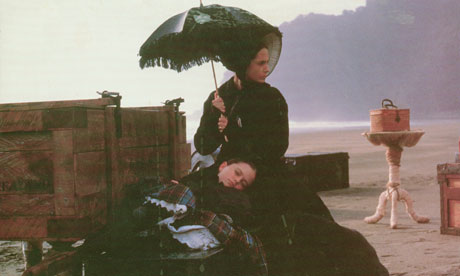
Ada’s father sells her into marriage to a New Zealand frontiersman named Alisdair (Sam Neill), a man who Ada has never even met.   When Ada and Flora first arrive in New Zealand, they are dropped off on the beach and forced to wait a night until Alsdair can meet them.  In the film’s most hauntingly beautiful scenes, Ada plays her piano on that beach while Ada dances in the surf.  It’s during those scenes that The Piano reveals three of its greatest strengths: the lush cinematography of Stuart Dryburgh, the haunting score composed from Michael Nyman, and the fact that Hunter and Paquin are totally believable as mother and daughter.  Not only is it easy to imagine Paquin growing up to look like Holly Hunter, but the two actresses even manage to perfectly imitate each other’s gestures and facial expressions.  Most of the reviews that I’ve read of  The Piano tend to emphasize the film’s focus on the conflict between the sensual and repressed but to me, the film works just as well as an exploration of the strong bonds that naturally exist between mothers and daughters.  I’m not ashamed to admit that when I look at the picture above, I reminded of how, when I was Flora’s age, I also used to hide behind my mom whenever I saw anyone that I didn’t know coming our way.

When Alisdair does finally show up to take them to their new home, he proves to be a rather cold and distant figure.  It would have been very easy for the film to portray Alisdair as being a completely heartless villain but, as played by Sam Neill, Alisdair is potrtayed as being less a traditional villain and more as just being a painfully unimaginative man who is incapable of understanding why Ada’s piano is so important to her.  To Ada, the piano and its music equals the life and freedom that she’s not allowed to experience.  To Alisdair, the piano is simply a bulky object that will not fit into his small house.  Over Ada’s objections (luckily, Flora is on hand to translate her sign language), Alisdair first leaves the piano on the beach and then agrees to sell it to Baines (Harvey Keitel), another white settler who — unlike Alisdair — is comfortable with the natives and their customs.

Baines, however, allows Ada to come over to his hut and play the piano.  He offers to give the piano back to her — key by key — if she agrees to continue to come to his hut and play while he watches and “pleasures” himself.  Reluctantly, Ada agrees but soon, she and Baines are falling in love.

Needless to say, when Alisdair finds out what has been going on at Baines’s hut, he is not happy.  As he largely considers to be his property, bought and paid for, he also feels that he has the right to decide whether or not she’s capable of playing her piano…

The Piano: Holly Hunter and Anna Paquin

The Piano is a simply an amazing and visually sensual film that is blessed with excellent lead performances from Hunter, Keitel, Neill, and Paquin.  As directed by Jane Campion, The Piano plays out as both a delirious homage to gothic romanticism and a feminist parable about the way that even women who aren’t mute are still punished for expressing their honest desires.

And, of course, there’s that amazing score:

Horror Quickie Review: Virus (dir. by John Bruno)


Virus

Not every comic book film is about superheroes. There’s been quite a bit of comic books adapted to film that has no superheroes, capes and superpowers at all. One such film came out in 1999. It was a film adapted from Chuck Pfarrer’s Dark Horse Comics mini-series titled Virus. This was a comic book that had a unique art-style to it that lent itself well to its scifi and body horror tale.

The film itself skews close enough to the comic book with some minor changes. Instead of a Chinese research vessel where most of the story takes place we find the film set on a derelict Soviet research ship. Even with the changes from comic book to film they both shared one common denominator and that would be the alien lifeform that has decided to systematically kill all humans aboard the ship.

Virus stars Jamie Lee Curtis and Donald Sutherland in two roles they probably wish they took a pass on or asked more money to do. While the film has some imaginative set pieces involving the melding of robotics and scavenged human body parts to create something bigger and homicidal the majority of the film involves pretty much every cast member in one stage or another of hysteria, incredulity and denial. Really, the only person in the whole film who seemed to go through the story with a clear and level head was Cliff Curtis’ seaman Hiko. All this means was that he would be one not to survive to the end of the film.

While the comic book itself was a nice piece of scifi horror storytelling then film stumbles right out of the gate not just because of the terrible acting, but just a dull and boring adaptation of the story. While, as stated earlier, some of the robotic designs were quite good and the use of practical effects made the killer robots something terrible behold, director John Bruno didn’t seem to have any ideas on how to put together an exciting sequence to take advantage of these inventive pieces at his disposal.

Virus was one film that comic book fans who read the mini-series were quite excited to see when it was first announced as a film in production. Stills of gruesome effects work would be admired and just add to the high expectations. What we got instead was a huge pile of a mess that was neither horrific, terrifying or remotely entertaining. Virus is one such film that I wouldn’t even bother catching on TV being shown for free.

6 Late Reviews: Atlas Shrugged: Part II, Project X, This Means War, A Thousand Words, Trouble With The Curve, The Vow


2012 is quickly drawing to an end and seriously, where has the time gone?  I’m seriously running behind in reviewing all of the films that I’ve seen in 2012 so, in the interest of getting caught up, here are six quick (and late) reviews of some of the film that I saw earlier this year.

(Fortunately, seeing as how we live in a world of Netflix, DVD, Blu-ray, and On Demand service, it’s never too late to review any film.)

1) Atlas Shrugged: Part II (dir by John Putch)

Picking up where the first Atlas Shrugged ended, Atlas Shrugged: Part II continues to tell the story of how America was ruined by elitist do-gooders and how the smartest people in the world responded by uttering the phrase, “Who Is John Galt?” and then vanishing.

There’s a lot of bad stuff that I could say about Atlas, Shrugged Part II.  I could point out how close to nothing actually happens in the film.  I understand that this is the second part of a proposed film trilogy but, seriously, that’s all that Atlas Shrugged Part II has in common with The Two Towers.  With the exception of the great Patrick Fabian (who has a lot of fun playing a weasel), the cast isn’t memorable and the film is full of slow spots.

Part II was made by a different director and with a far more professional cast than Part I but that proves to be a mistake.  Part of the odd charm of Atlas Shrugged, Part I was that it was such a low-budget, pulpy affair.  Atlas Shrugged, Part II is a lot more slick and, as a result, it feels a lot less sincere.

That said, I couldn’t help but enjoy Atlas Shrugged, Part II because, much like For Greater Glory, the film flew so completely in the face of conventional cinematic political statements.  Atlas Shrugged Part II might not be a great (or even a good) film but it annoyed all of the professional film critics and it’s always amusing to watch the same critical establishment that embraced Avatar whine about how any other film is too heavy-handed.

Am I, therefore, recommending Atlas Shrugged, Part II?  Not really.  I tend to learn towards the Libertarian point of view when it comes to politics and even I found the film to be tedious.  That said, if you ever really want to annoy your wannabe hipster friend (the same one who leaves a hundred comments a day over at the A.V. Club), Atlas Shrugged, Part II might make the perfect holiday present.

2) Project X (dir by Nima Nourizadeh)

In California, two loathsome high school students — Costa (Oliver Cooper) and J.B.(Johnathan Daniel Brown) — throw a birthday party for their friend Thomas (Thomas Mann).  Thomas is a stereotypical nice guy but he’s also friends with Costa and J.B. and that makes him loathsome by association.  The party quickly gets out of control and eventually, houses are destroyed and a SWAT team is called in to restore order.

Oh!  And the entire film is presented as being a bunch of “found footage.”  What that means is that we have to sit through all the usual stuff of people acting awkward in an attempt to convince us that we’re not watching a movie, despite the fact that we clearly are.

Project X fails on so many levels that it’s hard to even know where to begin.

It’s impossible to sympathize with the film’s three main characters and let’s just say that Oliver Cooper is no Jonah Hill.

There’s no real build-up to the party getting out of control and hence, most of the film’s comedy falls flat.  This is the type of film where a midget happens to show up at the party just so he can then be tossed into an oven.  Uwe Boll would probably call that genius but, for the rest of us, it just feels like desperation on the part of the filmgoers.  (You can just here them going, “Midgets are always funny!”)

Finally, worst of all, Project X is the latest film to use the whole found footage gimmick as a way to try to explain away the fact that it’s just not a very good movie.  Seriously, mediocre filmmakers of America — it’s time to move on to a new gimmick!

3) This Means War (dir. by McG)

Two CIA Agents (Chris Pine and Tom Hardy) set aside their friendship and go to war when they realize that they’re both attempting to win the heart of the same woman (played by Reese Witherspoon).   Fortunately for them, they’ve both managed to fall in love with the one woman in the world too stupid to realize that there’s anything strange going on.  Chelsea Handler is also in this film.  She plays Witherspoon’s best friend and delivers all of her lines in this kind of depressed monotone that seems to suggest that she’d rather be co-starring with Whitney Cummings.  Eventually, a lot of things explode and well, anyway … bleh.

Seriously, This Means War has absolutely no right to be as boring as it is.  Outside of this film, Chris Pine and Tom Hardy are both hot, Reese Witherspoon is likable, and even Chelsea Handler still makes me laugh on occasion.  And yet, when all four of these people are put together in the same film, the end result is a mess that just gets more and more annoying with each passing second.

Most of the blame has to be put on the director.  McG never finds a consistent tone for his film and never seems to be sure whether he’s parodying or celebrating the conventions of both action films and romantic comedies.

Myself, I just find it funny that people actually address him as “McG.”

4) A Thousand Words (dir by Brian Robbins)

Jack (Eddie Murphy) is a literary agent who talks too much.  So, one night, a tree with a thousand leaves magically appears in his back yard.  Every time that Jack says a word, a leaf falls off of the tree.  Luckily, Jack happens to know a new age guru (Cliff Curtis) who explains that once every leaf has fallen, Jack will die.  As a result, the formerly glib Jack learns the importance of saying just the right thing and he becomes a better husband, father, and son as a result.

A Thousand Words is just as bad as the above plot synopsis suggests and that’s all that really needs to be said about it.  Wasting a thousand words talking about A Thousand Words would be a mistake indeed.

5)  Trouble With The Curve (dir by Robert Lorenz)

Widower Gus (Clint Eastwood) is an aging baseball scout who is slowly losing his eyesight.  Mickey (Amy Adams) is Gus’s daughter, a driven lawyer who has a strained relationship with her father.

And together … they solve crimes!

No, not really.  Instead, Gus is given one last assignment and Mickey, who is both concerned for her father’s well-being and wants to try to repair their fractured relationship, accompanies him.  At first, Gus doesn’t want Mickey around but she eventually proves her worth to him and gets to flirt with a young scout played by Justin Timberlake as well.  So, it’s a win-win.

 I don’t know much about baseball (beyond the fact that my sister Erin yells at the TV a lot whenever the Rangers are playing) but Trouble With The Curve is such a predictable movie that you really don’t have to know much about the game to be able to follow the plot.  That said, Trouble With The Curve might be predictable but it’s also a genuinely sweet and likable film.  Timberlake and Adams make for a really cute couple and it’s always fun to watch Eastwood growl at a world that never fails to disappoint him.

6) The Vow (dir by Michael Sucsy)

Paige (Rachel McAdams) and her husband Leo (Channing Tatum) are in a horrific car accident.  Paige is sent flying through the windshield and when she recovers consciousness, she no longer remembers being married or anything else about her life after she first met Leo.  While Leo attempts to get Paige to fall in love with him for a second time, Paige’s parents (Sam Neill and Jessica Lange) attempt to convince her to divorce him and return to her previous life as a pampered law student with a rich fiancée (played by Scott Speedman).

The Vow is a lot like Trouble With The Curve in that it’s totally predictable but, at the same time, it’s so sweet and likable that anyone who complains about the film being too predictable probably doesn’t have a heart.  Rachel McAdams and Channing Tatum have a lot of chemistry and anyone who complains that this film is too much like a Lifetime movie has obviously never experienced a really great Lifetime movie.

Scene I Love: Sunshine (dir. by Danny Boyle)


The scene in Danny Boyle’s “Sunshine” where the crew reaches Mercury is one of my favorites. It may not be as powerful as Kaneda’s Death, but this is one of those moments I can watch and smile at. There are no words, but visually, It’s an awesome moment of reflection in the scheme of things. John Murphy and Underworld’s music add a nice touch to this.