Review: Mercy (dir. by Timur Bekmambetov)


“You and I both know that this clock is bullshit. You make your decisions about the people in this courtroom before they’re even in this chair.” — Det. Chris Raven

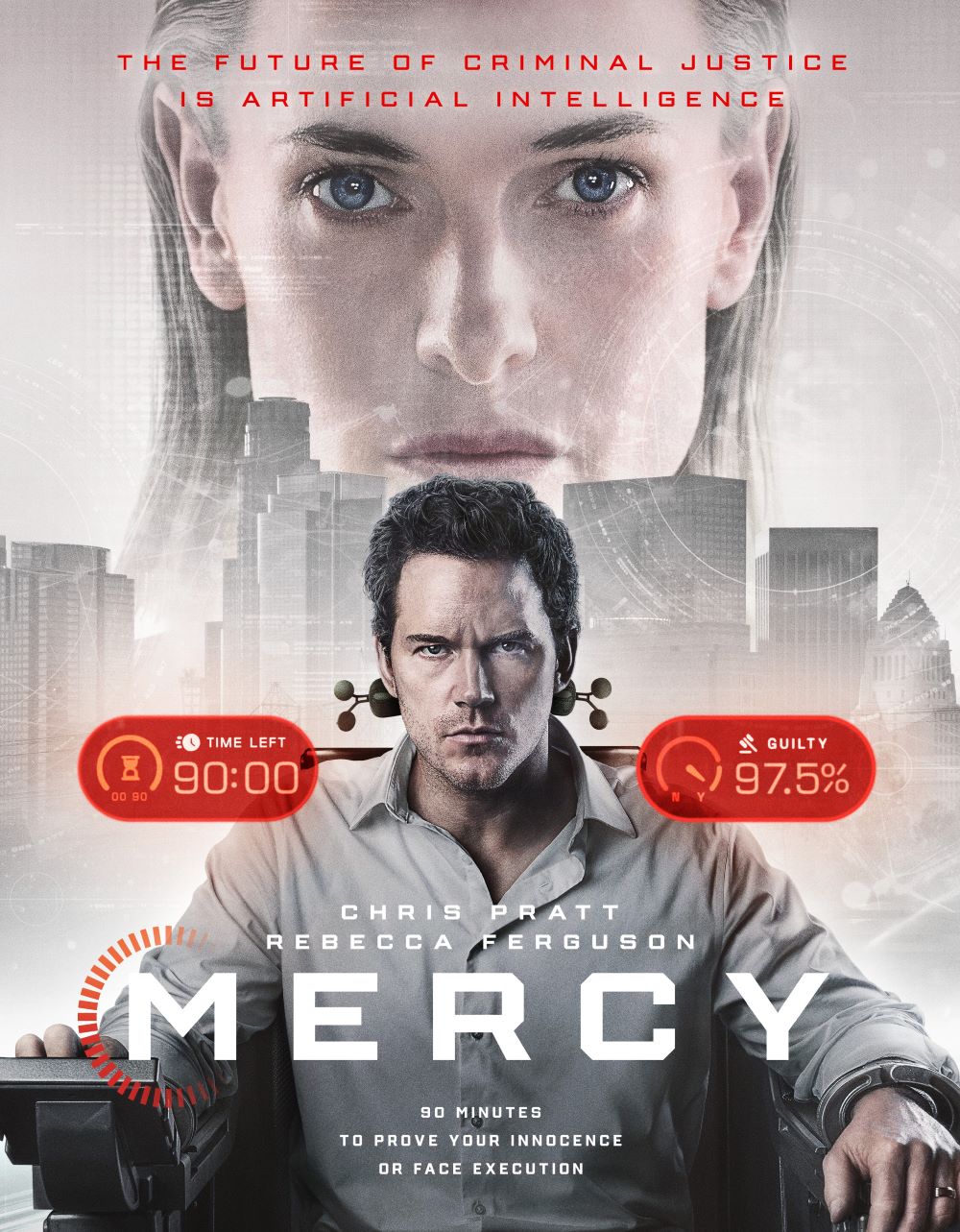
Mercy is the kind of movie that looks great in a trailer and promises a slick, high‑concept thriller, but then sputters once you sit through it. It’s set in a near‑future Los Angeles where the LAPD relies on a program called the “Mercy Court,” in which AI judges rapidly process violent crime cases, and the whole thing is framed as a techno‑noir twist on the courtroom thriller. The central gimmick is compelling on paper: detective Chris Raven wakes up strapped into a high‑tech chair, accused of brutally murdering his wife, and has 90 minutes to prove his innocence before being executed by a sonic blast. That setup alone should guarantee at least a tense, scrappy B‑movie; instead, the film keeps undercutting itself with lazy writing, cluttered subplots, and a surprising lack of nerve.

The biggest problem is the script, which feels like it’s trying to be three different movies at once and doesn’t really commit to any of them. On one level, Mercy wants to be a real‑time investigation, where Raven works with an AI judge to access security feeds, social media, emails, and police databases to piece together his wife’s murder. In practice, this becomes a series of exposition dumps—Raven talking out his thought process, the AI reciting rules, and side characters popping in just long enough to drop information before the movie rushes on. It’s not building tension; it’s building a checklist. The film’s pacing stays brisk, but that’s because so much of the middle act feels like procedural filler rather than a genuine mystery.

Tonally, Mercy swings wildly between modes. At times it’s going for something like a sleek, dystopian Minority Report–style narrative, then it veers into a revenge‑driven character drama about a cop who may be too reliant on an authoritarian justice system, and then it suddenly transforms into a generic bomb‑plot action movie. The initial setup—a world where people suspected of murder are strapped into a chair, presumed guilty, and given a brutally short window to prove themselves—feels genuinely unsettling. But the movie doesn’t really sit with those implications; it flirts with the moral and ethical questions and then rushes off to a more conventional, physical threat. What should be a caustic, uncomfortable critique of automated justice reduces to another last‑minute rescue mission.

The central mystery is another missed opportunity. The evidence stacked against Raven is substantial—blood on his clothes, footage from cameras, his drinking problem, and a history of violent outbursts—but the film telegraphs the real culprit so early that the final reveal feels less like a twist and more like a completion of prior signposting. The story tries to make the framing of Raven seem like a master‑plan‑level conspiracy, but the plan hinges on an almost impossible level of predictability on his part. The more the movie explains, the harder it becomes to buy into the logic of the setup. Instead of feeling like the net has tightened around him in a sophisticated way, it feels like the script is forcing contrivances to land on top of him.

Chris Pratt’s performance is an odd fit for the material. The movie seems determined to present him as a darker, more tortured version of himself, and there are a few moments where that dynamic works—Raven’s vulnerability, his self‑loathing, his conflicted belief in the system he helped create. But the script never really lets him live in the morally grey space it clearly wants him to inhabit. Instead, it keeps reassuring us that he’s essentially a good cop who’s been wronged, which undercuts any real tension about whether he might actually be guilty or at least dangerous. You get glimpses of a more interesting character, but they’re constantly being smoothed over by the need for a likable protagonist.

The AI judge, voiced and embodied by Rebecca Ferguson, is one of the few genuinely strong elements here. She plays the voice and presence of the system with a cool, clipped rationality that occasionally shades into dry wit, and her interactions with Raven hint at a more ambitious film lurking underneath. The idea of an AI judge slowly questioning its own assumptions—pushing back on emotional appeals, probing inconsistencies, and gradually developing something resembling curiosity—is inherently compelling. Ferguson gives the character enough personality and nuance to make that arc feel plausible, but the script mostly treats her as a glorified search engine and a moral referee for the final act, when she should be the co‑lead driving the film’s central conflict.

The supporting cast is fine, but underused. Raven’s partner mostly exists to run errands off‑screen—tracking suspects, raiding houses, reacting over the comms—so the movie can cut away from the courtroom whenever it gets bored. Raven’s AA sponsor is saddled with a mix of clumsy foreshadowing and heavy‑handed motivation, which only becomes relevant when the revenge angle kicks in. Raven’s daughter functions almost entirely as emotional leverage and a hostage, escalating the stakes in a way that feels mechanical rather than organic. You can tell the film wants these relationships to carry weight, especially when it leans on family flashbacks and guilt, but they play out like bullet points instead of lived‑in dynamics.

Visually, the film leans into its creator’s usual fondness for screens within screens, overlay graphics, and multimedia collage. The Mercy Court itself is a striking concept—an almost clinical chamber where Raven is strapped into a chair while the AI’s interface shifts around him—yet the movie keeps cutting away to external action once the premise might otherwise grow too tense or claustrophobic. The pacing is brisk, and there are a few set‑pieces—an intense raid on a suspect’s house, the final assault on the courthouse—that deliver a basic level of genre competence. The issue is that competence is about as high as Mercy ever aims; it never really experiments with the form or stakes of its own setup.

Where the film stumbles most is in its attempt at commentary. The world it presents is, on paper, horrifying: defendants are presumed guilty, strapped into a chair, surveilled across every aspect of their digital life, and given a brutally short window to clear their name before being executed. That’s fertile ground for a scathing critique of mass surveillance, algorithmic justice, and the erosion of due process. But the movie is oddly kind to the system itself; by the end, the AI judge is portrayed as more reasonable and “fair” than most humans, and the real villain is just an individual with a personal grudge. The film nods at privacy violations and the moral grey zones of automating justice, then quickly moves on to a more traditional, physical threat. For something that positions itself as a provocative AI courtroom thriller, it ends up feeling strangely apolitical and conflict‑averse.

To be fair, there are a few things Mercy gets right. The core structure—a detective investigating his own case against a clock—remains inherently watchable, even when handled clumsily. Ferguson’s performance gives the material a center of gravity whenever it threatens to spin out into nonsense. And there’s an occasionally interesting tension between Raven’s instinct‑driven, emotionally charged approach and the AI’s cold, probabilistic logic, suggesting a better film that really pits those worldviews against each other instead of letting them conveniently converge. If you go in with low expectations and a tolerance for generic sci‑fi thrillers, you might find it mildly diverting.

But for anyone hoping Mercy would be a sharp, nasty, high‑concept genre piece with something to say about AI, policing, and due process, it’s a disappointment. The movie leans on an admittedly strong premise, some slick production design, and a few scattered performances, yet it never commits to either being a full‑tilt B‑movie or a genuinely thoughtful techno‑thriller. It’s not unwatchable, just frustratingly timid—content to skim the surface of its own ideas and then blow something up when things get complicated. By the time the credits roll, you’re left with the sense that the AI judge wasn’t the only one operating on a strict time limit; somewhere along the way, the film seems to have run out of patience with itself, too.

The Films of 2025: Presence (dir by Steven Soderbergh)


Presence takes place in one very big house.  The Payne family — Rebekah (Lucy Liu) and Chris (Chris Sullivan) and their teenage children, Tyler (Eddy Maday) and Chloe (Callina Liang) — have moved into the house, little aware that it is already haunted by a poltergeist.  The entire film is seen through the eyes of the poltergeist, the Presence.

The Presence floats through the house, going from room to room and allowing us to hear snippets of conversation that help us to put the plot together.  The Paynes have moved to what they hope will be a better neighborhood and school district for their children.  Tyler is a swimmer and his new school will perhaps make it easier for him to get the attention of college scouts.  Chloe is still mourning the death of one of her friends.  Her friend died of a drug overdose and we hear enough conversations to learn that drugs were apparently a problem at Chloe’s old school.  More than one of Chloe’s classmates have died.  Chris keeps an eye on Chloe, looking for any signs of drug addiction.  Rebekah, meanwhile, is more concerned with the future of Tyler.  As for the Presence, it gets upset easily.  It’s not happy that Chloe seems to like Ryan (West Mulholland), a friend of Tyler’s who, at first, seems like almost a parody of sensitivity.  The Presence gets even more upset when Tyler circulates a nude photo of another student online.  What does the Presence want with the Paynes and will Rebekah and Chris’s already strained marriage survive the pressure of living with the mysterious spirit?

Written by David Koepp and directed by Steven Soderbergh, Presence is told with long takes and naturalistic lighting.  Following the film’s plot requires listening to snippets of conversations that sometimes drift in from a neighboring room.  It’s an interesting technique, or at least it is for the first half of the film.  Eventually, it becomes apparent that Soderbergh is more interested in the film as a technical experiment than as an actual story involving interesting characters or surprising twists.  At first, the long shots and the lack of close-ups seem to symbolize that the Presence is an outsider amongst the living family but eventually, they come to symbolize Soderbergh’s detachment from the story that he’s telling.  As with so many of Soderbergh’s genre exercises, it’s a film that’s easier to respect than enjoy.  Soderbergh sticks with his technique for the entire film, even when it would easier to abandon it.  I appreciate the dedication but sometimes, I wish Soderbergh could just make a genre film without continually trying to convince us that he’s actually too good for the material.

On the plus side, Soderbergh does get fairly effective performances from his cast.  There’s a twist involving Ryan’s character that isn’t really surprising but West Mulholland still does an excellent job selling it.  Callina Liang realistically portrays Chloe’s sadness and I could definitely relate to her need to rebel, as I would think anyone who has ever been a teenager would.  As so often happens with Soderbergh’s films, the extreme stylization gets in the way of the story but Liang still brings a bit humanity to Soderbergh’s chilly vision.

Film Review: Live By Night (dir by Ben Affleck)


Remember Live By Night?

Released in December of 2016, Live By Night was one of those highly anticipated films that ended up bombing at the box office and leaving critics cold.  The anticipation was due to the fact that Live By Night was the first film that Ben Affleck had directed since Argo won best picture.  It was seen as Affleck’s next prestige picture, the one that would remind everyone that he was more than just the latest actor to be cast as Batman.  Live By Night was expected to be a huge Oscar contender.  As for why it bombed at the box office, that may have had something to do with the fact that Live By Night is not a very good film.

It’s a gangster film, one that takes place during prohibition.  Joe Coughlin (Ben Affleck) is the most boring gangster in Boston.  Or, at least, he is until he falls for the wrong woman and he ends up having to flee down to Tampa.  Once down there, Joe sets himself up as the most boring gangster in Florida.  There’s all sorts of themes running through Live By Night — racial themes, economic themes, even some heavy-handed religious themes — but ultimately, the main impression that one gets from the film’s story is that Joe Coughlin was a very boring gangster.

Anyway, Joe gets involved in all sorts of corruption and violence.  He brings down his friend, Dion (Chris Messina), to help him out.  Whereas Joe is rational and dull, Dion is violent and dull.  You spend the entire movie waiting for the moment when Dion will turn on Joe but it never happens.  I guess that’s a good thing since Joe and Dion are busy battling the Klan.  Joe may be a 1920s gangster but he’s got the political and cultural outlook of a 21st century movie star.

Joe knows that prohibition is going to end someday, so he hopes to make money through opening up a casino.  Standing in the way of the casino is a prostitute-turned-evangelist named Loretta (Elle Fanning).  Loretta is the daughter of the local police chief (Chris Cooper), with whom Joe has an uneasy friendship.  You keep expecting this plot to go somewhere but it really doesn’t.  Loretta’s just kinda there.  That said, we do get a hilarious shot of a tearful Chris Cooper repeating the word repent over and over again so there is that.

Zoe Saldana is also just kind of there, playing Joe’s Cuban wife.  Again, you expect a lot to happen with Saldana’s character but, for the most part, she’s mostly just a plot device who exists solely so that Joe can have some sort of motivation beyond simply wanting to get rich.

It’s a big, sprawling film that never quite feels like an epic.  A huge part of the problem is that Ben Affleck the director is let down by Ben Affleck the actor.  Regardless of what’s happening in the scene, Affleck always has the same grim look on his face.  At times, it seems as if he’s literally been chiseled out of a marble and you find yourself wondering if he’s actually capable of any facial expression beyond glum annoyance.  A gangster film like this need a bigger-than-life protagonist but, as played by Affleck, Joe always seems to be in danger of vanishing into the scenery.

I think part of the problem is that Affleck’s previous films all dealt with places and subjects that Affleck felt comfortable with, perhaps because he could relate their stories to his own personal experiences.  Gone, Baby, Gone and The Town both took place exclusively in Boston.  Argo dealt with the film industry.  Live By Night is a period piece set in the South and Affleck is obviously lost from the minute Joe arrives in Florida.

Live By Night, I think, could have been a good movie if it had been directed by someone like Paul Thomas Anderson and maybe if an actor like Colin Farrell played the role of Joe.  But, as it is, it’s just a rather stolid and uninspiring gangster film.

Film Review: Guardians of the Galaxy Vol. 2 (dir by James Gunn)


(MINOR SPOILERS!  SPECIFICALLY, THE IDENTITY OF THIS FILM’S MAIN VILLAIN WILL BE REVEALED)

The Guardians of the Galaxy are back!

And this time, they’ve brought some new friends with them, friends with names like Kurt Russell, Sylvester Stallone, and … David Hasselhoff?

That’s right.  David Hasselhoff is now a part of the Marvel Cinematic Universe and somehow, it feels totally appropriate.  For all the words that have been written comparing Guardians of the Galaxy to the Star Wars franchise, it’s true ancestor is the 1978 Italian film, Starcrash.  (Perhaps not coincidentally, Starcrash was Hasselhoff’s film debut.)  Watch the trailer below and just try to tell me that you can’t imagine Chris Pratt and Zoe Saldana in the lead roles.

But enough about my obsession with Italian exploitation films.  I know the question that you want answered.  Is Guardians of the Galaxy Vol. 2 as good as the first one?

Well, it depends on how you look at it.  Guardians of the Galaxy Volume 2 is an absolute blast, a wonderfully entertaining film that mixes subversive comedy with sci-fi action.  Everyone from the first film — Chris Pratt, Zoe Saldana, Dave Bautista, Karen Gillan, Michael Rooker, and the voices of Bradley Cooper and Vin Diesel — is back and they’ve still got the same winning chemistry that made the first film so much fun.  Everyone is still committed to their roles, delivering even the strangest of dialogue with undeniable flair.  Nobody’s gotten bored with saving the universe yet.  The new additions to the cast are all well selected.  Kurt Russell totally disproves the assumption that MCU villains are never as interesting as their heroic opponents but, then again, it helps that he’s playing a character who has a memorable and odd backstory.  Once again, director James Gunn combines crowd-pleasing moments with his own sharp sense of humor.  If the pompous tone of Man of Steel and Batman v Superman made you sick, Guardians of the Galaxy Volume 2 is the perfect antidote.

Unfortunately, Volume 2 doesn’t provide the same thrill of discovery as the first film.  It’s easy to forget that, before the first film came out, a lot of people were predicting that Guardians of the Galaxy would be the first MCU film to flop at the box office.  The conventional wisdom was that, as opposed to a character like Captain America, no one, outside of a few comic book readers, knew who the Guardians of the Galaxy were.  Chris Pratt was just the goofy guy from Parks and Recreation.  A talking raccoon?  A walking tree?  It was all way too weird, the naysayers proclaimed, to appeal to a mainstream audience.

However, James Gunn proved them wrong.  Guardians of the Galaxy was not only the most successful MCU film to that date but it was also my pick for the best film of 2014.  I can still remember watching it for the first time and immediately falling in love with both the film’s skewered sensibility and Chris Pratt’s funny but soulful performance.  As opposed to a lot of films that were nominated for and won Oscars that year, Guardians of the Galaxy actually holds up after repeat viewings.

(Seriously, has anyone tried to rewatch Birdman lately?)

Going into the sequel, everyone now knows who the Guardians are and Chris Pratt is now a beloved film star.  Volume 2 has a lot to live up to and, for the most part, it succeeds.  It’s a tremendous amount of fun and, at the same time, it has a heart.  (The heart at the center of the Guardian of the Galaxy films is perhaps the biggest heart in the MCU.)

What is the film about?  Much like the first film, it’s about family.  After years of telling everyone that his father was David Hasselhoff, Peter Quill (Chris Pratt) finally meets his real father (Kurt Russell), a God-like figure named Ego.  Charismatic, cheerful, and just a little bit odd, Ego seems like the perfect father figure but he has some secrets of his own.  Russell gives a wonderful performance, making Ego one of the few MCU villains to be as interesting as the heroes.

While Peter is bonding with his dad, he is also being pursued by his adoptive father, the blue-skinned space pirate named Yondu (Michael Rooker).  Yondu has been rejected by both his adopted son and the rest of his adopted family.  The other space pirates are no longer loyal to him.  His former boss (Sylvester Stallone) wants nothing to do with him.  As silly as it all may sound, it’s also unexpectedly poignant, thanks to Michael Rooker’s performance.  Rooker has appeared in several of Gunn’s films.  He’s almost the Cary Grant to Gunn’s Alfred Hitchcock.  Rooker gives one of the best performances of his careeer in the role of Yondu.  It’s tempting to be dismissive of Yondu, with his blue-skin and his Alabama accent, but Rooker makes him one of the most compelling characters to ever be found in an MCU film.

Meanwhile, Rocket Raccoon (voiced again by Bradley Cooper) has become a surrogate father figure to Groot (voice by Vin Diesel), who is still just a baby tree.  (Groot, a living tree, was reduced to just a twig at the end of the first film.  Fortunately, Rocket planted the twig and, in another few movies, we’ll hopefully have a fully grown Groot.)  Yes, Baby Groot does get to dance, again.  At one point, one of the film’s villains forbids any of his henchmen from attacking Baby Groot because he’s just too adorable to destroy.  And he’s right!  After this movie, everyone will want a Baby Groot of their own.

Gamora (Zoe Saldana) has been reunited with her sister, Nebula (Karen Gilliam) and, once again, they spend most of the movie trying to kill each other.  I have three older sisters so I related to their relationship.

And finally, Drax (Dave Bautista) is still mourning his family.  Fortunately, he gets to spend some quality time with Ego’s odd assistant, an empath named Mantis (Pom Klementieff).  Drax and Mantis both have no idea how social interaction is supposed to work and their scenes together are definitely a highlight of the film.  Bautista and Klementieff share a really likable chemistry.  Bautista is one of those actors who can make you laugh just be giving the camera a quizzical look.  Drax may not be as a complicated as the other Guardians but that simplicity often makes him as interesting as his more complex compatriots.

The film’s not only about family.  It’s also a strike against elitism and a celebration for freedom.  Over the course of two films, the Guardians have battled against both an actual god and a fanatic who claimed to speak for God.  At a time when so many movie heroes are tools of authoritarianism, the Guardians of the Galaxy stand for freedom.  In many ways, Peter Quill is as much of a symbol for liberty as Captain America.  Captain America makes his point with a shield while Peter Quill makes his case by dancing.

As might be expected from an MCU film, Guardians of the Galaxy Volume 2 is full of thrilling visuals, exciting battles, and quotable one liners.  Even if it never reaches the heights of the first one, it’s a blast of a film and, as Arleigh told me it would, the finale brought tears to my mismatched eyes.  See it and have a good time.

Also, be sure to stick around through the entire end credits.  Along with a lot of clues about what might happen in the future of the MCU, there’s also one final Groot joke that made me laugh out loud.

Enjoy!


Guardians of the Galaxy Vol. 2 Teaser Trailer Arrives


guardians-of-the-galaxy-vol-2

“I am Groot.”

James Gunn finally unleashes the first full teaser trailer for his upcoming space opera superhero film out on May 2017. Guardians of the Galaxy Vol. 2 remains one of the 2017’s highly-anticipated films and looking back at how the first film there’s a great chance this band of galactic misfits’ next adventure could join the billion-dollar club. Not bad for a film that earned its popularity on the shoulders of a talking, psychotic raccoon and a talking tree (if I remember correctly, that tree made Lisa Marie cry).

This teaser trailer definitely focuses on the smallest member of the team in Baby Groot and from the reaction on the internet since the teaser trailer’s release it might have just broken the internet in some fashion. The humor from the first film looks to return as well with the cast staying the same and more in tuned with one another.

As all teaser trailer should do, this one doesn’t reveal much of the film’s plot. Just enough action and great visuals to whet the appetites of those already eagerly awaiting the film to arrive.

Consider appetites to be whetted.

Guardians of the Galaxy Vol. 2 is set for release on May 5, 2017 in 3D and IMAX everywhere in the galaxy.

A Sneak Peek At Guardians of the Galaxy Vol. 2


guardians-of-the-galaxy-vol-2

“There are two types of beings in the universe. Those who dance and those who do not.”

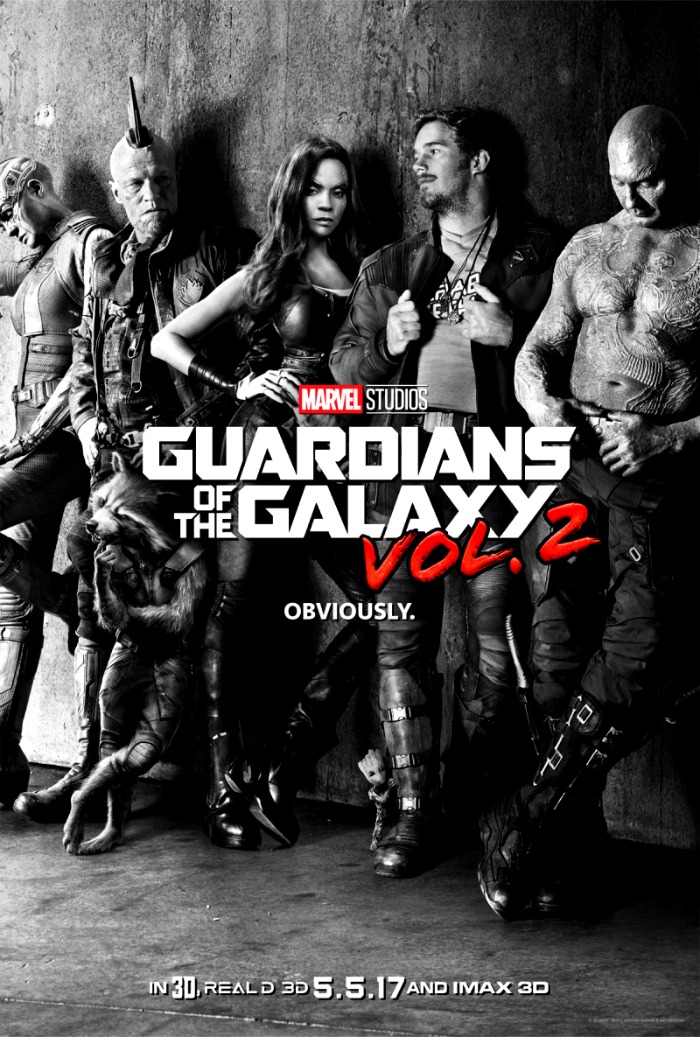
Another brief break from our regularly scheduled horror programming courtesy of Marvel Studios and James Gunn (and the rockin’ sweet poster of the whole Guardians looking like they’re about to drop the hottest 80’s rock album in history).

Guardians of the Galaxy was a surprise hit for Marvel Studios in 2014. It was an obscure Marvel Comics property that many thought would finally end the long streak of box-office success for Marvel Studios and it’s growing and ever-expanding Cinematic Universe. Instead, it was a huge hit with audiences and critics, alike.

This was the film that finally cemented the arrival of a juggernaut blockbuster studio. One that ended up tying Warner Bros. and DC Studios into so many knots in trying to keep up. If Marvel Studios could make a film that had a talking raccoon and tree who spoke only one phrase into a major hit then surely a film with Batman and Superman sharing the screen would be a mega-success.

Now, we have to wait until the start of the 2017 Summer film season to see what new cosmic adventures and hi-jinks Star-Lord and his Guardians of the Galaxy have been getting into.

Until then James Gunn has released this sneak peek (pretty much a teaser trailer) into Guardians of the Galaxy Vol. 2 (he did promise there will be an official trailer coming soon).

Guardians of the Galaxy Vol. 2 is set for a May 5, 2017 in theaters everywhere.