Pale Rider (dir. by Clint Eastwood)


We continue the Shattered Lens’ celebration of Clint Eastwood with 1985’s Pale Rider, one of my favorites. This was a film my long time friend Jay shared with me many years ago, as he owns most of Eastwood’s library of films. I like to think of it as a softer version of Eastwood’s own High Plains Drifter, which my father loved, but I couldn’t really get. It’s a tale of vengeance, but wrapped more in miracles. 

You should first know that Westerns aren’t really my genre when it comes to film types I often watch. I don’t have a lot of historical background when it comes to Westerns overall. If you asked for a short list of my favorites, I’d give up Rustler’s Rhapsody (it’s a fun comedy), The Good, The Bad & The Ugly (my Dad watched it often), Blazing Saddles, and in terms of books, the first few books of Stephen King’s The Dark Tower. I only recently watched Shaneafter Logan was first released, and I love the Red Dead Redemption games.

Pale Rider takes place in California around the time of the gold rush. Outside the town of LaHood, named after the wicked Coy LaHood (Richard Dysart, The Thing), we have a group of miners settled in that are hoping to strike it rich. It’s somewhat difficult with LaHood’s henchmen trying to drive them out at every turn, to steal the land. Hull Barrett (Michael Moriarty, Q The Winged Serpent) hopes to be successful, living with his fiancé Sarah (Carrie Snodgress, The Fury) and her daughter, Meghan (Sydney Penny, The Wife He Met Online). The most recent attack from LaHood’s men has shattered the miners’ morale and few are spared. Even Meghan’s dog is killed, causing her to wish for a miracle.

When LaHood’s son, Josh (Chris Penn, True Romance) and some other baddies (including The Thing‘s Charles Callahan, reuniting with Dysart) confront Hull, a stranger steps in. He handles them all easily with an axe handle, and as thanks, Hull welcomes him to the Miners area for room and board. Of course, having a stranger brings up all sorts of questions from the townsfolk, who don’t appear to be too trusting. Is he an outlaw, possibly? Even Meghan’s a little apprehensive at first, with her quote from Revelations 6:8 forshadowing the Pale Rider’s presence. Everyone is put at ease when they find our stranger is actually a Preacher, though Hull is still a bit curious about the six bullet sized scars on the man’s back. Can the Preacher help the Miners keep their land and stop LaHood? 

From a casting standpoint, Pale Rider is damn near perfect. Although Eastwood is the main star in his own film, he comes across more as an accessory for everyone else in scenes. Moriarty does most of the heavy lifting, as does Snodgress and Penny. Their characters are all easily likable and the supporting cast (particularly Doug McGrath’s Spider) shine in their parts. Dysart’s LaHood is a dark character and there’s a wonderful verbal conflict between him and Eastwood in one scene that’s just sweet to watch to see who loses their cool first. 

Pale Rider is both pretty simple and well executed from a story standpoint. It bears some similarities to Eastwood’s other film, High Plains Drifter. Though the town isn’t painted in red, there are allusions to the idea that the Preacher may be something of.a specter or ghost of vengeance. We’re not given any kind of full story as to why the Preacher’s here. We are shown that both The Preacher and LaHood’s Marshall, Stockburn (John Russell, The Outlaw Josey Wales) share a history, but that’s it. The story, like the Preacher and the events around him, moves in mysterious ways. 

What I love the most about Pale Rider is the way the Preacher changes the minds (and hearts) of those around him. The miners learn to fend for themselves. His enemies are often in shock over what he does (and at least one flips from bad to good). It kind of reminds me of Wild West version of John Wick or Nobody, with a character whose reputation precedes him. 

Bruce Surtees was the Cinematographer for Pale Rider, who also worked on a number of Eastwood’s earlier films, including The Outlaw Josey Wales and Play Misty for Me. Pale Rider has some beautiful landscape shots of the West (as the film was filmed in Idaho). Despite all the well lit shots, there are still moments where faces are obscured by the brim of a hat or the contrasts in a candlelit room. 

The story isn’t without some dark areas or some odd moments. A dog is killed, and there’s a scene where Meghan is nearly raped, but there’s some intervention before things can get out of hand. Both instances help to show how dark the villains are in the overall tale. Both Sarah and Meghan seem to take their own shine to The Preacher, one already in a relationship and the other too young for what she’s asking for, but I took it to just be that their both a bit mesmerized by the Preacher’s presence in different ways. 

Overall, Pale Rider is a wonderful offering by Eastwood, with fine performances by everyone involved. The Preacher does what he can to make things better around him with a peaceful approach. When push comes to shove, however, the guns come out blazing. 
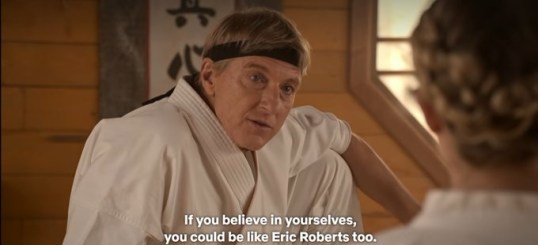
The Eric Roberts Collection: Best of the Best II (dir by Bob Radler)


Eric Roberts, Phillip Rhee, Simon Rhee, and Chris Penn all return for more martial arts action in 1993’s Best Of The Best II!

In the years since the American team’s quasi-victory over the Korean team in the first Best Of The Best, Travis (Chris Penn) has fallen on hard times.  While his former teammates, Alex (Eric Roberts) and Tommy (Phillip Rhee) attend to the day-to-day operations of running a martial arts studio in Las Vegas, Travis spends his time fighting in underground “colosseum” matches.  These matches, hosted by Weldon Mardano (Wayne Newton), are modern-day gladiatorial contests where the fighters often battle to the death while a bunch of rich people watch and cheer.  (We can tell they’re rich because they all wear tuxedos).  “There are no rules!” the crowd shouts as Travis defeats opponent after opponent.

Travis is convinced that he can defeat the colosseum’s German champion, fearsome Gustave Brakus (Ralf Moeller).  It turns out that Travis is wrong.  Travis loses to Brakus and is promptly killed after the crowd starts to chant, “Die!  Die!  Die!”  (In Brakus’s defense, he may have thought they were just chanting, “The!  The!  The!”)  (Actually, don’t ask me how that works in Brakus’s defense.  I really didn’t think that joke through.)  Travis’s death is witnessed by Alex’s young son, Walter (Edan Gross).  Travis, Walter, and Tommy go on the run, ending up at Tommy’s boyhood home.  Tommy, it turns out, is half-Native American and his bitter uncle, James (Sonny Landham), trains Tommy and Alex for their inevitable fight against Brakus.  Dae-han Park (Simon Rhee) also shows up, saying that he owes Tommy a debt for not killing him at the end of the previous film.

Best of the Best II is an improvement on the first film, if just because it doesn’t take itself seriously at all and it cheerfully embraces and celebrates the absurdity at the heart of the storyline.  Just the fact that one of the film’s villains is played by Wayne Newton should tell you everything you need to know about this film’s style.  This is a pure Vegas film, full of glitz and neon and plenty of tuxedos.  Eric Roberts even wears a tux at the end of the movie.  Just as in the first film, Roberts does most of the acting while Phillip Rhee supplies the action.  Roberts is a bit less emotional in this film.  If he spent the first film continually on the verge of tears, he spends the second one trying not to smile at the silliness of it all.  Towards the end of the film, you can actually see him starting to laugh at Wayne Newton’s over-the-top performance and it’s actually kind of a nice moment.  Don’t take this too seriously, the film seems to be saying, We’re not!  Just enjoy the fights!

Best of the Best II is definitely an improvement over the first one, even if it is unfortunate that neither James Earl Jones nor Sally Kirkland returned.  (Then again, if you were the Tony-winning, widely-celebrated, universally-beloved, and very much in-demand James Earl Jones, would you have returned?)   Best of the Best II doesn’t take itself too seriously and, as a result, it’s far more entertaining than you might otherwise expect.

Previous Eric Roberts Films That We Have Reviewed:

  1. Star 80 (1983)
  2. Runaway Train (1985)
  3. Best of the Best (1989)
  4. Blood Red (1989)
  5. The Ambulance (1990)
  6. The Lost Capone (1990)
  7. Love, Cheat, & Steal (1993)
  8. Voyage (1993)
  9. Love Is A Gun (1994)
  10. Sensation (1994)
  11. Dark Angel (1996)
  12. Doctor Who (1996)
  13. Most Wanted (1997)
  14. Mercy Streets (2000)
  15. Raptor (2001)
  16. Rough Air: Danger on Flight 534 (2001)
  17. Wolves of Wall Street (2002)
  18. Border Blues (2004)
  19. Mr. Brightside (2004)
  20. Six: The Mark Unleased (2004)
  21. We Belong Together (2005)
  22. Hey You (2006)
  23. Depth Charge (2008)
  24. Amazing Racer (2009)
  25. In The Blink of an Eye (2009)
  26. Bed & Breakfast (2010)
  27. Enemies Among Us (2010)
  28. The Expendables (2010) 
  29. Sharktopus (2010)
  30. Beyond The Trophy (2012)
  31. The Dead Want Women (2012)
  32. Deadline (2012)
  33. The Mark (2012)
  34. Miss Atomic Bomb (2012)
  35. Assault on Wall Street (2013)
  36. Bonnie And Clyde: Justified (2013)
  37. Lovelace (2013)
  38. The Mark: Redemption (2013)
  39. The Perfect Summer (2013)
  40. Self-Storage (2013)
  41. A Talking Cat!?! (2013)
  42. This Is Our Time (2013)
  43. Inherent Vice (2014)
  44. Road to the Open (2014)
  45. Rumors of War (2014)
  46. Amityville Death House (2015)
  47. Deadly Sanctuary (2015)
  48. A Fatal Obsession (2015)
  49. Las Vegas Story (2015)
  50. Stalked By My Doctor (2015)
  51. Enemy Within (2016)
  52. Joker’s Poltergeist (2016)
  53. Prayer Never Fails (2016)
  54. Stalked By My Doctor: The Return (2016)
  55. The Wrong Roommate (2016)
  56. Dark Image (2017)
  57. Black Wake (2018)
  58. Frank and Ava (2018)
  59. Stalked By My Doctor: Patient’s Revenge (2018)
  60. Clinton Island (2019)
  61. Monster Island (2019)
  62. The Reliant (2019)
  63. The Savant (2019)
  64. Seven Deadly Sins (2019)
  65. Stalked By My Doctor: A Sleepwalker’s Nightmare (2019)
  66. The Wrong Mommy (2019)
  67. Exodus of a Prodigal Son (2020)
  68. Free Lunch Express (2020)
  69. Her Deadly Groom (2020)
  70. Top Gunner (2020)
  71. Deadly Nightshade (2021)
  72. The Elevator (2021)
  73. Just What The Doctor Ordered (2021)
  74. Killer Advice (2021)
  75. Night Night (2021)
  76. The Poltergeist Diaries (2021)
  77. The Rebels of PT-218 (2021)
  78. A Town Called Parable (2021)
  79. Bleach (2022)
  80. My Dinner With Eric (2022)
  81. 69 Parts (2022)
  82. D.C. Down (2023)
  83. Aftermath (2024)
  84. Bad Substitute (2024)
  85. Devil’s Knight (2024)
  86. The Wrong Life Coach (2024)
  87. When It Rains In L.A. (2025

The Eric Roberts Collection: Best of the Best (dir by Bob Radler)


“No!” James Earl Jones says towards the end of 1989’s The Best of the Best, his already deep voice made even more imposing by the use of slow motion.

“No, Tommy, no!” Eric Roberts joins in as he watches martial artist Tommy Lee (Phillip Rhee) internally struggle with whether or not to strike a blow that will definitely kill his opponent and, if James Earl Jones is all gravitas and stern wisdom, Eric Roberts is all emotion and desperation.

The Best of the Best is a bit of an oddity, in that the script features just about every martial arts tournament cliche imaginable (right down to the other “bad” team having a history of killing people in the ring) but those cliches are all acted out by a surprisingly distinguished cast.  I counted four Oscar nominees (and one winner) in the cast.  James Earl Jones (nominated for The Great White Hope) plays Coach Couzo, who gets a team of Americans prepared to fight in an international tournament.  Sally Kirkland (nominated for Anna) plays their trainer, who worries not just about the team’s physical health but also their mental burdens.  Eric Roberts (nominated for Runaway Train) is Alex Grady, the former martial arts champion-turned-auto worker who makes the team despite having a bad shoulder.  Louise Fletcher (who won for One Flew Over The Cuckoo’s Nest) plays Alex’s mother, who looks after his son while Alex is off getting ready to face the Korean team.  And then there’s Chris Penn  (who seems like, if not for his early death, he would have eventually been nominated for something) as the arrogant Travis, a cowboy who can throw a punch.

(The American team is filled out by John Dye as Virgil, an intellectual Buddhist, David Agresta as Sonny “I’m Italian” Grasso, and Phillip Rhee, who not only plays Tommy but also wrote the film’s script.)

Roberts gets top-billing in this and he does get a lot of important moments, including a scene where he breaks the Coach’s rules so that he can visit his son in the hospital.  That said, the story centers around Phillip Rhee’s Tommy.  Tommy’s older brother was killed in the ring by the one-eyed Dae Han Park (Simon Rhee) and — wow, what a coincidence! — that just happens to be who Tommy needs to beat for the Americans to win the big tournament.  Both of the Rhee brothers actually are martial artists and they are very convincing in the fight scenes, which is good because neither Phillip nor Simon Rhee were particularly strong actors.  Eric Roberts is not a particularly convincing martial artist but it doesn’t matter because he acts the Heck out of every scene in which he appears.  What happens when you bring method intensity to the type of martial arts film that Jean-Claude Van Damme would later make his specialty?  You get scenes of a heavily-bruised Eric Roberts crying but, because Roberts is a good actor, the tears feel earned.  Still, whenever I saw Alex’s eyes starting to glisten, I imagined James Earl Jones saying, “Noooooooo!”  How can you win the world’s greatest tournament when you’re constantly on the verge of tears?  Well, maybe you don’t need to win.  Maybe you just need to show that you have more honor than anyone else there.

Best of the Best is a classic of its kind.  There’s nothing surprising about it but it’s entertaining in its own dumb way and, in the end, it reminds us that America doesn’t need medals to be the best.  It just needs Eric Roberts.

Previous Eric Roberts Films That We Have Reviewed:

  1. Star 80 (1983)
  2. Runaway Train (1985)
  3. Blood Red (1989)
  4. The Ambulance (1990)
  5. The Lost Capone (1990)
  6. Love, Cheat, & Steal (1993)
  7. Voyage (1993)
  8. Love Is A Gun (1994)
  9. Sensation (1994)
  10. Dark Angel (1996)
  11. Doctor Who (1996)
  12. Most Wanted (1997)
  13. Mercy Streets (2000)
  14. Raptor (2001)
  15. Rough Air: Danger on Flight 534 (2001)
  16. Wolves of Wall Street (2002)
  17. Border Blues (2004)
  18. Mr. Brightside (2004)
  19. Six: The Mark Unleased (2004)
  20. We Belong Together (2005)
  21. Hey You (2006)
  22. Depth Charge (2008)
  23. Amazing Racer (2009)
  24. In The Blink of an Eye (2009)
  25. Bed & Breakfast (2010)
  26. Enemies Among Us (2010)
  27. The Expendables (2010) 
  28. Sharktopus (2010)
  29. Beyond The Trophy (2012)
  30. The Dead Want Women (2012)
  31. Deadline (2012)
  32. The Mark (2012)
  33. Miss Atomic Bomb (2012)
  34. Assault on Wall Street (2013)
  35. Bonnie And Clyde: Justified (2013)
  36. Lovelace (2013)
  37. The Mark: Redemption (2013)
  38. The Perfect Summer (2013)
  39. Self-Storage (2013)
  40. A Talking Cat!?! (2013)
  41. This Is Our Time (2013)
  42. Inherent Vice (2014)
  43. Road to the Open (2014)
  44. Rumors of War (2014)
  45. Amityville Death House (2015)
  46. Deadly Sanctuary (2015)
  47. A Fatal Obsession (2015)
  48. Las Vegas Story (2015)
  49. Stalked By My Doctor (2015)
  50. Enemy Within (2016)
  51. Joker’s Poltergeist (2016)
  52. Prayer Never Fails (2016)
  53. Stalked By My Doctor: The Return (2016)
  54. The Wrong Roommate (2016)
  55. Dark Image (2017)
  56. Black Wake (2018)
  57. Frank and Ava (2018)
  58. Stalked By My Doctor: Patient’s Revenge (2018)
  59. Clinton Island (2019)
  60. Monster Island (2019)
  61. The Reliant (2019)
  62. The Savant (2019)
  63. Seven Deadly Sins (2019)
  64. Stalked By My Doctor: A Sleepwalker’s Nightmare (2019)
  65. The Wrong Mommy (2019)
  66. Exodus of a Prodigal Son (2020)
  67. Free Lunch Express (2020)
  68. Her Deadly Groom (2020)
  69. Top Gunner (2020)
  70. Deadly Nightshade (2021)
  71. The Elevator (2021)
  72. Just What The Doctor Ordered (2021)
  73. Killer Advice (2021)
  74. Night Night (2021)
  75. The Poltergeist Diaries (2021)
  76. The Rebels of PT-218 (2021)
  77. A Town Called Parable (2021)
  78. Bleach (2022)
  79. My Dinner With Eric (2022)
  80. 69 Parts (2022)
  81. D.C. Down (2023)
  82. Aftermath (2024)
  83. Bad Substitute (2024)
  84. Devil’s Knight (2024)
  85. The Wrong Life Coach (2024)
  86. When It Rains In L.A. (2025

Film Review: Short Cuts (dir by Robert Altman)


Opening with a swarm of helicopters spaying for medflies and ending with an earthquake, 1993’s Short Cuts is a film about life in Los Angeles.

An ensemble piece, it follows several different characters as they go through their own personal dramas.  Some of them are married and some of them are destined to be forever single but they’re all living in varying states of desperation.  Occasionally, the actions of one character will effect the actions of another character in a different story but, for the most part, Short Cuts is a portrait of people who are connected only by the fact that they all live in the same city.  There are 22 principal characters in Short Cuts and each one thinks that they are the star of the story.

Jerry Kaiser (Chris Penn) cleans the pools of rich people while, at home, his wife, Lois (Jennifer Jason Leigh), takes care of their baby and works as a phone sex operator.  Jerry’s best friend is a makeup artist named Bill (Robert Downey, Jr.) who enjoys making his wife, Honey (Lili Taylor), looks like a corpse so that he can take her picture.  One of her photographs is seen by a fisherman (Buck Henry) who has already discovered one actual corpse that weekend.  He and his buddies, Vern (Huey Lewis) and Stuart (Fred Ward), discovered a dead girl floating in a river and didn’t report it until after they were finished fishing.  (The sight of Vern unknowingly pissing on the dead body is one of the strongest in director Robert Altman’s filmography.)

Stuart’s wife, Claire (Anne Archer), is haunted by Stuart’s delay in reporting the dead body.  A chance meeting Dr. Ralph Wyman (Matthew Modine) and his wife, artist Marian (Julianne Moore), leads to an awkward dinner between the two couples.  Claire works as a professional clown and Ralph ends up wearing her clown makeup while his marriage falls apart.

Earlier, Claire was stopped and hit on by a smarmy policeman named Gene Shepard (Tim Robbins), who just happens to be married to Marian’s sister, Sherri (Madeleine Stowe).  Gene is already having an affair with Betty Weathers (Frances McDormand), the wife of a helicopter pilot named Stormy (Peter Gallagher).  When Stormy discovers that Betty has been cheating, he takes a creative revenge on her house.

Doreen Pigott (Lily Tomlin) lives in a trailer park with her alcoholic husband, Earl (Tom Waits).  Driving home from her waitressing job, Doreen hits a young boy.  The boy says he’s okay but when he gets home, he passes out.  His parents, news anchorman Howard Finnegan (Bruce Davison) and his wife, Anne (Andie MacDowell), rush him to the hospital, where his doctor is Ralph Wyman.  As Howard waits for his son to wake up, he has a revealing conversation with his long-estranged father (Jack Lemmon, showing up for one scene and delivering an amazing monologue).  Meanwhile, a baker named Andy (Lyle Lovett) repeatedly calls the Finnegan household, wanting to know when they’re going to pick up their son’s birthday cake.

Based on the short stories of Raymond Carver and directed by Robert Altman, Short Cuts can sometimes feel like a spiritual descendent of Altman’s Nashville.  The difference between this film and Nashville is that Short Cuts doesn’t have the previous film’s satiric bite.  As good as Nashville is, it’s a film that can be rather snarky towards it character and the town in which it is set.  Nashville is used as a metaphor for America coming apart at the seams.  Short Cuts, on the other hand, is a far more humanistic film, featuring characters who are flawed but, with a few very notable exceptions, well-intentioned.  If Nashville seem to be a portrait of a society on the verge of collapse, Short Cuts is a film about how that society ended up surviving.

It’s not a perfect film.  There’s an entire storyline featuring Annie Ross and Lori Singer that I didn’t talk about because I just found it to be annoying to waste much time with.  (The Ross/Singer storyline was the only one not to be based on a Carver short story.)  The conclusion of Chris Penn’s storyline wasn’t quite as shocking as it was obviously meant to be.  But, flaws and all, Altman and Carver’s portrait of humanity does hold our attention and it leaves us thinking about connections made and sometimes lost.  Seen today, Short Cuts is a portrait of life before social media and iPhones and before humanity started living online.  It’s a time capsule of a world that once was.

RUSH HOUR – 1998, a special year for this fan of Hong Kong action cinema!


1998 was certainly a special year for me as a fan of Hong Kong cinema but first let me provide a little context… After 150 years of British rule, Hong Kong was being handed over to communist China on July 1, 1997. This left a lot of uncertainty in Hong Kong’s local film industry. Because of that uncertainty, many of Hong Kong’s most popular filmmakers decided it was time to take their talents abroad. Director John Woo had already left for America in the early 90’s and had made successful films like HARD TARGET, BROKEN ARROW and FACE/OFF. This gets us to 1998, the year that many of Hong Kong’s biggest action stars would release their first American films. Chow Yun-fat would reprise his popular, honorable hitman role in his first American film, THE REPLACEMENT KILLERS, which was produced by John Woo and directed by Antoine Fuqua. Jet Li would make a strong impact as the badass villain in the 4th installment of the LETHAL WEAPON franchise. And then there’s Jackie Chan, probably the biggest of all the Hong Kong movie stars. Jackie had been banging around Hollywood as early as 1980 without a lot of fanfare in the west. But in 1996 Chan had a solid American box office hit when his Hong Kong production RUMBLE IN THE BRONX was dubbed and released in America. Armed with that success and a sizable budget provided by an American studio, Chan would get his own big release in 1998, the action-comedy RUSH HOUR!

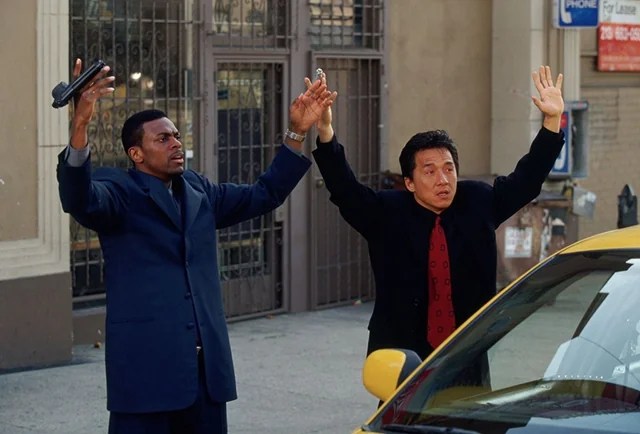
In RUSH HOUR, Jackie Chan plays inspector Lee, a Hong Kong police detective who’s also a friend to Chinese Consul Han (Tzi Ma), currently serving in Los Angeles. When Consul Han’s daughter Soo Yung is kidnapped, he asks Lee to come to America to assist him and the FBI in rescuing her. The FBI doesn’t really want Lee’s help so they ask the Los Angeles police department to assign someone, anyone, to stay with Lee and keep an eye on him so he doesn’t get in the way of their investigation. Enter fast-talking, LAPD Detective James Carter. After some initial clashes and disagreements, the mismatched duo eventually begins working together to find the criminal mastermind behind the kidnapping, Juntao.

I watched RUSH HOUR at the movie theater on my birthday in 1998. I loved every second of it. A few weeks later I was on a business trip in Chicago, I told my boss how good the film was, and we went to see it as well. I enjoyed it just as much the 2nd time. I’m a big fan of “buddy cop” films like LETHAL WEAPON and BAD BOYS, and RUSH HOUR is an excellent addition to that sub-genre of action films. Jackie Chan and Chris Tucker have an excellent chemistry together. Their comedic interplay is hilarious and entertaining. It’s one of the main reasons I enjoy the movie so much. Jackie Chan was 44 years old when RUSH HOUR was released, but he was still extremely athletic so his brand of martial arts action and comedy still worked. The movie would go on to gross just short of $250 million at the worldwide box office and establish Jackie Chan as a bonafide star in the American film market. 2001’s RUSH HOUR 2 would be an even bigger hit, making almost $350 million worldwide. No one works harder or gives more of himself to his film productions than Jackie Chan, and it was nice seeing him achieve the truly worldwide success that he had earned! 

Film Review: Murder by Numbers (dir by Barbet Schroeder)


First released in 2002, Murder by Numbers is one of those films that seems to be pop up on Cinemax every couple of months.  It’s not really that good, though it has its fans because if features Sandra Bullock being all self-destructive and one of the film’s villains is played by a young Ryan Gosling.

Ryan Gosling is Richard Haywood, child of privilege.  He’s handsome.  He’s funny.  He’s popular.  He’s spoiled.  He’s often high.  And he’s totally psychotic.  Richard wants to commit the perfect crime and, fortunately, so does his classmate, Justin (Michael Pitt).  Justin is a fiercely intelligent introvert who spends most of his time reading and writing and playing with his computer.  He’s got a crush on Richard’s ex, Lisa (Agnes Buckner).  From the minute that Lisa showed up and started talking to Justin, I was concerned.  I was like, “Is this another movie that’s going to feature someone named Lisa being murdered?  CHERISH ALL OF THE LISAS IN YOUR LIFE, PEOPLE!”

Anyway, Richard and Justin do end up killing a woman, though not Lisa.  They go through a lot of effort to frame the school’s pervy janitor, Ray (Chris Penn), for the crime.  And they nearly succeed, though Detective Cassie Mayweather (Sandra Bullock) is way too smart to fall for their tricks.  Unfortunately, no one believes anything that Cassie says because she has a shady past and a drinking problem.  Even her sympathetic new partner, Sam Kennedy (Ben Chaplin), thinks that it was probably Ray.

Literally everyone on the police force tells Sam that Cassie is unstable and not to be trusted, which leads to an interesting question.  If everyone’s convinced that everything Cassie says is wrong, why does she still have a job?  Why do they still assign her to cases?  It’s like, “We’ve got a murder that we have to solve!  Let’s give it to that detective who we think never gets anything right!”

Sandra Bullock does her best to bring the self-destructive Cassie to life but she kind of runs into the huge problem that she’s Sandra Bullock and she has such a firmly entrenched screen presence that it’s difficult to take her seriously as someone who spend her free time sitting on a houseboat, getting drunk, and obsessing on the past.  You really want her to give a good performance because it’s impossible not to root for Sandra Bulllock but she’s just too miscast.  You keep expecting Matthew McConaughey to show up, playing a bongo drum and trying to cheer her up.

Far more convincing is Ryan Gosling, who plays Richard as the type of guy that we all knew in high school.  You know he’s a jerk.  You know you should stay away from him.  But he’s just so much fun and he has so much money!  Unfortunately, Gosling is so charismatic that Richard quickly becomes the only compelling character in the film.  I mean, if you have the choice between watching Michael Pitt, Ben Chaplin, or Ryan Gosling, who are you going to go with?  You’re supposed to hate Richard and hope that justice catches up with him but instead, you find yourself hoping that he’ll sneak out of the country and spend the rest of his hiding out in South America or something.

So, as a result, the film really doesn’t work.  (It also doesn’t help matters that it’s directed in a rather detached fashion by the king of ennui, Barbet Schroeder.)  But it’s interesting to watch, just for a chance to see a future star in the making.  Gosling steps into a rather underwritten role and basically takes over the entire damn movie.

It’s also worth seeing for the scene in which Sandra Bullock gets attacked by a baboon.  It’s a weird moment and Schroeder screws things up by mixing in a flashback to Cassie’s past but still, it’s a baboon attacking Sandra Bullock.  That’s not something you see every day.

The TSL’s Grindhouse: Deceiver (dir by Jonas Pate and Josh Pate)


I have long contended that the most annoying serial killer of all time was Paul Michael Stephani, a resident of Minneapolis who killed three women in 1980.

Stephani was known as The Weepy-Voiced Killer.  (Even his nickname was annoying.)  Whenever Stephani committed a murder, he would promptly call 911 and confess while sobbing.  As you might expect would happen to someone who was enough of a dumbass to call the police right after murdering someone, Stephani was eventually captured and convicted.  Sentenced to 40 years, Stephani died of cancer while in prison and nobody misses him.

Unfortunately, because all of Stephani’s 911 calls were recorded, he’s recently become a very popular subject for true crime shows.  It’s not there’s anything particularly interesting about Stephani’s crimes.  It’s just that it’s easy (and cheap) to build a show around the sound of him whining on the phone.  As someone who probably spends too much time watching true crime realty television, I’ve had to listen to Stephani’s voice more than anyone should ever have to.  Making it even worse, there’s currently a show called Evil Calls, which uses a recording of Stephani in its commercials.  I’ve actually stopped watching Investigation Discovery just because I’ve gotten so sick of hearing that loser whining, “Please don’t talk, just listen… I’m sorry I killed that girl. I stabbed her 40 times…”

However, the Stephani tapes do provide one valuable service.  The sound of Stephani’s pathetic voice reminds us that most serial killers are not the urbanely witty and intelligent figures that we’ve gotten used to seeing in the movies.  Most real-life killers are whiny losers who kill for very basic reasons and who are stupid enough to call 911 and confess.  Movie killers are a different breed all together.

Take the 1997 mystery Deceiver, for instance.

In Deceiver, Renee Zellweger plays a world weary prostitute.  We only see her in flashbacks, largely because she was murdered before the film’s opening scene.  Her name was Elizabeth, which brings to mind Elizabeth Short, the legendary Los Angeles murder victim who is better known as the Black Dahlia.  Much like the real-life Black Dahlia, Elizabeth’s body was cut into two pieces and left in a park.  (According to the film’s imdb trivia section, Elizabeth was also named after Elizabeth Loftus, a psychologist who pioneered the study of false memories.)

Suspicion immediately falls on James Walter Wayland (Tim Roth).  The youngest son of a wealthy and powerful South Carolina family, Wayland is an infamous alcoholic.  Wayland admits that he knew Elizabeth.  He even took Elizabeth with him to a fancy party, all the better to offend his parents.  Wayland may be a black-out drunk with a history of erratic behavior but he also swears that he didn’t kill Elizabeth.

Two detectives are determined to trick Wayland into confessing.  Detective Edward Kennesaw (Michael Rooker) is a respected veteran, the type of detective who can get a confession out of almost anyone.  His partner is Detective Philip Braxton (Chris Penn), who is a bit less impressive.  As we’re informed early in the film, Braxton graduated at the bottom of his high school class and has been waiting for a promotion for quite some time.

From the minute that Kennesaw and Braxton start to interrogate Wayland, it becomes obvious that Wayland is hardly your typical murder suspect.  He’s certainly more impressive than the Weepy-Voiced Killer.  He’s witty.  He’s smart.  He’s cocky.  He admits to being an alcoholic and to suffering from black outs and seizures but he also claims that, unlike every other man who Elizabeth dealt with, he actually cared about her.  Wayland also reveals that he knows some details about Kennesaw and Braxton.  He knows about Kennesaw’s troubled marriage to a woman (Rosanna Arquette) who has a history of cheating on him.  He knows that Braxton is in debt to a local bookie (Ellen Burstyn).  And, as the interrogation continues, Wayland starts to suggest that one of the interrogators is hiding an even darker secret.

Deceiver‘s a frequently fascinating film to watch, even if it’s not always easy to follow.  If there’s any film that would seem to demand multiple viewings, it’s this one.  The majority of the movie takes place in one darkened room and directors Joan and Josh Pate do a wonderful job capturing the claustrophobia of that setting.  (Fortunately, there’s enough flashbacks to keep the film from getting too stagey.)  Roth, Rooker, and Penn all give intensely stylized performances.  They may not feel realistic but they fit in perfectly with the fever dream atmosphere of the film.  Roth, in particular, gives a performance that is both mannered and intriguing.  It even feel appropriate that his Southern accent is in no way convincing.  It just makes sense that Wayland wouldn’t sound like anyone else in the world.

It’s a heavily stylized film, full of odd dialogue and skewed camera angles.  It’s a film that often feels like a journey right to the center of an extremely twisted mind.  (Of course, the movie is designed so that you’re never quite sure whose mind you’ve entered.)  There’s nothing realistic about it but that’s okay.  It’s certainly preferable to watching a movie about The Weepy-Voiced Killer.

Sundance Film Review: Reservoir Dogs (dir by Quentin Tarantino)


The Sundance Film Festival is currently taking place in Utah so, for this week, I’m reviewing films that either premiered, won awards at, or otherwise made a splash at Sundance!  Today, I take a look at 1992’s Reservoir Dogs, which premiered at that year’s Sundance Film Festival.

Technically, I guess I’m obligated to start this review with a spoiler alert.  Though, seriously, is there anyone out there who hasn’t seen Reservoir Dogs?  I guess that there may be.  But surely, even if you haven’t seen it, you know everything that happens in the movie.  You know about the Like A Virgin conversation at the start of the movie.  You know about the ear scene.  You’ve seen countless parodies of that scene where the cast walks down the street in slow motion.  I find it hard to believe that there are people who don’t know everything about this film but still, I guess it’s always a possibility.

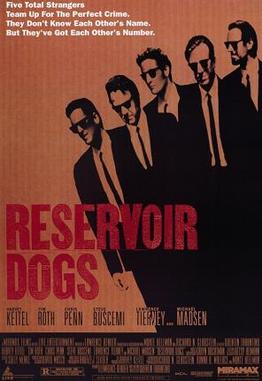
Reservoir Dogs is a challenging film to review, though not because it’s overly complicated or difficult to follow.  Instead, the problem is that it’s hard to know what’s left to say about Reservoir Dogs.  Just about every crime film that has come out in my lifetime has owed an obvious debt to Reservoir Dogs.  It’s the film that launched the directorial career of Quentin Tarantino.  It’s also features one of the greatest acting ensembles in the history of American film: Harvey Keitel, Tim Roth, Michael Madsen, Steve Buscemi, Chris Penn, Kirk Baltz, and Lawrence Tierney.  Tierney’s presence was especially important.  By appearing in the film, the veteran tough guy actor passed on the torch of hard-boiled crime to a new generation.

At its most basic, Reservoir Dogs is a heist film.  It employs the type of jumbled timeline that has become a Tarantino trademark.  The film starts with a group of 8 criminals eating breakfast and preparing to rob a jewelry store.  Then it jumps forward to immediately after the crime, with Mr. Orange (Tim Roth) shot in the gut and Mr. White (Harvey Keitel) desperately trying to get them both to the safety of a warehouse.  That’s where they are joined by Mr. Pink (Steve Buscemi).  Mr. Pink is convinced that they were set up.  He rants about being a professional.  He asks if Mr. White had to shoot anyone during his escape.

“A few cops,” Mr. White says.

“No real people?” Mr. Pink replies.

Eventually, Mr. Blonde (Michael Madsen) shows up.  We already know, from the film’s first scene, that Mr. Blonde strongly feels that everyone should tip their waitress.  After he arrives at the warehouse, we discover that he also likes good music and torturing hostages.  Meanwhile, the robbery’s mastermind, Joe Cabot (Lawrence Tierney) and his son, Eddie (Chris Penn), are also on their way to the warehouse.  Neither one is happy about how things are going.

And while all this goes on, Mr. Orange continues to bleed in the background…

Reservoir Dogs is known for being a violent film and, even though the movie is 26 years old, some of the violence can still catch you off-guard and make you flinch.  The scene where Mr. Blonde chops off the cop’s ear is still not easy to watch.  However, the scene that always freaks me out is when Mr. White starts shooting at a police car and the windshield is suddenly smeared with blood.  Mr. White is one of the film’s more sympathetic characters but he doesn’t hesitate to kill.

Of course, I think it could also be argued that Reservoir Dogs is actually as close as Tarantino has come to making a film that condemns violence.  Not counting the flashbacks, the story largely plays out in real time, which means that we basically spend the entire movie watching and listening as Mr. Orange slowly bleeds to death in front of us.

I rewatched Reservoir Dogs for this review and I have to say that I was really surprised to see how well the film holds up.  I was honestly expecting to be a little bit bored with it, just because I’d already seen it multiple times and I knew who the cop would turn out to be.  I already had all of the film’s great lines memorized.  But, as soon as the film started with everyone arguing about Like A Virgin and whether or not to tip their waitress, I was sucked back into Tarantino’s world.  Once again, I found myself laughing at Steve Buscemi’s brilliant delivery of the line: “Why am I Mr. Pink?”  I was enthralled all over again by Tim Roth’s nervous intensity and Harvey Keitel’s weary integrity.  Even Michael Madsen’s psycho routine felt fresh, despite the fact that he’s played numerous cool-as-ice psychos over the course of his career.  Even the way Chris Penn told the story about Lady E still made me laugh.

(To be honest, the line that makes me laugh the most in Reservoir Dogs — and don’t ask me why because I’m not sure of the exact reason — is when the unseen cop who is heard to say, “Yeah, give me the bearclaw,” while following Eddie’s car.)

It’s just a cool movie.  How can you resist this?

What happen at the end of the film?  Well, we all know the basics.  (And here’s where that probably unnecessary spoiler alert comes into play.)  Mr. White kills Joe and Eddie, all to protect Mr. Orange.  Mr. Pink runs from the warehouse.  The seriously wounded Mr. White cradles the dying Orange in his arms.  Orange confesses to being a cop.  Mr. White lets out a wail of both physical and emotional pain.  The police enter the warehouse and order Mr. White to drop his gun.  Mr. White shoots Orange in the head and is then gunned down by the police.

But what happened to Mr. Pink?

That’s a serious question because Mr. Pink is my favorite member of this band of robbers.  (He gets all the best lines, probably because Tarantino was planning on playing the role himself before Steve Buscemi auditioned.)  A lot of people will tell you that they can hear Mr. Pink being arrested outside of the warehouse, shortly before the cops come in and kill Mr. White.  And yes, I realize that, in at least one draft of the script, that’s exactly what happened.

Well, I don’t care.  We don’t actually see Mr. Pink getting arrested.  We don’t hear him getting shot.  As far as I’m concerned, Mr. Pink made it out of there alive and managed to escape with the diamonds.  The police may have yelled at him to stop but, in the end, they were too busy killing Mr. White to keep an eye on him.  Mr. Pink escaped and is currently living on the beach somewhere.  As a result of selling the diamonds, he’s now financially comfortable but he still doesn’t tip his waitress.  That’s just the way Mr. Pink is.

Finally, one little bit of trivia: Reservoir Dogs may have premiered at the 1992 Sundance Film Festival but it didn’t win any awards at the end of it.  Instead, the big winner that year was a comedy called In The Soup.  The star of that film?  Steve Buscemi.

Previous Sundance Film Reviews:

  1. Blood Simple
  2. I Don’t Feel At Home In This World Anymore
  3. Circle of Power
  4. Old Enough
  5. Blue Caprice
  6. The Big Sick
  7. Alpha Dog
  8. Stranger Than Paradise
  9. sex, lies, and videotape

A Movie A Day #103: Mobsters (1991, directed by Michael Karbelnikoff)


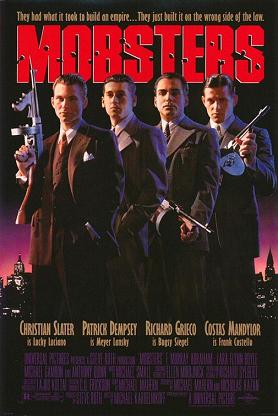
The place is New York City.  The time is the prohibition era.  The rackets are controlled by powerful but out of touch gangsters like Arnold Rothstein (F. Murray Abraham), Joe Masseria (Anthony Quinn), and Salvatore Faranzano (Michael Gambon).  However, four young gangsters — Lucky Luciano (Christian Slater), Meyer Lansky (Patrick Dempsey), Frank Costello (Costas Mandylor), and Bugsy Siegel (Richard Greico) — have an ambitious plan.  They want to form a commission that will bring together all of the Mafia families as a national force.  To do it, they will have to push aside and eliminate the old-fashioned mob bosses and take over the rackets themselves.  When Masseria and Faranzano go to war over who will be the new Boss of all Bosses, Luciano and Lansky seen their opportunity to strike.
I love a good gangster movie, which is one reason that I have never cared much for Mobsters. Mobsters was made in the wake of the success of Young Guns and, like that film, it attempted to breathe new life into an old genre by casting teen heartthrobs in the lead roles.  There was nothing inherently wrong with that because Luciano, Lansky, and Seigel were all still young men, in their 20s and early 30s, when they took over the Mafia.  (Costello was 39 but Mobsters presents him as being the same age as they other three.)  The problem was that none of the four main actors were in the least bit convincing as 1920s mobsters.  Christian Slater was the least convincing Sicilian since Alex Cord in The Brotherhood.  As for the supporting cast, actors like Chris Penn and F. Murray Abraham did the best that they could with the material but Anthony Quinn’s performance in Mobsters was the worst of his long and distinguished career.

Fans of Twin Peaks will note that Lara Flynn Boyle had a small role in Mobsters.  She played Luciano’s girlfriend.  Unfortunately, other than looking pretty and dying tragically, she was not given much to do in this disappointing gangster film.

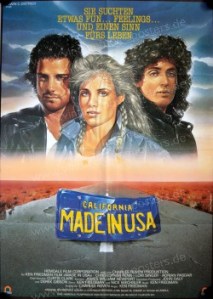
A Movie A Day #84: Made In U.S.A. (1987, directed by Ken Friedman)


Dar (Adrian Pasdar) and Tuck (Chris Penn) are two losers.  Dar is angry.  Tuck is a moron.  They live in a dying Pennsylvania industrial town, where they have no future.  Dar is worried that the air has been poisoned by the nearby coal mine.  He and Tuck decide to go to California so that they can look for a woman whose picture they’ve seen in a magazine.  Since Dar and Tucker have no money and no one is willing to pick up two hitchhikers who look like they are on sabbatical from the Manson Family, they end up having to steal cars and hold up convenience stores.  They also pick up a mentally unstable woman named Annie (Lori Singer).  Annie may be dying because of all the pollution in the world.  Dar and Tuck take the time to transport a Native American runaway back to her reservation, where they both get scalped.  Mostly, Dar and Tuck just drive through some of the ugliest parts of America and talk about how, because of pollution, everything is all messed up.

In the 1990s, Made In U.S.A. used to show up frequently on HBO.  It’s a lousy movie, featuring one of the worst performances of Chris Penn’s career.  (Adrian Pasdar is also pretty bad but more is expected from Chris Penn than from Adrian Pasdar.)  Made in U.S.A. does provide a contrast to the relentlessly pro-American films that dominated the box office in the 1980s but it’s really only noteworthy for the soundtrack, which features songs by Sonic Youth and Timbuk3.

Whatever you do, do not mistake this Made In U.S.A. for Jean-Luc Godard’s.