Brad reviews THE NAKED GUN (2025), starring Liam Neeson!


When I first saw that THE NAKED GUN was being rebooted with Liam Neeson as Frank Drebin, Jr., I must admit that I was quite skeptical. You see, the original THE NAKED GUN (1988) with Leslie Nielsen came out when I was 15 years old, and I remember watching it at the movie theater on a field trip with our high school’s Future Business Leaders of America (FBLA) club. I loved it so much! I eagerly watched THE NAKED GUN 2 1/2 (1991) and NAKED GUN 33 1/3 (1994) at the theaters as well. To be completely honest, this series is one of my favorites of my “growing into an adult” years, and I didn’t want to see it screwed up. When the trailer was released a couple of months ago my reaction was cautious optimism as I must admit it looked quite funny, and I decided that I would go watch it in the theater when it came out. Well, tonight my wife and I headed to the Cinemark in Little Rock to see what director Akiva Schaffer and his crew had come up with…

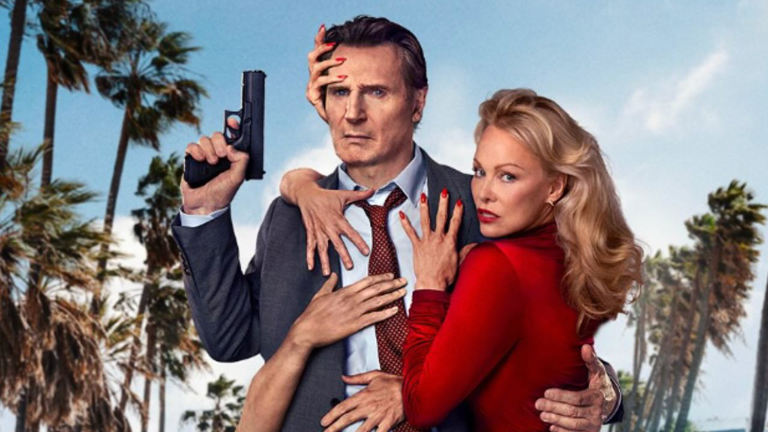
In THE NAKED GUN (2025), dedicated Detective Lt. Frank Drebin Jr. (Liam Neeson) follows in his father’s footsteps by leading Police Squad and causing an endless array of problems for Police Chief Davis (CCH Pounder). When a bank heist is staged by Sig Gustafson (Kevin Durand) in order to obtain a mysterious P.L.O.T. Device, Drebin teams up with his partner, Captain Ed Hocken Jr. (Paul Walter Hauser), and the beautiful crime novelist Beth Davenport (Pamela Anderson) to investigate. Their subsequent probe leads them to tech mogul Richard Cane (Danny Huston) and his sinister plot to use the device to revert humanity to a base barbaric state as the balls drop on New Year’s Eve. With the help of his deceased father’s spirit that’s being housed in the body of a large owl, Drebin goes all out to foil Cane’s plans while simultaneously falling in love with Beth! 

I’m going to go ahead and alleviate any suspense and state that I love the new NAKED GUN movie. I laughed out loud throughout the entire film, including the end credits, and I wasn’t the only one as there were people in our showing that were laughing much louder than me. It was a fun “crowd experience,” and I’m so glad we caught it in the theater. Not every joke is funny, but in the tradition of the original series, they come so fast and furious that there’s a good chance the next joke will be hilarious. Liam Neeson does a great job as Frank Drebin, Jr., infusing the character with just the right amount of seriousness to allow the absurdity all around him to be played for laughs. I told a friend a few months ago that I’d be really impressed if Neeson was able to pull this role off, and I’m glad to report that he passes with flying colors. He doesn’t make you forget the comedic genius of Leslie Nielsen, but he’s darn good. And Pamela Anderson is perfect in the crime novelist / love interest role. I haven’t seen her in anything in a long time, but she’s truly hilarious in the film. After watching her performance, I honestly don’t think any actress could have done any better. The rest of the game cast, including Paul Walter Hauser, Danny Huston and Kevin Durand each have good moments that add to the fun. I also enjoyed some of the specific throwbacks to the original series, including brief appearances by Priscilla Presley, Weird Al Yankovic, and especially the stuffed beaver, which got a big laugh out of me, just like it did when I was 15! 

Overall, I had a great time at the movie theater with THE NAKED GUN (2025). Director Akiva Schaffer delivers a hilarious, 85 minute film that’s a worthy follow-up to the original Zucker-Abrahams-Zucker / Leslie Nielsen classics. What else could you ask for?!!

Film Review: Rustin (dir by George C. Wolfe)


In Netflix’s Rustin, Colman Domingo plays Bayard Rustin.

A Quaker, a pacifist, a leader of the civil rights movement, and a former communist, Bayard Rustin was an early advisor to Martin Luther King, Jr.  Rustin commitment to non-violent protest was a huge influence on King’s own activism and Rustin helped King to organize the Southern Christian Leadership Council.  Rustin was one of King’s closest advisors but he was distrusted by other leaders of the movement because of both his independent nature and the fact that he was a gay man at a time when homophobia was the law of the land.  In fact, Rustin opens with Rustin’s rivals, the NAACP’s Roy Wilkins (Chris Rock) and U.S. Rep. Adam Clayton Powell, Jr. (Jeffrey Wright), letting King know that it would be in his best interest not to be associated with someone like Bayard Rustin.  Rustin, thinking that King will stand with him, offers to resign from the SCLC and is stunned when King (Aml Ameen) accepts his resignation.

After spending three years in relative obscurity and watching as younger civil rights activists start to reject the non-violence that is at the core of his philosophy, Rustin comes up with the idea that will become the 1963 March on Washington.  Putting aside his hurt feelings, Rustin works with King and several other civil rights leaders to organize the March and, at the same time, he once again finds himself being attacked for being both gay and a former member of the Communist Party.  Even while organizing the march, Rustin pursues a doomed relationship with a deeply closeted clergyman (Johnny Ramey).

It’s an important story but the film itself is sabotaged by both its script and its direction.  The script, which was co-written by Dustin Lance Black, is heavy on exposition and monologues but there’s few moments in which the characters really get to come alive.  Meanwhile, George C. Wolfe’s direction is stagey and stodgy.  Visually, the film has the aesthetic of a well-produced made-for-TV movie.  For all the time that is spent on the planning of the March of Washington, the event itself is recreated in a rushed and rather flat matter.  One could argue that the filmmakers felt that the real event is so iconic that there would no way to really do it justice and perhaps the filmmakers were correct in that.  Still, one can’t help but feel that Wolfe should have at least tried to capture some of the event’s electricity.  The film, to its credit, captures the hard work that went on behind-the-scenes of the civil rights movement but there are very few moments that feel spontaneous or as if they have a spark of life actually being lived in front of the camera.

Fortunately, the film is blessed to feature Colman Domingo in the title role.  Playing a larger-than-life figure, Domingo gives a performance that is big, charismatic, flamboyant, and sensitive.  As played by Domingo, Rustin is a collection of seemingly conflicting traits.  At times, he’s confident to the point of being arrogant but, when he finds himself shunned by the other leaders of the civil rights movement, he reveals the insecurity hiding underneath the surface.  Rustin is hyperactive yet focused, angry yet forgiving, and self-absorbed yet compassionate.  One of the film’s best moments comes when Rustin responds to an innuendo-filled attack on him by throwing himself into planning every detail of the March.  Rustin is surrounded by people telling him that, as a black man and a gay man, he will always be a second-class citizen and an outsider.  Rustin refuses to accept that and Domingo captures the intelligence, wit, and determination that allowed Rustin to continue to fight, against amazing odds, for equality.

The film doesn’t tell us much about Rustin’s life after the March on Washington.  In later years, Rustin, while remaining a socialist, became a strong anti-Communist and was also an outspoken supporter of Israel.  Today’s Left would probably not have much use for the moderate Bayard Rustin and, with his commitment to non-violence, it’s doubtful that Rustin would have much use for many of them.  Despite his prominence in the Civil Rights movement and the importance of his work, Rustin is still not as well-known as he should be.  Perhaps this movie, despite its flaws, will change that.

Lisa Reviews An Oscar Nominee: Prizzi’s Honor (dir by John Huston)


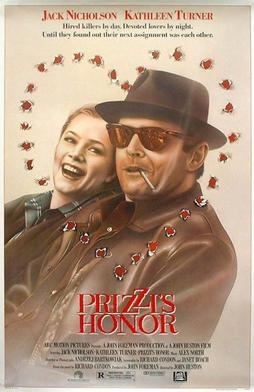
First released in 1985, Prizzi’s Honor tells the story of Charley Partanna (Jack Nicholson), a blue collar guy who lives in Brooklyn and who is a hard-working hit man for the Prizzi crime family.  Charley is the son of Angelo (John Randolph), who is the right-hand man to the family’s elderly but still ruthless Don (William Hickey).  In the past, Charley came close to marrying the Don’s daughter, Maerose Prizzi (Anjelica Huston), and he is almost as much a member of the family as the Don’s two sons, Eduardo (Robert Loggia) and Dominic (Lee Richardson).

While attending a family wedding, Charley meets and is immediately infatuated with a woman named Irene Walker (Kathleen Turner).  Later, when Charley is sent to California to kill a man who robbed one of the family’s Vegas casinos, he is shocked to discover that the man is Irene’s husband.  Irene swears that she didn’t have anything to do with the casino theft and, after a whirlwind courtship, Charley and Irene get married in Mexico.  What Charley doesn’t know (but eventually discovers) is that Irene is herself a professional killer.  While Charley and Irene try to balance work and love, Maerose conspires to turn the family against Irene and win Charley back.

Directed by the legendary John Huston, Prizzi’s Honor is pitch black comedy about two hard-working people who kill for a living.  (The film’s big set piece is an extended sequence in which Charley and Irene’s attempt to pull a job together goes wrong in every way and they end up arguing about their relationship while dragging dead bodies from one room to another.)  Though Prizzi’s Honor was released long before the series premiered on HBO, the film feels almost like a companion piece to The Sopranos, full of mobsters who are not as clever as they think they are and who struggle to uphold the old ways in an increasingly complicated world.  Particularly when compared to the gangster who populate a film like The Godfather, the Prizzis are defined by their pettiness.  If Don Corleone epitomized wisdom and honor, Don Prizzi epitomizes someone who holds onto power solely for power’s sake.

Prizzi’s Honor is one of those films that probably seemed a bit more revolutionary when it was first released than it does today.  At this point, we’ve seen so many films about hired killers who have quirky conversations while carrying out their work that the mix of violence and dark humor can feel almost like a cliché.  As well, there are certain parts of the film, like the opening wedding sequence, that feel as if they go on for just a few minutes too long, as if John Huston himself was not always comfortable with the balance between the dark drama and the comedy of mob manners.  That said, Jack Nicholson, Kathleen Turner (who gives a performance worthy of the great femme fatales of film noir), Anjelica Huston, John Randolph, and especially William Hickey all give strong enough performances to hold the audience’s attention and the film’s finale cuts to the point in such a way that it leaves you reconsidering everything that you’ve previously seen.  Prizzi’s Honor has its flaws but Nicholson and Turner have such chemistry that the film’s ending sticks with you.

Prizzi’s Honor was nominated for 8 Oscars, including Best Picture, Best Director, Best Actor, and Best Supporting Actor for William Hickey.  (Oddly, Kathleen Turner was not nominated for playing Irene.)  In the end, it only won one Oscar that year, for supporting actress Anjelica Huston.  The Oscars that year were dominated by a far more convention love story, Out of Africa.

Retro Television Reviews: South Central 1.3 “RTD” and 1.4 “CO-op”


Welcome to Retro Television Reviews, a feature where we review some of our favorite and least favorite shows of the past!  On Thursdays, I will be reviewing South Central, which aired, for 10 episodes, on Fox in 1994.  The entire show is currently streaming on YouTube!

This week, Andre is nearly killed while riding the bus and Joan is embarrassed by her new employer.

Episode 1.3 “RTD”

(Dir by Stan Lathan, originally aired on April 19th, 1994)

It’s Andre’s day to watch Deion but when Joan sees Andre’s report card and discovers that Andre failed one class and came close to failing several others, she orders him to go all the way to Inglewood to see his “mentor,” Ray (played by Ken Page).  Because Joan has to go to work and there’s no one around who can drive Andre all the way across town, she gives Andre permission to ride the bus.  However, she also orders him to sit in front, where it’s safe.  Joan then tells Tasha that she’s going to have to give up her day to look after Deion.  Tasha gets angry, wondering why she’s the one having to give up her freedom when she’s also the one who actually gets good grades and “doesn’t need a mentor to keep (her) from messing up (her) life.”

I have two thoughts about this.

First off, Tasha is absolutely right to be upset.  Why did Joan adopt Deion when she was already financially struggling and she had two children to raise?  The show suggests that Joan adopted Deion because she needed a replacement for Marcus but still, it does seem like the responsibility for looking after Deion falls on Tasha much more often than it does on Andre.  When Tasha says that she feels that she’s punished for being responsible, she has a point.  Obviously, someone has to look after Deion but Joan could, at the very least, acknowledge that the whole situation isn’t easy for Tasha.

Secondly, I have to admit that I’ve always taken the idea of riding the bus for granted.  Of course, it’s not something that I do on a regular basis but, whenever I have been on a bus, I’ve felt safe and the only thing that really worried me was dealing with motion sickness.  One of the things that South Central did so well was it showed how the experiences that I, as someone living in the suburbs, take for granted (like being able to safely ride a bus) are far different for people living in neighborhoods that are dealing with poverty and crime.

Andre and his friend Rashad, for instance, defy Joan and sit in the back of the bus, where they are eventually confronted by two gang members who steal Rashad’s radio.  When Andre tries to stand up to them, one of them pulls a gun on him.  Rashad escapes by jumping out the bus’s back window and probably the only thing that saves Andre’s life is that the gunman’s friend recognizes him as being Marcus’s brother.  In the second episode, a friend of Marcus’s gave Andre money.  In this episode, another one of Marcus’s friends saves Andre’s life.  Marcus may be dead but his name still carries some power and it’s hard not to compare the respect that Marcus commands with Joan having to take a job bagging groceries just to keep her home.

Andre finally does reach Ray’s home and is immediately impressed with Ray’s big house, his big TV, and his stereo equipment.  (He is less impressed with what’s playing on Ray’s radio, asking Ray why he’s listening to “white music.”)  Ray tells Andre that the only way he’ll ever have a decent home is if he improves his grades and goes to college.  Andre, however, is more interested in Nicole (Maia Campbell), who comes from a wealthy family and who works, “after school,” as Ray’s administrative assistant.  When Andre hears that Nicole wants to go to Princeton, Andre decides that he wants to go there too.

Ray is hesitant to give Nicole’s number to Andre, which Andre takes to mean that Ray thinks that Andre isn’t good enough to date a girl from an upper class family.  However, the next day, Ray has a change of heart and invites Andre to come to church with him and Nicole’s family.  An excited Andre agrees but, unfortunately, this means taking the bus once again.  When the guy who previously pulled a gun on him sees Andre on the bus, he not only beats up Andre but also steals his good church shoes.

Andre shows up at Ray’s house, bloody and barefoot.  It’s not the best way for Andre to meet Nicole’s parents.  When Nicole promises that she’ll check on how Andre is doing after church, Nicole’s mother responds, “No, you won’t.”  Ouch!

Ray takes Andre home where Joan announces that Andre is no longer allowed to ride the bus, regardless of how he feels about Nicole.  Andre, having paid Nicole’s cousin five dollars for her number, calls Nicole and promises her that they’ll see each other, regardless of what their parents think.

This was a strong episode.  It can be easy to get annoyed with Andre, who tends to talk a big game but, watching this episode, it’s obvious that he’s perhaps the most naïve character on the show.  The only male role model that he has in his life is Ray and, as this episode makes clear, Ray is well-meaning but doesn’t exactly understand the realities that Andre has to deal with on a day-to-day basis.  I mean, what’s the point of having a mentor if there’s a good chance you’re going to get killed trying to visit him?  Andre refuses to surrender and rides the bus a second time in order to see Nicole and he gets mugged for his trouble.  With the whole world seeming to be against him, who can be surprised that getting good grades isn’t his number one concern?

Episode 1.4 “CO-op”

(Dir by Stan Lathan, originally aired on May 3rd, 1994)

It’s a big day for all the members of the Mosely family!

Andre manages to get a ride into Inglewood, where he shows up unannounced at Ray’s office and finally gets Nicole to agree to go out on a date with him on Friday.  I have to admit that I cringed a bit at the scene where Andre showed up, if just because I worked as an administrative assistant when I first got out of college and I know how annoying it is to have some jerk show up and try to keep you from getting your filing done.  If the previous episode was about revealing Andre’s hidden depths, this episode was all about his immaturity.  Nicole’s decision to kiss Andre and make a date with him honestly felt more like her rebelling against her parents than actually being attracted to Andre as an individual.

While Andre is getting a date with Nicole, Joan is getting humiliated on television.  When Bobby (Clifton Powell) arranges for the local news to come do a live spot from the Ujamaa Co-op, he introduces Joan as being someone that he (and the Co-op) saved from having to go on welfare by hiring her to bag groceries.  When Joan snaps that Bobby humiliated her, Bobby challenges her to tell him what was inaccurate about anything he said.  Joan points out that, for someone who claims to be all about sacrificing for the community, Bobby certainly has the money to afford “a new dashiki.”  And Joan does have a point.  Bobby is one of the more interesting characters on the show, mixing a sincere desire to improve his community with a healthy ego that prevents him from realizing just how condescending he can be when spreading his message.

Of course, with Andre and Joan both occupied, it falls on Tasha to once again sacrifice her plans so that she can take care of Deion and make sure that he goes to his therapy session.  Deion, who doesn’t converse but does often yell, strikes Tasha at one point and, by the time Tasha arrives at the therapist’s office, she’s sick of dealing with him.  The therapist (CCH Pounder) sends Deion to play in another room and then talks to Tasha.  Tasha finally gets to talk about how unfair it is that, because she’s the responsible one, she’s the one who is always expected to give up her plans.  This really was Tasha Scott’s showcase episode and she did a great job showing how difficult it is to have to carry the weight of the world on your shoulders.  This episode works because it not only acknowledges Tasha’s anger but it also admits that there isn’t an easy solution.  The therapist doesn’t come up with some perfect turn of the phrase that makes everything better.  Instead, in the end, Tasha takes some comfort in the fact that the now calm Deion briefly reaches out towards her, showing her the first real appreciation that she’s received in the series.

Next week, Tasha and Andre’s father briefly returns to their lives.

Tales from the Crypt: Demon Knight (dir. by Ernest Dickerson)


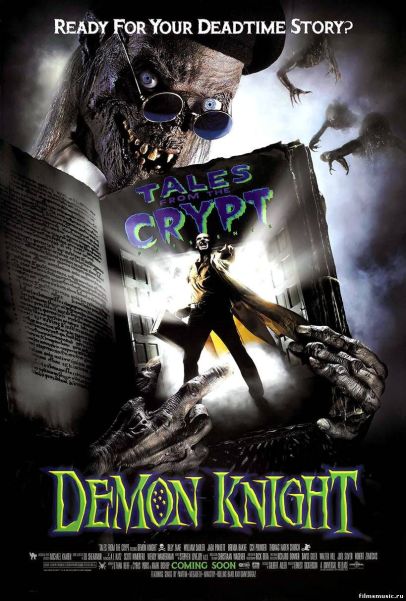
Demon Knight PosterI remember going to the movies for Demon Knight. I loved Tales from the Crypt on HBO, and the idea of a movie was cool at the time. My sister and my best friend joined me for the showing. It was treat to watch. I left the cinema thinking of different tales that could come up using some of the elements in this story.
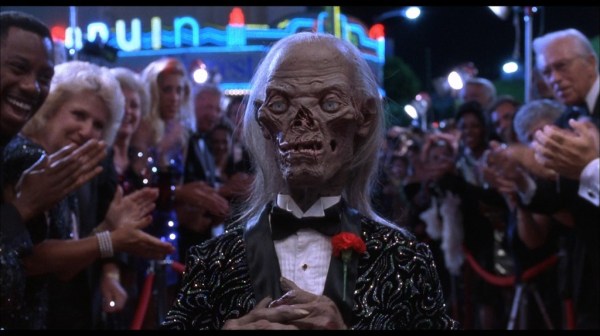
For those unfamiliar with Tales From the Crypt, the show aired on HBO during the late 1980s, and part of the 1990s. Based off of the old horror tales from EC Comics, each episode was a horror story. Unlike Tales From the Darkside, Monsters and Darkroom, Tales from the Crypt had the bonus of being on cable. This meant they were able to get away with more gore and nudity than their prime time counterparts. Perhaps that’s the only real disadvantage with the film. At least with Tales From the Darkside: The Movie, the story could push into darker elements with their restrictions lifted.

As with every episode of the show, Demon Knight is sandwiched between a scene with the Crypt Keeper (John Kassir) greeting the audience with some corny jokes and introducing the story. Frank Brayker (William Sadler – The Mist, Bill & Ted Face the Music) is on the run from The Collector (Billy Zane – Titanic). With his options dwindling and the strange seven-star pattern tattoo on his hand slowly forming a circle, Brayker makes his last stand at a motel with a group of individuals. In his possession is a key shaped vial that has the power to create wards. These wards hold back the army of demons that wish to reclaim the key and bring darkness across the land. Can Brayker make it through the night, while protecting the key and everyone around him? That’s pretty much the plot.

Demon Knight CryptKeeper

The Crypt Keeper is ready for his close up in Demon Knight. 

Having previously worked as a Cinematographer for Spike Lee, Ernest Dickerson made the jump to directing with 1992’s Juice. Demon Knight was his follow up and for the most part, it’s good. The creature design is interesting, reminiscent of Top Cow’s comic book, The Darkness. The demons are thin and indeed strange to behold, but they mostly take a back seat to Billy Zane’s Collector, who tries to seduce everyone into turning against the rest of the group.  Zane brings a lot of humor to the movie with his villain, as does Thomas Hayden Church (Sideways) playing that one guy you’d really like to slug in the mouth. CCH Pounder (Avatar), Jada Pinkett (Collateral), Brenda Bakke (L.A. Confidential), the legendary Dick Miller (Gremlins and just about everything Joe Dante did), and Charles Fleisher (Who Framed Roger Rabbit?) and Gary Farmer (Forever Knight) round it all out. It’s Sadler’s film to carry, however, and he does a great job here playing the hero.

From a sound/musical standpoint, Demon Knight boasts a interesting soundtrack, which I picked up around the time I first saw the film. Filter’s “Hey Man, Nice Shot” seemed like the only song featured in the film, but Ministry’s “Tonight We Murder”, Henry Rollins “Fall Guy” and Pantera’s “Cemetary Gates” are the standouts. The pacing of the film is pretty even, despite being a one shot. There’s not enough of a slowdown to feel bored. Demon Knight is just one regular Tales from the Crypt tale in a longer format. I would have preferred shorter pieces in this larger timespan, but that’s more a nitpick than anything.

Overall, Tales From the Crypt: Demon Knight is a fun film to visit around Halloween. Just make sure your doors and windows are locked (and sealed, if possible), when watching.