The Right To Remain Silent (1996, directed by Hubert de La Bouillerie)


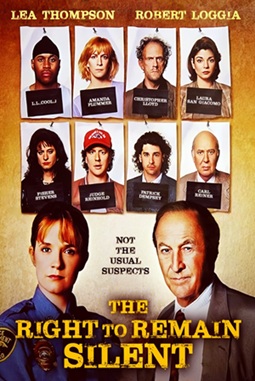
It’s one very busy night at a police station.  Everyone who is brought in from off the streets has the right to remain silent but no one exercises it.  Rookie cop Lea Thompson listens to everyone’s stories.  LL Cool J is the documentarian who thought it would be smart to put on Klan robes and a hood and try to infiltrate a demonstration undercover.  Patrick Dempsey is the drunk who killed a kid.  Carl Reiner comes in and confesses to mercy killing his wife.  Christopher Lloyd is homeless.  Fisher Stevens is a trans streetwalker.  Judge Reinhold, I don’t even know what he was supposed to be.  Reinhold actually plays two characters in this film and he’s miscast in both roles.  Amanda Plummer is a pizza delivery person who shoots someone in self-defense.  No one asks for a lawyer.  No one lies about what they did.  Instead, they just talk and talk and talk and talk some more.  Thompson listens while Robert Loggia, as the chief, growls about donuts.

The Right To Remain Silent is based on a play and that is its downfall.  Instead of being a story about a rookie cop and her first night on the job, it’s just a collection of rambling stage monologues.  Some of the actors, like Carl Reiner and Christopher Lloyd, do okay.  Most of them still seem to be acting for the folks sitting in the back row.  It ultimately doesn’t add up too much because the stories are too predictable to make much of an impression.  Everyone in this film had the right to remain silent and I wish they had exercised it.

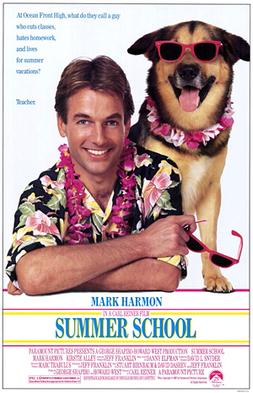
Summer School (1987, directed by Carl Reiner)


Summer School was the movie that made flunking out look like fun.

Freddy Shoop (Mark Harmon) is a relaxed, fun-loving gym teacher who is looking forward to spend his summer in Hawaii until he’s assigned to spend the summer teaching remedial English in summer school.  (His girlfriend goes to Hawaii without him.)  Freddy’s not happy about giving up his summer and he’s prepared to just spend his days taking his students to the beach, the amusement park, and the zoo.  But when he finds out that he’s going to lose his job unless his students pass the big test at the end of the summer, he gets serious and discovers what teaching is supposed to be all about.

When I was growing up, Summer School seemed to be on television all the time.  If it wasn’t on HBO, it was on one of the local stations, usually right before summer began.  The summer school kids seemed to be having too much fun for kids stuck in school.  I don’t think my classmates in Baltimore would have been as happy about losing their summer as the students in this film.  Everyone who has seen this film remembers Dave and Chainsaw (Gary Riley and Dean Cameron) making jokes and showing everyone The Texas Chainsaw Massacre.  They also remember Anna-Maria (Fabiana Udenio), the Italian exchange student who took summer school to work on her English.  They remember Freddy letting one of his students move in with him, which doesn’t seem like a good idea even if she was played by Courtney Thorne-Smith.  Myself, I remember Robin Bishop, the teacher next door, who was played by an extremely sexy Kirstie Alley.  (This was one of the many 80s films in which Kirstie Alley made being uptight seem sexy.)  Of course, Robin was dating the snobbish principal who was trying to get Freddy Shoop fired.

I’m not going to sit here and say that Summer School is a great film.  It’s a dumb comedy with an uplifting message about what a good teacher can accomplish.  However, Summer School is a very likable film, an enjoyable 80s teen romp that suggests summer school was the place to be in the late 80s.  Mark Harmon, Kirstie Alley, and all the students give good performances.  How many future horror nerds were inspired by Dave and Chainsaw?  Legendary nice guy Carl Reiner directed and the movie itself is amiable and amusing enough to be watchable.

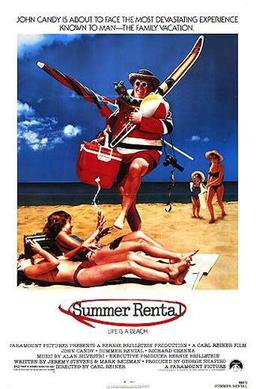
Summer Rental (1985, directed by Carl Reiner)


After a blow-up at work, air traffic controller John Chester (John Candy) is given five weeks of paid leave.  He takes his family to Florida, where they rent a beach house and discover that their summer town is controlled by snobbish sailing champion Al Pellett (Richard Crenna).  It’s the snobs vs slobs as Pellett tries to kick John and his family out of their summer rental and John tries to prove himself to his son and daughter (Joey Lawrence and Kerri Green) by winning the local sailing championship.  Luckily, John has Sully (Rip Torn), a modern-day pirate captain, on his side.

John Candy was a remarkable talent.  It’s just a shame that he didn’t appear in more good films.  He will always be remembered for films like Splash, Uncle Buck, Planes, Train, and Automobiles, and Only The Lonely but unfortunately, most of his starring roles were in lightweight, forgettable far like Summer Rental.  Candy is likable as John Chester and sympathetic even when he’s losing his temper over every minor inconvenience.  But the film itself never really does much to distinguish itself from all of the other 80s comedies about middle class outsiders taking on the richest man in town.  Candy is stuck playing a role that really could have been played by any comedic actor in 1985.  It’s just as easy to imagine Dan Aykroyd or even Henry Winkler in the role.  It feels like a waste of Candy.

The best thing about the film is Rip Torn’s performance as Sully.  Torn’s performance here feels like a dry run for his award-winning work as Artie on The Larry Sanders Show.  I would have watched an entire movie about Sully.  As it is, Summer Rental is inoffensive and forgettable.

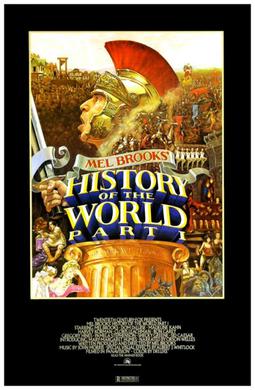
The History of the World, Part I (1981, directed by Mel Brooks)


Overlong, wildly uneven, gimmicky too a fault, and often laugh out loud funny with a mix of jokes that range from the crude to the sublimely clever to the surprisingly sentimental, The History of the World, Part I is the ultimate Mel Brooks films.

Narrated by Orson Welles and featuring five historical stories and a collection of coming attractions, The History of the World Part I follows man from his caveman origins to the French Revolution and the thread that ties it all together is that humanity always screws up but still finds a way to survive.  Moses (Mel Brooks) might drop and break one of the three tablets listing the 15 Commandments but he’s still able to present the other ten.  Stand-up philosopher Comicus (Mel Brooks) might make the mistake of poking fun at the weight of Emperor Nero (Dom DeLuise) but he still makes his escape with Josephus (Gregory Hines), Swiftus (Ron Carey), and Miriam the Vestal Virgin (Mary-Margaret Humes) and ends up serving as the waiter at the Last Supper.  (“Jesus!”)  The Spanish Inquisition may have been a catastrophe but it also gave Torquemada (Mel Brooks) a chance to show off his performance skills.  The French Revolution may have been a bloodbath but the future still held promise.  Ask for a miracle and he’ll show up as a white horse named Miracle, no matter what era of history you’re living in.

The humor is very Mel Brooks.  During the Roman Empire sequence, Madeline Kahn plays Empress Nympho.  Jackie Mason, Harvey Korman, Cloris Leachman, Spike Milligan, Jan Murray, Sammy Shores, Shecky Greene, Sid Caesar, Henny Youngman, and Hugh Hefner all make cameo appearances.  Carl Reiner is the voice of God.  John Hurt plays Jesus.  The film ends with the promise of a sequel that will feature “Jews in Space.”  Not every joke lands.  The entire caveman sequence feels forced.  But when the film works — like during The Inquisition production number — it’s hard not get caught up in its anything-goes style.  The entire Roman Empire sequence is probably more historically accurate than the typical Hollywood Roman epic.  That’s especially true of Dom DeLuise’s naughty performance as Emperor Nero.

Mel Brooks is 99 years old today and he says that he has at least one more film to give us, a sequel to Spaceballs.  I’m looking forward to it!  I’m also looking forward to rewatching and enjoying all of the films that he’s already given us.  The History of the World, Part I may not have initially enjoyed the critical acclaim of his earlier films but, in all of its anarchistic glory, it’s still pure Mel Brooks.

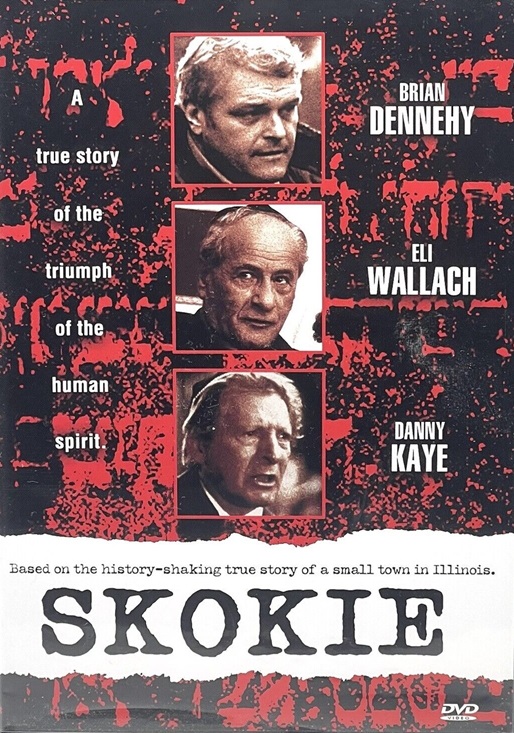
Made-For-Television Movie Review: Skokie (dir by Herbert Wise)


Skokie, a 1981 made-for-television movies, opens in a shabby Chicago office.

A group of men, all wearing brownshirts and swastika armbands, listen to their leader, Frank Collin (George Dzundza).  Collin says that they will be holding their next rally in the town of Skokie.  Collin explains that Skokie has a large Jewish population, many of whom came to the United States after World War II.  Collin wants to march through their town on Hitler’s birthday.

If not for the swastika and the brownshirt, the overweight Collin could easily pass for a middle-aged insurance salesman, someone with a nice house in the suburbs and an office job in the city.  However, Frank Collin is the head of the American National Socialist Party. a small but very loud group of Nazis who specialize in marching through towns with large Jewish populations and getting fee media attention as a result of people confronting them.  Making Frank Collin all the more disturbing is that he isn’t just a character in a made-for-television movie.  Frank Collin is a real person and Skokie is based on a true story.

The Mayor (Ed Flanders) and the police chief (Brian Dennehy) of Skokie are, needless to say, not happy about the idea of modern-day Nazis marching through their city.  Though they inform Collin that he will have to pay for insurance before he and his people will be allowed to hold their rally, they know that the courts have been striking down the insurance requirement as being a violation of the First Amendment.  While the mayor and the police chief worry about the political fallout of the rally, the Jewish citizens of Skokie debate amongst themselves how to deal with the Nazis.  Bert Silverman (Eli Wallach) and Abbot Rosen (Carl Reiner) argue that the best way to deal with Collin and his Nazis is to refuse to acknowledge them, to “quarantine” them.  As Rosen explains it, Collin is only marching to get the free publicity that comes with being confronted.  If he’s not confronted, he won’t make the evening news and his rally will have been for nothing.  However, many citizens of Skokie — including Holocaust survivor Max Feldman (Danny Kaye) — are tired to turning their back on and ignoring the Nazis.  They demand that the Nazis be kept out and that, if they do enter the city, they be confronted.

With the support of the ACLU, Collin sues for his right to march through Skokie.  The ACLU is represented by Herb Lewishon (John Rubinstein), a Jewish attorney who hates Collin and everything that he stands for but who also feels that the First Amendment must be respected no matter what.  When Lewishon is asked how he, as a Jew, can accept a Nazi as a client, Lewishon relies that his client is the U.S. Constitution.

Skokie is a thought-provoking film, all the more so today when there’s so much debate about who should and should not be allowed a platform online.  (Indeed, Collin and his Nazis would have loved social media.)  Lewishon argues that taking away any group’s First Amendment rights, regardless of how terrible that group may be, will lead to slippery slope and soon everyone’s First Amendment rights will be at risk.  Max Feldman, and others argue that the issue isn’t free speech.  Instead, the issue is standing up to and defeating evil.  The film gives both sides their say while, at the same time, making it clear that Frank Collin and his Nazis are a bunch of fascist losers.  It’s a well-acted and intelligently written movie, one that rejects easy answers.  Needless to say, at a time when so many people feel free to be openly anti-Semitic, it’s a film that’s still very relevant.

As for the real Frank Collin, he would eventually be charged with and convicted of child molestation.  After three years in prison, he changed his name to Frank Joseph and became a writer a New Age literature.  He’s looking for Atlantis but I doubt they’d want him either.
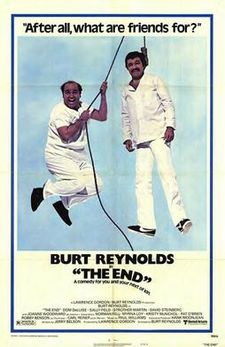
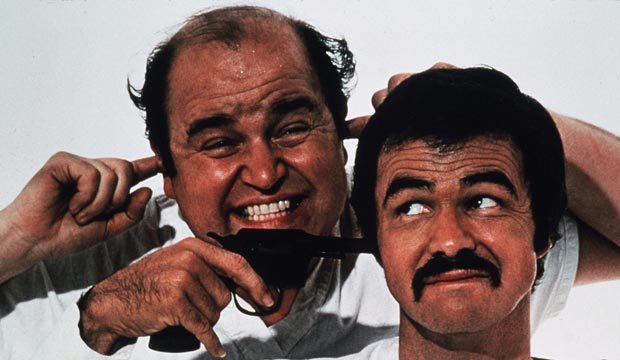
Film Review: The End (1978, directed by Burt Reynolds)


What if you were dying and no one cared?

That is the theme of The End, which is probably the darkest film that Burt Reynolds ever starred in, let alone directed. Burt plays Sonny Lawson, a shallow real estate developer who is told that he has a fatal blood disease and that, over the next six months, he is going to die a slow and painful death. After seeking and failing to find comfort with both religion and sex, Sonny decides to kill himself. The only problem is that every time he tries, he fails. He can’t even successfully end things. When he meets an mental patient named Marlon Borunki (Dom DeLuise), he hires the man to murder him. Marlon is determined to get the job done, even if Sonny himself later changes his mind.

Yes, it’s a comedy.

The script for The End was written by Jerry Belson in 1971. Though Belson also worked on the scripts for Spielberg’s Close Encounters of the Third Kind and Always, he was best-known for his work on sitcoms. (Belson was an early collaborator of Garry Marshall’s.) The End was originally written with Woody Allen in mind but when Allen passed on it to concentrate on directing his own movies about death, the script spent five years in limbo. Reynolds later said that, when he eventually came across The End, he knew he had to do it because it was the only script that reflected “my strange sense of comedy.” United Artists was uncertain whether there was much box office potential in a film about a self-centered man dying and they required Reynolds to first make the commercially successful Hooper before they would produce The End.

The End was made for 3 million dollars and it went on to gross 40 million. That the film was a box office success is a testament to the late 70s starpower of Burt Reynolds because it’s hard to think of any other mainstream comedy that goes as much out of its way to alienate the audience as The End does. While watching The End for the first time, most viewers will probably expect two things to happen. First off, Sonny will learn to appreciate life and be a better person. Secondly, it will turn out that his fatal diagnosis was incorrect. Instead, neither of those happen. Sonny is going to die no matter what and he never becomes a better person. What’s more is that he never even shows any real interest in becoming a better person. The film’s signature scene comes when Sonny prays to God and offers to give up all of his money if he survives, just to immediately start backtracking on the amount. It’s funny but it’s also a sign that if you’re looking for traditional Hollywood sentiment, you’re not going to find it here.

Burt not only stared in The End but he also directed it and, as was usually the case whenever he directed a film, the cast is a mix of friends and Hollywood veterans. Sally Field plays Sonny’s flakey, hippie girlfriend while Robby Benson is cast as a young priest who fails to provide Sonny with any spiritual comfort. Joanne Woodward plays his estranged wife and Kristy McNichol plays his daughter. Myrna Loy and Pat O’Brien play his parents. Norman Fell, Carl Reiner, and Strother Martin play various doctors. The movie is stolen by Dom DeLuise, playing the only person who seems to care that Sonny’s dying, if just because it offers him an excuse to kill Sonny before the disease does. DeLuise was a brilliant comedic actor whose talents were often underused in films. The End sets DeLuise free and he gives a totally uninhibited performance.

Despite DeLuise’s performance, The End doesn’t always work as well as it seems like it should. Though Reynolds always said that this film perfectly captured his sense of humor, his direction often seems to be struggling to strike the right balance between comedy and tragedy and, until DeLuise shows up, the movie frequently drags. As a character, the only interesting thing about Sonny is that he’s being played by Burt Reynolds. That is both the film’s main flaw and the film’s biggest strength. Sonny may not be interesting but, because we’re not used to seeing Burt cast as such a self-loathing, self-pitying character, it is interesting to watch a major star so thoroughly reveal all of his fears and insecurities.

If you’re a Burt Reynolds fan, The End is an interesting film, despite all of its flaws. Burt often described this as being one of his favorite and most personal films. It’s a side of Burt Reynolds that few of his other films had the courage to show.

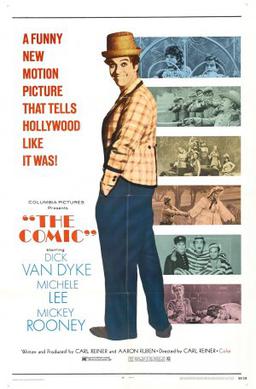
Film Review: The Comic (dir by Carl Reiner)


The 1969 film, The Comic, details the long and not particularly happy life of silent screen star Billy Bright (played by Dick Van Dyke).  Billy Bright tells us his story from beyond the grave.  The film opens with his funeral, which is sparsely attended and features the type of self-consciously mawkish eulogies that are usually trotted out whenever a generally unlikable person dies.  The only sign of life at the funeral comes when Billy’s oldest friend, Cockeye (Mickey Rooney), throws a pie at one of the speakers.  The speaker says that the pie was Billy’s final joke.

Billy Bright was a funny performer but a miserable man.  That’s pretty much the entire plot of The Comic.  We see the young Billy, performing in silent films and winning laughs through the seemingly impossible contortions through which he puts his body and his face.  Off-screen, Billy marries one of his co-stars (Michele Lee) and starts a production company.  When she discovers that he’s been cheating on her, their divorce is a major Hollywood scandal.

Even before the coming of the talkies, Billy struggles with alcohol.  Once the talkies do come, his career is pretty much over.  Billy became a star in silent films and he stubbornly wants to continue to make silent films, despite the fact that there’s no longer an audience for them.  Billy quickly goes from being a star to being forgotten.  He’s reduced to walking down Hollywood Boulevard with Cockeye and looking at the names under his feet.  When he reaches his name, he discovers that someone has dropped their gum on it.

Billy finally does get his comeback in the late 60s but it’s not much of a comeback.  He appears on a talk show and it’s hard not to cringe a little as the clearly infirm Billy duplicates some of his silent era pratfalls.  He’s reduced to appearing in a rather awkward commercial for a laundry detergent called, I kid you not, White-ee.  “That’s White-ee, baby!” his commercial co-star says after a freshly cleaned Billy emerges from a washing machine.

The idea that most funny performers are actually rather serious and depressing off-stage is certainly nothing new.  Judd Apatow has basically built an entire career out of making films about how funny people are actually carrying around tons of emotional baggage.  The thing distinguishes The Comic from so many other films about angsty comedians is that Billy Bright himself never seems to have a single moment of self-awareness.  Usually, films about miserable celebrities will at least have one scene where the main character realizes that his misery is all his fault.  Billy Bright is pretty much a jerk from the minute we meet him and he’s still a jerk when the film ends.  He’s the type of guy who makes a big deal about picking up his son from school but who still manages to grab the wrong kid because it’s been so long since he’s spent any time with his family that he’s really not sure what his son looks like.  Towards the end of the film, we see him watching one of his old films and what we notice is that he doesn’t seem amused at all.  Is he thinking about how he lost it all or is it possible that this man who made millions laugh never really had much of sense of humor himself?  The film leaves it to you to decide.

The Comic was written and directed by Carl Reiner, who undoubtedly knew quite a few Billy Brights in his life.  As such, the film feels authentic in a way that a lot of other films about creative people do not.  The Comic is a well-made film.  It’s hard not to appreciate the film’s obviously affection for Old Hollywood.  That said, Billy Bright is such an unpleasant character that I found the film difficult to enjoy.  Van Dyke is genuinely funny whenever he’s doing Billy’s silent film shtick and he’s genuinely tiresome when Billy’s ego gets out of control.  It’s a good performance as a generally unlikable character.  How you react to The Comic will probably depend on how much sympathy you can summon up for a character who doesn’t really seem to deserve any.

RIP, Carl Reiner


I just heard that Carl Reiner has died.  He was 98 years old and he was one of the funniest men who ever lived.

By creating The Dick Van Dyke Show, Reienr redefined the American sitcom and made writing comedy seem like the most wonderful and rewarding job that someone could hope to have.  Not only do you get to be funny 24 hours a day but you also get to marry Laura Petrie.  In many ways, Reiner was responsible for a generation of writers flocking to New York City with dreams of writing for Saturday Night Live and Norman Lear.

Reiner was also an actor, a film director, and an always-entertaining talk show guest.  For many, he will also be forever known as the man who interviewed the 2000 Year Old Man.  In these interviews, Reiner asked questions to a 2000 year old man, who was played by Mel Brooks and who would largely improvise his answers.  This was a skit that Reiner and Brooks developed (mostly as an inside joke) while they were both writing for Your Show Of Shows.  It went on to become a beloved comedy classic and it is often cited as being the ideal comedy sketch.  Though Reiner played the “straight man” in the 200 Year Old Man routine, his contribution was just as important as Brooks’s.  Brooks may have gotten the most laughs with his improvised answers but Reiner always instinctively knew the right questions to ask.

Here they are performing it in 1967:

Carl Reiner, R.I.P.

Fatal Instinct (1993, directed by Carl Reiner)


Ned Ravine (Armand Assante) is a cop who is also a lawyer.  His shtick is to make an arrest and then defend that person in court.  He’s married to Lana (Kate Nelligan), who is having an affair with a mechanic named Frank (Christopher McDonald).  Lana has taken out a life insurance policy on Ned, one that has a triple indemnity clause.  If he’s shot on a northbound train and then falls off and drowns in a nearby stream, Lana and Frank will make a lot of money.  However, Lana and Frank are not the only people who want to kill Ned Ravine.  One of Ned’s former clients, Max Shady (James Remar), has just been released from prison and is seeking revenge.  The main reason why Ned hasn’t figured out that everyone is trying to kill him is because he’s been distracted by the seductive Lola (Sean Young), a client who asked him to look over some legal papers and who has an improbable connection to Lana.

As you might guess by the plot and Carl Reiner’s directorial credit, Fatal Instinct is a spoof of detective movies, with the majority of the jokes being inspired by Basic Instinct, the remake of Cape Fear, Double Indemnity, and Body Heat.  How much you laugh will depend on how well you know those films.  There’s a scene in Ned’s office where Ned notices that Lola isn’t wearing panties.  He helpfully produces a pair from inside his desk and hand them to her.  In 1994, that scene was funny because Basic Instinct and whether or not Sharon Stone was aware of how her famous interrogation scene was being filmed were still a huge part of the pop cultural conversation.  Today, it might just seem weird.

Carl Reiner has always been an uneven filmmaker and that trend continues in Fatal Instinct, where he tries to do to erotic thrillers what Mel Brooks did to westerns and Airplane! did to disaster films.  Unfortunately, Reiner often gets bogged down by the film’s plot, which should really be the last thing anyone should be worried about when it comes to a spoof like this.  Some of the jokes are funny and some of them aren’t but, because Reiner doesn’t duplicate the joke-every-minute style of a film like Airplane!, there’s a lot more time to think about the jokes that fall flat.

Fatal Instinct does have a good cast, featuring a lot of actors who probably should have become bigger stars than they did.  I especially liked Kate Nelligan’s and Christopher McDonald’s performances as the two triple indemnity conspirators.  Sherilyn Fenn plays Ned’s loyal secretary and seeing her give such a fresh and likable performance in this otherwise uneven film makes me regret even more that, outside of Twin Peaks, she never really got the roles that she deserved.

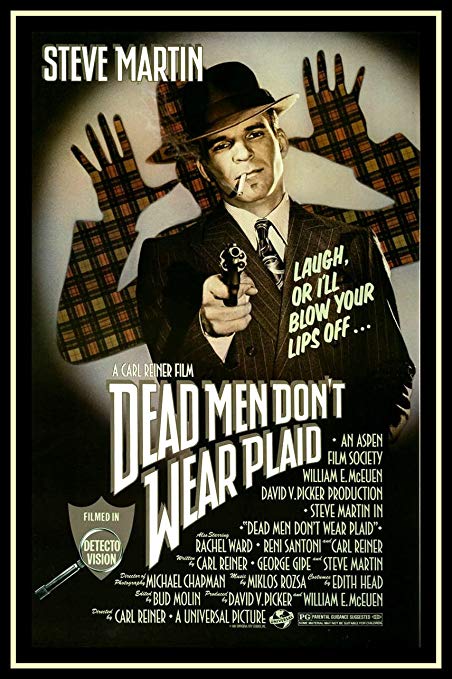
The Dork Knight: Steve Martin in DEAD MEN DON’T WEAR PLAID (Universal 1982)


gary loggins's avatarcracked rear viewer

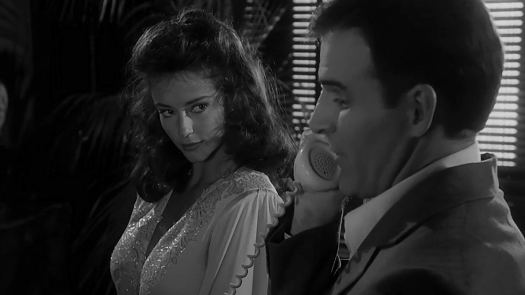
Quick, name a film noir that stars Humphrey Bogart, James Cagney, Joan Crawford, Bette Davis, Ava Gardner, Cary Grant, Veronica Lake, Alan Ladd, Vincent Price, and… Steve Martin? There’s only one: 1982’s DEAD MEN DON’T WEAR PLAID, the second collaboration between that “wild and crazy guy” Martin and comedy legend Carl Reiner. I remember, back in 1982, being dazzled by editor Bud Molin’s seamless job of incorporating classic film footage into the new narrative while simultaneously laughing my ass off. Things haven’t changed – the editing still dazzles, and I’m still laughing!

Martin and Reiner’s first comedy, 1979’s THE JERK, was an absurdist lover’s delight, and this time around the two, along with cowriter George Gipe, concocted this cockeyed detective saga after combing through old black and white crime dramas (we didn’t call ’em film noir back then) and cherry picking scenes to build their screenplay around. Martin plays PI…

View original post 376 more words