Have you heard the rumor?
Rocky Balboa, also know as the Italian Stallion and the former heavyweight champion of the world, is going to die.
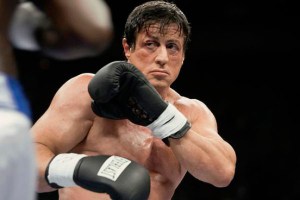 At least that is what some people think after reading the official plot synopsis of the upcoming boxing film Creed. Here is the press release from MGM and Warner Brothers:
From Warner Bros. Pictures and Metro-Goldwyn-Mayer Pictures comes award-winning filmmaker Ryan Coogler’s “Creed.” The film explores a new chapter in the “Rocky” story and stars Academy Award nominee Sylvester Stallone in his iconic role. The film also reunites Coogler with his “Fruitvale Station” star Michael B. Jordan as the son of Apollo Creed.
Adonis Johnson (Jordan) never knew his famous father, world heavyweight champion Apollo Creed, who died before he was born. Still, there’s no denying that boxing is in his blood, so Adonis heads to Philadelphia, the site of Apollo Creed’s legendary match with a tough upstart named Rocky Balboa.
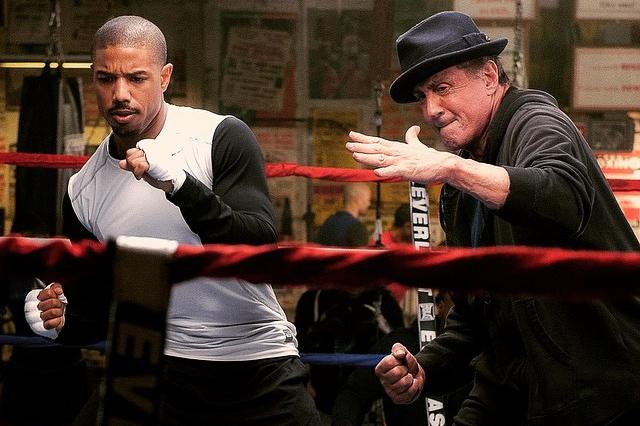
Once in the City of Brotherly Love, Adonis tracks Rocky (Stallone) down and asks him to be his trainer. Despite his insistence that he is out of the fight game for good, Rocky sees in Adonis the strength and determination he had known in Apollo—the fierce rival who became his closest friend. Agreeing to take him on, Rocky trains the young fighter, even as the former champ is battling an opponent more deadly than any he faced in the ring.
With Rocky in his corner, it isn’t long before Adonis gets his own shot at the title…but can he develop not only the drive but also the heart of a true fighter, in time to get into the ring?
 Many have interpreted that to mean that, while training Adonis, Rocky will be battling cancer. With the exception of the first one and Rocky V, every installment in the Rocky franchise has featured a character either dying or coming close. Since Paulie will apparently not be appearing in Creed, that leaves Rocky himself as the most likely candidate to tragically pass away before or after the big fight. In death, Rocky would not only pass on his legacy Adonis Creed but Sylvester Stallone would pass on the Rocky franchise to Ryan Coogler and Michael B. Jordan.
With his days possibly numbered, I decided to take a look back at Rocky Balboa’s amazing career.
Rocky (1976)
Sylvester Stallone was just another out-of-work actor when, one night in 1975, he saw a little known boxer named Chuck Wepner go 15 rounds against the reigning heavyweight champion, Muhammad Ali. Inspired by the fight, Stallone wrote the first draft of Rocky in three days. When he sold his script, he did so with one condition: that he be allowed to play Rocky Balboa. You know the rest of the story: Directed by John G. Avildsen, Rocky became a huge box office hit, won the Oscar for best picture of the year, and made Sylvester Stallone into an unlikely star.
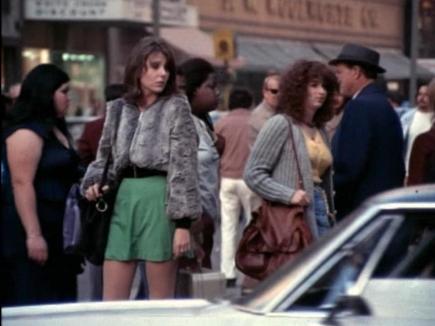
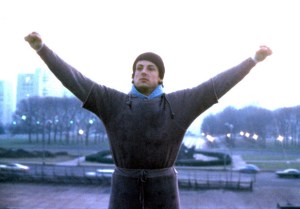 Rocky Balboa is an aging boxer and a collector for Philadelphia loan shark, Tony Gazzo (Joe Spinell). The current heavyweight champion, Apollo Creed (Carl Weathers), is scheduled to fight a match in Philadelphia in honor of America’s bicentennial. When his opponent injures his hand, Apollo decides to give a local boy a chance and the unknown Rocky gets a once-in-a-lifetime shot at the title. Nobody gives Rocky a chance, except for Rocky. With the help of grizzled trainer Mickey (Burgess Meredith) and alcoholic best friend, Paulie (Burt Young), Rocky prepares for the fight. After a training montage (the first of many) that ends with Rocky running up the steps of the Philadelphia Museum of Art, Rocky shocks everyone by going the distance against Apollo. Though he loses by a split decision, Rocky wins both his self-respect and the love of Paulie’s sister, Adrian (Talia Shire).
Rocky holds up as one of the best boxing movies ever made and it set the standard by which almost all future underdog sports movies have been judged. Rocky may have ended with Rocky ready to take off his gloves and concentrate on his life with Adrian but the box office demanded that Rocky get another once-in-a-lifetime shot.
Rocky II (1979)
The first Rocky may have ended with Apollo saying there would be no rematch and Rocky replying that he did not want one but the film’s box office success said otherwise. In Rocky II, Apollo is stung by criticism over how he nearly lost his first fight against Rocky and demands a rematch. At first, Rocky refuses but, with no prospects and a wife, son, and alcoholic brother-in-law to support, Rocky finally agrees to a rematch. What follows is largely a repeat of the first film, except this time Rocky has a lot more fans following him through the streets of Philadelphia during his training montage and Rocky actually wins the fight, becoming the heavyweight champion of the world.
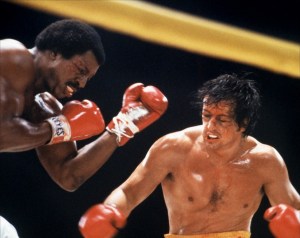 The best thing about Rocky II is that it fleshes out the character of Apollo. No longer is he just the cocky villain from the first film. Instead, he is revealed to be a proud man, a fierce competitor, and a worthy opponent. Though he may lose the final fight, Apollo regains the respect that he sacrificed as the end of the first film.
Rocky II is also notable for being the first film in the franchise to be directed by Sylvester Stallone. Stallone would direct all of the subsequent installments, with the exception of the John G. Avildsen-directed Rocky V.
Rocky III (1982)
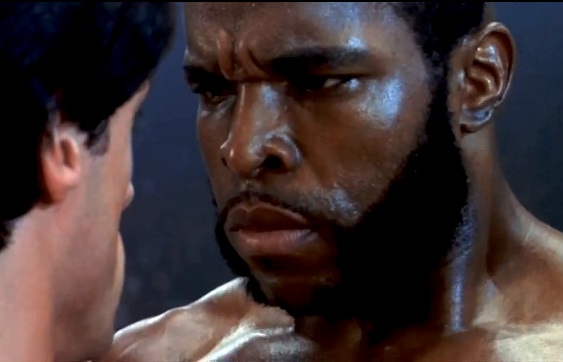
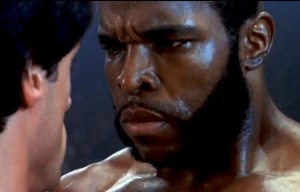 Rocky III has the best opening of the franchise. While Rocky does commercials and trades jokes with Kermit and Miss Piggy on The Muppet Show, Clubber Lang (Mr. T) relentlessly trains and savagely knocks out every opponent that he faces in the ring. The premise of the first two films has been reversed. Now, Rocky is the overconfident champion who does not take his latest fight seriously while Clubber Lang is the challenger who is hungry for victory. Clubber has the “eye of the tiger” and is determined to win. Rocky is busy doing charity events with Hulk Hogan and bailing alcoholic freeloader Paulie out of jail.
Rocky III features the first death of the franchise, when Clubber shoves Mickey so hard that Mickey ends up having a heart attack and dying almost immediately after Clubber defeats Rocky and becomes the new heavyweight champion of the world. As if Rocky needed another reason to demand a rematch, Mickey’s death makes it personal. Unfortunately, Rocky has lost his hunger. He no longer has the eye of the tiger.
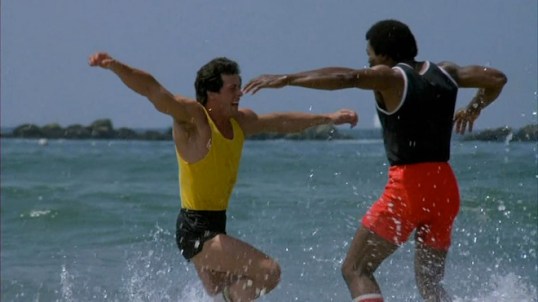
Fortunately, Rocky’s former rival, Apollo Creed, is there to help him get it back. Taking over as Rocky’s trainer, Apollo gets the former champion back into fighting shape. This means that it is time for a training montage! This one ends with a great moment in bromance history as Rocky and Apollo embrace while jumping up and down in the ocean.
 Rocky III ends with what may be the best fight in the history of the franchise. It is also the only fight to be shown straight from beginning to end, without jumping to future rounds. From the start of the fight, it is obvious that Clubber is stronger than Rocky but, taking a page from the rope-a-dope strategy that Muhammad Ali used on George Foreman in Zaire, Rocky knows that Clubber is so aggressive that he will tire himself out before the end of the fight. Once Clubber has exhausted himself, Rocky sends him down to the canvas.
At the end of the film, Rocky and Apollo square off one last time to see who is truly the best boxer. The film ends before the first punch is thrown and we never find out who won. I like to think that it was Apollo, if just because I know what is going to happen to him in Rocky IV.
Rocky IV (1985)
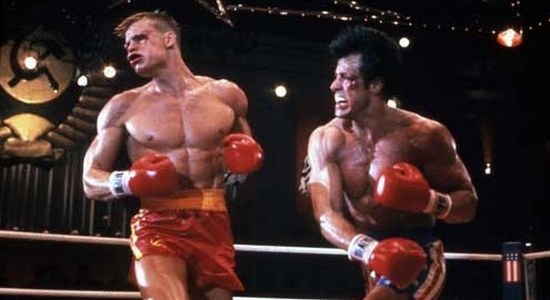
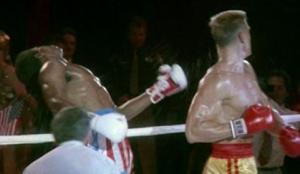 Having defeated every contender in the U.S., it only made sense that Rocky’s next opponent would come from the evil empire itself, the Soviet Union. But before Rocky could battle Ivan Drago (Dolph Lundgren), someone had to die. This installment’s sacrificial victim was none other than Apollo Creed. Apollo dies in the ring, beaten to death by the robotic Russian. Of all the deaths in the Rocky franchise, Apollo’s was the most shocking and the most traumatic. After Apollo falls face forward onto the mat, his body is still twitching even as Ivan says, “If he dies, he dies.”
Knowing that he should have been in the ring instead of Apollo, Rocky challenges Drago to a rematch, to be held in Moscow on, of all days, Christmas. Leaving behind his mansion, his son, and his robot (yes, Rocky owns a robot in this one), Rocky goes to Siberia and that means that it is time for a training montage! While Drago trains with machines and shoots steroids, Rocky trains by chopping wood and running in the snow.
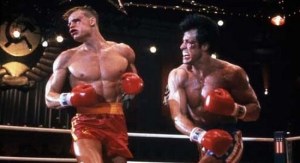 It’s a tough fight. At first, Drago does not even seem to feel Rocky’s punches. The Soviet audience (including someone who looks a lot like Mikhail Gorbachev) chants Drago’s name. Just like in Philadelphia, Rocky refuses to go down. The crowd starts to chant Rocky’s name. When Drago’s manager demands that he win the fight in the name of communism, Drago shouts that he does not fight for the Soviet Union, he fights for himself. Finally, with seconds left in the final round, Rocky knocks Drago out.
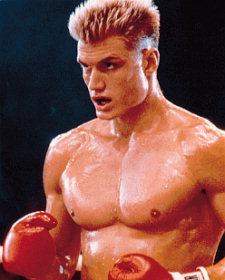 As a bloody Drago looks on, Rocky literally wraps himself in an American flag and gives a speech. Rocky thanks the Americans and the Soviets for supporting him and then says, “”If I can change, and you can change, then everybody can change!” Gorbachev stands and applauds. Is it just a coincidence that, four years later, the Berlin Wall fell and the Cold War ended?
Rocky IV may be the best remembered of all of the Rocky films. Ivan Drago was Rocky’s greatest and most imposing opponent and it is not surprising that, despite killing Apollo, he still has a strong fan base. Unlike Clubber Lang, Ivan is a cold and methodical machine. Rocky’s improbable win over him is not just a victory for America but a victory for humanity as well.
Rocky V (1990)
Is Rocky V canonical? A lot of fans consider this to be the weakest film in the franchise. Despite writing the film’s screenplay, Sylvester Stallone reportedly hates Rocky V and ignored it when he made Rocky Balboa.
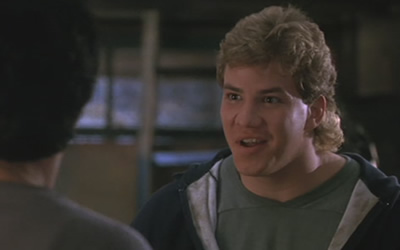
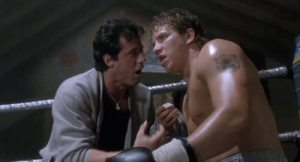 Rocky V starts with Rocky retiring after being told that his battle with Drago has left him with permanent brain damage. Paulie, proving once again that he’s the worst best friend that anyone could hope for, loses all of Rocky’s money. Rocky, Adrian, and Rocky, Jr. (now played by Sage Stallone) move back to the old neighborhood. Following in the footsteps of Mickey and Apollo, Rocky trains a mulletheaded young boxer named Tommy Gunn (Tommy Morrison). Instead of a training montage, we get a fight montage as Tommy becomes a champion but rejects Rocky’s management and signs with
 Don King George Washington Duke (Richard Gant). Tommy and Rocky eventually face off in a street fight. Originally, the plan was for Rocky to die at the end of the fight but, fortunately, someone in production realized that nobody would want to see Rocky Balboa beaten to death by Tommy Morrison.
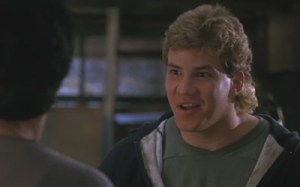 Tommy Morrison was a real-life boxer. Rocky V was his only film role and he’s almost too convincing as the dim-witted Tommy Gunn. In the real world, Tommy Morrison was suspended from boxing in 1996 when he tested positive for HIV. He spent the rest of his life loudly insisting that the test was a false positive and trying to make a comeback. He was 44 years old when he died of AIDS in 2013.
Rocky V suffers because Tommy Gunn and George Washington Duke cannot begin to compare to great Rocky opponents like Clubber Lang and Ivan Drago. However, Rocky V does feature one of the franchise’s best endings. Rocky and Rocky, Jr. jog up the steps of the Philadelphia Museum of Art and, father and son together, they finally decide to enter the building and discover what’s inside.
Rocky Balboa (2006)
After the critical and box office failure of Rocky V, it seemed like Rocky Balboa had retired for good. However, after 16 years of well-deserved retirement, Rocky followed the path of George Foreman, Larry Holmes, and Riddick Bowe and decided to make a comeback.
 As Rocky Balboa begins, Rocky is a widower and owns an Italian restaurant named Adrian’s, where he spends most of his time telling patrons stories about his fighting career. He is estranged from his son, who now wants to be called Robert and is played by Milo Ventimiglia, but Rocky still has his best friend Paulie. If not for Rocky, Paulie would probably be living in a cardboard box. After a computer simulation suggests that Rocky, in his prime, could have defeated the reigning heavyweight champion, Mason Dixon (Antonio Tarver), Rocky comes out of retirement for one last fight. With the help of Apollo’s former trainer, Duke (Tony Burton), Rocky proves that he can still go the distance, even though he ultimately loses the fight in a split decision.
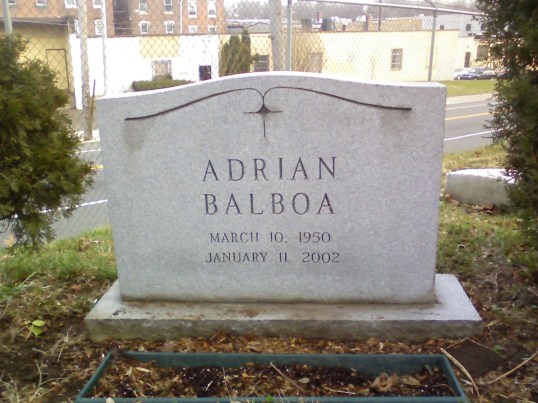
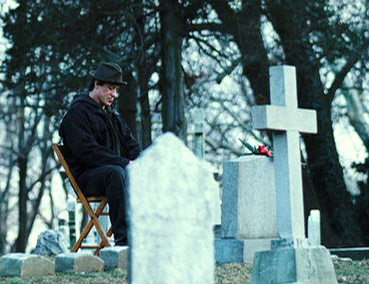
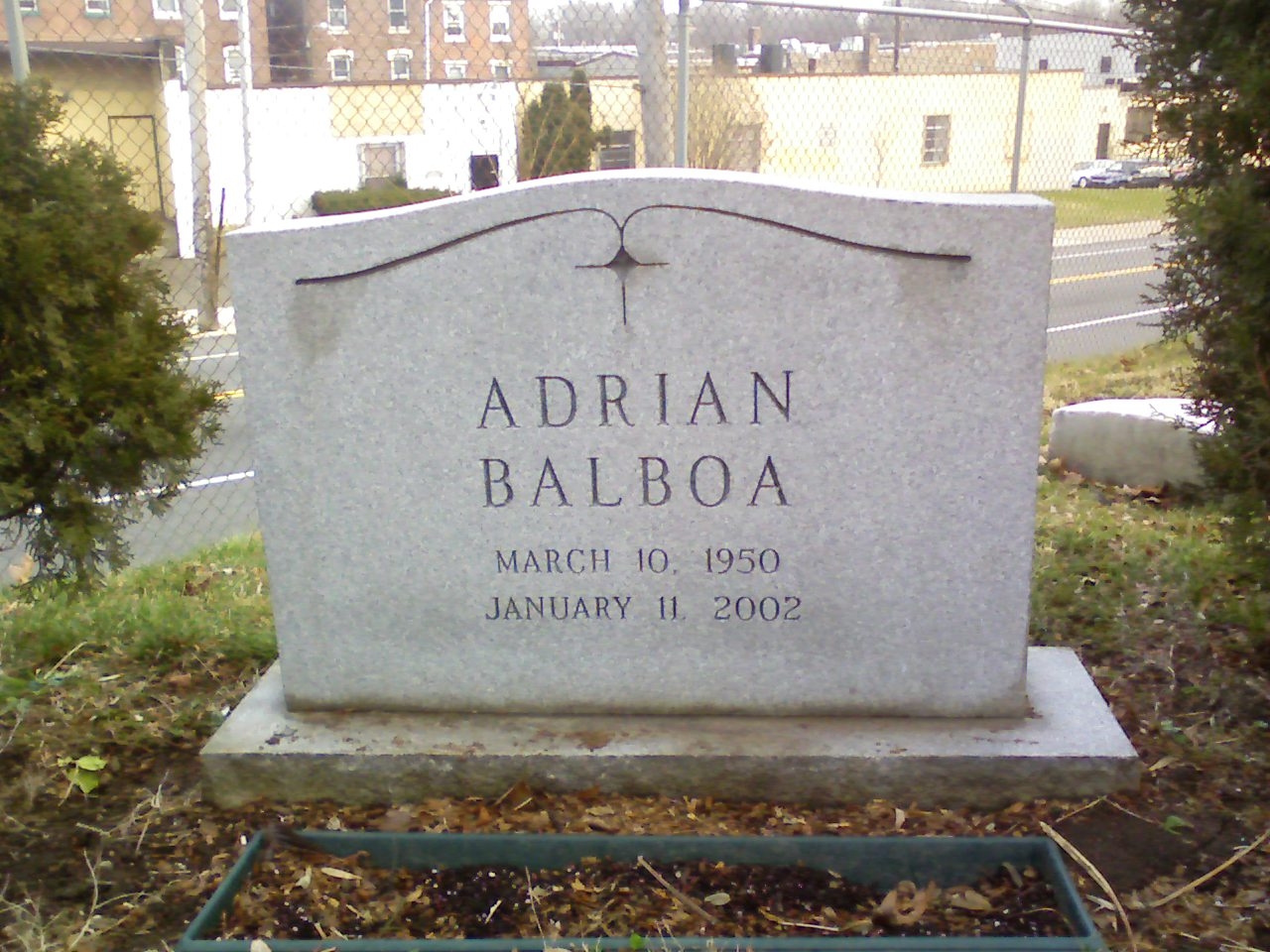
At the start of the film, Adrian has been dead for four years. However, her ghost haunts the film. Rocky regularly visits her grave and the film ends with him at her grave and saying, one last time, “Yo Adrian, we did it.” Stallone may be the battered face of the Rocky franchise but Talia Shire was the heart. Though she’s only seen in flashback, Rocky Balboa is a tribute to the way that Talia Shire brought Adrian to life.
Sentimental and nostalgic, Rocky Balboa felt like the perfect way to end the franchise. However, Rocky will be returning for at least one more fight when Creed is released on November 25th.










 Through the Shattered Lens