
Last night, as a part of my attempt to get caught up with the films of 2018, I watched White Boy Rick.
As you might guess from the title, this film is about a white boy named Rick. It’s based on the true story of Richard Wershe, Jr., who grew up on the streets of Detroit. His father sold guns out of the trunk of his car and, by the time he turned 14, Rick was running with drug dealers and street gangs. (The fact that he was white while all of his friends were black is what led to him getting his nickname.) Rick became an informant for the FBI and, according to Wershe, the government helped him build up his reputation by supplying him with the drugs that he would then sell on the streets. When the FBI eventually decided that Wershe was no longer a useful asset, he was arrested for dealing and sentenced to life in prison.
The story seems like one that has the potential to say a lot that needs to be said about not only the economic realities of life in a dying city but also about the role that race plays in America’s often misdirected “war on drugs.” Unfortunately, the film falls flat because, with the exception of a few scenes, it never really convinces us that Rick was really worthy of being the subject of a film. While the film surrounds him with interesting supporting characters, Rick himself remains something of a cipher. Rick is played by a young actor named Richie Merritt. Merritt’s has the right look for the character but you never get the feeling that there’s anything going on underneath the surface. Rick comes across as just being a moron who got lucky and then, eventually, not so lucky.
The supporting cast fares a bit better. For instance, Matthew McConaughey plays Rick’s father with just the right amount of manic energy and Bel Powley has a few harrowing scenes as Rick’s drug addicted sister. Bruce Dern and Piper Laurie don’t get to do much as Rick’s grandparents but it doesn’t matter because they’re Bruce Dern and Piper Laurie. (All Bruce Dern has to do to make a character interesting is look at the camera.) Jennifer Jason Leigh plays one of Rick’s FBI handlers with the perfect hint of subversiveness. You’re never quite sure whether she’s messing with Rick’s life because she’s incompetent or because she’s enjoying it. Unfortunately, the supporting characters are often so interesting that Rick often gets overshadowed. He’s a bystander in his own story, which may have been the film’s point but, from a storytelling point of view, it hardly makes for compelling viewing.
Admittedly, there are a few memorable scenes to be found in White Boy Rick. At one point, Rick goes to a wedding at the mayor’s mansion and he’s a sight to behold in his blue tuxedo. In another scene, it’s explained to Rick why, when it comes to being arrested, charged, and incarcerated, the stakes are very different when you’re black than when you’re white. In scenes like that, you kind of get a hint of White Boy Rick could have been if it had been centered around a more compelling character.
As it is, though, White Boy Rick is well-made but kind of dull. It’s definitely a missed opportunity.




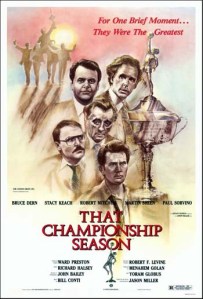 Four former high school basketball players and their coach gather for a reunion in Pennsylvania. Twenty-five years ago, they were state champions. Now, they are all still struggling with the legacy of that championship season. George (Bruce Dern) is the mayor of Scranton and is in a fierce race for reelection. Phil (Paul Sorvino) is a wealthy and corrupt businessman who is having an affair with George’s wife. James (Stacy Keach) is a high school principal who is still struggling to come to terms with his abusive father. James’s younger brother, Tom (Martin Sheen), is an alcoholic who can not hold down a steady job. The Coach (Robert Mitchum) remains the Coach. All four of the men still want his approval, even though they know that he is actually an old bigot who pushed them to cut too many corners on their way to the championship.
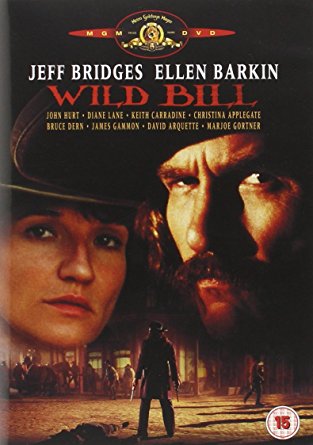 The year is 1876 and the legendary Wild Bill Hickok (Jeff Bridges) sits in a saloon in Deadwood and thinks about his life (most of which is seen in high-resolution, black-and-white flashbacks). Hickok was a renowned lawman and a sure shot, a man whose exploits made him famous across the west. Thanks to his friend, Buffalo Bill Cody (Keith Carradine), he even appeared on the New York stage and reenacted some of his greatest gun battles. Now, Hickok is aging. He is 39 years old, an old man by the standards of his profession. Though men like Charlie Prince (John Hurt) and California Joe (James Gammon) continue to spread his legend, Hickok is going blind and spends most of his time in a haze of opium and regret.
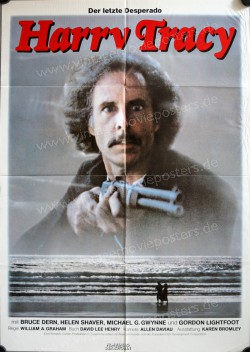 The year is 1902. The old west is coming to an end. Almost all of the famous outlaws are either dead or imprisoned. Only a few, like Harry Tracy (Bruce Dern), continue to make a living by robbing banks and trains. Though he is often captured and even sentenced to death a few times, Harry is always able to escape. His latest escape, from a prison in Washington, has led to the largest manhunt in American history. Harry is being pursued by a trigger-happy army, led by U.S. Marshal Morrie Nathan (played by singer Gordon Lightfoot). Harry has been in this situation before but this time, things are different. Harry is traveling with Catherine Tuttle (Helen Shaver), the daughter of a local judge. Harry and Catherine are in love but that does not matter to the men with the guns.
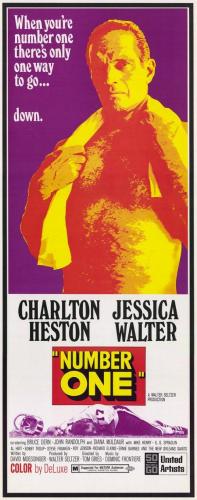 Quarterback Cat Catlan (Charlton Heston) used to be one of the greats. For fifteen years, he has been a professional football player. He probably should have retired after he led the New Orleans Saints to their first championship but, instead, the stubborn Cat kept playing. Now, he is 40 years old and struggling to keep up with the younger players. His coach (John Randolph) says that Cat has another two or three years left in him but the team doctor (G.D. Spradlin who, ten years later, played a coach in North Dallas Forty) says that one more strong hit could not only end Cat’s career but possibly his life as well. Two of former Cat’s former teammates (Bruce Dern and Bobby Troup) offer to help Cat find a job off the field but Cat tells them the same thing that he tells his long-suffering wife (Jessica Walter). He just has to win one more championship.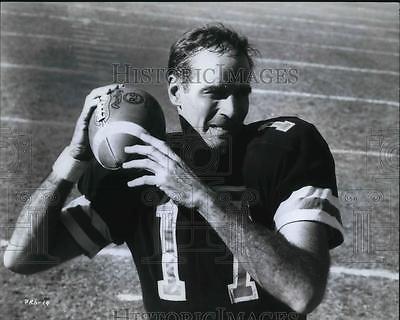
 Through the Shattered Lens