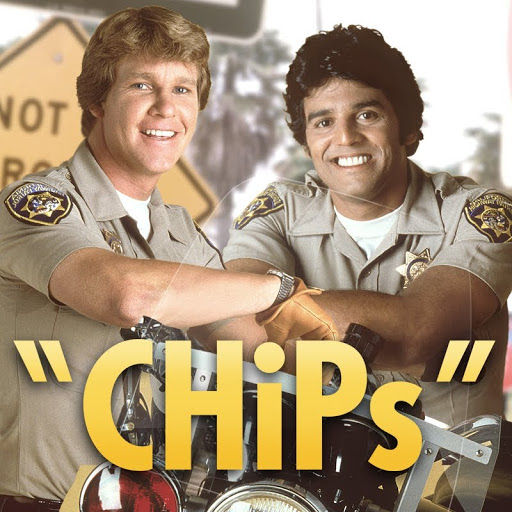
Welcome to Late Night Retro Television Reviews, a feature where we review some of our favorite and least favorite shows of the past! On Mondays, I will be reviewing CHiPs, which ran on NBC from 1977 to 1983. The entire show is currently streaming on Prime!
Who will be Jon’s partner this week? Read on to find out!
Episode 5.7 “Bomb Run”
(Dir by Phil Bondelli, originally aired on November 15th, 1981)
I was really hoping that this would be another episode with Caitlyn Jenner playing Steve but no, Ponch was back. (Erik Estrada is the better actor of the two but Jenner’s performance is often so bizarre in its utter blandness that it becomes fascinating to watch.) This episode opened with Baker observing as Ponch piloted a small airplane. CHiPs was all about the California lifestyle and apparently, a big part of that lifestyle was being able to take off in a small private plane whenever you felt like it. Ponch thinks that he’s ready for a solo flight but Baker tells him that he still needs to work on his landing skills. Sorry, Ponch, you’re not a Kennedy.
The highway patrol is preparing for the big air show. Officer Baricza (Brodie Greer) is surprised when he sees his ex-girlfriend, Terri (Kristin Griffith), hanging out around an airplane and preparing to take part in the show despite the fact that she has always been scared of flying. What Baricza does not know is that Terri and her father (Ed King) have planned a big robbery to take place during the air show. While Terri drops bombs from the airplane, the explosions will cover the sound of two safecrackers (played by Brion James and Taylor Lacher) blowing open a safe and stealing a bunch of bearer bonds. However, things get complicated when the safecrackers illegally park their car (which leads to a helicopter towing it off, carrying it through the sky). Things get even more complicated when Terri’s father has a heart attack when they’re in the air and Baker and Ponch have to perform a mid-air rescue.
So, how does Baricza react to his ex-girlfriend being a criminal? We never find out. Ponch roughly lands Terri’s plane and then show pretty much ends. As a result, we don’t know what happens to Terri and her father. We don’t know if the police succeeded in catching the safecrackers. We don’t even know if Terri’s father merely passed out or if he actually died up there. Instead, Getraer makes a joke about Ponch’s terrible landing skills and we get the familiar CHiPs freeze frame.
This episode featured a lot of airshow stock footage and it was pretty obvious that the plot was secondary to showing off all of the planes doing fancy maneuvers in the sky. It felt a bit lazy on the part of the show’s producers but I also imagine that this episode was also fairly cheap to produce. There’s more stock footage than plot. As a result, the ending is a bit unsatisfying. Is Baricza upset about Terri being a criminal? Who knows? He certainly does seem to be amused by Ponch’s landing though!
“This ain’t no god damn way to start a partnership.” – Reggie Hammond
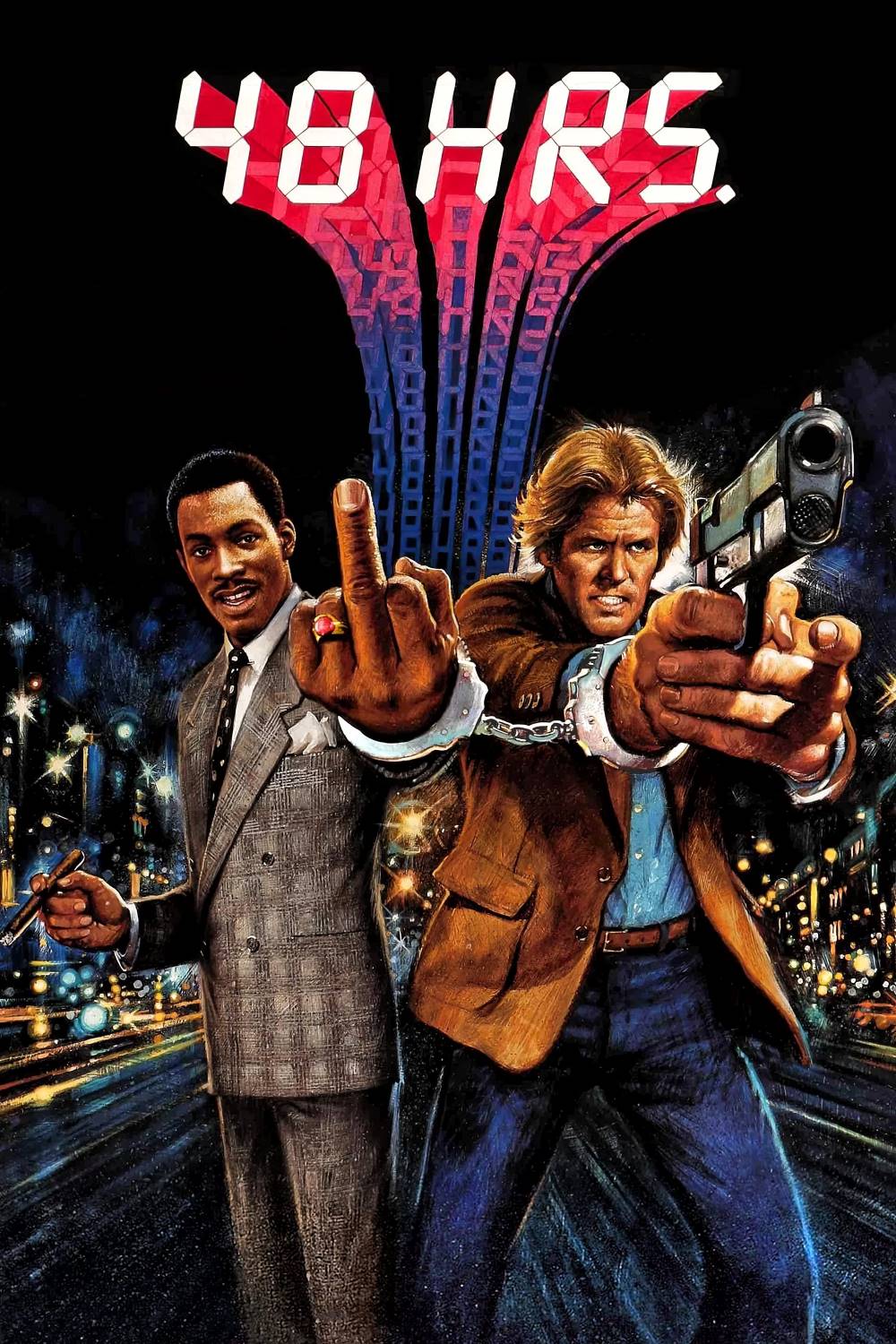
48 Hrs. bursts onto the screen with a gritty prison breakout that sets the stage for chaos in the foggy streets of San Francisco, where a pair of ruthless killers slip away after gunning down a cop’s partner in cold blood. Jack Cates, the surviving detective, is left battered and furious, piecing together a case that points to a slick convict named Reggie Hammond holding the key to the crooks’ whereabouts—and a stash of stolen cash. With time ticking down, Jack pulls strings to get Reggie out on a 48-hour pass, thrusting these two polar opposites into a reluctant alliance that turns the city into their personal battlefield of bullets, banter, and bad blood.
From the jump, Jack comes across as the ultimate rough-around-the-edges cop, nursing a flask under his trench coat, snapping at colleagues, and charging headfirst into danger like a man who’s got nothing left to lose. His apartment is a mess of empty bottles and regret, and his rocky relationship with his girlfriend underscores how the job has chewed him up and spit him out, leaving him more beast than man. Reggie, by contrast, rolls in with street-honed swagger, his prison jumpsuit barely containing the energy of a guy who’s survived by being quicker on his feet and sharper with his mouth than anyone around him. He’s got a girlfriend waiting with that hidden money, and no intention of playing nice with a cop who’s eyeing him like fresh meat.
The beauty of their pairing lies in how the film lets their friction spark from the very first shared car ride, where Jack’s growled commands clash against Reggie’s nonstop ribbing, turning a simple stakeout into a verbal demolition derby. Picture them peeling out after a lead goes south, tires screeching through narrow alleys while Reggie gripes about the beat-up car and Jack slams the dash in frustration—it’s these raw, unscripted-feeling moments that make the movie breathe. As they hit up seedy bars, chase informants through strip joints, and dodge ambushes, the script peels back layers: Jack’s not just a bully, he’s haunted by close calls; Reggie’s bravado masks real fear of ending up dead or broke.
One standout sequence drops them into a hillbilly roadhouse packed with hostile locals, where Reggie grabs the mic for an impromptu takedown that flips the room from menace to mayhem, buying them time while Jack backs him up with sheer firepower. It’s tense, hilarious, and perfectly timed, showing how their skills complement each other—Jack’s brute force meeting Reggie’s silver tongue—in ways neither saw coming. The villains, led by a stone-cold Luther and his trigger-happy sidekick, keep the heat cranked high, popping up for savage hits that leave bodies in the gutter and force the duo to improvise on the fly, like hot-wiring rides or shaking down lowlifes for scraps of intel.
Walter Hill’s direction keeps it all taut and visceral, with handheld cameras capturing the sweat and grime of every punch thrown or shot fired, no glossy filters to soften the blows. The San Francisco backdrop shines through rain-slicked hills, neon-lit dives, and shadowy piers, giving the action a grounded, almost documentary edge that amps up the stakes. Sound design punches too—the roar of engines, the crack of gunfire, the thud of fists—layered over a pulsing ’80s score that shifts from funky grooves during chases to ominous drones in quieter beats, mirroring the push-pull between comedy and threat.
Diving deeper into the characters, Jack’s arc feels earned through small touches: a hesitant phone call to his ex, a flicker of respect when Reggie saves his skin, moments that humanize the hardass without forcing redemption. Reggie evolves too, his initial scam-artist vibe giving way to flashes of loyalty, like when he risks his neck to protect that cash not just for himself, but to build something real outside the walls. Supporting roles flesh out the world—the precinct captain barking orders, the sultry singer tangled with the bad guys, Reggie’s tough-as-nails woman who won’t take guff—but they never overshadow the core duo, serving as sparks for conflict or comic relief.
Pacing-wise, the film rarely pauses for breath, clocking in under two hours yet packing in a full meal of twists, from double-crosses at motels to a frantic foot chase across rooftops that leaves you winded. The 48-hour ticking clock adds urgency without gimmicks, every dead end ramping tension as dawn breaks on their deadline. Humor lands organically too, not from slapstick but from character-driven zingers—Reggie calling out Jack’s outdated tough-guy schtick, Jack grumbling about Reggie’s flashy clothes—keeping the tone light even as blood spills.
Of course, watching through modern eyes, the dialogue packs some era-specific punches, with raw language around race, cops, and crooks that reflects ’80s attitudes head-on, for better or worse. It’s unapologetic, mirroring the film’s macho pulse, but adds texture to the time capsule feel, making replays fascinating for how boldly it leaned into taboos. The women, while fierce in spots, often play second fiddle to the bromance brewing, a hallmark of the genre that 48 Hrs. helped cement before it evolved.
What elevates this beyond standard action fare is how it nails the buddy dynamic’s slow burn: no instant high-fives, just gradual thaw from shared survival, culminating in a dockside finale where alliances solidify amid explosions and last stands. The editing zips between high-octane set pieces and downtime breather scenes, like a roadside diner heart-to-heart that reveals backstories without halting momentum. Cinematography plays with shadows and neon to heighten paranoia, turning everyday spots into pressure cookers.
Influence-wise, you can trace lines straight to later hits—the grizzled vet and smooth-talking newbie formula got refined here, blending Lethal Weapon grit with Beverly Hills Cop wit years ahead of schedule. Performances anchor it all: the leads’ chemistry crackles, carrying weaker beats on sheer charisma, while Hill’s lean style ensures every frame earns its keep. Runtime flies because it’s efficient, no fat, just muscle.
Final stretch ramps to operatic violence on those windswept docks, bullets flying as personal scores settle, leaving our heroes bloodied but bonded in a way that feels hard-won. 48 Hrs. endures as a rowdy blueprint for the genre, blending laughs, thrills, and toughness into a package that’s addictive on first watch and rewarding on revisit. It’s got heart under the bruises, edge in the jokes, and a vibe that’s pure ’80s adrenaline—grab it for a night of no-holds-barred entertainment that still packs a wallop over four decades later.
Welcome to Retro Television Reviews, a feature where we review some of our favorite and least favorite shows of the past! On Mondays, I will be reviewing Miami Vice, which ran on NBC from 1984 to 1989. The entire show can be purchased on Prime!
This week, Vice helps the communists once again.
Episode 5.5 “Borrasca”
(Dir by Vern Gillum, originally aired on December 9th, 1988)
Martillo Borrasca (Juan Fernandez) is a drug dealer who uses the money to fund anti-communist revolutionaries in his native South American country. Castillo, Tubbs, and Switek want to arrest him, especially after Barrisco and his men use a machete to hack an undercover cop to death. CIA agent Reese (Brion James) wants the Vice Squad to lay off Barrisco because Barrisco is working to overthrow a communist.
Personally, I’m on Reese’s side. Sure, Borrasca is a bad guy and he deserves to be punished for his crimes but the communist dictators in South and Central America were just as bad. Just because they quoted Marx and spouted a lot of anti-imperialist propaganda, that didn’t change the fact that they oppressed their own people and many of them were involved in the drug trade themselves. This episode aired long before the rise of Hugh Chavez but one need only look at the state of Venezuela today to see that the CIA perhaps had a point.
Castillo, of course, doesn’t see it that way. He assassinated Barrisco while the latter is trying to make an escape via helicopter. “I have a code,” Castillo says. Really, Castillo? That’s your code? Assassinate a drug dealer but don’t do anything about the dictators who would have allowed the Russians to plant nuclear missiles in their countries?
This episode was actually pretty routine. How many times have we been through the whole “The Vice Squad is after a drug dealer who has friends in the government” thing? On the one hand, I always appreciate Miami Vice’s cynicism about the War on Drugs. On the other hand, it’s frequent defense of communism has always been one of the show’s more glaring blind spots. Communists make just as much money from the drug trade as capitalists.
Crockett was not in this episode. Instead, Tubbs worked with Switek. It was nice to see Switek get to more than usual but, in the end, this was definitely a Castillo episode.
Though the Academy of Motion Picture Arts and Sciences claim that the Oscars honor the best of the year, we all know that there are always worthy films and performances that end up getting overlooked. Sometimes, it’s because the competition too fierce. Sometimes, it’s because the film itself was too controversial. Often, it’s just a case of a film’s quality not being fully recognized until years after its initial released. This series of reviews takes a look at the films and performances that should have been nominated but were, for whatever reason, overlooked. These are the Unnominated.
1981’s SouthernComfort takes place in 1973. While America tries to wind down its presence in Vietnam, a squad of nine National Guardsmen take part in war games in the Louisiana bayous. The squad is led by the ineffectual Sgt. Crawford Poole (Peter Coyote) while other members include the trigger-happy Lonnie Reece (Fred Ward), the weed-smoking Tyrone Cribbs (T.K. Carter), the cowardly Private Simms (Franklyn Seales), and the tightly-wound Coach Bowden (Alan Autry). Poole may be in charge but most of the members of the squad seem to look up to the laid-back and friendly Private Spencer (Keith Carradine). The newest member of the squad is Charles Hardin (Powers Boothe), a sober-minded transfer from Texas who doesn’t seem to get along with anyone but Spencer.
With the exception of Poole and Hardin, no one takes the weekend maneuvers seriously until they find themselves lost in the bayou and it becomes obvious that Poole has no idea what he’s doing. When they come across some canoes that belong to some Cajun trappers, they decide to “borrow” them. When the trappers protest, Reece fires his weapon at them. Reece’s gun is loaded with blanks but the trappers don’t know that. They fire back, killing Poole.
The national guardsmen now find themselves lost and being stalked by the trappers, a largely unseen force that always seems to attack out of nowhere. The men have no idea where they are. The trappers, on the other hand, have lived in the swamps their entire lives. The guardsmen bicker and argue over the best way to respond. Some want to fight back and some just want to get back to civilization. One-by-one, the men are picked off until only two remain.
Though the film is a somewhat heavy-handed metaphor for the Vietnam War, SouthernComfort is still a deeply affecting and suspenseful mix of horror and action. Director Walter Hill keeps the action moving at a quick pace and the film, which was shot on location and featured scenes shot during an actual Cajun celebration, perfectly captures the languid yet ominous atmosphere of the bayous. As soon as the men see those canoes unattended, we know that they’re going to steal them and that they are making the biggest mistake of their lives. Keith Carradine and Powers Boothe both give powerful performances in the lead roles and the members of the supporting cast — especially Alan Autry and Fred Ward — make a strong impression as well. I especially liked the performance of Brion James, who has a small role as a one-armed Cajun who is more crafty than he looks.
Being a mix of horror and action, it’s probably not a shock that SouthernComfort was ignored by the Academy. At the very least, I would have found room for Ry Cooder’s original score and Andrew Laszlo’s haunting cinematography.
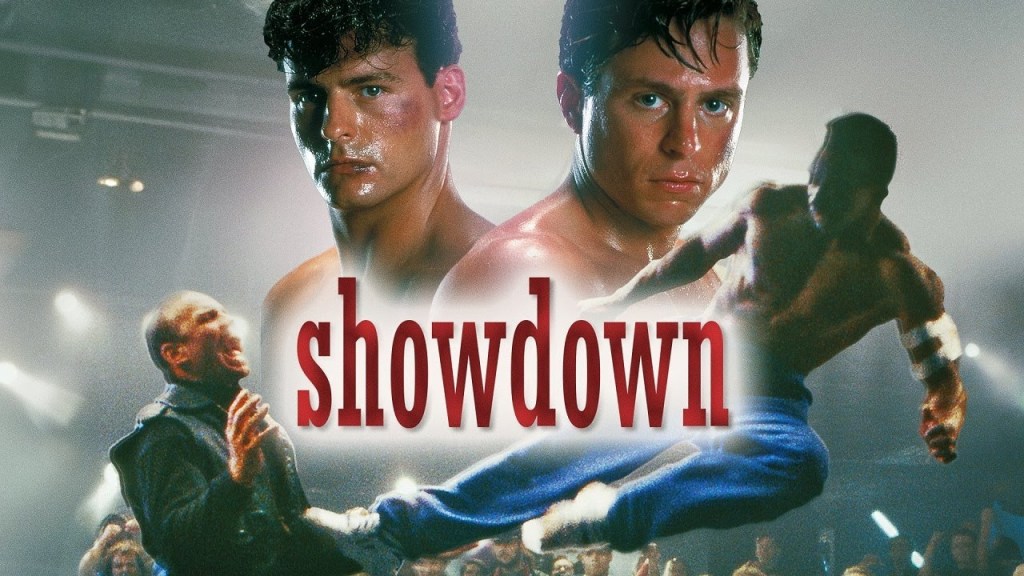
Are you a fan of THE KARATE KID? If you are, then I have the movie for you… SHOWDOWN (1993)! What’s better is that it’s now streaming on Amazon Prime, so you can go watch it right now!
SHOWDOWN is primarily the story of Ken Marx (Kenn Scott), a high school student who has recently moved to a new city with his mom. When he enrolls in the local high school, he catches the eye of the beautiful Julie (Christine Taylor), unaware that her boyfriend is a bullying asshole named Tom (Ken McLeod), a young martial artist trained by the ruthless sensei Lee (Patrick Kilpatrick). SHOWDOWN is also the story of ex-cop Billy Grant (Billy Blanks), who accidentally killed evil sensei Lee’s brother seven years earlier when breaking up a wild party one night when he was on duty with his partner Spinelli (Mike Genovese). Unable to cope with killing a man, Billy is now working as a janitor at the high school. The two main characters come together one afternoon when Tom gives Ken a good beating for having the nerve to talk to his property, I mean his girlfriend, Julie. Billy sees Ken doubled over in pain after taking a shot from Tom in the face and the gut, so he reluctantly decides to help the new kid, eventually introducing him to self-defense techniques and martial arts that will help him stand up to the bully. His teaching methods are quite unconventional and include such humbling tasks as cleaning toilets and urinals. The stories all come to a head one night when Ken and Tom fight it out in the ring. When evil sensei Lee tries to involve himself in the battle between the students, Billy gets his own shot at redemption when he steps in to enforce law and order for the first time in many years!
Based on the plot description above, it’s evident that SHOWDOWN is not afraid to wear its “Karate Kid” influences on its sleeve! I had never seen this 1993 B-movie before, so I found a lot of nostalgic fun in its familiar underdog story, with characters even specifically referencing key moments from the 80’s classic. Even if he’s somewhat limited as an actor, Billy Blanks just has this likable presence about him, and he’s definitely believable as a martial arts master. I enjoy watching him. Kenn Scott carries on the tradition of being a 25-year-old man playing a high school student, but he seems much older to me than Ralph Macchio did in THE KARATE KID. Scott in 1993 was much more physically developed than Macchio was in 1984, so while he doesn’t seem reasonable as a high school student, he does seem more reasonable as a fighter. Continuing my comparisons, Christine Taylor is cute as the love interest, but a fifth grade Brad Crain fell head over heels in love with Elizabeth Shue as “Ali with an I.” That’s not Christine’s fault though, and she’s fine here. Finally, I have to give a shoutout to Patrick Kilpatrick as the evil sensei Lee. In a career defined by playing bad guys, his deliriously unhinged, over-the-top performance here is a true highlight of the film.
As for the fight choreography in SHOWDOWN, it’s serviceable and delivered with conviction, but it’s not that great when viewed in 2025 and compared to the better movies of the genre. But that’s okay because the movie does what a lot of movies can’t do… it entertains and moves by at a fast pace. I enjoyed it, and I can easily recommend it to any person who enjoyed THE KARATE KID series or low budget, early 90’s, direct-to-video action.
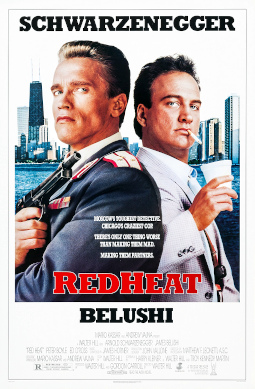
Ivan Danko (Arnold Schwarzenegger) is a Russian who lives in Moscow. Art Ridzik (James Belushi) is an American who lives in Chicago. They have two things in common. They’re both cops and they both recently lost their partners while pursuing Russian drug lord Viktor Rostavali (Ed O’Ross). When Danko comes to Chicago to bring the recently arrested Rostavali back to Moscow, Ridzik is assigned to be his handler. When Rostavali escapes from custody, Ridzik and Danko team up to take him down.
Directed by Walter Hill, RedHeat may not be as well-remembered as some of Arnold Schwarzenegger’s other action films from the 80s but it’s still a good example of Schwarzenegger doing what Schwarzenegger did best. Danko may not have been the quip machine that Schwarzenegger usually played but the movie gets a lot of comedic mileage out of his straight-to-the-point dialogue and the culture clash that Danko, a proud Soviet, experiences in Chicago. It’s also an exciting action film, featuring a classic bus chase that perfectly complements Schwarzenegger’s bigger-than-life persona.
It gets a lot of mileage from the comedic chemistry of Arnold Schwarzenegger and James Belushi. The always-talking Belushi provides a good comic foil to the steely Schwarzenegger. Made in the waning years of the Cold War, Red Heat featured Belushi learning that the Russian cops didn’t worry about Miranda warnings and Schwarzenegger learning about “decadent” capitalism. Belushi does a good job defending the honor of America. Schwarzenegger, an anti-communist in real life, does an equally good job defending the Soviet Union. Ultimately, they put aside their differences and show that even people on opposite sides can work together.
(We all know who won ultimately won the Cold War, though.)
Walter Hill specialized in buddy action movies. RedHeat isn’t up to the level of 48Hrs but it’s still an entertaining East-meets-West action film that packs a punch.
1992’s The Player tells the story of Griffin Mill (Tim Robbins).
It’s not easy being Griffin Mill. From the outside, of course, it looks like he has the perfect life. He’s a studio executive with a nice house in Hollywood. He’s young. He’s up-and-coming. Some people, especially Griffin, suspect that he’ll be the president of the studio some day. By day, he sits in his office and listens to pitches from respected screenwriters like Buck Henry. (Henry has a great idea for The Graduate II!) During the afternoon, he might attends dailies and watch endless takes of actors like Scott Glenn and Lily Tomlin arguing with each other. Or he might go to lunch and take a minute to say hello to Burt Reynolds. (“Asshole,” Burt says as Griffin walks away.) At night, he might go to a nice party in a big mansion and mingle with actors who are both young and old. He might even run into and share some sharp words with Malcolm McDowell.
But Griffin’s life isn’t as easy as it seems. He’s constantly worried about his position in the studio, knowing that one box office failure could end his career. He fears that a new executive named Larry Levy (Peter Gallagher) is after his job. Two new screenwriters (Richard E. Grant and Dean Stockwell) keep bugging him to produce their downbeat, no-stars anti-capitol punishment film. His girlfriend (Cynthia Stevenson) wants to make good movies that mean something. Even worse, someone is sending Griffin threatening notes.
It doesn’t take long for Griffin to decide that the notes are coming from a screenwriter named Dave Kahane (Vincent D’Onofrio). Griffin’s attempt to arrange a meeting with Dave at a bar so that Griffin can offer him a production deal instead leads to Griffin murdering Dave in a parking lot. While the other writers in Hollywood mourn Dave’s death, Griffin starts a relationship with Dave’s artist girlfriend (Great Scacchi) and tried to hide his guilt from two investigating detectives (Whoopi Goldberg and Lyle Lovett). Worst of all, the notes keep coming. The writer, whomever they may be, is now not only threatening Griffin but also seems to know what Griffin did.
After spend more than a decade in the industry wilderness, Robert Altman made a critical and commercial comeback with The Player. It’s a satire of Hollywood but it’s also a celebration of the film industry, featuring 60 celebrities cameoing as themselves. Everyone, it seems, wanted to appear in a movie that portrayed studio execs as being sociopathic and screenwriters as being whiny and kind of annoying. The Player both loves and ridicules Hollywood and the often anonymous men who run the industry. Largely motivated by greed and self-preservation, Griffin may not love movies but he certainly loves controlling what the public sees. In the end, only one character in The Player sticks to her values and her ideals and, by the end of the movie, she’s out of a job. At the same time, Griffin has a social life that those in the audience can’t help but envy. He can’t step out of his office without running into someone famous.
The Player is one Altman’s most entertaining films, with the camera continually tracking from one location to another and giving as a vision of Hollywood that feels very much alive. Tim Robbins gives one of his best performances as Griffin Mill and Altman surrounds him with a great supporting cast. I especially liked Fred Ward as the studio’s head of security. With The Player, Altman mixes melodrama with a sharp and sometimes bizarre comedy, with dialogue so snappy that the film is as much a joy to listen to as to watch. That said, the real attraction of the film is spotting all of the celebrity cameos. (That and cheering when Bruce Willis saves Julia Roberts from certain death.) Altman was a director who often used his films to explore eccentric communities. With The Player, he opened up his own home.
Welcome to Late Night Retro Television Reviews, a feature where we review some of our favorite and least favorite shows of the past! On Mondays, I will be reviewing CHiPs, which ran on NBC from 1977 to 1983. The entire show is currently streaming on Prime!
This week, it’s a special two-hour episode of CHiPs!
Episodes 3.9 and 3.10 “Drive, Lady, Drive”
(Dir by Don Weis, originally aired on November 10, 1979)
The police at nearby Palma Vista are on strike and the state of California has agreed to allow some members of the Highway Patrol to patrol the town until the strike is over. Getraer assigns Baker, Ponch, Bear, and some new guy named Lenny (Leon Isaac Kennedy) to head over to the town, Baker is named the OIC, which I eventually figured out stood for “Officer in Charge.” Getraer knows better than to give the job to Ponch.
Ponch, by the way, is back! After being absent for two episodes due to Erik Estrada actually injuring himself in a motorcycle crash, Ponch returns in this episode and he goes through the entire episode with this huge grin on his face as if he’s saying, “You know you missed me.” Ponch’s return means that Baker is once again relegated to being the strong, silent partner who doesn’t really get to do anything. In fact, Baker crashes his motorcycle early on in this episode, as if the show was trying to tell us, “See? It could happen to anyone!”
The striking cops accuse Baker, Ponch, Bear, and Lenny of being scabs and strike breakers. I’m not really a fan of public sector unions. (When it comes to the police striking, my hero is Calvin Coolidge, who came to fame when he broke up a policeman’s strike in Massachusetts.) Still, it felt strange to watch the show’s heroes cross that picket line. That would definitely not happen on television today.
There’s a lot going on in Palma Vista. There’s some rich kids who keep joyriding in a dune buggy and who think they can escape prosecution by crossing the city limits. (Joke’s on them! The Highway Patrol has jurisdiction everywhere!) There’s some truck hijackers who are setting up a headquarters in town. There’s an angry city councilman (Michael Conrad) who doesn’t feel his children should be held accountable for their actions.
That said, the majority of this two-hour episode centered on a stock car race and one of the racers, Candi Wright (Kelly Harmon). Will Candi win the big race or will she lose to her friendly rival (and possible future romantic partner) Don Croyden (Jordan Clarke)? Will Ponch be able to both date her and do his job? And most importantly, will she be able to adopt a traumatized little girl (played by Tracey Gold) who Candi discovered outside of a burning house? That’s a lot of storylines for someone who wasn’t even a regular cast member and a part of me wonders if maybe this episode was meant to be a secret pilot for a Candi Wright television series. It would explain a lot.
This really was a basic episode of CHiPs, with the only real difference being that it was two-hours long for some reason. A lot of what happened in the episode, especially the racing footage, felt like filler. There was really no need for this to be a double-sized episode. It also doesn’t help that, as opposed to the lovely Los Angeles scenery that we usually see, this episode took place in a rather ugly town. There was some appropriately spectacular crashes but, in the end, this episode ran too long and felt a bit pointless. Get the Highway Patrol back on the highways!
48 Hrs. begins with a violent and bloody jailbreak. The fearsome Billy Bear (Sonny Landham) helps his criminal associate, Albert Ganz (James Remar), escape from a chain gang and kills several guards in the process. Billy and Ganz then head to San Francisco, where they start killing their former associates while searching for Luther (David Patrick Kelly). Another bloody shootout leaves several detectives dead and SFPD Detective Jack Cates (Nick Nolte) looking for revenge.
That’s not the way you might expect one of the most famous comedies of the 80s to begin. It’s not until Jack arranges for another associate of of Ganz’s to be released from prison for 48 hours that anything humorous happens in the film. However, because Reggie Hammond is played by Eddie Murphy, 48 Hrs. quickly becomes very funny.
Murphy was appearing on Saturday Night Live when he was cast in 48 Hrs, in a role that was written with Richard Pryor in mind. One of the first things that Murphy requested was that the character’s name be changed from Willie Biggs to Reggie Hammond. Murphy made the role his own and watching him, it’s hard to believe that he was only 21 and also that 48 Hrs was his first film. Murphy performs with the confidence of a natural movie star. He’s good in the film’s most famous scene, where he pretends to be a cop and talks down an entire bar full of rednecks. (I can’t repeat his most famous line but everyone knows it.) But Murphy is even better in the scenes where he’s just reacting to Nolte’s slovenly cop.
The comedy in 48 Hrs comes from the mismatched partnership and initially hostile chemistry of Jack Cates and Reggie Hammond. Cates has a job to do while Reggie, understandably, wants to enjoy as much freedom as he can before he gets sent back to prison. The humor is so effective because it’s almost entirely character-based. There are no gags but there are two well-written characters with differing ways of looking at the world who have to learn how to work with each other. The two of them start out disliking and distrusting each other but ultimately become best friends, even if Jack does punch Reggie and Reggie does keep trying to steal Jack’s lighter. Because this is a Walter Hill movie, there’s still a lot of action. Nolte and Murphy may make you laugh but there’s nothing funny about full-on psycho performances of James Remar and Sonny Landham. 48 Hrs. not only allows Murphy and Nolte to show off their comedic ability but it also allows them to be true action heroes.
Popular with critics and audiences, 48 Hrs. was the most commercially successful film of 1982. It set the standard for most buddy-cop movies to this day and it introduced the world to Eddie Murphy.
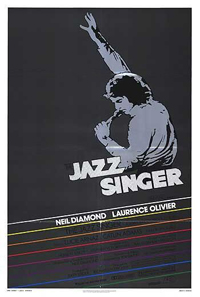
In the 1980 remake of The Jazz Singer, it only takes the film seven minutes to find an excuse to put Neil Diamond in blackface.
Of course, the film was a remake of the 1927 version of The Jazz Singer, which featured several scenes of Al Jolson performing in blackface. In fact, Al Jolson in blackface was such a key part of the film that it was even the image that was used to advertise the film when it was first released. Back in the 20s, Jolson said that wearing blackface was a way of honoring the black artists who created jazz. (As shocking as the image of Al Jolson wearing blackface is to modern sensibilities, Jolson was considered a strong advocate for civil rights and one of the few white singers to regularly appear on stage with black musicians.) Regardless of Jolson’s motives, less-progressively minded performers used blackface as a way to reinforce racial stereotypes and, to modern audiences, blackface is an abhorrent reminder of how black people were marginalized by a racist culture. You would think that, if there was any element of the original film that a remake would change, it would be the lead character performing in blackface.
But nope. Seven minutes into the remake, songwriter Jess Robin (Neil Diamond) puts on a fake afro and dons blackface so that he can perform on stage at a black club with the group that is performing his songs. The group’s name is the Four Brothers and, unfortunately, one of the Brothers was arrested the day of the performance. Jess performs with the group and the crowd loves it until they see his white hands. Ernie Hudson — yes, Ernie Hudson — stands up and yells, “That’s a white boy!” A riot breaks out. The police show up. Jess and the three remaining Brothers are arrested and taken to jail. Jess is eventually bailed out by his father, Cantor Rabinovitch (Laurence Olivier). The Cantor is shocked to discover that his son, Yussel Rabinovitch, has been performing under the name Jess Robin. He’s also stunned to learn that Yussel doesn’t want to be a cantor like his father. Instead, he wants to write and perform modern music. The Cantor tells Yussel that his voice is God’s instrument, not his own. Yussel returns home to his wife, Rivka (Caitlin Adams), and tries to put aside his dreams.
But when a recording artist named Keith Lennox (Paul Nicholas) wants to record one Yussel’s songs, Yussel flies out to Los Angeles. As Jess Robin, he is shocked to discover that Lennox wants to turn a ballad that he wrote into a hard rock number, Jess sings the song to show Lennox how it should sound. The arrogant Lennox is not impressed but his agent, Molly (Lucie Arnaz) is. Soon, Jess has a chance to become a star but what about the family he left behind in New York? “I have no son!” the Cantor wails when he learns about Jess’s new life in California.
I’ve often seen the 1980 version of The Jazz Singer referred to as being one of the worst films of all time. I watched it a few days ago and I wouldn’t go that far. It’s not really terrible as much as its just kind of bland. For someone who has had as long and successful a career as Neil Diamond, he gives a surprisingly charisma-free performance in the lead role. The most memorable thing about Diamond’s performance is that he refuses to maintain eye contact with any of the other performers, which makes Jess seem like kind of a sullen brat. It also doesn’t help that Diamond appears to be in his 40s in this film, playing a role that was clearly written for a much younger artist. Still, when it comes to bad acting, no one can beat a very miscast Laurence Olivier, delivering his lines with an overdone Yiddish accent and dramatically tearing at his clothes to indicate that Yussel is dead to him. Olivier was neither Jewish nor a New Yorker and that becomes very clear the more one watches this film. It takes a truly great actor to give a performance this bad. Diamond, at least, could point to the fact that he was a nonactor given a starring role in a major studio production. Olivier, on the other hand, really had no one to blame but himself.
Still, I have to admit that ending the film with a sparkly Neil Diamond performing America while Laurence Olivier nods in the audience was perhaps the best possible way to bring this film to a close. It’s a moment of beautiful kitsch. The Jazz Singer needed more of that.


 Through the Shattered Lens