October True Crime: Murder in Coweta County (dir by Gary Nelson)


In 1948, one of the richest men in Georgia committed a murder.

John Wallace was a landowner, back when that title actually meant something.  He was known as the boss of Meriweather County.  Everyone in the county seemed to work for Wallace in one way or another.  He controlled the county officials.  The sheriff enforced the law only as far as John Wallace would allow him.  The bootleggers had to pay Wallace for protection.  When one bootlegger, a sharecropper named Wilson Turner, failed to do so, he was fired and kicked off of Wallace’s land.

Turner retaliated by stealing two of Wallace’s cows.

Wallace responded by murdering Turner.

Because Turner attempted to flee and Wallace chased after him, Wallace committed the murder not in Meriweather County but in neighboring Coweta County.  What Wallace didn’t realize was that this meant the investigation didn’t fall under the jurisdiction of his hand-picked sheriff.  Instead, Sheriff Lamar Potts of Coweta County headed up the investigation.  John Wallace was eventually arrested by Sheriff Potts and he was eventually convicted of murdering Wilson Turner.  At the time, the case drew a lot of attention both because of Wallace’s wealth but also because two of the main witnesses for the prosecution were the two black men who Wallace forced to help him dispose of Wallace’s body.

It’s an interesting story, largely because the history of America is full of men like John Wallace, people who set up their own little dictatorships.  It’s often portrayed as being a Southern phenomena but John Wallace really wasn’t that much different from the crude political bosses who, for decades, dominated politics in city like New York and Chicago, the type who held onto power through a combination of intimidation and patronage.  In my home state of Texas, George Berham Parr inherited the political machine that controlled Duval and Jim Wells County.  Parr committed numerous crimes during his time as the “Duke of Duval” but he had important friends.  He was the one who “found” the votes necessary for Lyndon Johnson to win a senate seat in 1948.  (In return, Johnson got Harry Truman to pardon Parr for failing to pay his taxes.)  Parr is also suspected of having been involved in at least one murder but it wasn’t until LBJ himself retired from politics that anyone truly investigated Parr’s activities.  In 1974, he was again convicted of failing to pay his taxes and Parr was later found dead at his ranch.  Suicide was the official police ruling.

As for the story of John Wallace, it was turned into a made-for-TV movie in 1983.  Murder in Coweta County stars Andy Griffith as John Wallace and Johnny Cash as Sheriff Potts.  Griffith, playing a soulless villain, is chilling as John Wallace.  Wallace is all-smiles and good ol’ boy charisma whenever there’s a crowd around but, once it’s just him and his cronies, a different side comes out.  Wallace thinks that he can get away with murder because he’s been able to get away with everything else.  Sheriff Potts is determined to see that justice is done.  Murder in Coweta County is an atmospheric Southern crime story, one that is so full of atmosphere that you can feel the humidity.  While Johnny Cash was definitely a better singer than an actor, Andy Griffith’s villainous turn makes the film worth watching.

Retro Television Review: Miami Vice 4.22 “Mirror Image”


Welcome to Retro Television Reviews, a feature where we review some of our favorite and least favorite shows of the past!  On Mondays, I will be reviewing Miami Vice, which ran on NBC from 1984 to 1989.  The entire show can be purchased on Prime!

This week, season 4 comes to a close.

Episode 4.22 “Mirror Image”

(Dir by Richard Compton, originally aired on May 6th, 1988)

Trying to recover from the assassination of his wife, Sonny Crockett throws himself back into his Sonny Burnett persona.  As this episode starts, Sonny has managed to get close to a ruthless drug dealer named Gutierrez (Antonio Fargas).  When Guiterrez blows up a boat that is full of rival drug dealers, the Vice Squad assumes that Gutierrez died in the explosion.  They also assume that Sonny was lost as well.

They are incorrect.  Gutierrez got off the boat before the bomb went off and somehow, Sonny was able to survive being blown up without suffering any sort of physical injuries.  However, mentally, he wakes up with amnesia.  When Gutierrez’s doctor tells Sonny that he’s a drug dealer and this his last name is “Burnett,” Sonny believes him.

In Ft. Lauderdale, Sonny quickly moves up in the organization of drug lord Miguel Manolo (Tony Azito).  Now believing himself to be a criminal, Sonny has no hesitation about murdering anyone who he views as being a threat.  He kills Gutierrez in cold blood about halfway through the episode.  At the end of the episode, he shoots a corrupt detective (Chris Cooper) in cold blood.  Tubbs, who has been investigating Manolo, witnesses that final murder.  “SONNY!” he yells as Sonny escapes in a speedboat and season 4 comes to an end.

Season 4 was truly uneven, featuring some terrible episodes and also some episodes that were good but not particularly memorable.  Before I started this season, I read that it was considered to be the worst of Miami Vice‘s five seasons and, having now watched every episode, I can see why.  Sonny marrying Caitlin never made any sense.  Most of the villains were either generic or ludicrous.  Most of the episodes just didn’t have the style that made the first three seasons so memorable.  Even worse than the boring episodes were the ones that tried too hard to be quirky.  Trudy going into space was definitely not a great idea.  With all that in mind, this final episode was great.  The action was stylish, Don Johnson actually seemed invested in the story for once, and Phillip Michael Thomas got to show off his own skills as an actor.  If only the entire season had been this good!

As well, I should mention that, along with Chris Cooper as a bad cop, this episode also featured Julia Roberts as Manolo’s girlfriend.  Roberts didn’t really get to do much but, even in a small role, her screen presence was obvious.  It’s not a surprise she became a star.

Next week …. we’ll start the final season of Miami Vice!

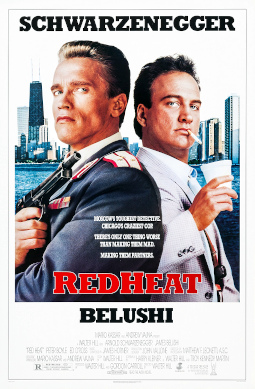
Red Heat (1988, directed by Walter Hill)


Ivan Danko (Arnold Schwarzenegger) is a Russian who lives in Moscow.  Art Ridzik (James Belushi) is an American who lives in Chicago.  They have two things in common.  They’re both cops and they both recently lost their partners while pursuing Russian drug lord Viktor Rostavali (Ed O’Ross).  When Danko comes to Chicago to bring the recently arrested Rostavali back to Moscow, Ridzik is assigned to be his handler.  When Rostavali escapes from custody, Ridzik and Danko team up to take him down.

Directed by Walter Hill, Red Heat may not be as well-remembered as some of Arnold Schwarzenegger’s other action films from the 80s but it’s still a good example of Schwarzenegger doing what Schwarzenegger did best.  Danko may not have been the quip machine that Schwarzenegger usually played but the movie gets a lot of comedic mileage out of his straight-to-the-point dialogue and the culture clash that Danko, a proud Soviet, experiences in Chicago.  It’s also an exciting action film, featuring a classic bus chase that perfectly complements Schwarzenegger’s bigger-than-life persona.

It gets a lot of mileage from the comedic chemistry of Arnold Schwarzenegger and James Belushi.  The always-talking Belushi provides a good comic foil to the steely Schwarzenegger.  Made in the waning years of the Cold War, Red Heat featured Belushi learning that the Russian cops didn’t worry about Miranda warnings and Schwarzenegger learning about “decadent” capitalism.  Belushi does a good job defending the honor of America.  Schwarzenegger, an anti-communist in real life, does an equally good job defending the Soviet Union.  Ultimately, they put aside their differences and show that even people on opposite sides can work together.

(We all know who won ultimately won the Cold War, though.)

Walter Hill specialized in buddy action movies.  Red Heat isn’t up to the level of 48 Hrs but it’s still an entertaining East-meets-West action film that packs a punch.

Retro Television Reviews: Miami Vice 1.19 “The Home Invaders”


Welcome to Retro Television Reviews, a feature where we review some of our favorite and least favorite shows of the past!  On Mondays, I will be reviewing Miami Vice, which ran on NBC from 1984 to 1989.  The entire show is currently streaming on Tubi!

This week, Crockett and Castillo take down some home invaders.  Yes, Crockett and Castillo.  Not Crockett and Tubbs.  Read on to find out why.

Episode 1.19 “The Home Invaders”

(Dir by Abel Ferrara, originally produced by March 15th, 1985)

Always do your research.

Philip Michael Thomas does not appear in this episode of Miami Vice.  At the start of the episode, it’s mentioned that he’s in New York, visiting Valerie Gordon.  It’s a line that sounds like it was written at the spur of the moment and, when I heard it, I assumed that there had been some sort of behind-the-scenes drama between Thomas and the producers.  Fortunately, before I went with that and said something snarky, I actually looked up the reason for Thomas’s absence and I discovered that he was injured performing a stunt in the previous episode.  Thomas missed this episode because he was recovering.  As well, this was the only episode that he missed during the entire run of Miami Vice.

Thomas may be absent but that doesn’t mean that crime is going to take a break in Miami.  A series of violent home invasions lead to Crockett and Castillo getting temporarily assigned to the robbery division.  Crockett is excited to be working under his former boss and mentor, Lt. John Malone (Jack Kehoe).  Castillo quickly realizes that Malone has gotten rusty and that his investigation into the robberies has been sloppy.

This is a moody episode, with the emphasis as much on Crockett’s disillusionment with his old boss as with the efforts to catch the home invaders.  That said, the home invaders are a scary bunch.  Led by Esai Morales and David Patrick Kelly, they are totally ruthless and willing to kill anyone who fails to move quickly enough.  The scenes in which they break into various mansions and threaten the inhabitants are difficult to watch and it definitely captures the trauma of having your personal space invaded and your sense of safety destroyed.

(When I was 17, our house was broken into and, for months, I couldn’t sleep through the night.  Almost every night, I was woken up by what I thought was the sound of someone breaking into my house and I would end up walking through the house in my nightclothes, carrying a golf club for protection.  One night, I nearly hit my sister when she came out of the kitchen with a midnight snack.  It may sound funny now but, at the time, it was terrifying.)

It ends with a shootout that’s violent even by the standards of Miami Vice.  Castillo and Crockett gun down the bad guys and it’s hard not to notice that, while Crockett seems to be clearly upset by the fact that he had to kill a few men, Castillo barely shows any emotion at all.  Castillo is effective because he holds back his feelings about everything.  That’s also why Castillo, and not Crockett, is capable of seeing that Lt. Malone is past his prime.  With the home invaders neutralized, Malone tells Crockett that he’s quitting the force.  His days of being an effective detective are over.  The job and all of the terrible stuff that he deals with on a daily basis has left him burned out and it’s hard not to notice that he and Crockett are the same age.  Fighting crime in Miami takes a toll.

This episode was directed by Abel Ferrara, who keeps the action moving quickly and who fills the screen with ennui-drenched images of people who are not sure whether they’re making any difference at all.  This is an effective episode, even without the presence of Ricardo Tubbs.

Retro Television Reviews: The George McKenna Story (dir by Eric Laneuville)


Welcome to Retro Television Reviews, a feature where we review some of our favorite and least favorite shows of the past!  On Sundays, I will be reviewing the made-for-television movies that used to be a primetime mainstay.  Today’s film is 1986’s The George McKenna Story!  It  can be viewed on Netflix, under the title Hard Lessons!

George Washington High School is a school that has defeated many well-meaning principals.  The hallways are full of drugs and gang members.  A good deal of the student body never shows up for class.  Fights are frequent.  The police are a common sight.  The majority of the teachers are men like Ben Proctor (Richard Masur), burned-out and content to hide in the teacher’s lounge.

New Orleans-raised George McKenna (Denzel Washington) is the latest principal and, from the minute that he shows up at the school, he seems a bit more confident than the other principals that the school has had.  He barely flinches when a raw egg hits his suit.  When he hears a fight occurring, he doesn’t hesitate to head down the hall to investigate.  McKenna is determined to make George Washington High into a worthwhile institution and that means inspiring both the students and the teachers.

When it comes to films about dedicated educators trying to reform a troubled school, most films tend to take one of two approaches.  One approach, the well-intentioned but not always realistic liberal approach, features the teacher or the principal who demands respect but who also treats the good students and teachers with equal respect and who turns around the school through the power of benevolence.  The other approach is the one where the principal or teacher grows frustrated and turns into an armed vigilante who forces the students to shut up and learn.  Think of The Principal or The Substitute or Class of 1984.  The first approach is the one that most teachers claim that they try to follow but I imagine that, for most of them, there’s an element in wish-fulfillment to be found in watching the second approach.  In the real world, of course, neither approach is as automatically successful as it is in the movies.

The George McKenna Story was made for television and it’s based on a true story so, not surprisingly, it follows the first approach.  Denzel Washington plays McKenna as someone who could probably handle himself in a fight if he ever got into one but, for the most part, the film portrays McKenna as succeeding by treating his students with more empathy and respect that they’ve gotten from anyone else in their lives.  Though cranky old Ben Proctor thinks that McKenna’s methods are foolish and that he’s asking the teachers to do too much, McKenna starts to turn the school around.  One student, whose father was threatening to make him drop out, ends up getting nearly straight A’s and reciting Shakespeare.  Unfortunately, not everyone can be rescued.  One student is arrested for murder and taken away by the cops but McKenna is still willing to be there for that student.  McKenna doesn’t give up on his students and, unlike that music teacher in The Class of 1984, he doesn’t allow them to fall through a skylight either.

The George McKenna Story is a predictable film.  It’s easy to guess which student will be saved by McKenna’s approach and which student will end up getting stabbed in a gang fight and which student will end up in prison.  That said, the film definitely benefits from Denzel Washington in the lead role.  Washington exudes confidence from the minute that he appears on screen and you’re left with little doubt that if anyone could reform a school simply through good intentions, it would definitely be Denzel Washington.

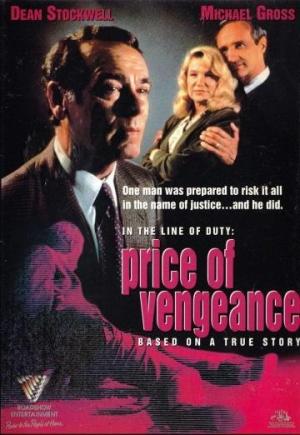
In the Line of Duty: The Price of Vengeance (1994, directed by Dick Lowry)


Johnnie Moore (Brent Jennings) is a former limo driver turned criminal mastermind.  The members of his gang look up to him with cult-like admiration.  On his orders, they have been robbing businesses all over town.  Johnnie says that he is a man of God but he has no hesitation when it comes to ordering his men to threaten and sometimes kill any witnesses.  When Detective Tom Williams (Michael Gross) comes to close to finally convincing someone to testify against the gang, Moore orders his assassination.  When the members of his gang fail to get the job done because none of them want to shoot Tom when his family is around, Johnnie does it himself by dressing up as a clown and gunning Tom down in front of Tom’s son.  That was Johnnie’s biggest mistake because now, he’s got Tom’s best friend, Detective Jack Lowe (Dean Stockwell), after him.

After Street Wars, NBC’s next two In The Line of Duty films both focused on FBI sieges.  Both The Siege at Marion and Ambush in Waco featured true stories of the FBI trying to arrest religious fanatics and having to wait out a stand-off.  Ambush in Waco was controversial because it was not only based on the Branch Davidian stand-off but it was actually filmed while the stand-off was still going on.  Perhaps because of the controversy, The Price of Vengeance tells a much simpler and less exploitive story.  Johnnie Moore is a criminal who kills a cop.  Jack Lowe makes it his mission to put him away.  There’s no risk of anyone watching siding with Johnnie Moore like they may have done with David Koresh while watching Ambush in Waco.  Moore kills a man in front of his son and then laughs about it.  Everyone watching is going to want to see him get punished and they are going to cheer on the efforts of law enforcement to make sure the punishment fits the crime.

The Price of Vengeance is a typical police procedural but it has a good cast.  After playing a killer in the first In The Line of Duty movie and the lead FBI man in the third one, Michael Gross is cast as the victim here and he’s so likable that you’ll be angered when he gets gunned down.  Dean Stockwell brings his no-nonsense, down-to-Earth style to the role of Gross’s best friend and Brent Jennings is smug and evil as Johnnie Moore.  Mary Kay Place, Kathleen Robertson, and Justin Garms play the members of Gross’s family and they all do a good job of showing the trauma that they’ve suffered as a result of his murder.  Keep an eye out for Courtney Gains, playing a member of Moore’s criminal crew.  Gains played this same character in a dozen different films.  If you see Courtney Gains in a movie, look out because he’s up to no good!

The Price of Vengeance is a standard 90s cop show.  Nothing about it will take you by surprise but it’s partially redeemed by its cast.

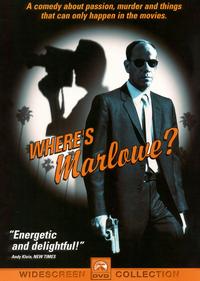
A Movie A Day #109: Where’s Marlowe? (1999, directed by Daniel Pyne)


Two documentarians (Mos Def and John Livingston) decided to make a film about two real-life private detectives, Joe Boone (Miguel Ferrer) and Kevin Murphy (John Slattery).  At first, Boone is skeptical of the two filmmakers.  He watched their last documentary, a three-hour epic about New York’s water supply, and was disappointed by the lack of sex.  However, as the two filmmakers follow him around, he warms up to them and they discover that the tough and sarcastic Boone is actually a soft-hearted idealist who can barely pay the bills.  When Boone discovers that Murphy is sleeping with the wife of one of their clients, their partnership dissolves.  It looks like Boone is going to have to shut down his agency, unless the two filmmakers can help him solve his latest case.
Where’s Marlowe? starts out strong by focusing on Miguel Ferrer’s performance as Joe Boone.  Ferrer did not get to play many leading roles but he was perfectly cast as Joe Boone.  He is completely believable as an old-fashioned private investigator struggling to survive in the modern world.  During the movie’s less interesting second half, the attention shifts to the filmmakers trying to help Boone.  Mos Def and John Livingston are good in their roles but the film’s focus should have stayed on Ferrer.  Unfortunately, the main mystery is never as interesting as Miguel Ferrer’s solid lead performance.

Where’s Marlowe? started out as a pilot and it is easy to see where it would have gone if it had become a television series.  For all of its flaws, it is worth it just to see Miguel Ferrer in a rare leading role.

A Movie A Day #16: Boycott (2001, directed by Clark Johnson)


boycott

Originally made for HBO, Boycott is one of the best and, unfortunately, least-known films made about the life of Martin Luther King, Jr.  Boycott tells the story of the Montgomery Bus Boycott, starting with the arrest of Rosa Parks for refusing to sit in the back of the bus to the eventual integration of the Montgomery public transportation system.  Clark Johnson directs Boycott in a semi-documentary, handheld style, which adds an immediacy to the oft-told story.

Boycott focuses on the role that 24 year-old Martin Luther King, Jr. (played by Jeffrey Wright) played as the leader of the Montgomery Bus Boycott and how the boycott’s success turned King into a national figure.  Jeffrey Wright does a great job playing the young King and it’s interesting to watch as the initially uncertain King finds both his voice and his strength as a leader.  Boycott works as a good companion piece to Selma, not the least because Carmen Ejogo plays Coretta Scott King in both of them.

Also giving a noteworthy performances are Terrence Howard as King’s second-in-command, Ralph Abernathy and Erik Dellums in the role of Bayard Rustin, who was one of King’s closest confidants but, because he was gay, was often left outside of the movement’s inner circle.  Before they worked together on Boycott, Dellums, the son of former U.S. Rep. Ron Dellums, co-starred with Clark Johnson on Homicide: Life on the Street.

Boycott is a tribute to not just Martin Luther King but also the entire civil rights movement.

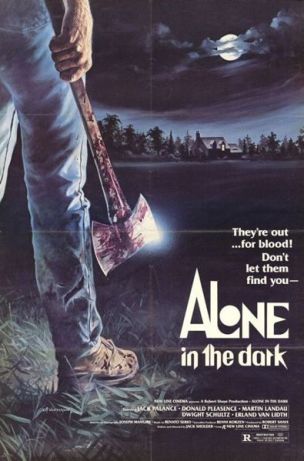
Horror Film Review: Alone in the Dark (dir by Jack Sholder)


Alone_in_the_dark_ver1

“There are no crazy people, doctor.  We’re all just on vacation.”

— Frank Hawkes in Alone In The Dark (1982)

What is the difference between being crazy and being sane?  Why are some forms of delusion considered to be socially acceptable while others are condemned?  Who is the ultimate authority on what is normal and what is abnormal?  These are just some of the issues that are raised by the gleefully subversive 1982 horror film, Alone In The Dark.

We know that there’s something off about Dr. Leo Bain (Donald Pleasence) from the minute we meet him.  His smile is a little too nervous and his constant patter of positive words sound a little bit too rehearsed and convenient.  When he greets another doctor, he insists on hugging him but it’s an awkward hug.  Dr. Bain seems to be trying just a little bit too hard.  (In many ways, Pleasence seems to be poking fun at his best-known role, Halloween‘s intense and dramatic Dr. Loomis.)

Dr. Bain is in charge of a psychiatric hospital.  He doesn’t believe in conventional therapy.  Instead, his hospital is perhaps the most oppressively positive place in the world, a place where every delusion is treated as being perfectly normal and where the patients are treated very leniently.

In fact, security is only present on the third floor of the hospital.  That’s because the third floor is home to four inmates who are criminally insane.  Frank Hawkes (Jack Palance) is a former POW who suffers from paranoia and gets mad whenever he hears anyone curse.  Bryon “Preacher” Sutcliffe (Martin Landau) is a pyromaniac.  Ronald Estler (Erland van Lidth) is a gigantic child molester.  And finally, there’s The Bleeder, who always hides his face.  The Bleeder is a serial killer who is called the Bleeder because, whenever he kills, his nose starts to bleed.

Dr. Bain scoffs at the idea that these four even need security but, as he explains it, the state requires it.  However, one night, the power goes out and the four of them manage to escape.  As they make their way into the nearby town, they rather easily blend into the mob of “normal” people who are using the blackout as an excuse to go looting.

However, these four patients are on a very specific mission.  They had all grown to trust their psychiatrist, Dr. Merton.  However, Dr. Merton was eventually hired away by another hospital.  Frank is convinced — and has convinced the others — that Dr. Merton was murdered by their new psychiatrist, Dr. Dan Potter (Dwight Schultz).  They’re goal now is to track down Dr. Potter and kill him and his family.

Meanwhile, Dr. Potter has issues of his own to deal with.  He’s a nice guy but he’s also a bit too uptight and rational for his own good.  (Early on in the film, he gets upset when his wife tries to get him to go see a band called the Sic Fucks.)  His younger sister, Toni (Lee Taylor-Allan), is visiting while she recovers from a nervous breakdown of her own.  She manages to get arrested while protesting a nuclear power plant and, when she gets out of jail, she insists on bringing another protester, Tom (Phillip Clark), home with her.

It all leads to one long night, during which the inmates lay siege to Dan’s house.  And, all the while, Dr. Bain worries about whether or not they’re all mad at him…

Alone in the Dark may come disguised as a slasher movie but actually, it’s a pitch black comedy, with a lot of the humor coming from the contrast between Dan’s rationality, Bain’s nonstop optimism, and the fact that every one else in the film is literally batshit insane.  The final siege is a masterpiece of suspense and Palance, van Lidth, and especially Martin Landau are memorably frightening in their menacing roles.  The film’s final scene deserves to be iconic.

Alone in the Dark is one of those horror films that definitely deserves to be better known.  Do NOT mistake it for the Uwe Boll film.

http://www.youtube.com/watch?v=WhUA4VAd6_0

Embracing the Melodrama Part II #75: Witness (dir by Peter Weir)


Witness_movieLast night, I was lucky enough to watch Witness, a best picture nominee from 1985.

Taking place in Pennsylvania, Witness tells the story of what happens when an Amish widow named Rachel (Kelly McGillis) and her 8 year-old son Samuel (Lukas Haas) decide to take a trip to visit Rachel’s sister.  Traveling on an Amtrak train, Samuel is amazed by his first view of the world outside of the close-knit and insular Amish society.  However, Samuel’s excitement soon turns to horror when they arrive in Philadelphia and he witnesses a man being brutally murdered.

Detective John Book (Harrison Ford, who received his first and, to date, only Oscar nomination for this film) is assigned to the case and arranges for Rachel and Samuel to stay with his sister.  John soon discovers that the murder was committed by two crooked cops, McFee (Danny Glover, who is pure evil in this film) and Ferguson (Angus MacInnes).  John goes to his superior officer, Chief Schaefer (Josef Sommer) with his evidence.  Soon after, McFee attempts to kill and seriously wounds John.  John realizes that Schaefer must be corrupt as well.

Book manages to drive Rachel and Samuel back to their farm in Lancaster County but, after dropping them off, he passes out from blood loss.  Knowing that sending John to the hospital would reveal Rachel and Samuel’s location to Schaefer, Rachel’s father (Jan Rubes) reluctantly allows John to stay at the farm.

And so, while McFee, Ferguson, and Schaefer search for him, John temporarily pretends to be Amish.  He works in the fields.  He helps to build a barn.  He becomes something of a surrogate father to Samuel and he begins a forbidden flirtation with Rachel.

He also goes to town, where he watches as an idiotic local bullies the Amish, knowing that their religion forbids them from fighting back.  John responds by punching a bully, upsetting both the Amish and the a local store owner who yells that this will be terrible for the tourism.  In many ways, the scene is played for laughs and applause but there’s a very serious subtext here, as it would appear that the area’s main appeal to tourists is that you can humiliate the Amish without having to worry about any sort of retaliation.

While we, as viewers, definitely get some satisfaction from seeing John punch that jackass, it also allows Schaefer to discover where he and Rachel are hiding.  One morning, McFee, Ferguson, and Schaefer pull up outside the farm.  They get out of their car and, as the sun rises and with beautiful green fields on either side of them, the three men hold up their shotguns and start to walk down the road….

Witness may technically be a cop film but it’s actually so much more.  It’s a character study of a deeply cynical man who finds himself changed by simple and innocent surroundings.  It’s a love story, with Ford and McGillis illuminating the screen with their chemistry.  It’s a celebration of community, with the harshness of Philadelphia being contrasted with life among the Amish.  It’s a film full of beautiful images and it also features an excellent performance from Harrison Ford.

It’s a good film.  I’m glad that I witnessed Witness.