Andy Farmer (Chevy Chase) is a New York sports writer who leaves the city and moves to the small town of Rosebud, Vermont so that he can work on his novel. He and his wife, Elizabeth (Madolyn Smith), struggle to adjust to living in a small town. The delivery of their furniture is delayed by the collapse of a covered bridge. When they try to make a phone call from inside their own house, the local operator tells them to deposit ten cents. They were expecting a Norman Rockwell-type town and instead, they find themselves having to pay for the funeral of a man who was buried on their property long before they moved in. When Elizabeth makes more progress writing a children’s book than Andy does with his heist novel, their marriage starts to feel the strain.
Chevy Chase is now so much better known for the stories of his unprofessional and diva-like behavior on film and television sets that it’s easy to forget that he was, at his peak, a very funny actor. Chase may be playing a variation of his put-upon everyman but, compared to the first two Vacation movies, most of the humor in FunnyFarm is very mild. George Roy Hill was a classy director who had been making movies since the 50s and FunnyFarm feels like a throwback to the type of family-friendly comedies that Disney would make in the 60s. That I laughed as much as I did was largely due to Chase’s performance. Whether he was tripping over a Dutch door, reacting to his wife’s dislike of the first few chapters of his new novel, or offering to pay the townspeople $50 to pretend to be nice for a weekend, Chase was consistently funny and even likable. I don’t know if this is the type of performance that Chevy Chase could give today. There’s a bitterness that’s now integral to screen persona and it’s made him into someone who audience want to laugh at instead of with. It’s too bad because FunnyFarm is a reminder of the type of comedic actor that Chevy Chase used to be and who he probably still could be if not for the failed talk show and the infamous Friar’s Club roast.
As for FunnyFarm, it’s an amusing and likable comedy and it still holds up well today. Chase is the key to the film’s success but he’s not the only reason that the film works. I liked the scene where Mike Starr and Glenn Plummer, as the two movers, watch as the bridge they tried to drive over collapses. I even liked the running joke about the two ducks who refused to leave the Farmers’s property. FunnyFarm may not have been a hit when it was first released but it’s since built up a cult following. There will always be a place for a funny comedy that leaves you in a good mood.
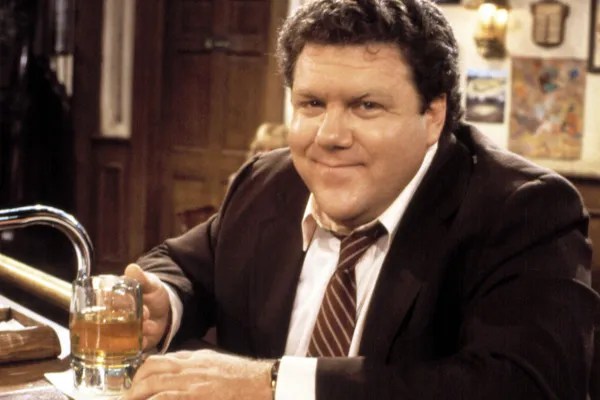
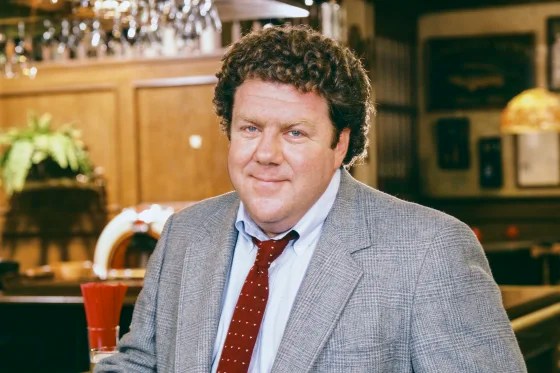
George Wendt passed away in his sleep earlier today. He was 76 years old.
If you’re old enough to have watched Cheers when it originally aired or to have caught it in reruns, George Wendt will always be Norm Peterson, the beer-drinking accountant who spent all of his time at the show’s titular bar. One of the show’s trademarks was that, whenever he entered the bar, everyone greeted him by shouting, “Norm!” “How’s the world treating you?” a bartender would ask. “It’s a dog eat world and I’m wearing milkbone underwear,” Norm once replied.
(One of my favorite joke from the series was when Norm went into a steakhouse and everyone inside was heard to yell, “Norm!” as the door closed behind him.)
If we’re going to be really honest, Norm was probably a high-functioning alcoholic and terrible husband. (Wife Vera was often-mentioned but never seen.) Wendt was so likable in the role and was so good at delivering those one-liners that it didn’t matter. Watching the show, you never wondered why Norm was in the bar. You were just glad he was.
George Wendt was also an accomplished stage actor. (I saw him on stage when he was co-starring with Richard Thomas in 12AngryMen.) He appeared in several movies, usually playing the comedic sidekick or the hero’s best friend. His film roles often didn’t ask him to do much other than be likable but one exception was his performance in 1991’s GuiltyBySuspicion.
GuiltyBySuspicion is a film about the McCarthy era, starring Robert De Niro as film director David Merrill, who is threatened with being blacklisted unless he names four of his colleagues as being communists. George Wendt plays screenwriter Bunny Baxter, a childhood friend of David’s who attended a few communist rallies when he was younger, failed to mention it to the FBI, and who is now being investigated as a subversive. The studio argues that David should name Baxter because his name is already out there. When David refuses, he finds himself blacklisted and unable to make a living. Bunny Baxter, meanwhile, is offered a similar deal. Baxter can save his own career but only if he names David as a communist. Unlike David, Baxter considers betraying his friend because it’s the only way that he can ever hope to work again. “Your dead anyway,” Baxter says to David.
GuiltyBySuspicion suffers from Irwin Winkler’s plodding direction but De Niro gives a good performance, as does Martin Scorsese who is cast as a director based on Joseph Losey. The film is full of actors who would later become better-known, like Chris Cooper, Tom Sizemore, and Annette Bening. Wendt, however, gives the film’s best performance as the screenwriter who is torn between protecting his career and maintaining his integrity. The scene where he asks permission to name Merrill as a communist is powerful and it shows how good an actor George Wendt could be. Bunny Baxter is asking his best friend to allow himself to be stabbed in the back. Baxter is that desperate. That he’s played by George Wendt, an actor who was everyone’s favorite likable barfly in the 80s, makes the scene all the more powerful.
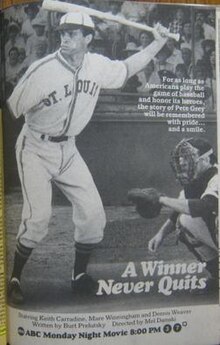
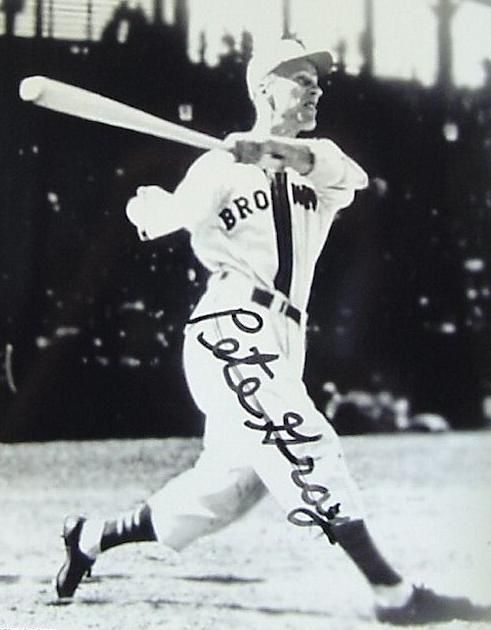
In 1945, Peter Gray made history when he became the first one-armed major league baseball player. Gray grew up in poverty in Pennsylvania. His father was a miner and Peter was one of five children. He was only seven years old when he lost his right arm in a wagon accident but he loved baseball and he wasn’t going to let his disability keep him from playing. He learned how to bat and catch and throw with his left hand. He quit school when he was thirteen and worked for a while as waterboy while playing baseball in the local leagues. Eventually, he made his way up to the minor leagues and, in 1945, he was called up to the majors. He played one season for the St. Louis Browns.
The media loved the story of the one-armed baseball player but Peter always said that he resented feeling like he was being put on display whenever he took the field. He was a competitive outfielder who could catch a ball, remove his glove, and then throw the ball to the infield just as quickly as anyone with two hands. As a hitter, he struggled because pitchers figured out early on that he couldn’t hit the breaking ball. After the 1945 season, Peter was sent to back to the minors, where he spent the rest of his career. Though Peter was known for being an angry player who resented anyone pointing out his disability, he still made time to visit amputees in military hospitals to show them that they could still find success and to encourage them to chase after their dreams.
Peter’s story was the basis of A Winner Never Quits, which I watched on YouTube this weekend. It was a good baseball movie, starring Keith Carradine as Peter. What I liked is that the movie didn’t make him into a saint. Carradine played Peter as being angry and with a definite chip on his shoulder. Peter had every right to be angry and I’m glad the movie acknowledged that. In both the movie and in real life, Peter was worried that he was just being treated as a sideshow. In the movie, his attitude improves when he meets a young boy who recently lost his arm and who looks up to Peter. Peter remained a friend to the boy and his family for the rest of his life. A Winner Never Quits is about pursuing what you love and never giving up. That’s what baseball is all about. A Winner Never Quits is a good and inspiring baseball movie that’s not just for the fans.
Welcome to Retro Television Reviews, a feature where we review some of our favorite and least favorite shows of the past! On Mondays, I will be reviewing Miami Vice, which ran on NBC from 1984 to 1989. The entire show can be purchased on Prime!
This week, another figure from Castillo’s past comes to Miami.
Episode 3.15 “Duty And Honor”
(Dir by John Nicollela, originally aired on February 6th, 1987)
There is apparently some controversy over what this episode should be called. When it originally aired in 1987, it was called The Savage, after the serial killer who is pursued by Castillo. When the episode later turned up in syndication, the title was changed to Duty and Honor, a reflection of the fact that the episode links back to Castillo’s (and, to a lesser extent, Crockett’s) service in Vietnam. Since the imdb has chosen to go with Duty and Honor, I’ve decided to do the same.
The episode opens in Saigon, in the early 70s. A clean-shaved Castillo (with a pony tail!) investigates the ritualistic murder of a prostitute. It’s one of several murders that have occurred over the past few days, with all of the victims being sex workers. Jump forward to Miami in the 80s and prostitutes are now once again being murdered. Castillo recognizes the M.O. and soon, Crockett and Tubbs are investigating the local VA. The doctor (Gary Basaraba) refuses to compromise the confidentiality of what his patients have told him but he does allow Crockett and Tubbs to speak to some of them. One of the patients talks about a mysterious man who was known as The Savage, who was used as an assassin by the CIA. The Savage was obsessed with killing and hated women because one violent encounter led to him getting castrated.
Tranh (Haing S. Ngor), who investigated the Saigon murders with Castillo, comes to Miami and shows Castillo that, whenever an enemy or critic of the United States has been assassinated overseas, it’s always coincided with a serial killer targeting prostitutes. Tranh believes The Savage has come to Miami to assassinate a South American activist who is in town to give a speech. Tranh and Castillo’s investigation leads them to the Savage’s CIA handler, Jack Colman (Brad Sullivan). Colman makes clear that he really doesn’t care what The Savage does on his own time.
And yes, The Savage (played by Michael Wright), is indeed in Miami and he is killing prostitutes. As played by Wright, The Savage is one of the most frightening villains to show up on Miami Vice. He’s a relentless and sadistic killer who has no control over his impulses. The CIA turned him into a weapon of war and now that the war is over, he no longer has a place in the real world. Instead, he’s a nightmare creature who exists to execute anyone who Colman considers to be a threat.
(Around the same time this episode aired, Michael Wright also played the high school gang lord in The Principal.)
Up until the final twist, this episode is Miami Vice at its best — dark, moody, thought-provoking, and morally ambiguous. After spending most of the season staring at the floor, Edward James Olmos finally gets to be the center of the action. Unfortunately, the film ends with Tranh revealing that he was actually a spy for North Vietnam and that he’s now a colonel in the Vietnamese army. He leaves Castillo a note, saying that he hopes they can still be friends and promote the type of peaceful world where nations will not create men like The Savage. And while I agree that the CIA should not be breeding assassins, I still have to say, what’s up with all the pro-commie crap this season, Miami Vice?
Anyway, other than that, this was a good episode. I should mention that Helena Bonham Carter briefly appears as Sonny’s new girlfriend. Apparently, she’ll be the center of next week’s episode.
There was a time in my life, before I could drive, when I would beg my parents to stop at the video store every time we went to the neighboring town of Conway, Arkansas. The town I grew up in was too small to have more than just a gas station, so this movie buff had to take advantage of every trip to town. One night when we were headed home, my parents relented to my repeated requests, so we stopped off at Budget Video. I wanted to choose all the movies, but unfortunately mom and dad would also let my brother and sister choose movies from time to time as well. On this particular night, my brother wanted to rent THE UNTOUCHABLES (1987). I don’t remember what I was wanting, but I do remember that it was not THE UNTOUCHABLES. I probably pouted a little bit, but we ended up taking THE UNTOUCHABLES home with us. We turned it on that night, and I’ll gladly admit that I was 100% wrong. THE UNTOUCHABLES immediately became one of my favorite films. Great job, bro!
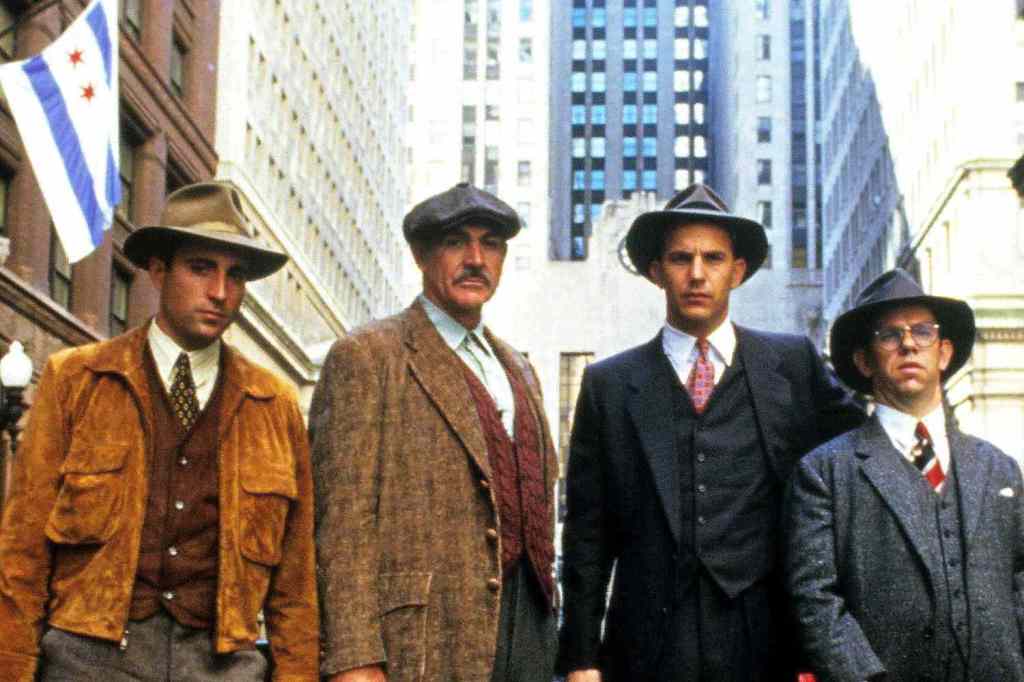
It’s 1930 and Prohibition is the law of the land in the United States of America. Treasury agent Eliot Ness (Kevin Costner) has been given the seemingly impossible task of bringing down notorious gangster Al Capone (Robert De Niro), who supplies booze to nearly all of Chicago. Capone doesn’t just supply the booze, he rules Chicago with an iron fist; and if you’re a local business who doesn’t want to buy his product, he just may blow your ass up! Ness’ job is made especially difficult due to the rampant corruption in Chicago, where everyone from the Mayor, to the judges, lawyers, and law enforcement officers are all on Capone’s payroll, making it pretty much impossible to trust anyone. In a complete stroke of luck, Ness encounters the honest Irish American policeman James Malone (Sean Connery) and asks him to join him in bringing down Capone. With Malone, Ness has found that honest and badass cop who’s not afraid to go up against Capone and his goons. Knowing that most of the police force is already compromised, the two men head to the police academy to try to find another honest cop. This turns out to be another great move as they come upon an Italian American trainee named George Stone (Andy Garcia), who’s a prodigy with a gun. Their last, and greatest move in this humble CPA’s opinion, comes when they accept accountant Oscar Wallace (Charles Martin Smith) to their team. Wallace is convinced that the key to bringing down Capone is trying to build a tax evasion case against him. He’s initially laughed at, but it’s soon apparent that this accountant knows his debits and credits, and his expertise may be just what’s needed to end Capone’s reign of terror once and for all.
I’ve always considered THE UNTOUCHABLES to be a near perfect film. One of the main reasons I find the film so perfect is the direction of Brian De Palma. I’ve been a fan of his “style” for so long, with films like DRESSED TO KILL (1980) and BLOW OUT (1981), but I think he just nails the material here. There are so many great scenes, but the “Union Station” sequence has to be one of the most perfectly choreographed sequences of all time. The building of the tension, the slow-motion shootout when the bad guys arrive, and finally the badass resolution all prove what an absolute master De Palma could be with the right material. De Palma claims that he made up the series of shots as he was filming the scenes at the train station, making the final product that much more impressive. And this all plays out against the background of a “lullaby theme” composed by the legendary Ennio Morricone (THE GOOD, THE BAD, AND THE UGLY). This is what “cinema” is all about.
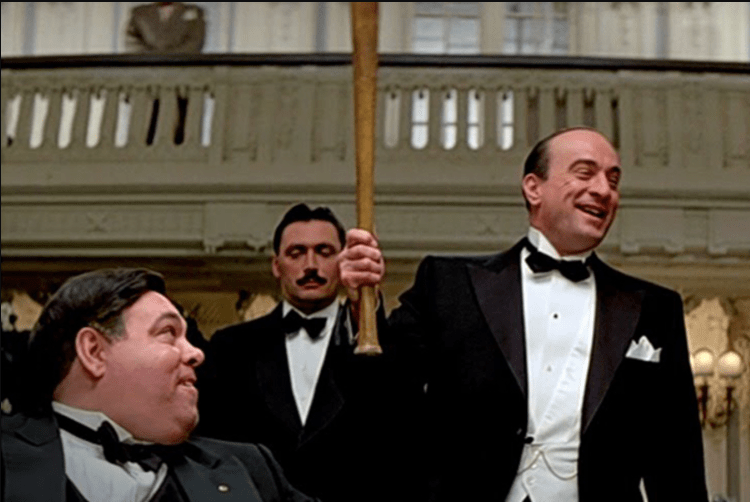
THE UNTOUCHABLES has an amazing cast of actors to bring its “based on real events” story to life. Kevin Costner was just beginning to emerge as a movie star when this movie was made back in 1987. Especially as a younger actor, Costner was good at projecting both a certain innocence, tempered with the willingness to do what it takes to get the job done once his family and friends are put in danger. And what can you say about actors like Sean Connery and Robert De Niro?!! Connery is so charismatic, wise, and tough as the beat cop who shows Eliot Ness how to beat Capone… ”he sends one of yours to the hospital, you send one of his to the morgue!” He’s a beat cop because he’s incorruptible, and Connery projects that stubborn honesty perfectly. I’m so glad that Connery won an Oscar for this performance, as it would be the only time he would ever be nominated for an Academy Award. He’s amazing in this role, even if his accent is Scottish rather than Irish (a notable controversy at the time). Connery may have won the Oscar, but Robert De Niro matches him scene for scene. His ability to make Capone both charismatic and evil in equal measure is an example of what makes De Niro special as an actor. So many actors phone in these types of broad performances, but not De Niro. I also just think it’s cool that De Niro admitted that his performance was heavily influenced by Rod Steiger’s in 1959’s AL CAPONE. I love Steiger and consider this a wonderful tribute. Throw in a young Andy Garcia, the always underrated Charles Martin Smith, and a creepy Billy Drago as Frank Nitti, and you have one of the better casts ever assembled. I especially became a fan of Garcia based on his performance in THE UNTOUCHABLES.
The last person I want to mention is the screenwriter, David Mamet. His screenplay is another perfect element of THE UNTOUCHABLES. The same man who has directed his own films like HOUSE OF GAMES (1987), HOMICIDE (1991), THE SPANISH PRISONER (1997), and SPARTAN (2004) knows how to write a great screenplay. There are so many amazing moments, from the “baseball bat” sequence to the “Stone recruitment” scene, and even Ness’ “he’s in the car” line about Frank Nitti, it’s a muscular screenplay full of big-time moments of audience satisfaction.
At the end of the day, THE UNTOUCHABLES is just a great movie. I still periodically thank my brother for picking it out that fateful day in the late 80’s, and it will always be one of my very favorites. It’s one of those movies that I recommend with zero reservations!
Check out the trailer below, and if you’re smart, you’ll watch one of the great movies of the 1980’s, Brian De Palma’s THE UNTOUCHABLES.
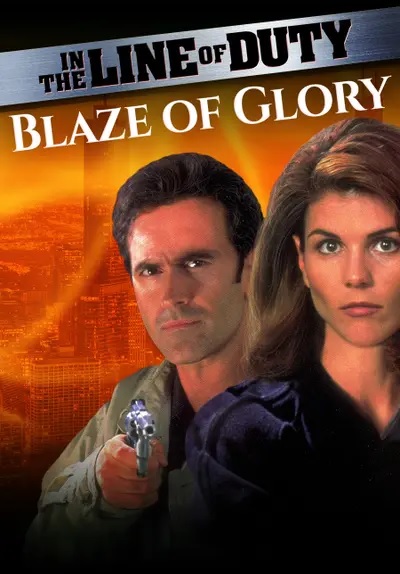
In 1997, NBC’s series of In The Line of Duty movie went out in a blaze of glory with Lori Loughlin and Bruce Campbell!
Lori and Bruce play Jill and Jeff Erickson, an attractive couple who finance their perfect life by robbing banks. Jeff wears an obvious fake beard and, because he’s played by Bruce Campbell, it is easy to initially treat his crime spree as being a big joke. Jeff and Jill use their money to buy a big house and to open up their own used bookstore. Their robberies start to get bigger and more elaborate and Jill goes from being a passive observer to an active participant. Jill gets such a rush from the robberies that she can’t stop. While the press treats the two of them like a modern day Bonnie and Clyde, FBI agent Tom LaSalle (Bradley Whitford) tries to bring them to justice before someone gets killed.
Blaze of Glory is based on a true story. The crime spree of Jill and Jeff Erickson also inspired another film, John McNaughton’s Normal Life, which starred Luke Perry as Jeff and Ashley Judd as Jill. Normal Life is told almost entirely from the point of view of the bank robbers while Blaze of Glory, like all of the In The Line of Duty movies, is firmly on the side of law enforcement. Both films tell the same story and stay fairly close to the facts of the case but it’s interesting to see how behavior that was presented as being romantic and tragic in Normal Life is portrayed as being dangerous and arrogant in Blaze of Glory.
Bruce Campbell and Lori Loughlin are the two main reasons to watch Blaze of Glory. Campbell plays Jeff Erickson as being a slightly smarter version of Ash. Jeff may enjoy running his used bookstore and talking to people about literature but he simply cannot stay out of trouble. He has the confidence necessary to rob a bank but he’s also so reckless that he doesn’t think much about what he’s going to do after he puts on his fake beard and fires his gun at the ceiling. Lori Loughlin, having finally escaped from Full House, gives an uninhibited and sexy performance as Jill, who is never happier than when she’s helping her husband to rob a bank. Eventually, she turns out to be just as reckless as her husband and even more willing to fight her way out of a police chase. Campbell and Louglin are so good that it’s too bad that half of the movie is Bradley Whitford as the lead FBI agent and Brad Sullivan as his father.
After sitting out Kidnapped, Dick Lowry returns to the director’s chair for the final In The Line of Duty and it’s one of the best of the series. The action scenes are exciting and Campbell and Loughlin burn up the screen. Blaze of Glory was the finale of In The Line of Duty but what a way to go!
Last night, after I watched Cutthroat Island, I continued to prepare for Talk Like A Pirate Day by watching The Island, a pirate movie from 1980.
Michael Caine has appeared in some truly bizarre films over the course of his long career but The Island may be the strangest. (According to the imdb, it’s also one of the few films that he refuses to discuss in interviews, which is kind of amazing when you consider some of the films that Caine will discuss.) In The Island, Caine is plays Blair Maynard, a cynical New York journalist who happens to have a cockney accent. Looking to do a story about the Bermuda Triangle, Maynard heads down to Florida. He takes along his 12 year-old son, Justin (Jeffrey Frank), because what father wouldn’t unnecessarily put his only child’s life in danger? Of course, Justin isn’t happy when he finds out that his father lied about visiting Disney World but all is forgiven after Maynard buys him a gun. Justin does love to shoot guns, which will become a plot point soon enough.
Anyway, Maynard and Justin soon discover that the reason people are disappearing in the Bermuda Triangle is because they’re being kidnapped by … wait for it … PIRATES!
David Warner and the Pirates
That’s right, real-life pirates! Apparently, centuries ago, a group of French pirates set up a colony on an uncharted island in the Caribbean. Now, under the leadership of the savage Nau (played by the very British and not very savage David Warner), these pirates spend their time attacking boats, murdering people, and speaking in an odd combination of English, French, and Portuguese. However, centuries of in-breeding have weakened the bloodline. So, while Nau brainwashes Justin and turns him into a little buccaneer, Maynard is given to Beth (Angela Punch McGregor) and told to “thrust thrust.”
Yes, that’s right. This is a film in which a middle-aged Michael Caine — complete with his trademark glasses and his “what the bloody Hell?” attitude — is turned into a sex slave. (Again, this is one of the few films that Caine apparently refuses to discuss.) The scene in which Beth strips the chained Maynard naked and then starts to rub Vaseline on him would be strange regardless of who played the main role but when it’s Michael Caine, it goes beyond the merely strange to becoming almost a work of outsider art.
Anyway, the movie only gets stranger from there as Justin grows to love the pirate life style and, eventually, both he and his father even get to take part in a raid on a schooner. It’s during this raid that, from out of nowhere, a guy in extremely tight shorts pops up and starts doing all sorts of elaborate kung fu moves. (He also makes all of the expected kung fu sounds while David Warner has a good laugh.) It’s also during this raid that the pirates come across several packets of white powder.
“It’s a drug called cocaine,” Maynard says.
“What does it cure?” Beth asks.
“Insecurity,” Maynard answers.
It all leads to not only an impromptu wedding ceremony but also to the sight of Michael Caine screaming his head off while firing a machine gun. I think we’re supposed to feel that the ordeal has driven Maynard somewhat mad but it’s hard to tell. Caine has always been open about the fact that, for many years, he basically just accepted any role that was offered to him and The Island would appear to be a perfect example. Maynard may have been trying to rescue his son but Caine’s main concern was obviously getting his paycheck and moving on to the next role.
Michael Caine in The Island
The Island is one of those movies that’s so odd that it really doesn’t matter whether it’s any good or not. Between the strange plot and Michael Caine’s almost comically detached performance, this one of those films that, once you start watching, you really can’t look away from it. In the end, The Island is so weird and misjudged that it becomes brilliant despite itself.
Yes, indeed. Ghost Story is a horror movie and it does indeed star Fred Astaire. However, Fred doesn’t dance or anything like that in Ghost Story. This movie was made in 1981 and Fred was 82 years old when he appeared in it. Fred still gave an energetic and likable performance and, in fact, his performance is one of the few things that really does work in Ghost Story.
Fred Astaire isn’t the only veteran of Hollywood’s Golden Age to appear in Ghost Story. Melvyn Douglas, John Houseman, and Douglas Fairbanks, Jr. all appear in the movie as well. They play four lifelong friends, wealthy men who have formed an informal little club called The Chowder Society. They gather one a week and tell ghost stories. Myself, I’m wondering why these four intelligent and accomplished men (one is a lawyer, another a doctor, another a politician, and another is Fred Astaire) couldn’t come up with a better name than Chowder Society.
(But I guess that’s something that people do up north. Harvard has something called the Hasty Pudding Club, which just sounds amazingly annoying.)
Unfortunately, the members of the Chowder Society have a deep, dark secret. Way back in the 1930s, the boys listening to too much jazz and they all ended up lusting after the mysterious and beautiful Eva Galli (Alice Krige). As Astaire explains it, “We killed her, the Chowder Society.”
(Of course, there’s more to the story. It was more manslaughter than murder but either way, it was pretty much the fault of the Chowder Society.)
And now, decades later, a woman named Alma (Alica Krige, again) has mysteriously appeared. When she sleeps with David (Craig Wasson), the son of a member of the Chowder Society, David falls out of a window and ends up splattered on the ground below. David’s twin brother, Don (also played by Craig Wasson), returns to their childhood home and attempts to make peace with his estranged father.
However, now the member of the Chowder Society are starting to die. One falls off a bridge. Another has a heart attack in the middle of the night. Fred Astaire thinks that Eva has come back for revenge. John Houseman is a little more skeptical…
I pretty much went into Ghost Story with next to no knowledge concerning what the film was about. I thought the plot desription sounded intriguing. As a classic film lover, I appreciated that Ghost Story was not only Fred Astaire’s final film but the final film of Douglas and Fairbanks as well. Before he deleted his account, I had some pleasant interactions with Craig Wasson on Facebook. I was really hoping that Ghost Story would be a horror classic.
Bleh.
Considering all the talent involved, Ghost Story should have been great but instead, it just fell flat. Alice Krige is properly enigmatic as both Alma and Galli and really, the entire cast does a pretty good job. But, with the exception of exactly three scenes, the film itself is never that scary. (Two of those scary scenes involve a decaying corpse and it’s not that hard to make decay scary. The other is a fairly intense nightmare sequence.) Largely due to John Irvin’s detached direction, you never really feel any type of connection with the characters. I mean, obviously, you don’t want to see the star of Top Hat die a terrible death but that has more to do with the eternal charm of Fred Astaire than anything that happens in Ghost Story.
Add to that, Ghost Story‘s special effects have aged terribly. There are two scenes in which we watch different characters fall to their death and both times, you can see that little green outline that always used to appear whenever one image was super imposed on another. It makes it a little hard to take the movie seriously.
Sadly, Ghost Story did not live up to my expectations. At least Fred Astaire was good…
Earlier tonight, as a part of their 31 Days of Oscar, TCM aired The Sting, the film that the Academy selected as being the best of 1973. I just finished watching it and what can I say? Based on what I’ve seen of the competition (and there were a lot of great films released in 1973), I would not necessarily have picked The Sting for best picture. However, the movie is still fantastic fun.
The Sting reunited the director (George Roy Hill) and the stars (Robert Redford and Paul Newman) of Butch Cassidy and the Sundance Kidand told yet another story of likable criminals living in the past. However, whereas Butch Cassidy largely satirized the conventions of the traditional Hollywood western, The Sting is feels like a loving homage to the films of 1930s, a combination of a gritty, low-budget gangster film and a big budget musical extravaganza. The musical comparison may sound strange at first, especially considering that nobody in The Sting randomly breaks out into song. However, the musical score (which is famously dominated by Scott Joplin’s The Entertainer) is ultimately as much of a character as the roles played by Redford, Newman, and Robert Shaw. And, for that matter, the film’s “let-pull-off-a-con” plot feels like an illegal version of “let’s-put-on-a-show.”
The film takes place in the 1936 of the cultural imagination, a world dominated by flashy criminals and snappy dialogue. When con artists Johnny Hooker (Robert Redford) and Luther Coleman (Robert Earl Jones) inadvertently steal money from a gangster named Lonnegan (Robert Shaw), Lonnegan has Luther murdered. Fleeing for his life, Hooker goes to Chicago where he teams up with Luther’s former partner, veteran con man Henry Gondorff (Paul Newman). Gondorff used to be one of the great con artists but he is now living in self-imposed obscurity, spending most of his time drinking and trying to avoid the FBI. Hooker wants to get revenge on Lonnegan by pulling an elaborate con on him. When Gondorff asks Hooker why, Hooker explains that he can either con Lonnegan or he can kill him and he doesn’t know enough about killing.
The rest of the film deals with Hooker and Gondorff’s plan to con Lonnegan out of a half million dollars. It’s all very elaborate and complicated and a bit confusing if you don’t pay close enough attention and if you’re ADHD like me. But it’s also a lot of fun and terrifically entertaining and that’s the important thing. The Sting is one of those films that shows just how much you can accomplish through the smart use of movie star charisma. Redford and Newman have such great chemistry and are so much fun to watch that it really doesn’t matter whether or not you always understand what they’re actually doing.
It also helps that, in the great 70s tradition, they’re taking down stuffy establishment types. Lonnegan may be a gangster but he’s also a highly respected and very wealthy gangster. When Newman interrupts a poker game, Lonnegan glares at him and tells him that he’ll have to put on a tie before he’s allowed to play. Lonnegan may operate outside the law but, in many ways, he is the establishment and who doesn’t enjoy seeing the establishment taken down a notch?
As entertaining as The Sting may be and as influential as it undoubtedly is (Steven Soderbergh’s Ocean films may be a lot more pretentious — which makes sense considering that Soderbergh is one of the most pretentious directors in film history — but they all owe a clear debt to The Sting), it still feels like an unlikely best picture winner. Consider, for instance, that The Sting not only defeated American Graffiti and The Exorcistbut Ingmar Bergman’s Cries and Whispers as well. On top of that, when you consider some of the films that were released in 1973 and not nominated — Mean Streets, Badlands,The Candy Snatchers, Day of the Jackal, Don’t Look Now, Jesus Christ Superstar, and The Long Goodbye — it’s debatable whether The Sting should have been nominated at all. That’s not a criticism of The Sting as much as it’s an acknowledgement that 1973 was a very good year in film.
So, maybe The Sting didn’t deserve its Oscar. But it’s still a wonderfully entertaining film. And just try to get that music out of your head!
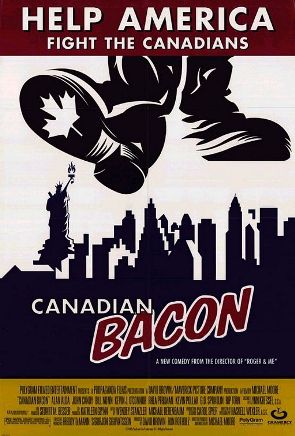
I have mixed feelings about the 1995 films Canadian Bacon.
On the one hand, Canadian Bacon is the only non-documentary to have been directed by Michael Moore. And I’m just going to admit right now that I don’t care much for Michael Moore. I think he’s fake. I think he’s the epitome of the type of limousine liberal who exclusively preaches to the converted and who, when all is said and done, does more harm to his causes than good. Just because he doesn’t shave, dresses like a slob, and apparently has never been to a gym, that doesn’t change the fact that he’s worth $50 million dollars. Just because he may claim to be for the workers, that doesn’t keep him from notoriously overworking and underpaying his own employees. Just because he may make films critical of capitalism, that certainly hasn’t stopped him from investing millions in the very same companies that he claims to oppose. And, quite frankly, it’s hard for me to take seriously a man who rails against income inequality when that man happens to own 9 mansions, none of which are exactly housing the homeless right now.
On the other hand, I love Canada! Canada has produced some of my favorite actors. It’s the country that created Degrassi. It’s the home of Lindsay Dianne and the Becoming A Bolder Being blog! Seriously, how can you not love Canada?
In fact, if a war ever broke out between American and Canada, I’m not sure who I’d support. Then again, hopefully Texas will have seceded from the U.S.A. before that happens. I’m keeping fingers crossed about that. Hopefully, once we have seceded, our first action will be to declare war on Vermont. (Not the rest of America, though. Just Vermont.)
The plot of Canadian Bacon is that the President of the United States (Alan Alda) is suffering from low approval ratings so he decides that America needs to find a new country to be enemies with. Mind you, the President doesn’t necessarily want to go to war. Instead, he just wants to have an enemy that he can always be on the verge of going to war with. After a riot breaks out at a hockey game, the President’s advisors realize that Canada would be the perfect enemy!
(And, while this is played for laughs, there actually is a historical precedent here. The War of 1812 was basically a result of America’s desire to conquer Canada.)
Anyway, American airwaves are soon full of anti-Canada propaganda and, since Michael Moore thinks everyone in America is an idiot except for him, gun-toting rednecks are soon preparing to do whatever it takes to defend America. A patriotic sheriff named Boomer (John Candy) decides to invade Canada on his own. Needless to say, things get even more complicated from there and soon a crazy weapons manufacturer (G.D. Spradlin) is plotting to launch a missile attack on Russia and … oh, who cares?
When Canadian Bacon tries to satirize politics and blind patriotism, it falls flat. Michael Moore has somehow earned a reputation for being a satirist but, if you actually look at his work, it quickly becomes apparent that he really doesn’t have much of a sense of humor. The humor in his documentaries is pretty much based on Moore saying, “Look how stupid everyone is except for me!” Since the people who watch Michael Moore documentaries are usually people who already agree with Michael Moore, they naturally find that to be hilarious because they already think anyone who disagrees with them is a joke. However, that doesn’t mean that Moore himself is a comic genius. He’s just a guy telling a joke to an audience that already knows the punchline.
Canadian Bacon is long on righteous indignation but it’s short on anything that would make you want to spend 90 minutes listening to the same point being made over and over again. Moore did make one good decision, in that he selected Rip Torn to play a crazed general. Rip Torn can deliver militaristic insults with the best of them.
The few times that Canadian Bacon actually works is when it gently (as opposed to indignantly) satirizes Canada’s reputation for being the most polite (and most hockey-obsessed) place on Earth. Dan Aykroyd has a great cameo as a Canadian police officer who pulls over Boomer’s truck and politely reprimands him for not including French translations for all of the anti-Canadian graffiti on the side of the vehicle.
Canadian Bacon could have used more scenes like that.
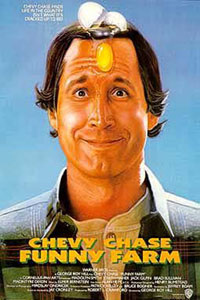 Andy Farmer (Chevy Chase) is a New York sports writer who leaves the city and moves to the small town of Rosebud, Vermont so that he can work on his novel. He and his wife, Elizabeth (Madolyn Smith), struggle to adjust to living in a small town. The delivery of their furniture is delayed by the collapse of a covered bridge. When they try to make a phone call from inside their own house, the local operator tells them to deposit ten cents. They were expecting a Norman Rockwell-type town and instead, they find themselves having to pay for the funeral of a man who was buried on their property long before they moved in. When Elizabeth makes more progress writing a children’s book than Andy does with his heist novel, their marriage starts to feel the strain.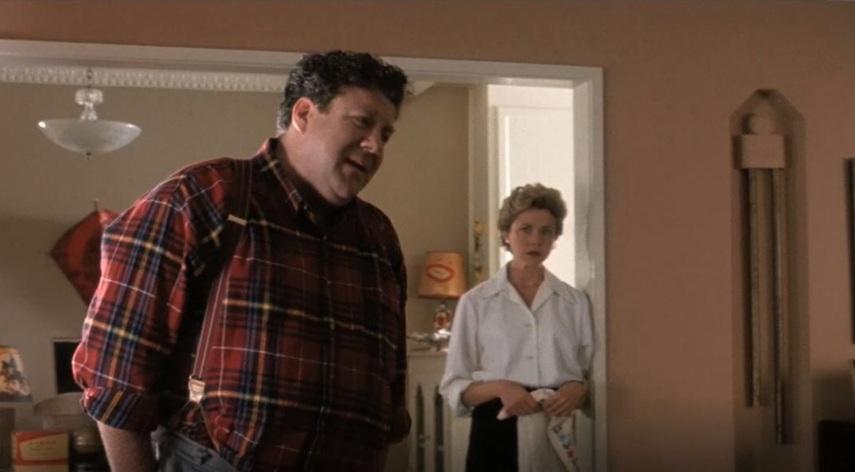




 Through the Shattered Lens