For tonight’s excursion into the world of televised horror, here is the 6th episode of the 2nd season of Thriller!
Introduced by Boris Karloff, Masquerade tells the story of a married couple (Elizabeth Montgomery and Tom Poston) who find themselves checking into a creepy boarding house. If the house looks familiar, that’s because it’s the same house that was used in Psycho!
The house is occupied by a family of cannibals. And who plays the patriarch of this dangerous clan? The always wonderful, theatrical, and intimidating John Carradine!
And, of course, there’s a fun little twist at the end!
This episode originally aired on the day before Halloween, October 30th, 1961.
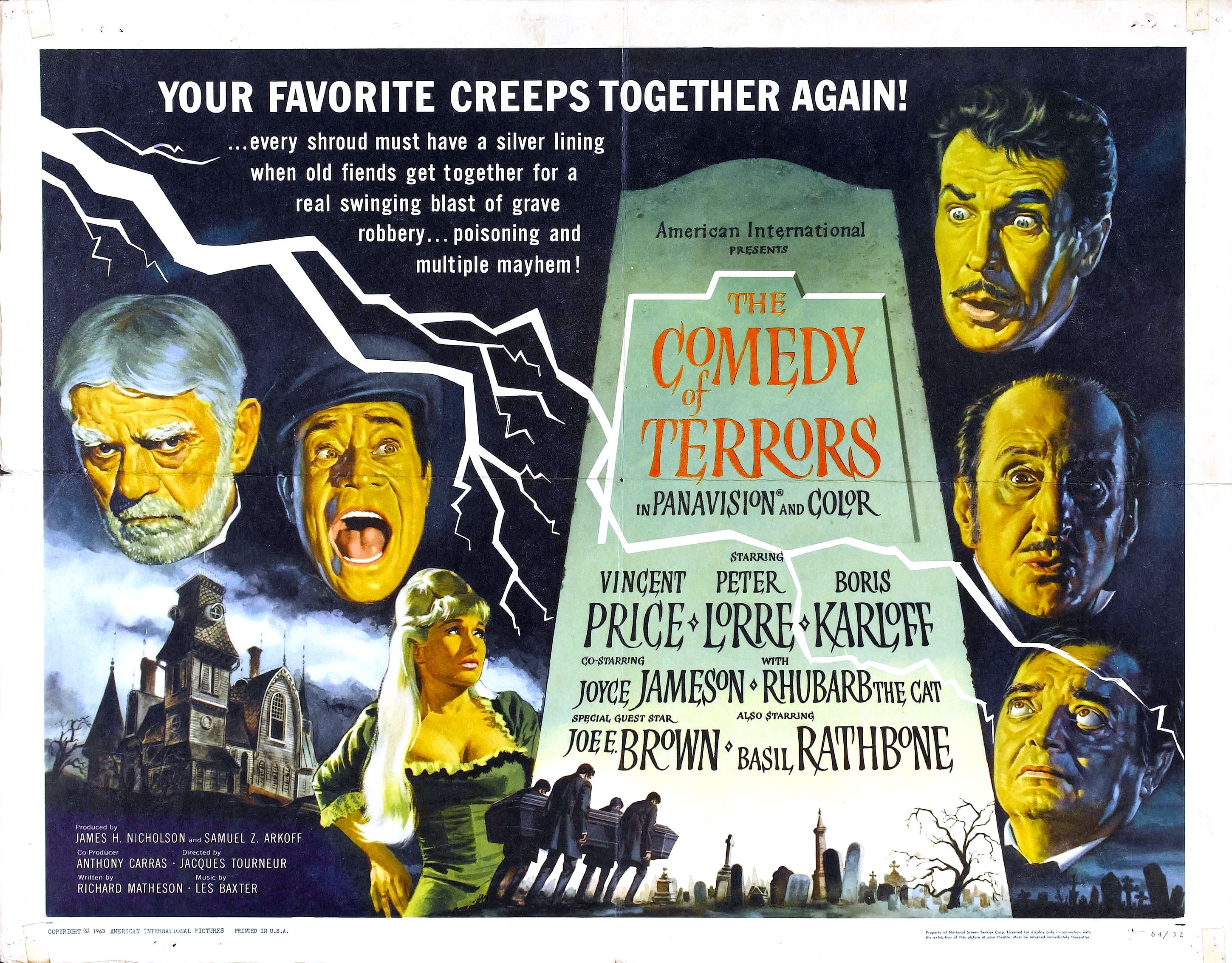
Vincent Price, Peter Lorre, Boris Karloff, and Basil Rathbone had all appeared together on film in various combinations seven different times, but never all at once until THE COMEDY OF TERRORS. This black comedy masterpiece spoofs AIP’s own Poe flicks and Shakespeare, with the quartet of chiller icons having a grand old time playing Richard Matheson’s delicious screenplay to the hilt. Horror and noir vet Jacques Tourneur gets to direct the old pros, and the supporting cast features classic comic Joe E. Brown and Rhubarb The Cat (more on him later!).
Price is Waldo Trumble, the besotted, greedy proprietor of Trumble & Hinchley Funeral Parlor. He’s cruel to wife Amaryllis (Joyce Jameson), a failed opera singer (“I wish her vocal chords would snap”) who he married only to gain control of the company from her doddering old, half-deaf father Amos. “Demon rum will get you yet!”, she tells Waldo, to which…
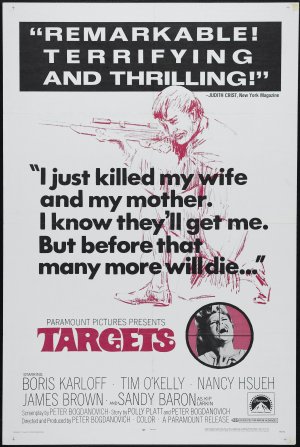
The year was 1968 and legendary producer Roger Corman had aging horror star Boris Karloff under contract. Karloff still owed Corman two days of work and Corman was never one to let an opportunity pass him by. Corman approached film critic Peter Bogdanovich and made him an offer. Corman would finance any film that Bogdanovich wanted to make, on the condition that he stayed under budget, used Boris Karloff, and included some scenes from The Terror. Bogdanovich agreed and the end result was one of the best films of Karloff’s long career.
Karloff plays Byron Orlok. Orlok (named, of course, after the vampire in Nosferatu) is a veteran horror star who now finds himself working almost exclusively in B-movies. When the film starts, he’s just announced his retirement. Orlok is bitter that Hollywood never fully appreciated his talents but, beyond that, he’s come to believe that horror movies can never hope to compete with the horrors of the real world. People have become so desensitized to horror that it’s impossible to scare them, he believes. Orlok plans on making one final promotional appearance at a drive-in that will be showing his final film. (His final film, of course, is The Terror.)
Meanwhile, there’s a man named Bobby Thompson (Tim O’Kelly) and he’s about to shock the world. Bobby has just recently returned from Vietnam. He works as an insurance agent and his cheerfully bland countenance hides the fact that Bobby is going insane. He is struggling to pay the bills and he resents the fact that his wife is now working and that they have to live with his parents. His strict and taciturn father continues to criticize him, especially after Bobby points a rifle at him during target practice. Bobby, incidentally, loves his guns. After he murders both his wife and his mother, Bobby uses that gun to start shooting at strangers.
Bobby starts his rampage by shooting at cars on the freeway but eventually, he ends up at the drive-in. While The Terror plays out on the big screen, Bobby shoots at the men, women, and children who have gathered to watch the movie, proving Orlok’s point that cinematic horror cannot hope to match the horror of everyday life…
Even though it was made 48 years ago, Targets is a film that feels extremely relevant today. As I watched the film, I couldn’t help but think about not only James Holmes’s 2012 rampage in Aurora, Colorado but also the more recent sniper attacks in my hometown of Dallas. For me, it was interesting to see that apparently this stuff was going on even in 1968. (We tend to think of mass shooting as being a recent phenomena.) Targets is an open plea for gun control (which, again, is something that we tend to think of as being a relatively new thing). I’ll leave the political debate for others to consider and instead just say that Targets is a chilling portrait of both madness and violence.
However, Targets also works brilliantly as a tribute to Boris Karloff. Though he may have never been as bitter as Orlok, Karloff is basically playing himself in Targets. He’s portrayed as a cultured and kindly man who just happened to be very good at playing scary characters and Karloff gives perhaps his best performance in the role. Some of the best scenes in Targets are the scenes where Orlok (and, by extension, Karloff) discusses his career with his friend, Sammy Michaels (played by Bogdanovich). You find yourself really wishing that you could have hung out on the set of Targets just to hear the stories that were told while the cameras weren’t rolling.
(Incidentally, Sammy Michaels was named after famed director Sam Fuller, who helped to write the film’s screenplay and provided a good deal of free advice to Bogdanovich.)
Targets works as both a horror film and a tribute to a great actor. If for no other reason, watch it for Boris.
(As some of you may have noticed, I shared this movie last year as well. However, since the video that I embedded in the previous post was subsequently taken down, I figured I might as well post it again this year. Plus, it’s Boris Karloff, Jack Nicholson, and Dick Miller! Why not post it twice?)
Have you ever woken up and thought to yourself, “I’d love to see a movie where a youngish Jack Nicholson played a French soldier who, while searching for a mysterious woman, comes across a castle that’s inhabited by both Dick Miller and Boris Karloff?”
Of course you have! Who hasn’t?
Well, fortunately, it’s YouTube to the rescue. In Roger Corman’s 1963 film The Terror, Jack Nicholson is the least believable 19th century French soldier ever. However, it’s still interesting to watch him before he became a cinematic icon. (Judging from his performance here and in Cry Baby Killer, Jack was not a natural-born actor.) Boris Karloff is, as usual, great and familiar Corman actor Dick Miller gets a much larger role than usual. Pay attention to the actress playing the mysterious woman. That’s Sandra Knight who, at the time of filming, was married to Jack Nicholson.
Reportedly, The Terror was one of those films that Corman made because he still had the sets from his much more acclaimed film version of The Raven. The script was never finished, the story was made up as filming moved alone, and no less than five directors shot different parts of this 81 minute movie. Among the directors: Roger Corman, Jack Hill, Monte Hellman, Francis Ford Coppola, and even Jack Nicholson himself! Perhaps not surprisingly, the final film is a total mess but it does have some historical value.
(In typical Corman fashion, scenes from The Terror were later used in the 1968 film, Targets.)
Tonight’s excursion into televised horror is the very first episode of Boris Karloff’s Thriller!
Thriller was an anthology series that lasted from 1960 to 1962. Each episode presented a new story of horror and/or suspense. What makes this series especially memorable is that each episode was introduced by none other than Boris Karloff! I’ve seen a few episodes of Thriller (the entire series is on YouTube) and, to be honest, it’s kind of a hit-or-miss show. But Karloff and that mischievous twinkle in his eye makes it all worth it!
This episode originally aired on September 13th, 1960. It’s called The Twisted Image and stars Leslie Neilsen as a man being stalked by two mentally disturbed individuals. This episode was well-directed by Arthur Hiller and, if it’s more of a suspense story than a horror story, it still has its creepy moments.
For those who might have a hard time keeping their Universal monster films straight, 1939’s Son of Frankenstein is the third Frankenstein film, following the original and Bride of Frankenstein. It’s the first one to have been directed by someone other than James Whale. It’s the one that features the one-armed policeman. It’s the one that features Bela Lugosi as a vengeful grave robber named Ygor. It’s also the final film in which Boris Karloff would play the monster.
And, on top of all that, it’s also a pretty good movie, one that holds up as both a sequel and stand-alone work!
Son of Frankenstein opens decades after the end of Bride of Frankenstein. (How many decades is open for debate. I’ve read that the film is supposed to be taking place in 1901 but there’s a scene featuring a 1930s-style car. Let’s just compromise and say that the film is taking place in 1901 but someone in the village owns a time machine. I think that’s the most logical solution.) Henry Frankenstein is long dead, but his name continues to strike fear in the heart of Germans everywhere. Someone has even tagged his crypt with: “Heinrich von Frankenstein: Maker of Monsters.”
Needless to say, everyone in the old village is a little uneasy when Henry’s son, Wolf von Frankenstein (Basil Rathbone) shows up at the castle. In fact, they’re so uneasy that the local constable, Krogh (Lionel Atwill), pays Wolf and his family a visit. Krogh explains that, when he was a child, the Monster ripped his arm out “by the roots.” AGCK!
(That said, that really doesn’t sound like the Frankenstein Monster that we all know and love, does it? I suspect there’s more to the story than Krogh is letting on…)
Wolf explains that he has no plans to bring the Monster back to life. He then sets out to do just that. Wolf wants to redeem Henry’s reputation and the only way to do that is to prove that Henry was not misguided in his quest to play God. Helping Wolf out is Ygor (Bela Lugosi). Ygor is a former blacksmith who was due to be hanged but, because of a malfunction with the gallows, he just ended up with a disfigured neck.
It turns out that Ygor happens to know where the Monster’s body is being hidden. When Wolf brings the Monster back to life, he quickly discovers that Ygor’s motives weren’t quite as altruistic as Wolf originally assumed. It turns out that Ygor wants revenge on the jury that sentenced him to death and now, he can use the Monster to get that revenge.
As for the Monster, he no longer speaks. Instead, he just angrily grunts and he kills. Whatever kindness he developed during the previous film was obviously blown up with Elsa Lanchester at the end of Bride of Frankenstein. On the one hand, it’s fun to see Karloff as the monster. On the other hand, it’s impossible not to regret that he doesn’t get to do much other than stumble around, grunt, and strangle people. There are only two scenes where Karloff gets to show any real emotion and, in both cases, he does such a great job that you can’t help but regret that the monster is such a one-dimensional character in Son of Frankenstein.
But no matter! Regardless of how the film uses (or misuses) the Monster, it’s still an entertaining 1930s monster film. Basil Rathbone does a great job as the imperious but ultimately kindly Wolf von Frankenstein. And Bela Lugosi’s natural theatricality makes him the perfect choice for Ygor. To be honest, I actually think Lugosi does a better job as Ygor than he did as Dracula. I know that’s blasphemy to some but watch the two films side-by-side. Lugosi is clearly more invested in the role of Ygor. Considering that Lugosi reportedly felt that he was mistreated in Hollywood, it’s tempting to wonder if some of his own anger informed his performance as the perennially mistreated and bitter Ygor.
Son of Frankenstein closed out the Karloff Frankenstein trilogy. When Frankenstein’s Monster made his next appearance, he would be played by the same actor who later took over the role of Dracula from Lugosi, Lon Chaney, Jr.
(And interestingly enough, Lugosi would subsequently take over the role of the Monster from Chaney. But that’ll have to wait for a future review…)
1935‘s The Bride of Frankenstein is usually described as being a sequel to Frankenstein, but I think it would be better to call it a continuation. In much the same way that all modern YA adaptations seem to be split into two parts, Universal split Mary Shelley’s Frankenstein into two separate films. The bare basics of The Bride of Frankenstein‘s plot — the monster learns to talk and demands that his creator build him a mate — can all be found in the original novel.
(Of course, in the original novel, the monster somehow learns how to speaks like an Oxford grad and Dr. Frankenstein destroys the female monster before bringing her to life. The monster responds by killing Elizabeth. Seriously, Frankenstein is a dark book.)
Bride of Frankenstein features one of my favorite openings of all time. Lord Byron (Gavin Gordon) and Percy Bysshe Shelley (Douglas Walton) are praising Mary Shelley (Elsa Lanchester) and the story that she’s told about how a dedicated scientist played God and created life. Mary informs them that she’s not finished and then proceeds to tell them the rest of the story. It’s a great opening because it lets us know that the rest of what we’re seeing is taking place directly inside of Mary’s mind. It frees the film from the constraints of realism and allows director James Whale to fully indulge his every whim, no matter how bizarre. When you’re inside someone else’s imagination, anything can happen and that’s certainly the feeling that you get as you watch The Bride of Frankenstein.
The Bride of Frankenstein opens with that burning windmill and a wounded Henry Frankenstein (Colin Clive) being carried back to his wife, Elizabeth (Valerie Hobson, replacing Mae Clarke). Gone is the original film’s coda, in which Elizabeth announces that she’s pregnant. And why shouldn’t it be gone? It felt awkward in the first movie and, like any good writer, Mary Shelley is fixing her story as she goes along.
While Henry is recovering, he is approached by a former mentor, Dr. Pretorious (Ernest Thesiger). Dr. Pretorious is undoubtedly an eccentric and definitely a little bit crazy but he believes in Frankenstein’s work. In fact, Dr. Pretorious has even created life on his own! He’s created a bunch of tiny people that he keeps in several glass jars. They’re impressive but, sadly, they’ll never conquer the world. Pretorious wants Frankenstein to, once again, work with him to create life. As Pretorious explains it, it’s time to usher in a new age of “God and monsters!”
(Interestingly enough, one of Pretorious’s henchmen is played by Dwight Frye, who previously played Frankenstein’s henchman, Fritz, in the first film. Frye dies in both films. Reportedly, Universal bestowed upon him the nickname, “The Man of a Thousand Deaths.” It can perhaps be argued that Dwight Frye was both the Steve Buscemi and the Giovanni Lombardo Radice of Universal horror.)
Meanwhile, the monster (Boris Karloff, credited with just his last name because, just four years after Frankenstein and the Mummy, he was already an icon) has survived the burning windmill. He’s lonely, he’s afraid, and he actually kills more people in The Bride of Frankenstein than he did in Frankenstein. And yet, he’s still the film’s most sympathetic character. With everyone constantly trying to kill him, you can understand why the monster is quick to attack every human being that he sees. He’s almost like a dog who, after years of abuse, automatically growls and bears his teeth at anyone that he sees.
And yet, the monster does eventually find a friend. A blind hermit (O.P. Heggie) invites the monster into his own home. (Of course, the hermit does not know who the monster is. He just assumes that monster is a normal man who does not know how to speak.) As time passes, the hermit teaches the monster how to say a few words and also tells the monster that there is nothing worse than being lonely. The monster learns that “Friend good.” The monster even learns how to smoke a cigar and Heggie and Karloff play these roles with such warmth (Bride of Frankenstein is not only the film where the Monster learns to talk, it’s also the one where he learns to smile) that you really start to dread the inevitable scene where everything goes wrong.
And that scene does arrive. Two hunters stop by the hermit’s shack and immediately attack the Monster. The Monster flees. The shack burns down. The hermit is led away from his only friend, apparently destined to be lonely once again.
Eventually, of course, the Monster does get his bride. The Bride is such an iconic character that it’s easy to forget that she only appears in the final ten minutes of the film. Elsa Lanchester plays both Mary and the Bride. She screams when she sees the Monster. “We belong dead,” the Monster replies and my heart breaks a little every time.
So, which is better? Frankenstein or The Bride of Frankenstein? I don’t think it’s necessary to choose one or the other. To use a metaphor that might be appreciated by Henry and Dr. Petorious, Frankenstein is the brain while The Bride of Frankenstein is the heart. They’re two good films that, when watched together, form one great film.
No, not Victor von Frankenstein, though he certainly suffered greatly for playing God. How much he suffered depends on which version of the story you see or read. If you’ve read the book, you know that Victor lost his family, his love, his mentor, his best friend, and eventually his own life. Victor is usually a bit more resilient in the films. For instance, if you go by what we’ve seen in the Hammer films, Baron Frankenstein was pretty much indestructible. The only thing he lost was his sanity, sacrificed as he continually insisted on making the same mistake over and over again.
And when I say “Pity poor Frankenstein,” I’m not referring to the monster either, though he certainly deserves some sympathy as well. The monster never asked to be brought to life. He may have destroyed castles and killed people and tossed little girls into a lake but Frankenstein’s Monster rarely seemed to mean any harm. He was just scared, confused, and often abused.
Instead, when I say pity poor Frankenstein, I’m referring to the 1931 film. It’s a classic horror film, one that, after 85 years, still holds up remarkably well. It’s probably the best directed of all the Universal horror films, with James Whale bringing his own dark wit and idiosyncratic style to the film. As was often the case with films of the era, some of the performances are better than others but no one can find fault with Boris Karloff’s definitive portrayal of Frankenstein’s monster.
And yet, for a lot of filmgoers, Frankenstein will always just be that movie where Colin Clive rants, “It’s alive! IT’S ALIVE!” That scene is justifiably famous but it always bothers me when it shows up as an isolated clip, devoid of context. I’ve seen it used in documentaries. I’ve seen it used on snarky news programs where it’s almost always used to poke fun at someone. I’ve even seen it used in a car commercial.
You’ve seen it too. It’s one of those scenes that everyone has seen, regardless of whether or not they’ve sat through the entire movie:
When you watch this scene without any context, it’s easy to smirk. You might assume that the entire film is Colin Clive ranting and Dwight Frye snorting. It’s only after you’ve seen the entire film that you appreciate Clive’s performance. Throughout the entire first part of the film, Colin Clive plays Henry Frankenstein as being unstable but also rather withdrawn. He’s almost vampiric, hiding inside of his laboratory all day and only coming out at night to rob graves with the hunchbacked Fritz (Dwight Frye). He’s almost a recluse, which is why his fiancée, Elizabeth (Mae Clarke) asks his best friend, Victor (John Boles), and his mentor, Dr. Waldman (Edward Van Sloan, who also played Van Helsing in Dracula) to check in on him.
When the monster does move its hand and Clive shouts, “It’s alive!,” it’s the first sign of true emotion that Frankenstein has shown through the entire film. He’s spent a lifetime dreaming of playing God and, now that he has, it overwhelms his mind. Much like poor Ralph Norton in The Mummy, Clive sees something that defies all reason and he has a breakdown.
I have to admit that, for me, the first third of the film drags. That may not have been as much of a problem in 1931, when audiences were seeing the story for the first time and didn’t already know what was going to happen. In 1931, the slow start undoubtedly helped to build up suspense. But, when seen today, there is a temptation to say, “Get on with it!”
(Of course, I tend to say that with all Frankenstein movies, because I’m impatient and there always seems to be an endless number of scenes people digging graves and stealing brains until we finally get to the good part. If anything, the 1931 Frankenstein doesn’t take as long to get going as some of the later Hammer films, many of which treated the monster as almost an afterthought.)
Fortunately, Frankenstein does get on with it. When the monster finally comes to life and Colin Clive has his moment of divine madness (“This is what it feels like to be God!”), the film shifts in tone. If anything it becomes a bit of a dark comedy. Henry (who is noticeably more subdued after his outburst, a bit like a drug addict who is only now starting to come down after being awake for a week) and his friends now have to not only hide the monster but try to figure out how to deal with it. Every few minutes, it seems like another villager or Frankenstein relative is dropping by the castle. Having created life, Henry now has no idea what to do with it. Being God isn’t as easy as it looks. Having created life, all Henry can now do is keep the doors locked and attempt to go back to living a relatively normal life. In this case, that means preparing for his wedding.
It’s not until the sadistic Fritz torments the frightened monster with a torch that this horror classic truly becomes a horror film. And it’s significant that the true monster here is not Frankenstein’s Monster but instead Fritz. When the monster kills Fritz, he does it out of self-defense. When he strangles Dr. Waldman, it’s because Waldman was about to cut into him with scapel.
And then there’s the little girl. How this scene must have shocked audiences in 1931! It’s still shocking today, because we’re not used to children dying in movies, not even horror movies. Of course, the monster doesn’t mean to hurt the girl. The girl is the first person to show the monster any sort of kindness. It’s just that the monster doesn’t understand that the girl won’t float like the flowers.
The sequence where the girl’s father carries her body into the town square is perhaps one of the most devastating ever filmed. Not only does the father’s grief contrast with the happiness of the villagers but it also contrasts with the attitude of Henry and Elizabeth who are busy preparing from their wedding, ignorant of what Henry’s creation has done.
Or, at least, they are until the monster confronts Elizabeth in her bedroom.
I love that dress.
It all ends, of course, with a confrontation between Henry and his monster and a windmill being set aflame. There’s also a happy coda that, in the best tradition of horror, feels a bit tacked on. Fortunately, those of us who know our film history know that the story didn’t end with this film. It continued with The Bride of Frankenstein, which I’ll be reviewing tomorrow.
As for Frankenstein, it’s a classic and it’s pretty much required viewing for any film lover. Boris Karloff’s performance as the confused and often child-like monster is both poignant and menacing. Watching the film, you just wish that the world had been nicer to him.
(Then again, that approach didn’t exactly work out well for the little girl with the flowers…)
Frankenstein is so much more than just Colin Clive shouting, “It’s alive!” If you haven’t actually sat down watched the entire movie from beginning to end, you owe it to yourself to do so today.
Did H.P. Lovecraft enjoy movies? I’d love to think that he did but in all probability, he didn’t. After all, Lovecraft frequently wrote, in both his fiction and his personal correspondence, that he found the modern world to be “decadent.” He was not a fan of technological development, viewing it as being the source of civilization’s decline.
In all probability, Lovecraft did not enjoy the movies. When The Mummy was first released in 1932, it’s probable that Lovecraft did not rush out to a local Providence movie theater and buy a ticket.
And, really, that’s a shame. Of the many horror films released by Universal Pictures in the 1930s, The Mummy was perhaps the most Lovecraftian. The bare bones of the film’s plot could have easily been lifted from one of Lovecraft’s stories: a group of rational and educated men are confronted with an ancient evil that defies all reason. When the title character is brought back to life by a man foolishly reading from the fictional Scroll of Thoth, one is reminded of not only the Necronomicon but also of the dozens of other fictional-but-plausible texts that have appeared in the works of both Lovecraft and his successors. Just the sight of the Mummy coming back to life causes one man to have an immediate nervous breakdown, a fate shared by almost every Lovecraft protagonist who was unfortunate enough to learn about Cthulhu, Azathoth, and the truth concerning man’s insignificant place in the universe.
The story of The Mummy goes something like this: In ancient Egypt, a priest is caught trying to bring his dead lover back to life and, as punishment, he is mummified alive and locked away in a tomb. Centuries later, a group of explorers discover the tomb. The mummy comes back to life and, ten years later, he abducts the woman (played by the very beautiful Zita Johann) whom he believes to be the reincarnation of his former love.
I’ve watched The Mummy a few times and one thing that always surprises me is how little we actually see of the Mummy as a mummy. After he’s accidentally resurrected by Ralph Norton (Bramwell Fletcher), the Mummy steps out of his sarcophagus and stumbles out into the streets of Cairo, leaving a now insane Norton to giggle incoherently about how the mummy just stepped outside for a walk. That is pretty much the last time that we ever see the Mummy wrapped up in bandages. When we next see the Mummy, he’s going by the name Ardath Bey and he bears a distinct resemblance to Boris Karloff.
Karloff gives one of his best performance as the sinister and calculating Bey. Of all the horror films that were released by Universal in the 1930s, The Mummy is perhaps the only one that can still be considered to be, at the very least, disturbing. That’s largely due to the fact that, as played by Karloff, Bey is the epitome of pitiless and relentless evil. I’m always especially shaken by the scene in which Bey uses his magical powers to make a man miles away die of a heart attack. It’s not just the fact that Bey has the power to do something like this. It’s that Bey seems to get so much enjoyment out of it. There’s a sadistic gleam in Karloff’s eyes during these scenes and his expression of grim satisfaction is pure nightmare fuel.
Just compare Bey to the other Universal monsters: The Invisible Man was driven insane by an unforeseen side effect of his formula. Frankenstein’s Monster was destructive because he didn’t know any better. The Wolf Man spent five movies begging people to kill him and put him out of his misery. And while Dracula was certainly evil, he had as many limitations as he had power. He couldn’t go out in daylight. He was easily repelled by both crosses and garlic. He often didn’t do a very good job of hiding his coffin. Ardath Bey, on the other hand, was not only evil but apparently unstoppable as well.
The rest of the cast is pretty much overshadowed by Karloff but fans of the old Universal horror movies will enjoy picking out familiar faces. They’ll recognize David Manners from Dracula. Edward Van Sloan also shows up here, fresh from playing Van Helsing in Dracula and Dr. Waldman in Frankenstein. But ultimately, it is Karloff who dominates the film and that’s the way it should be. There’s a reason why Boris Karloff could get away with only his last name appearing in the credits. He was an icon of both cinema and horror and The Mummy reminds us why.
For a film that was first released 84 years ago, The Mummy holds up surprisingly well. There have been countless movies about homicidal mummies over the years but none have yet to match the original.
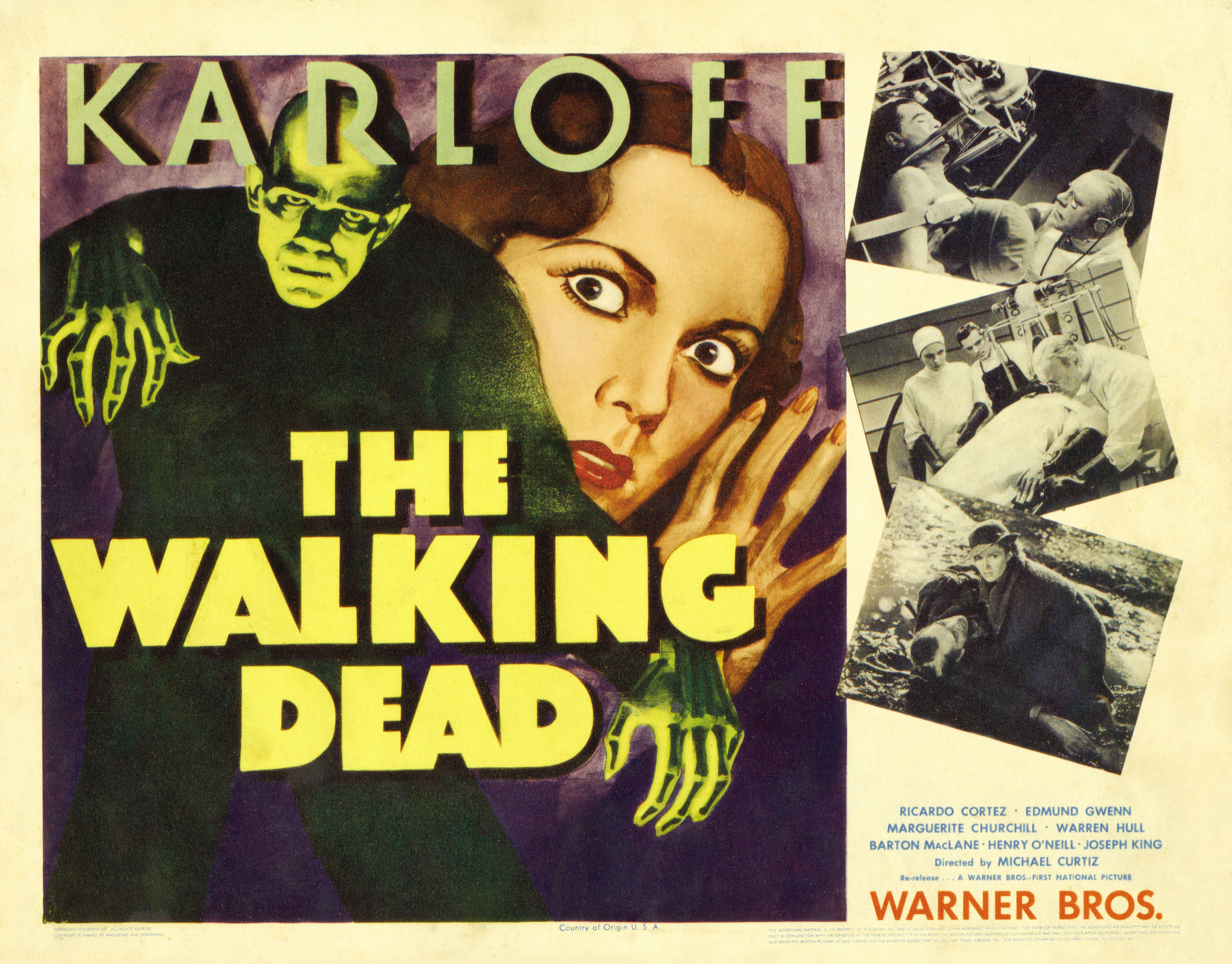
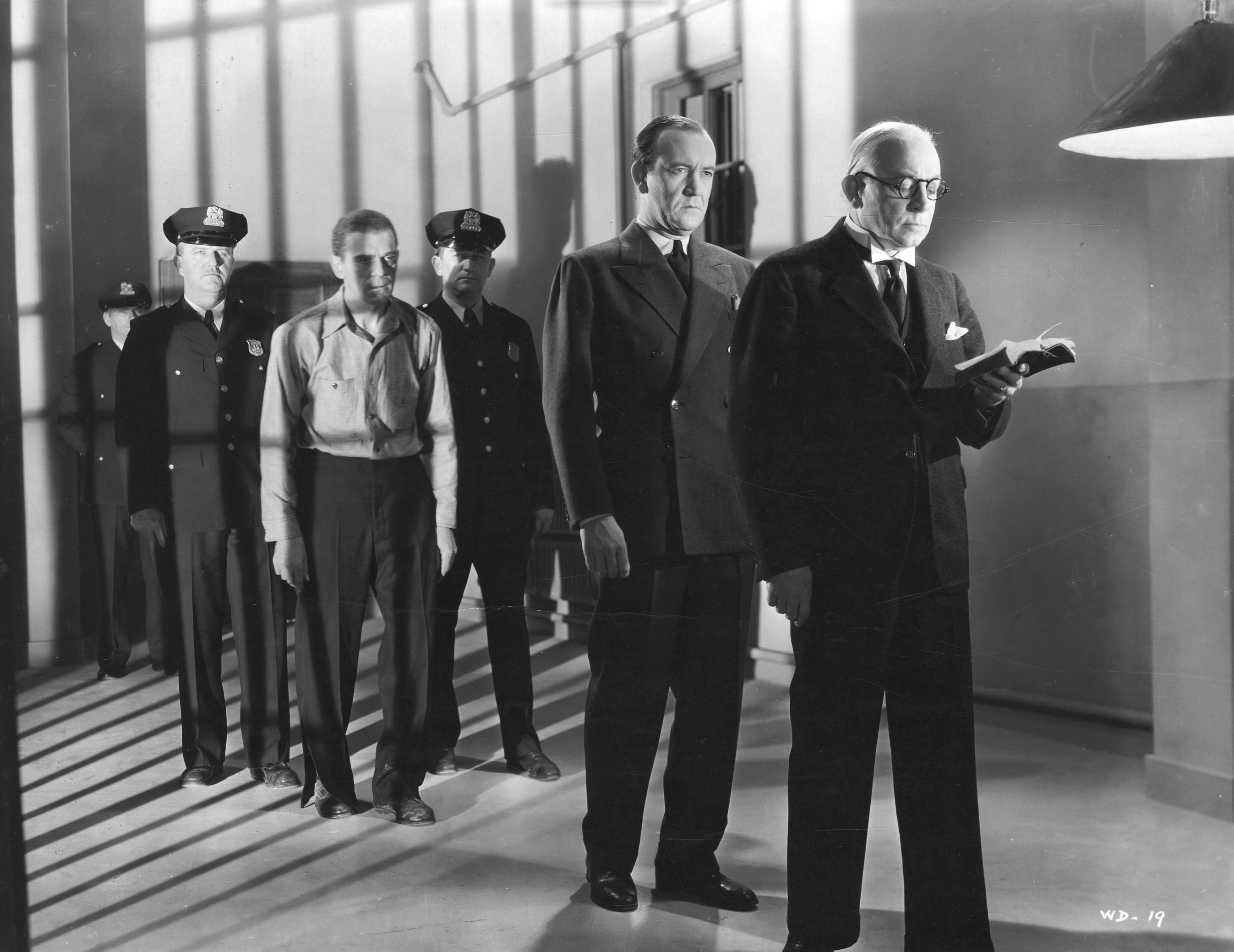
1936’s THE WALKING DEAD has absolutely nothing to do with the wildly popular AMC TV series. This WALKING DEAD stars Boris Karloff , making the first of a five-picture deal he signed with Warners, an interesting hybrid of the gangster and horror genres about an unjustly executed man who’s revived by science exacting vengeance on those who set him up. The result was a fast paced (clocked at 66 minutes) entry in the first horror cycle, and one of the last horror films made until their 1939 revival (more about that later).
Boris stars as John Ellman, newly released from a stretch in prison. A gangland cartel, looking to get rid of a law-and-order judge, set Ellman up as a patsy, hiring him to stake out the judge’s home, murdering the guy, and dumping the body in Ellman’s car. He goes on trial, defended by crooked lawyer Nolan, and sentenced to death…



 Through the Shattered Lens