Horror Film Review: The Ghoul (dir by T. Hayes Hunter)


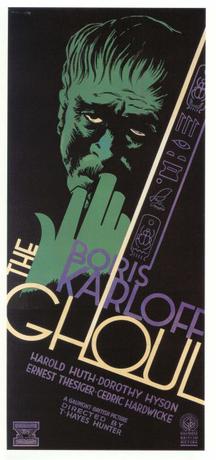
Some actors can make just about anything worth watching.  That’s certainly the case with Boris Karloff and 1933’s The Ghoul.

In The Ghoul, Karloff plays Prof. Henry Moriant.  The professor is an Egyptologist, a world-renowned expert on the dead.  Moriant is now facing death himself, sick in bed and ranting about how he wants to be treated after he passes.  Nigel Hartley (Ralph Richardson) stops by the mansion while pretending to be a vicar and offers to comfort Prof. Moriant in his last moments.  The butler, Laing (Ernest Thesiger), explains that Moriant has never had much use for traditional religion.  Instead, Moriant believes in the Gods of Egypt.

In death, Moriant wants to be buried with an Egyptian jewel in his hands.  He believes that, after he dies, he will exchange the jewel with the Egyptian God Anubis and he will be reborn with amazing powers.  However, when Moriant passes, Laing keeps the jewel for himself and attempts to hide it from the countess number of people who show up at the mansion, all seeking either the jewel or just information about Moriant’s estate.  Moriant may not have been loved in life but everyone clearly loves his money.

Boris Karloff is not actually in that much of The Ghoul.  He dominates the start of the film, ranting from his deathbed.  And then, towards the end of the film, he rises from the dead and attacks those who he thinks have betrayed him and stolen the jewel.  He’s only onscreen for a few minutes but he dominates those minutes.  Karloff’s screen presence is undeniable.  When he’s in a scene, he’s the only person that you watch.  When he’s not in a scene, you find yourself wondering how long it’s going to take for Karloff to return.

That’s not to say that the other actors in The Ghoul aren’t good.  The cast is full of distinguished names.  Along with Richardson and Thesiger, Cedric Hardwicke, Anthony Bushnell, Dorothy Hyson, and Kathleen Harrison all wander through the mansion and try to avoid getting caught up in Karloff’s vengeance.  Harrison provides the film’s comic relief and I actually enjoyed her flighty performance.  The film itself is so darkly lit and full of so many greedy characters that it was nice to have someone on a totally different wavelength thrown into the mix.  That said, the majority of the actors are stuck with paper-thin characters and aren’t really allowed the time to make much of an impression.  This is Karloff’s film, from the beginning to end.  And while the film itself is definitely a bit creaky, Karloff is always enjoyable to watch.

The Ghoul was made at a time when Karloff, having become a star with Frankenstein, was frustrated with the roles that he was being offered in America.  He returned to his native UK and promptly discovered that he was just as typecast over there as he was in the United States.  For a long time, The Ghoul was believed to be a lost film.  However, in 1968, a copy was discovered in Egypt of all places.  It’s unfortunate that the film itself isn’t better but there’s no denying the power of Karloff the performer.
 

6 Trailers For October 13th, 2025


For today’s edition of Lisa Marie’s Favorite Grindhouse And Exploitation Film Trailers, we share some trailers from the maestro of Italian horror, Mario Bava!

  1. Black Sunday (1960)

After starting his career as a cinematographer and a visual effects engineer, Mario Bava made his directorial debut with 1960’s Black Sunday, starring Barbara Steele!

2. Black Sabbath (1963)

In 1963, Bava directed one of his most popular films, the horror anthology Black Sabbath.  The trailer put the spotlight on the great Boris Karloff.

3. Planet of the Vampires (1965)

One of Bava’s best films, Planet of the Vampires, was later cited by many as an influence on the Alien films.

4. Bay of Blood (1971)

One of the first slasher films, Bay of Blood was also a social satire that featured Bava’s dark sense of humor.

5. The House of Exorcism (1974)

When it was released in the United States, Bava’s Lisa and the Devil was re-titled House of Exorcism and, after new scenes were filmed, sold as a rip-off to The Exorcist.

6. Shock (1977)

Bava’s final film as a director was Shock, which starred Daria Nicolodi as a woman who is being haunted by the ghost of her first husband.

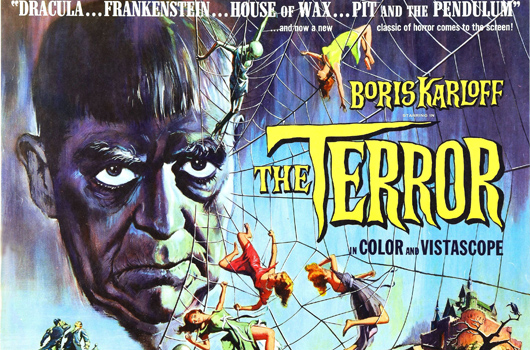
Horror On The Lens: The Terror (dir by Roger Corman, et al)


Today, we’ve got a treat!

Who wouldn’t love to see a movie where a youngish Jack Nicholson played a French soldier who, while searching for a mysterious woman, comes across a castle that’s inhabited by both Dick Miller and Boris Karloff?

In Roger Corman’s 1963 film The Terror, New Jersey-accented Jack Nicholson is the least believable 19th century French soldier ever.  However, it’s still interesting to watch him before he became a cinematic icon.  His performance here is rather earnest, with little of the sarcasm that would later become his trademark.  Boris Karloff is, as usual, great and familiar Corman actor Dick Miller gets a much larger role than usual.  Pay attention to the actress playing the mysterious woman.  That’s Sandra Knight who, at the time of filming, was married to Jack Nicholson.

Reportedly, The Terror was one of those films that Corman made because he still had the sets from his much more acclaimed film version of The Raven.  The script was never finished, the story was made up as filming moved alone, and no less than five directors shot different parts of this 81 minute movie.  Boris Karloff’s scenes were filmed first, with the other actors performing in front of a body double during their scenes.  Among the many directors who filmed bits and pieces of The Terror: Roger Corman, Jack Hill, Monte Hellman, Francis Ford Coppola, Coppola’s roommate Dennis Jakob, and even Jack Nicholson himself!  (Despite this number of directors involved, Corman received the sole directorial credit.)  Perhaps not surprisingly, the final film is a total mess but it does have a definite historical value.

(In typical Corman fashion, scenes from The Terror were later used in the 1968 film, Targets.  In that film, Karloff plays a version of himself, an aging horror actor who watches The Terror and dismisses it as being “terrible.”)

Check out The Terror below!

Horror on the Lens: The Ghost In The Invisible Bikini (dir by Don Weis)


In 1965’s The Ghost In The Invisible Bikini, the recently deceased Hiram Stokely (Boris Karloff) is informed that he has just 24 hours to perform a good deed and get into Heaven.  He also has 24 hours to keep Basil Rathbone from stealing his estate.  Hiram teams up with the ghost of his his dead girlfriend (Susan Hart) and together, they help Hiram’s real heir throw a pool party!

I know, I know.  That makes no sense.  Go with it, it’s the 60s and it’s a party.  The film is silly even by the standards of the typical beach party film but it features Boris Karloff and Basil Rathbone somehow managing to maintain their dignity and Nancy Sinatra singing a song.  (Dean Martin’s daughter, Claudia, also makes an appearance.)  Even more importantly, this is a film that epitomizes an era.  Released in 1965, this was the last AIP beach party movie and it’s a product of the innocent, fun-loving early 60s that would soon be replaced by the violent turmoil of the late 60s.  Hiram was probably happy that he got out when he could.

Here is The Ghost In The Invisible Bikini:

Here Is Boris Karloff For Butternut Coffee


Happy Halloween!

The afternoon hours are approaching and soon, the sun will go down and the trick or treaters will be demanding candy.  If you’re still having a hard time reaching the status of being fully alert on this all-important day, why not have some coffee with Boris Karloff?  From 1966, here is Boris Karloff for Butternut coffee:

Scenes I Love: The Monster Escapes In Bride of Frankenstein


Today’s scene comes from 1935’s Bride of Frankenstein.  The villagers want to execute the Monster (Boris Karloff).  The Monster has other ideas.

This scene epitomizes what made the first two Karloff Frankenstein films so effective.  As scary and as destructive as the Monster may be, he’s nowhere near as bad or deliberately sadistic as the humans around him.  He’s a monster who is definitely more of a victim than a victimizer, someone who has been cruelly tossed into a world that he doesn’t understand and who has been persecuted nonstop since the moment he was created.  It’s hard not to feel sorry for Karloff’s Monster, no matter what he does.  And it’s hard not to cheer a little when he escapes, even though it does inevitably lead to more tragedy and heartbreak.

Horror on the Lens: The Terror (dir by Roger Corman, Francis Ford Coppola, Jack Hill, Monte Hellman, Dennis Jakob, and Jack Nicholson)


Have you ever woken up and thought to yourself, “I’d love to see a movie where a youngish Jack Nicholson played a French soldier who, while searching for a mysterious woman, comes across a castle that’s inhabited by both Dick Miller and Boris Karloff?”

Of course you have!  Who hasn’t?

Well, fortunately, it’s YouTube to the rescue.  In Roger Corman’s 1963 film The Terror, Jack Nicholson is the least believable 19th century French soldier ever.  However, it’s still interesting to watch him before he became a cinematic icon.  (Judging from his performance here and in Cry Baby Killer, Jack was not a natural-born actor.)  Boris Karloff is, as usual, great and familiar Corman actor Dick Miller gets a much larger role than usual.  Pay attention to the actress playing the mysterious woman.  That’s Sandra Knight who, at the time of filming, was married to Jack Nicholson.

Reportedly, The Terror was one of those films that Corman made because he still had the sets from his much more acclaimed film version of The Raven.  The script was never finished, the story was made up as filming moved alone, and no less than five directors shot different parts of this 81 minute movie.  Among the directors: Roger Corman, Jack Hill, Monte Hellman, Francis Ford Coppola, and even Jack Nicholson himself!  Perhaps not surprisingly, the final film is a total mess but it does have some historical value.

(In typical Corman fashion, scenes from The Terror were later used in the 1968 film, Targets.)

Check out The Terror below!

Celebrate Halloween With The Covers of Boris Karloff Tales of Mystery!


Published by Gold Key Comics, Boris Karloff Tales of Mystery ran from 1963 to 1980.  The first few issues contained stories based on episodes of the Boris Karloff-hosted anthology series, Thriller, but later issues featured original tales of horror, science fiction, and mystery, all of which were introduced by a comic book version of Boris Karloff.  Today, to help us celebrate Halloween, here is a sampling of the covers of Boris Karloff Tales of Mystery!

Artist Unknown

Artist Unknown

by George Wilson

by George Wilson

by George Wilson

by George Wilson

by George Wilson

by George Wilson

by Jesse Santos

by Luis Dominguez

by Luis Dominguez

6 Trailers For October 30, 2023


For today’s edition of Lisa Marie’s Favorite Grindhouse And Exploitation Film Trailers, we share some trailers from the maestro of Italian horror, Mario Bava!

  1. Black Sunday (1960)

After starting his career as a cinematographer and a visual effects engineer, Mario Bava made his directorial debut with 1960’s Black Sunday, starring Barbara Steele!

2. Black Sabbath (1963)

In 1963, Bava directed one of his most popular films, the horror anthology Black Sabbath.  The trailer put the spotlight on the great Boris Karloff.

3. Planet of the Vampires (1965)

One of Bava’s best films, Planet of the Vampires, was later cited by many as an influence on the Alien films.

4. Bay of Blood (1971)

One of the first slasher films, Bay of Blood was also a social satire that featured Bava’s dark sense of humor.

5. The House of Exorcism (1974)

When it was released in the United States, Bava’s Lisa and the Devil was re-titled House of Exorcism and, after new scenes were filmed, sold as a rip-off to The Exorcist.

6. Shock (1977)

Bava’s final film as a director was Shock, which starred Daria Nicolodi as a woman who is being haunted by the ghost of her first husband.

Horror Film Review: The Raven (dir by Roger Corman)


“Shall I ever see the rare and radiant Lenore again?” — Dr. Erasmus Craven (Vincent Prince)

“How they Hell should I know?” — Dr. Adolphus Bedlo (Peter Lorre)

This exchange comes from Roger Corman’s 1963 film, The Raven, and it pretty much epitomizes the film.  Very loosely based on the poem by Edgar Allan Poe, The Raven was one of the many Poe adaptations that Corman did with Vincent Price.  As opposed to the other films in Corman’s Poe cycle, The Raven was a flat-out comedy, one that parodied the other films in the cycle.  Reportedly, Peter Lorre improvised his response to Vincent Price’s question about Lenore.  In fact, Lorre improvised a good deal of his performance and his jokes sometimes even took Corman by surprise.  As a result and despite the fact that Richard Matheson did write a script for the film, The Raven is one of those films that feels like it was made up while the camera was rolling.

The Raven is a film about three sorcerers who are always fighting and arguing with each other.  Dr. Erasmus Craven (Vincent Price) spends his time mourning the late Lenore.  The evil Dr. Scarabus (a frail-looking Boris Karloff) has his own castle where he lives with the ghost of the late Lenore (Hazel Court).  Dr. Adolphus Bedlo (Peter Lorre) is a sarcastic ne’er-do-well who saw Lenore in Scarabus’s castle and was transformed into a talking raven as a result.

In raven form, Dr. Bedlo flies over to Craven’s castle and convinces Craven to transform him back into human form.  After informing Craven that Scarabus has Lenore’s ghost in his castle, the heart-broken Craven decides to head over to Scarabus’s castle and get some answers.  Accompanying the group is Craven’s daughter, Estelle (Olive Sturgess) and Bedlo’s son, Rexford (Jack Nicholson, looking somewhat lost in the role of a boring young man).

At the castle, Scarabus puts on an act of being a friendly and gracious host but the opposite soon turns out to be true.  In fact, the entire castle is full of secrets and it quickly turns out that hardly anyone — with the exception of Estelle and Rexford — are who they actually claim to be.  It leads to a battle in magic between Craven and Scarabus.  I nearly described their battle as being “epic” but that’s probably not the right world.  It’s epic by the standards of Roger Corman but actually, the big battle is just as jokey as the rest of the film.

The Raven is definitely not a film that’s meant to be taken seriously.  One gets the feeling that Corman knew that the presence of Price, Karloff, and Lorre would make the film a success no matter what the film was like so he decided to have some fun with it.  (Price and definitely Lorre appear to have been in on the joke while Karloff was perhaps a bit less so.)  To be honest, the film’s only earnest moments come courtesy of Oliva Sturgess and Jack Nicholson but, because Nicholson is Nicholson, you watch those earnest moments waiting for Rexford to arch an eyebrow or flash that devilish grin.  Unfortunately, he doesn’t.  Jack is pretty boring here.

The Raven, if we’re going to be honest, is probably too jokey for its own good but it’s still hard to resist the charm of Price, Lorre, and Karloff.  The film is a chance to see three horror icons acting opposite each other and, as a result, it’s a fun film for horror fans.  Vincent Price breaks the fourth wall at the end of the film and it’s hard not to love it.