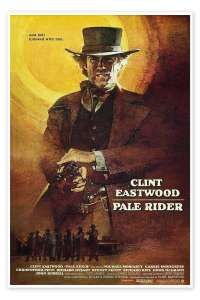
Pale Rider (dir. by Clint Eastwood)


We continue the Shattered Lens’ celebration of Clint Eastwood with 1985’s Pale Rider, one of my favorites. This was a film my long time friend Jay shared with me many years ago, as he owns most of Eastwood’s library of films. I like to think of it as a softer version of Eastwood’s own High Plains Drifter, which my father loved, but I couldn’t really get. It’s a tale of vengeance, but wrapped more in miracles. 

You should first know that Westerns aren’t really my genre when it comes to film types I often watch. I don’t have a lot of historical background when it comes to Westerns overall. If you asked for a short list of my favorites, I’d give up Rustler’s Rhapsody (it’s a fun comedy), The Good, The Bad & The Ugly (my Dad watched it often), Blazing Saddles, and in terms of books, the first few books of Stephen King’s The Dark Tower. I only recently watched Shaneafter Logan was first released, and I love the Red Dead Redemption games.

Pale Rider takes place in California around the time of the gold rush. Outside the town of LaHood, named after the wicked Coy LaHood (Richard Dysart, The Thing), we have a group of miners settled in that are hoping to strike it rich. It’s somewhat difficult with LaHood’s henchmen trying to drive them out at every turn, to steal the land. Hull Barrett (Michael Moriarty, Q The Winged Serpent) hopes to be successful, living with his fiancé Sarah (Carrie Snodgress, The Fury) and her daughter, Meghan (Sydney Penny, The Wife He Met Online). The most recent attack from LaHood’s men has shattered the miners’ morale and few are spared. Even Meghan’s dog is killed, causing her to wish for a miracle.

When LaHood’s son, Josh (Chris Penn, True Romance) and some other baddies (including The Thing‘s Charles Callahan, reuniting with Dysart) confront Hull, a stranger steps in. He handles them all easily with an axe handle, and as thanks, Hull welcomes him to the Miners area for room and board. Of course, having a stranger brings up all sorts of questions from the townsfolk, who don’t appear to be too trusting. Is he an outlaw, possibly? Even Meghan’s a little apprehensive at first, with her quote from Revelations 6:8 forshadowing the Pale Rider’s presence. Everyone is put at ease when they find our stranger is actually a Preacher, though Hull is still a bit curious about the six bullet sized scars on the man’s back. Can the Preacher help the Miners keep their land and stop LaHood? 

From a casting standpoint, Pale Rider is damn near perfect. Although Eastwood is the main star in his own film, he comes across more as an accessory for everyone else in scenes. Moriarty does most of the heavy lifting, as does Snodgress and Penny. Their characters are all easily likable and the supporting cast (particularly Doug McGrath’s Spider) shine in their parts. Dysart’s LaHood is a dark character and there’s a wonderful verbal conflict between him and Eastwood in one scene that’s just sweet to watch to see who loses their cool first. 

Pale Rider is both pretty simple and well executed from a story standpoint. It bears some similarities to Eastwood’s other film, High Plains Drifter. Though the town isn’t painted in red, there are allusions to the idea that the Preacher may be something of.a specter or ghost of vengeance. We’re not given any kind of full story as to why the Preacher’s here. We are shown that both The Preacher and LaHood’s Marshall, Stockburn (John Russell, The Outlaw Josey Wales) share a history, but that’s it. The story, like the Preacher and the events around him, moves in mysterious ways. 

What I love the most about Pale Rider is the way the Preacher changes the minds (and hearts) of those around him. The miners learn to fend for themselves. His enemies are often in shock over what he does (and at least one flips from bad to good). It kind of reminds me of Wild West version of John Wick or Nobody, with a character whose reputation precedes him. 

Bruce Surtees was the Cinematographer for Pale Rider, who also worked on a number of Eastwood’s earlier films, including The Outlaw Josey Wales and Play Misty for Me. Pale Rider has some beautiful landscape shots of the West (as the film was filmed in Idaho). Despite all the well lit shots, there are still moments where faces are obscured by the brim of a hat or the contrasts in a candlelit room. 

The story isn’t without some dark areas or some odd moments. A dog is killed, and there’s a scene where Meghan is nearly raped, but there’s some intervention before things can get out of hand. Both instances help to show how dark the villains are in the overall tale. Both Sarah and Meghan seem to take their own shine to The Preacher, one already in a relationship and the other too young for what she’s asking for, but I took it to just be that their both a bit mesmerized by the Preacher’s presence in different ways. 

Overall, Pale Rider is a wonderful offering by Eastwood, with fine performances by everyone involved. The Preacher does what he can to make things better around him with a peaceful approach. When push comes to shove, however, the guns come out blazing. 
THE UNTOUCHABLES (1987) – Happy 70th Birthday, Kevin Costner!


There was a time in my life, before I could drive, when I would beg my parents to stop at the video store every time we went to the neighboring town of Conway, Arkansas. The town I grew up in was too small to have more than just a gas station, so this movie buff had to take advantage of every trip to town. One night when we were headed home, my parents relented to my repeated requests, so we stopped off at Budget Video. I wanted to choose all the movies, but unfortunately mom and dad would also let my brother and sister choose movies from time to time as well. On this particular night, my brother wanted to rent THE UNTOUCHABLES (1987). I don’t remember what I was wanting, but I do remember that it was not THE UNTOUCHABLES. I probably pouted a little bit, but we ended up taking THE UNTOUCHABLES home with us. We turned it on that night, and I’ll gladly admit that I was 100% wrong. THE UNTOUCHABLES immediately became one of my favorite films. Great job, bro!

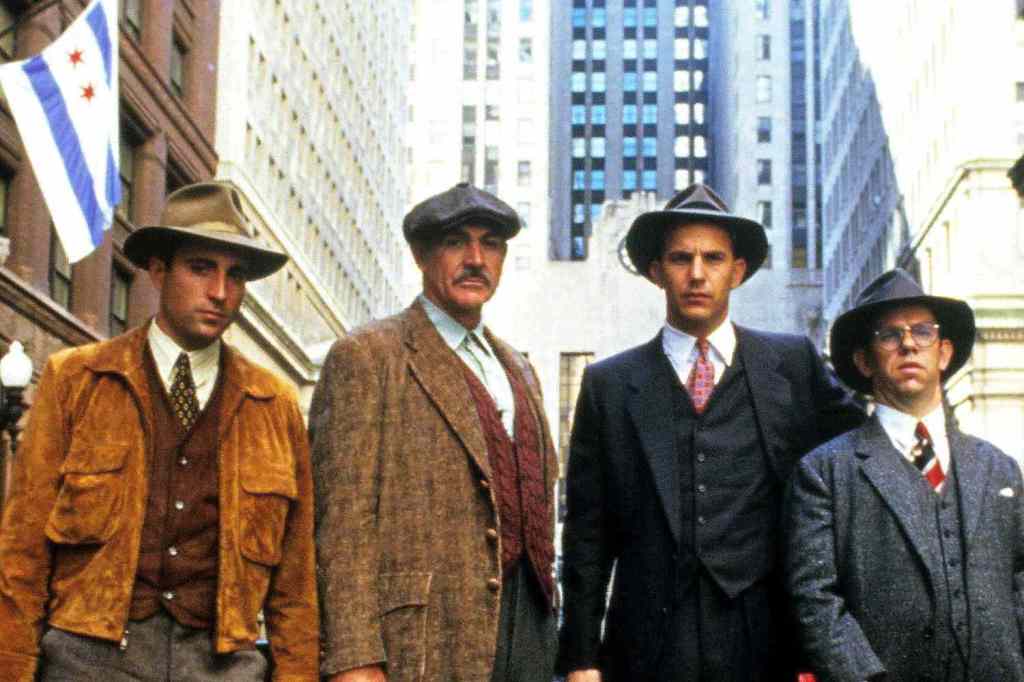
It’s 1930 and Prohibition is the law of the land in the United States of America. Treasury agent Eliot Ness (Kevin Costner) has been given the seemingly impossible task of bringing down notorious gangster Al Capone (Robert De Niro), who supplies booze to nearly all of Chicago. Capone doesn’t just supply the booze, he rules Chicago with an iron fist; and if you’re a local business who doesn’t want to buy his product, he just may blow your ass up! Ness’ job is made especially difficult due to the rampant corruption in Chicago, where everyone from the Mayor, to the judges, lawyers, and law enforcement officers are all on Capone’s payroll, making it pretty much impossible to trust anyone. In a complete stroke of luck, Ness encounters the honest Irish American policeman James Malone (Sean Connery) and asks him to join him in bringing down Capone. With Malone, Ness has found that honest and badass cop who’s not afraid to go up against Capone and his goons. Knowing that most of the police force is already compromised, the two men head to the police academy to try to find another honest cop. This turns out to be another great move as they come upon an Italian American trainee named George Stone (Andy Garcia), who’s a prodigy with a gun. Their last, and greatest move in this humble CPA’s opinion, comes when they accept accountant Oscar Wallace (Charles Martin Smith) to their team. Wallace is convinced that the key to bringing down Capone is trying to build a tax evasion case against him. He’s initially laughed at, but it’s soon apparent that this accountant knows his debits and credits, and his expertise may be just what’s needed to end Capone’s reign of terror once and for all.

I’ve always considered THE UNTOUCHABLES to be a near perfect film. One of the main reasons I find the film so perfect is the direction of Brian De Palma. I’ve been a fan of his “style” for so long, with films like DRESSED TO KILL (1980) and BLOW OUT (1981), but I think he just nails the material here. There are so many great scenes, but the “Union Station” sequence has to be one of the most perfectly choreographed sequences of all time. The building of the tension, the slow-motion shootout when the bad guys arrive, and finally the badass resolution all prove what an absolute master De Palma could be with the right material. De Palma claims that he made up the series of shots as he was filming the scenes at the train station, making the final product that much more impressive. And this all plays out against the background of a “lullaby theme” composed by the legendary Ennio Morricone (THE GOOD, THE BAD, AND THE UGLY). This is what “cinema” is all about.

THE UNTOUCHABLES has an amazing cast of actors to bring its “based on real events” story to life. Kevin Costner was just beginning to emerge as a movie star when this movie was made back in 1987. Especially as a younger actor, Costner was good at projecting both a certain innocence, tempered with the willingness to do what it takes to get the job done once his family and friends are put in danger. And what can you say about actors like Sean Connery and Robert De Niro?!! Connery is so charismatic, wise, and tough as the beat cop who shows Eliot Ness how to beat Capone… ”he sends one of yours to the hospital, you send one of his to the morgue!” He’s a beat cop because he’s incorruptible, and Connery projects that stubborn honesty perfectly. I’m so glad that Connery won an Oscar for this performance, as it would be the only time he would ever be nominated for an Academy Award. He’s amazing in this role, even if his accent is Scottish rather than Irish (a notable controversy at the time). Connery may have won the Oscar, but Robert De Niro matches him scene for scene. His ability to make Capone both charismatic and evil in equal measure is an example of what makes De Niro special as an actor. So many actors phone in these types of broad performances, but not De Niro. I also just think it’s cool that De Niro admitted that his performance was heavily influenced by Rod Steiger’s in 1959’s AL CAPONE. I love Steiger and consider this a wonderful tribute. Throw in a young Andy Garcia, the always underrated Charles Martin Smith, and a creepy Billy Drago as Frank Nitti, and you have one of the better casts ever assembled. I especially became a fan of Garcia based on his performance in THE UNTOUCHABLES.

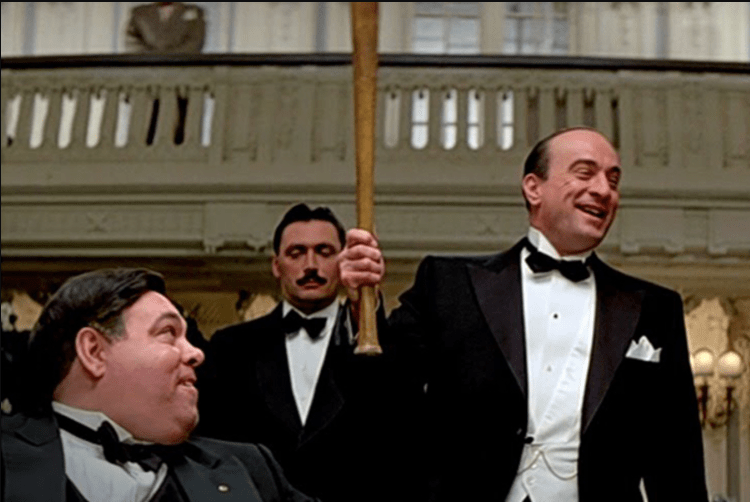
The last person I want to mention is the screenwriter, David Mamet. His screenplay is another perfect element of THE UNTOUCHABLES. The same man who has directed his own films like HOUSE OF GAMES (1987), HOMICIDE (1991), THE SPANISH PRISONER (1997), and SPARTAN (2004) knows how to write a great screenplay. There are so many amazing moments, from the “baseball bat” sequence to the “Stone recruitment” scene, and even Ness’ “he’s in the car” line about Frank Nitti, it’s a muscular screenplay full of big-time moments of audience satisfaction.

At the end of the day, THE UNTOUCHABLES is just a great movie. I still periodically thank my brother for picking it out that fateful day in the late 80’s, and it will always be one of my very favorites. It’s one of those movies that I recommend with zero reservations!

Check out the trailer below, and if you’re smart, you’ll watch one of the great movies of the 1980’s, Brian De Palma’s THE UNTOUCHABLES.

Late Night Retro Television Review: Friday the 13th 2.8 “Read My Lips”


Welcome to Late Night Retro Television Reviews, a new feature where we review some of our favorite and least favorite shows of the past! On Fridays, I will be reviewing Friday the 13th: The Series, a show which ran in syndication from 1987 to 1990. The show can be found on YouTube!

This week, Oscar will haunt your nightmares….

Episode 2.8 “Read My Lips”

(Dir by Francis Delia, originally aired on November 21st, 1988)

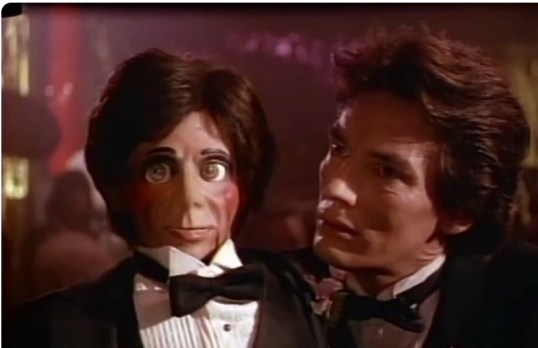
When you watch as much horror as I do, you automatically assume that anyone who is a ventriloquist is going to have an unhealthy relationship with their dummy.  Sometimes, the dummy is alive.  Sometimes, the dummy is possessed.  Sometimes, the dummy is just a dummy but the ventriloquist has decided that it’s alive and urging him to kill.  (For some reason, evil ventriloquists are always male.)  I’ve seen a lot of creepy ventriloquist dummies but nothing quite compared me for Oscar….

AGCK!  I mean …. LOOK AT THAT THING!

Oscar is at the center of this week’s episode of Friday the 13th.  Oscar is wearing a boutonniere that once belonged to the noted ventriloquist, Adolf Hitler.   The boutonniere not only brings Oscar to foul-mouthed life but it also inspires whoever owns Oscar to commit countless murders.  When we first see Oscar, he is owned by Edgar Van Horne (played by a youngish Billy Drago).  After Edgar attempts to break his bond with Oscar, Oscar drives Edgar crazy and then invites another ventriloquist, Travis Plunkett (John Byner), to be his owner.  Things don’t turn out well for Travis either.

Sadly, Jack is not in this episode.  With its emphasis on desperate nightclub performers and Oscar’s corny sense of humor, it’s hard not to feel that this storyline would have been right up Jack’s alley.  Instead, it’s left to Micki and Ryan to deal with Oscar and the ventriloquists.  Micki’s best friend from high school, Gabriella Montrose (Linda Griffiths), is planning on marrying Edgar but, needless to say, that all goes out the window once Edgar loses his mind and end up in a mental hospital.  For the most part, Micki and Ryan are largely bystanders in this episode.  All of the action revolves around Oscar and his unfortunate owners.

Billy Drago gives a wonderful performance as Edgar, making him both frightening and, in the end, surprisingly sympathetic.  Edgar is desperate to escape the clutches of Oscar but, in the end, it turns out that he’s grown addicted to performing with Oscar and the attempt to quit cold turkey leads to him losing his mind.  (Many episodes of Friday the 13th feature storylines that felt as if they were meant to be a metaphor for drug addiction and that’s certainly the case here.)  John Byner plays his role a bit more broadly than Drago but still, it’s hard not to feel bad for Travis as he comes to realize that he’s in over his head with Oscar.

This was an effectively creepy episode, even if it did owe an obvious debt to the 1978 film Magic.  Oscar makes for a memorable monster.  Hopefully, he’ll never be seen again.

Late Night Retro Television Review: Monsters 1.20 “The Cocoon”


Welcome to Late Night Retro Television Reviews, a feature where we review some of our favorite and least favorite shows of the past! On Wednesdays, I will be reviewing Monsters, which aired in syndication from 1988 to 1991. The entire show is streaming on Tubi.

This week, Billy Drago learns an important lesson about cheating, greed, and cocoons.

Episode 1.20 “The Cocoon”

(Dir by John Gray, originally aired on April 29th, 1989)

A woman (Kim Ulrich) is involved in a serious traffic accident, one that should have killed her.  Instead, she survives the accident with hardly a scratch but also without her memory (or so she claims).  A greedy police detective named Richard (Billy Drago) is called in when it is discovered that the woman has a good deal of money but no identification on her.  When the woman says that she knows that she’s wealthy, Richard becomes very interested in helping her regain her memory.

Richard’s girlfriend, Sarah (Silvana Gallardo), is a psychic.  Richard brings her to see the woman, hoping that Sarah will have a vision.  When she handles the woman’s comb, Sarah has a vision of the woman in the 1920s, seducing a man who has been missing for over 60 years.  But the woman appears to be in her 20s in both the present and in Sarah’s vision.  Richard suggests that Sarah might be seeing the woman’s grandmother.

Of course, the truth is a bit more complex.  The woman has been alive for centuries, surviving by wrapping her lovers in a cocoon and then feasting off their life force.  The woman is hoping to make Richard her next lover and Richard, being a bit of a sleazeball, is prepared to go along with it.  However, Sarah has a few tricks of her own….

This was an interesting and ambitious episode, one that attempted to tell a very complex story in just 21 minutes and on a very limited budget.  Unfortunately, the show didn’t really have the resources to do this particular story justice but it’s still hard not to admire the imagination involved.  Throughout the episode there are moments that work really well, like a sequence where Sarah has a vision of all of the different costumes that the woman has worn through the centuries.  The episode also ends with an entertaining little twist.  It’s effective, even if the scenes involving the actual spinning of the cocoon fall victim to the show’s low budget.

Billy Drago was a veteran screen bad guy, one who almost always cast as an evil henchman.  (In Brian De Palma’s The Untouchables, Kevin Costner memorably threw him off of a roof.)  This episode gives Drago a rare leading role, though Richard is just as amoral and sleazy as the characters for which Drago was best known.  Drago does a good job in the lead, playing Richard as being a not particularly smart guy who is undone by his own cockiness.  If nothing else, it’s impossible not to enjoy seeing him get his comeuppance.

Next week on Monsters …. Adrienne Barbeau dabbles in the magical arts!

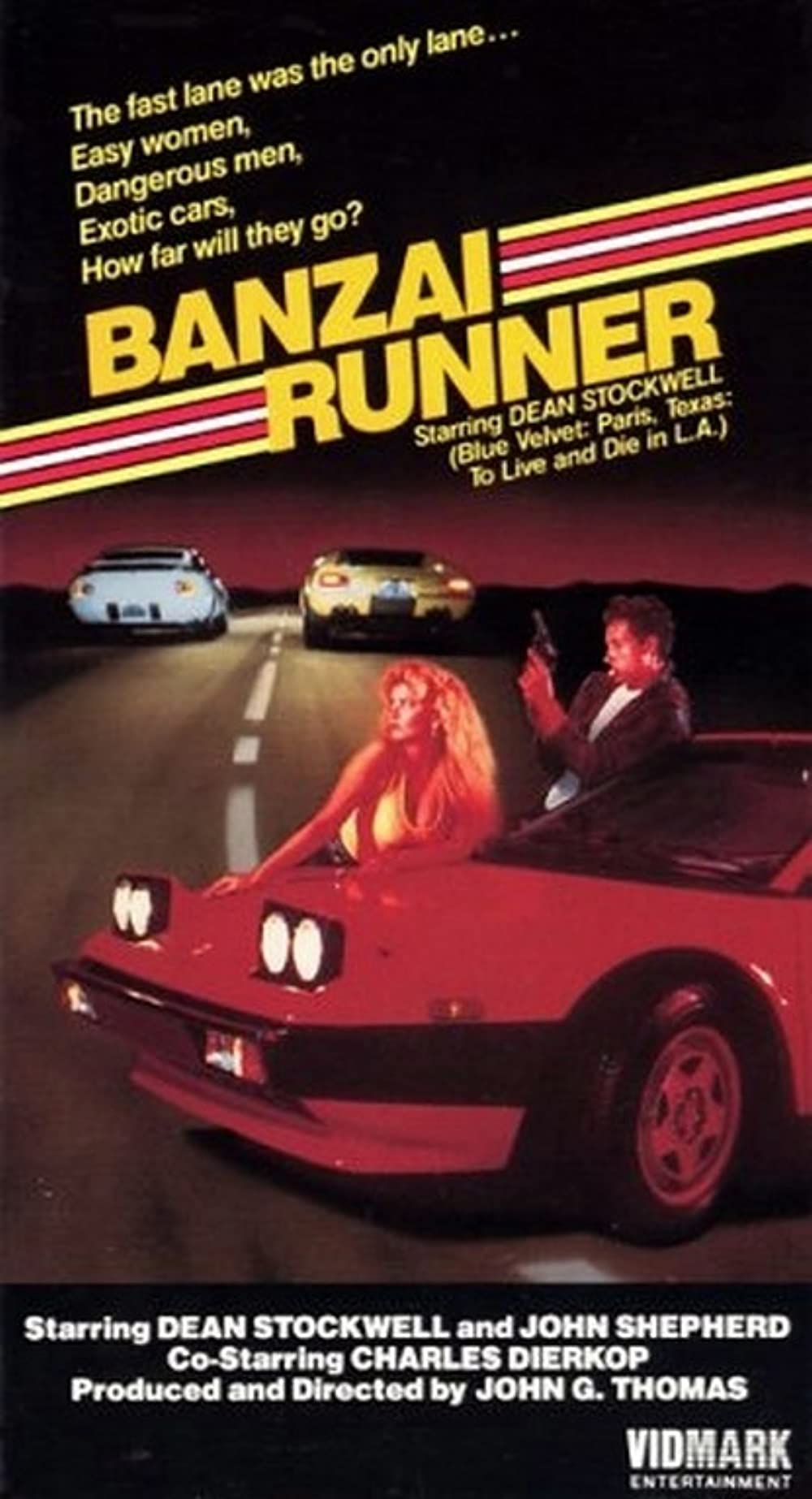
What Lisa Marie Watched Last Night #222: Banzai Runner (dir by John G. Thomas)


Last night, I watched the 1987 film, Banzai Runner!

Why Was I Watching It?

Last night, it was my turn to host the #MondayActionMovie live tweet!  The loyal members of MAM trusted me to find an exciting, action-filled movie with which they could start their week.  I failed.

What Was It About?

Listen, it’s not totally my fault.  I checked with the IMDb.  I checked Wikipedia.  I read the film’s description on YouTube.  They all said that the film starred Dean Stockwell as a cop who goes undercover to bring down a group of wealthy street racers.

And technically, that is what the film’s about but only at the very end.  Before we get around to any of that fun stuff, the film is basically just Highway Patrolman Billy Baxter (Dean Stockwell) driving around the desert and trying to keep his dumbass nephew, Beck (John Shepard), from getting into trouble.  How big of a dumbass is Beck?  He’s so dumb that he lights up a joint while he’s driving and while his uncle — the policeman — is sitting right next to him.  Needless to say, Billy gets upset about that.  (The scene is amusing if — and only if — you know that Dean Stockwell was one of Hollywood’s most prominent hippies.)

Eventually, Billy and Beck do go undercover to take out Syszek (Billy Drago), a wealthy drug dealer who likes to street race but who also does to much cocaine.  In a coincidence that comes out of nowhere, it turns out that Syszek is responsible for the death of Billy’s brother and Beck’s father.  Neither Billy nor Beck really seem to be too upset about it, though.

What Didn’t Work?
(Usually I like to start with what did work but I’m making an exception here.)

It’s an 84 minute film (not counting the end credits).  It takes 60 minutes for Billy to go undercover.  It takes another 5 minutes or so for Billy to actually meet Syszek.  The only reason that anyone is going be watching this film is because they want to see Dean Stockwell and Billy Drago race against each other but that part of the film doesn’t even kick in until the movie is nearly over!  Instead, we get an hour of Billy aimlessly doing his job and Beck complaining about his uncle being too strict.  It’s very slow and dull.

Dean Stockwell was a good actor who gave some wonderfully eccentric performances in his adult years but he’s miscast as Billy.  John Shepherd played Tommy in Friday the 13th: A New Beginning and I’ve always preferred Shepherd’s interpretation of the character over Thom Matthews’s performance in Jason Lives.  Shepherd had an appealing vulnerability in A New Beginning but none of that is present in Banzai Runners.  It doesn’t help that the script portrays Beck as being a combination of every bad boyfriend I had from the sixth grade through my senior year of high school.

What Worked?

I’m a Southern girl and I’m also enough of a country girl that I do have a weakness for fast cars and the people who drive them.  So, I could appreciate the film on that level.  The car chases were fun, I just wish that there had been more of them.  All of those scenes of Billy worrying about paying his mortgage (and yes, that was a huge subplot during the first hour of the film) should have been edited out and replaced with scenes from The Wraith.  Or maybe just the Shangri-Las singing Leader of the Pack.

“Oh my God!  Just like me!” Moments

There’s a scene where the rich daughter of one of the racers announce that she’ll remove a piece of clothing for every mile that Beck goes over 55.  On the one hand, it’s a scene that feels like it was lifted from a Crown International cheerleader film.  On the other hand …. well, like I said, I had a weakness for bad boys who drove fast cars.  So, even in this rather bland film, I still found someone to whom I could relate.  Yay!

Lessons Learned

Never assume that a movie is exciting just because of its name.

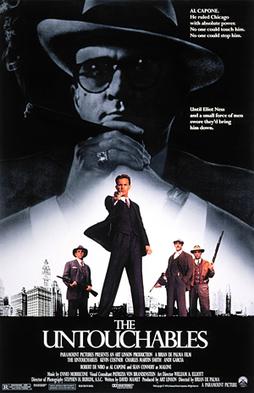
An Offer You Can’t Refuse #20: The Untouchables (dir by Brian DePalma)


“Let’s do some good!” Eliot Ness shouts as he and a platoon of Chicago cops raid what they believe is a bootlegger’s warehouse.

That line right there tells you everything that you need to know about the 1987 film, The Untouchables.  In real life, Eliot Ness was known to be an honest member of law enforcement (which did make him a bit of a rarity in 1920s Chicago) but he was also considered to be something of a self-promoter, someone who tried to leverage his momentary fame into an unsuccessful political career.  In the 50s, after Ness had lost most of his money due to a series of bad investments and his own alcoholism, Ness wrote a book about his efforts to take down Al Capone in Chicago.  That book was called The Untouchables and though Ness died of a heart attack shortly before it was published, it still proved popular enough to not only rehabilitate Ness’s heroic image but also to inspire both a television series and the movie that I’m currently reviewing.

None of that is to say that Ness didn’t play a role in Al Capone’s downfall.  He did, though it’s since been argued that Ness had little to do with actual tax evasion case that led to Capone going to prison.  It’s just that, in real life, Eliot Ness was a complicated human being, one who had his flaws.  In The Untouchables, Kevin Costner plays him as a beacon of midwestern integrity, a Gary Cooper-type who has found himself in the very corrupt city of Chicago in the very corrupt decade of the 1920s.  The film version of Eliot Ness has no flaws, beyond his naive belief that everyone is as determined to “do some good” as he is.

So, The Untouchables may not be historically accurate but it’s still an entertaining film.  It’s less concerned with the reality of Eliot Ness’s life and more about the mythology that has risen up around the roaring 20s.  Everything about the film is big and operatic.  In the role of Al Capone, Robert De Niro sneers through every scene with the self-satisfaction of a tyrant looking over the kingdom that he’s just conquered.  While Costner’s Ness tells everyone to do some good, De Niro’s Capone uses a baseball bat to keep his underlings in line.  He goes to the opera and cries until he’s told that one of Ness’s men has been killed.  Then a big grin spreads out across his face.  It’s not exactly a subtle performance but then again, The Untouchables is not exactly a subtle movie.  It’s not designed to be a film that makes you think about whether or not prohibition was a good law.  Instead, everything is bigger-than-life.  It’s a film that takes place in a dream world that appears to have sprung from mix of old movies and American mythology.

In real life, Ness had ten agents working under him.  They were all selected because they were considered to be honest lawmen and they were nicknamed The Untouchables after it was announced to the press that Ness had refused a bribe from one of Capone’s men.  In the film, Ness only has three men working underneath him and they’re all recognizable types.  Sean Connery won an Oscar for playing Jmmy Malone, the crusty old beat cop who teaches Ness about the Chicago Way.  A young and incredibly hot Andy Garcia plays George Stone, the youngest of the Untouchables.  Best of all is Charles Martin Smith, cast as Oscar Wallace, a mild-mannered accountant who first suggests that Capone must be cheating on his taxes.  There’s a great scene in which the Untouchables intercept a liquor shipment on the Canadian border, all while riding horses.  Sitting on the back of his galloping horse and trying not to fall off, both Oscar Wallace and the actor playing him appear to be having the time of their lives.  For Oscar (and probably for much of the audience), it’s a fantasy come to life, a chance to “do some good.”

The Untouchables was directed by Brian DePalma and his stylish approach to the material is perfect for the film’s story.  DePalma fills the film with references to other movies, some from the gangster genre and some not.  (In one of the film’s most famous sequence, DePalma reimagines Battleship Potemkin‘s massacre on The Odessa Steps as a shoot-out between Eliot Ness and Capone’s men.)  DePalma’s kinetic style reminds us that The Untouchables is less about history and more about how we imagine history.  In reality, Capone was succeeded by Frank Nitti and The Chicago Outfit continued to thrive even in Capone’s absence.  In the film, Nitti (played by Billy Drago) brags about killing one of the Untouchables and, as a result, is tossed off the roof of a courthouse by Eliot Ness.  It’s not historically accurate but it makes for a crowd-pleasing scene.

Big, operatic, and always entertaining, The Untouchables is an offer that you can’t refuse.

Previous Offers You Can’t (or Can) Refuse:

  1. The Public Enemy
  2. Scarface (1932)
  3. The Purple Gang
  4. The Gang That Could’t Shoot Straight
  5. The Happening
  6. King of the Roaring Twenties: The Story of Arnold Rothstein 
  7. The Roaring Twenties
  8. Force of Evil
  9. Rob the Mob
  10. Gambling House
  11. Race Street
  12. Racket Girls
  13. Hoffa
  14. Contraband
  15. Bugsy Malone
  16. Love Me or Leave Me
  17. Murder, Inc.
  18. The St. Valentine’s Day Massacre
  19. Scarface (1983)

Delta Force 2: The Colombian Connection (1990, directed by Aaron Norris)


Cocaine is flooding the United States and only one man is to blame!  Ramon Cota (Billy Drago) is so evil that, after killing a group of DEA agents, he appears on closed-circuit television just so he can taunt their superior, John Page (Richard Jaeckel).  When Ramon drives through his home country of San Carlos, he kills the peasants, rapes their women, and murders their babies, just because he can.  He’s one bad dude.

Ramon is untouchable as long as he stays in San Carlos but occasionally he does have to leave the country so he can conduct business.  A frequent flyer, Ramon always buys every seat in first class so that he and his bodyguards can have privacy.  However, what Ramon didn’t count on, was Delta Force’s Col. Scott McCoy (Chuck Norris!).  McCoy and his partner, Maj. Chavez (Paul Perri), aren’t intimidated by that curtain separating first class from the rest of the plane.  As soon as Ramon’s flight enters American air space, they burst out of coach, knock out Ramon’s bodyguards, and then toss Ramon out of the plane.  Being an experienced skydiver (not to mention that he’s also Chuck Norris), Col. McCoy is able to catch up to Ramon and grab him before he plummets all the way to the Earth.

Unfortunately, arresting Ramon in America means that you run the risk of a liberal, Carter-appointed judge setting a low-enough bail that Ramon can go free.  Having taken advantage of America’s own legal system, Ramon murders Chavez and returns to San Carlos, leaving Col. McCoy and the rest of the Delta Force to seek vengeance for their fallen comrade.

Only Chuck Norris returns for this sequel to the greatest movie ever made.  Unfortunately, Lee Marvin died shortly after the release of the first Delta Force.  Even though John P. Ryan (as General Taylor) and Richard Jaeckel both seem to be attempting to channel Marvin’s grim, no-nonsense spirit in their performances, it’s just not the same.  What made the first Delta Force so memorable was the mix of Marvin’s cool authority and Chuck Norris’s general badassery.  Norris is as tough as always but the film still has a Lee Marvin-size hole in the middle of it and, without Marvin glaring at the bad guys and barking at the Washington pencil pushers who think they know how to keep America safe, Delta Force 2 could just as easily be a sequel to one of Norris’s Missing In Action films.  This is a Chuck In The Jungle movie, with drug dealers replacing the usual Vietnamese POW camp commandants.

If you can see past the absence of Lee Marvin, Delta Force 2 is an okay Chuck Norris action movie.  It’s typical of the movies that he made for Cannon but the fight scenes are well-directed by Chuck’s brother and Billy Drago is a loathsome drug lord who gets what he deserves.  Chuck gets a few good one-liners and you’ve got to love the film’s final shot.  Delta Force 2 never comes close to matching the original but at least it’s got Chuck Norris doing what he does best.

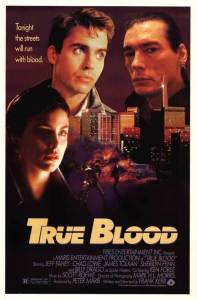
A Movie A Day #104: True Blood (1989, directed by Richard Kerr)


Ten years after being wrongly accused of murdering a cop, Raymond Trueblood (Jeff Fahey) returns to the old neighborhood.  Ray has just finished a stint with the Marines and he is no longer the irresponsible hoodlum that he once was.  He wants to rescue his younger brother, Donny (Chad Lowe), from making the same mistakes that he made.  But Donny now hates Ray and is running with Ray’s former friend, Spider Masters (Billy Drago).  Spider is also responsible for framing Ray for killing the cop.  When he is not trying to save his brother, Ray falls in love with Jennifer Scott (Sherilyn Fenn), a tough waitress who is soon being menaced by Spider.

Like Crime Zone, True Blood is typical of the type of B-movies that Sherilyn Fenn was stuck in before being cast as Audrey Horne in Twin Peaks.  It’s a nothing part but Fenn is authentic and sincere in the part and, as usual, Fenn’s performance is one of the best things about the movie.

Overall, True Blood is predictable but it is still better than the typical late 80s B-movie.  Chad Lowe is never believable as a member of a street gang but Jeff Fahey does a good Clint Eastwood impersonation as Ray and Billy Drago is, as always, a great villain.  Fans of Dawn of the Dead will want to keep an eye out for Ken Foree as one of the detectives investigating Ray.

A Movie A Day #42: Hero and The Terror (1988, directed by Steve Tannen)


hero_and_the_terror_posterDanny O’Brien (Chuck Fucking Norris!) is a tough Los Angeles cop who has been nicknamed Hero.  Danny hates it when people call him “Hero.”  Maybe if Danny knew what people usually call cops, he would not complain so much about his nickname.  Three years ago, Danny captured Simon Moon (Jack O’Halloran), a neck-breaking serial killer nicknamed “The Terror.”  After he was captured, The Terror faked his own death and disappeared.  He ended up living in a deserted theater and not bothering anyone until the Mayor of Los Angeles (Ron O’Neal, Superfly himself!) decides to tear down his new home.  The Terror does not take kindly to urban renewal and goes on another killing spree.  Can Hero track down and beat the The Terror while also making it to the hospital in time to see his girlfriend give birth to their baby?
Not surprisingly, Hero and the Terror is one of the films that Chuck made for Cannon Films in the late 80s and, along with Chuck and Ron O’Neal, it features Cannon regulars Steve James and Billy Drago.  (Billy Drago actually plays a good guy, for a change.)  It’s obvious that Chuck was trying to broaden his horizons with Hero and the Terror: with the exception of the final confrontation between Hero and the Terror, there’s less kung fu action than in his previous films and a lot of the movie is dedicated to his relationship with his girlfriend and his struggle to handle her pregnancy.  That’s all good and well and the Chuck Norris of Hero and The Terror is a much better actor than the Chuck Norris who could barely deliver his lines in Breaker, Breaker but, ultimately, a Chuck Norris movie with more human interest and less roundhouse kicks just feels wrong.

(On Netflix, there’s a whole documentary about how Chuck Norris’s roundhouse kicks led to the collapse of Nicolae Ceaușescu’s communist dictatorship in Romania.  It’s called Chuck Norris vs. Communism.  Communism didn’t have a chance.  Hopefully, Chuck will never turn against capitalism because, if he does, it’ll probably lead to another stock market crash.)

I once read an interview with Gene Hackman, in which he was asked to name his least favorite of the movies that he had made.  Hackman selected March or Die.  “I can’t believe I was in something called March or Die,” Hackman said.  If he thought March or Die was a bad title, he should be happy that he didn’t end up in Hero and The Terror.  Give Chuck Norris credit.  Even if he’s not Gene Hackman and even if the movie does not really work, he is the only actor who could credibly star in something called Hero and the Terror.

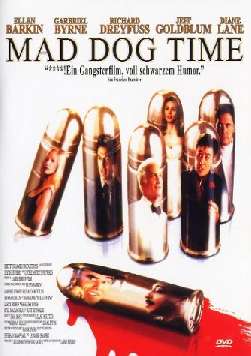
Worst of the Worst: Mad Dog Time (1996, directed by Larry Bishop)


Mad_dog_time_4841Remember how, in the 1990s, every aspiring indie director tried to rip off Quentin Tarantino by making a gangster film that mixed graphic violence with quirky dialogue, dark comedy, and obscure pop cultural references?  That led to a lot of terrible movies but not a single one (not even Amongst Friends) was as terrible as Mad Dog Time.
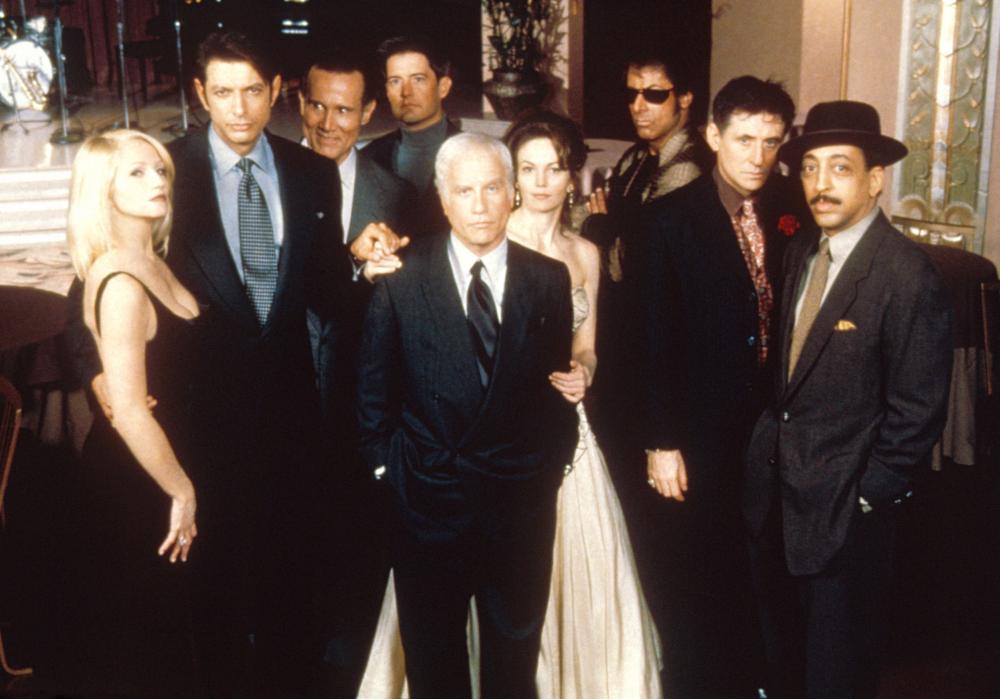
That Mad Dog Time was terrible should come as no surprise.  Most directorial debuts are.  What made Mad Dog Time unique was the sheer amount of talent that was assembled and wasted in the effort to bring this sorry movie to life.  As the son of Joey Bishop, director Larry Bishop was Hollywood royalty and was able to convince several ridiculously overqualified actors to play the thinly drawn gangsters and rouges who populated Mad Dog Time.  Much like the Rat Pack movies that his father once starred in, Larry Bishop’s debut film was full of familiar faces.  Some of them only appeared for a few seconds while others had larger roles but they were all wasted in the end.  Hopefully, everyone was served a good lunch in between filming their scenes because it is hard to see what else anyone could have gotten out of appearing in Mad Dog Time.

Mob boss Vic (Richard Dreyfuss) has just been released from a mental hospital.  With the help of his main enforcer, Mick (Jeff Goldblum), and a legendary hitman named Nick (Larry Bishop, giving not only the worst performance in the film but also the worst performance of the 1990s), Vic is going to reassert his control over the rackets.  Vic also wants to find his former mistress, Grace Everly (Diane Lane) but he doesn’t know that Grace is now with Mick and that Mick is also having an affair with Grace’s sister, Rita (Ellen Barkin).

(Grace and Rita are the Everly Sisters!  Ha ha, between that and all the rhyming names, are you laughing yet?)

Anka and Byrne

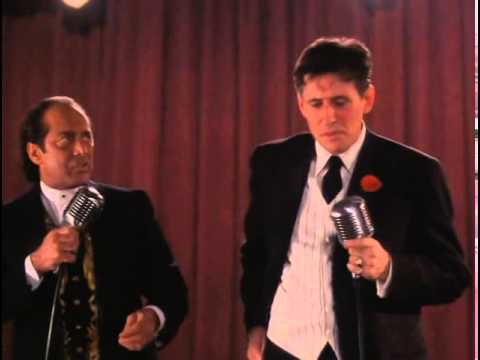
Ben London (Gabriel Byrne) has taken over Vic’s nightclub and, while singing My Way with Paul Anka, tells Vic that he should take an early retirement because he’s a paranoid schizophrenic.  Before he can deal with Ben, Vic has to kill all of his other rivals, all of whom are played by actors like Michael J. Pollard, Billy Idol, Kyle MacLachlan, Gregory Hines, and Burt Reynolds.  The bodies start to pile up but Jimmy the Undertaker (Richard Pryor, looking extremely frail in one of his final roles) is always around to make sure that everyone gets a proper burial.

And there are other cameos as well.  Joey Bishop is the owner of a mortuary.  Henry Silva is wasted as one the few gangsters to stay loyal to Vic.  Christopher Jones, who previously co-starred with Larry Bishop and Richard Pryor in Wild In The Streets before dropping out of a society, plays a hitman who pretends to be Nick Falco.  Even Rob Reiner shows up a limo driver who talks too much.

Almost every poorly paced scene in Mad Dog Time plays out the same way.  Three or more men confront each other in a room.  Hard-boiled dialogue is exchanged for an interminable length of time until someone finally gets shot.  You would think, at the very least, it would be watchable because of all the different people in the cast but none of the actors really seem to be into it.  Richard Dreyfuss and Jeff Goldblum resort to smirking through their scenes while Gabriel Byrne often appears to be drunk.  Whenever he’s in a scene, Burt Reynolds seems to be trying to hide his face and it is hard to blame him.  There were many terrible movies released in the 90s but none were as bad as Mad Dog Time.