Guilty Pleasure No. 83: Meteor (dir by Ronald Neame)


1979’s Meteor is about a big rock that is tumbling through space.  Earth is directly in its path and, if it hits the planet, it could be an extinction-level event.  Unfortunately, little bits of the rock keep breaking off and crashing into Earth, destroying cities and fleeing extras.  Goodbye, Hong Kong.  Goodbye, Switzerland, which is destroyed via stock footage lifted from Avalanche.  Goodbye, New York, which blows up in such spectacular fashion that the scene was later re-used in The Day After.

It might seem like the planet is doomed.  The meteor is unstoppable.  Bruce Willis hasn’t become a star yet.  But fear not!  Some of the brightest faces of the 70s have been recruited to stop the meteor.  Natalie Wood, in one of her final films, plays a translator and gets covered in muddy river water.  Sean Connery wears a turtleneck and curses in that Scottish way of his.  Karl Malden wears a hat and tells people to calm down while he calls the President.  Brian Keith plays a Russian with all the grace and skill of a cat trying to rip open a bag of treats.  Martin Landau is the military official who doesn’t think that the scientist know what they’re talking about.  Henry Fonda is the president.  That’s a lot of balding men for one movie and it’s hard not to notice that both Malden and Keith often seem to be wearing a hat whenever they share a scene with Connery.  My personal theory is that the production, having spent all of their money on blowing up New York, couldn’t afford more than two toupees so everyone had to take turns wearing them.  (The few scenes where Malden is hatless while in Connery’s presence are often oddly filmed, with either Connery on Malden standing with their back to the camera, almost as if the scenes were actually done with a stand-in.)

We’re supposed to breathe a sigh of relief when we see that Henry Fonda is playing the President but I’ve seen Fail Safe and I remember him allowing the Russian to nuke New York City.  Interestingly enough, New York gets destroyed in this film too.  Why didn’t President Fonda care about New York City?  Of course, the scientists and the military folks are all located in a control center that’s located under the city.  Malden mentions that they’re right next to the Hudson River.  It doesn’t seem to occur to anyone that this is a bad idea but, then again, they also elected Henry Fonda president again.

My late friend and colleague Gary Loggins described Meteor as being a “crashing bore.”  I have to admit that this is one of the few times that I have ever disagreed with Gary.  Meteor is a tremendous amount of fun, as long as you’re watching it with a group of people and nobody takes it seriously.  (The first time I saw it was at one in the morning while I was in college.  Jeff and I watched it in the lounge of one of the dorms.  We may be the only two people to have romantic memories of Meteor.)  Meteor features a cast of champion scenery chewers.  Karl Malden, Sean Connery, Martin Landau, Brian Keith, none of them were exactly subtle actors and giving them an excuse to argue about how to deal with a meteor allows for a lot of very enjoyable overacting.  As well, the special effects are so cheap and obviously fake that it’s hard not to laugh out loud whenever the film cuts to that shot of the meteor rolling through space or the incredibly shiny American and Russian missiles slowly heading towards it.

Meteor’s a lot of fun, even if it is one of those movies where no one points out that our heroes inevitably seem to make every situation worse with their own stupidity.  It’s very much at the tail-end of the 70s disaster boom.  Watch it for the stars.  Watch it for the rock.  And watch it for the hairpieces.

Previous Guilty Pleasures

  1. Half-Baked
  2. Save The Last Dance
  3. Every Rose Has Its Thorns
  4. The Jeremy Kyle Show
  5. Invasion USA
  6. The Golden Child
  7. Final Destination 2
  8. Paparazzi
  9. The Principal
  10. The Substitute
  11. Terror In The Family
  12. Pandorum
  13. Lambada
  14. Fear
  15. Cocktail
  16. Keep Off The Grass
  17. Girls, Girls, Girls
  18. Class
  19. Tart
  20. King Kong vs. Godzilla
  21. Hawk the Slayer
  22. Battle Beyond the Stars
  23. Meridian
  24. Walk of Shame
  25. From Justin To Kelly
  26. Project Greenlight
  27. Sex Decoy: Love Stings
  28. Swimfan
  29. On the Line
  30. Wolfen
  31. Hail Caesar!
  32. It’s So Cold In The D
  33. In the Mix
  34. Healed By Grace
  35. Valley of the Dolls
  36. The Legend of Billie Jean
  37. Death Wish
  38. Shipping Wars
  39. Ghost Whisperer
  40. Parking Wars
  41. The Dead Are After Me
  42. Harper’s Island
  43. The Resurrection of Gavin Stone
  44. Paranormal State
  45. Utopia
  46. Bar Rescue
  47. The Powers of Matthew Star
  48. Spiker
  49. Heavenly Bodies
  50. Maid in Manhattan
  51. Rage and Honor
  52. Saved By The Bell 3. 21 “No Hope With Dope”
  53. Happy Gilmore
  54. Solarbabies
  55. The Dawn of Correction
  56. Once You Understand
  57. The Voyeurs 
  58. Robot Jox
  59. Teen Wolf
  60. The Running Man
  61. Double Dragon
  62. Backtrack
  63. Julie and Jack
  64. Karate Warrior
  65. Invaders From Mars
  66. Cloverfield
  67. Aerobicide 
  68. Blood Harvest
  69. Shocking Dark
  70. Face The Truth
  71. Submerged
  72. The Canyons
  73. Days of Thunder
  74. Van Helsing
  75. The Night Comes for Us
  76. Code of Silence
  77. Captain Ron
  78. Armageddon
  79. Kate’s Secret
  80. Point Break
  81. The Replacements
  82. The Shadow

Late Night Retro Television Review: Highway to Heaven 2.23 “Children’s Children”


Welcome to Late Night Retro Television Reviews, a feature where we review some of our favorite and least favorite shows of the past!  On Thursdays, I will be reviewing Highway to Heaven, which aired on NBC from 1984 to 1989.  The entire show is currently streaming on Freevee and several other services!

This week, Jonathan and Mark find themselves in a Douglas Sirk-style melodrama.

Episode 2.23 “Children’s Children”

(Dir by Victor French, originally aired on April 30th, 1986)

When I watched this episode, I saw that the script was credited to David Thoreau and I immediately assumed that it had to be a pseudonym for the actual writer.  Fortunately, for once, I actually did some research and I discovered that the writer’s name actually was David Thoreau.  He wrote a few scripts that were produced in the 80s and 90s and, in fact, this was the first of seven scripts that he wrote for Highway to Heaven.  He’s also credited as writing the screenplay for the classic beach volleyball film, Side Out.

As for this episode, it finds Mark and Jonathan working at a home for unwed mothers.  Just the term “home for unwed mothers” brings to mind the 50s melodramas of Douglas Sirk and I found myself thinking about just how old-fashioned Highway to Heaven must have seemed even in the 80s.  I did a google search and I discovered that homes from unwed mothers do still exist, though they’re now called “maternity homes.”

The manager of the home for unwed mothers is Joyce Blair (Bibi Besch), who finds herself being hounded by a reporter named Dan Rivers (Robert Lipton).  Dan is determined to take Joyce down and, to do so, he brings up a past incident in which Joyce was arrested.  Dan twists the facts to make Joyce look like a criminal and soon, Joyce finds that she might not be able to keep the home open.  Why is Dan doing this?  Like most reporters on Highway to Heaven, he’s just plain evil.  But when one of the girls at the home suggests that Dan might be the father of her child, Dan learns what it’s like to be falsely accused.

Meanwhile, evil businessman Jack Brent (James T. Callahan) hopes for a chance to foreclose on the home so that he can bulldoze it and replace it with condominiums.  (Bad guys in the 80s always wanted to build condos.)  But how will he react when he discovers that his teenage son (Scott Coffey) is going to be a father and that the girl he impregnated in currently living at the home?

This episode is the type of episode that most people think of when they dismiss Highway to Heaven as just being an old-fashioned and slightly preachy melodrama.  There’s not a single subtle moment or particularly nuanced moment to be found in this particular episode.  It’s note quite as heavy-handed as that episode where Mark begged the President to talk to the Russians and reduce amount of nuclear missiles but it’s close.

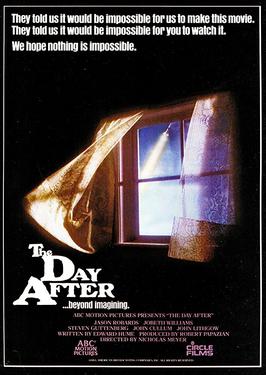
Film Review: The Day After (dir by Nicholas Meyer)


“This is Lawrence. This is Lawrence, Kansas. Is anybody there? Anybody at all?”

The words of Joe Huxley (John Lithgow) hang over the ending of The Day After, a 1983 film that imagines what the aftermath of a nuclear war would be like not on the East or the West Coasts but instead in the rural heartland of America.  Huxley is a professor at the University of Kansas and, as he explains early on in the film, Kansas would be an automatic target in any nuclear war because it houses a number of missile silos.  When he explains that, it’s in an almost joking tone, largely because the missiles haven’t been launched yet.  Instead, the only thing we’ve heard are a few barely noticed news stories about growing tensions between America and Russia.  About halfway through The Day After, the bombs go off and there are suddenly no more jokes to be made.

When the bombs drop over Kansas, we watch as cities and field and people burst into flames.  In a matter of minutes, several thousands are killed.  I’m almost ashamed to admit that I was probably more upset by the image of a horse being vaporized than I was by the death of poor Bruce Gallatin (Jeff East), the college student who was planning on marrying Denise Dahlberg (Lori Lethin).  I guess it’s because horses — really, all animals — have nothing to do with the conflicts between nations.  Humans are the ones who take the time to build bigger and better weapons and The Day After is one of the few films about war that’s willing to acknowledge that, when humans fight, it’s not just humans that die.

The bombing sequence is lengthy and I have to admit that I was a bit distracted by the fact that I recognized some of the footage from other movies.  A scene of panicked people running through a building was taken from Two-Minute Warning.  A scene of a building exploding and a construction worker being consumed by flames was lifted from Meteor.  As well, there’s some stock footage which should be familiar to anyone who has ever seen a documentary about the early days of the Cold War.  Still, despite that, it’s an effective sequence simply because it’s so relentless.  Some of the film’s most likable characters are vaporized before our eyes.  Steve Guttenberg, of all people, is seen ducking into a store.

Guttenberg plays Stephen Klein, a pre-med student who manages to survive the initial attack and takes shelter with the Dahlberg family at their ranch.  At first, it’s a bit distracting to see Steve Guttenberg in a very serious and very grim film about the nuclear apocalypse but he does a good job.  The sight of him losing both his teeth and his hair carries a punch precisely because he is reliably goofy Steve Guttenberg.

If the film has a star, it’s probably Jason Robards, the doctor who witnesses the initial blast from the safety of his car and then treats the dying in Lawrence, Kansas.  He does so, despite the fact that he doesn’t know if his wife, son, and daughter are even still alive.  He continues to do so until he also falls ill with radiation poisoning.  Knowing that he’s dying, he heads home just to discover that there is no home to return to.

Home is reccuring theme throughout The Day After.  Everyone wants to return to their home but everyone’s home has been wiped out.  “This is my home,” Jim Dahlberg (John Cullum) tries to explain before he’s attacked by a group of feral nomads.  Home no longer exists and trying to pretend like life can go back to the way it once was is an often fatal mistake.

Real happy film, right?  Yeah, this isn’t exactly a film that you watch for fun.  I have to admit that I made a joke about how I wouldn’t want to die while wearing the unfortunate blue jumpsuit that Jason Robards’s daughter chooses to wear on the day of the nuclear attack and I felt guilty immediately.  (Well, not that guilty.  Seriously, it was a terrible fashion choice.)  The Day After is a film that gives audiences zero hope by design.  It was made at a time when it was generally assumed that nuclear was inevitable and it was designed to scare the Hell out of everyone watching.  And while I can’t attest to how audience may have reacted in 1983, I can say that, in 2020, it’s still a powerful and disturbing film.

“Is anybody there? Anybody at all?” Joe Huxley asks and by the end of the film, the answer doesn’t matter.  The damage has already been done.

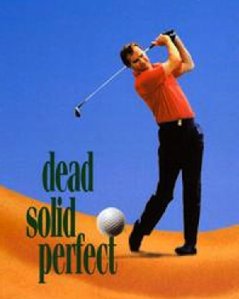
A Movie A Day #119: Dead Solid Perfect (1988, directed by Bobby Roth)


Based on a novel by veteran sports writer Dan Jenkins, Dead Solid Perfect takes an episodic look at a year on the PGA tour.  Kenny Lee (Randy Quaid) is a good but aging golfer who wants to finally have his time in the spotlight.  His sponsor (Jack Warden) is an eccentric old racist.  His girlfriend (Corinne Bohrer, who has a lengthy scene where she walks naked down hotel hallway while carrying an ice bucket) isn’t looking for a commitment while his wife (Kathryn Harrold) is getting sick of his emotional immaturity.  Kenny Lee just wants to hit the perfect shot.

An early HBO production, Dead Solid Perfect is one of the best movies ever made about pro golfers, not that there is really much competition.  Eschewing the pretentious blathering that has marred other golf films (like The Legend of Bagger Vance), Dead Solid Perfect focuses on the day-to-day life of aging athletes who have never had to grow up.  This was Dan Jenkins’s specialty and Dead Solid Perfect feels authentic in a way that many other sports film, like Bagger Vance, do not.  Randy Quaid, long before he had his widely publicized breakdown and started making videos about the “star whackers,” is perfectly cast as Kenny.  Sadly, Dead Solid Perfect has never been released on DVD or Blu-ray but it will entertain any golf fan who owns an operational VCR.

Of course, the best movie about golf is still Caddyshack.


Embracing the Melodrama #34: The Lonely Lady (dir by Peter Sasdy)


The_lonely_lady

“I guess I’m not the only who has had to fuck her way to the top!” — Jerilee Randall (Pia Zadora), accepting an award at The Awards Ceremony in The Lonely Lady (1983)

When I first started doing research on which movies were worthy of being considered for inclusion in this series about embracing the melodrama, I had no idea that it would eventually lead to me watching the worst film ever made.

However, that is exactly what happened.  1983’s The Lonely Lady is without a doubt the worst film that I have ever seen.  Normally, this is where I would say that the film is entertaining specifically because it is so bad but no, this movie just terrible.  Is it so bad that its good?  No, it’s just bad.  Is it one of those films that you simply have to see to believe?  Well, that depends on how much faith you have in God.  Does the film at least have a curiosity value?  Well, maybe.  As bad as you think this movie may be, it’s even worse.

Seriously, to say this film is a piece of crap is to do a disservice to crap.

The Lonely Lady tells the story of Jerilee Randall (Pia Zadora, who also played the girl martian in the classic Santa Claus Conquers the Martian), an aspiring writer who learns about the dark side of Hollywood.  The movie opens with Jerilee graduating from Valley High School and receiving a special prize for being the school’s most promising English major.  Now, from the very beginning, we run into several issues.  Number one, Pia looks way too old to be in high school and the fact that they decided to put her hair in pig tails doesn’t change the fact.  Number two, Pia Zadora is even less convincing as a writer than she was as a girl martian.

At the graduation party, Joe (played by Ray Liotta, of all people) violates Jerilee with a garden hose, in an amazingly ugly scene that pretty much sets the tone for the rest of the film.  No longer an innocent optimist, Jerilee moves out to Hollywood where she ends up married to award-winning screenwriter Walter Thornton (Lloyd Bochner).  When she secretly helps Walter rewrite his latest script (she replaces a long monologue with two lines of dialogue: “Why!?  Why!?”), Walter grows jealous and starts to taunt her by holding up a garden hose.  Jerilee and Walter divorce and Jerilee ends up sleeping with everyone else in Hollywood in an attempt to get a screenplay of her own produced.  Eventually, this leads to Jerilee having a nervous breakdown in which the keys of her typewriter are replaced with the accusatory faces of everyone in her life…

Bleh!  You know what?  Describing this plot is probably making The Lonely Lady sound a lot more interesting than it actually is.  Imagine if Beyond The Valley Of The Dolls was meant to be taken seriously and you have a pretty good idea what The Lonely Lady is like.

Furthermore, I’ve seen a lot of films that claim to be about writers.  Occasionally, we get lucky and the writer is played be an actor who you could actually imagine writing something worth reading.  (Perhaps the best recent example would be Paul Dano, who was completely believable as a critically acclaimed writer in Ruby Sparks.)  However, most of the time, we end up with actors who you can hardly imagine having the either the discipline or the intellectual ability to write anything worth reading.  And then, in the case of The Lonely Lady, we get Pia Zadora who is not only unbelievable as a writer but also as a human being as well.  Watching her performance, you’re shocked that she can remember to breathe from minute to minute, much less actually write anything longer than her first name.

I know it’s a pretty big claim to say that one movie is the worst ever made.  So, feel free to watch The Lonely Lady and then let me know if you agree.

(Be warned — this movie is NSFW and generally sucks.)

What Lisa Watched Last Night: Doing Time On Maple Drive (dir. by Ken Olin)


Early Friday morning, I found myself watching an old school made-for-TV movie, Doing Time On Maple Drive, on the Lifetime Movie Network.  If you’ve heard of this film, it’s probably because it features a kinda young Jim Carrey in a supporting role.

Why Was I Watching It?

Because when it’s 3 a.m. and you’re getting hit by the old insomnia curse, what’s a girl to do put turn on the TV and change the channel to the Lifetime Movie Network?

What’s It About?

The Carters appear to be the perfect American family.  They’ve got a beautiful house in the suburbs (on Maple Drive, no less), the children are all handsome and intelligent, the dad is a succesful businessman, the mom a perfect homemaker, and blah blah blah.  You know how this is going to turn out already, don’t you?  Dad is actually an overly competitive jerk, mom is in denial, the daughter is a neurotic mess, the youngest son is a closeted homosexual, and the oldest child is Jim Carrey.  He’s also an alcoholic and he claims that his name is actually Tim but that doesn’t change the fact that he’s still Jim Carrey.

What Worked?

Tolstoy once said that all happy families are the same but that each unhappy family is unique.  The family in this film is unique because — well, oh my God, how dysfunctional can you be?  Not only do you have the judgmental parents and the alcoholic son but you’ve got the frigid daughter and the self-loathing gay son.  Just using one of these stock characters would have made the film’s storyline seem familiar and predictable.  However, tossing all of them into the mix and you’ve got an old school camp classic, complete with dramatic monologues, scary silences, and all the rest.  Though this was originally made and shown by Fox, Doing Time On Maple Drive really does take the beloved Lifetime Family Drama formula to its most logical extreme.

The film is also pretty well-acted and features some familiar faces for those of us who love horror and exploitation films.  For instance, the gay son is played by William McNamara who, if you’re an Argento fan, you may remember his extremely graphic death scene in Opera.

Making the film even more odd, McNamara’s character is engaged to Alison, who is played by Lori Loughlin, the mom from 90210.  How often do you get to see a mix of Argento, 90210, and Jim Carrey on screen?

What Didn’t Work?

Jim Carrey!  Don’t get me wrong, Jim did a good enough job playing his role but the whole time you’re watching the film, you keep thinking “that’s not Tim the alcoholic, that’s Jim Carrey.”

What’s ironic about that, of course, is that Jim Carrey is probably the only reason why anyone ever chooses to watch Doing Time On Maple Drive.  Well, Jim Carrey and insomnia.

(As a sidenote, Jim Carrey had to deliver the line, “I’ve done my time on Maple Drive,” which, of course, meant I had to yell, “We have a title!”)

“Oh My God!  Just Like Me!” Moments

During one dramatic moment, Alison tells her boyfriend, “What’s funny is a part of me always suspected you might be gay…”  This line made me cringe just because I said the exact same thing to one of my ex-boyfriends once.  He started crying.  It was just kinda awkward.

Lessons Learned

If you ever meet the “perfect” family, run away.