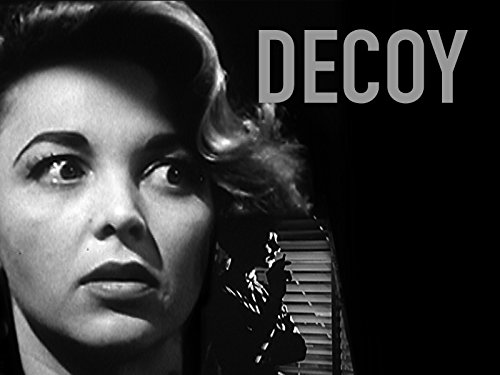
Welcome to Retro Television Reviews, a feature where we review some of our favorite and least favorite shows of the past! On Thursdays, I will be reviewing Decoy, which aired in Syndication in 1957 and 1958. The show can be viewed on Tubi!
This week, Casey investigates an elderly crime lord.
Episode 1.25 “High Swing”
(Dir by David Alexander, originally aired on March 31st, 1958)
Casey rides to the hospital with a young woman named Anne (Zohra Lampert). Anne has overdosed on heroin. Before she dies, Anne tells that Casey that she was poisoned by an old man named Otto Flagler (Albert Dekker). After learning that Anne was a pickpocket, Casey goes undercover as a thief until Otto Flagler approaches her and invites her to come live and work with him and his wife, Lily (Edith Atwater).
Casey is shocked to discover that Lily is in a wheelchair, the result of an accident that occurred when Lily was a trapeze artist. Otto is a mugger because he needs the money to take care of his wife. Casey even starts to feel sorry for Oto and Lily. That said, Casey is still a cop and she has a job to do. When Otto realizes that he and his wife are about to be arrested, he slips heroin into their coffee. By the time the police arrive, both Otto and Lily are dead.
Casey is upset. One of the other cops offers to buy her a cup of coffee. Casey says that she won’t be drinking coffee for a while.
This was a sad episode. Casey didn’t really have to do much to solve the mystery. The whole point of the episode was that Otto and Lily were not master criminals. They were two people who loved each other and found themselves in a desperate situation. That said, Otto did murder Anne so let’s not feel too sorry for him.
Albert Dekker and Edith Atwater both gave good performances and, as always, Beverly Garland was excellent in the role of Casey. This was a good episode.
Welcome to Retro Television Reviews, a feature where we review some of our favorite and least favorite shows of the past! On Thursdays, I will be reviewing Decoy, which aired in Syndication in 1957 and 1958. The show can be viewed on Tubi!
This week, Casey learns about the dangers of reefer!
Episode 1.24 “Saturday Lost”
(Dir by Stuart Rosenberg, originally aired on March 24th, 1958)
Casey and her partner-of-the-week (played by Simon Oakland) are investigating the death of Geraldine “Geri” Wilson, a quiet and studious college student who was found dead on the side of the road after attending a college football game with her sister, Beth (Barbara Lord). Beth, who couldn’t even remember her own name when she was first found the morning after, isn’t much of a witness. She can’t remember what happened that night but, as she and Casey sit in one Geri’s old hangouts, she recognizes Ken Davidson (Larry Hagman), a student who was with them at the football game. Beth remembers that Ken and Geri had a fight.
The stunned Ken says that he had no reason to kill Geri.
Casey replies, “Marijuana gave you a reason!”
Casey has figured out, from listening to the way the spacey Beth talks, that Beth and Geri smoked “reefer” the night of the football game. Casey is convinced that, in a marijuana-crazed state, Ken tossed Geri out of the car. To help jog Beth’s memory, she has her partner drive Beth, Ken, and Casey along the same route where Geri’s body was found.
“Where did you get the reefers, sonny!?” Casey demands of Ken.
Beth suddenly remembers that she’s the one who bought the marijuana. Beth says that it only cost a dollar and that Ken himself didn’t indulge. Instead, it was just Beth and Geri who got stoned. Beth was driving when Geri opened the car door and fell out. “Faster! Faster!” Beth says, a line that immediately brings to mind the 30s anti-drug film, Reefer Madness.
(Why wasn’t Ken driving if he was the only one who wasn’t stoned?)
Back at police headquarters, Casey looks at the camera and tell us that the case has been dismissed. However, Beth will never forget that her sister died because Beth bought “reefer.”
Beverly Garland is, as always, excellent and a young Larry Hagman does well as Ken. But Barbara Lord overacts to such an extent that you really find yourself wondering if maybe she actually popped a bunch of amphetamines as opposed to smoking weed. Indeed, Beth and Geri’s story would be plausible with a lot of different drugs but it’s not particularly plausible with marijuana. There’s also a rather bizarre cameo from a young William Hickey (you’ll recognize the voice), playing a hipster who spouts a lot of nonsense. If anything, Hickey’s hipster comes across as if he’d be more likely to know where to get weed on campus than Ken but Casey just lets him wander off. In the end, this episode feels like a version of the urban legend about the girl who walked into an airplane propeller because she took too many pills.
Larry Hagman, I should mention, was a proud member of the Hollywood counter-culture and was very open about his own use of marijuana. (Apparently, he was introduced to it by Jack Nicholson, who felt it would help Hagman cut back on his drinking.) I wonder if anyone ever asked him about this episode.
Welcome to Retro Television Reviews, a feature where we review some of our favorite and least favorite shows of the past! On Thursdays, I will be reviewing Decoy, which aired in Syndication in 1957 and 1958. The show can be viewed on Tubi!
This week, Casey investigates a case of arson!
Episode 1.23 “Night of Fire”
(Dir by Don Medford, originally aired on March 17th, 1957)
This is one of those episodes that ends with Casey speaking directly to the camera. She tells us that Michele (Betty Lou Holland) will be hitting the streets in search of a new job. If she comes in your office, Casey says, give her a chance.
It’s a nice sentiment, especially since the viewer has just spent 30 minutes watching a number of people wrongly accuse of Michele of having set a fire at a factory. Casey, working undercover as another secretary, knows that Michele has recently been released from a mental hospital and that she’s still haunted by a bad relationship that she had with an older man. But Casey also understands that evidence against Michele is circumstantial. Yes, Michele had some matches in desk. Yes, Michele had a can of turpentine in her desk. All the rest, though, is gossip.
And it does turn out that Michele is innocent. Co-worker Joe (Clifford David) has an alibi for the night of the fire. While the factory was burning, Joe was getting arrested for making a scene at the bar. When Casey learns that Joe is diabetic, she announces that diabetics can’t drink so Joe must have been faking being drunk to give himself an alibi. Joe confesses that he was hired by the owner of the factory to set the place on fire for the insurance money.
(And it’s a good thing that Joe confessed because I’m pretty sure Casey’s logic would not have held up in court.)
Problems with Casey’s logic aside, I did like this episode. Betty Lou Holland gave a very good performance as Michele, as did Betty Walker as Jenny, Michele’s main tormenter. Beverly Garland did a great job communicating Casey’s righteous fury over Jenny’s self-righteous attitude. Finally, after two stage-bound episodes, this story saw a return to the location shooting that makes Decoy such a fun show for history nerds like you and me. 1950s New York was apparently the best place in the world to go shopping with a suspect.
As this episode ended, I found myself hoping that someone did give Michele a shot.
Welcome to Retro Television Reviews, a feature where we review some of our favorite and least favorite shows of the past! On Thursdays, I will be reviewing Decoy, which aired in Syndication in 1957 and 1958. The show can be viewed on Tubi!
This week, Casey deals with two brothers who may or may not be guilty of a crime.
Episode 1.22 “Reasonable Doubts”
(Dir by Teddy Sills, originally aired on March 10th, 1958)
An office is robbed and the manager is shot. As Casey Jones tells us in her narration, the difference between this robbery and countless others is that someone got a good look at the robber. Lawrence Osler (Joe Warren) is arrested for the crime. However, Lawrence’s sister, Julia (Anna Minot), is convinced that Lawrence is innocent and she thinks that Lawrence’s younger brother, John (Thomas A. Carlin), can prove it. Casey agrees to go undercover as a friend of Julia’s who has agreed to pay Lawrence’s bail. Her assignment is to get John to talk. Julia thinks that Casey is going to exonerate both the brothers but, in reality, Casey is trying to put John in jail with Lawrence.
“It wasn’t very nice,” Casey ruefully tells us. But, Casey goes on to note, neither is robbing an office and putting a man in the hospital.
Casey discovers that Lawrence is innocent. It was John and his shady buddy Oscar (Edward Walsh) who robbed the place. John was willing to let Lawrence take the fall because he thought Lawrence would be acquitted in court. But now, Oscar is trying to frame Lawrence. Will John take responsibility for his own actions?
This episode probably sounds more interesting than it is. With only a 30 minute running time, there’s not much room to generate any sort of suspense as to which brother is guilty. Lawrence is obviously innocent from the start and John is obviously guilty. It doesn’t take Casey long to figure this out but she can’t really do anything about it until Oscar shows up unexpectedly and casually reveals that truth about what happened. This is one of those episodes where the viewer feels like Casey just got lucky. As well, most of the action too place indoors so there weren’t any of the 1950s New York location shots that so often added life to this series.
That said, Beverly Garland was great as always. Her regret over manipulating Julia added an extra dimension to the story. As Casey said, “It wasn’t nice.” In the end, Julia saves one brother but loses another.
Welcome to Retro Television Reviews, a feature where we review some of our favorite and least favorite shows of the past! On Thursdays, I will be reviewing Decoy, which aired in Syndication in 1957 and 1958. The show can be viewed on Tubi!
Casey goes under cover at yet another cocktail lounge.
Episode 1.21 “The Showplace”
(Dir by David Alexander, originally aired on March 3rd, 1958)
There’s been a murder at a cocktail lounge. One of the girls who worked there has been found in alley, strangled. That means that it’s time for Casey to go undercover as a clip-joint girl, convincing men to buy her drinks. It’s a sleazy place, run by two brothers (Bill Hayes and Lewis Troy) and featuring a sad-eyed bartender (Lou Polan) with a mysterious past. Casey’s investigation uncovers all sorts of nefarious dealings. In the end, the murderer is revealed and it’s not who you might have thought. In a cocktail lounge full of largely ugly people, the murderer is the one handsome man. Casey mentions that he may have been handsome on the outside but, on the inside, there was nothing.
This was a great episode, a moody slice of downbeat noir that featured Casey doing actual undercover work. The cocktail lounge was a wonderfully atmospheric location, the supporting cast was full of strong character actors, and Beverly Garland did a great job as Casey both empathized and suspected the men with whom she was working.
This episode ended, as the best ones always did, with Casey talking about the tragedy of it all. Casey’s New York is a city of dreams but it can also be a nightmare.
Welcome to Retro Television Reviews, a feature where we review some of our favorite and least favorite shows of the past! On Thursdays, I will be reviewing Decoy, which aired in Syndication in 1957 and 1958. The show can be viewed on Tubi!
This week, Casey gets involved with gun smugglers!
Episode 1.20 “Across the World”
(Dir by Teddy Sills, originally aired on February 24th, 1958)
Andrew Garcia (Frank Silvera), Herbert Carson (Arthur Batanides), and Carl Walton (Nicholas Colasanto) are using an import/export business to smuggle guns to the communists. (Booo!) When the owner of the company finds out, they murder her in a hit-and-run. Because of the suspicious nature of the woman’s death, Casey is sent undercover to investigate. She shows up at the company, claiming to be the woman’s only heir. Her cover is blown early, leading to her getting knocked around by the bad guys. Fortunately, for her, the bad guys end up turning on each other and eventually, the rest of the police force arrives and puts an end to the smuggling once and for all.
This episode didn’t feature much of Beverly Garland. Instead, the majority of it focused on the three smugglers arguing amongst themselves and then plotting various double crosses. Unfortunately, the smugglers weren’t particularly interesting. Sometimes, bad guys can be compelling to watch but these dopes were obviously doomed from the minute that they first appeared. Though it’s never specifically said to whom they were smuggling the weapons, I’m going to assume that it was probably Castro and his forces. In 1958, there were a lot of Americans who actually thought that Castro would be more willing to work with America than Batista was. Needless to say, they turned out to be incorrect. Casey could have warned them if anyone had bothered to listen!
This was a lesser episode of Decoy but the episode did feature some location shots of New York City. The actors where shivering so I can only assume it was very cold when they filmed this episode.
Welcome to Retro Television Reviews, a feature where we review some of our favorite and least favorite shows of the past! On Thursdays, I will be reviewing Decoy, which aired in Syndication in 1957 and 1958. The show can be viewed on Tubi!
This week, Casey gets involved in dark and dirty world of professional boxing!
Episode 1.19 “The Challenger”
(Dir by Stuart Rosenberg, originally aired on February 17th, 1958)
Up-and-c0ming boxer Lenny Capper (Bob Carraway) has a chance to become the middle weight champion of the world but a local mobster known as The Bull (Vincent Gardenia) wants Lenny to throw the fight. First, the Bull has his goons beat up Lenny’s manager, Hecky (Frank Sutton). Then the Bull attempts to spike Lenny’s orange juice. Luckily, Casey is there to switch out the spiked orange juice with a glass of freshly squeezed orange juice. With the power of citrus goodness backing him up, Lenny is able to win the fight and the Bull and his goons are arrested.
This episode was kind of boring. Until it was time for her to switch out the orange juice, Casey spent most of this episode as an observer. The majority of the episode was taken up with scenes of Carraway, Sutton, and Gardenia playing out the very familiar story of the honest lunk-headed boxer with a streetwise manager and a gangster demanding that he throw the big fight. The only thing that was messing was someone to say, “I coulda been somebody, Charlie! I coulda been a contender!”
Casey didn’t even really get to go undercover in this episode. She attended a boxing match and then she just kind of hung around in the locker room. If I was working a case that involved the world of boxing, I would at least want to get dressed up for one of the matches. I would demand to wear the dress that Amy Adams wore whenever she went to Mark Wahlberg’s fights in The Fighter. I would also insist that How You Like Me Now be played while The Bull and his men were being marched out to the paddy wagon.
In the end, the main problem with this episode is that it wasn’t really a Casey Jones story. Instead, it was just a standard boxing tale with Casey rather awkwardly inserted into the action. That said, as the episode ends, Casey looks at the camera and tells us that it takes a lot of work to be the middleweight champion of the world. And then she smokes a cigarette because, even in an episode like this one, Casey was the coolest person in New York.
1979’s Roller Boogie opens with an impromptu parade of roller skaters rolling across the Venice Beach boardwalk. They don’t care about any stuffy people who think that they should be in school or working behind a counter. They’re young, they’re free! One of them wears rainbow suspenders and juggles while skating. (I’ve noticed that every roller skating movie seems to feature at least one juggler in rainbow suspenders. Strangely, you never see them in real life.)
This is followed by a scene of a teenage rich girl Terry Barkley (Linda Blair) getting ready for her day in her poster decorated bedroom. The camera zooms in for a close-up as she picks just the right chunky bracelet to wear.
In other words, it doesn’t get much more late 70s/early 80s than Roller Boogie.
The plot is pretty simple. Terry meets the king of the roller skaters, Bobby James (Jim Bray). Bobby is a kid from a working class background and he dreams of the day that his roller skating skills will lead to him competing in the Olympics. Terry is rich and she has a snooty best friend (Kimberly Beck) and parents (Beverly Garland and Roger Perry) who are planning on sending her to Julliard. Despite everyone saying that they’re from different worlds, Terry and Bobby enter the roller disco contest together! Cue the montage!
Unfortunately, a crooked businessman (Mark Goddard) is planning on bulldozing the skating rink. Can Bobby and the other skaters defeat the businessman and his gangster pals? Even when guns are pulled on them, Bobby and his friends refuse to give up. Myself, I’d just find another skating rink. I mean, it’s Venice Beach in 1979. It’s hard to believe that there’s only one place to go.
The gangster subplot feels out of place, a misguided attempt to bring some action to a perfectly acceptable teen romance. This was Jim Bray’s only film role and he wasn’t a particularly good actor but he and Linda Blair had enough natural chemistry to bring some charm to the film. Linda Blair, for her part, skates as if the fate of the world depended upon it and she seems to enjoy playing a relatively happy character for once. It’s totally predictable, a bit dumb at times but it’s still likable enough. Ultimately, it’s such a product of its time — look at the clothes, look at the hair, listen to the slang — that it becomes rather fascinating to watch. This is a movie that you watch and say, “So, that’s what 1979 was like!”
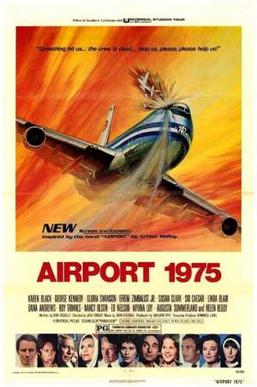
About halfway through 1974’s Airport 1975, Sid Caesar has one of the greatest lines in film history.
“The stewardess is flying the plane?”
Hell yeah, she is! After a collision with another plane takes out the crew of a Broening 747, it’s up to head flight attendant Nancy (Karen Black) to keep the plane from crashing until another pilot can somehow be lowered into the cockpit of the stricken airliner. Nancy’s never flown an airplane before but she is dating Al Murdock (Charlton Heston), who may be scared of commitment but who is still described as being one of the greatest pilots who has ever lived. None other than Joe Patroni (George Kennedy) says that no one knows more about flying than Al Murdock.
George Kennedy is the only cast member to return from the original Airport. When we previously met Patroni, he was the cigar-chewing chief mechanic for Trans World Airlines. In Airport 1975, he’s suddenly an executive with Columbia Airlines. His wife (Susan Clark) and his son (Brian Morrison) are also on the plane. Joe Patroni and Al Murdock are determined to bring that plane safely to the ground in Salt Lake City and if that means dropping a pilot into the cockpit from a helicopter, that’s what they’ll do. It’s all a question of whether or not Nancy can keep that plane from crashing while they round up a helicopter and a pilot.
Airport 1975 is so famous for being the movie where the stewardess is flying the plane that it’s often overlooked that it’s also the film where Linda Blair plays a young girl in need of a kidney transplant. When Sister Ruth (Helen Reddy) sees that the girl has a guitar with her, Ruth sings a folk song that has everyone on the airplane smiling. (If I was on a plane and someone started playing folk music, I’d probably jump out. That may seem extreme but seriously, you don’t want to test me on how much I dislike the folk sound.) This scene was, of course, parodied in Airplane! In fact, it’s pretty much impossible to watch Airport 1975 without thinking about Airplane!
It’s also overlooked that Gloria Swanson is one of the many stars to appear in this film but Swanson is the only one playing herself. Gloria Swanson starts as Gloria Swanson and I assume that this 1974 film was set in 1975 in order to generate some suspense as to whether or not Swanson was going to survive the crash. Swanson talks about how, in 1919, Cecil B. DeMille flew her over California. She does not talk about Joseph Kennedy or Sunset Boulevard and that’s a shame. As I watched Airport 1975, I found myself thinking about how different the film would have been if Gloria Swanson had been the one who had to pilot the plane instead of Karen Black.
“Gloria Swanson is piloting the plane?”
As entertaining as that would have been, it would have meant missing out on Karen Black’s intense performance as Nancy. At times, Nancy seems to be so annoyed with the situation that one gets the feeling that she’s considering intentionally crashing the plane into one of Utah’s mountains. At other times, she seems to be at a strange sort of peace with whatever happens. There’s a scene where she attempts to clear some of the clutter in the cockpit and an instrument panel falls on her head and it’s such a powerful moment because I know the exact same thing would have happened to me in that situation. There’s another moment where I’m pretty sure she accidentally kills the first pilot who attempts to drop into the cockpit and again, it’s a mistake that anyone could have made. The film doesn’t call her out on it because the film understand that none of us are perfect, except for Charlton Heston.
Speaking of which, Karen Black’s emotional performance contrasts nicely with the performance of Charlton Heston. This is perhaps the most Hestonesque performance that Charlton Heston ever gave. Al Murdock is confident, he doesn’t suffer fools, and he’s condescending as Hell. Every time he calls Nancy “honey,” you’ll want to cringe. And yet, it’s hard not to appreciate someone who can be so confident while wearing a tight yellow turtleneck. Charlton Heston watches as the first pilot to attempt to enter the cockpit plunges to his death and immediately declares that it’s his turn to try. “Get me in that monkey suit!” he snaps and it’s such a Heston moment that you have to love it.
There’s a ton of people in this movie. Norman Fell, Jerry Stiller, and Conrad Janis play three rowdy drunks. Erik Estrada, Efrem Zimbalist, and Roy Thinnes are the unfortunate members of the flight crew. Dana Andrews has a heart attack while piloting a small private plane. Myrna Loy appears not as herself but as Mrs. Delvaney, who spends almost the entire flight drinking. Christopher Norris plays Bette, who says that she may look like a teenager but she prefers to be called “Ms. Teenager” and that she’s trained in Kung Fu. Beverly Garland played Dana Andrews’s wife. Larry Storch is an obnoxious reporter. Character actor Alan Fudge plays Danton, the Salt Lake City controller who keeps Nancy calm until Charlton Heston can start snapping at people.
The first time that I watched Airport 1975, I was pretty dismissive of it but, over the years, I’ve rewatched it a few times and I have to admit that I’ve fallen in love with this wonderfully ridiculous film. There’s just so many odd details, like American Graffiti showing up as the plane’s in-flirt entertainment and Sid Caesar saying that he’s only on the flight because he has a small role in the movie and he finally wanted to see it. (It seems like it would have been cheaper to just go to a drive-in but whatever.) And there’s Karen Black, giving the performance of a lifetime and letting us all know that, in 1975, the stewardess flies the airplane!
Welcome to Retro Television Reviews, a feature where we review some of our favorite and least favorite shows of the past! On Thursdays, I will be reviewing Decoy, which aired in Syndication in 1957 and 1958. The show can be viewed on Tubi!
This week, Casey solves her easiest case yet!
Episode 1.14 “Bullet of Hate”
(Dir by Teddy Sills, originally aired on January 13th, 1958)
This week, Casey doesn’t go undercover. Instead, she’s just a uniformed police officer who responds to fight between teenage Stella (Sandra Whiteside) and her adoptive aunt, Mary (Joanna Roos). Casey takes sympathy on Stella, who isn’t a bad kid but who is rebelling against her heartless Aunt Mary and Uncle Lester (Alfred Ryder). When Mary ends up getting shot, Stella is the number one suspect and Stella herself even thinks that she’s responsible. But, of course, it turns out that Stella has been framed by Lester.
The main problem with this episode is that we watch as Lester frames Stella by giving her a gun. When Stella fires the gun during an argument, Mary isn’t injured but she does faint. Stella flees. Lester then uses the gun to actually shoot Mary. Since we know that Lester committed the crime, there’s not really any suspense when Casey starts to suspect that Stella’s been set up. We already know she’s been set up and we also know that, since Lester is an idiot, Casey is going to be able to easily solve the case. And since we know that Casey is good with a gun, we’re not that surprised when Casey ends up taking Lester out (in self-defense, of course!). This isn’t like Columbo or the first season of Poker Face where the killer is so diabolically clever that we can’t wait to see how the hero manages to trick them into confessing. Lester’s just a dummy.
Joanna Loos and Alfred Ryder both went overboard as the villainous aunt and uncle but Sandra Whiteside was effective as the desperate Stella. Apparently, this was one of only two roles that Whiteside played in her career. She gives a strong performance.
This is my final Decoy review for 2025. Retro Television Reviews is going on break for the holidays so that I can focus on Awards Season and Christmas movies! Decoy will return on January 8th, 2026.

 Through the Shattered Lens