RIP, George Wendt: Guilty By Suspicion (1991, directed by Irwin Winkler)


George Wendt passed away in his sleep earlier today.  He was 76 years old.

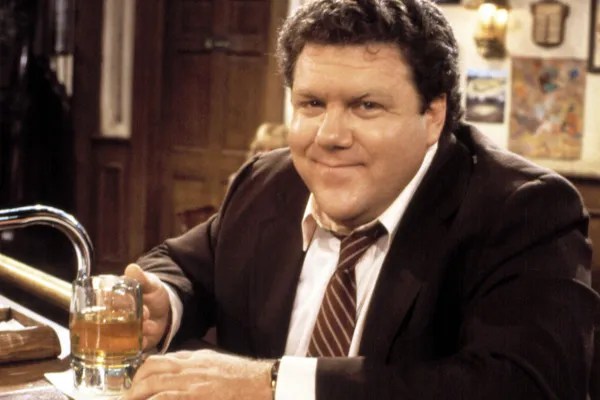
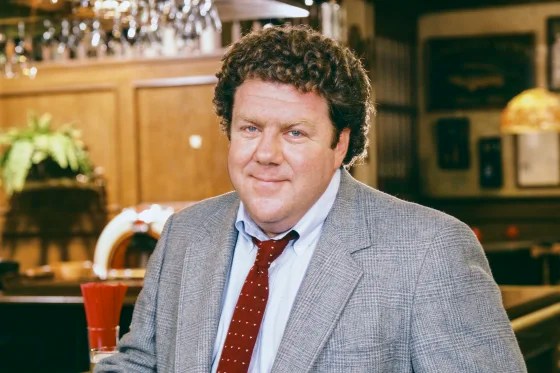
If you’re old enough to have watched Cheers when it originally aired or to have caught it in reruns, George Wendt will always be Norm Peterson, the beer-drinking accountant who spent all of his time at the show’s titular bar.  One of the show’s trademarks was that, whenever he entered the bar, everyone greeted him by shouting, “Norm!”  “How’s the world treating you?” a bartender would ask.  “It’s a dog eat world and I’m wearing milkbone underwear,” Norm once replied.

(One of my favorite joke from the series was when Norm went into a steakhouse and everyone inside was heard to yell, “Norm!” as the door closed behind him.)

If we’re going to be really honest, Norm was probably a high-functioning alcoholic and terrible husband.  (Wife Vera was often-mentioned but never seen.)  Wendt was so likable in the role and was so good at delivering those one-liners that it didn’t matter.  Watching the show, you never wondered why Norm was in the bar.  You were just glad he was.

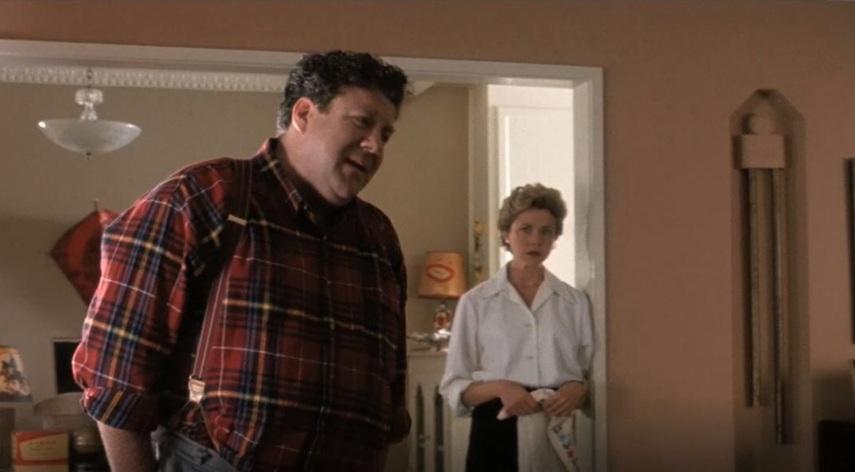
George Wendt was also an accomplished stage actor.  (I saw him on stage when he was co-starring with Richard Thomas in 12 Angry Men.)  He appeared in several movies, usually playing the comedic sidekick or the hero’s best friend.  His film roles often didn’t ask him to do much other than be likable but one exception was his performance in 1991’s Guilty By Suspicion.

Guilty By Suspicion is a film about the McCarthy era, starring Robert De Niro as film director David Merrill, who is threatened with being blacklisted unless he names four of his colleagues as being communists.  George Wendt plays screenwriter Bunny Baxter, a childhood friend of David’s who attended a few communist rallies when he was younger, failed to mention it to the FBI, and who is now being investigated as a subversive.  The studio argues that David should name Baxter because his name is already out there.  When David refuses, he finds himself blacklisted and unable to make a living.  Bunny Baxter, meanwhile, is offered a similar deal.  Baxter can save his own career but only if he names David as a communist.  Unlike David, Baxter considers betraying his friend because it’s the only way that he can ever hope to work again.  “Your dead anyway,” Baxter says to David.

Guilty By Suspicion suffers from Irwin Winkler’s plodding direction but De Niro gives a good performance, as does Martin Scorsese who is cast as a director based on Joseph Losey.  The film is full of actors who would later become better-known, like Chris Cooper, Tom Sizemore, and Annette Bening.  Wendt, however, gives the film’s best performance as the screenwriter who is torn between protecting his career and maintaining his integrity.  The scene where he asks permission to name Merrill as a communist is powerful and it shows how good an actor George Wendt could be.  Bunny Baxter is asking his best friend to allow himself to be stabbed in the back.  Baxter is that desperate.  That he’s played by George Wendt, an actor who was everyone’s favorite likable barfly in the 80s, makes the scene all the more powerful.

George Wendt, RIP.  Thanks for the memories.

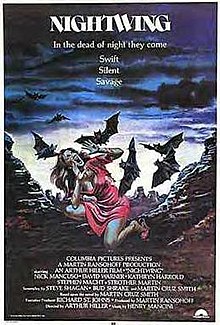
Nightwing (1979, directed by Arthur Hiller)


Cattle and humans are dying in New Mexico at an alarming rate.  Scientist Phillip Payne (David Warner) thinks that the local bat population has become infected with the plague.  Deputy Youngman Duran (Nick Mancuso) thinks that the bats may be attacking because of a curse that was cast by a Hopi medicine man.  Meanwhile, the corrupt tribal chief (Stephen Macht) just wants to sell the land to an evil land developer (Ben Piazza) and be done with it.  Dr. Anne Dillion (Kathryn Harrold) tries to spread the word about the bats but the authorities don’t want the bad publicity.  They’ve never seen Jaws.  And, finally, a group of missionaries camp in the desert with no idea what’s about to swoop down on them.

I don’t know about you but I would never think of missing an Arthur Hiller horror movie!  While many directors in the 70s proudly wore the auteur and rebel label, Arthur Hiller went the opposite route.  He oversw conventional, Hollywood productions, the best known of which was Love Story.  Arthur Hiller was so mainstream that he eventually served as President of the Academy.  This is all to say that Arthur Hiller directed some good films and he directed some bad films but, with his total lack of any sort of personal vision, he was absolutely the wrong director to do a horror movie.  Hiller’s direction is flat.  He’s not mean-spirited enough to enjoy the bat attacks and instead, he focuses on the debate over whether white developers should be buying native land, as if the people watching this movie are going to be watching for the human drama.  By the end of the film, the bats have almost been abandoned and the movie turns into an action film, with a group of survivors fighting off Stephen Macht’s security force.

The most interesting thing about Nightwing is catching Strother Martin, the veteran western actor who memorably talked about a failure to communicate in Cool Hand Luke, as an ex-missionary.  Otherwise, the film pales in comparison to The Birds and Wolfen, the two films which it must resembles in theme and action.

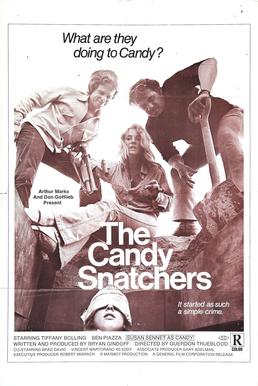
Embracing the Melodrama Part II #48: The Candy Snatchers (dir by Guerdon Trueblood)


The_Candy_Snatchers_Poster

(SPOILER ALERT)

Do you remember how, just last night, I described The Sister-in-Law as being one of the darkest films ever made?  Well, I stand by that description but, believe it or not, there was another low-budget thriller that was released in 1973 and which is even darker than The Sister-In-Law!  Compared to this film, The Sister-in-Law is a life affirming comedy.

The Candy Snatchers begins with Catholic school student Candy (Susan Sennet) walking home.  As a song called “Money Is The Root Of All Happiness” plays on the soundtrack, we watch Candy as she makes her way across the city.  However, we’re not the only ones watching Candy.  There are also three people in a van and they’re slowly following behind Candy.  They’re also wearing fake noses and glasses.

Despite the elaborate disguises, it’s not difficult to tell the three of them apart.  Jessie (Tiffany Bolling) is their leader, a high-strung woman who always seems to be on the verge of an emotional breakdown.  Alan (Brad David) is her brother and brags that he’s killed twelve people so far and he’s looking forward to adding more to the count.  Their partner is Eddy (Vince Martorano), an overly sensitive criminal who wants to make some money but who doesn’t want to hurt anybody.  Their plan is to kidnap Candy.

(Hence, the Candy Snatchers!)

See, they’re under the impression that Candy’s father, Avery (Ben Piazza) owns a jewelry store and, that by kidnapping Candy, they’ll be able to get him to pay them a ransom.  Pulling up beside her while she attempts to hitchhike home, the three kidnappers grab Candy, pull her into the van, and blindfold her.  They drive up to the mountains and bury Candy in a wooden box, leaving her with a breathing tube to make sure that she doesn’t suffocate.  They then call Avery and give him their demands.

The problem is that the kidnappers haven’t done as thorough a research job as they thought they had.  What they did not realize is that Avery doesn’t own the jewelry store.  Instead, he’s just the manager.  Even worse, it turns out that Avery is not Candy’s father.  Instead, he has just recently married Candy’s mother for her money.  As Avery cheerfully explains, with Candy out of the way, he now stands to inherit $2,000,000 when Candy’s mom dies.

In other words, the kidnappers are now stuck with Candy.

After retrieving her from her underground prison, Alan wants to rape Candy while Jessie wants to kill her.  Eddy, however, feels sorry for Candy.  After telling his two partners that he’s going to kill her, Eddy takes Candy back up to the mountains.  Again, he buries her alive but he promises her that he will return to dig her up as soon as he takes care of his partners.

What Alan, Jessie, and Eddy don’t realize is that all of this is being witnessed by Sean (played by Christophe, the actor’s son), an autistic child who apparently cannot speak.  Candy begs Sean to let someone know where she is but every time that Sean tries to get the attention of his loathsome parents, they either ignore him or they beat him.

By the end of the film, Jessie, Alan, and Candy’s mother are all dead.  When Eddy returns to Candy’s grave, he gets into a gunfight with Avery.  Eddy manages to kill Avery but, before he can dig up Candy, he’s shot in the back.  As he turns around, he sees that he’s been shot by Sean, who has picked up Avery’s gun.  Eddy tumbles down the mountain.  Sean goes back to his house and apparently shoots his abusive mother.  The movie ends with the sound of Candy struggling to breathe underground…

AGCK!

Seriously, I am totally claustrophobic so the end of The Candy Snatchers is pure nightmare fuel for me.  To be honest, the whole film is nightmare fuel.  There’s only two likable characters in the entire film and, as the end credits roll, Sean has just killed his mother and Candy is slowly suffocating underground.

As dark as The Candy Snatchers may be, it’s still strangely watchable and compelling.  It’s not a film that I would recommend to anyone getting over a serious bout of depression but still, it’s a well-acted, well-directed, and consistently surprising film.  In fact, I would say that it’s probably one of the best grindhouse films ever made.

That said, you do have to wonder just how depressing life was in 1973.  Between this film and The Sister-in-Law, I’m surprised humanity survived to see 1974.

What could have been: The Godfather


I don’t know about you but I love to play the game of “What if.”  You know how it works.  What if so-and-so had directed such-and-such movie?  Would we still love that movie as much?  Would so-and-so be a star today?  Or would the movie have failed because the director was right to reject so-and-so during preproduction?

I guess that’s why I love the picture below.  Taken from one of Francis Ford Coppola’s notebooks, it’s a page where he jotted down a few possibilities to play the roles of Don Vito, Michael, Sonny, and Tom Hagen in The Godfather.  It’s a fascinating collection of names, some of which are very familiar and some of which most definitely are not.  As I look at this list, it’s hard not wonder what if someone like Scott Marlowe had played Michael Corleone?  Would he had then become known as one of the great actors of his generation and would Al Pacino then be fated to just be an unknown name sitting on a famous list?

(This page, just in case you happen to be in the neighborhood , is displayed at the Coppola Winery in California.)

The production of the Godfather — from the casting to the final edit — is something of an obsession of mine.  It’s amazing the amount of names — obscure, famous, and infamous — that were mentioned in connection with this film.  Below is a list of everyone that I’ve seen mentioned as either a potential director or a potential cast member of The Godfather.  Consider this my contribution to the game of What If….?

Director: Aram Avankian, Peter Bogdonavich, Richard Brooks, Costa-Gravas, Sidney J. Furie, Norman Jewison, Elia Kazan, Steve Kestin, Sergio Leone, Arthur Penn, Otto Preminger, Franklin J. Schaffner, Peter Yates, Fred Zinnemann

Don Vito Corleone (played by Marlon Brando): Melvin Belli, Ernest Borgnine, Joseph Callelia, Lee. J. Cobb, Richard Conte, Frank De Kova, Burt Lancaster, John Marley, Laurence Olivier, Carlo Ponti, Anthony Quinn, Edward G. Robinson, George C. Scott, Frank Sinatra, Rod Steiger, Danny Thomas, Raf Vallone,  Orson Welles

Michael Corleone (played by Al Pacino): John Aprea, Warren Beatty, Robert Blake, Charles Bronson*, James Caan, David Carradine, Robert De Niro, Alain Delon, Peter Fonda, Art Genovese, Dustin Hoffman, Christopher Jones, Tommy Lee Jones, Tony Lo Bianco, Michael Margotta, Scott Marlowe, Sal Mineo, Jack Nicholson, Ryan O’Neal, Michael Parks, Robert Redford, Burt Reynolds, Richard Romanus, Gianni Russo, Martin Sheen, Rod Steiger**, Dean Stockwell

Sonny Corleone (played by James Caan): Lou Antonio, Paul Banteo, Robert Blake, John Brascia, Carmine Caridi, Robert De Niro, Peter Falk, Harry Guardino, Ben Gazzara, Don Gordon, Al Letteiri, Tony LoBianco, Scott Marlowe, Tony Musante, Anthony Perkins, Burt Reynolds***, Adam Roarke, Gianni Russo, John Saxon, Johnny Sette, Rudy Solari, Robert Viharo, Anthony Zerbe

Tom Hagen (played by Robert Duvall): James Caan, John Cassavettes, Bruce Dern, Peter Donat, Keir Dullea, Peter Falk, Steve McQueen, Richard Mulligan, Paul Newman, Jack Nicholson, Ben Piazza, Barry Primus, Martin Sheen, Dean Stockwell, Roy Thinnes, Rudy Vallee****, Robert Vaughn, Jerry Van Dyke, Anthony Zerbe

Kay Adams (played by Diane Keaton): Anne Archer, Karen Black, Susan Blakeley, Genevieve Bujold, Jill Clayburgh, Blythe Danner, Mia Farrow, Veronica Hamel, Ali MacGraw, Jennifer O’Neill, Michelle Phillips, Jennifer Salt, Cybill Shepherd, Trish Van Devere

Fredo Corleone (played by John Cazale): Robert Blake, Richard Dreyfuss, Sal Mineo, Austin Pendleton

Connie Corleone (played by Talia Shire): Julie Gregg, Penny Marshall, Maria Tucci, Brenda Vaccaro, Kathleen Widdoes

Johnny Fontane (played by Al Martino): Frankie Avalon, Vic Damone*****, Eddie Fisher, Buddy Greco, Bobby Vinton, Frank Sinatra, Jr.

Carlo Rizzi (played by Gianni Russo): Robert De Niro, Alex Karras, John Ryan******, Sylvester Stallone

Virgil “The Turk” Sollozzo (played by Al Letteiri): Franco Nero

Lucas Brasi (played by Lenny Montana): Timothy Carey, Richard Castellano

Moe Greene (played by Alex Rocco): William Devane

Mama Corleone (played by Morgana King): Anne Bancroft, Alida Valli

Appollonia (played by Simonetta Steffanelli): Olivia Hussey

Paulie Gatto (played by John Martino): Robert De Niro*******, Sylvester Stallone

—-

* Charles Bronson, who was in his mid-40s, was suggested for the role of Michael by the then-chairman of Paramount Pictures, Charlie Bluhdorn.

** By all accounts, Rod Steiger – who was then close to 50 – lobbied very hard to be given the role of Michael Corleone.

*** Some sources claim that Burt Reynolds was cast as Sonny but Brando refused to work with him.  However, for a lot of reasons, I think this is just an cinematic urban legend.

**** Despite being in his 60s at the time, singer Rudy Vallee lobbied for the role of the 35 year-old Tom Hagen.  Supposedly, another singer — Elvis Presley — lobbied for the role as well but that just seems so out there that I couldn’t bring myself to include it with the “official” list.

***** Vic Damone was originally cast as Johnny Fontane but dropped out once shooting began and announced that the project was bad for Italian Americans.  He was replaced by Al Martino.

****** John P. Ryan was originally cast as Carlo Rizzi but was fired and replaced with Gianni Russo.  Ryan went on to play the distraught father in Larry Cohen’s It’s Alive.  Russo went on to co-star in Laserblast.

******* Robert De Niro was originally cast in this role but dropped out to replace Al Pacino in The Gang That Couldn’t Shoot Straight.  Pacino, incidentally, had to drop out of that film because he was given the role of Michael in The Godfather.